

The DOI matches its Crossref record; 48 of the 48 references it cites were found in a registry or an index; none of the 1 sources its claims cite is checked for support yet.
Secure image encryption using a 4D chaotic system and Langton’s ant cellular automaton
Open accessAbstract
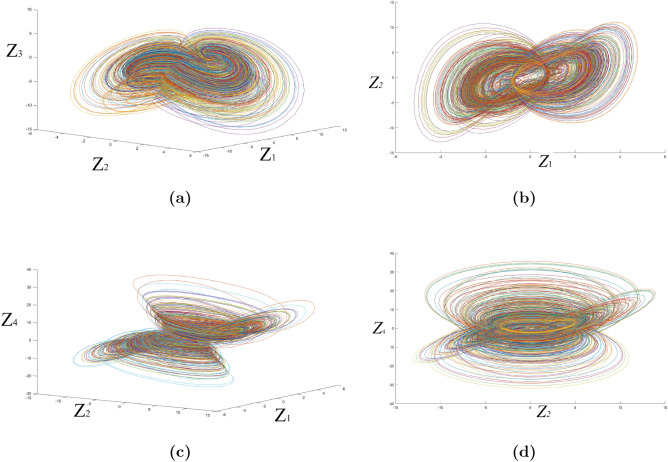
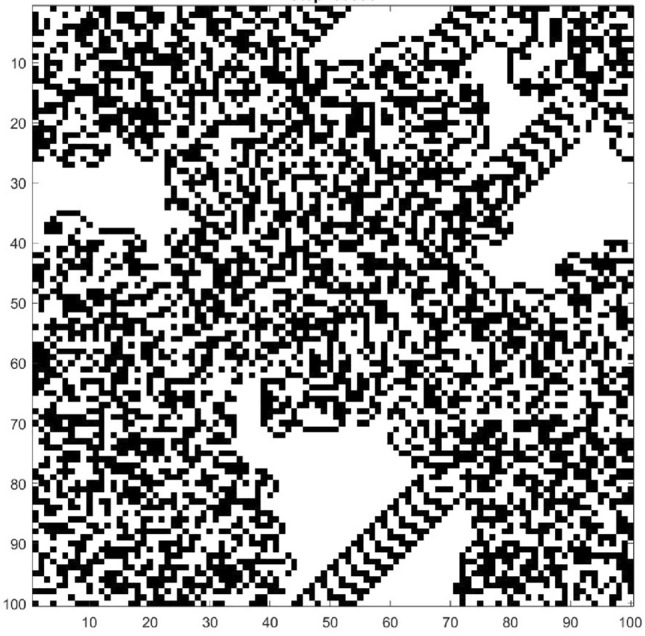
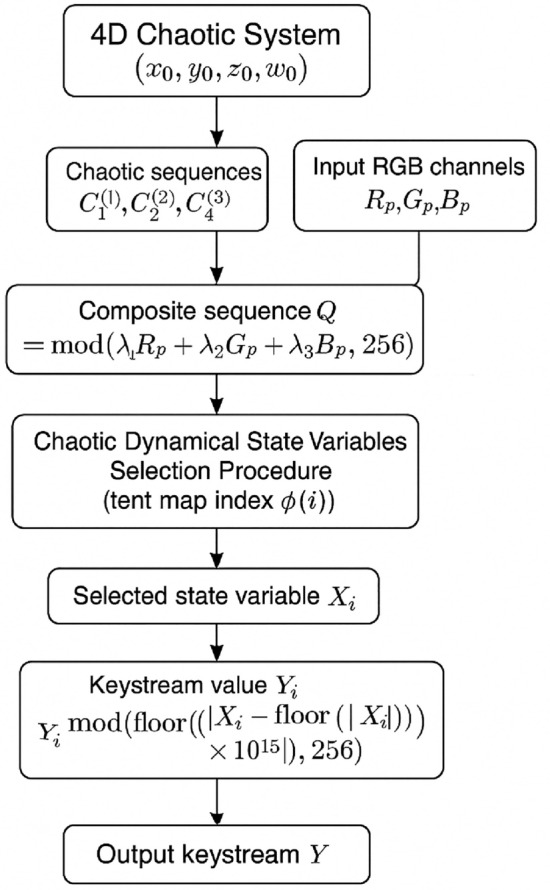
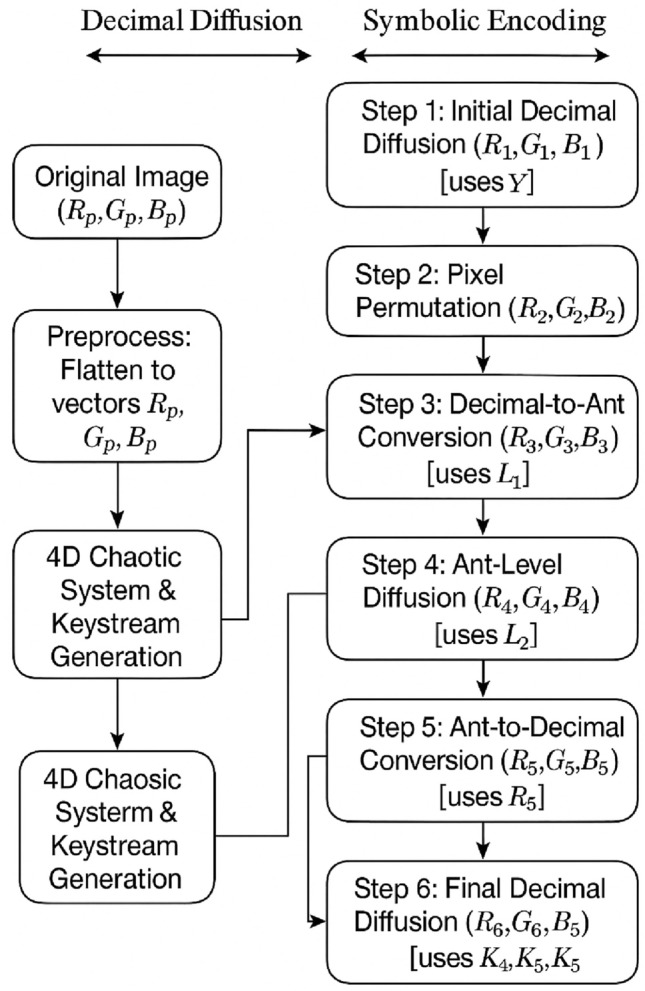
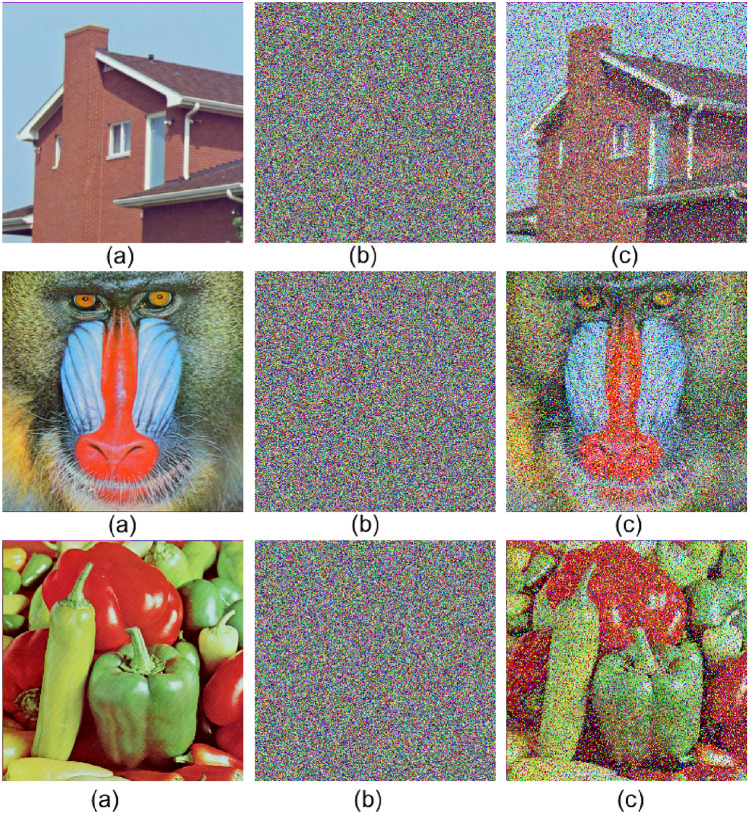
The recent explosion of high-rate multimedia transfer has heightened the need for image ciphers that are lossless, payload-grade, and computationally efficient, yet fully structure-adaptive. Traditional block ciphers are effective for byte streams but do not account for spatial dependencies in images, while many chaos-based methods remain ad hoc, lacking strict invertibility and clear keying or synchronization mechanisms. Motivated by these gaps, we present a keyed image cipher that integrates a four-dimensional (4D) chaotic driver with a rule-adaptive variant of Langton's Ant cellular automaton. The scheme performs pixel permutation followed by two mutually inverse decimal diffusions with cross-channel feedback, and a symbolic diffusion stage that encodes bytes into Ant symbols intermingled through three distinct, keystream- and rule-dependent operators. The core novelty is a provably bijective symbolic diffusion with an explicit inverse and a branch-number-style local diffusion lower bound, combined with a linear-time streaming implementation. The cipher passes the NIST SP 800-22 statistical tests on both keystream and ciphertext-derived bitstreams. Experiments on standard test images show NPCR[Formula: see text] UACI[Formula: see text] Shannon entropy [Formula: see text]bits/pixel, negligible adjacent-pixel correlations, high key sensitivity, and strong robustness against 20% salt-and-pepper noise and 20% occlusion. The overall key space is approximately [Formula: see text], indicating high resistance to brute-force attacks.
Overview
CoChat Summary
TL;DR
The paper proposes a lossless RGB image cipher that combines a 4D chaotic system with Langton’s Ant symbolic diffusion, using permutation plus two decimal diffusions and an invertible symbolic layer. Reported experiments on standard 256×256 images show near-ideal security metrics, including NPCR around 99.6%, UACI around 33.46%, entropy close to 8 bits/pixel, and NIST SP 800-22 passes.
Key findings
- On standard test images, the cipher reports NPCR values around 99.6%; one summary gives average NPCRs of 99.6316% (R), 99.6226% (G), and 99.6251% (B), with another example reporting 99.6374%, 99.6589%, and 99.6311% for Lena.
- UACI is reported around the 8-bit ideal of 33.46%; the abstract states UACI ≈ 33.46%, and one example reports 33.4428%, 33.4219%, and 33.3873% for Lena’s RGB channels.
- Shannon entropy after encryption is reported near the theoretical maximum, with the abstract giving ≈ 7.998 bits/pixel and an example for Lena rising to 7.9983, 7.9979, and 7.9980 for RGB.
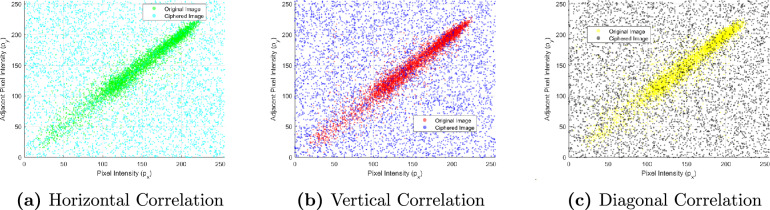
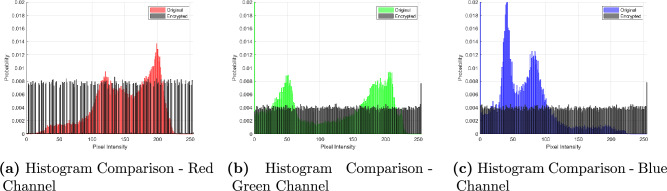
- Adjacent-pixel correlations drop from about 0.73–0.98 in plaintext images to roughly −0.003 to +0.003 after encryption; histograms flatten, and the abstract reports an overall key space of 10^346.
- The scheme passes the NIST SP 800-22 suite at α = 0.01; the text reports 6/6 pass proportion for the tested case and says the cipher passes on both keystream and ciphertext-derived bitstreams.
Methods
- Design: a keyed, lossless symmetric image encryption scheme using a 4D continuous-time chaotic system (discretized with RK4, step size Δt = 0.01) plus Langton’s Ant symbolic operations; the pipeline is permutation, decimal diffusion, symbolic diffusion, symbolic-to-decimal conversion, final diffusion, and reconstruction.
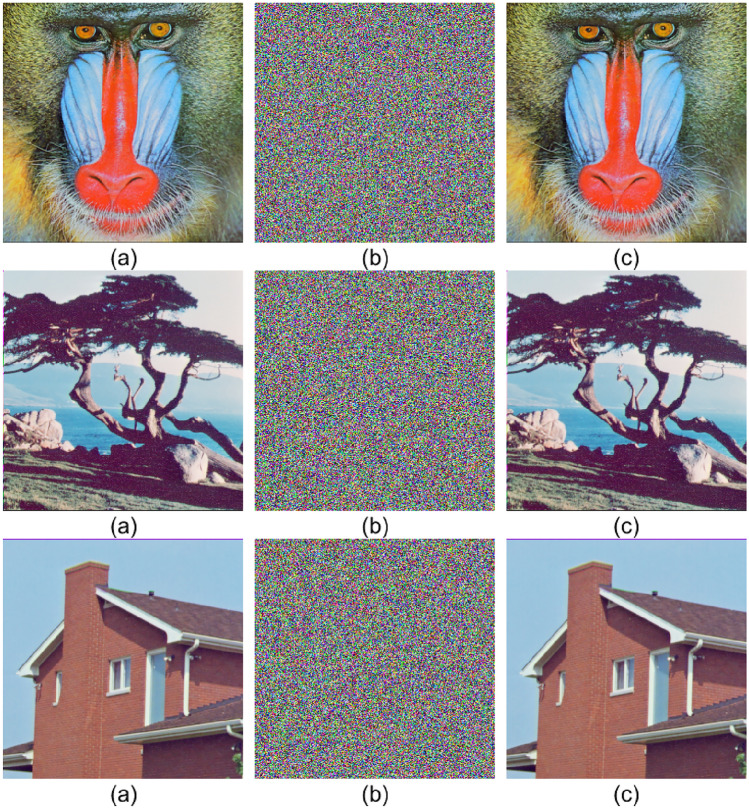
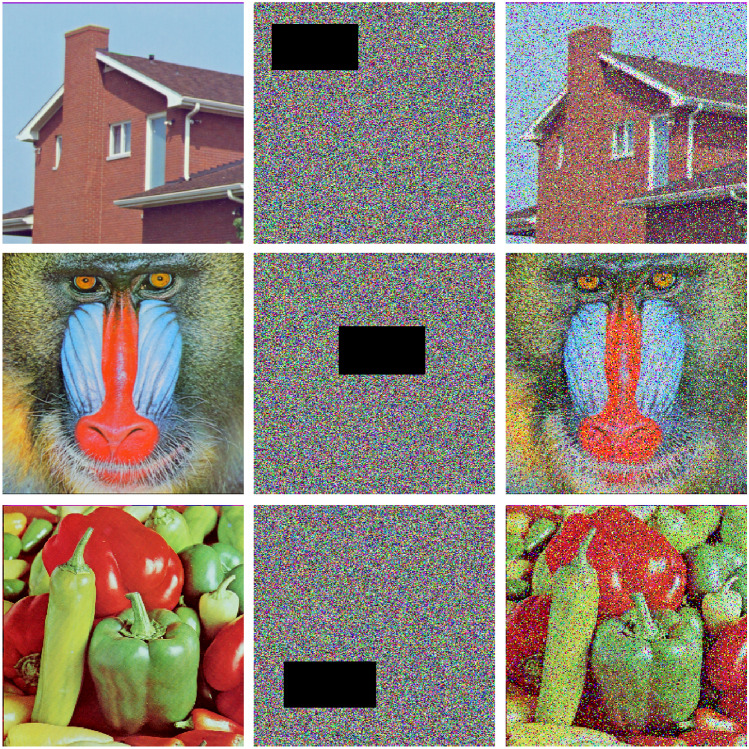
- Data/sample: experiments used benchmark images from the USC-SIPI Image Database, specifically Baboon, Tree, House, and also Lena, Peppers, Beans, F16, Girl; images were resized to 256×256.
- Analysis: the paper evaluates key space, key sensitivity (including perturbations of 10^-14), entropy, histograms, correlation, chi-square, NPCR/UACI, robustness to 20% salt-and-pepper noise and 20% occlusion, NIST SP 800-22, and computational complexity.
Limitations
- The paper states that it focuses on empirical/statistical security rather than formal indistinguishability proofs.
- It states that it does not exhaustively benchmark throughput against highly optimized block ciphers across heterogeneous hardware or very high resolutions.
- It says side-channel resilience and broader parameter stress testing under finite precision are outside the present scope.
Model-written summary. Check it against the paper before relying on it.
Integrity signals
Registry
Cites
Statistics
Figures
Verification
Claims the paper makes
0 Valid · 1 Not valid · 1 Not checked · 108 Own results and interpretations
A result the paper states — it cites no source for it, so there is none to check. The quote shows it is in the paper.
In the paper
“strong robustness against 20% salt-and-pepper noise and 20% occlusion”
§ Secure image encryption using a 4D chaotic system and Langton’s ant cellular automaton > Abstract
boostedstates a cause- Asserted: passes — The authors put it forward as true.
- Checkable: passes — It can be checked against evidence.
- Load-bearing: passes — The paper’s conclusions depend on it.
- Based: passes — The paper gives a reason why it holds.
A result the paper reports from its own data — it cites no other source for it, so there is none to check. The quote shows it is in the paper.
In the paper
“Decrypted images corresponding to these encrypted images are shown in Fig. 5c and closely resemble the original input images provided that proper secret keys are employed illustrating both reversibility and resilience.”
§ Secure image encryption using a 4D chaotic system and Langton’s ant cellular automaton > Simulation environment and evaluation
plainstates a possible cause- Asserted: passes — The authors put it forward as true.
- Checkable: passes — It can be checked against evidence.
- Load-bearing: passes — The paper’s conclusions depend on it.
- Based: passes — The paper gives a reason why it holds.
A result the paper states — it cites no source for it, so there is none to check. The quote shows it is in the paper.
In the paper
“high key sensitivity”
§ Secure image encryption using a 4D chaotic system and Langton’s ant cellular automaton > Abstract
plain- Asserted: passes — The authors put it forward as true.
- Checkable: passes — It can be checked against evidence.
- Load-bearing: passes — The paper’s conclusions depend on it.
- Based: passes — The paper gives a reason why it holds.
A result the paper reports from its own data — it cites no other source for it, so there is none to check. The quote shows it is in the paper.
In the paper
“The encrypted outputs show total loss of spatial structure, as expected for confirming that the system can properly obfuscate visual content.”
§ Secure image encryption using a 4D chaotic system and Langton’s ant cellular automaton > Simulation environment and evaluation
plain- Asserted: passes — The authors put it forward as true.
- Checkable: passes — It can be checked against evidence.
- Load-bearing: passes — The paper’s conclusions depend on it.
- Based: passes — The paper gives a reason why it holds.
A result the paper reports from its own data — it cites no other source for it, so there is none to check. The quote shows it is in the paper.
In the paper
“This encryption scheme was applied against each of these images, resulting in highly scrambled cipher images as depicted in Fig. 5b.”
§ Secure image encryption using a 4D chaotic system and Langton’s ant cellular automaton > Simulation environment and evaluation
plainstates a cause- Asserted: passes — The authors put it forward as true.
- Checkable: passes — It can be checked against evidence.
- Load-bearing: passes — The paper’s conclusions depend on it.
- Based: passes — The paper gives a reason why it holds.
49 more claims
Create a free account to see all 110 claims and every source verdict.
- Borderline: one of the tests for a substantial claim is unclear. 1
- It may state two separate claims as one. 38
- Probably not a substantial claim. 28
- The quote only partly states this claim. 2
Citations
Cites
Communication Theory of Secrecy Systems
Shannon, C. E. (1949) · Bell System Technical Journal · doi:10.1002/j.1538-7305.1949.tb00928.x · Cited by 9,440
A symmetric image encryption scheme based on 3D chaotic cat maps
Chen, G., Mao, Y., & Chui, C. K. (2004) · Chaos, Solitons & Fractals · doi:10.1016/j.chaos.2003.12.022 · Cited by 2,092
Symmetric Ciphers Based on Two-Dimensional Chaotic Maps
Fridrich, J. (1998) · International Journal of Bifurcation and Chaos · doi:10.1142/s021812749800098x · Cited by 1,917
Image encryption using chaotic logistic map
Pareek, N. K., Patidar, V., & Sud, K. K. (2006) · Image and Vision Computing · doi:10.1016/j.imavis.2006.02.021 · Cited by 1,261
ON THE DERIVATION OF A “CHAOTIC” ENCRYPTION ALGORITHM
Matthews, R. (1989) · Cryptologia · doi:10.1080/0161-118991863745 · Cited by 1,044
Cosine-transform-based chaotic system for image encryption
Hua, Z., Zhou, Y., & Huang, H. (2019) · Information Sciences · doi:10.1016/j.ins.2018.12.048 · Cited by 776
A new color image encryption using combination of the 1D chaotic map
Pak, C., & Huang, L. (2017) · Signal Processing · doi:10.1016/j.sigpro.2017.03.011 · Cited by 632
A novel chaos-based image encryption algorithm using DNA sequence operations
Chai, X., Chen, Y., & Broyde, L. (2017) · Optics and Lasers in Engineering · doi:10.1016/j.optlaseng.2016.08.009 · Cited by 631
A fast image encryption algorithm based on chaotic map
Liu, W., Sun, K., & Zhu, C. (2016) · Optics and Lasers in Engineering · doi:10.1016/j.optlaseng.2016.03.019 · Cited by 487
A new hybrid digital chaotic system with applications in image encryption
Alawida, M., Samsudin, A., Teh, J. S., & Alkhawaldeh, R. S. (2019) · Signal Processing · doi:10.1016/j.sigpro.2019.02.016 · Cited by 401
Research works printed but not linked: 2
- Blahut, R. E. Cryptography and Secure Communication (eds Huang, Y. H., Xue, M. F. & Xu, J.) 1st ed 270–294 (China Machine Press, 2018).
- Zhou, R. G. & Li, Y. B. Quantum image encryption based on Lorenz hyper-chaotic system. Int. J. Quantum Inf. 22(1), 2250022 (2024).
Cited by
SCD-CHAOS: dynamic S-box and chaotic hybrid adaptive image encryption using multi-map diffusion
Yogi, B., Majumdar, R., Ghosh, P., Sharma, L., & Roy, S. (2026) · Scientific Reports · doi:10.1038/s41598-026-43981-z · Cited by 7
Vamsikrishna, M., Godiyal, Y., Pandey, A. K., Lilhore, U. K., Simaiya, S., Aldossary, S. M., Hussien, S. A., Ghith, E. S., Tekeste, L. G., & Sharma, Y. K. (2026) · International Journal of Computational Intelligence Systems · doi:10.1007/s44196-026-01181-7 · Cited by 6
“Research questions addressed in this research are the following are the key questions: ● How to incorporate chaos into cryptographic designs, to provide more secure mechanisms at low computational overhead and memory size [ 14]?”
Cavazzana, R., Галюк, С. Д., Ascoli, A., Vovchuk, D., Salgals, T., Bobrovs, V., Pareschi, F., Corinto, F., & Secco, J. (2026) · IEEE Transactions on Circuits and Systems I Regular Papers · doi:10.1109/tcsi.2026.3662486 · Cited by 1
“Alshehri [16] proposes a software pipeline combining a 4D chaotic system with a Langton’s ant cellular automaton.”
Hybrid Vigenere and elliptic curve cryptography technique over the finite field $$\mathbb{F}_{256}$$
Bourakkadi, H. E., Tabti, H., Chemlal, A., Abid, A., Jarjar, A., & Benazzi, A. (2026) · Scientific Reports · doi:10.1038/s41598-026-42951-9 · Cited by 1
“Alshehri 26 has proposed a lossless image encryption scheme that combines a rule-adaptive Langton’s Ant cellular automaton with a four-dimensional chaotic system to achieve strong permutation and multi-level decimal and symbolic diffusion with guaranteed bijectivity.”
InfluentialYang, J., Xu, X., Yin, Z., & Yang, S. (2026) · Physica Scripta · doi:10.1088/1402-4896/ae783f
Metadata
- Authors
- Alshehri, H.
- Affiliations
- Jazan University (SA)
- Corresponding author
- Alshehri, Hamdan
- ORCID
- Alshehri, Hamdan
- Venue
- Scientific Reports
- Published
- 2025-11-25
- Volume
- 15
- Issue
- 1
- Pages
- 41918-41918
- ISSN
- 2045-2322 (ISSN-L)
- PMC
- PMC12647653
- OpenAlex
- W4416666816
- Semantic Scholar
- 673388ca6d7926bf6ca913ee2c09118e7761cb06
- Cited by
- 18
- References
- 41
- Citations by year
- 2026: 18
- FWCI
- 6.32
- Type
- journal article
- Language
- en
- Open access
- gold
- doi.org
- Licence
- cc-by-nc-nd
- creativecommons.org/licenses/by-nc-nd/4.0 (tdm)
- creativecommons.org/licenses/by-nc-nd/4.0 (vor)
- Locations
- Scientific Reports (publishedVersion, cc-by-nc-nd)
- PubMed (publishedVersion)
- DOAJ (DOAJ: Directory of Open Access Journals) (submittedVersion, cc-by-sa)
- Funders
- Jazan University
- Topics
- Physical Sciences › Computer Science › Computer Vision and Pattern Recognition › Chaos-based Image/Signal Encryption
- Physical Sciences › Computer Science › Computational Theory and Mathematics › Cellular Automata and Applications
- Physical Sciences › Computer Science › Artificial Intelligence › Computer Science and Engineering
- Keywords
- image encryption, four-dimensional chaotic system, Langton's ant, cellular automata, pixel permutation, keystream generation, key sensitivity, NPCR and UACI, key space analysis
About these checks
Registry, retraction, Cites and statistics results are computed, not judged, with one exception: a printed reference that no index lists is read once by a model before it counts as a citation error. Claims are extracted by a model and kept only when their quote appears verbatim in the text; each cited source is then checked, with a model’s help, for whether it says what the claim relies on. Those verdicts can be wrong — read the claim’s quote and the cited source before relying on one.
A language model drew the claims from the paper on 2026-10-10, under version 3 of the claim definition (model deepseek-v4.1-flash, prompt extract-v3).
A second model labelled each claim on 2026-10-10 (model jev-1.13-20260917, definition revision gold-guideline-v0.2).
Statistics and arithmetic are recomputed, not judged.
Confidence bands are shown only for fields calibrated on our annotated test set. None is calibrated yet, so no band is shown.
What counts as a claim ›How we measure confidence ›How we check this ›
Are you an author, or do you see a problem with this page? Request a review
How to cite
Cite CoChat for the checks on this page, and the paper for its own findings.
- This page
- CoChat. (2026). Citation check: Secure image encryption using a 4D chaotic system and Langton’s ant cellular automaton. https://app.cochat.ai/papers/10.1038/s41598-025-25929-x
- The paper
- Alshehri, H. (2025). Secure image encryption using a 4D chaotic system and Langton’s ant cellular automaton. Scientific Reports. https://doi.org/10.1038/s41598-025-25929-x
Data sources
Bibliographic data: Semantic Scholar, OpenAlex, Crossref.
Contains information from the Semantic Scholar Academic Graph Datasets, made available under the ODC Attribution License (ODC-BY 1.0).
Semantic Scholar’s data is described in: Kinney, R., et al. (2023). The Semantic Scholar Open Data Platform. arXiv:2301.10140.
