

The DOI matches its Crossref record; 6 of the 6 references it cites were found in a registry or an index.
Tackling copyright issues in AI image generation through originality estimation and genericization
Overview
The claims and statistics of this paper haven’t been checked yet.
Run the check — free, no account needed. It reads the open-access text and checks the sources it cites.
Integrity signals
Registry
Cites
Statistics
Figures
Verification
Claims the paper makes
The claims and statistics of this paper haven’t been checked yet.
Run the check — free, no account needed. It reads the open-access text and checks the sources it cites.
Claims other papers make about this one
Each is checked against this paper’s own text: does it say what the citing paper says it does?
In the citing paper
“The 'originality evaluation' algorithm proposed by Chiba-Okabe & Su ( 2025) is based on pairwise similarity computation between all the images: the more similar an image is to the others, the less original it is considered.”
From Generative AI and intellectual property: a systematic literature review of possible issues and mitigations (2026) · cites this paper as Chiba-Okabe & Su, 2025
In the citing paper
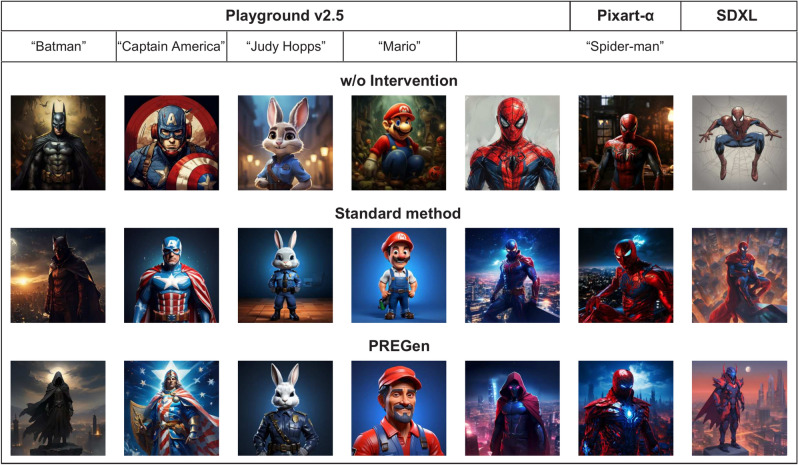
“The application of standard prompt rewriting techniques reduced this rate to 2.6-13.4%,while PREGen further reduced it to a range between 0.6% and 6.6%.”
From Generative AI and intellectual property: a systematic literature review of possible issues and mitigations (2026) · cites this paper as Chiba-Okabe & Su, 2025
In the citing paper
“Building on the work of He et al. (2024), Chiba-Okabe & Su (2025) introduced PREGen (Prompt Rewriting-Enhanced Genericisation).It is a model-agnostic approach that works by altering the input prompt and applying a systematic originality reduction mechanism.”
From Generative AI and intellectual property: a systematic literature review of possible issues and mitigations (2026) · cites this paper as Chiba-Okabe & Su, 2025
In the citing paper
“The application of standard prompt rewriting techniques reduced this rate to 2.6-13.4%,while PREGen further reduced it to a range between 0.6% and 6.6%.”
From Generative AI and intellectual property: a systematic literature review of possible issues and mitigations (2026) · cites this paper as Chiba-Okabe & Su, 2025
In the citing paper
“In the direct anchoring scenarios-i.e., where prompts explicitly mentioned the names of copyright-protected characters-baseline models generated such characters in 56.0% to 82.6% of the cases.”
From Generative AI and intellectual property: a systematic literature review of possible issues and mitigations (2026) · cites this paper as Chiba-Okabe & Su, 2025
1 more claim about this paper
Create a free account to see every claim other papers make about this one.
Self-check
Percentages, sums and reported differences re-computed from the paper’s own numbers.
The self-check needs the paper’s full text.
Citations
Cites
High-Resolution Image Synthesis with Latent Diffusion Models
Rombach, R., Blattmann, A., Lorenz, D., Esser, P., & Ommer, B. (2022) · 2022 IEEE/CVF Conference on Computer Vision and Pattern Recognition (CVPR) · doi:10.1109/cvpr52688.2022.01042 · Cited by 20,302
DINOv2: Learning Robust Visual Features without Supervision
Oquab, M., Darcet, T., Moutakanni, T., Vo, H., Szafraniec, M., Khalidov, V., Fernandez, P., Haziza, D., Massa, F., El-Nouby, A., et al. (2023) · arXiv · doi:10.48550/arxiv.2304.07193 · Cited by 1,078 · cited 2×
“For image generation, possible choices of distance metrics include the cosine distance between feature embeddings obtained from CLIP 27 and DINOv2 28 , which achieve state-of-the-art performance in various tasks, such as image classification and representation learning.”
Design Guidelines for Prompt Engineering Text-to-Image Generative Models
Liu, V., & Chilton, L. B. (2022) · CHI Conference on Human Factors in Computing Systems · doi:10.1145/3491102.3501825 · Cited by 639 · cited 1×
“| is the size of the test set (50 in the case of COPYCAT), m is the intervention (either the standard prompt rewriting method or PREGen in our case), v is the VQAScore. p-CONS measures the alignment with the prompt itself, whereas the standard CONS metric measures the alignment with key…”
Design Guidelines for Prompt Engineering Text-to-Image Generative Models
Liu, V., & Chilton, L. B. (2021) · arXiv · doi:10.48550/arxiv.2109.06977 · Cited by 635
Prompt Engineering in Large Language Models
Marvin, G., Hellen, N., Jjingo, D., & Nakatumba-Nabende, J. (2024) · Algorithms for Intelligent Systems · doi:10.1007/978-981-99-7962-2_30 · Cited by 403
Samuelson, P. (2023) · Science · doi:10.1126/science.adi0656 · Cited by 240
Research works printed but not linked: 42
- Bubeck, S. et al. Sparks of artificial general intelligence: Early experiments with GPT-4. Preprint at http://arxiv.org/abs/2303.12712 (2023). · arXiv
- Litman, J. D. The public domain. Emroy Law J. 39, 965–1023 (1990).
- Sag, M. Copyright safety for generative AI. Houston Law Rev. 61, 295–347 (2023).
- Lee, K., Cooper, A. F. & Grimmelmann, J. Talkin’ ’bout AI generation: Copyright and the generative-AI supply chain. Preprint at http://arxiv.org/abs/2309.08133 (2024). · DOI
- He, L. et al. Fantastic copyrighted beasts and how (not) to generate them. Preprint at http://arxiv.org/abs/2406.14526 (2024). · arXiv
- Vyas, N., Kakade, S. & Barak, B. On provable copyright protection for generative models. In Proc. of the 40th International Conference on Machine Learning, 35277 – 35299 (2023).
- Wang, Z., Chen, C., Sehwag, V., Pan, M. & Lyu, L. Evaluating and mitigating IP infringement in visual generative AI. Preprint at http://arxiv.org/abs/2406.04662 (2024). · arXiv
- Ma, R. et al. A dataset and benchmark for copyright infringement unlearning from text-to-image diffusion models. Preprint at http://arxiv.org/abs/2403.12052 (2024). · arXiv
- Balganesh, S. The normativity of copying in copyright law. Duke Law J. 62, 203–284 (2012).
- Samuelson, P. A fresh look at tests for nonliteral copyright infringement. Northwest. Univ. Law Rev. 107, 1821–1850 (2015).
- Lund, J. Copyright genericide. Creighton Law Rev. 42, 131–156 (2009).
- Hacohen, U. Y. & Elkin-Koren, N. Copyright regenerated: Harnessing GenAI to measure originality and copyright scope. Harvard J. Law Technol. 37, 555–609 (2024).
- Vermont, S. The sine qua non of copyright is uniqueness, not originality. Texas Intell. Property Law J. 20, 327–386 (2012).
- Byron, T. M. Tying up feist’s loose ends: A probability theory of copyrightable creativity. Wake For. Intell. Property Law J. 7, 45–95 (2006).
- Khong, D. W. Copyright doctrines, abstraction and court error. Rev. Law Econ. 3, 715–744 (2007). · DOI
- Pavoine, S. & Ricotta, C. On the relationships between rarity, uniqueness, distinctiveness, originality and functional/phylogenetic diversity. Biol. Cons. 263, 109356 (2021). · DOI
- Jones, R. H. The myth of the idea/expression dichotomy in copyright law. Pace Law Rev. 10, 551–607 (1990). · DOI
- Gorman, R. A. Copyright courts and aesthetic judgments: Abuse or necessity?. Columbia J. Law Arts 25, 1–20 (2001).
- Tu, S. S. Use of artificial intelligence to determine copyright liability for musical works. West Virginia Law Rev. 123, 835–872 (2021).
- Franceschelli, G. & Musolesi, M. Deepcreativity: measuring creativity with deep learning techniques. Intell. Artif. 16, 151–163 (2022).
- Hacohen, U. et al. Not all similarities are created equal: Leveraging data-driven biases to inform GenAI copyright disputes. Preprint at http://arxiv.org/abs/2403.17691 (2024). · arXiv
- Haviv, A. et al. Not every image is worth a thousand words: Quantifying originality in stable diffusion. Preprint at http://arxiv.org/abs/2408.08184 (2024). · arXiv
- Radford, A. et al. Learning transferable visual models from natural language supervision. In Proc. of the 38th International Conference on Machine Learning, vol. 139, 8748–8763 (2021).
- Podell, D. et al. SDXL: Improving latent diffusion models for high-resolution image synthesis. Preprint at http://arxiv.org/abs/2307.01952 (2023). · arXiv
- Lin, Z. et al. Evaluating text-to-visual generation with image-to-text generation. Preprint at http://arxiv.org/abs/2404.01291 (2024). · DOI
- Li, D. et al. Playground v2.5: Three insights towards enhancing aesthetic quality in text-to-image generation. Preprint at http://arxiv.org/abs/2402.17245 (2024). · arXiv
- Chen, J. et al. Pixart-$$\alpha$$: Fast training of diffusion transformer for photorealistic text-to-image synthesis. Preprint at http://arxiv.org/abs/2310.00426 (2023). · arXiv
- Scheffler, S., Tromer, E. & Varia, M. Formalizing human ingenuity: A quantitative framework for copyright law’s substantial similarity. In Proc. of the 2022 Symposium on Computer Science and Law, 37-49 (2022). · DOI
- Chiba-Okabe, H. Probabilistic analysis of copyright disputes and generative AI safety. Preprint at http://arxiv.org/abs/2410.00475 (2024). · arXiv
- Chu, T., Song, Z. & Yang, C. How to protect copyright data in optimization of large language models?. In Proc. of the AAAI Conference on Artificial Intelligence 38, 17871–17879 (2024). · DOI · Paper page
- Min, S. et al. Silo language models: Isolating legal risk in a nonparametric datastore. Preprint at http://arxiv.org/abs/2308.04430 (2024). · arXiv
- Wei, B. et al. Evaluating copyright takedown methods for language models. Preprint at http://arxiv.org/abs/2406.18664 (2024). · arXiv
- Dou, G., Liu, Z., Lyu, Q., Ding, K. & Wong, E. Avoiding copyright infringement via machine unlearning. Preprint at http://arxiv.org/abs/2406.10952 (2024). · arXiv
- Abad, J., Donhauser, K., Pinto, F. & Yang, F. Strong copyright protection for language models via adaptive model fusion. Preprint at http://arxiv.org/abs/2407.20105 (2024). · arXiv
- Chen, T. et al. CopyBench: Measuring literal and non-literal reproduction of copyright-protected text in language model generation. Preprint at http://arxiv.org/abs/2407.07087 (2024). · DOI
- Deng, J. & Ma, J. Computational copyright: Towards a royalty model for AI music generation platforms. Preprint at http://arxiv.org/abs/2312.06646 (2023). · arXiv
- Wang, J. T., Deng, Z., Chiba-Okabe, H., Barak, B. & Su, W. J. An economic solution to copyright challenges of generative AI. Preprint at http://arxiv.org/abs/2404.13964 (2024). · arXiv
- Sahoo, P. et al. A systematic survey of prompt engineering in large language models: Techniques and applications. Preprint at http://arxiv.org/abs/2402.07927 (2024). · arXiv
- Chen, B., Zhang, Z., Langrené, N. & Zhu, S. Unleashing the potential of prompt engineering in large language models: a comprehensive review. Preprint at http://arxiv.org/abs/2310.14735 (2024). · arXiv
- Clemmer, C., Ding, J. & Feng, Y. Precisedebias: An automatic prompt engineering approach for generative AI to mitigate image demographic biases. In Proc. of the IEEE/CVF Winter Conference on Applications of Computer Vision, 8596–8605 (2024). · DOI
- Siino, M. & Tinnirello, I. GPT hallucination detection through prompt engineering. In Proc. of the 25th Working Notes of the Conference and Labs of the Evaluation Forum, vol. 3740, 712–721 (2024).
- Siino, M. & Tinnirello, I. Prompt engineering for identifying sexism using GPT Mistral 7B. Proc. of the 25th Working Notes of the Conference and Labs of the Evaluation Forum, 3740, 1228–1236 (2024).
Cited by
Arnaudo, A., Coppola, R., Morisio, M., Vetrò, A., Borghi, M., Raso, R., & Khan, B. (2026) · PeerJ Computer Science · doi:10.7717/peerj-cs.3928 · Cited by 2
Metadata
- Authors
- Chiba-Okabe, H., & Su, W. J.
- Venue
- Scientific Reports
- Published
- 2025-03-27
- Volume
- 15
- Issue
- 1
- ISSN
- 2045-2322
- PMC
- PMC11950165
- Cited by
- 6
- References
- 6
- Language
- en
- Licence
- Funders
- Wharton AI for Business
- Simons Foundation
About these checks
Registry, retraction, Cites and statistics results are computed, not judged, with one exception: a printed reference that no index lists is read once by a model before it counts as a citation error. Claims are extracted by a model and kept only when their quote appears verbatim in the text; each cited source is then checked, with a model’s help, for whether it says what the claim relies on. Those verdicts can be wrong — read the claim’s quote and the cited source before relying on one.
Statistics and arithmetic are recomputed, not judged.
Confidence bands are shown only for fields calibrated on our annotated test set. None is calibrated yet, so no band is shown.
What counts as a claim ›How we measure confidence ›How we check this ›
Are you an author, or do you see a problem with this page? Request a review
Data sources
Bibliographic data: Semantic Scholar, OpenAlex, Crossref.
Contains information from the Semantic Scholar Academic Graph Datasets, made available under the ODC Attribution License (ODC-BY 1.0).
Semantic Scholar’s data is described in: Kinney, R., et al. (2023). The Semantic Scholar Open Data Platform. arXiv:2301.10140.
