

New radiocarbon dates of human tooth enamel reveal a late appearance of farming life in the indus Valley
Open accessThe DOI matches its Crossref record; 41 of the 41 references it cites were found in a registry or an index; none of the 43 sources its claims cite is checked for support yet.
Abstract
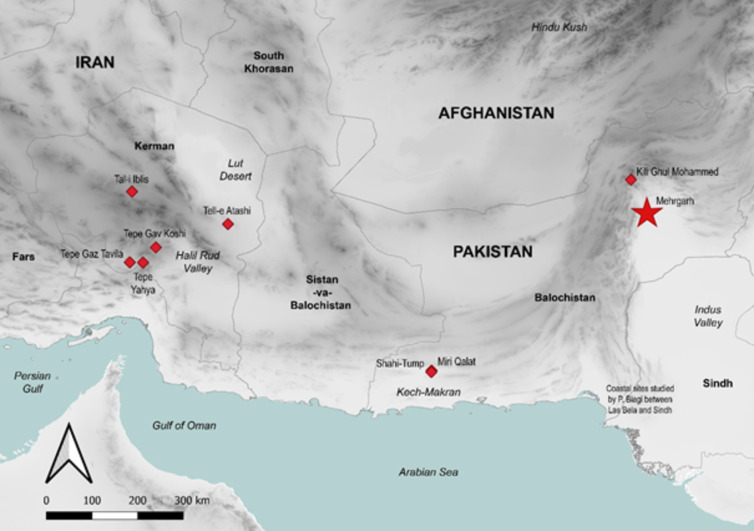
The domestication of plants and animals is believed to have commenced around 9500 BCE in the Near East. If the timing of the westward diffusion of the Neolithic transition is well documented, the precise mechanisms by which agriculture emerged between the Iranian Plateau, Central Asia, and South Asia remain unclear. In this context, the archaeological site of Mehrgarh (Pakistan) represents an essential point of reference. It is the sole site in the region where Neolithic occupation deposits have been extensively excavated, thereby providing the most essential insights into this period in northwest South Asia. Nevertheless, the accurate dating of these deposits remains a matter of contention, with implications for the most critical question of the emergence of agricultural life in the regions between the Fertile Crescent in the west and the Indus Valley in the east. Bayesian modelling of new radiocarbon dates performed on human tooth enamel from 23 Neolithic burials indicates that the aceramic Neolithic cemetery at Mehrgarh started between 5200 and 4900 BCE and lasted for a period of between two and five centuries. This result is in stark contrast with the previously proposed chronology of Neolithic Mehrgarh, which had not only suggested an early beginning around 8000 BCE but also a much longer duration of three millennia. This new, younger chronology implies that agriculture emerged in the Indus Valley as the result of a late diffusion of farmers into this region. Additionally, the data suggest that the thick Neolithic occupation deposits of Mehrgarh were formed at a faster rate than previously assumed, and that pottery production and its utilization in present-day Pakistan emerged not before the mid-fifth millennium BCE.
Overview
CoChat Summary
TL;DR
Bayesian modelling of new radiocarbon dates on human tooth enamel from 23 Neolithic burials at Mehrgarh (Pakistan) places the aceramic Neolithic cemetery in Period I at 5223–4914 to 4769–4679 cal. BCE, lasting 186–531 years. This younger chronology contradicts an ~8000 BCE start and implies farming life appeared late in the Indus Valley via diffusion, with pottery no earlier than ca. 4650 BCE.
Key findings
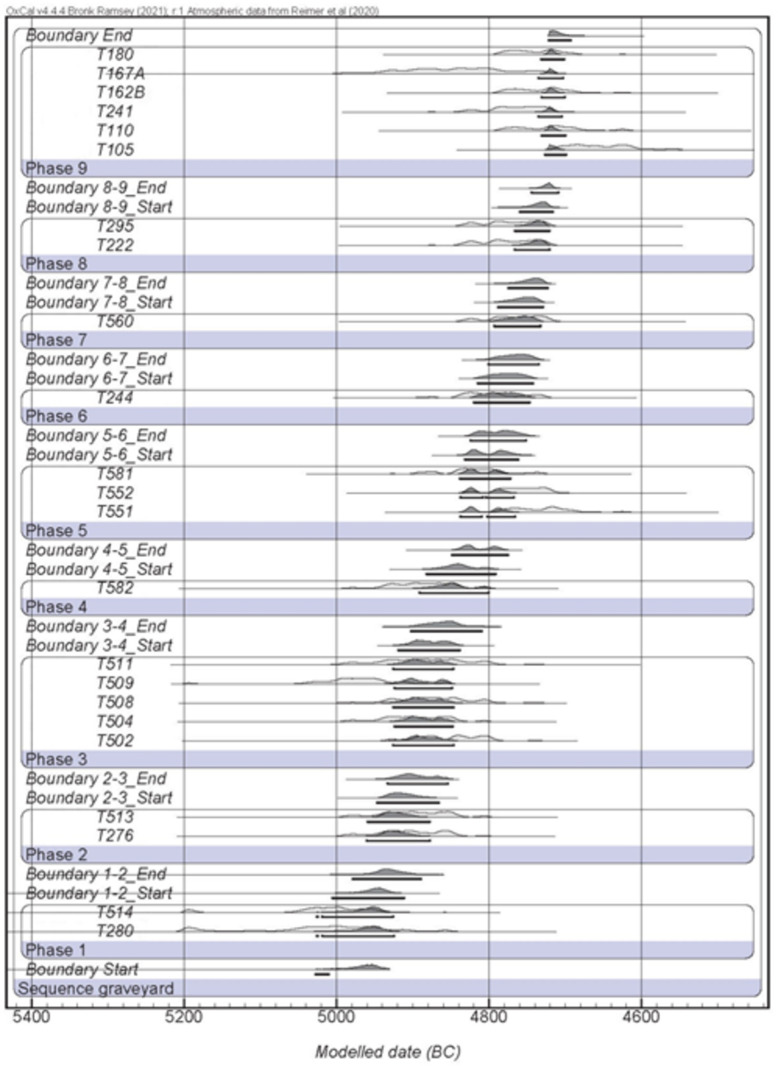
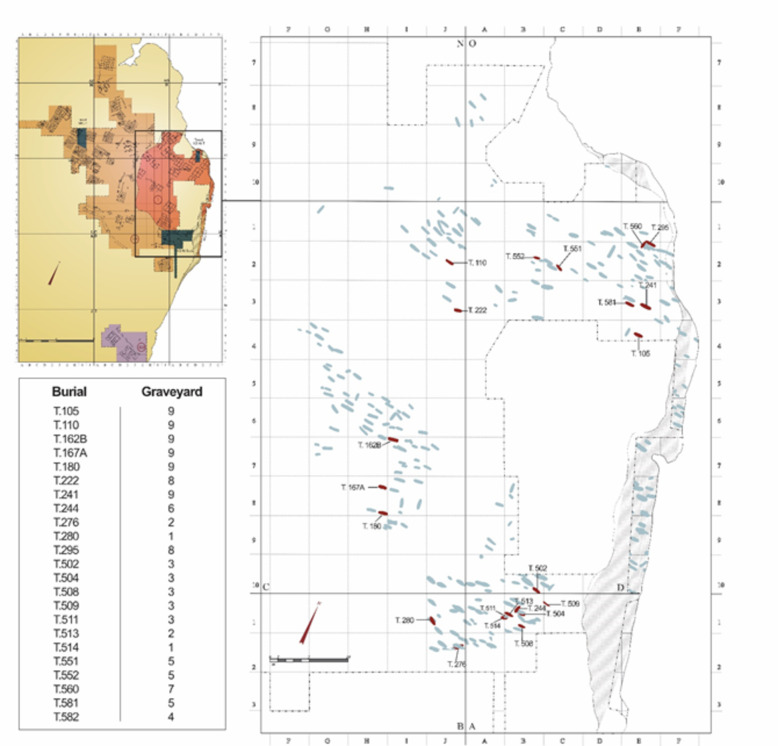
- New enamel dates from 23 graves across nine cemetery levels range from 6092 ± 27 BP (T514, Level 1) to 5801 ± 25 BP (T105, Level 9), and are stratigraphically consistent from bottom to top.
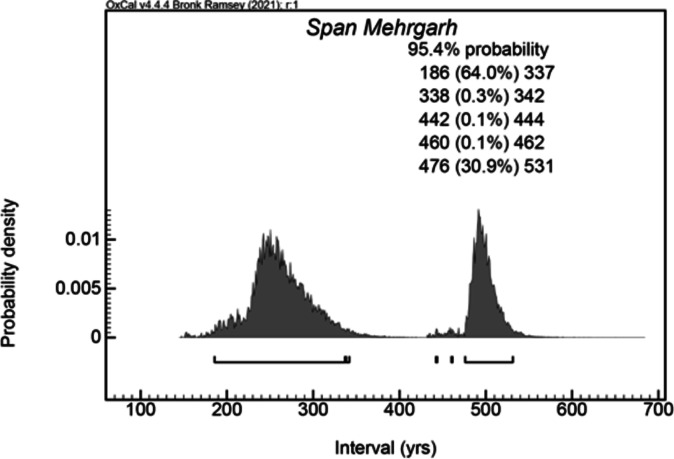
- Bayesian model v1.1 (Amodel = 98) estimates the cemetery started 5223–4914 cal. BCE and ended 4769–4679 cal. BCE, spanning 186–531 years; start probabilities are 5200 BCE (32%) and 5000–4900 BCE (62%), while duration is bimodal at 186–337 years (64%) and 476–531 years (31%).
- Period I dates to 5250–4650 cal. BCE, incompatible with Jarrige’s proposed ~8000 BCE start and three-millennium duration; Period IIA pottery is no earlier than ca. 4650 BCE, with three available Period IIA dates suggesting 4704, 4494, and 4443 BCE as earliest possible dates.
- Micronizing improved dating: age differences of 72 (T180), 89 (T162B), and 235 (T167A) 14C years BP were observed between hand-ground and micronized subsamples, with the most ancient ages from micronized powders; T167A micronized gave 5960 ± 60 BP from a minuscule, non-duplicated gas-source sample.
Methods
- Dental enamel was sampled from 23 graves representing the nine cemetery levels of Mehrgarh Period I; one individual per grave was sampled (T162 and T167 are double inhumations), using a premolar or molar. Enamel was cleaned, dentin removed, pulverized, micronized, pretreated with acetic acid, reacted with orthophosphoric acid, and measured by AMS ECHoMicadas; some samples were measured twice and averaged.
- A Bayesian model in OxCal used nine phases for the nine successive cemetery levels, with boundaries between phases and modelled elapsed time. Only new dates from micronized enamel samples were considered; charcoal dates were excluded because most predate AMS and have larger uncertainty, and because Jarrige identified several as outliers/intrusive.
- Model v1.1 manually rejected two dates in Levels 3 and 5 with the lowest Amodel (T509, Amodel = 25; T551, Amodel = 32) to improve model support.
Limitations
- Stated: model v1.0 was only moderately supported (Amodel = 51; plausible if >60), possibly due to slight rejuvenation from diagenesis; v1.1 rejected two dates with low Amodel. A calibration plateau between 5200 and 5000 BCE causes large uncertainty in the start date and a bimodal duration estimate. T167A was a minuscule, non-duplicated sample measured with the gas source, giving larger uncertainty. Within-level variability of 0–99 14C years is attributed partly to residual diagenetic carbon.
- Stated: the diffusion hypothesis is difficult to trace because Neolithic data are scarce between Mehrgarh and eastern Iran to the west, and between Mehrgarh and southern Central Asia to the north; some comparative chronological settings require further investigation and reassessment.
- Evident from the text: the chronology rests on 23 enamel samples and deliberately excludes charcoal dates, so it depends on the enamel subset and on pretreatment assumptions in the absence of preserved collagen.
Model-written summary. Check it against the paper before relying on it.
Integrity signals
Registry
Cites
Statistics
Figures
Verification
Claims the paper makes
0 Valid · 2 Not valid · 23 Not checked · 55 Own results and interpretations
A result the paper states — it cites no source for it, so there is none to check. The quote shows it is in the paper.
In the paper
“It is important to note that there is some variability in age within each level, with values typically ranging from 0 (Level 1) to 99 (Level 3) 14C years. This variability can be attributed, at least in part, to the residual presence of diagenetic carbon.”
§ New radiocarbon dates of human tooth enamel reveal a late appearance of farming life in the indus Valley > Results
hedgedstates a possible cause- Asserted: passes — The authors put it forward as true.
- Checkable: passes — It can be checked against evidence.
- Load-bearing: unclear — It is unclear whether the paper’s conclusions depend on it.
- Based: passes — The paper gives a reason why it holds.
A result the paper reports from its own data — it cites no other source for it, so there is none to check. The quote shows it is in the paper.
In the paper
“The model suggests that Mehrgarh Neolithic cemetery started at the end of the 6th millennium BCE or the beginning of the 5th millennium BCE (5223 − 4914 cal. BCE) and ended during the first third of the 5th millennium BCE (4769 − 4679 cal. BCE), spanning between 186 and 531 years.”
§ New radiocarbon dates of human tooth enamel reveal a late appearance of farming life in the indus Valley > Results
hedged- Asserted: passes — The authors put it forward as true.
- Checkable: passes — It can be checked against evidence.
- Load-bearing: passes — The paper’s conclusions depend on it.
- Based: passes — The paper gives a reason why it holds.
In the paper
“The radiocarbon ages from these 23 new analyses range between 6092 ± 27 BP (T514, Level 1) to 5801 ± 25 BP (T105, Level 9) (Supplementary information 6).”
§ New radiocarbon dates of human tooth enamel reveal a late appearance of farming life in the indus Valley > Results
What the sources say
- Not matchedcites Supplementary information 6
This doesn’t read as a citation we can look up.
plain- Asserted: passes — The authors put it forward as true.
- Checkable: passes — It can be checked against evidence.
- Load-bearing: passes — The paper’s conclusions depend on it.
- Based: passes — The paper gives a reason why it holds.
- Not matched
A result the paper reports from its own data — it cites no other source for it, so there is none to check. The quote shows it is in the paper.
In the paper
“The Neolithic occupation of Mehrgarh has now been demonstrated to be considerably more recent.”
§ New radiocarbon dates of human tooth enamel reveal a late appearance of farming life in the indus Valley > Discussion > The dating and process of inception of agriculture in Northwest South Asia
boosted- Asserted: passes — The authors put it forward as true.
- Checkable: passes — It can be checked against evidence.
- Load-bearing: passes — The paper’s conclusions depend on it.
- Based: passes — The paper gives a reason why it holds.
- Rests on an assumption not shown here.
A result the paper reports from its own data — it cites no other source for it, so there is none to check. The quote shows it is in the paper.
In the paper
“The model suggests that Mehrgarh Neolithic cemetery started at the end of the 6th millennium BCE or the beginning of the 5th millennium BCE (5223 − 4914 cal. BCE) and ended during the first third of the 5th millennium BCE (4769 − 4679 cal. BCE), spanning between 186 and 531 years.”
§ New radiocarbon dates of human tooth enamel reveal a late appearance of farming life in the indus Valley > Results
hedged- Asserted: passes — The authors put it forward as true.
- Checkable: passes — It can be checked against evidence.
- Load-bearing: passes — The paper’s conclusions depend on it.
- Based: passes — The paper gives a reason why it holds.
41 more claims
Create a free account to see all 80 claims and to verify the 36 references still open.
- It may state two separate claims as one. 28
- Probably not a substantial claim. 13
- The quote only partly states this claim. 1
Citations
Cites
Bayesian Analysis of Radiocarbon Dates
Bronk Ramsey, C. (2009) · Radiocarbon · doi:10.1017/s0033822200033865 · Cited by 8,725
Agricultural Origins and Frontiers in South Asia: A Working Synthesis
Fuller, D. Q. (2006) · Journal of World Prehistory · doi:10.1007/s10963-006-9006-8 · Cited by 387 · cited 1×
“Furthermore, it is consistent with the majority of currently available bioarchaeological data, particularly the fact that animals and plants were domesticated from the outset of Period I and were predominantly West Asian in character 7,18,39 (see Supplementary Information 1, 2 & 3).”
Evidence for early dispersal of domestic sheep into Central Asia
Taylor, W. T. T., Pruvost, M., Posth, C., Rendu, W., Krajcarz, M. T., Abdykanova, A., Brancaleoni, G., Spengler, R. N., Hermes, T. R., Schiavinato, S., et al. (2021) · Nature Human Behaviour · doi:10.1038/s41562-021-01083-y · Cited by 156
Bone and enamel carbonate diagenesis: A radiocarbon prospective
Zazzo, A. (2014) · Palaeogeography, Palaeoclimatology, Palaeoecology · doi:10.1016/j.palaeo.2014.05.006 · Cited by 109
Self-citationOut of the Fertile Crescent: The dispersal of domestic livestock through Europe and Africa
Zeder, M. A. (2017) · Cambridge University Press eBooks · doi:10.1017/9781316686942.012 · Cited by 97
The Archaeology of Iran from the Palaeolithic to the Achaemenid Empire
Matthews, R., & Nashli, H. F. (2022) · Routledge eBooks · doi:10.4324/9781003224129 · Cited by 91
Mehrgarh: field reports 1974-1985 from Neolithic times to the Indus civilization
Jarrige, C. (1995) · Cited by 70
Origins of Agriculture in Western Central Asia: An Environmental-Archaeological Study
Harris, D. R. (2011) · University of Pennsylvania Press eBooks · doi:10.9783/9781934536513 · Cited by 65
Fuller, D. Q., & Lucas, L. (2017) · Cambridge University Press eBooks · doi:10.1017/9781316686942.013 · Cited by 63
Tappeh Sang-e Chakhmaq and the beginning of the Neolithic in north-east Iran
Roustaei, K., Mashkour, M., & Tengberg, M. (2015) · Antiquity · doi:10.15184/aqy.2015.26 · Cited by 40
Research works printed but not linked: 9
- Costantini, L. The first farmers in Western Pakistan: the evidence of the neolithic agropastoral settlement of Mehrgarh. Pragdhara 18, 167–178 (2008).
- Biagi, P., Nisbet, R. & Fantuzzi, T. Exploiting mangroves: environmental changes and human interference along the Northern Coast of the Arabian sea (Pakistan) during the holocene. Archäologische Mitteilungen Aus Iran. Und Turan. 48, 1–31 (2019).
- Jarrige, C. The figurines of the first farmers at Mehrgarh and their offshoots. Pragdhara 18, 155–166 (2008).
- Jarrige, J. F., Jarrige, C. & Quivron, G. Mehrgarh Neolithic: the updated sequence. In South Asian Archaeology vol. I (C. Jarrige, C. & Lefèvre, V. eds.) 129–141 (Éditions Recherche sur les Civilisations, 2005). (2001).
- Beale, T. W. & Lamberg-Karlovsky, C. C. Excavations at Tepe Yahya, Iran 1967–1975. The Early Periods. American School of Prehistoric Research, Bulletin 38 (Peabody Museum of Archaeology and Ethnology, 1986).
- Prickett, M. E. & Man land and water: settlement distribution and the development of irrigation agriculture in the upper Rud-i Gushk drainage, southeastern-Iran. Unpublished doctoral thesis, Harvard University, Department of Anthropology (1986).
- Harris, D. R. Origins of Agriculture in Western Central Asia: an environmental-archaeological Study (University of Pennsylvania, 2010). · DOI · Paper page
- Ranov, V. A. & Korobkova, G. F. Tutkaul - mnogoslojnoe Poselenie Gissarskoj kultury V Yuzhnom Tadzhikistane (Tutkaul– multilayered settlement site of the Gissar culture in Southern Tajikistan). Sovetskaya Arheologiya (Soviet Archaeology). 2, 134–147 (1971).
- Azizi Kharanaghi, H., Fazeli Nashli, H. & Nishiaki, Y. The second season of excavations at Tepe Rahmat Abad, Southern Iran: the absolute and relative chronology. Anc. Near East. St. 51, 1–32 (2014).
Cited by
Petrie, C. A., Jürcke, F., Wilkinson, T. C., & Orengo, H. A. (2026) · Journal of Archaeological Research · doi:10.1007/s10814-026-09221-8 · Cited by 3
The Hydro-Politics of Indus River Basin: The Role of Water in Pak-India Relations
Khatoon, S., Taj, S., Fayaz, H., Naseer, Z., & Tanveer, R. (2025) · Journal of Social Signs Review · Cited by 3
Settled Human Life in South Asia
Prabhakar, V. N. (2025) · Springer eBooks · doi:10.1007/978-981-96-8635-3_2
Prabhakar, V. N. (2025) · Springer eBooks · doi:10.1007/978-981-96-8635-3_1
Indus Valley farming started later than thought, radiocarbon study shows
Priyadarshini, S. (2025) · Nature India · doi:10.1038/d44151-025-00060-y
Metadata
- Authors
- Mutin, B., Zazzo, A., Bondioli, L., Coppa, A., Garbé, L., Müller, W., Nava, A., Quivron, G., Tombret, O., Vidale, M., & Didier, A.
- Affiliations
- Sorbonne Université (FR)
- Centre National de la Recherche Scientifique (FR)
- University of Padua (IT)
- Unitelma Sapienza University (IT)
- Goethe University Frankfurt (DE)
- Sapienza University of Rome (IT)
- Archéologies et Sciences de l’Antiquité (FR)
- Corresponding author
- Mutin, Benjamin
- ORCID
- Venue
- Scientific Reports
- Published
- 2025-04-15
- Volume
- 15
- Issue
- 1
- Pages
- 11345-11345
- ISSN
- 2045-2322 (ISSN-L)
- PMC
- PMC12000376
- OpenAlex
- W4409442947
- Cited by
- 5
- References
- 41
- Citations by year
- 2026: 1 · 2025: 4
- FWCI
- 4.92
- Type
- journal article
- Language
- en
- Open access
- gold
- doi.org
- Licence
- cc-by-nc-nd
- creativecommons.org/licenses/by-nc-nd/4.0 (tdm)
- creativecommons.org/licenses/by-nc-nd/4.0 (vor)
- Locations
- Scientific Reports (publishedVersion, cc-by-nc-nd)
- PubMed Central (publishedVersion, cc-by-nc-nd)
- PubMed (publishedVersion)
- HAL (submittedVersion, cc-by-nc-nd)
- DOAJ (DOAJ: Directory of Open Access Journals) (submittedVersion)
- IRIS Research product catalog (Sapienza University of Rome) (submittedVersion, cc-by-nc-nd)
- Padua Research Archive (University of Padova) (submittedVersion)
- Funders
- UMR 7209 Archéozoologie et Archéobotanique - Sociétés, Pratiques et Environnements
- Topics
- Social Sciences › Archeology › Archaeology and ancient environmental studies
- Social Sciences › Arts and Humanities › Archeology (arts and humanities) › Archaeological and Geological Studies
- Social Sciences › Arts and Humanities › Archeology (arts and humanities) › Ancient and Medieval Archaeology Studies
- Keywords
- Neolithic transition, emergence of agriculture, Indus Valley, Mehrgarh, human enamel, radiocarbon dating, Aceramic Neolithic, Neolithic burials, chronology, pottery production, Fertile Crescent
- MeSH terms
- Agriculture, Archaeology, Bayes Theorem, Dental Enamel, Humans, Pakistan, History, Ancient, Radiometric Dating
About these checks
Registry, retraction, Cites and statistics results are computed, not judged, with one exception: a printed reference that no index lists is read once by a model before it counts as a citation error. Claims are extracted by a model and kept only when their quote appears verbatim in the text; each cited source is then checked, with a model’s help, for whether it says what the claim relies on. Those verdicts can be wrong — read the claim’s quote and the cited source before relying on one.
A language model drew the claims from the paper on 2026-11-24, under version 3 of the claim definition (model deepseek-v4.1-flash, prompt extract-v3).
A second model labelled each claim on 2026-11-24 (model jev-1.13-20260917, definition revision gold-guideline-v0.2).
Statistics and arithmetic are recomputed, not judged.
Confidence bands are shown only for fields calibrated on our annotated test set. None is calibrated yet, so no band is shown.
What counts as a claim ›How we measure confidence ›How we check this ›
Are you an author, or do you see a problem with this page? Request a review
How to cite
Cite CoChat for the checks on this page, and the paper for its own findings.
- This page
- CoChat. (2026). Citation check: New radiocarbon dates of human tooth enamel reveal a late appearance of farming life in the indus Valley. https://app.cochat.ai/papers/10.1038/s41598-025-92621-5
- The paper
- Mutin, B., Zazzo, A., Bondioli, L., Coppa, A., Garbé, L., Müller, W., Nava, A., Quivron, G., Tombret, O., Vidale, M., & Didier, A. (2025). New radiocarbon dates of human tooth enamel reveal a late appearance of farming life in the indus Valley. Scientific Reports. https://doi.org/10.1038/s41598-025-92621-5
Data sources
Bibliographic data: Semantic Scholar, OpenAlex, Crossref.
Contains information from the Semantic Scholar Academic Graph Datasets, made available under the ODC Attribution License (ODC-BY 1.0).
Semantic Scholar’s data is described in: Kinney, R., et al. (2023). The Semantic Scholar Open Data Platform. arXiv:2301.10140.
