

The DOI matches its Crossref record; the references it cites are not checked yet.
Multifactorial formulation for stable encapsulated plant growth promoting microorganisms
Open accessAbstract
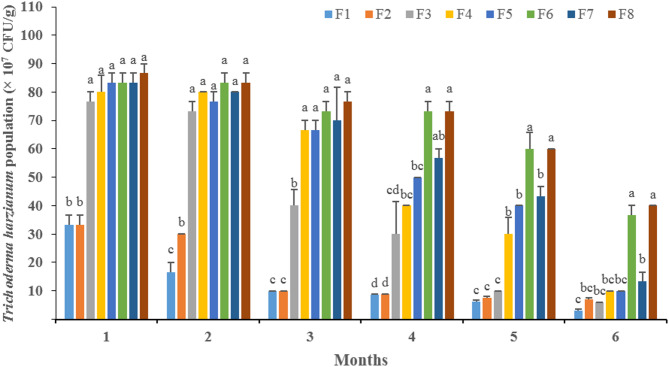
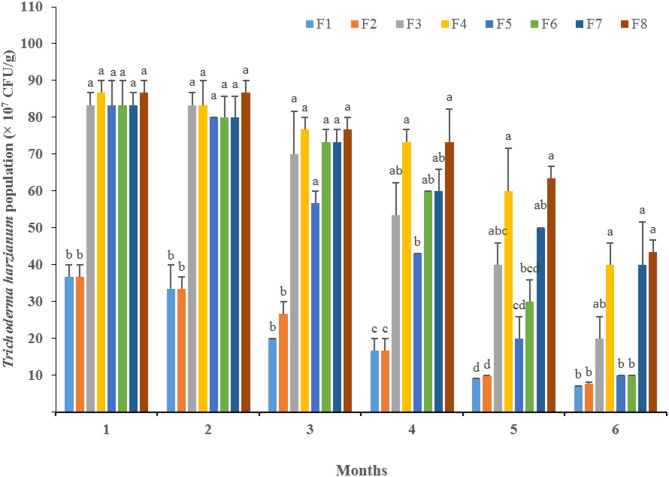
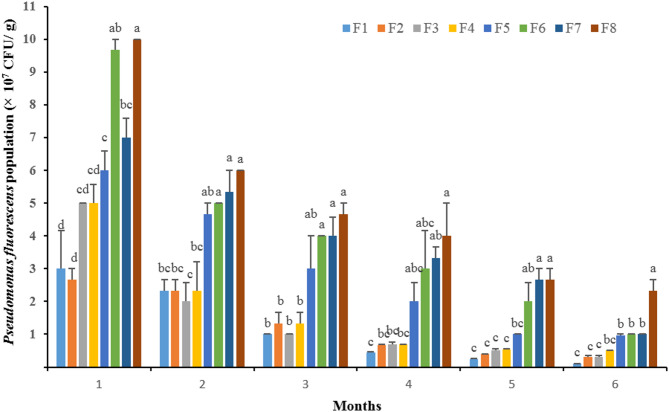
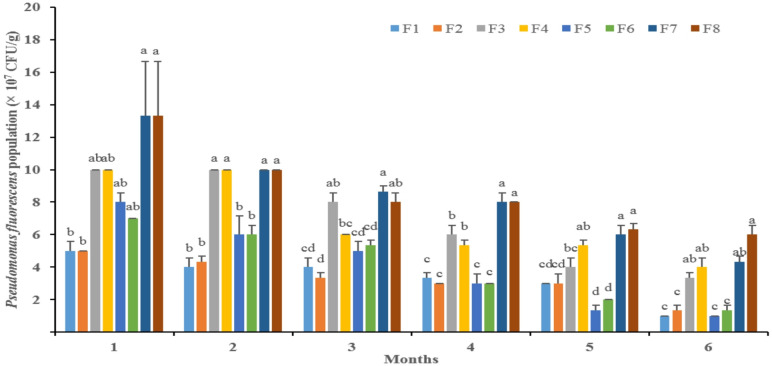
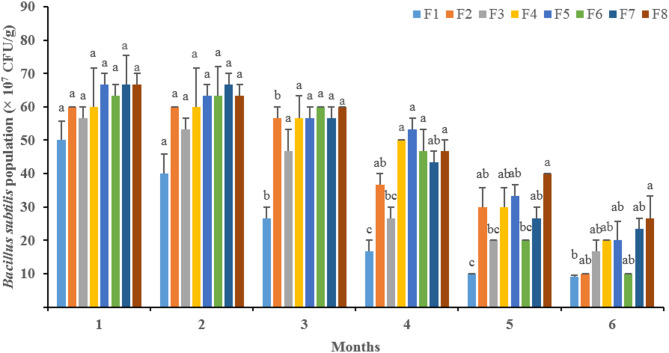
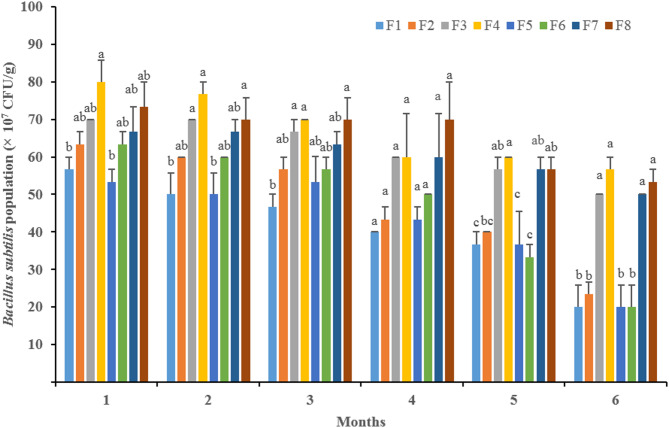
The effectiveness of plant growth-promoting microorganisms (PGPMs) in agriculture depends on their formulation into stable, viable products. This study evaluated the stability and viability of three PGPMs- Trichoderma harzianum I 20, Pseudomonas fluorescens P-187, and Bacillus subtilis SWRIs-using various carrier-based and encapsulation formulations. A factorial experiment was conducted with eight formulations, stored at room and cold temperatures for up to six months. Significant interactions between formulation type, storage temperature, and duration were observed ( p < 0.01). After six months at room temperature, the biochar-trehalose-glycerol formulation maintained the highest populations for all three microorganisms. At cold room temperature, this formulation also provided the greatest stability for T. harzianum I 20 (4.33 × 10 8 CFU/g) and P. fluorescens P-187 (6 × 10 7 CFU/g), while B. subtilis SWRIs showed the least population reduction in formulation 7 (talc-trehalose-glycerol) with 5 × 10 8 CFU/g. Although talc and biochar showed comparable overall effectiveness as carriers, biochar generally promoted better microbial survival. Glycerol enhanced the preservation of all three species at cold room temperature, whereas trehalose was more effective for P. fluorescens P-187 and T. harzianum I 20 stability at room temperature. These findings highlight the critical role of carrier selection and osmotic stabilizer inclusion in developing robust bioinoculant formulations for different storage conditions and target microorganisms.
Overview
The claims and statistics of this paper haven’t been checked yet.
Run the check — free, no account needed. It reads the open-access text and checks the sources it cites.
Integrity signals
Registry
Cites
Statistics
Figures
Verification
Claims the paper makes
The claims and statistics of this paper haven’t been checked yet.
Run the check — free, no account needed. It reads the open-access text and checks the sources it cites.
Self-check
Percentages, sums and reported differences re-computed from the paper’s own numbers.
The self-check needs the paper’s full text.
Citations
The citation lists haven’t been fetched yet
References 8 · Cited by 15
Research works printed but not linked: 29
- Bolton, H., Fredrickson, J. K. & Elliott, L. J. Microbial ecology of the rhizosphere. In Soil Microbial Ecology: Applications in Agricultural and Environmental Management (ed Metting, F. B.) 27–63 (Marcel Dekker, 1993).
- Suarez, C., Ratering, S., Kramer, I., Schnell, S. & &Schröder, P. Microbial community dynamics in maize rhizosphere depending on nitrogen supply, soil and plant genotype. Microb. Biotechnol. 8, 1235–1243 (2015).
- Malusa, E., Sas-Paszt, L. & &Ciesielska, J. Technologies for beneficial microorganisms inocula used as biofertilizers. Sci. World J. 491206 (2012). · DOI
- Sarma, B. K., Yadav, S. K., Singh, S. & Singh, H. B. Microbial inoculants and their carrier materials. In Microbial Inoculants in Sustainable Agricultural Productivity (eds. Singh, D. P., Singh, H. B. &Prabha, R.) 1–18 (Springer, 2011).
- Ajeng, I. I., Aini, N., Sumarno, S. & &Sunardi, S. Effectiveness of various formulations of trichoderma sp. in controlling fusarium wilt and promoting the growth of banana plants. Indones J. Agric. Res. 5, 12–22 (2023).
- Glodowska, M. Plant growth promoting rhizobacteria: their role in plant growth and strategies for commercialization. J. Plant. Nutr. 37, 1974–1985 (2014).
- Boontun, S., Chayapan, P. & &Wattanachai, P. Comparative efficacy of biopolymer-based formulations on Bacillus subtilis for sustainable plant disease management. Sustain. Agric. Rev. 61, 185–204 (2024).
- Nunes, C., Usall, J., Teixidó, N., Viñas, I. & Solsona, C. Encapsulation of beneficial bacteria in skim milk for improved shelf life and field performance. Biol. Control. 121, 1–8 (2018).
- Gopi, R., Radhakrishnan, R. & &Paek, K. Y. Plant growth promoting rhizobacteria: mechanisms and role in stress tolerance. 131–149 (Springer, 2019).
- Bashan, Y., de-Bashan, L. E., Prabhu, S. R. & Hernandez, J. P. Advances in plant growth-promoting bacterial inoculant technology: formulations and practical perspectives (1998–2013). Plant. Soil. 378, 1–33 (2014). · DOI
- Schoebitz, M., López, M. D. & &Roldán, A. Bioencapsulation of microbial inoculants for better soil–plant fertilization. A review. Agron. Sustain. Dev. 32, 751–765 (2012).
- Løvschall, M., Jacobsen, S., Nørgaard, T. & C. & Slow-release microencapsulation of biopesticides: A promising approach for pest control. Pestic Biochem. Physiol. 194, 105405 (2024).
- Maruyama, C. R., Guilger, M., Pascoli, M., Bileshy-José, N. & Abhilash, P. C. &Fraceto, L. F. Nanoparticles for agrochemicals: advancing delivery systems and addressing challenges in the agricultural sector. Environ. Sci. Nano. 7, 371–386 (2020).
- Berninger, T., González López, Ó. & Behrendt, U. &Schäfer, B. Biological control agents in combination with fungicides: compatible or not? Agronomy 8, 197 (2018).
- Bheemaraya, P., Sreenivasa, M. N., Nagaraja, G. J. & Ramesh, G. S. Formulation of trichoderma Harzianum using organic carriers for the management of Pigeonpea wilt. Karnataka J. Agric. Sci. 24, 517–519 (2011).
- Martinez, A., Silva, D., Fonseca, L., Perez, E. & Souza, R. Effect of encapsulated Pseudomonas fluorescens on tomato plant growth and root colonization. J. Soil. Sci. Plant. Nutr. 23, 1089–1099 (2023).
- Choube, S. K. Biofertilizer formulations and their impact on plant growth. In Bioformulations: for Sustainable Agriculture (eds Arora, N. K. & Mehnaz, S. & Balestrini, R.) 57–72 (Springer, 2018).
- Mancera-López, M. E., Espinosa-Victoria, D., Cruz-Ortega, R. & Martínez-Gallardo, N. A. &Alarcón, A. Quantification of trichoderma conidia using a hemocytometer. J. Microbiol. Methods159, 1–4 (2019).
- Rekha, P. D., Lai, W. A., Arun, A. B., Young, C. C. & &Shen, F. T. Effect of free and encapsulated Pseudomonas Putida on plant growth and soil microbial communities. Appl. Soil. Ecol. 36, 195–203 (2007).
- Przyklenk, M. et al. Rillig, M. C. Plant resistance to drought depends on the substrate composition and the presence of Biochar. Sci. Rep. 7, 44735 (2017). · DOI
- Young, C. C., Rekha, P. D., Lai, W. A. & &Arun, A. B. Encapsulation of plant growth-promoting bacteria in alginate beads enriched with humic acid. Biotechnol. Bioeng. 95, 76–83 (2006). · DOI
- Locatelli, A., Travaglia, C., Cattivelli, L., Gennari, M. & Nerva, L. &Chiapello, M. Encapsulation of Trichoderma Harzianum and its application in plant protection. J. Appl. Microbiol. 125, 1234–1245 (2018).
- Vejan, P., Abdullah, R., Khadiran, T. & &Ismail, S. Encapsulation of Bacillus Salmalaya 139SI using double coating biopolymer technique. Lett. Appl. Microbiol. 68, 56–63 (2019). · DOI
- Lorch, H. J., Benckieser, G. & &Ottow, J. C. G. Basic methods for counting microorganisms in soil and water. In Methods in Applied Soil Microbiology and Biochemistry (ed Alef, K.) (1995). &Nannipieri, P.) 146–161 (Academic, London.
- Tripathi, L., Tripathi, J. N. & &Tushemereirwe, W. K. Efficient regeneration and transformation of plants for genetic improvement. Methods Mol. Biol. 1223, 1–18 (2015).
- Adzmi, H., Ibrahim, M. H., Kadir, J. & Saud, H. M. Development of a powder formulation of trichoderma Harzianum using Talc as a carrier. Crop Prot. 43, 143–151 (2012).
- Balla, M. K., Singh, H., Wani, S. H. & &Saxena, R. K. Plant growth-promoting rhizobacteria: A potential microbial tool for sustainable agriculture. Front. Microbiol. 13, 823084 (2022).
- Brar, S. K., Verma, M. & Tyagi, R. D. &Surampalli, R. Y. Valuation of carrier materials for development of bioinoculant formulations. Can. J. Microbiol. 58, 1–14 (2012).
- Zhang, S., Liu, H., Meng, L., Zhang, H. & Zhao, Y. Shen, Q. Development of a bioformulation of Bacillus amyloliquefaciens for biocontrol of tomato bacterial wilt. Biol. Control. 164, 104769 (2022).
Metadata
- Authors
- Dolatabad, H. K.
- Affiliations
- Agricultural Research & Education Organization (IR)
- Corresponding author
- Dolatabad, Hossein Kari
- Venue
- Scientific Reports
- Published
- 2026-01-07
- Volume
- 16
- Issue
- 1
- Pages
- 4797-4797
- ISSN
- 2045-2322 (ISSN-L)
- PMC
- PMC12873143
- OpenAlex
- W7118247620
- Cited by
- 15
- References
- 8
- Citations by year
- 2026: 15
- FWCI
- 55.48
- Type
- journal article
- Language
- en
- Open access
- gold
- doi.org
- Licence
- Locations
- Scientific Reports (publishedVersion, cc-by-nc-nd)
- Europe PMC (PubMed Central) (publishedVersion, cc-by-nc-nd)
- PubMed (publishedVersion)
- PubMed Central (publishedVersion, cc-by-nc-nd)
- DOAJ (DOAJ: Directory of Open Access Journals) (submittedVersion, cc-by-sa)
- Funders
- Southwest Research Institute
- Topics
- Life Sciences › Agricultural and Biological Sciences › Plant Science › Agriculture, Plant Science, Crop Management
- Life Sciences › Agricultural and Biological Sciences › Plant Science › Plant-Microbe Interactions and Immunity
- Life Sciences › Agricultural and Biological Sciences › Agronomy and Crop Science › Polymer-Based Agricultural Enhancements
- Keywords
- plant growth-promoting microorganisms, microbial encapsulation, microbial viability, storage stability, Trichoderma harzianum, Pseudomonas fluorescens, Bacillus subtilis, biochar, trehalose, glycerol, osmotic stabilizer, cold storage
- MeSH terms
- Bacillus subtilis, Charcoal, Glycerol, Pseudomonas fluorescens, Temperature, Trehalose, Microbial Viability, Plant Development
About these checks
Registry, retraction, Cites and statistics results are computed, not judged, with one exception: a printed reference that no index lists is read once by a model before it counts as a citation error. Claims are extracted by a model and kept only when their quote appears verbatim in the text; each cited source is then checked, with a model’s help, for whether it says what the claim relies on. Those verdicts can be wrong — read the claim’s quote and the cited source before relying on one.
Statistics and arithmetic are recomputed, not judged.
Confidence bands are shown only for fields calibrated on our annotated test set. None is calibrated yet, so no band is shown.
What counts as a claim ›How we measure confidence ›How we check this ›
Are you an author, or do you see a problem with this page? Request a review
How to cite
Cite CoChat for the checks on this page, and the paper for its own findings.
- This page
- CoChat. (2026). Citation check: Multifactorial formulation for stable encapsulated plant growth promoting microorganisms. https://app.cochat.ai/papers/10.1038/s41598-026-35331-w
- The paper
- Dolatabad, H. K. (2026). Multifactorial formulation for stable encapsulated plant growth promoting microorganisms. Scientific Reports. https://doi.org/10.1038/s41598-026-35331-w
