

The DOI matches its Crossref record; its reference list is not available.
The use of fish diversity and abundance as environmental indicators in a mining region in Brazilian Amazonia
Open accessPublished version of a preprint
Abstract
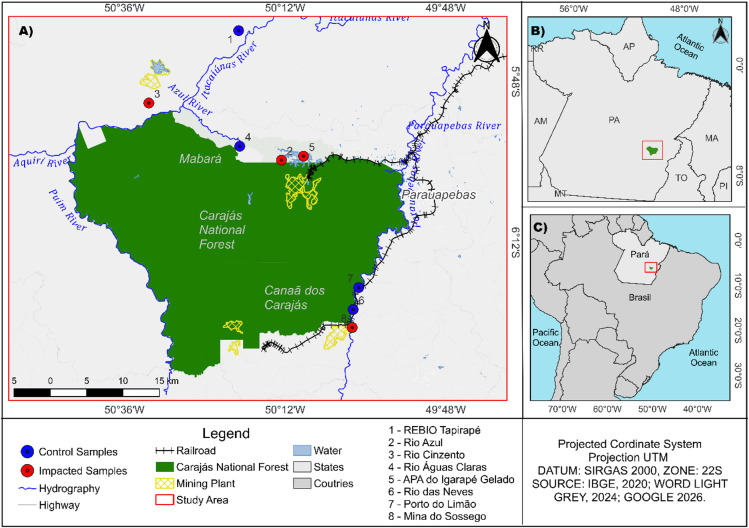
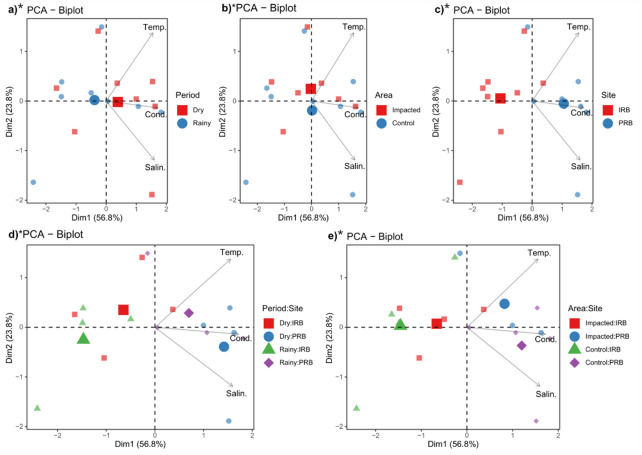
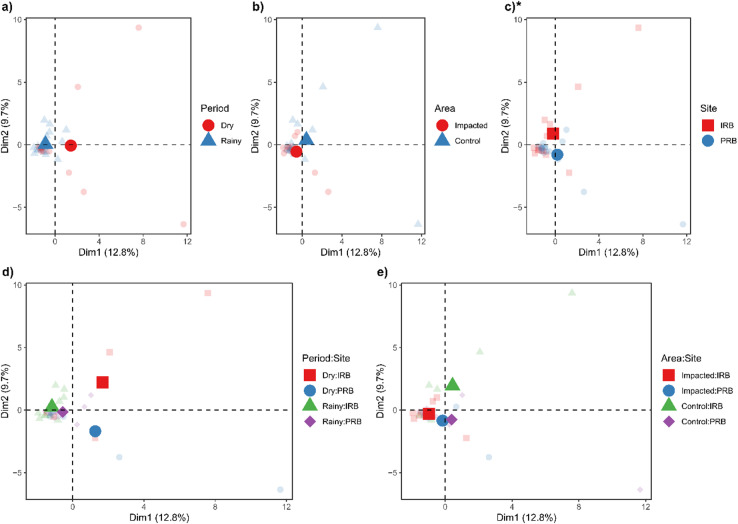
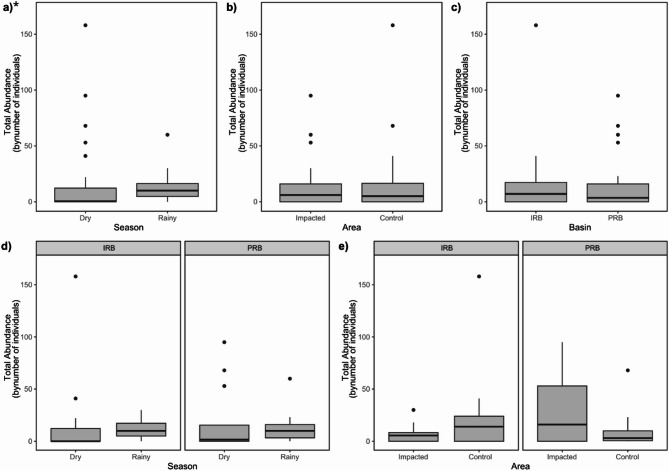
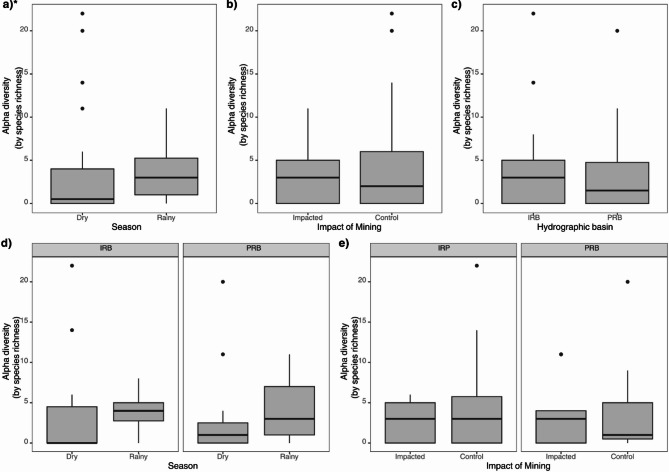
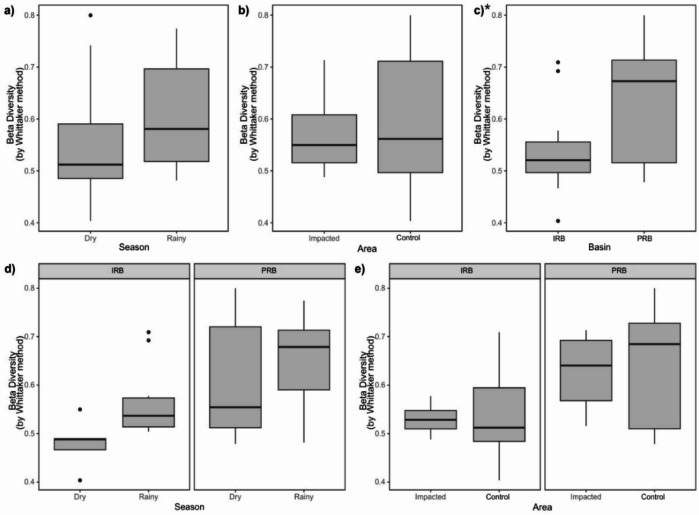
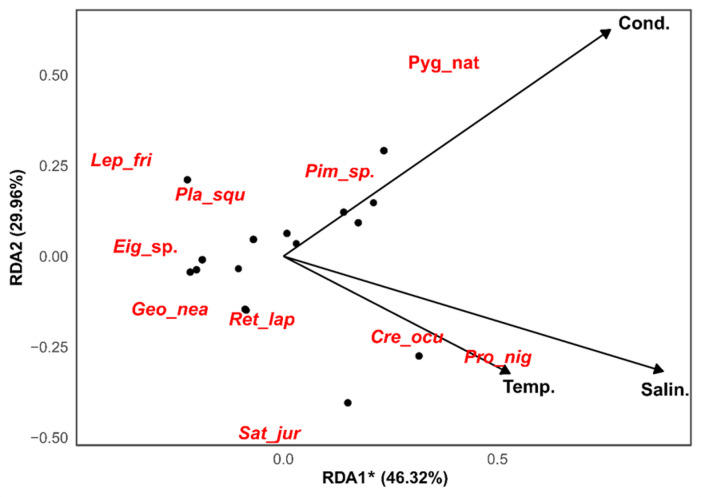
The impacts of mining on aquatic biodiversity pose significant challenges for environmental mitigation, particularly near protected areas. This study assessed fish abundance and diversity (assemblage composition, alpha and beta diversity, indicator species, and Species Contribution to Beta Diversity - SCBD) in the Itacaiúnas and Parauapebas river basins, Brazilian Amazonia, across dry and rainy seasons. We hypothesized that basins near mining-impacted areas would exhibit reduced fish abundance and diversity compared to control areas. To test this, four sampling points were established per basin (two controls, two impacted), totaling eight sites, where fish were collected using gillnets and physicochemical water parameters were simultaneously recorded. Fish abundance and alpha diversity peaked during the rainy season but showed no significant differences between control and impacted areas. Beta diversity was higher in the Parauapebas basin, and indicator species analysis identified taxa associated with particular groups. A Redundancy Analysis (RDA) linked environmental variables (temperature, salinity, and conductivity) to species distributions, suggesting an influence of water quality on assemblage organization. Although abundance and richness did not clearly differentiate areas, the combined assemblage and species-level results support the importance of continuous, integrated monitoring to assess long-term ecological changes.
Overview
The claims and statistics of this paper haven’t been checked yet.
Run the check — free, no account needed. It reads the open-access text and checks the sources it cites.
Integrity signals
Registry
Cites
Statistics
Figures
Verification
Claims the paper makes
The claims and statistics of this paper haven’t been checked yet.
Run the check — free, no account needed. It reads the open-access text and checks the sources it cites.
Self-check
Percentages, sums and reported differences re-computed from the paper’s own numbers.
The self-check needs the paper’s full text.
Citations
No citation lists for this paper
No citation lists for this paper yet — checked again daily.
References 82 · Cited by 1
Research works printed but not linked: 17
- Correa, S. B. et al. Floodplain forests drive fruit-eating fish diversity at the Amazon Basin-scale. Proc. Natl. Acad. Sci. USA 122 (2025).
- Dani, A. et al. Social and environmental impacts of mining and spatialization of human development index (HDI) to the microregion of Parauapebas (PA). Revista GeoAmazônia. 10, 141–158 (2022). https://periodicos.ufpa.br/index.php/geoamazonia/index
- Pontes, P. R. M. et al. Environmental assessment based on soil loss, deforestation in permanent preservation areas, and water quality applied in the Itacaiúnas Watershed. East. Amazon. 13, 248–262 (2025).
- Ribeiro, E. S. et al. Multitemporal evaluation of the vegetation cover of the Tapirapé biological reserve, Pará. Res. Soc. Dev. 10, 4 (2021).
- Pontes, F. H. G. et al. For whom is the environmental protection? Territorial disputes between Vale and rural peasant communits: The case of the Rio Gelado Environmental Protection. Ambientes 3, 330–359 (2021).
- Camargo, M., Junior, H. G. & Py-Daniel, L. H. Ornamental Plecos of the Middle Xingu River, first edition (Belém-PA, 2012).
- Ohara, W. M. et al. Peixes do Rio Teles Pires: diversidade e guia de identificação. Neotropical Ichthyol. 15, 160085 (2017).
- Legendre, P., Legendre, L. & Edition Numerical Ecology, 2nd English Elsevier, Amsterdam, 1-853. - References - Scientific Research Publishing. Scirp.org (1998). https://www.scirp.org/reference/referencespapers?referenceid=3103110 (2021).
- Rigby, R. A. & Stasinopoulos, D. M. Generalized additive models for location, scale and shape (with discussion). J. Roy. Stat. Soc.: Ser. C (Appl. Stat.). 54, 507–554 (2005).
- Legendre, P. & Legendre, L. Numerical ecology (Elsevier, 2012).
- Dufrene, M. & Legendre, P. Species Assemblages and Indicator Species: The Need for a Flexible Asymmetrical Approach. Ecol. Monogr. 67, 345 (1997).
- Bührnheim, C. M. & Fernandes, C. C. Low seasonal variation of fish assemblages in Amazonian rain forest streams. Ichthyological Explor. Freshwaters. 12, 65–78 (2001).
- Ayoola, S. O. & Kuton, M. P. Seasonal variation in fish abundance and physicochemical parameters of Lagos lagoon, Nigeria. Afr. J. Environ. Sci. Technol. 3, 149–158 (2016).
- Gerking, S. D. Feeding ecology of fish (Academic Press, 1994).
- Mazzoni, R. & Caramaschi, E. P. Spawning season, ovarian development and fecundity of Hypostomus affinis (Osteichthyes, Loricariidae). Rev. Bras. Biol. 57, 455–462 (1997).
- De Oliveira, C. et al. Genotoxicity assessment in two Amazonian estuaries using the Plagioscion squamosissimus as a biomonitor. Environ. Sci. Pollut. Res. 29, 41344–41356 (2022). · DOI
- Rossoni, D. M. A utilização das descargas dos órgãos elétricos de Apteronotus hasemani e Apteronotus bonapartii (Apteronotidae-Gymnotiformes) como bioindicadores em ambientes aquáticos. Manaus: INPA. (2005).
Metadata
- Authors
- de Oliveira, C. A. C. R., Morais, K. S., de Oliveira, J. P. S., de Oliveira Marques, A., da Silva, A. B. F., da Conceição Palheta, D., & Bentes, B.
- Affiliations
- Universidade Federal do Pará (BR)
- Instituto Federal de Educação, Ciência e Tecnologia do Pará (BR)
- Corresponding author
- de Oliveira, Claudia Antônia Campos Rodrigues
- ORCID
- Venue
- Scientific Reports
- Published
- 2026-03-12
- Volume
- 16
- Issue
- 1
- ISSN
- 2045-2322 (ISSN-L)
- PMC
- PMC13102912
- OpenAlex
- W7135095830
- Cited by
- 1
- References
- 82
- Citations by year
- 2026: 1
- FWCI
- 3.99
- Type
- journal article
- Language
- en
- Open access
- gold
- doi.org
- Licence
- cc-by-nc-nd
- creativecommons.org/licenses/by-nc-nd/4.0 (tdm)
- creativecommons.org/licenses/by-nc-nd/4.0 (vor, 42 d)
- Locations
- Scientific Reports (publishedVersion, cc-by-nc-nd)
- Research Square (acceptedVersion, cc-by)
- PubMed Central (publishedVersion, cc-by-nc-nd)
- PubMed (publishedVersion)
- DOAJ (DOAJ: Directory of Open Access Journals) (submittedVersion, cc-by-sa)
- Funders
- Instituto Chico Mendes de Conservação da Biodiversidade
- Topics
- Physical Sciences › Environmental Science › Nature and Landscape Conservation › Fish biology, ecology, and behavior
- Physical Sciences › Environmental Science › Nature and Landscape Conservation › Fish Ecology and Management Studies
- Physical Sciences › Environmental Science › Ecology › Freshwater macroinvertebrate diversity and ecology
- Keywords
- fish diversity, fish abundance, environmental indicators, mining impacts, aquatic biodiversity, beta diversity, indicator species, seasonal variation, water quality, Amazon basin, protected areas, environmental monitoring
- MeSH terms
- Animals, Brazil, Environmental Monitoring, Fishes, Mining, Seasons, Ecosystem, Biodiversity, Rivers
About these checks
Registry, retraction, Cites and statistics results are computed, not judged, with one exception: a printed reference that no index lists is read once by a model before it counts as a citation error. Claims are extracted by a model and kept only when their quote appears verbatim in the text; each cited source is then checked, with a model’s help, for whether it says what the claim relies on. Those verdicts can be wrong — read the claim’s quote and the cited source before relying on one.
Statistics and arithmetic are recomputed, not judged.
Confidence bands are shown only for fields calibrated on our annotated test set. None is calibrated yet, so no band is shown.
What counts as a claim ›How we measure confidence ›How we check this ›
Are you an author, or do you see a problem with this page? Request a review
How to cite
Cite CoChat for the checks on this page, and the paper for its own findings.
- This page
- CoChat. (2026). Citation check: The use of fish diversity and abundance as environmental indicators in a mining region in Brazilian Amazonia. https://app.cochat.ai/papers/10.1038/s41598-026-43889-8
- The paper
- de Oliveira, C. A. C. R., Morais, K. S., de Oliveira, J. P. S., de Oliveira Marques, A., da Silva, A. B. F., da Conceição Palheta, D., & Bentes, B. (2026). The use of fish diversity and abundance as environmental indicators in a mining region in Brazilian Amazonia. Scientific Reports. https://doi.org/10.1038/s41598-026-43889-8
Data sources
Bibliographic data: Semantic Scholar, OpenAlex, Crossref.
Contains information from the Semantic Scholar Academic Graph Datasets, made available under the ODC Attribution License (ODC-BY 1.0).
Semantic Scholar’s data is described in: Kinney, R., et al. (2023). The Semantic Scholar Open Data Platform. arXiv:2301.10140.
