

The DOI matches its Crossref record; 36 of the 36 references it cites were found in a registry or an index; 1 of the 13 sources its claims cite were checked for support.
Big data information security encryption scheme based on complex chaotic systems in the Internet of Things
Open accessAbstract
With the increasing demand for image information security in the Internet of Things, traditional encryption methods still have shortcomings in key space, scrambling diffusion coordination, and anti-attack capabilities. A multi-level image encryption model is proposed, which integrates a two-dimensional lagged complex Logistic chaotic system, a complex Chen-Lorenz framework, deoxyribonucleotide bidirectional operation, and wavelet domain decomposition. The model enhances key sensitivity through multi-source chaotic sequences and perturbations from the dynamic perturbation function, achieves nonlinear diffusion in the deoxyribonucleotide domain, and combines wavelet decomposition to improve randomness and robustness. The experimental results demonstrate that the proposed model achieves average encryption and decryption times of approximately 510 ms and 500 ms, respectively. Ablation experiments validate the effectiveness of each submodule from the perspectives of internal state stability and modular synergy. With the integration of composite chaos and dual-domain processing, the root mean square error of intermediate states decreases from 0.12 to 0.06, indicating enhanced numerical stability after multi-module integration. In security testing, the memory consumption for encryption and decryption remains between 250 kb and 500 kb, with the highest value not exceeding 650 kb. Under six typical IoT tampering attacks, the bit error rate of the model is consistently maintained below…
Overview
CoChat Summary
TL;DR
The paper proposes a multi-level IoT image encryption model combining an improved 2D-LCLM chaotic system, CCS/CLS composite chaos, DNA operations, wavelet decomposition, and dynamic S-boxes to improve security and randomness. The experiments report stronger security metrics and randomness than comparison methods, at the cost of higher computation and memory use, especially on embedded hardware.
Key findings
- On SNID and IoT-SID, the proposed model’s average encryption/decryption time was reported as approximately 510 ms / 500 ms in the abstract, and approximately 300 ms in the conclusion for the main benchmark setting; the paper also states that on a Raspberry Pi 4B, times were 1185 ms and 1127 ms at 256 × 256 resolution.
- Security metrics improved with added modules: key space expanded from 2^96 to 2^256, average entropy increased from 7.75 to 7.999, and the final model achieved NPCR = 99.63% and UACI = 33.47%.
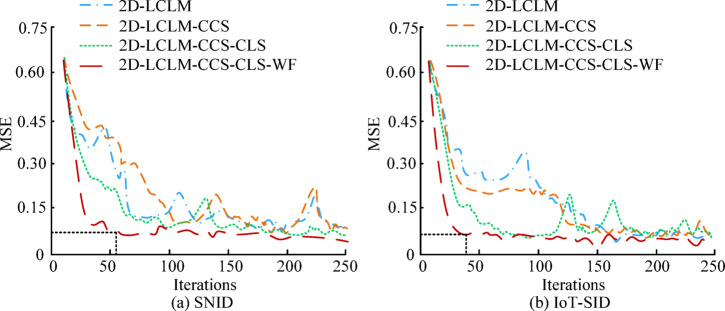
- In ablation tests, the mean square error (MSE) dropped from 0.12 to 0.06 on SNID and from 0.15 to 0.06 on IoT-SID as modules were added, which the authors interpret as improved numerical stability.
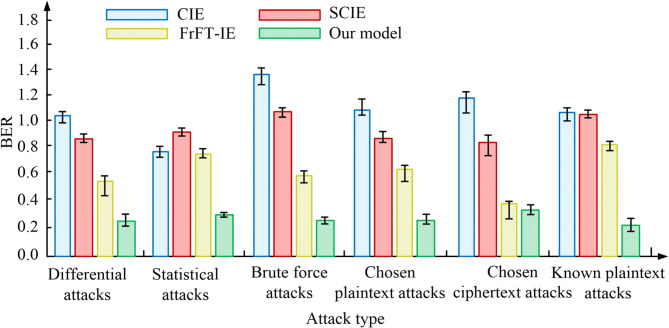
- Under six IoT tampering attacks, the paper reports the BER remained below 0.2 in the abstract and below 0.3 in the results section for some attack types, with the conclusion stating it stayed stable below 0.2 overall.
Methods
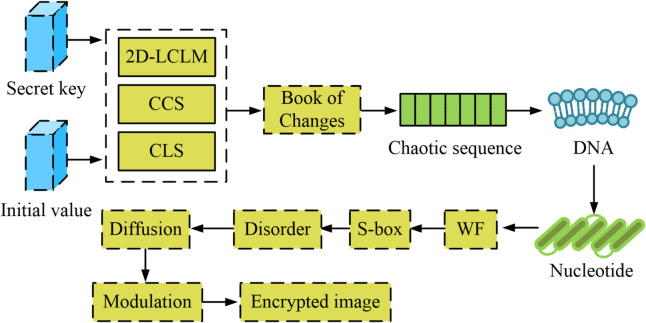
- The study proposes a multi-stage image encryption scheme for IoT that combines an improved 2D-LCLM key-stream generator, CCS and CLS composite chaos, DNA encoding/nucleotide operations, wavelet function (WF) decomposition/reconstruction, dynamic perturbation, and a dynamic S-box.
- Evaluation used SNID (~6500 images) and IoT-SID (~8000 images), plus tests on a Raspberry Pi 4B; experiments were run with Batch Size = 1 on an Intel i9-13900K CPU and RTX 4090 GPU for the main benchmark platform.
- The analysis included hyperparameter selection, ablation experiments, comparisons with methods such as CIE, CSIE, FrFT-IE, DWT-DNA, ChaoticGAN-IE, ACM-IE, and TTSM-IoT, statistical tests (one-way ANOVA, two-tailed t-tests, significance level 0.05), and randomness testing with NIST SP 800-22.
Limitations
- The paper states that the model has slightly higher computational complexity than traditional algorithms and can create efficiency bottlenecks in large-scale data processing or high-frame-rate scenarios.
- It explicitly says deployment validation has not been conducted on real-world resource-limited IoT devices such as Raspberry Pi and Jetson Nano for the main desktop-based experiments; later, Raspberry Pi 4B tests are described, but the text still notes missing instruction-level optimization or parallel acceleration for ARM.
- The paper also notes that performance results are more applicable to edge gateway or small-scale edge server scenarios than to ultra-lightweight terminals, and that further memory optimization and parallel processing are needed in large-scale settings.
Model-written summary of a shortened version of the paper’s full text (it is longer than we read). Check it against the paper before relying on it.
Integrity signals
Registry
Cites
Statistics
Figures
Verification
Claims the paper makes
0 Valid · 2 Not valid · 5 Not checked · 105 Own results and interpretations
A result the paper reports from its own data — it cites no other source for it, so there is none to check. The quote shows it is in the paper.
In the paper
“Under six typical IoT tampering attacks, the bit error rate of the model is consistently maintained below 0.2”
§ Big data information security encryption scheme based on complex chaotic systems in the Internet of Things > Abstract With the increasing demand for image information security in the Internet of Things, traditional encryption methods still have shortcomings in key space, scrambling diffusion coordination, and anti-attack capabilities. A multi-level image encryption model is proposed, which integrates a two-dimensional lagged complex Logistic chaotic system, a complex Chen-Lorenz framework, deoxyribonucleotide bidirectional operation, and wavelet domain decomposition. The model enhances key sensitivity through multi-source chaotic sequences and perturbations from the dynamic perturbation function, achieves nonlinear diffusion in the deoxyribonucleotide domain, and combines wavelet decomposition to improve randomness and robustness. The experimental results demonstrate that the proposed model achieves average encryption and decryption times of approximately 510 ms and 500 ms, respectively. Ablation experiments validate the effectiveness of each submodule from the perspectives of internal state stability and modular synergy. With the integration of composite chaos and dual-domain processing, the root mean square error of intermediate states decreases from 0.12 to 0.06, indicating enhanced numerical stability after multi-module integration. In security testing, the memory consumption for encryption and decryption remains between 250 kb and 500 kb, with the highest value not exceeding 650 kb. Under six typical IoT tampering attacks, the bit error rate of the model is consistently maintained below 0.2, demonstrating superior performance compared to most competing methods. This highlights the ciphertext’s excellent statistical indistinguishability. The overall results have verified the comprehensive improvement of the research method in terms of encryption and decryption efficiency, security, and robustness, and have good application and promotion value in Internet of Things scenarios.
boosted- Asserted: passes — The authors put it forward as true.
- Checkable: passes — It can be checked against evidence.
- Load-bearing: passes — The paper’s conclusions depend on it.
- Based: passes — The paper gives a reason why it holds.
A result the paper reports from its own data — it cites no other source for it, so there is none to check. The quote shows it is in the paper.
In the paper
“The experimental results demonstrate that the proposed model achieves average encryption and decryption times of approximately 510 ms and 500 ms, respectively.”
§ Big data information security encryption scheme based on complex chaotic systems in the Internet of Things > Abstract With the increasing demand for image information security in the Internet of Things, traditional encryption methods still have shortcomings in key space, scrambling diffusion coordination, and anti-attack capabilities. A multi-level image encryption model is proposed, which integrates a two-dimensional lagged complex Logistic chaotic system, a complex Chen-Lorenz framework, deoxyribonucleotide bidirectional operation, and wavelet domain decomposition. The model enhances key sensitivity through multi-source chaotic sequences and perturbations from the dynamic perturbation function, achieves nonlinear diffusion in the deoxyribonucleotide domain, and combines wavelet decomposition to improve randomness and robustness. The experimental results demonstrate that the proposed model achieves average encryption and decryption times of approximately 510 ms and 500 ms, respectively. Ablation experiments validate the effectiveness of each submodule from the perspectives of internal state stability and modular synergy. With the integration of composite chaos and dual-domain processing, the root mean square error of intermediate states decreases from 0.12 to 0.06, indicating enhanced numerical stability after multi-module integration. In security testing, the memory consumption for encryption and decryption remains between 250 kb and 500 kb, with the highest value not exceeding 650 kb. Under six typical IoT tampering attacks, the bit error rate of the model is consistently maintained below 0.2, demonstrating superior performance compared to most competing methods. This highlights the ciphertext’s excellent statistical indistinguishability. The overall results have verified the comprehensive improvement of the research method in terms of encryption and decryption efficiency, security, and robustness, and have good application and promotion value in Internet of Things scenarios.
boosted- Asserted: passes — The authors put it forward as true.
- Checkable: passes — It can be checked against evidence.
- Load-bearing: passes — The paper’s conclusions depend on it.
- Based: passes — The paper gives a reason why it holds.
A result the paper reports from its own data — it cites no other source for it, so there is none to check. The quote shows it is in the paper.
In the paper
“Ablation experiments validate the effectiveness of each submodule from the perspectives of internal state stability and modular synergy.”
§ Big data information security encryption scheme based on complex chaotic systems in the Internet of Things > Abstract With the increasing demand for image information security in the Internet of Things, traditional encryption methods still have shortcomings in key space, scrambling diffusion coordination, and anti-attack capabilities. A multi-level image encryption model is proposed, which integrates a two-dimensional lagged complex Logistic chaotic system, a complex Chen-Lorenz framework, deoxyribonucleotide bidirectional operation, and wavelet domain decomposition. The model enhances key sensitivity through multi-source chaotic sequences and perturbations from the dynamic perturbation function, achieves nonlinear diffusion in the deoxyribonucleotide domain, and combines wavelet decomposition to improve randomness and robustness. The experimental results demonstrate that the proposed model achieves average encryption and decryption times of approximately 510 ms and 500 ms, respectively. Ablation experiments validate the effectiveness of each submodule from the perspectives of internal state stability and modular synergy. With the integration of composite chaos and dual-domain processing, the root mean square error of intermediate states decreases from 0.12 to 0.06, indicating enhanced numerical stability after multi-module integration. In security testing, the memory consumption for encryption and decryption remains between 250 kb and 500 kb, with the highest value not exceeding 650 kb. Under six typical IoT tampering attacks, the bit error rate of the model is consistently maintained below 0.2, demonstrating superior performance compared to most competing methods. This highlights the ciphertext’s excellent statistical indistinguishability. The overall results have verified the comprehensive improvement of the research method in terms of encryption and decryption efficiency, security, and robustness, and have good application and promotion value in Internet of Things scenarios.
plainstates a cause- Asserted: passes — The authors put it forward as true.
- Checkable: passes — It can be checked against evidence.
- Load-bearing: passes — The paper’s conclusions depend on it.
- Based: passes — The paper gives a reason why it holds.
A result the paper reports from its own data — it cites no other source for it, so there is none to check. The quote shows it is in the paper.
In the paper
“With the integration of composite chaos and dual-domain processing, the root mean square error of intermediate states decreases from 0.12 to 0.06”
§ Big data information security encryption scheme based on complex chaotic systems in the Internet of Things > Abstract With the increasing demand for image information security in the Internet of Things, traditional encryption methods still have shortcomings in key space, scrambling diffusion coordination, and anti-attack capabilities. A multi-level image encryption model is proposed, which integrates a two-dimensional lagged complex Logistic chaotic system, a complex Chen-Lorenz framework, deoxyribonucleotide bidirectional operation, and wavelet domain decomposition. The model enhances key sensitivity through multi-source chaotic sequences and perturbations from the dynamic perturbation function, achieves nonlinear diffusion in the deoxyribonucleotide domain, and combines wavelet decomposition to improve randomness and robustness. The experimental results demonstrate that the proposed model achieves average encryption and decryption times of approximately 510 ms and 500 ms, respectively. Ablation experiments validate the effectiveness of each submodule from the perspectives of internal state stability and modular synergy. With the integration of composite chaos and dual-domain processing, the root mean square error of intermediate states decreases from 0.12 to 0.06, indicating enhanced numerical stability after multi-module integration. In security testing, the memory consumption for encryption and decryption remains between 250 kb and 500 kb, with the highest value not exceeding 650 kb. Under six typical IoT tampering attacks, the bit error rate of the model is consistently maintained below 0.2, demonstrating superior performance compared to most competing methods. This highlights the ciphertext’s excellent statistical indistinguishability. The overall results have verified the comprehensive improvement of the research method in terms of encryption and decryption efficiency, security, and robustness, and have good application and promotion value in Internet of Things scenarios.
plainstates a cause- Asserted: passes — The authors put it forward as true.
- Checkable: passes — It can be checked against evidence.
- Load-bearing: passes — The paper’s conclusions depend on it.
- Based: passes — The paper gives a reason why it holds.
A result the paper reports from its own data — it cites no other source for it, so there is none to check. The quote shows it is in the paper.
In the paper
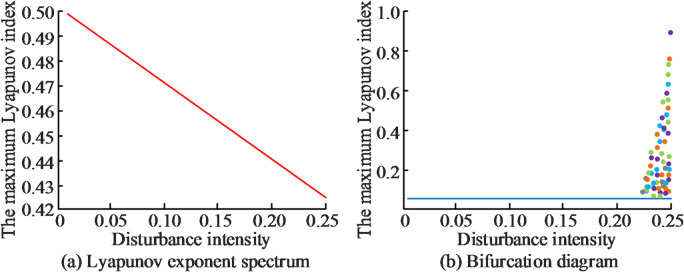
“As illustrated in Fig. 4a, the maximum Lyapunov exponent of the two-dimensional delayed complex Logistic chaotic system remains strictly positive throughout the entire design allowable range of perturbation intensity parameter λ, continuously varying from 0 to 0.25. No segments where the exponent approaches zero or undergoes sign reversal are observed.”
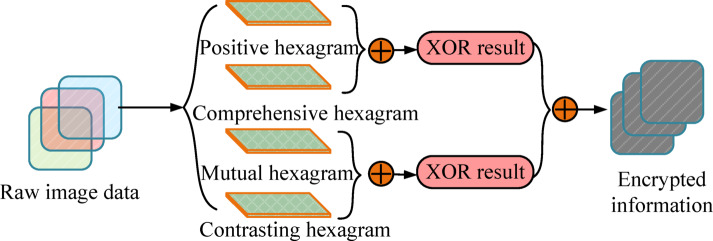
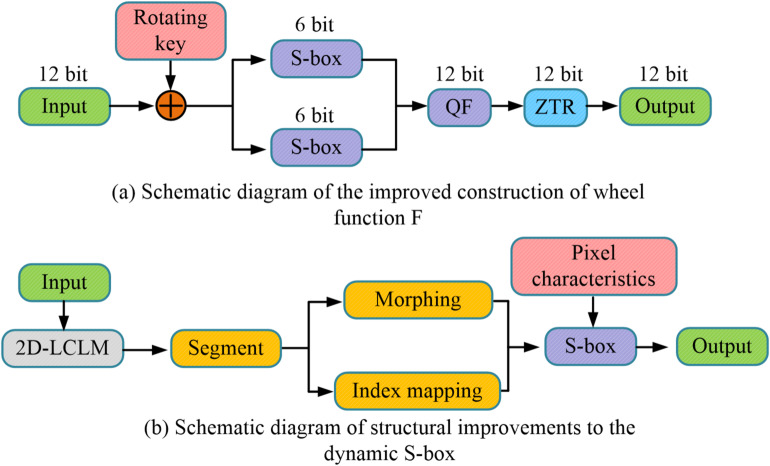
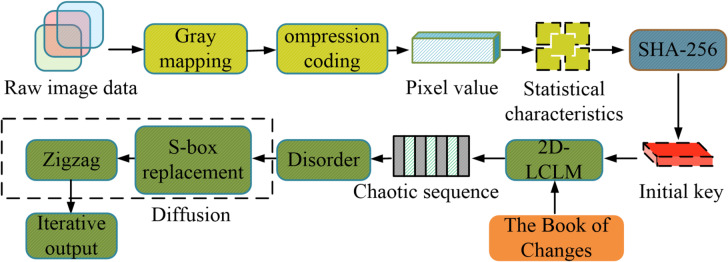
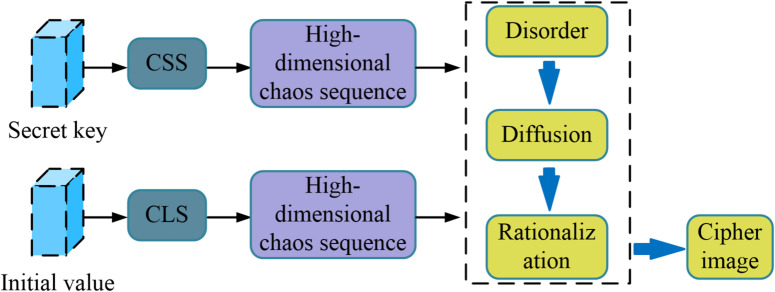
§ Big data information security encryption scheme based on complex chaotic systems in the Internet of Things > Methodology > Design of IoT image encryption algorithm based on improved 2D-LCLM In IoT IE, the chaotic encryption process usually includes four core steps: chaotic sequence generation, pixel scrambling, pixel diffusion, and ciphertext generation. Firstly, a highly random and initial value sensitive key stream is generated through a chaotic system. Then, the spatial position of image pixels is scrambled using this sequence to break the original spatial correlation. Subsequently, global perturbation of pixel grayscale values is combined with diffusion operations to ultimately form a highly secure encrypted image14–16. In this study, the generation of chaotic sequences relies on 2D-LCLM, which introduces complex domain operations and time lag terms on the basis of traditional logistic mapping, and can generate more complex and evenly distributed chaotic trajectories, suitable for application in high security IE scenarios17–19. Assuming the system state variable is in complex form \documentclass[12pt]{minimal} \usepackage{amsmath} \usepackage{wasysym} \usepackage{amsfonts} \usepackage{amssymb} \usepackage{amsbsy} \usepackage{mathrsfs} \usepackage{upgreek} \setlength{\oddsidemargin}{-69pt} \begin{document}$${Z_n}={x_n}+i{y_n}$$\end{document}, its iteration rule is defined as shown in Eq. (1).1\documentclass[12pt]{minimal} \usepackage{amsmath} \usepackage{wasysym} \usepackage{amsfonts} \usepackage{amssymb} \usepackage{amsbsy} \usepackage{mathrsfs} \usepackage{upgreek} \setlength{\oddsidemargin}{-69pt} \begin{document}$${Z_{n+1}}=({\mu _1}{Z_n}(1 - \left| {{Z_{n - \tau }}} \right|)+\alpha {Z_{n - \tau }}){e^{i{\theta _n}}}$$\end{document} In Eq. (1), \documentclass[12pt]{minimal} \usepackage{amsmath} \usepackage{wasysym} \usepackage{amsfonts} \usepackage{amssymb} \usepackage{amsbsy} \usepackage{mathrsfs} \usepackage{upgreek} \setlength{\oddsidemargin}{-69pt} \begin{document}$${Z_n}$$\end{document} means the complex state variable of the nth iteration, which includes the real part \documentclass[12pt]{minimal} \usepackage{amsmath} \usepackage{wasysym} \usepackage{amsfonts} \usepackage{amssymb} \usepackage{amsbsy} \usepackage{mathrsfs} \usepackage{upgreek} \setlength{\oddsidemargin}{-69pt} \begin{document}$${x_n}$$\end{document} and the imaginary part \documentclass[12pt]{minimal} \usepackage{amsmath} \usepackage{wasysym} \usepackage{amsfonts} \usepackage{amssymb} \usepackage{amsbsy} \usepackage{mathrsfs} \usepackage{upgreek} \setlength{\oddsidemargin}{-69pt} \begin{document}$${y_n}$$\end{document}; \documentclass[12pt]{minimal} \usepackage{amsmath} \usepackage{wasysym} \usepackage{amsfonts} \usepackage{amssymb} \usepackage{amsbsy} \usepackage{mathrsfs} \usepackage{upgreek} \setlength{\oddsidemargin}{-69pt} \begin{document}$$\left| {{Z_{n - \tau }}} \right|$$\end{document} represents the modulus of delay \documentclass[12pt]{minimal} \usepackage{amsmath} \usepackage{wasysym} \usepackage{amsfonts} \usepackage{amssymb} \usepackage{amsbsy} \usepackage{mathrsfs} \usepackage{upgreek} \setlength{\oddsidemargin}{-69pt} \begin{document}$$\tau$$\end{document} steps; \documentclass[12pt]{minimal} \usepackage{amsmath} \usepackage{wasysym} \usepackage{amsfonts} \usepackage{amssymb} \usepackage{amsbsy} \usepackage{mathrsfs} \usepackage{upgreek} \setlength{\oddsidemargin}{-69pt} \begin{document}$${Z_{n - \tau }}$$\end{document} represents the conjugate complex with a lag of \documentclass[12pt]{minimal} \usepackage{amsmath} \usepackage{wasysym} \usepackage{amsfonts} \usepackage{amssymb} \usepackage{amsbsy} \usepackage{mathrsfs} \usepackage{upgreek} \setlength{\oddsidemargin}{-69pt} \begin{document}$$\tau$$\end{document} steps; \documentclass[12pt]{minimal} \usepackage{amsmath} \usepackage{wasysym} \usepackage{amsfonts} \usepackage{amssymb} \usepackage{amsbsy} \usepackage{mathrsfs} \usepackage{upgreek} \setlength{\oddsidemargin}{-69pt} \begin{document}$$\alpha$$\end{document} represents the conjugate term adjustment coefficient; \documentclass[12pt]{minimal} \usepackage{amsmath} \usepackage{wasysym} \usepackage{amsfonts} \usepackage{amssymb} \usepackage{amsbsy} \usepackage{mathrsfs} \usepackage{upgreek} \setlength{\oddsidemargin}{-69pt} \begin{document}$${\mu _1}$$\end{document} represents the nonlinear growth control parameter; \documentclass[12pt]{minimal} \usepackage{amsmath} \usepackage{wasysym} \usepackage{amsfonts} \usepackage{amssymb} \usepackage{amsbsy} \usepackage{mathrsfs} \usepackage{upgreek} \setlength{\oddsidemargin}{-69pt} \begin{document}$${\theta _n}$$\end{document} represents the amount of phase disturbance. Among them, the complex field iteration can be divided into a two-dimensional form of real and imaginary parts, as denoted in Eq. (2).2\documentclass[12pt]{minimal} \usepackage{amsmath} \usepackage{wasysym} \usepackage{amsfonts} \usepackage{amssymb} \usepackage{amsbsy} \usepackage{mathrsfs} \usepackage{upgreek} \setlength{\oddsidemargin}{-69pt} \begin{document}$$\left\{ {\begin{array}{*{20}{c}} {{x_{n+1}}={\mu _1}{x_n}(1 - {x_{n - \tau }}) - {\lambda _{1}}{y_{n - \tau }}+\alpha \cos ({\theta _n})} \\ {{y_{n+1}}={\mu _2}{y_n}(1 - {y_{n - \tau }})+{\lambda _2}{x_{n - \tau }}+\alpha \sin ({\theta _\partial })} \end{array}} \right.$$\end{document} In Eq. (2), \documentclass[12pt]{minimal} \usepackage{amsmath} \usepackage{wasysym} \usepackage{amsfonts} \usepackage{amssymb} \usepackage{amsbsy} \usepackage{mathrsfs} \usepackage{upgreek} \setlength{\oddsidemargin}{-69pt} \begin{document}$${\mu _1}$$\end{document} and \documentclass[12pt]{minimal} \usepackage{amsmath} \usepackage{wasysym} \usepackage{amsfonts} \usepackage{amssymb} \usepackage{amsbsy} \usepackage{mathrsfs} \usepackage{upgreek} \setlength{\oddsidemargin}{-69pt} \begin{document}$${\mu _2}$$\end{document} represent the components of nonlinear gain \documentclass[12pt]{minimal} \usepackage{amsmath} \usepackage{wasysym} \usepackage{amsfonts} \usepackage{amssymb} \usepackage{amsbsy} \usepackage{mathrsfs} \usepackage{upgreek} \setlength{\oddsidemargin}{-69pt} \begin{document}$$\mu$$\end{document} in the x and y directions; \documentclass[12pt]{minimal} \usepackage{amsmath} \usepackage{wasysym} \usepackage{amsfonts} \usepackage{amssymb} \usepackage{amsbsy} \usepackage{mathrsfs} \usepackage{upgreek} \setlength{\oddsidemargin}{-69pt} \begin{document}$${\lambda _{1}}$$\end{document} and \documentclass[12pt]{minimal} \usepackage{amsmath} \usepackage{wasysym} \usepackage{amsfonts} \usepackage{amssymb} \usepackage{amsbsy} \usepackage{mathrsfs} \usepackage{upgreek} \setlength{\oddsidemargin}{-69pt} \begin{document}$${\lambda _2}$$\end{document} denote the distribution of hysteresis coupling strength across the two dimensions; a signifies the rotational disturbance parameter, corresponding to the amplitude coefficient of \documentclass[12pt]{minimal} \usepackage{amsmath} \usepackage{wasysym} \usepackage{amsfonts} \usepackage{amssymb} \usepackage{amsbsy} \usepackage{mathrsfs} \usepackage{upgreek} \setlength{\oddsidemargin}{-69pt} \begin{document}$$\alpha$$\end{document}. Therefore, Eq. (2) can be regarded as a real-imaginary coupling model derived from the complex-domain expansion of Eq. (1), rather than an independently defined new system. Although 2D-LCLM has advantages in sequence complexity and key space, it is prone to local chaotic decay during long sequence generation, and fixed parameters pose a risk of being speculated under certain conditions20–22. To this end, the study introduces a dynamic parameter adjustment mechanism based on symbolic matrix mapping within the parameter perturbation design. This mechanism centers on a lookup table set comprising 64 logical perturbation patterns. It randomly selects perturbation patterns through index sequences to simulate the multi-path mapping concept from traditional philosophical ideas of “change,” yet fundamentally operates as a data-driven process for generating random perturbation matrices23–25. Consequently, the research is entirely grounded in formal mathematical modeling and reproducible logical implementation, involving no unscientific or esoteric concepts whatsoever. Let the perturbation index space be denoted as \documentclass[12pt]{minimal} \usepackage{amsmath} \usepackage{wasysym} \usepackage{amsfonts} \usepackage{amssymb} \usepackage{amsbsy} \usepackage{mathrsfs} \usepackage{upgreek} \setlength{\oddsidemargin}{-69pt} \begin{document}$$S=\{ {S_1},{S_2},...,{S_{64}}\}$$\end{document}, where each \documentclass[12pt]{minimal} \usepackage{amsmath} \usepackage{wasysym} \usepackage{amsfonts} \usepackage{amssymb} \usepackage{amsbsy} \usepackage{mathrsfs} \usepackage{upgreek} \setlength{\oddsidemargin}{-69pt} \begin{document}$${S_i}$$\end{document} represents an 8 × 8 binary perturbation template generated by the pseudorandom function \documentclass[12pt]{minimal} \usepackage{amsmath} \usepackage{wasysym} \usepackage{amsfonts} \usepackage{amssymb} \usepackage{amsbsy} \usepackage{mathrsfs} \usepackage{upgreek} \setlength{\oddsidemargin}{-69pt} \begin{document}$${f_{PRNG}}(seed,i)$$\end{document}. This pseudorandom function employs the Mersenne Twister algorithm, with its seed derived from the hash result of the initial key \documentclass[12pt]{minimal} \usepackage{amsmath} \usepackage{wasysym} \usepackage{amsfonts} \usepackage{amssymb} \usepackage{amsbsy} \usepackage{mathrsfs} \usepackage{upgreek} \setlength{\oddsidemargin}{-69pt} \begin{document}$${K_0}$$\end{document}, denoted as \documentclass[12pt]{minimal} \usepackage{amsmath} \usepackage{wasysym} \usepackage{amsfonts} \usepackage{amssymb} \usepackage{amsbsy} \usepackage{mathrsfs} \usepackage{upgreek} \setlength{\oddsidemargin}{-69pt} \begin{document}$$seed=SHA256({K_0})$$\end{document}. Consequently, each perturbation template \documentclass[12pt]{minimal} \usepackage{amsmath} \usepackage{wasysym} \usepackage{amsfonts} \usepackage{amssymb} \usepackage{amsbsy} \usepackage{mathrsfs} \usepackage{upgreek} \setlength{\oddsidemargin}{-69pt} \begin{document}$${S_i}$$\end{document} can be reproducibly generated from a given key. In each encryption iteration, select the perturbation matrix index \documentclass[12pt]{minimal} \usepackage{amsmath} \usepackage{wasysym} \usepackage{amsfonts} \usepackage{amssymb} \usepackage{amsbsy} \usepackage{mathrsfs} \usepackage{upgreek} \setlength{\oddsidemargin}{-69pt} \begin{document}$${i_t}$$\end{document}, denoted as \documentclass[12pt]{minimal} \usepackage{amsmath} \usepackage{wasysym} \usepackage{amsfonts} \usepackage{amssymb} \usepackage{amsbsy} \usepackage{mathrsfs} \usepackage{upgreek} \setlength{\oddsidemargin}{-69pt} \begin{document}$${i_t}=(\left[ {{{10}^5} \times \left| {{x_t}} \right.} \right]mod64)+1$$\end{document}. Here, \documentclass[12pt]{minimal} \usepackage{amsmath} \usepackage{wasysym} \usepackage{amsfonts} \usepackage{amssymb} \usepackage{amsbsy} \usepackage{mathrsfs} \usepackage{upgreek} \setlength{\oddsidemargin}{-69pt} \begin{document}$${x_t}$$\end{document} represents the current real part of the 2D-LCLM system. Subsequently, define the chaotic parameter update \documentclass[12pt]{minimal} \usepackage{amsmath} \usepackage{wasysym} \usepackage{amsfonts} \usepackage{amssymb} \usepackage{amsbsy} \usepackage{mathrsfs} \usepackage{upgreek} \setlength{\oddsidemargin}{-69pt} \begin{document}$${\alpha _{t+1}}={\alpha _t} \cdot (1+\upsilon \cdot mean({S_{{i_t}}}))+{\epsilon _t}$$\end{document}. Here, \documentclass[12pt]{minimal} \usepackage{amsmath} \usepackage{wasysym} \usepackage{amsfonts} \usepackage{amssymb} \usepackage{amsbsy} \usepackage{mathrsfs} \usepackage{upgreek} \setlength{\oddsidemargin}{-69pt} \begin{document}$$\upsilon$$\end{document} is the perturbation strength coefficient, and \documentclass[12pt]{minimal} \usepackage{amsmath} \usepackage{wasysym} \usepackage{amsfonts} \usepackage{amssymb} \usepackage{amsbsy} \usepackage{mathrsfs} \usepackage{upgreek} \setlength{\oddsidemargin}{-69pt} \begin{document}$${\epsilon _t}$$\end{document} is the Gaussian white noise term. The pseudocode for the perturbation mechanism is as follows: To enhance the reproducibility of the algorithm, key implementation details and parameter specifications are further elaborated. For the two-dimensional delayed complex Logistic chaotic system (2D-LCLM), the control parameters α and β are set within the ranges α∈[3.6,4.0] and β∈[0.2,0.9], respectively, while the phase perturbation parameter λ ranges from [0.6,0.8]. The parameter configurations for the complex Chen system (CCS) and complex Lorenz system (CLS) adhere to their standard chaotic state ranges, with consistent parameter combinations maintained throughout experiments. All chaotic systems’ initial conditions are generated via SHA-256 hash mapping of a 256-bit master key, with precision maintained at 10− 14 to ensure initial value sensitivity. To eliminate transient effects, the three-channel chaotic system undergoes 1,000 iterations of Ttrans prior to formal encryption participation, with outputs discarded during this phase. Subsequent valid iterations match the image pixel count. These settings remain consistent across all experiments. The encryption rules are shown in Fig. 1. As shown in Fig. 1, this scheme employs symbol matrix perturbations to define multi-directional logical operation paths (vertical, horizontal, cross, etc.) for logically scrambling image data. The results from each path are then XOR-diffused with the chaotic key stream generated by 2D-LCLM, achieving pixel-level perturbation. Subsequently, the results of each path operation are XORed diffused with the chaotic key stream generated by the improved 2D-LCLM to achieve pixel level perturbation. Finally, the diffusion results of multiple paths are fused again to form a globally encrypted ciphertext image26,27. For ease of understanding, the study considers the original image as the element set S, the chaotic key stream as the perturbation set K, and the symbolic perturbation index change rules correspond to the mapping operator set \documentclass[12pt]{minimal} \usepackage{amsmath} \usepackage{wasysym} \usepackage{amsfonts} \usepackage{amssymb} \usepackage{amsbsy} \usepackage{mathrsfs} \usepackage{upgreek} \setlength{\oddsidemargin}{-69pt} \begin{document}$$\Phi =\{ \phi 1,\phi 2,...\}$$\end{document}. The results of operations on different paths can be abstracted as \documentclass[12pt]{minimal} \usepackage{amsmath} \usepackage{wasysym} \usepackage{amsfonts} \usepackage{amssymb} \usepackage{amsbsy} \usepackage{mathrsfs} \usepackage{upgreek} \setlength{\oddsidemargin}{-69pt} \begin{document}$${\phi _i}(S)$$\end{document}, which is combined with K perturbations to form a new set, and then the ciphertext is generated through a fusion operator. At this point, in the 2D-LCLM system perturbed by the dynamic perturbation function, the improvement of its round function F and dynamic S-box construction is shown in Fig. 2. Figure 2a,b are schematic diagrams of the improved construction of the wheel function F and the dynamic S-box. As shown in Fig. 2a, first is to perform bitwise XOR operation between the input 12 bit data and the round key \documentclass[12pt]{minimal} \usepackage{amsmath} \usepackage{wasysym} \usepackage{amsfonts} \usepackage{amssymb} \usepackage{amsbsy} \usepackage{mathrsfs} \usepackage{upgreek} \setlength{\oddsidemargin}{-69pt} \begin{document}$${k_r}$$\end{document} to achieve preliminary key injection; Subsequently, the results are divided into two parts based on the high 6 bits and low 6 bits, and input into independent S-boxes for nonlinear substitution to enhance confusion and resistance to differential analysis. The two S-box outputs are recombined into 12 bit data, and further permutation and mixing operations are performed through a Quasi-Feistel Mixing (QF) module. Finally, a linear transformation is performed through a Zigzag-Transpose-Rotation (ZTR) module to output the encrypted result. As shown in Fig. 2b, firstly, the chaotic sequence is segmented according to a specified length, and each segment of data is subjected to modular operation and index mapping, mapping it to the initial S-box template to obtain nonlinear alternatives corresponding to different rounds; Secondly, to increase dynamism, the generation of S-boxes in each round not only relies on the current state of the chaotic sequence, but also introduces the pixel statistical characteristics of the previous round’s output as disturbance factors, making the mapping relationship of S-boxes adaptively changing in time. The improved key injection and dynamic masking are shown in Eq. (3).3\documentclass[12pt]{minimal} \usepackage{amsmath} \usepackage{wasysym} \usepackage{amsfonts} \usepackage{amssymb} \usepackage{amsbsy} \usepackage{mathrsfs} \usepackage{upgreek} \setlength{\oddsidemargin}{-69pt} \begin{document}$${U^{(r)}}={X^{(r)}} \oplus R{K^{(r)}} \oplus ROL({M^{(r)}},{s^{(r)}})$$\end{document} In Eq. (3), \documentclass[12pt]{minimal} \usepackage{amsmath} \usepackage{wasysym} \usepackage{amsfonts} \usepackage{amssymb} \usepackage{amsbsy} \usepackage{mathrsfs} \usepackage{upgreek} \setlength{\oddsidemargin}{-69pt} \begin{document}$${X^{(r)}}$$\end{document} represents the input of 12 bit plaintext in the current round; \documentclass[12pt]{minimal} \usepackage{amsmath} \usepackage{wasysym} \usepackage{amsfonts} \usepackage{amssymb} \usepackage{amsbsy} \usepackage{mathrsfs} \usepackage{upgreek} \setlength{\oddsidemargin}{-69pt} \begin{document}$$R{K^{(r)}}$$\end{document} represents a 12 bit round key for the current round; \documentclass[12pt]{minimal} \usepackage{amsmath} \usepackage{wasysym} \usepackage{amsfonts} \usepackage{amssymb} \usepackage{amsbsy} \usepackage{mathrsfs} \usepackage{upgreek} \setlength{\oddsidemargin}{-69pt} \begin{document}$${M^{(r)}}$$\end{document} denotes the 12-bit mask jointly generated by 2D-LCLM and the symbol perturbation index; \documentclass[12pt]{minimal} \usepackage{amsmath} \usepackage{wasysym} \usepackage{amsfonts} \usepackage{amssymb} \usepackage{amsbsy} \usepackage{mathrsfs} \usepackage{upgreek} \setlength{\oddsidemargin}{-69pt} \begin{document}$$ROL$$\end{document} stands for cycle left shift; \documentclass[12pt]{minimal} \usepackage{amsmath} \usepackage{wasysym} \usepackage{amsfonts} \usepackage{amssymb} \usepackage{amsbsy} \usepackage{mathrsfs} \usepackage{upgreek} \setlength{\oddsidemargin}{-69pt} \begin{document}$${s^{(r)}}$$\end{document} denotes the displacement amount generated by the symbol mapping table; \documentclass[12pt]{minimal} \usepackage{amsmath} \usepackage{wasysym} \usepackage{amsfonts} \usepackage{amssymb} \usepackage{amsbsy} \usepackage{mathrsfs} \usepackage{upgreek} \setlength{\oddsidemargin}{-69pt} \begin{document}$$\oplus$$\end{document} stands for bitwise XOR. The improved dynamic S-box generation and selection are shown in Eq. (4).4\documentclass[12pt]{minimal} \usepackage{amsmath} \usepackage{wasysym} \usepackage{amsfonts} \usepackage{amssymb} \usepackage{amsbsy} \usepackage{mathrsfs} \usepackage{upgreek} \setlength{\oddsidemargin}{-69pt} \begin{document}$${S^{(r)}}(a)={S_0}(a \oplus {\pi ^{(r)}}(a)) \oplus {\sigma ^{(r)}},{\pi ^{(r)}}(i)=(i \oplus \eta _{i}^{{(r)}}) \otimes {\rho ^{(r)}}\bmod 64$$\end{document} In Eq. (4), \documentclass[12pt]{minimal} \usepackage{amsmath} \usepackage{wasysym} \usepackage{amsfonts} \usepackage{amssymb} \usepackage{amsbsy} \usepackage{mathrsfs} \usepackage{upgreek} \setlength{\oddsidemargin}{-69pt} \begin{document}$${S_0}$$\end{document} represents the initial S-box template of 6 → 6; \documentclass[12pt]{minimal} \usepackage{amsmath} \usepackage{wasysym} \usepackage{amsfonts} \usepackage{amssymb} \usepackage{amsbsy} \usepackage{mathrsfs} \usepackage{upgreek} \setlength{\oddsidemargin}{-69pt} \begin{document}$${S^{(r)}}$$\end{document} represents the dynamic S-box of the current round; a represents a 6-bit branch input; \documentclass[12pt]{minimal} \usepackage{amsmath} \usepackage{wasysym} \usepackage{amsfonts} \usepackage{amssymb} \usepackage{amsbsy} \usepackage{mathrsfs} \usepackage{upgreek} \setlength{\oddsidemargin}{-69pt} \begin{document}$${\pi ^{(r)}}$$\end{document} represents wheel level permutation for index \documentclass[12pt]{minimal} \usepackage{amsmath} \usepackage{wasysym} \usepackage{amsfonts} \usepackage{amssymb} \usepackage{amsbsy} \usepackage{mathrsfs} \usepackage{upgreek} \setlength{\oddsidemargin}{-69pt} \begin{document}$$i \in [0,63]$$\end{document}; \documentclass[12pt]{minimal} \usepackage{amsmath} \usepackage{wasysym} \usepackage{amsfonts} \usepackage{amssymb} \usepackage{amsbsy} \usepackage{mathrsfs} \usepackage{upgreek} \setlength{\oddsidemargin}{-69pt} \begin{document}$$\eta _{i}^{{(r)}}$$\end{document} represents the index perturbation obtained by concatenating adjacent samples in 2D-LCLM and compressing them through hashing; \documentclass[12pt]{minimal} \usepackage{amsmath} \usepackage{wasysym} \usepackage{amsfonts} \usepackage{amssymb} \usepackage{amsbsy} \usepackage{mathrsfs} \usepackage{upgreek} \setlength{\oddsidemargin}{-69pt} \begin{document}$${\rho ^{(r)}}$$\end{document} denotes the cyclic offset generated by the symbol perturbation index; \documentclass[12pt]{minimal} \usepackage{amsmath} \usepackage{wasysym} \usepackage{amsfonts} \usepackage{amssymb} \usepackage{amsbsy} \usepackage{mathrsfs} \usepackage{upgreek} \setlength{\oddsidemargin}{-69pt} \begin{document}$${\sigma ^{(r)}}$$\end{document} represents the current round of 6-bit masking; \documentclass[12pt]{minimal} \usepackage{amsmath} \usepackage{wasysym} \usepackage{amsfonts} \usepackage{amssymb} \usepackage{amsbsy} \usepackage{mathrsfs} \usepackage{upgreek} \setlength{\oddsidemargin}{-69pt} \begin{document}$$\otimes$$\end{document} represents modulus 64 plus. The cross diffusion of QF quasi Feistel mixture is shown in Eq. (5).5\documentclass[12pt]{minimal} \usepackage{amsmath} \usepackage{wasysym} \usepackage{amsfonts} \usepackage{amssymb} \usepackage{amsbsy} \usepackage{mathrsfs} \usepackage{upgreek} \setlength{\oddsidemargin}{-69pt} \begin{document}$$\left[ {\begin{array}{*{20}{c}} {L'} \\ {R'} \end{array}} \right]=\left[ {\begin{array}{*{20}{c}} 1&{{\kappa ^{(r)}}} \\ {{\kappa ^{(r)}}}&1 \end{array}} \right] * \left[ {\begin{array}{*{20}{c}} L \\ R \end{array}} \right] \oplus {P^{(r)}}(L\left\| R \right.)$$\end{document} In Eq. (5), L and R represent the two 6 bits behind the S box; \documentclass[12pt]{minimal} \usepackage{amsmath} \usepackage{wasysym} \usepackage{amsfonts} \usepackage{amssymb} \usepackage{amsbsy} \usepackage{mathrsfs} \usepackage{upgreek} \setlength{\oddsidemargin}{-69pt} \begin{document}$$*$$\end{document} represents multiplication and addition over Galois Field (GF) (26); \documentclass[12pt]{minimal} \usepackage{amsmath} \usepackage{wasysym} \usepackage{amsfonts} \usepackage{amssymb} \usepackage{amsbsy} \usepackage{mathrsfs} \usepackage{upgreek} \setlength{\oddsidemargin}{-69pt} \begin{document}$${\kappa ^{(r)}}$$\end{document} denotes the coupling coefficient obtained from the symbol perturbation index mapping; \documentclass[12pt]{minimal} \usepackage{amsmath} \usepackage{wasysym} \usepackage{amsfonts} \usepackage{amssymb} \usepackage{amsbsy} \usepackage{mathrsfs} \usepackage{upgreek} \setlength{\oddsidemargin}{-69pt} \begin{document}$${P^{(r)}}$$\end{document} represents the current round permutation of 12 bit serial \documentclass[12pt]{minimal} \usepackage{amsmath} \usepackage{wasysym} \usepackage{amsfonts} \usepackage{amssymb} \usepackage{amsbsy} \usepackage{mathrsfs} \usepackage{upgreek} \setlength{\oddsidemargin}{-69pt} \begin{document}$$L\left\| R \right.$$\end{document}; \documentclass[12pt]{minimal} \usepackage{amsmath} \usepackage{wasysym} \usepackage{amsfonts} \usepackage{amssymb} \usepackage{amsbsy} \usepackage{mathrsfs} \usepackage{upgreek} \setlength{\oddsidemargin}{-69pt} \begin{document}$$L'$$\end{document} and \documentclass[12pt]{minimal} \usepackage{amsmath} \usepackage{wasysym} \usepackage{amsfonts} \usepackage{amssymb} \usepackage{amsbsy} \usepackage{mathrsfs} \usepackage{upgreek} \setlength{\oddsidemargin}{-69pt} \begin{document}$$R'$$\end{document} respectively represent the two outputs of QF. The level rearrangement and rotation of ZTR linear diffusion are shown in Eq. (6).6\documentclass[12pt]{minimal} \usepackage{amsmath} \usepackage{wasysym} \usepackage{amsfonts} \usepackage{amssymb} \usepackage{amsbsy} \usepackage{mathrsfs} \usepackage{upgreek} \setlength{\oddsidemargin}{-69pt} \begin{document}$${Y^{(r)}}=RO{T_{\rho (r)}}(TRANS(ZIGZAG({W^{(r)}}) \oplus {\nu ^{(r)}}))$$\end{document} In Eq. (6), \documentclass[12pt]{minimal} \usepackage{amsmath} \usepackage{wasysym} \usepackage{amsfonts} \usepackage{amssymb} \usepackage{amsbsy} \usepackage{mathrsfs} \usepackage{upgreek} \setlength{\oddsidemargin}{-69pt} \begin{document}$${Y^{(r)}}$$\end{document} represents the 12 bit data output by the ZTR module; \documentclass[12pt]{minimal} \usepackage{amsmath} \usepackage{wasysym} \usepackage{amsfonts} \usepackage{amssymb} \usepackage{amsbsy} \usepackage{mathrsfs} \usepackage{upgreek} \setlength{\oddsidemargin}{-69pt} \begin{document}$${W^{(r)}}$$\end{document} represents the output data of the QF module; \documentclass[12pt]{minimal} \usepackage{amsmath} \usepackage{wasysym} \usepackage{amsfonts} \usepackage{amssymb} \usepackage{amsbsy} \usepackage{mathrsfs} \usepackage{upgreek} \setlength{\oddsidemargin}{-69pt} \begin{document}$${\nu ^{(r)}}$$\end{document} represents dynamic bit mask; \documentclass[12pt]{minimal} \usepackage{amsmath} \usepackage{wasysym} \usepackage{amsfonts} \usepackage{amssymb} \usepackage{amsbsy} \usepackage{mathrsfs} \usepackage{upgreek} \setlength{\oddsidemargin}{-69pt} \begin{document}$$ZIGZAG$$\end{document} stands for Z-shaped path scanning and rearrangement operation; \documentclass[12pt]{minimal} \usepackage{amsmath} \usepackage{wasysym} \usepackage{amsfonts} \usepackage{amssymb} \usepackage{amsbsy} \usepackage{mathrsfs} \usepackage{upgreek} \setlength{\oddsidemargin}{-69pt} \begin{document}$$ROT$$\end{document} represents cyclic rotation operation; \documentclass[12pt]{minimal} \usepackage{amsmath} \usepackage{wasysym} \usepackage{amsfonts} \usepackage{amssymb} \usepackage{amsbsy} \usepackage{mathrsfs} \usepackage{upgreek} \setlength{\oddsidemargin}{-69pt} \begin{document}$$TRANS$$\end{document} represents matrix transposition operation. Finally, the parameters of the symbolic perturbation index chaotic mapping are unified as shown in Eq. (7).7\documentclass[12pt]{minimal} \usepackage{amsmath} \usepackage{wasysym} \usepackage{amsfonts} \usepackage{amssymb} \usepackage{amsbsy} \usepackage{mathrsfs} \usepackage{upgreek} \setlength{\oddsidemargin}{-69pt} \begin{document}$$({s^{(r)}},{\rho ^{(r)}},{\kappa ^{(r)}},{\sigma ^{(r)}},{\nu ^{(r)}})=M({H^{(r)}},2D - LCLM~Status)$$\end{document} In Eq. (7), \documentclass[12pt]{minimal} \usepackage{amsmath} \usepackage{wasysym} \usepackage{amsfonts} \usepackage{amssymb} \usepackage{amsbsy} \usepackage{mathrsfs} \usepackage{upgreek} \setlength{\oddsidemargin}{-69pt} \begin{document}$${H^{(r)}}$$\end{document} represents the index of the current round of symbolic perturbation indexs; M represents the mapping parameters from symbolic perturbation indexs to chaotic states. From this, based on the ideas of the dynamic perturbation function, an improved 2D-LCLM IoT IE algorithm is proposed, and its process is shown in Fig. 3. In Fig. 3, the process of the improved 2D-LCLM IoT IE algorithm includes four main stages: input preprocessing, chaotic sequence generation, scrambling diffusion, and ciphertext output. Firstly, the original image undergoes grayscale mapping and compression encoding, extracting pixel values and calculating their statistical features, combined with hash operations to generate initial key parameters. Subsequently, an improved 2D-LCLM incorporating the perturbation concept from the dynamic perturbation function is utilized to generate high-dimensional chaotic sequences, and the pixel positions are globally dispersed through a scrambling module. The scrambled data enters the diffusion stage, where it undergoes initial rounds of key injection and dynamic S-box substitution, followed by Zigzag rearrangement and ZTR linear diffusion to achieve multi-level mixing at the bit and byte levels. Finally, after multiple iterations, the output is a ciphertext image, achieving high-strength encryption of large-scale image data in IoT scenarios. While dynamic perturbation mechanisms can enhance parameter time-varying properties and key sensitivity, improper control of perturbation amplitude may theoretically push system parameters into non-chaos regions, thereby triggering weak key risks. To validate the stability of system dynamics within the perturbation parameter range established in this study, we conducted systematic Lyapunov exponent verification analysis on a two-dimensional delayed complex Logistic chaotic system under dynamic perturbation. As shown in Table 1.
plain- Asserted: passes — The authors put it forward as true.
- Checkable: passes — It can be checked against evidence.
- Load-bearing: passes — The paper’s conclusions depend on it.
- Based: passes — The paper gives a reason why it holds.
58 more claims
Create a free account to see all 112 claims and every source verdict.
- It may state two separate claims as one. 42
- Probably not a substantial claim. 9
- The quote only partly states this claim. 1
Self-check
Percentages, sums and reported differences re-computed from the paper’s own numbers.
Each contradiction between two passages listed here was confirmed by an independent check.
Rated major: it would touch a result — a value a result rests on, reported and recomputed p-values on opposite sides of the significance level, two passages that conflict with no sign which is right, or a cited work retracted before this paper was published.
In the paper
§ Big data information security encryption scheme based on complex chaotic systems in the Internet of Things > Conclusion
“deployment validation has not been conducted on real-world resource-limited IoT devices such as Raspberry Pi.”
§ Big data information security encryption scheme based on complex chaotic systems in the Internet of Things > Results and analysis > Simulation testing of a new IoT image encryption strategy model
“To further validate the proposed algorithm’s operational feasibility on real-world IoT devices, this study conducted experiments using the Raspberry Pi 4B as a representative embedded platform.”
Rated major: it would touch a result — a value a result rests on, reported and recomputed p-values on opposite sides of the significance level, two passages that conflict with no sign which is right, or a cited work retracted before this paper was published.
In the paper
§ Big data information security encryption scheme based on complex chaotic systems in the Internet of Things > Conclusion
“On the SNID and IoT-SID datasets, the model’s average encryption/decryption time was controlled within approximately 300 ms.”
§ Big data information security encryption scheme based on complex chaotic systems in the Internet of Things > Abstract
“The experimental results demonstrate that the proposed model achieves average encryption and decryption times of approximately 510 ms and 500 ms, respectively.”
Rated major: it would touch a result — a value a result rests on, reported and recomputed p-values on opposite sides of the significance level, two passages that conflict with no sign which is right, or a cited work retracted before this paper was published.
In the paper
§ Big data information security encryption scheme based on complex chaotic systems in the Internet of Things > Abstract
“The experimental results demonstrate that the proposed model achieves average encryption and decryption times of approximately 510 ms and 500 ms, respectively.”
§ Big data information security encryption scheme based on complex chaotic systems in the Internet of Things > Conclusion
“On the SNID and IoT-SID datasets, the model’s average encryption/decryption time was controlled within approximately 300 ms.”
Rated minor: it would not touch a result — a value no result rests on, a p-value that stays on the same side of the significance level, or a conflict that is clerical, resolved elsewhere in the paper, or outside its own findings.
In the paper
§ Big data information security encryption scheme based on complex chaotic systems in the Internet of Things > Conclusion
“The experimental results of the ablation demonstrate that the MSE decreases from 0.12 to 0.06 with the introduction of WF domain multi-scale decomposition and dynamic S-box module”
§ Big data information security encryption scheme based on complex chaotic systems in the Internet of Things > Results and analysis > Performance testing of a new IoT image encryption strategy model
“The complete strategy achieved an MSE reduction of about 60% to 65% on both datasets compared to the basic model, fully demonstrating the effectiveness of the composite chaos mechanism in improving model accuracy and robustness.”
Citations
Cites
Sun, J., Li, C., Wang, Z., & Wang, Y. (2024) · IEEE Transactions on Industrial Informatics · doi:10.1109/tii.2023.3312405 · Cited by 172 · cited 1×
“On the other hand, CLS exhibits stable global chaos and excellent traversal under multi-parameter conditions, which can effectively compensate for the shortcomings of CCS in local phase space distribution 29,30 .”
Self-citationEvaluation of Deep Learning CNN Model for Recognition of Devanagari Digit
Bhosle, K., & Musande, V. B. (2023) · Artificial Intelligence and Applications · doi:10.47852/bonviewaia3202441 · Cited by 167
A chaotic based image encryption scheme using elliptic curve cryptography and genetic algorithm
Kumar, S., & Sharma, D. (2024) · Artificial Intelligence Review · doi:10.1007/s10462-024-10719-0 · Cited by 167
A novel chaos-based permutation for image encryption
Alawida, M. (2023) · Journal of King Saud University - Computer and Information Sciences · doi:10.1016/j.jksuci.2023.101595 · Cited by 115
Meaningful image encryption algorithm based on compressive sensing and integer wavelet transform
Huang, X., Dong, Y., Ye, G., & Shi, Y. (2022) · Frontiers of Computer Science · doi:10.1007/s11704-022-1419-8 · Cited by 105 · cited 1×
“The findings denoted that the algorithm had high efficiency and effectiveness in encrypting images with large amounts of data 3 .”
Wang, X., Xu, X., Sun, K., Jiang, Z., Li, M., & Wen, J. (2023) · Nonlinear Dynamics · doi:10.1007/s11071-023-08538-z · Cited by 103 · cited 1×
“…generation of chaotic sequences relies on 2D-LCLM, which introduces complex domain operations and time lag terms on the basis of traditional logistic mapping, and can generate more complex and evenly distributed chaotic trajectories, suitable for application in high security IE scenarios 17–19 .”
A survey of image encryption algorithms based on chaotic system
Fang, P., Liu, H., Wu, C., & Liu, M. (2023) · The Visual Computer · doi:10.1007/s00371-022-02459-5 · Cited by 97
A novel color image encryption method based on new three-dimensional chaotic mapping and DNA coding
Yan, X., Hu, Q., & Teng, L. (2025) · Nonlinear Dynamics · doi:10.1007/s11071-024-10277-8 · Cited by 93 · cited 1×
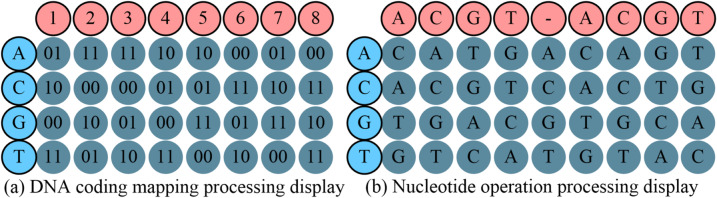
“In the DNA domain, each pixel’s 8-bit value is grouped and mapped to four bases {A, T, C, G}, with eight encoding rules R j,j ∈ [1 , 8] .”
A Novel Image Encryption Algorithm Based on Cyclic Chaotic Map in Industrial IoT Environments
Alawida, M. (2024) · IEEE Transactions on Industrial Informatics · doi:10.1109/tii.2024.3395631 · Cited by 91
An image encryption algorithm based on 6-dimensional hyper chaotic system and DNA encoding
Li, Q., & Chen, L. (2024) · Multimedia Tools and Applications · doi:10.1007/s11042-023-15550-3 · Cited by 86 · cited 1×
“Specific encoding and operation rules can refer to the standard definitions provided in references 5,6,23 , and the implementation in this paper strictly adheres to these rules.”
Metadata
- Authors
- Liang, L., Lou, L., Wang, M., Xu, Y., Liu, C., & Li, C.
- Affiliations
- Henan Provincial Chest Hospital (CN)
- Corresponding author
- Liang, Lili
- Venue
- Scientific Reports
- Published
- 2026-05-09
- Volume
- 16
- Issue
- 1
- ISSN
- 2045-2322 (ISSN-L)
- PMC
- PMC13346895
- OpenAlex
- W7160724911
- Cited by
- 0
- References
- 36
- FWCI
- 0.00
- Type
- journal article
- Language
- en
- Open access
- gold
- doi.org
- Licence
- cc-by-nc-nd
- creativecommons.org/licenses/by-nc-nd/4.0 (tdm)
- creativecommons.org/licenses/by-nc-nd/4.0 (vor, 61 d)
- Locations
- Scientific Reports (publishedVersion, cc-by-nc-nd)
- PubMed (publishedVersion)
- PubMed Central (publishedVersion, cc-by-nc-nd)
- DOAJ (DOAJ: Directory of Open Access Journals) (submittedVersion)
- Funders
- The Soft Science Project of Henan Province Medical Science and Technology Research Program, The construction of DIP information system helps to refine hospital management (No. RKX202301005)
- Topics
- Physical Sciences › Computer Science › Computer Vision and Pattern Recognition › Chaos-based Image/Signal Encryption
- Physical Sciences › Computer Science › Artificial Intelligence › Computer Science and Engineering
- Physical Sciences › Computer Science › Computer Vision and Pattern Recognition › Advanced Steganography and Watermarking Techniques
- Keywords
- image encryption, Internet of Things security, chaos-based cryptography, complex chaotic systems, key sensitivity, statistical indistinguishability, encryption efficiency
About these checks
Registry, retraction, Cites and statistics results are computed, not judged, with one exception: a printed reference that no index lists is read once by a model before it counts as a citation error. Claims are extracted by a model and kept only when their quote appears verbatim in the text; each cited source is then checked, with a model’s help, for whether it says what the claim relies on. Those verdicts can be wrong — read the claim’s quote and the cited source before relying on one.
The claim verdicts this report counts are experimental: their accuracy is not yet measured.
A language model drew the claims from the paper on 2026-10-10, under version 3 of the claim definition (model deepseek-v4.1-flash, prompt extract-v3).
A second model labelled each claim on 2026-10-10 (model jev-1.13-20260917, definition revision gold-guideline-v0.2).
Statistics and arithmetic are recomputed, not judged.
Confidence bands are shown only for fields calibrated on our annotated test set. None is calibrated yet, so no band is shown.
What counts as a claim ›How we measure confidence ›How we check this ›
Are you an author, or do you see a problem with this page? Request a review
How to cite
Cite CoChat for the checks on this page, and the paper for its own findings.
- This page
- CoChat. (2026). Citation check: Big data information security encryption scheme based on complex chaotic systems in the Internet of Things. https://app.cochat.ai/papers/10.1038/s41598-026-50509-y
- The paper
- Liang, L., Lou, L., Wang, M., Xu, Y., Liu, C., & Li, C. (2026). Big data information security encryption scheme based on complex chaotic systems in the Internet of Things. Scientific Reports. https://doi.org/10.1038/s41598-026-50509-y
Data sources
Bibliographic data: Semantic Scholar, OpenAlex, Crossref.
Contains information from the Semantic Scholar Academic Graph Datasets, made available under the ODC Attribution License (ODC-BY 1.0).
Semantic Scholar’s data is described in: Kinney, R., et al. (2023). The Semantic Scholar Open Data Platform. arXiv:2301.10140.
