

Uncertainty-aware temperature field reconstruction from sparse samples and sensing via latent-space enhancement for GIS digital twin applications
Open accessThe DOI matches its Crossref record; 30 of the 30 references it cites were found in a registry or an index; none of the 30 sources its claims cite is checked for support yet.
Abstract
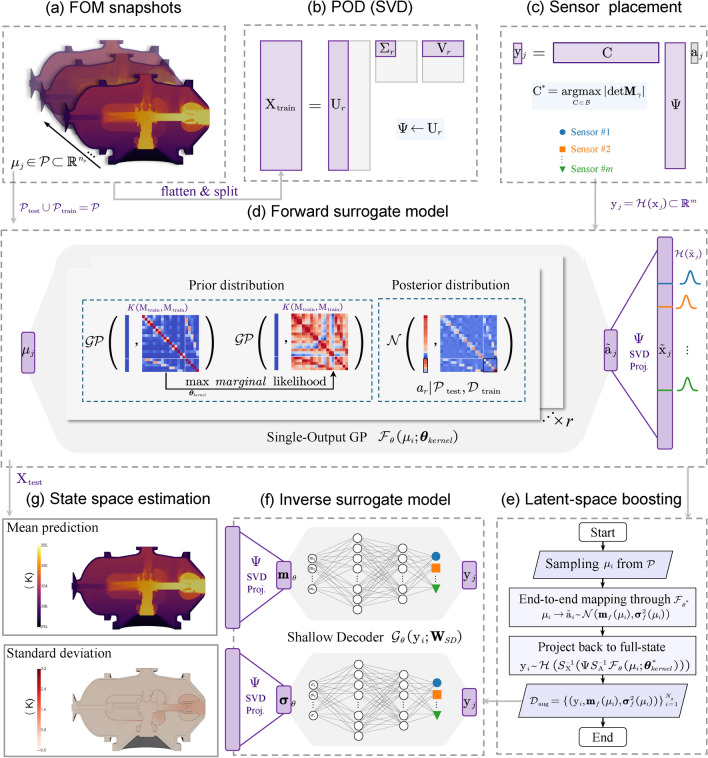
Efficient and reliable full-state temperature estimation is critical for condition monitoring and digital twin applications of enclosed high-voltage equipment, yet it remains challenging due to sparse measurements and the high computational cost of multiphysics simulations. This paper proposes an uncertainty-aware workflow for full-state temperature estimation of a 550 kV gas-insulated switchgear (GIS) disconnector under contact degradation scenarios, based on a proper orthogonal decomposition (POD) reduced-order representation. A probabilistic forward surrogate enables posterior-driven data augmentation, while a lightweight inverse surrogate is trained to infer POD coefficients from only three temperature measurements on the enclosure surface, followed by full-state reconstruction with uncertainty quantification. Numerical results on the evaluated cases show favorable reconstruction accuracy and noise tolerance, with lower errors than gappy POD under the reported settings despite using fewer sensors. These results indicate the potential of the proposed workflow for digital twin-oriented temperature-field estimation in GIS.
Overview
CoChat Summary
TL;DR
This paper proposes an uncertainty-aware POD-based workflow for full-state temperature reconstruction in a 550 kV GIS disconnector under contact degradation, using a probabilistic forward GPR surrogate for posterior-driven data augmentation and a lightweight inverse surrogate that infers POD coefficients from only three enclosure-surface temperature measurements. Under the reported settings, it achieves lower reconstruction errors than gappy POD despite using fewer sensors, with uncertainty quantification.
Key findings
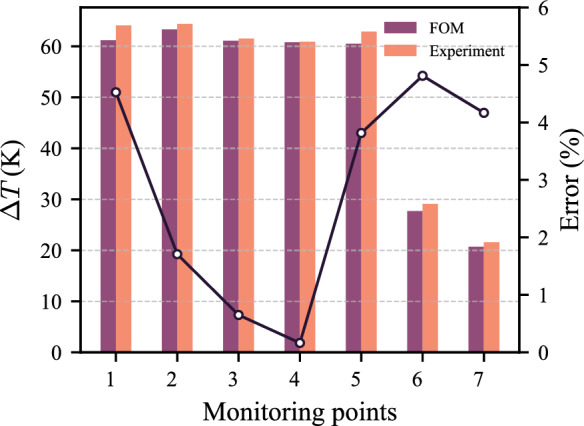
- The validated 3D FEM full-order model showed relative errors consistently within 5% across all monitored locations; the database contained 21 high-fidelity degradation scenarios (16 training, 5 held-out testing), with contact-pressure reductions up to 65% and N_h=586,332 spatial degrees of freedom.
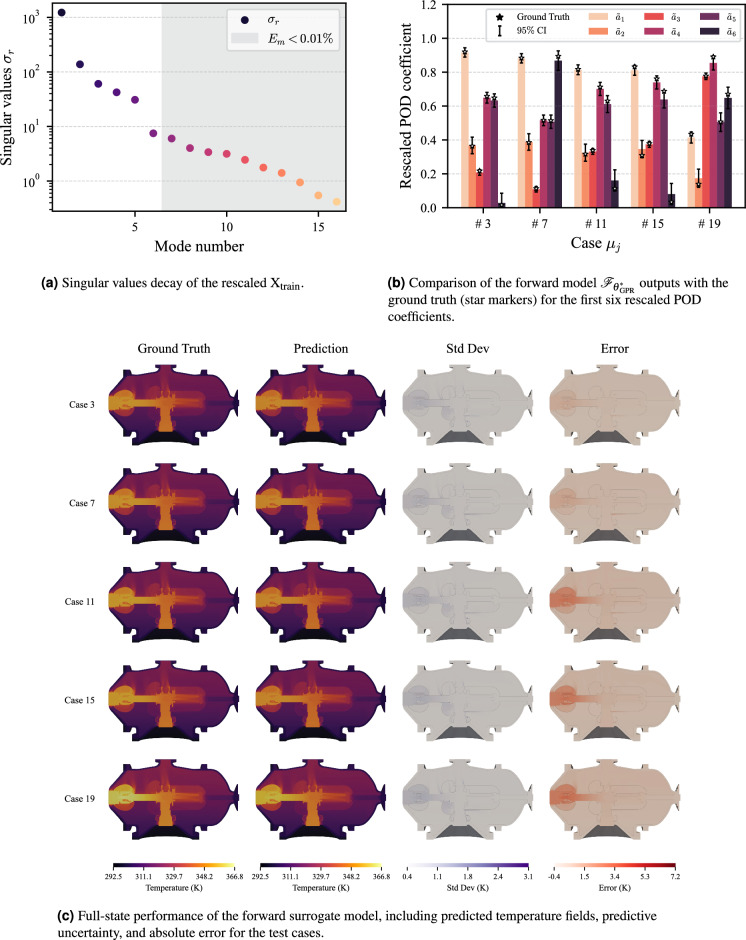
- POD truncation at r=6 preserved 99.9927% cumulative energy; held-out POD residuals had full-field MAPE 0.0017%–0.0074%, full-field MAE 0.0057–0.0251 K, and contact-region MAE 0.0185–0.0920 K.
- The forward GPR surrogate’s ground truth values consistently fell within predicted 95% confidence intervals; repeated random splits across eight partitions gave mean full-field MAPE 0.0873%–0.2757% and worst-case full-field MAPE below 0.5653%.
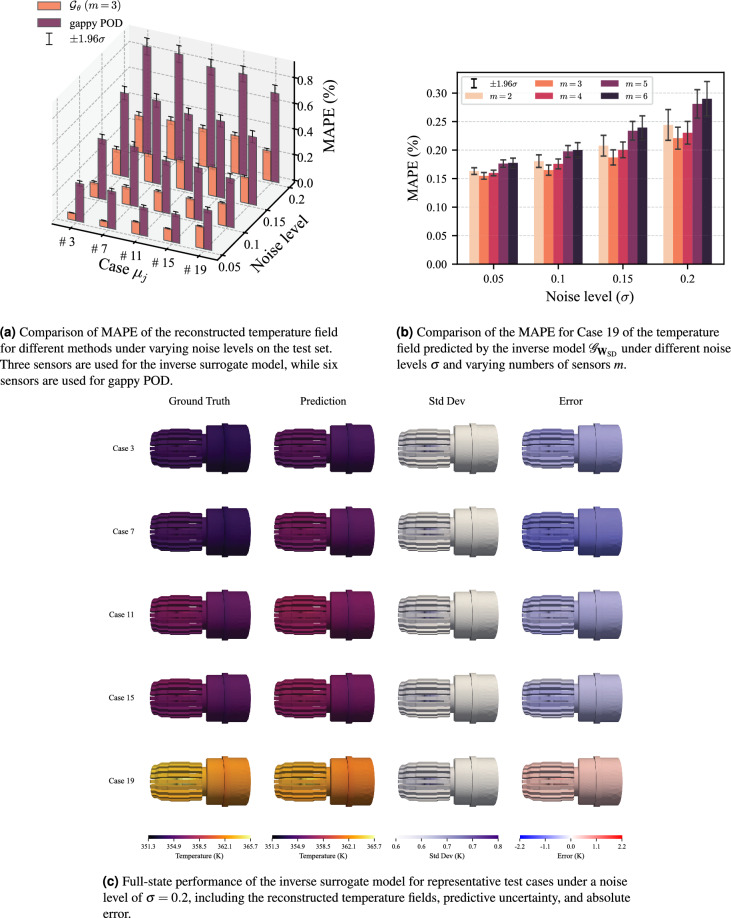
- The inverse surrogate using three sensors outperformed gappy POD using six sensors: at noise level 0.05, average MAPE was 0.11% vs 0.27% (57.84% relative reduction); at the highest noise level 0.20, average MAPE was 0.28% vs 0.79% (64.29% reduction), with 15 independent noise realizations per level and approximate physical standard deviations of 0.13–0.67 K.
Methods
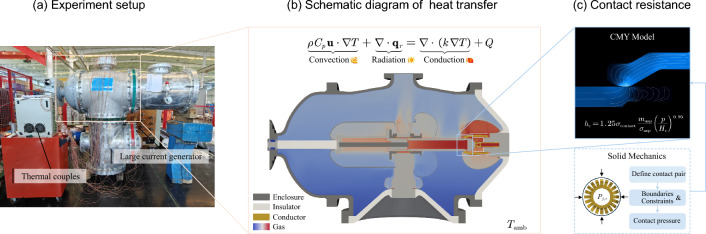
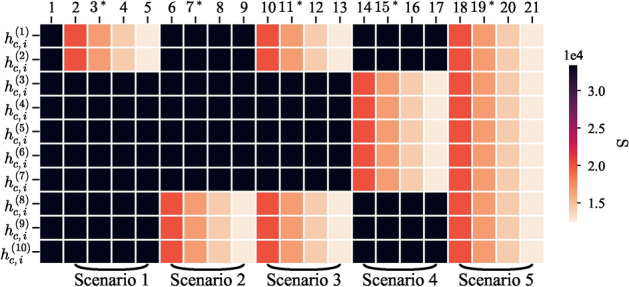
- A validated 3D FEM full-order model in COMSOL Multiphysics 6.2 simulated steady electro-thermal behavior of a 550 kV GIS disconnector (20-sheet bundled contact structure, rated 5 kA, operating at 1.1 times nominal current); contact degradation was parameterized by thermal contact conductance using the Cooper–Mikic–Yovanovich model, generating 21 parameter samples from five spatial degradation patterns and four increasing pressure-reduction levels up to 65%, split into 16 training and 5 held-out test cases.
- The workflow used POD/rSVD for latent representation, a forward Gaussian process regression surrogate per POD coefficient with a Matérn kernel, posterior-driven data augmentation via Latin hypercube sampling and posterior sampling, and two shallow decoder networks trained to infer the posterior mean and variance of POD coefficients from three enclosure-surface measurements by minimizing KL divergence between the GPR posterior and inverse-model output, followed by full-state reconstruction with uncertainty quantification.
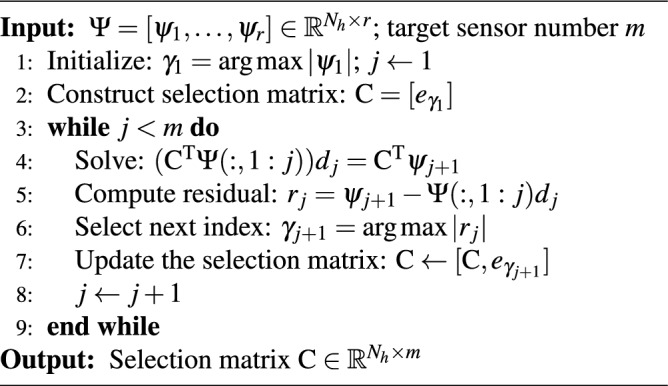
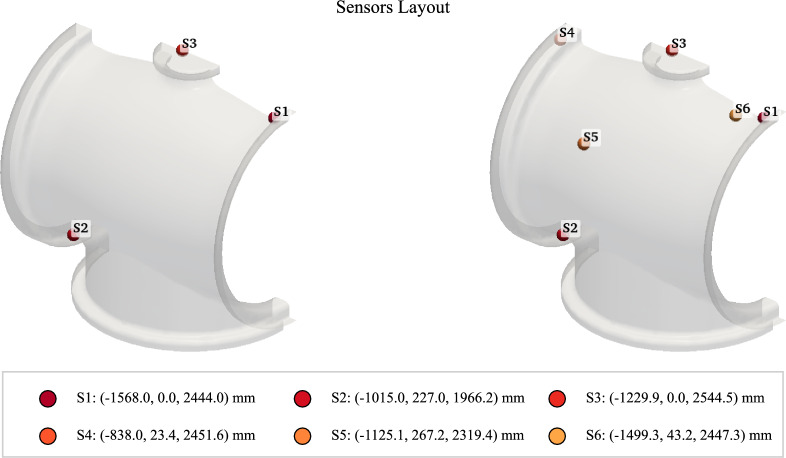
- Sensor locations were selected by DEIM; evaluation introduced additive Gaussian noise into normalized sensor inputs at four levels (0.05, 0.10, 0.15, 0.20), used 15 independent noise realizations per level, and assessed reconstruction with MAPE, comparing against gappy POD with six sensors.
Limitations
- The paper states that the trained surrogate models are specific to the considered 550 kV GIS disconnector geometry, operating condition, and contact-degradation parameterization; extending to other GIS configurations, voltage levels, or fault mechanisms would require regenerating representative high-fidelity data and retraining, and manufacturing tolerances, aging histories, and environmental variations not represented in the parameterization are outside the validated scope.
- The paper states that the reported uncertainty mainly characterizes surrogate/posterior uncertainty within the prescribed contact-degradation domain and does not fully eliminate model-form discrepancy or unmodeled field variability; direct validation against independent experimental measurements is identified as an important next step, and POD truncation remains an intrinsic approximation error that may be insufficient for sharper localized hotspots, moving heat sources, transient thermal fronts, or stronger nonlinear degradation mechanisms.
- The text also makes evident that the study relies on only 21 high-fidelity scenarios (16 training, 5 testing), that this sample count is case-specific and not a universal minimum, that augmented data are not independent high-fidelity simulations or evidence of extrapolative validity outside the sampled parameter space, that the three-sensor superiority is case-specific under the current geometry, sensing constraints, noise model, and DEIM sequence rather than a universal rule, and that the highest noise level is a severe stress test rather than a nominal operational accuracy claim.
Model-written summary. Check it against the paper before relying on it.
Integrity signals
Registry
Cites
Statistics
Figures
Verification
Claims the paper makes
0 Valid · 0 Not valid · 14 Not checked · 55 Own results and interpretations
A result the paper reports from its own data — it cites no other source for it, so there is none to check. The quote shows it is in the paper.
In the paper
“Accordingly, the truncation order is chosen as r=6, which preserves 99.9927% of the cumulative energy based on the criterion defined in Eq. (9).”
§ Uncertainty-aware temperature field reconstruction from sparse samples and sensing via latent-space enhancement for GIS digital twin applications > Numerical results and discussion > Performance of the forward surrogate model
plainstates a cause- Asserted: passes — The authors put it forward as true.
- Checkable: passes — It can be checked against evidence.
- Load-bearing: passes — The paper’s conclusions depend on it.
- Based: passes — The paper gives a reason why it holds.
A result the paper reports from its own data — it cites no other source for it, so there is none to check. The quote shows it is in the paper.
In the paper
“In particular, the ground truth values consistently fall within the predicted confidence intervals”
§ Uncertainty-aware temperature field reconstruction from sparse samples and sensing via latent-space enhancement for GIS digital twin applications > Numerical results and discussion > Performance of the forward surrogate model
plain- Asserted: passes — The authors put it forward as true.
- Checkable: passes — It can be checked against evidence.
- Load-bearing: passes — The paper’s conclusions depend on it.
- Based: passes — The paper gives a reason why it holds.
A result the paper reports from its own data — it cites no other source for it, so there is none to check. The quote shows it is in the paper.
In the paper
“The singular values in Fig. 5a decay approximately exponentially”
§ Uncertainty-aware temperature field reconstruction from sparse samples and sensing via latent-space enhancement for GIS digital twin applications > Numerical results and discussion > Performance of the forward surrogate model
plain- Asserted: passes — The authors put it forward as true.
- Checkable: passes — It can be checked against evidence.
- Load-bearing: passes — The paper’s conclusions depend on it.
- Based: passes — The paper gives a reason why it holds.
A result the paper states — it cites no source for it, so there is none to check. The quote shows it is in the paper.
In the paper
“For the utilized sensor normalization ranges, these dimensionless values map to approximate physical standard deviations of 0.13–0.67 K.”
§ Uncertainty-aware temperature field reconstruction from sparse samples and sensing via latent-space enhancement for GIS digital twin applications > Numerical results and discussion > Performance of the inverse surrogate model
hedgedstates an association- Asserted: passes — The authors put it forward as true.
- Checkable: passes — It can be checked against evidence.
- Load-bearing: unclear — It is unclear whether the paper’s conclusions depend on it.
- Based: passes — The paper gives a reason why it holds.
A result the paper reports from its own data — it cites no other source for it, so there is none to check. The quote shows it is in the paper.
In the paper
“For the evaluated test cases, the reconstructed temperature fields show good agreement with the full-order model results”
§ Uncertainty-aware temperature field reconstruction from sparse samples and sensing via latent-space enhancement for GIS digital twin applications > Numerical results and discussion > Performance of the forward surrogate model
plainstates an association- Asserted: passes — The authors put it forward as true.
- Checkable: passes — It can be checked against evidence.
- Load-bearing: passes — The paper’s conclusions depend on it.
- Based: passes — The paper gives a reason why it holds.
32 more claims
Create a free account to see all 69 claims and to verify the 28 references still open.
- It may state two separate claims as one. 23
- Probably not a substantial claim. 18
Self-check
Percentages, sums and reported differences re-computed from the paper’s own numbers.
Each contradiction between two passages listed here was confirmed by an independent check.
Rated minor: it would not touch a result — a value no result rests on, a p-value that stays on the same side of the significance level, or a conflict that is clerical, resolved elsewhere in the paper, or outside its own findings.
In the paper
§ Uncertainty-aware temperature field reconstruction from sparse samples and sensing via latent-space enhancement for GIS digital twin applications > Problem setup
“the system parameters \mu \in \mathscr {P} (in this case, the contact resistances)”
§ Uncertainty-aware temperature field reconstruction from sparse samples and sensing via latent-space enhancement for GIS digital twin applications > Method > Full-order modeling of heat transfer
“where h_{c,i}^{(k)} denotes the thermal contact conductance assigned to the k-th representative contact pair under the i-th degradation scenario.”
Citations
Cites
Gaussian Processes for Machine Learning
Rasmussen, C. E., & Williams, C. K. I. (2005) · doi:10.7551/mitpress/3206.001.0001 · Cited by 11,705
Holm, R. (1967) · Springer eBooks · doi:10.1007/978-3-662-06688-1 · Cited by 1,488
Data-Driven Science and Engineering: Machine Learning, Dynamical Systems, and Control
Brunton, S. L., & Kutz, J. N. (2019) · Cambridge University Press eBooks · doi:10.1017/9781108380690 · Cited by 1,154
Cooper, M. G., Mikic, B. B., & Yovanovich, M. M. (1969) · International Journal of Heat and Mass Transfer · doi:10.1016/0017-9310(69)90011-8 · Cited by 1,069 · cited 1×
“It is quantified using the Cooper–Mikic–Yovanovich (CMY) model, where the thermal contact conductance h c is given by: where σ contact is surface conductivity, m asp and σ asp are mean asperity height and standard deviation, P c is contact pressure, and H c is material hardness 25 .”
(2018) · IEEE Control Systems · doi:10.1109/mcs.2018.2810460 · Cited by 518 · cited 1×
“…error can be interpreted as a trade-off among POD truncation, the conditioning of the sampled system, and measurement noise, which can be bounded as 21 ∥ x i − ˜ x i 2 ≤ ( ) This observation motivates sensor placement strategies that improve the conditioning of the sampled POD system 27 .”
Reduced Basis Methods for Partial Differential Equations
Quarteroni, A., Manzoni, A., & Negri, F. (2016) · UNITEXT · doi:10.1007/978-3-319-15431-2 · Cited by 491
Drmač, Z., & Gugercin, S. (2016) · SIAM Journal on Scientific Computing · doi:10.1137/15m1019271 · Cited by 325 · cited 6×
“The observed superiority of m = 3 should therefore be interpreted under the current geometry, sensing constraints, noise model, and DEIM sequence, rather than as a universal rule advocating for minimal sensor counts.”
InfluentialReduced order modeling for nonlinear structural analysis using Gaussian process regression
Guo, M., & Hesthaven, J. S. (2018) · Computer Methods in Applied Mechanics and Engineering · doi:10.1016/j.cma.2018.07.017 · Cited by 277
Shallow neural networks for fluid flow reconstruction with limited sensors
Erichson, N. B., Mathelin, L., Yao, Z., Brunton, S. L., Mahoney, M. W., & Kutz, J. N. (2020) · Proceedings of the Royal Society A: Mathematical, Physical and Engineering Sciences · doi:10.1098/rspa.2020.0097 · Cited by 259
Stochastic Tools in Turbulence
(1970) · Elsevier eBooks · doi:10.1016/b978-0-12-395772-6.x5001-2 · Cited by 192
Research works printed but not linked: 2
- Bergman, T. L. & Lavine, A. S. Fundamentals of Heat and Mass Transfer (John Wiley & Sons, Hoboken, NJ, 2017), eighth edition edn.
- IEC 62271–100: High-voltage switchgear and controlgear - Part 100: High-voltage alternating-current circuit-breakers (2008). Edition 2.2.
Cited by
Wang, X., & Luo, H. (2026) · Sensors · doi:10.3390/s26175538
“More recently, Wang et al. reconstructed the full temperature field of GIS from sparse sensor measurements with uncertainty quantification for digital-twin applications [13].”
Bulăcel, M. C., Costinaș, S., & Opriș, I. (2026) · Energies · doi:10.3390/en19235693
Metadata
- Authors
- Wang, J., Zhou, Z., Chen, W., Liu, B., Su, S., Ding, J., Peng, Z., & Gao, W.
- Affiliations
- Tsinghua University (CN)
- China Southern Power Grid (China) (CN)
- Corresponding author
- Zhou, Ziqi
- ORCID
- Ding, Jiangang
- Venue
- Scientific Reports
- Published
- 2026-05-13
- Volume
- 16
- Issue
- 1
- Pages
- 21868
- ISSN
- 2045-2322 (ISSN-L)
- PMC
- PMC13365485
- OpenAlex
- W7160985213
- Semantic Scholar
- 103584234cf8a883729c0579f677eca5d9dfc769
- Cited by
- 2
- References
- 30
- Citations by year
- 2026: 2
- FWCI
- 2.10
- Type
- journal article
- Language
- en
- Open access
- gold
- doi.org
- Licence
- cc-by-nc-nd
- creativecommons.org/licenses/by-nc-nd/4.0 (tdm)
- creativecommons.org/licenses/by-nc-nd/4.0 (vor, 62 d)
- Locations
- Scientific Reports (publishedVersion, cc-by-nc-nd)
- PubMed Central (publishedVersion, cc-by-nc-nd)
- PubMed (publishedVersion)
- DOAJ (DOAJ: Directory of Open Access Journals) (submittedVersion)
- Funders
- China Southern Power Grid (GDKJXM20222621)
- Topics
- Physical Sciences › Physics and Astronomy › Statistical and Nonlinear Physics › Model Reduction and Neural Networks
- Physical Sciences › Computer Science › Computational Theory and Mathematics › Advanced Multi-Objective Optimization Algorithms
- Physical Sciences › Engineering › Electrical and Electronic Engineering › Thermal Analysis in Power Transmission
- Keywords
- temperature field reconstruction, gas-insulated switchgear, disconnectors, uncertainty quantification, proper orthogonal decomposition, model reduction, contact degradation, digital twin
About these checks
Registry, retraction, Cites and statistics results are computed, not judged, with one exception: a printed reference that no index lists is read once by a model before it counts as a citation error. Claims are extracted by a model and kept only when their quote appears verbatim in the text; each cited source is then checked, with a model’s help, for whether it says what the claim relies on. Those verdicts can be wrong — read the claim’s quote and the cited source before relying on one.
A language model drew the claims from the paper on 2026-11-29, under version 3 of the claim definition (model deepseek-v4.1-flash, prompt extract-v3).
A second model labelled each claim on 2026-11-29 (model jev-1.13-20260917, definition revision gold-guideline-v0.2).
Statistics and arithmetic are recomputed, not judged.
Confidence bands are shown only for fields calibrated on our annotated test set. None is calibrated yet, so no band is shown.
What counts as a claim ›How we measure confidence ›How we check this ›
Are you an author, or do you see a problem with this page? Request a review
How to cite
Cite CoChat for the checks on this page, and the paper for its own findings.
- This page
- CoChat. (2026). Citation check: Uncertainty-aware temperature field reconstruction from sparse samples and sensing via latent-space enhancement for GIS digital twin applications. https://app.cochat.ai/papers/10.1038/s41598-026-52842-8
- The paper
- Wang, J., Zhou, Z., Chen, W., Liu, B., Su, S., Ding, J., Peng, Z., & Gao, W. (2026). Uncertainty-aware temperature field reconstruction from sparse samples and sensing via latent-space enhancement for GIS digital twin applications. Scientific Reports. https://doi.org/10.1038/s41598-026-52842-8
Data sources
Bibliographic data: Semantic Scholar, OpenAlex, Crossref.
Contains information from the Semantic Scholar Academic Graph Datasets, made available under the ODC Attribution License (ODC-BY 1.0).
Semantic Scholar’s data is described in: Kinney, R., et al. (2023). The Semantic Scholar Open Data Platform. arXiv:2301.10140.
