

The DOI matches its Crossref record; 47 of the 47 references it cites were found in a registry or an index; none of the 22 sources its claims cite is checked for support yet.
Pain-centered symptom-language co-occurrence networks differ between interstitial cystitis/bladder pain syndrome and fibromyalgia in Reddit patient discourse
Open accessAbstract
Interstitial cystitis/bladder pain syndrome (IC/BPS) and fibromyalgia (FM) are chronic pain conditions frequently discussed within shared conceptual frameworks such as central sensitization. Despite this conceptual overlap, IC/BPS is clinically characterized by pelvic and urinary symptoms, whereas FM is associated with widespread pain, fatigue, sleep disturbance, and other systemic manifestations. Whether these differences are reflected in the organization of symptom-related language within patient-generated discourse remains insufficiently characterized. Patient-generated text related to IC/BPS and FM was collected from disease-specific Reddit communities using identical retrieval procedures, yielding temporally comparable corpora. A predefined evaluative lexicon was constructed from validated clinical questionnaires together with pain-related, affective, and anatomical vocabulary. Symptom-language co-occurrence networks were analyzed using a three-step framework examining global pain-centered network organization, dense-core topology and community structure, and local pain-centered lexical configurations. Both conditions exhibited pain-centered symptom-language networks. However, the FM network showed a greater concentration of symptom-language terms within the immediate network neighborhood of “pain,” whereas the IC/BPS network retained a larger peripheral structure. Dense-core analysis revealed distinct topological organization. The IC/BPS dense core retained partial modular differentiation, whereas the FM dense core formed a highly interconnected structure with minimal residual community organization. At the local level, pain-centered lexical neighborhoods also differed between conditions. In IC/BPS, “pain” was preferentially associated with pelvic, urinary, and sensory terms, whereas in FM it was more frequently associated with whole-body, fatigue-, sleep-, chronicity-, and affect-related vocabulary. These findings indicate that two chronic pain conditions sharing substantial conceptual overlap nevertheless exhibit distinct pain-centered symptom-language topologies within patient-generated discourse. Comparative network analysis of patient-generated language may provide a complementary framework for characterizing disease-specific patterns of symptom-language organization in online health communities.
Overview
CoChat Summary
TL;DR
This study compared pain-centered symptom-language co-occurrence networks in Reddit discourse from IC/BPS and fibromyalgia communities using a three-step network framework. Both conditions showed pain-centered networks, but FM had greater concentration around “pain” and a fully connected dense core, whereas IC/BPS retained peripheral structure and partial modular differentiation.
Key findings
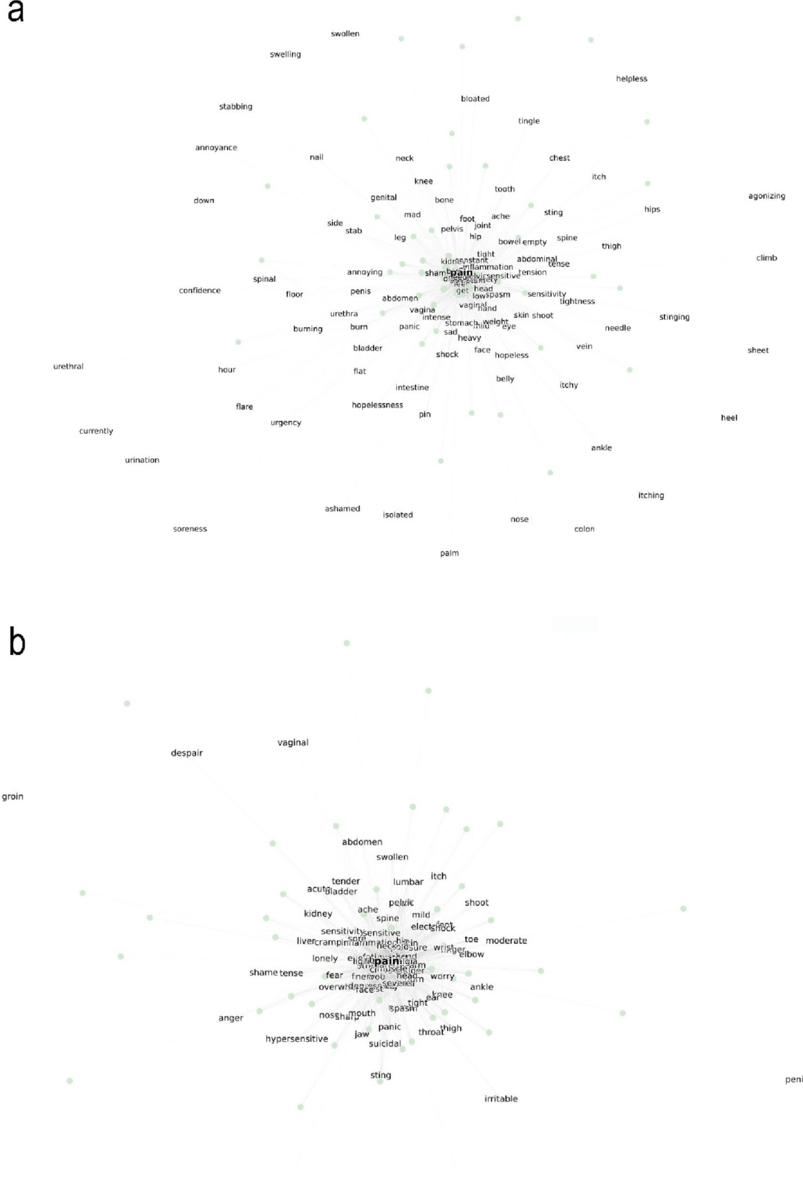
- At the global level, the IC/BPS network had 78 nodes and 513 edges, with 68 nodes (87.18%) in the pain core and 10 nodes (12.82%) in the periphery. The FM network had 144 nodes and 2,384 edges, with all 144 nodes in the pain core and no peripheral nodes; higher pain-core proportions in FM persisted across matched-corpus subsampling, permutation null models, exclusion of disease-specific questionnaire vocabulary, and alternative co-occurrence window sizes.
- Dense-core topology differed: IC/BPS had 10 nodes, 43 edges, density = 0.956, average degree = 8.6, and modularity Q = 0.095, retaining partial modular differentiation. FM had 18 nodes, 153 edges, density = 1.000, average degree = 17.0, and Q = 0.001, forming a fully connected dense core with minimal residual community organization.
- Local pain-centered language differed. Top IC/BPS triads included “pain”–“pelvic”–“cystitis” (triangle share 0.062), “pain”–“back”–“cystitis” (0.057), and “pain”–“back”–“pelvic” (0.054); IC/BPS-enriched first-order neighbors included “pelvic”, “urethra”, “kidney”, “vaginal”, and “urinate”. Top FM triads included “pain”–“sleep”–“fibromyalgia” (0.030), “pain”–“fibromyalgia”–“body” (0.029), and “pain”–“fibromyalgia”–“flare” (0.025); FM-enriched neighbors included “fatigue”, “chronic”, “stress”, “muscle”, “nerve”, and “depression”. After disease-label exclusion, pain-centered triads decreased from 34 to 26 in IC/BPS and from 136 to 120 in FM, with top triads becoming “pain”–“back”–“pelvic” and “pain”–“sleep”–“body”, respectively.
Methods
- Patient-generated text was collected from Reddit disease-specific communities: r/interstitialcystitis for IC/BPS and r/fibromyalgia for FM, using identical retrieval procedures on December 31, 2025. The IC/BPS corpus comprised 245 original posts, 4,697 associated comment threads, and 525,465 words; the FM corpus comprised 752 posts, 13,062 associated comment threads, and 1,073,952 words. Analyses were corpus-level, with no user identification or linkage.
- A predefined evaluative lexicon was built from the full text of six validated questionnaires—FIQR, FiRST, and the 2016 ACR Fibromyalgia Survey Questionnaire for FM; PUF, ICSI, and ICPI for IC/BPS—plus pain-related, affective, and anatomical vocabularies. Text was normalized and lemmatized, and network construction was restricted to this lexicon.
- The three-step framework used: (1) symptom co-occurrence networks with a five-token sliding window and min_edge = 5, then geodesic distance from “pain” to define core versus periphery; (2) dense-core extraction using top 12% weighted eigenvector-centrality nodes plus k-core filtering, with Louvain community detection; and (3) pain-centered triadic motif enumeration and first-order neighbor enrichment using corpus-size-normalized rates per million words and log2 rate ratios. Robustness analyses varied window sizes, eigenvector-centrality thresholds, and k-core parameters.
Limitations
- Stated in the paper: the analysis relied on self-identified patient discourse from online peer-support communities without independent diagnostic verification; participation may not represent the broader patient population and may be influenced by platform-specific norms; the cross-sectional design does not capture temporal dynamics; lexicon-based network construction constrains analysis to predefined vocabulary; and the five-token sliding-window co-occurrence network describes discourse-level lexical proximity rather than patient-level symptom networks or perceived symptom associations.
- Evident from the text: Reddit retrieval constraints mean the accessible corpus may not represent the complete historical archive of a subreddit, with both corpora covering approximately one year before collection; data collection was manual; no independent verification of author identity, moderator status, bot status, or deletion history was undertaken; and repeated contributions by the same user could not be evaluated.
Model-written summary. Check it against the paper before relying on it.
Integrity signals
Registry
Cites
Statistics
Figures
Verification
Claims the paper makes
0 Valid · 0 Not valid · 10 Not checked · 65 Own results and interpretations
A result the paper reports from its own data — it cites no other source for it, so there is none to check. The quote shows it is in the paper.
In the paper
“The highest-ranking triad was “pain”–“sleep”–“fibromyalgia”, followed by “pain”–“fibromyalgia”–“body” and “pain”–“fibromyalgia”–“flare”.”
§ Pain-centered symptom-language co-occurrence networks differ between interstitial cystitis/bladder pain syndrome and fibromyalgia in Reddit patient discourse > Results > Step 3: Pain-centered triadic motifs and first-order neighbors
plain- Asserted: passes — The authors put it forward as true.
- Checkable: passes — It can be checked against evidence.
- Load-bearing: unclear — It is unclear whether the paper’s conclusions depend on it.
- Based: passes — The paper gives a reason why it holds.
- Rests on 2 assumptions not shown here.
A result the paper reports from its own data — it cites no other source for it, so there is none to check. The quote shows it is in the paper.
In the paper
“The IC/BPS dense core retained partial modular differentiation, whereas the FM dense core formed a highly interconnected structure with minimal residual community organization.”
§ Pain-centered symptom-language co-occurrence networks differ between interstitial cystitis/bladder pain syndrome and fibromyalgia in Reddit patient discourse > Abstract
plain- Asserted: passes — The authors put it forward as true.
- Checkable: passes — It can be checked against evidence.
- Load-bearing: passes — The paper’s conclusions depend on it.
- Based: passes — The paper gives a reason why it holds.
- Rests on 2 assumptions not shown here.
A result the paper reports from its own data — it cites no other source for it, so there is none to check. The quote shows it is in the paper.
In the paper
“Figure 1b shows the FM symptom-language co-occurrence network, consisting of 144 nodes and 2,384 edges.”
§ Pain-centered symptom-language co-occurrence networks differ between interstitial cystitis/bladder pain syndrome and fibromyalgia in Reddit patient discourse > Results > Step 1: Global pain-centered organization of symptom vocabularies
plain- Asserted: passes — The authors put it forward as true.
- Checkable: passes — It can be checked against evidence.
- Load-bearing: passes — The paper’s conclusions depend on it.
- Based: passes — The paper gives a reason why it holds.
- Rests on 2 assumptions not shown here.
A result the paper reports from its own data — it cites no other source for it, so there is none to check. The quote shows it is in the paper.
In the paper
“In IC/BPS, “pain” was preferentially associated with pelvic, urinary, and sensory terms, whereas in FM it was more frequently associated with whole-body, fatigue-, sleep-, chronicity-, and affect-related vocabulary.”
§ Pain-centered symptom-language co-occurrence networks differ between interstitial cystitis/bladder pain syndrome and fibromyalgia in Reddit patient discourse > Abstract
plainstates an association- Asserted: passes — The authors put it forward as true.
- Checkable: passes — It can be checked against evidence.
- Load-bearing: passes — The paper’s conclusions depend on it.
- Based: passes — The paper gives a reason why it holds.
- Rests on 2 assumptions not shown here.
A result the paper reports from its own data — it cites no other source for it, so there is none to check. The quote shows it is in the paper.
In the paper
“Based on geodesic distance from “pain”, 68 nodes (87.18%) were located within the core (distance 0–1), whereas 10 nodes (12.82%) occupied the periphery (distance ≥ 2).”
§ Pain-centered symptom-language co-occurrence networks differ between interstitial cystitis/bladder pain syndrome and fibromyalgia in Reddit patient discourse > Results > Step 1: Global pain-centered organization of symptom vocabularies
plain- Asserted: passes — The authors put it forward as true.
- Checkable: passes — It can be checked against evidence.
- Load-bearing: passes — The paper’s conclusions depend on it.
- Based: passes — The paper gives a reason why it holds.
- Rests on 2 assumptions not shown here.
21 more claims
Create a free account to see all 75 claims and to verify the 22 references still open.
- It may state two separate claims as one. 19
- Probably not a substantial claim. 41
Self-check
Percentages, sums and reported differences re-computed from the paper’s own numbers.
Each contradiction between two passages listed here was confirmed by an independent check.
Rated minor: it would not touch a result — a value no result rests on, a p-value that stays on the same side of the significance level, or a conflict that is clerical, resolved elsewhere in the paper, or outside its own findings.
In the paper
§ Pain-centered symptom-language co-occurrence networks differ between interstitial cystitis/bladder pain syndrome and fibromyalgia in Reddit patient discourse > Methods > Questionnaire-based evaluative vocabulary
“the Pelvic Pain and Urgency/Frequency questionnaire (PUF)46”
§ Pain-centered symptom-language co-occurrence networks differ between interstitial cystitis/bladder pain syndrome and fibromyalgia in Reddit patient discourse > References
“46. Fors, E. A. et al. Fibromyalgia 2016 criteria and assessments: comprehensive validation in a Norwegian population. Scand. J. Pain. 20, 663–672 (2020). 32609652”
Rated minor: it would not touch a result — a value no result rests on, a p-value that stays on the same side of the significance level, or a conflict that is clerical, resolved elsewhere in the paper, or outside its own findings.
In the paper
§ Pain-centered symptom-language co-occurrence networks differ between interstitial cystitis/bladder pain syndrome and fibromyalgia in Reddit patient discourse > Results > Community structure within dense cores
“Weighted Louvain analysis identified two residual communities (Q = 0.095).”
§ Pain-centered symptom-language co-occurrence networks differ between interstitial cystitis/bladder pain syndrome and fibromyalgia in Reddit patient discourse > Results > Community structure within dense cores
“The remaining communities corresponded to a urinary–sensory cluster characterized by terms such as “bladder”, “urethra”, “urgency”, and “burning”, and to a broader health-evaluative cluster including “health”, “patient”, and “avoid”.”
Rated minor: it would not touch a result — a value no result rests on, a p-value that stays on the same side of the significance level, or a conflict that is clerical, resolved elsewhere in the paper, or outside its own findings.
In the paper
§ Pain-centered symptom-language co-occurrence networks differ between interstitial cystitis/bladder pain syndrome and fibromyalgia in Reddit patient discourse > Methods > Questionnaire-based evaluative vocabulary
“the Revised FM Impact Questionnaire (FIQR)43”
§ Pain-centered symptom-language co-occurrence networks differ between interstitial cystitis/bladder pain syndrome and fibromyalgia in Reddit patient discourse > References
“43. Hao, Z., Qu, W., Wang, Z. & Tan, S. Cross-sectional and longitudinal network analyses depict variations of symptom networks in depression patients across the lifespan: insight from a large-scale sample. BMC Psychiatry. 25, 1032 (2025). 41162915 PMC12574187”
Rated minor: it would not touch a result — a value no result rests on, a p-value that stays on the same side of the significance level, or a conflict that is clerical, resolved elsewhere in the paper, or outside its own findings.
In the paper
§ Pain-centered symptom-language co-occurrence networks differ between interstitial cystitis/bladder pain syndrome and fibromyalgia in Reddit patient discourse > Results > Community structure within dense cores
“The most central community, defined by cumulative eigenvector centrality, was centered on “pain” and included terms such as “symptom”, “pelvic”, “feel”, and “sleep”.”
§ Pain-centered symptom-language co-occurrence networks differ between interstitial cystitis/bladder pain syndrome and fibromyalgia in Reddit patient discourse > Results > Contrasting organizational principles between IC/BPS and FM
“Community 1 included pain, pelvic, back, cold, and sleep. Community 2 included cystitis, test, body, avoid, and shame.”
Citations
Cites
Newman, M. (2010) · doi:10.1093/acprof:oso/9780199206650.001.0001 · Cited by 6,595
Wolfe, F., Clauw, D. J., Fitzcharles, M., Goldenberg, D. L., Katz, R. S., Mease, P., Russell, A. S., Russell, I. J., Winfield, J. B., & Yunus, M. B. (2010) · Arthritis Care & Research · doi:10.1002/acr.20140 · Cited by 3,952
A network theory of mental disorders
Borsboom, D. (2017) · World Psychiatry · doi:10.1002/wps.20375 · Cited by 3,482
Borgatti, S. P. (2005) · Social Networks · doi:10.1016/j.socnet.2004.11.008 · Cited by 3,191
2016 revisions to the 2010/2011 fibromyalgia diagnostic criteria
Wolfe, F., Clauw, D. J., Fitzcharles, M.-A., Goldenberg, D. L., Häuser, W., Katz, R. L., Mease, P. J., Russell, A. S., Russell, I. J., & Walitt, B. (2016) · Seminars in Arthritis and Rheumatism · doi:10.1016/j.semarthrit.2016.08.012 · Cited by 2,232
Network structure and minimum degree
Seidman, S. B. (1983) · Social Networks · doi:10.1016/0378-8733(83)90028-x · Cited by 1,891
The Cerebral Signature for Pain Perception and Its Modulation
Tracey, I., & Mantyh, P. W. (2007) · Neuron · doi:10.1016/j.neuron.2007.07.012 · Cited by 1,843
Bridge Centrality: A Network Approach to Understanding Comorbidity
Jones, P. J., Ma, R., & McNally, R. J. (2021) · Multivariate Behavioral Research · doi:10.1080/00273171.2019.1614898 · Cited by 1,741
Predicting Depression via Social Media
De Choudhury, M., Gamon, M., Counts, S., & Horvitz, E. (2021) · Proceedings of the International AAAI Conference on Web and Social Media · doi:10.1609/icwsm.v7i1.14432 · Cited by 1,579
What do centrality measures measure in psychological networks?
Bringmann, L. F., Elmer, T., Epskamp, S., Krause, R. W., Schoch, D., Wichers, M., Wigman, J. T. W., & Snippe, E. (2019) · Journal of Abnormal Psychology · doi:10.1037/abn0000446 · Cited by 1,345
Research works printed but not linked: 1
- O’Leary, M. P. et al. The Interstitial Cystitis Symptom Index and Problem Index. Urology 49, 58–63 (1997). · DOI · Paper page
Cited by
Still being checked.
Metadata
- Authors
- Okui, N., Ichino, K., Ide, H., Matsushita, K., Ikehata, Y., Okui, M., & Horie, S.
- Affiliations
- Kanazawa University (JP)
- Juntendo University (JP)
- Corresponding author
- Okui, Nobuo
- Venue
- Scientific Reports
- Published
- 2026-06-22
- Volume
- 16
- Issue
- 1
- ISSN
- 2045-2322 (ISSN-L)
- PMC
- PMC13562692
- OpenAlex
- W7165597284
- Semantic Scholar
- 5370ed1b9aa8f29e97dc766ec24b565a404a681e
- Cited by
- 0
- References
- 47
- FWCI
- 0.00
- Type
- journal article
- Language
- en
- Open access
- gold
- doi.org
- Licence
- cc-by
- creativecommons.org/licenses/by/4.0 (tdm)
- creativecommons.org/licenses/by/4.0 (vor, 81 d)
- Locations
- Scientific Reports (publishedVersion, cc-by)
- PubMed Central (publishedVersion, cc-by)
- PubMed (publishedVersion)
- DOAJ (DOAJ: Directory of Open Access Journals) (submittedVersion)
- Topics
- Social Sciences › Psychology › Social Psychology › Mental Health via Writing
- Social Sciences › Psychology › Experimental and Cognitive Psychology › Mental Health Research Topics
- Health Sciences › Medicine › Psychiatry and Mental health › Fibromyalgia and Chronic Fatigue Syndrome Research
- Keywords
- fibromyalgia, chronic pain, Reddit communities, community structure, central sensitization, online health communities
- MeSH terms
- Adult, Female, Fibromyalgia, Humans, Language, Male, Middle Aged, Surveys and Questionnaires, Cystitis, Interstitial
About these checks
Registry, retraction, Cites and statistics results are computed, not judged, with one exception: a printed reference that no index lists is read once by a model before it counts as a citation error. Claims are extracted by a model and kept only when their quote appears verbatim in the text; each cited source is then checked, with a model’s help, for whether it says what the claim relies on. Those verdicts can be wrong — read the claim’s quote and the cited source before relying on one.
A language model drew the claims from the paper on 2026-11-18, under version 3 of the claim definition (model deepseek-v4.1-flash, prompt extract-v3).
A second model labelled each claim on 2026-11-18 (model jev-1.13-20260917, definition revision gold-guideline-v0.2).
Statistics and arithmetic are recomputed, not judged.
Confidence bands are shown only for fields calibrated on our annotated test set. None is calibrated yet, so no band is shown.
What counts as a claim ›How we measure confidence ›How we check this ›
Are you an author, or do you see a problem with this page? Request a review
How to cite
Cite CoChat for the checks on this page, and the paper for its own findings.
- This page
- CoChat. (2026). Citation check: Pain-centered symptom-language co-occurrence networks differ between interstitial cystitis/bladder pain syndrome and fibromyalgia in Reddit patient discourse. https://app.cochat.ai/papers/10.1038/s41598-026-58586-9
- The paper
- Okui, N., Ichino, K., Ide, H., Matsushita, K., Ikehata, Y., Okui, M., & Horie, S. (2026). Pain-centered symptom-language co-occurrence networks differ between interstitial cystitis/bladder pain syndrome and fibromyalgia in Reddit patient discourse. Scientific Reports. https://doi.org/10.1038/s41598-026-58586-9
Data sources
Bibliographic data: Semantic Scholar, OpenAlex, Crossref.
Contains information from the Semantic Scholar Academic Graph Datasets, made available under the ODC Attribution License (ODC-BY 1.0).
Semantic Scholar’s data is described in: Kinney, R., et al. (2023). The Semantic Scholar Open Data Platform. arXiv:2301.10140.
