

Antibiotics are associated with worse outcomes in lung cancer patients treated with chemotherapy and immunotherapy
Open accessThe DOI matches its Crossref record; 35 of the 35 references it cites were found in a registry or an index.
Abstract
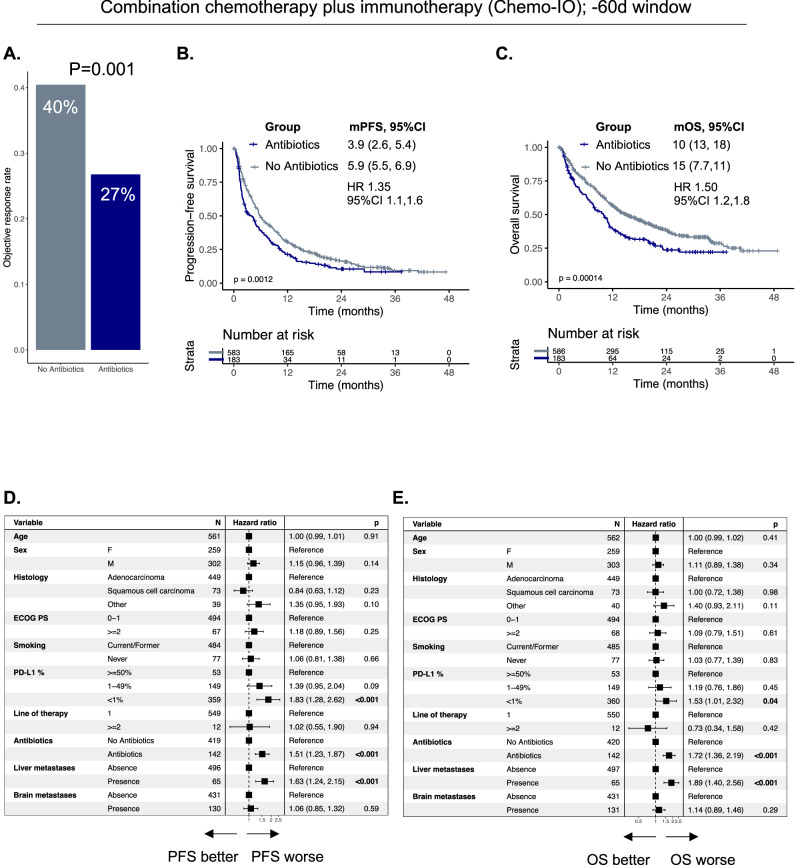
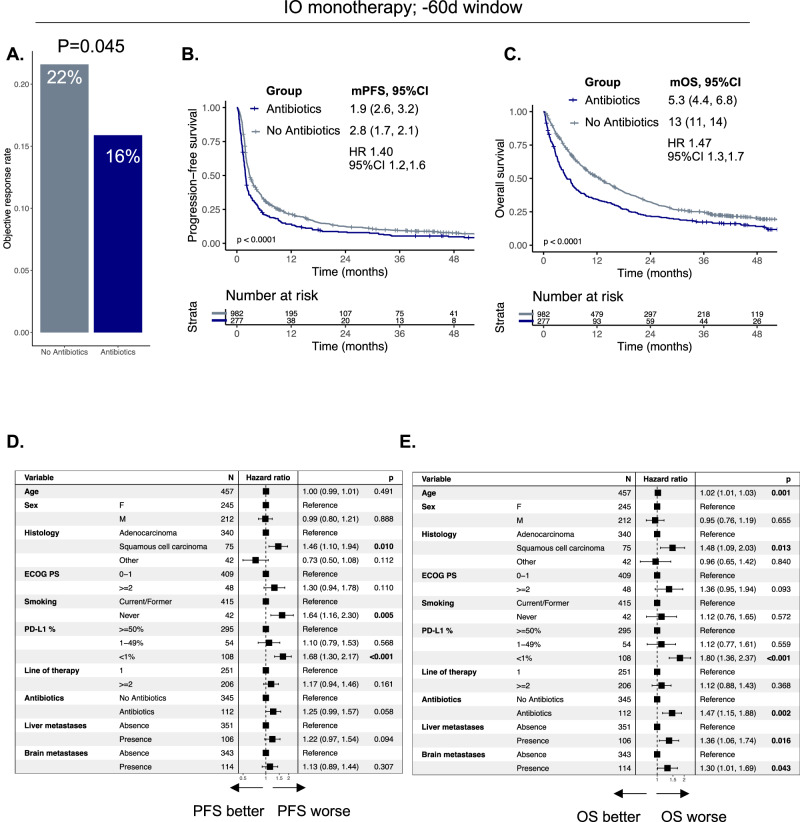
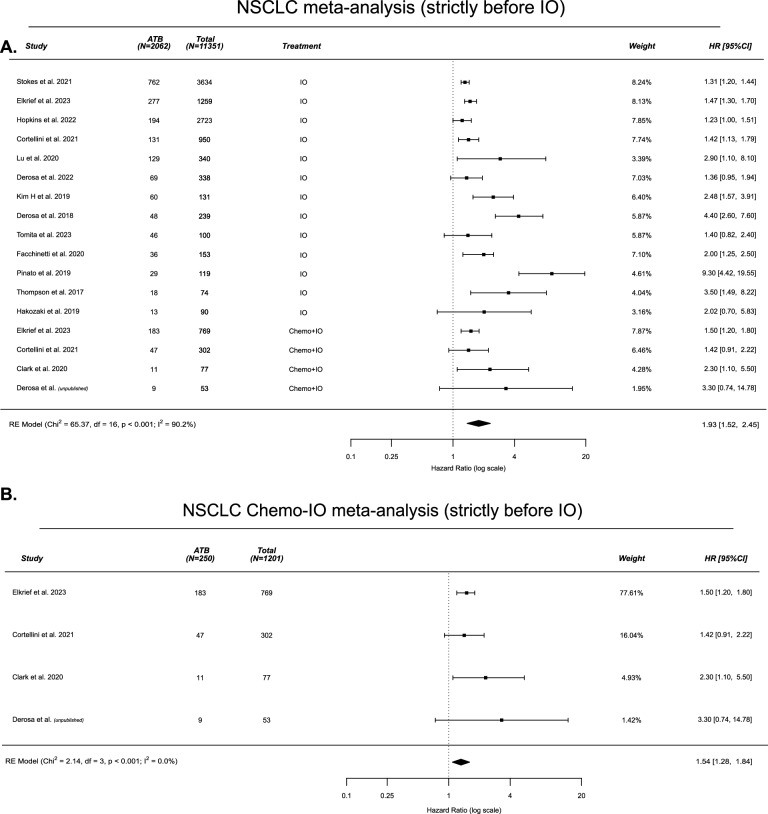
Anti-PD(L)-1 inhibition combined with platinum doublet chemotherapy (Chemo-IO) has become the most frequently used standard of care regimen in patients with non-small cell lung cancer (NSCLC). The negative impact of antibiotics on clinical outcomes prior to anti-PD(L)-1 inhibition monotherapy (IO) has been demonstrated in multiple studies, but the impact of antibiotic exposure prior to initiation of Chemo-IO is controversial. We assessed antibiotic exposures at two time windows: within 60 days prior to therapy (-60 d window) and within 60 days prior to therapy and 42 days after therapy (-60 + 42d window) in 2028 patients with advanced NSCLC treated with Chemo-IO and IO monotherapy focusing on objective response rate (ORR: rate of partial response and complete response), progression-free survival (PFS), and overall survival (OS). We also assessed impact of antibiotic exposure in an independent cohort of 53 patients. Univariable and multivariable analyses were conducted along with a meta-analysis from similar studies. For the -60 d window, in the Chemo-IO group (N = 769), 183 (24%) patients received antibiotics. Antibiotic exposure was associated with worse ORR (27% vs 40%, p = 0.001), shorter PFS (3.9 months vs. 5.9 months, hazard ratio [HR] 1.35, 95%CI 1.1,1.6, p = 0.0012), as well as shorter OS (10 months vs. 15 months, HR 1.50, 95%CI 1.2,1.8, p = 0.00014). After adjusting for known prognostic factors in NSCLC, antibiotic exposure was independently associated with worse PFS (HR 1.39, 95%CI 1.35,1.7, p = 0.002) and OS (HR 1.61, 95%CI 1.28,2.03, p < 0.001). Similar results were obtained in the -60 + 42d window, and also in an independent cohort. In a meta-analysis of patients with NSCLC treated with Chemo-IO (N = 4) or IO monotherapy (N = 13 studies) antibiotic exposure before treatment was associated with worse OS among all patients (n = 11,351) (HR 1.93, 95% CI 1.52, 2.45) and Chemo-IO-treated patients (n = 1201) (HR 1.54, 95% CI 1.28, 1.84). Thus, antibiotics exposure prior to Chemo-IO is common and associated with worse outcomes, even after adjusting for other factors. These results highlight the need to implement antibiotic stewardship in routine oncology practice.
Overview
The claims and statistics of this paper haven’t been checked yet.
Free: it reads the open-access text and checks the first 5 claims that cite a source we can check. Create a free account to check every claim.
Integrity signals
Registry
Cites
Statistics
Figures
Verification
Claims the paper makes
The claims and statistics of this paper haven’t been checked yet.
Free: it reads the open-access text and checks the first 5 claims that cite a source we can check. Create a free account to check every claim.
Claims other papers make about this one
Each is checked against this paper’s own text: does it say what the citing paper says it does?
The source backs part of the claim, not all of it — or backs it for a different population, condition or comparison.
In the citing paper
“the demonstration of the deleterious impact of antibiotics on the efficacy of immune checkpoint blockade (ICB) 3,4 and chimeric antigen receptor (CAR) T cell therapies 5”
From Impact of the ONCOBIOME network in cancer microbiome research (2025) · cites this paper as [4]
Experimental — accuracy not yet measuredThe cited source says what the claim attributes to it.
In the citing paper
“The two currently largest meta-analyses corroborating the deleterious effects of antibiotics on the outcome of immunotherapy alone 3 or in combination with chemotherapy (chemo-immunotherapy) 4 involve >110,000 patients.”
From Impact of the ONCOBIOME network in cancer microbiome research (2025) · cites this paper as [4]
In the citing paper
“A meta-analysis of 105 studies and 46,000 cancer patients treated with ICIs convincingly showed that exposure to antibiotics was associated with shorter progression-free survival and overall survival in NSCLC patients.104”
From Gut dysbiosis in oncology: a risk factor for immunoresistance (2026) · doi:10.1038/s41422-025-01212-6 · cites this paper as [104]
In the citing paper
“the negative correlation between broad-spectrum antibiotic use and prognosis was, at least initially, independent of possible confounding factors including age, performance status and comorbidities 3,4 and was observed in patients receiving immunotherapy-based regimens but not in those receiving chemotherapy alone 91,92 .”
From Impact of the ONCOBIOME network in cancer microbiome research (2025) · cites this paper as [4]
In the citing paper
“The two currently largest meta-analyses corroborating the deleterious effects of antibiotics on the outcome of immunotherapy alone 3 or in combination with chemotherapy (chemo-immunotherapy) 4 involve >110,000 patients.”
From Impact of the ONCOBIOME network in cancer microbiome research (2025) · cites this paper as [4]
1 more claim about this paper
Create a free account to see every claim other papers make about this one.
Self-check
Percentages, sums and reported differences re-computed from the paper’s own numbers.
The self-check needs the paper’s full text.
Citations
Cites
Wickham, H., Averick, M., Bryan, J., Chang, W., McGowan, L., François, R., Grolemund, G., Hayes, A., Henry, L., Hester, J., et al. (2019) · Journal of Open Source Software · doi:10.21105/joss.01686 · Cited by 22,138
Pembrolizumab versus Chemotherapy for PD-L1-Positive Non-Small-Cell Lung Cancer
Reck, M., Rodríguez-Abreu, D., Robinson, A. G., Hui, R., Csőszi, T., Fülöp, A., Gottfried, M., Peled, N., Tafreshi, A., Cuffe, S., et al. (2016) · New England Journal of Medicine · doi:10.1056/nejmoa1606774 · Cited by 10,089
Pembrolizumab plus chemotherapy in metastatic non–small-cell lung cancer
Gandhi, L., Rodríguez-Abreu, D., Gadgeel, S., Esteban, E., Felip, E., De Angelis, F., Domine, M., Clingan, P., Hochmair, M. J., Powell, S. F., et al. (2018) · New England Journal of Medicine · doi:10.1056/nejmoa1801005 · Cited by 6,607
Gut microbiome influences efficacy of PD-1-based immunotherapy against epithelial tumors
Routy, B., Le Chatelier, E., Derosa, L., Duong, C. P. M., Alou, M. T., Daillère, R., Fluckiger, A., Messaoudene, M., Rauber, C., Roberti, M. P., et al. (2018) · Science · doi:10.1126/science.aan3706 · Cited by 5,671
Self-citationGut microbiome modulates response to anti-PD-1 immunotherapy in melanoma patients
Gopalakrishnan, V., Spencer, C. N., Nezi, L., Reuben, A., Andrews, M. C., Karpinets, T. V., Prieto, P. A., Vicente, D., Hoffman, K., Wei, S. C., et al. (2018) · Science · doi:10.1126/science.aan4236 · Cited by 4,812
Self-citationAtezolizumab for First-Line Treatment of Metastatic Nonsquamous NSCLC
Socinski, M. A., Jotte, R. M., Cappuzzo, F., Orlandi, F., Stroyakovskiy, D., Nogami, N., Rodríguez-Abreu, D., Moro-Sibilot, D., Thomas, C. A., Barlesi, F., et al. (2018) · New England Journal of Medicine · doi:10.1056/nejmoa1716948 · Cited by 3,733
Neoadjuvant Nivolumab plus Chemotherapy in Resectable Lung Cancer
Forde, P. M., Spicer, J., Lu, S., Provencio, M., Mitsudomi, T., Awad, M. M., Felip, E., Broderick, S. R., Brahmer, J. R., Swanson, S. J., et al. (2022) · New England Journal of Medicine · doi:10.1056/nejmoa2202170 · Cited by 2,825 · cited 1×
“Given increasing use of Chemo-IO as a mainstay fi rst-line therapy in patients with NSCLC, and recent approvals of Chemo-IO in the neoadjuvant setting 21 , there isa needto further understand the role of antibioticuse in clinical outcomes prior to the initiation of Chemo-IO.”
The Intestinal Microbiota Modulates the Anticancer Immune Effects of Cyclophosphamide
Viaud, S., Saccheri, F., Mignot, G., Yamazaki, T., Daillère, R., Hannani, D., Enot, D. P., Pfirschke, C., Engblom, C., Pittet, M. J., et al. (2013) · Science · doi:10.1126/science.1240537 · Cited by 2,050 · cited 1×
“The addition of chemotherapy to IO could already disrupt gut microbiota and potentially make the impact of antibiotic exposure less clinically signi fi cant 20 .”
Self-citationReck, M., Rodríguez–Abreu, D., Robinson, A. G., Hui, R., Csőszi, T., Fülöp, A., Gottfried, M., Peled, N., Tafreshi, A., Cuffe, S., et al. (2019) · Journal of Clinical Oncology · doi:10.1200/jco.18.00149 · Cited by 1,670 · cited 1×
“Drugs that inhibit PD-1 or PD-L1 (PD-(L)1 blockade) alone (IO) or in combination with platinum-doublet chemotherapy (Chemo-IO) are now standard-of-care therapeutic regimens in patients with advanced non-small cell lung cancer (NSCLC) without a driver alteration 1 – 5 .”
Reproducible Summary Tables with the gtsummary Package
Sjoberg, D., Whiting, K., Curry, M., Lavery, J., & Larmarange, J. (2021) · The R Journal · doi:10.32614/rj-2021-053 · Cited by 1,290
Cited by
Gut microbiota shapes cancer immunotherapy responses
Lei, W., Zhou, K., Lei, Y., Li, Q., & Zhu, H. (2025) · npj Biofilms and Microbiomes · doi:10.1038/s41522-025-00786-8 · Cited by 196
Duttagupta, S., Messaoudene, M., Hunter, S., Desîlets, A., Jamal, R., Mihalcioiu, C. L. D., Belkaïd, W., Marcoux, N., Fidelle, M., Suissa, D., et al. (2026) · Nature Medicine · doi:10.1038/s41591-025-04186-5 · Cited by 126
“This dysbiosis can be further compounded by iatrogenic insults such as antibiotics 16–19 , now validated as an independent negative prognostic factor across multiple oncology settings.”
Self-citationElkrief, A., Pidgeon, R., Vareki, S. M., Messaoudene, M., Castagner, B., & Routy, B. (2025) · Nature Reviews Drug Discovery · doi:10.1038/s41573-025-01211-7 · Cited by 109
“Although broad-spectrum antibiotics have a detrimental effect on the microbiome and on overall survival of patients treated with ICIs 194 , selectively removing taxa that mediate an inappropriate immune environment in the microbiome could be achieved by selective antibiotics or decolonization…”
Self-citationTumor microbiome: roles in tumor initiation, progression, and therapy
Zhang, S., Huang, J., Jiang, Z., Tong, H., Ma, X., & Liu, Y. (2025) · Molecular Biomedicine · doi:10.1186/s43556-025-00248-9 · Cited by 63
Pharmacomicrobiomics: The Role of the Gut Microbiome in Immunomodulation and Cancer Therapy
Bolte, L. A., Björk, J. R., Gaćeša, R., & Weersma, R. K. (2025) · Gastroenterology · doi:10.1053/j.gastro.2025.04.025 · Cited by 43
Chen, S., Deng, T., Yang, Q., Jin, L., Shen, J., Xu, L., Tang, J., Zhang, X., Salvador, J. T., & Ma, J. (2025) · EClinicalMedicine · doi:10.1016/j.eclinm.2025.103386 · Cited by 56
“48 Currently, the specific effects of the duration of closed chest drain retention and antibiotic use on PPCs are unknown, and continued expansion of the sample size and multicentre studies are recommended to further validate their effects on PPCs.”
Optimizing Cancer Treatment Through Gut Microbiome Modulation
Kim, K., Lee, M., Shin, Y., Lee, Y., & Kim, T. J. (2025) · Cancers · doi:10.3390/cancers17071252 · Cited by 40
“Furthermore, antibiotic-induced microbiota depletion has been associated with OS and PFS in NSCLC patients undergoing chemotherapy [66].”
Elkrief, A., Routy, B., Derosa, L., Bolte, L. A., Wargo, J. A., McQuade, J. L., & Zitvogel, L. (2025) · American Society of Clinical Oncology Educational Book · doi:10.1200/edbk-25-472902 · Cited by 43
Self-citationGut dysbiosis in oncology: a risk factor for immunoresistance
(2026) · doi:10.1038/s41422-025-01212-6 · Cited by 24
Self-citationMessaoudene, M., Ferreira, S., Saint-Lu, N., Ponce, M., Truntzer, C., Boidot, R., Le Bescop, C., Loppinet, T., Corbel, T., Féger, C., et al. (2024) · Nature Communications · doi:10.1038/s41467-024-52373-8 · Cited by 24
“Thisobservation wasvalidated in a meta-analysis of 105studies across 46,000 patients with cancer amenable to immunotherapy, demonstrating that ATB use six weeks before ICI initiation was associated with a shorter overall survival 8 .”
Self-citationImpact of the ONCOBIOME network in cancer microbiome research
Zitvogel, L., Derosa, L., Routy, B., Loibl, S., Heinzerling, L., de Vries, I. J. M., Engstrand, L., ONCOBIOME Network, Silva, C. A. C., Barbieri, D., et al. (2025) · Nature Medicine · doi:10.1038/s41591-025-03608-8 · Cited by 23
Self-citationAntibiotic-mediated dysbiosis leads to activation of inflammatory pathways
Taitz, J., Tan, J., Ni, D., Potier‐Villette, C., Grau, G. E., Nanan, R. K. H., & Macia, L. (2025) · Frontiers in Immunology · doi:10.3389/fimmu.2024.1493991 · Cited by 37
Wekking, D., Silva, C. A. C., Viscò, R., Denaro, N., Lambertini, M., Maccioni, A., Loddo, E., Willard-Gallo, K. E., Scartozzi, M., Derosa, L., et al. (2025) · Critical Reviews in Oncology/Hematology · doi:10.1016/j.critrevonc.2025.104767 · Cited by 30
Self-citationHarnessing the microbiome for cancer therapy
Hajjar, R., Mars, R. A. T., & Kashyap, P. (2026) · Nature Reviews Microbiology · doi:10.1038/s41579-025-01268-6 · Cited by 34
Mascaux, C., Sen, T., Sánchez‐Céspedes, M., Ortiz‐Cuaran, S., Bossé, Y., Dammeijer, F. F., Cavic, M. R., Barr, M. P., Arulananda, S., Armisén, R., et al. (2025) · Journal of Thoracic Oncology · doi:10.1016/j.jtho.2025.05.024 · Cited by 23
Microbiota-centered interventions to boost immune checkpoint blockade therapies
Almonte, A. A., Thomas, S., & Zitvogel, L. (2025) · Journal of Experimental Medicine · doi:10.1084/jem.20250378 · Cited by 19
Self-citationSusiriwatananont, T., Eiamprapaporn, P., Roque, M. V., Farraye, F. A., Pearlman, A., & Chumsri, S. (2025) · Cells · doi:10.3390/cells14221779 · Cited by 21
“…trials studying this association are not feasible, extensive preclinical data and multiple large observational studies and meta-analyses [179,180] consistently demonstrate that antibiotic exposure around the time of ICI initiation (up to 90 days before and after) is linked to inferior…”
Intra-tumoral bacteria in breast cancer and intervention strategies
Hou, T., Huang, X., Lai, J., & Zhou, D. (2025) · Advanced Drug Delivery Reviews · doi:10.1016/j.addr.2025.115516 · Cited by 20
Diop, K., Mbaye, B., Nili, S., Filin, A., Benlaïfaoui, M., Malo, J., Renaud, A. S., Belkaïd, W., Hunter, S., Messaoudene, M., et al. (2025) · Gut Pathogens · doi:10.1186/s13099-025-00694-4 · Cited by 17
Self-citationThe microbiota in radiotherapy-induced cancer immunosurveillance
Chen, J., Deutsch, É., Kroemer, G., Galluzzi, L., & Zitvogel, L. (2025) · Nature Reviews Clinical Oncology · doi:10.1038/s41571-025-01052-8 · Cited by 19
Self-citationStone, S., McPherson, J. P., Kulkarni, R. P., & Young, A. (2025) · Nature reviews. Cancer · doi:10.1038/s41568-025-00890-z · Cited by 15
“Treatment with antibiotics reduces baseline microbial diversity and induces dysbiosis 133,134 (Fig.”
Soluble MAdCAM-1 as a biomarker in metastatic renal cell carcinoma
Silva, C. A. C., Machaalani, M., Saliby, R. M., Zhong, C., Xie, W., Pasolli, E., Piccinno, G., Dalban, C., Fidelle, M., Meurisse, A., et al. (2026) · Nature Medicine · doi:10.1038/s41591-025-04067-x · Cited by 17
“…administration of the immunostimulatory immune checkpoint inhibitors anti-PD-1, anti-PD-L1 and anti-CTLA-4 monoclonal antibodies on response rates and survival of patients across various cancer types and immune checkpoint inhibitors (ICIs) regimens (alone or combined with chemotherapy or TKI) 4,8 .”
Self-citationMontégut, L., Rousseau, A., Ungolo, C., Derosa, L., Fidelle, M., Alves Costa Silva, C., Routy, B., Zitvogel, L., Besse, B., Pasolli, E., et al. (2025) · OncoImmunology · doi:10.1080/2162402x.2025.2528955 · Cited by 8
“34,35 The characteristics of this population are listed in Table 1.”
Self-citationBrunetti, L., Santo, V., Pinato, D. J., Citarella, F., Orlando, S., Acker, F., Colella, V., Ricciuti, B., Naidoo, J., Nassar, A., et al. (2026) · The Lancet Oncology · doi:10.1016/s1470-2045(26)00191-9 · Cited by 10
Self-citationRafie, E., Zugman, M., Pal, S. K., Routy, B., & Elkrief, A. (2024) · European Urology Focus · doi:10.1016/j.euf.2024.12.009 · Cited by 8
Self-citationSilva, C. A. C., Almonte, A. A., & Zitvogel, L. (2025) · Biomolecules · doi:10.3390/biom15040504 · Cited by 6
“ATB [4,5,117–119] and proton pump inhibitors (PPIs) [120,121] are associated with reduced efficacy of ICI treatments.”
Self-citationImproving neoadjuvant and perioperative therapy in non-small-cell lung cancer
Garitaonaindía, Y., Wakelee, H. A., Reck, M., Forde, P. M., Cascone, T., Spicer, J. D., & Provencio, M. (2026) · Nature Reviews Clinical Oncology · doi:10.1038/s41571-026-01174-7 · Cited by 8
“Importantly, exposure to broad-spectrum antibiotics around the time of initiation of chemoimmunotherapy has been associated with inferior outcomes 96 .”
Han, W., Li, Q., & Yuan, G. (2026) · Frontiers in Immunology · doi:10.3389/fimmu.2026.1802676 · Cited by 4
“Multiple systematic reviews and meta-analyses have associated antibiotics given shortly before or around ICI initiation with worse outcomes across cancers, and more recent analyses continue to support this concern in contemporary immunotherapy-treated populations (44, 45).”
Orletskaia, V., & Olekhnovich, E. I. (2026) · Computational and Structural Biotechnology Journal · doi:10.34133/csbj.0065 · Cited by 6
“…this ecological view, factors such as an imbalanced diet, stress, and antibiotic use may disrupt community assembly processes—a disruption that, as we hypothesize, could compromise functional resilience and, consequently, diminish the capacity to support an adequate immune response [ 39 – 41 ].”
Yiu, C. H., Winardi, K., & Lu, C. Y. (2026) · Current Oncology Reports · doi:10.1007/s11912-026-01789-0 · Cited by 6
“Although similar associations have been reported in patients receiving chemoimmunotherapy, the magnitude of effect appears attenuated, potentially reflecting partial compensation by the cytotoxic component [29, 30 ].”
Sun, Q., Li, X., Wu, J., Zhang, J., Zhu, Y., & Dong, Y. (2026) · Critical Reviews in Oncology/Hematology · doi:10.1016/j.critrevonc.2026.105382 · Cited by 5
Routy, B., Rafie, E., & Elkrief, A. (2025) · Nature Cancer · doi:10.1038/s43018-025-01055-5 · Cited by 5
Self-citationIntratumoral Microbiota in Lung Cancer: Emerging Roles in TME Modulation and Immunotherapy Response
Yang, X., Yin, L., Tian, Z., & Zhou, Q. (2025) · International Journal of Molecular Sciences · doi:10.3390/ijms27010255 · Cited by 5
“Antibiotic exposure during immunotherapy is associated with lower survival [158,159], likely due to its disruption of airway and gut microbiota.”
Petouhoff, A., Hicks, R., Husain, M., Hoyd, R., Xu, M., Dravillas, C. E., Patel, S. H., Johns, A. C., Grogan, M. M., Li, M., et al. (2026) · Cancer Immunology Immunotherapy · doi:10.1007/s00262-026-04346-7 · Cited by 2
Zhang, H., Zhang, X., Guo, J., Huang, X., An, M., Wang, S., Wang, S., & Fu, B. (2026) · Molecular Biology Reports · doi:10.1007/s11033-026-11858-z · Cited by 2
Fang, Y., Wu, B., Zhang, R., Chen, X., Jiang, F., Jin, Q., Jin, T., Huang, S., Tao, C., Qiang, M., et al. (2025) · Journal of Immunotherapy · doi:10.1097/cji.0000000000000556 · Cited by 2
Bin, W., & Wei, Y. (2025) · Journal of Medical Biochemistry · doi:10.5937/jomb0-57772 · Cited by 1
“PCT can be applied to guide the application of antibiotics, predicting outcomes and prognosis of disease (25).”
Lasagna, A. (2025) · Immunotherapy · doi:10.1080/1750743x.2025.2516995 · Cited by 1
Ullern, A., Holm, K., Andresen, N. K., Røssevold, A. H., Bang, C., Naume, B., Hov, J. R., & Kyte, J. A. (2025) · Molecular Oncology · doi:10.1002/1878-0261.70117 · Cited by 3
“Antibiotics represent a possibly confounding factor, as they are more extensively used in patients in a poorer condition and have been reported to impact alpha diversity and to be associated with reduced efficacy of ICB in other cancer forms [46].”
The gut microbiome and dietary interventions in cancer cachexia
Nasrah, R., & Jagoe, R. T. (2026) · Current Opinion in Clinical Nutrition & Metabolic Care · doi:10.1097/mco.0000000000001211 · Cited by 2
Microbiome‐urothelium crosstalk in bladder cancer: From dysbiosis to clinical translation
Xu, H., Li, Z., Yang, L., Zheng, J., Li, W., Liao, R., Huang, W., Sun, B., Li, Z., Ma, C., et al. (2026) · iMetaOmics. · doi:10.1002/imo2.70081 · Cited by 1
“Conversely, a large ‐ scale retrospective analysis of 2028 patients with advanced NSCLC, including 769 patients treated with Chemo ‐ IO, reported that antibiotic exposure was associated with a lower objective response rate (27% vs. 40%; p = 0.001) and shorter overall survival [187].”
InfluentialXiao, Y., Li, J., Xiang, L., & Xiu, W. (2026) · Frontiers in Cellular and Infection Microbiology · doi:10.3389/fcimb.2026.1767998 · Cited by 1
Decoding the microbiome-immune crosstalk in cancer: from mechanisms to therapeutic translation
Zhao, N., Wu, L., Peng, S., Yang, H., 宋永春, Zhang, Y., & Ding, L. (2026) · Biomarker Research · doi:10.1186/s40364-026-00930-2 · Cited by 2
Stylianakis, D., Bertaglia, V., Sangiolo, D., Podda, M., Saba, G., Stylianakis, I., Denaro, N., Pisanu, A., Agelaki, S., Scartozzi, M., et al. (2026) · Cancer Treatment Reviews · doi:10.1016/j.ctrv.2026.103162 · Cited by 3
Luo, W., Huang, Z., Mei, S., Zhang, Q., Chen, Z., Chen, P.-P., Huang, G.-H., Wang, F., Deng, Y., Tu, H.-Y., et al. (2026) · Journal of Translational Medicine · doi:10.1186/s12967-026-08580-6 · Cited by 1
Échanges autour des soins oncologiques
Sicard, J. (2025) · Actualités Pharmaceutiques · doi:10.1016/j.actpha.2025.01.012
Ye, Q., Liu, L., Cui, M., Liu, M., & Yan, B. (2025) · Clinical Medicine Insights Oncology · doi:10.1177/11795549251348376
Siegel, R., Schlosser‐Hupf, S., Müller-Schilling, M., Kharroubi, S. A., Gessner, A., & El‐Najjar, N. (2025) · Frontiers in Pharmacology · doi:10.3389/fphar.2025.1652957
Wang, Y. S., Wang, Q. Y., Moise, A. E., Syed, H. C., Malo, J., Soberano, S., Belkaïd, W., Messaoudene, M., Bélanger, K., Desîlets, A., et al. (2025) · Current Oncology · doi:10.3390/curroncol32110630
“We assessed time windows of exposure to ATB at 30, 60, or 90 days prior to or after initiation of BRAFi/MEKi, as performed in previous landmark ATB exposure studies [12].”
InfluentialSelf-citationRole of Crosstalk between Microbiota and Immune System in Cancer Immunotherapy
Ciappina, G., Carroccio, P., Bignoli, F., Santarpía, M., Mauro, G. D., & Berretta, M. (2025) · IntechOpen eBooks · doi:10.5772/intechopen.1011506 · Cited by 1
Abdu, S. A., Al-Haddad, F., Asaad, W. A., Al‐Aroomi, M. A., Ameen, N. A., Muhammad, T., & Huang, L. (2026) · Critical Reviews in Oncology/Hematology · doi:10.1016/j.critrevonc.2026.105306 · Cited by 1
Lung microbiota analysis in early-stage lung adenocarcinoma
Sun, K., Li, B., Zhang, C., Zhou, K., Zheng, Z., Gao, C., Lin, Y., Zhang, N., Wang, Z., Li, J., et al. (2026) · Microbiology Spectrum · doi:10.1128/spectrum.01987-25
Rao, X., Zhou, R., Li, W., Chai, X., & Zhang, H. (2026) · Critical Reviews in Oncology/Hematology · doi:10.1016/j.critrevonc.2026.105308
A “healthy gut state” as the key determinant of immune checkpoint inhibitor efficacy
Sokol, H., Elkrief, A., & Routy, B. (2026) · Molecular Therapy · doi:10.1016/j.ymthe.2026.04.034
Self-citationCOPD–Lung Cancer Comorbidity: Mechanistic Insights and Precision Oncology Implications
He, Y., Liu, B., Li, W., Zhou, X., & Tao, H. (2026) · International Journal of COPD · doi:10.2147/copd.s606647 · Cited by 2
“60,61 Emphysema Phenotype as a Malignant Precursor Emphysematous lung regions constitute biologically high-risk niches for carcinogenesis.”
Antibiotic Timing and Survival After Immune Checkpoint Inhibitor Initiation in Patients With CancerPreprint
Zhang, K., John, D., Li, W. T., Hogarth, M., McKay, R. R., & Ongkeko, W. M. (2026) · medRxiv · doi:10.64898/2026.05.27.26354193
Soh, S., Costescu, F., Najmeh, S., Spicer, J., & Amir, A. (2026) · Journal of Cardiothoracic and Vascular Anesthesia · doi:10.1053/j.jvca.2026.05.067
Zalabardo-Aguilar, M., Fernandez, I., Girona, A., González, A., Blanco, J., Campos, O., Sánchez‐Muñoz, A., Onieva, J. L., Jerez, J. M., Pascual, J., et al. (2026) · The Breast · doi:10.1016/j.breast.2026.104833
“Similar windows have been applied in chemotherapy and ICI cohorts [25,30], with additional detrimental effects reported in BC when ATBs are administered during NACT [25].”
The challenge of defining optimal antibiotic treatment duration in immunocompromised hosts
Molina, J., Aguilar‐Guisado, M., & Cisneros, J. M. (2026) · Clinical Microbiology and Infection · doi:10.1016/j.cmi.2026.06.015
Joo, M.-K., Tak, J., Ha, S., Yoon, K., Namgoong, J., & Kim, H. O. (2026) · Frontiers in Microbiology · doi:10.3389/fmicb.2026.1835588
“Comparable window-dependent effects have been observed in melanoma, RCC, and urothelial carcinoma, where exposures clustered in the 30–60 days pre-ICI period consistently predict poorer response and survival (Chorti et al., 2024; Elkrief et al., 2024; Febriyanto et al., 2024; Lalani et al., 2020).”
InfluentialBenlaïfaoui, M., Richard, C., Hunter, S., Méndez-Salazar, E. O., Kourtian, S., Malo, J., Prifti, D. K., Ponce, M., Khalfi, S., Belkaïd, W., et al. (2026) · Gut Microbes · doi:10.1080/19490976.2026.2699457 · Cited by 4
“40,41 However, dietary fiber intake was not associated with OS (HR 1.01, 95% CI 0.93–1.09; p = 0.81) or PFS (HR 1.01, 95% CI 0.95–1.08 p = 0.73) (Supplementary Figure 4B).”
InfluentialSelf-citationMiller, B. C., Hoover, J., Yadav, H., & Jain, S. (2026) · Frontiers in Molecular Neuroscience · doi:10.3389/fnmol.2026.1815079
“For example, antibiotic-induced gut dysbiosis was linked with lower efficacy of ICIs in patients with lung cancer (Elkrief et al., 2024).”
Panda, P., Mohanty, S., & Mohapatra, R. (2026) · Clinical Microbiology Newsletter · doi:10.1016/j.clinmicnews.2026.08.003
Gut microbiota alterations in patients with non‐small‐cell lung cancer undergoing chemoradiotherapy
Nymoen, H. M., Zhao, Z., Horndalsveen, H., Bjaanæs, M. M., Grønberg, B. H., Halvorsen, T. O., Madebo, T., Aanerud, M., Koivunen, J. P., Oselin, K., et al. (2026) · Molecular Oncology · doi:10.1002/1878-0261.70326
Molecular pathways linking the gut microbiome to antitumor immunity
Olea, X. D., Ramer‐Tait, A. E., Cohen, J. E., Osterman, A., & Ronai, Z. A. (2026) · Trends in Microbiology · doi:10.1016/j.tim.2026.08.013
ZHANG, Y.-F., Ran, X. U. E., & Lin, S. H. E. N. (2026) · Shengming kexue · doi:10.3724/cbls.2026124
Wang, Z. P., Luo, Z., Wang, L., Tang, J., Zhang, Z., & Fan, X. (2026) · Cancer Medicine · doi:10.1002/cam4.72335
“Studies find that activated endothelial cells in lung cancer tissues highly express vascular cell adhesion molecule-1 (VCAM-1) and inter-cellular adhesion molecule-1 (ICAM-1), which interact with integrins on lymphocytes to mediate T cell rolling, adhesion, and transendothelial migration [31, 92].”
Antibiotics and outcomes of cancer immunotherapy: An updated meta-analysis and clinical applications
Porcari, S., Bolte, L. A., Björk, J. R., Elkrief, A., Derosa, L., Ferrari, M., Pezzullo, A. M., Severino, A., Fusco, W. G., Messaoudene, M., et al. (2026) · Cancer Cell · doi:10.1016/j.ccell.2026.09.012
Self-citation
Metadata
- Authors
- Elkrief, A., Méndez-Salazar, E. O., Maillou, J., Vanderbilt, C. M., Gogia, P., Desilets, A., Messaoudene, M., Kelly, D., Ladanyi, M., Hellmann, M. D., Zitvogel, L., Rudin, C. M., Routy, B., Derosa, L., & Schoenfeld, A. J.
- Affiliations
- Memorial Sloan Kettering Cancer Center (US)
- Centre Hospitalier de l’Université de Montréal (CA)
- Inserm (FR)
- Corresponding author
- Elkrief, Arielle
- Schoenfeld, Adam J.
- ORCID
- Venue
- npj Precision Oncology
- Published
- 2024-07-16
- Volume
- 8
- Issue
- 1
- Pages
- 143-143
- ISSN
- 2397-768X (ISSN-L)
- PMC
- PMC11252311
- OpenAlex
- W4400677411
- Cited by
- 68
- References
- 35
- Citations by year
- 2026: 36 · 2025: 30 · 2024: 2
- FWCI
- 11.64
- Type
- journal article
- Language
- en
- Open access
- gold
- doi.org
- Licence
- cc-by
- creativecommons.org/licenses/by/4.0 (tdm)
- creativecommons.org/licenses/by/4.0 (vor)
- Locations
- npj Precision Oncology (publishedVersion, cc-by)
- PubMed Central (publishedVersion, cc-by)
- PubMed (publishedVersion)
- DOAJ (DOAJ: Directory of Open Access Journals) (submittedVersion, cc-by-sa)
- Funders
- Damon Runyon Cancer Research Foundation (P30 CA008748, CI-98-18)
- Memorial Sloan-Kettering Cancer Center (CA008748, P30 CA008748)
- Cancer Research Society
- Parker Institute for Cancer Immunotherapy
- Royal College of Physicians and Surgeons of Canada
- Agence Nationale de la Recherche (ANR-21-RHUS-0017)
- Canadian Institutes of Health Research
- National Cancer Institute (P30CA008748)
- Topics
- Health Sciences › Medicine › Oncology › Cancer Immunotherapy and Biomarkers
- Health Sciences › Medicine › Pulmonary and Respiratory Medicine › Lung Cancer Diagnosis and Treatment
- Health Sciences › Medicine › Pulmonary and Respiratory Medicine › Lung Cancer Treatments and Mutations
- Keywords
- antibiotics, non-small cell lung cancer, immune checkpoint inhibitors, anti-PD-1 therapy, platinum-based chemotherapy, chemoimmunotherapy, objective response rate, progression-free survival, overall survival, prognostic factors, immune-related adverse events
About these checks
Registry, retraction, Cites and statistics results are computed, not judged, with one exception: a printed reference that no index lists is read once by a model before it counts as a citation error. Claims are extracted by a model and kept only when their quote appears verbatim in the text; each cited source is then checked, with a model’s help, for whether it says what the claim relies on. Those verdicts can be wrong — read the claim’s quote and the cited source before relying on one.
Statistics and arithmetic are recomputed, not judged.
Confidence bands are shown only for fields calibrated on our annotated test set. None is calibrated yet, so no band is shown.
What counts as a claim ›How we measure confidence ›How we check this ›
Are you an author, or do you see a problem with this page? Request a review
Data sources
Bibliographic data: Semantic Scholar, OpenAlex, Crossref.
Contains information from the Semantic Scholar Academic Graph Datasets, made available under the ODC Attribution License (ODC-BY 1.0).
Semantic Scholar’s data is described in: Kinney, R., et al. (2023). The Semantic Scholar Open Data Platform. arXiv:2301.10140.
