

The DOI matches its Crossref record; 41 of the 41 references it cites were found in a registry or an index.
Translating evidence into practice: eligibility criteria fail to eliminate clinically significant differences between real-world and study populations
Open accessAbstract
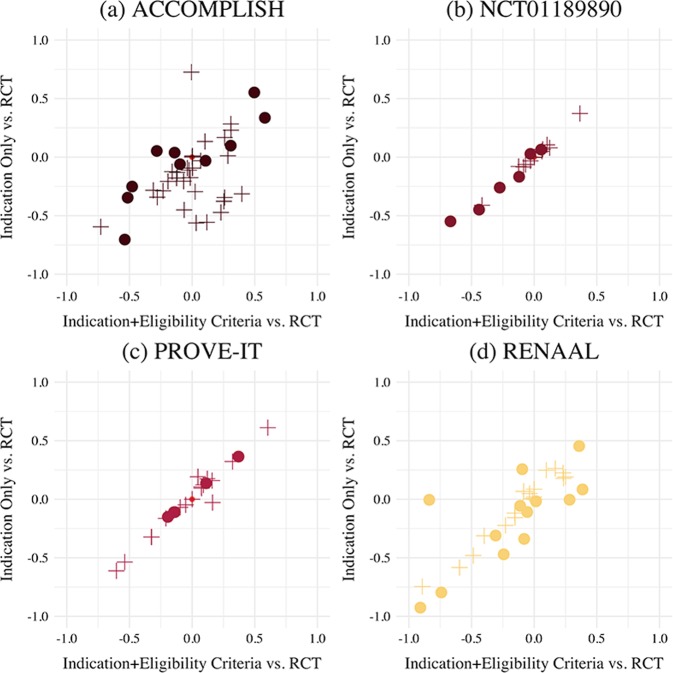
Randomized controlled trials (RCTs) are regarded as the most reputable source of evidence. In some studies, factors beyond the intervention itself may contribute to the measured effect, an occurrence known as heterogeneity of treatment effect (HTE). If the RCT population differs from the real-world population on factors that induce HTE, the trials effect will not replicate. The RCTs eligibility criteria should identify the sub-population in which its evidence will replicate. However, the extent to which the eligibility criteria identify the appropriate population is unknown, which raises concerns for generalizability. We compared reported data from RCTs with real-world data from the electronic health records of a large, academic medical center that was curated according to RCT eligibility criteria. Our results show fundamental differences between the RCT population and our observational cohorts, which suggests that eligibility criteria may be insufficient for identifying the applicable real-world population in which RCT evidence will replicate.
Overview
The claims and statistics of this paper haven’t been checked yet.
Run the check — free, no account needed. It reads the open-access text and checks the sources it cites.
Integrity signals
Registry
Cites
Statistics
Figures
Verification
Claims the paper makes
The claims and statistics of this paper haven’t been checked yet.
Run the check — free, no account needed. It reads the open-access text and checks the sources it cites.
Claims other papers make about this one
Each is checked against this paper’s own text: does it say what the citing paper says it does?
The source backs part of the claim, not all of it — or backs it for a different population, condition or comparison.
In the citing paper
“Though randomized controlled trials (RCTs) exist, 19,25 ethical quandaries and external validity issues given that participants must relinquish autonomy of a reproductive organ to randomization places limits on utility and appropriateness of RCT evidence for this topic.31,32”
From Hysterectomy versus uterine preservation for pelvic organ prolapse surgery: a prospective cohort study (2025) · cites this paper as [31]
Experimental — accuracy not yet measured
Self-check
Percentages, sums and reported differences re-computed from the paper’s own numbers.
The self-check needs the paper’s full text.
Citations
Cites
Evidence based medicine: what it is and what it isn't
Sackett, D. L., Rosenberg, W. M. C., Gray, J. A. M., Haynes, R. B., & Richardson, W. S. (1996) · BMJ · doi:10.1136/bmj.312.7023.71 · Cited by 15,769
(1963) · Medical Entomology and Zoology · Cited by 15,085
CONSORT 2010 Statement: updated guidelines for reporting parallel group randomised trials
the CONSORT Group, Schulz, K. F., Altman, D. G., & Moher, D. (2010) · BMC Medicine · doi:10.1186/1741-7015-8-18 · Cited by 13,371
Ahmed, A., Jorna, T., & Bhandari, S. (2016) · The Nephron journals/Nephron journals · doi:10.1159/000447068 · Cited by 11,782
CONSORT 2010 Statement: updated guidelines for reporting parallel group randomised trials
Schulz, K. F., Altman, D. G., Moher, D., & for the CONSORT Group (2010) · BMJ · doi:10.1136/bmj.c332 · Cited by 9,329
Brenner, B. M., Cooper, M. E., de Zeeuw, D., Keane, W. F., Mitch, W. E., Parving, H.-H., Remuzzi, G., Snapinn, S. M., Zhang, Z., & Shahinfar, S. (2001) · New England Journal of Medicine · doi:10.1056/nejmoa011161 · Cited by 7,493
Intensive versus Moderate Lipid Lowering with Statins after Acute Coronary Syndromes
Cannon, C. P., Braunwald, E., McCabe, C. H., Rader, D. J., Rouleau, J. L., Belder, R., Joyal, S. V., Hill, K. A., Pfeffer, M. A., & Skene, A. M. (2004) · New England Journal of Medicine · doi:10.1056/nejmoa040583 · Cited by 4,938
Yeh, M. (2014) · Journal of Nursing Research · doi:10.1097/jnr.0000000000000065 · Cited by 3,836
Real-World Evidence — What Is It and What Can It Tell Us?
Sherman, R. E., Anderson, S. A., Pan, G. J. D., Gray, G. W., Gross, T. P., Hunter, N. L., LaVange, L. M., Marinac‐Dabic, D., Marks, P. W., Robb, M. A., et al. (2016) · New England Journal of Medicine · doi:10.1056/nejmsb1609216 · Cited by 2,192
The Levels of Evidence and Their Role in Evidence-Based Medicine
Burns, P. B., Rohrich, R. J., & Chung, K. C. (2011) · Plastic and Reconstructive Surgery · doi:10.1097/prs.0b013e318219c171 · Cited by 2,155
Research works printed but not linked: 3
- Djulbegovic, B. & Guyatt G. in Users Guide to Medical Literature. 3rd edn. (McGraw-Hill Education, 1976).
- Velasco, E. in Encyclopedia of Research Design (ed. Salkind, N) (SAGE, Thousand Oaks Publications, 2010).
- Karanis, Y. B., Canta, F. A. B., Mitrofan, L., Mistry, H. & Anger, C. ‘Research’ vs ‘real world’ patients: the representativeness of clinical trial participants. Ann. Oncol. (2016) https://doi.org/10.1093/annonc/mdw392.51/2800468/Research-vs-real-world-patients-the · DOI
Cited by
Sorted by citations
Semaglutide vs Tirzepatide for Weight Loss in Adults With Overweight or Obesity
Rodriguez, P. J., Goodwin Cartwright, B. M., Gratzl, S., Brar, R., Baker, C., Gluckman, T. J., & Stucky, N. L. (2024) · JAMA Internal Medicine · doi:10.1001/jamainternmed.2024.2525 · Cited by 334
Tan, Y. Y., Papež, V., Chang, W. H., Mueller, S. H., Denaxas, S., & Lai, A. G. (2022) · The Lancet Healthy Longevity · doi:10.1016/s2666-7568(22)00186-6 · Cited by 284
Increasing Participation of Women in Cardiovascular Trials
Cho, L., Vest, A. R., O’Donoghue, M. L., Ogunniyi, M. O., Sarma, A. A., Denby, K. J., Lau, E. S., Poole, J. E., Lindley, K. J., & Mehran, R. (2021) · Journal of the American College of Cardiology · doi:10.1016/j.jacc.2021.06.022 · Cited by 149
Williams, C., Senft, N., Shelburne, N., & Norton, W. E. (2021) · JAMA Network Open · doi:10.1001/jamanetworkopen.2021.27792 · Cited by 95
Takuathung, M. N., Sakuludomkan, W., Khatsri, R., Dukaew, N., Kraivisitkul, N., Ahmadmusa, B., Mahakkanukrauh, C., Wangthaweesap, K., Onin, J., Srichai, S., et al. (2022) · International Journal of Environmental Research and Public Health · doi:10.3390/ijerph19148373 · Cited by 71
Smart watches: A review of evolution in bio-medical sector
Chandel, R. S., Sharma, S., Kaur, S., Singh, S., & Kumar, R. (2021) · Materials Today Proceedings · doi:10.1016/j.matpr.2021.07.460 · Cited by 71
Oh, B., Boyle, F. M., Pavlakis, N., Clarke, S. J., Eade, T., Hruby, G., Lamoury, G., Carroll, S. L., Morgia, M., Kneebone, A. B., et al. (2021) · Cancers · doi:10.3390/cancers13194824 · Cited by 66
Gan, C. L., Stukalin, I., Meyers, D. E., Dudani, S., Grosjean, H. A. I., Dolter, S., Ewanchuk, B. W., Goutam, S., Sander, M. S., Wells, J. C., et al. (2021) · European Journal of Cancer · doi:10.1016/j.ejca.2021.04.004 · Cited by 49
Chiu, J. W. Y., Lee, S. C., Ho, J., Park, Y. H., Chao, T., Kim, S., Lim, E., Lin, C., Loi, S., Low, S. Y., et al. (2023) · Drug Safety · doi:10.1007/s40264-023-01328-x · Cited by 44
When and Why Adults Abandon Lifestyle Behavior and Mental Health Mobile Apps: Scoping Review
Kidman, P. G., Curtis, R., Watson, A., & Maher, C. A. (2024) · Journal of Medical Internet Research · doi:10.2196/56897 · Cited by 53
Aeschbacher‐Germann, M., Kaiser, N., Speierer, A., Blum, M. R., Bauer, D. C., Giovane, C. D., Aujesky, D., Gencer, B., Rodondi, N., & Moutzouri, E. (2022) · Journal of the American Heart Association · doi:10.1161/jaha.122.026551 · Cited by 41
Treatment of Atopic Dermatitis with Baricitinib: First Real-life Experience
Rogner, D. F., Biedermann, T., & Lauffer, F. (2022) · Acta Dermato Venereologica · doi:10.2340/actadv.v102.1088 · Cited by 32
A review of research on eligibility criteria for clinical trials
Su, Q., Cheng, G., & Huang, J. (2023) · Clinical and Experimental Medicine · doi:10.1007/s10238-022-00975-1 · Cited by 40
Bröckelmann, N., Balduzzi, S., Harms, L., Beyerbach, J., Πετροπούλου, Μ., Kubiak, C., Wolkewitz, M., Meerpohl, J. J., & Schwingshackl, L. (2022) · BMC Medicine · doi:10.1186/s12916-022-02369-2 · Cited by 29
Luccarelli, J., McCoy, T. H., Seiner, S. J., & Henry, M. (2021) · Acta Psychiatrica Scandinavica · doi:10.1111/acps.13378 · Cited by 28
Ingrasciotta, Y., Spini, A., L’Abbate, L., Fiore, E. S., Carollo, M., Ientile, V., Isgrò, V., Cavazzana, A., Biasi, V., Rossi, P., et al. (2024) · Pharmacological Research · doi:10.1016/j.phrs.2024.107074 · Cited by 28
Secular and Regional Trends among Pulmonary Arterial Hypertension Clinical Trial Participants
Min, J., Appleby, D. H., McClelland, R. L., Minhas, J., Holmes, J. H., Urbanowicz, R. J., Pugliese, S. C., Mazurek, J. A., Smith, K. A., Fritz, J. S., et al. (2021) · Annals of the American Thoracic Society · doi:10.1513/annalsats.202110-1139oc · Cited by 25
Walsh, J., Cave, J. A. K., & Griffiths, F. E. (2024) · Journal of Medical Internet Research · doi:10.2196/54321 · Cited by 25
Shaikh, F., Wynne, R. M., Castelino, R. L., Inglis, S. C., & Ferguson, C. (2021) · Frontiers in Cardiovascular Medicine · doi:10.3389/fcvm.2021.732828 · Cited by 25
Robinson, D., Abdulkareem, R., Nasrollah, D., Ljung, A., Hintze, P., Wallby, S., Ståhlbrandt, H., Frennvall, T., Styrke, J., Stattin, P. E., et al. (2023) · JAMA Network Open · doi:10.1001/jamanetworkopen.2023.30233 · Cited by 23
Uncertainty in low back pain care – insights from an ethnographic study
Costa, N., Olson, R. E., Mescouto, K. A., Hodges, P. W., Dillon, M., Evans, K. A., Walsh, K., Jensen, N., & Setchell, J. (2022) · Disability and Rehabilitation · doi:10.1080/09638288.2022.2040615 · Cited by 23
Melzer, G., Maiwald, T., Prokosch, H., & Ganslandt, T. (2021) · Applied Clinical Informatics · doi:10.1055/s-0040-1721010 · Cited by 22
Heuts, S., Gabrio, A., Veenstra, L. F., Maesen, B. A. E., Kats, S., Maessen, J. G., Walton, A., Nanayakkara, S., Lansky, A. J., Hof, A. W. J. V. ’., et al. (2023) · Heart · doi:10.1136/heartjnl-2023-323359 · Cited by 22
den Eynde, J. V., Manlhiot, C., Bruaene, A. V. D., Diller, G., Frangi, A. F., Budts, W., & Kutty, S. (2021) · Frontiers in Cardiovascular Medicine · doi:10.3389/fcvm.2021.798215 · Cited by 23
Arora, A., Pell, D., van Sluijs, E. M. F., & Winpenny, E. M. (2020) · PLoS ONE · doi:10.1371/journal.pone.0242852 · Cited by 21
Real-world longitudinal data collected from the SleepHealth mobile app study
Deering, S., Pratap, A., Suver, C., Borelli, A., Amdur, A., Headapohl, W., & Stepnowsky, C. J. (2020) · Scientific Data · doi:10.1038/s41597-020-00753-2 · Cited by 20
Sciarra, A., Santarelli, V., Salciccia, S., Moriconi, M., Basile, G., Santodirocco, L., Carino, D., Frisenda, M., Pierro, G. B. D., Giudice, F. D., et al. (2024) · Cancers · doi:10.3390/cancers16040764 · Cited by 21
A conceptual framework for external validity
Averitt, A., Ryan, P. B., Weng, C., & Perotte, A. (2021) · Journal of Biomedical Informatics · doi:10.1016/j.jbi.2021.103870 · Cited by 22
Self-citationBrennand, E. A., Scime, N. V., Huang, B., Edwards, A. D., Kim-Fine, S., Hall, J., Birch, C., Robert, M., & Carter Ramirez, A. (2025) · American Journal of Obstetrics and Gynecology · doi:10.1016/j.ajog.2024.10.021 · Cited by 18
Beckmann, K., Garmo, H., Lissbrant, I. F., & Stattin, P. E. (2021) · Cancers · doi:10.3390/cancers13040875 · Cited by 17
Bonacina, D., Tosatto, D., Ugolini, A., Rossi, F., Corno, I., Pellicciari, L., Perin, C., Colón-Semenza, C., & Piscitelli, D. (2024) · Clinical Biomechanics · doi:10.1016/j.clinbiomech.2024.106359 · Cited by 20
Stavraka, C., Pouptsis, A., Synowiec, A., Angelis, V., Satterthwaite, L., Khan, S., Chauhan, M., Holden, C., Young, S., Karampera, C., et al. (2021) · Clinical Colorectal Cancer · doi:10.1016/j.clcc.2021.09.009 · Cited by 16
Auvin, S., Nortvedt, C., Fuller, D. S., & Sahebkar, F. (2023) · Epilepsia · doi:10.1111/epi.17618 · Cited by 18
Semenescu, L. E., Kamel, A., Ciubotaru, V. G., Rodriguez, S. M. B., Fürtös, A. M., Costachi, A., Dricu, A., & Tătăranu, L. G. (2023) · Current Issues in Molecular Biology · doi:10.3390/cimb45090485 · Cited by 18
Rogers, J. R., Hripcsak, G. M., Cheung, Y. K., & Weng, C. (2021) · Journal of Biomedical Informatics · doi:10.1016/j.jbi.2021.103822 · Cited by 16
Self-citationImmunotherapy After Chemotherapy and Radiation for Clinical Stage III Lung Cancer
Pichert, M. D., Canavan, M., Maduka, R. C., Li, A. X., Ermer, T., Zhan, P. L., Kaminski, M. F., Udelsman, B. V., Blasberg, J. D., Park, H. S.-M., et al. (2022) · JAMA Network Open · doi:10.1001/jamanetworkopen.2022.24478 · Cited by 15
Shimoyama, R., Imamura, Y., Uryu, K., Mase, T., Fujimura, Y., Hayashi, M., Ohtaki, M., Ohtani, K., Shinozaki, N., & Minami, H. (2022) · Healthcare · doi:10.3390/healthcare10112146 · Cited by 15
Vanner, E. A., Sun, C. Q., McSoley, M. J., Persad, P. J., Feuer, W. J., Lum, F., Kelly, S. P., Parrish, R. K., II, Chang, T. C., & Gedde, S. J. (2020) · American Journal of Ophthalmology · doi:10.1016/j.ajo.2020.11.014 · Cited by 15
Kyr, M., Svobodnik, A., Štěpánová, R., & Hejnová, R. (2021) · Cancers · doi:10.3390/cancers13215428 · Cited by 15
Kroese, T. E., Jorritsma, N. K. N., van Laarhoven, H. W. M., Verhoeven, R. H. A., Mook, S., Mohammad, N. H., Ruurda, J. P. H., van Rossum, P. S. N., & van Hillegersberg, R. (2022) · Clinical and Translational Radiation Oncology · doi:10.1016/j.ctro.2022.08.012 · Cited by 14
Li, H., Zhou, M.-C., Sun, Y., Yang, J., Zeng, X., Qiu, Y. H., Xia, Y., Zheng, Z., Jin, Y., Feng, Y., et al. (2024) · JMIR Medical Informatics · doi:10.2196/49138 · Cited by 14
Ansari, E. A., Pavičić-Astaloš, J., Ayan, F., King, A. J., Kinsella, M., Ng, E., Nita, A., & The VISIONARY Group (2021) · Advances in Therapy · doi:10.1007/s12325-021-01725-7 · Cited by 13
Tucker, S., Edmonds, S. W., Cullen, L., Hanrahan, K., & Laures, E. L. (2023) · Journal of PeriAnesthesia Nursing · doi:10.1016/j.jopan.2023.07.002 · Cited by 12
Shimoyama, R., Imamura, Y., Uryu, K., Mase, T., Fujimura, Y., Hayashi, M., Ohtaki, M., Ohtani, K., Shinozaki, N., & Minami, H. (2023) · Molecular and Clinical Oncology · doi:10.3892/mco.2023.2694 · Cited by 11
Koretsune, Y., Hoshino, H., Matsuo, Y., Ibuki, T., & Morimoto, T. (2021) · Circulation Journal · doi:10.1253/circj.cj-21-0682 · Cited by 11
Step-by-step causal analysis of EHRs to ground decision-making
Doutreligne, M., Struja, T., Abécassis, J., Morgand, C., Celi, L. A., & Varoquaux, G. P. (2025) · PLOS Digital Health · doi:10.1371/journal.pdig.0000721 · Cited by 12
Cho, Y., Shang, S., & Zhou, W. (2023) · Journal of Clinical Epidemiology · doi:10.1016/j.jclinepi.2023.09.016 · Cited by 10
Kang, J., & Cairns, J. (2022) · BMJ Open · doi:10.1136/bmjopen-2021-055985 · Cited by 10
Angermann, R., Franchi, A., Stöckl, V., Rettenwander, J., Rettenwander, T., Goldin, D., Stattin, M., Kralinger, M. T., & Zehetner, C. (2022) · Ophthalmology and Therapy · doi:10.1007/s40123-022-00452-8 · Cited by 9
Hewage, S. A., Noviyani, R., Brain, D., Sharma, P., Parsonage, W. A., McPhail, S., Barnett, A. G., & Kularatna, S. (2023) · Cost Effectiveness and Resource Allocation · doi:10.1186/s12962-023-00486-0 · Cited by 10
Dodkins, J., Cook, A. D., Mayne, E., Parry, M., Parry, M. G., Boyle, J. M., Nossiter, J., Cowling, T. E., Tree, A. C., Clarke, N. W., et al. (2025) · European Journal of Cancer · doi:10.1016/j.ejca.2025.115335 · Cited by 9
McLaughlin, M. J., Campbell, E. M., Sutherland, R., McKenzie, T., Davies, L. J., Wiggers, J., & Wolfenden, L. (2021) · Frontiers in Health Services · doi:10.3389/frhs.2021.719194 · Cited by 10
DAPA-HF applicability: the point of view of a cardiology setting
Iacoviello, M., Marini, M., Gori, M., Orso, F., Gonzini, L., Gorini, M., Fenici, P., & Maggioni, A. P. (2023) · Acta cardiologica. Supplementum · doi:10.1080/00015385.2023.2243130 · Cited by 9
Meng, X., Chen, J. W., D’Onise, K., & Barreto, S. G. (2021) · ANZ Journal of Surgery · doi:10.1111/ans.16767 · Cited by 9
Exploring the application of target trial emulation in vaccine evaluation: scoping review
Komura, T., Watanabe, M., & Shioda, K. (2025) · American Journal of Epidemiology · doi:10.1093/aje/kwaf053 · Cited by 8
Enrollment Success, Factors, and Prediction Models in Cancer Trials (2008-2019)
Zhang, S., Zhang, J., Liu, S., Pang, H., Stinchcombe, T. E., & Wang, X. (2023) · JCO Oncology Practice · doi:10.1200/op.23.00147 · Cited by 8
From clinical trials to clinical practice: How long are drugs tested and then used by patients?
Yuan, C., Ryan, P. B., Ta, C., Kim, J. H., Li, Z., & Weng, C. (2021) · Journal of the American Medical Informatics Association · doi:10.1093/jamia/ocab164 · Cited by 10
Self-citationYou, S. C., & Krumholz, H. M. (2022) · Circulation · doi:10.1161/circulationaha.121.057931 · Cited by 8
Wiens, E. J., Leon, S. J., Whitlock, R. H., Tangri, N., & Shah, A. H. (2023) · The American Journal of Cardiology · doi:10.1016/j.amjcard.2023.03.012 · Cited by 7
More efficient and inclusive time-to-event trials with covariate adjustment: a simulation study
Momal, R., Li, H., Trichelair, P., Blum, M. G. B., & Balazard, F. (2023) · Trials · doi:10.1186/s13063-023-07375-0 · Cited by 8
Shimoyama, R., Imamura, Y., Uryu, K., Mase, T., Ohtaki, M., Ohtani, K., Shiragami, M., Fujimura, Y., Hayashi, M., Shinozaki, N., et al. (2024) · Molecular and Clinical Oncology · doi:10.3892/mco.2024.2788 · Cited by 7
Chen, Y., Wang, G., Burge, R. T., Ye, E., Dou, G., Li, J., Harrison, R. W., McLean, R. R., Kerti, S. J., & Bagel, J. (2022) · Dermatology and Therapy · doi:10.1007/s13555-022-00843-6 · Cited by 7
Yi, T. W., Atiquzzaman, M., Zheng, Y., Smyth, B. J., Jardine, M., & Levin, A. (2022) · Canadian Journal of Kidney Health and Disease · doi:10.1177/20543581221145068 · Cited by 7
Jang, A. Y., Kim, M., Lee, J., Seo, J., Shin, Y. H., Oh, P. C., Suh, S. Y., Lee, K., Kang, W. C., Ahn, T., et al. (2022) · Journal of Clinical Medicine · doi:10.3390/jcm11030503 · Cited by 6
Mikulski, D., Robak, P. J., Ryżewska, W., Stańczak, K., Kościelny, K., Góra‐Tybor, J., & Robak, T. (2022) · Journal of Clinical Medicine · doi:10.3390/jcm11195908 · Cited by 6
Mansour, A. R., Loggini, A., Ammar, F. E., Alvarado-Dyer, R., Polster, S. P., Stadnik, A., Das, P., Warnke, P. C., Yamini, B., Lazaridis, C., et al. (2021) · Journal of Stroke and Cerebrovascular Diseases · doi:10.1016/j.jstrokecerebrovasdis.2021.105996 · Cited by 6
Ratajczak, P., Banach, Z., Kopciuch, D., Paczkowska, A., Zaprutko, T., Krawczyk, J., Maciuszek-Bartkowska, B., & Kus, K. (2023) · Healthcare · doi:10.3390/healthcare11111532 · Cited by 6
Fiscal incentives for energy poverty in Italy: Bridging the gap or missing the mark?
Carfora, A., Minervini, L. F., & Scandurra, G. (2025) · Energy Research & Social Science · doi:10.1016/j.erss.2025.104161 · Cited by 5
Clinical trials for older cancer patients: A systematic review
Fazio, R., Audisio, A., Bregni, G., Sur, D. G., Daprà, V., Conti, C., Abbassi, F.-Z., Benhima, N., Assaf, I., Lago, L. D., et al. (2025) · Cancer Treatment Reviews · doi:10.1016/j.ctrv.2025.103045 · Cited by 5
Analysis of Terminated Hand and Wrist-Related Clinical Trials
Delma, S., Foster, B. K., Baylor, J. L., Ozdag, Y., Manzar, S., Langford, K., Klena, J. C., & Grandizio, L. C. (2023) · Journal of Hand Surgery Global Online · doi:10.1016/j.jhsg.2023.04.003 · Cited by 4
Lu, Y., Liu, Y., Totojani, T., Kim, C., Khera, R., Xu, H., Brush, J. E., Krumholz, H. M., & Abaluck, J. (2025) · JAMA Network Open · doi:10.1001/jamanetworkopen.2025.26013 · Cited by 5
Tube Versus Trabeculectomy IRIS Registry Study: 1-Year Secondary Treatment Outcomes
Sun, C. Q., McSoley, M. J., Lum, F., Chang, T. C., Gedde, S. J., & Vanner, E. A. (2023) · American Journal of Ophthalmology · doi:10.1016/j.ajo.2023.08.011 · Cited by 5
Depression per App behandeln? Möglichkeiten und Grenzen digitaler Gesundheitsanwendungen (DiGAs)
Mayer, G., & Schultz, J. (2021) · PiD - Psychotherapie im Dialog · doi:10.1055/a-1215-1563 · Cited by 5
Re-Assessing the Experiment / Observation-Divide
Boge, F. J. (2024) · Philosophy of Science · doi:10.1017/psa.2024.23 · Cited by 4
Real-world perioperative outcomes of neoadjuvant chemoimmunotherapy in non–small cell lung cancer
Caturegli, G., Kaminski, M. F., Canavan, M., Ayoade, O. F., Resio, B. J., & Boffa, D. J. (2025) · JTCVS Open · doi:10.1016/j.xjon.2025.09.016 · Cited by 4
Contemporary Treatment Paradigms are Associated with Improved Survival in Pancreatic Cancer
Kelly, B. N., Nicolais, L. M., Mohamed, A., & Fitzgerald, T. L. (2023) · The American Surgeon · doi:10.1177/00031348231157897 · Cited by 4
Heuts, S., Kawczynski, M. J., Nia, P. S., Maessen, J. G., Biondi‐Zoccai, G., & Gabrio, A. (2023) · Interdisciplinary CardioVascular and Thoracic Surgery · doi:10.1093/icvts/ivad185 · Cited by 4
Li, Y. Q., Law, J. H., Le, L. W., Li, J. J. N., Pettengell, C., DeMarco, P., Duong, M., Merritt, D., Davidson, S., Sung, M., et al. (2025) · Lung Cancer · doi:10.1016/j.lungcan.2025.108080 · Cited by 4
Vorderstrasse, A. A., Reagan, L., Melkus, G. D., Nowlin, S. Y., Birdsall, S. B., Burd, A., Cho, Y. H., Jang, M., & Johnson, C. (2021) · Contemporary Clinical Trials · doi:10.1016/j.cct.2021.106399 · Cited by 4
Hurley, T., Quirke, F. A., Branagan, A., McCarthy, R., Finucane, E., King, G., Taneri, P. E., El‐Dib, M., Bloomfield, F. H., Maeso, B., et al. (2026) · Pediatric Research · doi:10.1038/s41390-025-04750-2 · Cited by 3
Egg Allergy Prevalence Before and After Guidelines for Earlier Egg Introduction
Koplin, J. J., Shifti, D. M., Soriano, V. X., Wijesuriya, R., Moreno‐Betancur, M., Odoi, A., Ponsonby, A., Perrett, K. P., Lowe, A. J., Tang, M. L. K., et al. (2026) · Archives of Pediatrics and Adolescent Medicine · doi:10.1001/jamapediatrics.2026.2080 · Cited by 3
Kang, J., & Cairns, J. (2024) · Journal of Cancer Policy · doi:10.1016/j.jcpo.2024.100507 · Cited by 3
Thangaraj, P., Oikonomou, E. K., Dhingra, L. S., Aminorroaya, A., Jayaram, R. H., Suchard, M. A., & Khera, R. (2025) · Circulation Cardiovascular Quality and Outcomes · doi:10.1161/circoutcomes.124.011306 · Cited by 3
Lohman, E. D. S., Belkouz, A., Nuliyalu, U., Koerkamp, B. G., Klümpen, H., de Reuver, P., & Nathan, H. (2022) · Journal of Gastrointestinal Oncology · doi:10.21037/jgo-22-348 · Cited by 3
Shimoyama, R., Imamura, Y., Uryu, K., Mase, T., Taguri, M., Okuda, T., Fujimura, Y., Hayashi, M., Tanaka, S., Sawamukai, K., et al. (2023) · Japanese Journal of Clinical Oncology · doi:10.1093/jjco/hyad133 · Cited by 3
Achieving Inclusivity by Design: Social and Contextual Information in Medical Knowledge
Hastings, J. (2022) · Yearbook of Medical Informatics · doi:10.1055/s-0042-1742509 · Cited by 4
Duarte, C. F., Daalhuizen, J., Cash, P. J., Stilbo, R., & Pedersen, M. (2025) · Journal of Engineering Design · doi:10.1080/09544828.2025.2524271 · Cited by 2
Takae, A., Sasaki, N., Imamura, K., & Nishi, D. (2025) · JMIR mhealth and uhealth · doi:10.2196/73512 · Cited by 2
Use of Deferred Consent in Randomized Clinical Trials
Leeve, J. V., & Colacci, M. (2026) · NEJM Evidence · doi:10.1056/evidctw2400266 · Cited by 2
Livingston, E. H., Zelicha, H., Dutson, E., Li, Z., Maciejewski, M. L., & Chen, Y. (2024) · Annals of Surgery Open · doi:10.1097/as9.0000000000000414 · Cited by 2
Timing of Stoma Closure in Neonates: the ToSCiN mixed-methods study
Lansdale, N., Woolfall, K., Deja, E., Mitchell, T. K., Singhal, G., Goldacre, R., Ramakrishnan, R., Hall, N. J., Battersby, C., Gale, C., et al. (2024) · Health Technology Assessment · doi:10.3310/jfbc1893 · Cited by 2
Bresee, L. C., Lamont, N. C., Ocampo, W., Holroyd-Leduc, J. M., Sabuda, D. M., Leal, J. R., Dalton, B., Kaufman, J., Missaghi, B., Kim, J., et al. (2023) · BMC Health Services Research · doi:10.1186/s12913-023-10350-9 · Cited by 2
Eldridge, L. A., Meyerson, B. E., & Agley, J. D. (2024) · JMIR Formative Research · doi:10.2196/54077 · Cited by 2
Clapp, M. A. (2023) · Obstetrics and Gynecology · doi:10.1097/aog.0000000000005268 · Cited by 2
Giraldo-Huertas, J. (2023) · PLoS ONE · doi:10.1371/journal.pone.0287186 · Cited by 3
A taxonomic schema of potential pitfalls in clinical variant analysis based on real-world evidence
Coovadia, A., Boccuto, L., Chang, Y., & DeLuca, J. M. (2023) · PLoS ONE · doi:10.1371/journal.pone.0295010 · Cited by 1
Clinical trial participation for vulnerable cancer patients in Denmark and England
Nielsen, L. H., Skelmose, J. B. K., Poulsen, L. Ø., Severinsen, M. T., Bøgsted, M., & Brøndum, R. F. (2025) · Cancer Epidemiology · doi:10.1016/j.canep.2025.102793 · Cited by 1
Pfeffer, P., Karaj, J., Brown, T., Burhan, H., Chaudhuri, R., Prior, K., Siddiqui, S., Heaney, L., Jackson, D. J., Patel, M., et al. (2025) · ERJ Open Research · doi:10.1183/23120541.00565-2025 · Cited by 1
P2Y12 Inhibitor or Aspirin Monotherapy for Chronic Coronary Disease: A Nationwide Cohort Study
Baik, M., Jeon, J., Yoo, J., & Kim, J. (2025) · Cardiovascular Therapeutics · doi:10.1155/cdr/2715470 · Cited by 1
Bellmunt Risk Score as a Prognostic Tool in Metastatic Castration-Resistant Prostate Cancer Survival
Büttner, T., Klümper, N., Ellinger, J., Ritter, M., & Krausewitz, P. (2026) · JAMA Network Open · doi:10.1001/jamanetworkopen.2026.0300 · Cited by 1
Metadata
- Authors
- Averitt, A. J., Weng, C., Ryan, P., & Perotte, A.
- Affiliations
- Columbia University (US)
- Corresponding author
- Perotte, Adler
- Venue
- npj Digital Medicine
- Published
- 2020-05-11
- Volume
- 3
- Issue
- 1
- Pages
- 67-67
- ISSN
- 2398-6352 (ISSN-L)
- PMC
- PMC7214444
- OpenAlex
- W3021472140
- Cited by
- 137
- References
- 41
- Citations by year
- 2026: 14 · 2025: 20 · 2024: 24 · 2023: 31 · 2022: 21 · 2021: 23 · 2020: 4
- FWCI
- 13.93
- Type
- journal article
- Language
- en
- Open access
- gold
- doi.org
- Locations
- npj Digital Medicine (publishedVersion, cc-by)
- PubMed Central (publishedVersion, cc-by)
- PubMed (publishedVersion)
- DOAJ (DOAJ: Directory of Open Access Journals) (submittedVersion, cc-by-sa)
- Funders
- U.S. Department of Health & Human Services | NIH | U.S. National Library of Medicine (R01LM009886-10, T15LM007079)
- Janssen Pharmaceuticals (CU15-2317)
- Topics
- Physical Sciences › Mathematics › Statistics and Probability › Advanced Causal Inference Techniques
- Social Sciences › Decision Sciences › Statistics, Probability and Uncertainty › Meta-analysis and systematic reviews
- Physical Sciences › Mathematics › Statistics and Probability › Statistical Methods in Clinical Trials
- Keywords
- eligibility criteria, treatment effect heterogeneity, generalizability, real-world data, electronic health records, randomized controlled trials, observational cohort, evidence-to-practice translation
About these checks
Registry, retraction, Cites and statistics results are computed, not judged, with one exception: a printed reference that no index lists is read once by a model before it counts as a citation error. Claims are extracted by a model and kept only when their quote appears verbatim in the text; each cited source is then checked, with a model’s help, for whether it says what the claim relies on. Those verdicts can be wrong — read the claim’s quote and the cited source before relying on one.
Statistics and arithmetic are recomputed, not judged.
Confidence bands are shown only for fields calibrated on our annotated test set. None is calibrated yet, so no band is shown.
What counts as a claim ›How we measure confidence ›How we check this ›
Are you an author, or do you see a problem with this page? Request a review
