

The DOI matches its Crossref record; 112 of the 112 references it cites were found in a registry or an index.
The potential use of digital health technologies in the African context: a systematic review of evidence from Ethiopia
Open accessPublished version of a preprint
Abstract
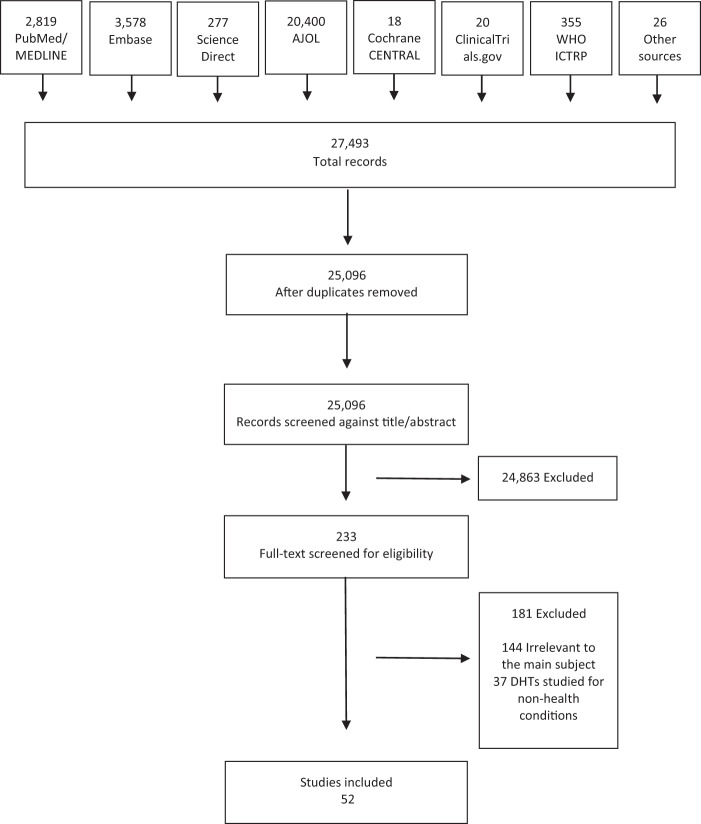
The World Health Organization (WHO) recently put forth a Global Strategy on Digital Health 2020–2025 with several countries having already achieved key milestones. We aimed to understand whether and how digital health technologies (DHTs) are absorbed in Africa, tracking Ethiopia as a key node. We conducted a systematic review, searching PubMed-MEDLINE, Embase, ScienceDirect, African Journals Online, Cochrane Central Registry of Controlled Trials, ClinicalTrials.gov, and the WHO International Clinical Trials Registry Platform databases from inception to 02 February 2021 for studies of any design that investigated the potential of DHTs in clinical or public health practices in Ethiopia. This review was registered with PROSPERO ( CRD42021240645 ) and it was designed to inform our ongoing DHT-enabled randomized controlled trial (RCT) (ClinicalTrials.gov ID: NCT04216420 ). We found 27,493 potentially relevant citations, among which 52 studies met the inclusion criteria, comprising a total of 596,128 patients, healthy individuals, and healthcare professionals. The studies involved six DHTs: mHealth (29 studies, 574,649 participants); electronic health records (13 studies, 4534 participants); telemedicine (4 studies, 465 participants); cloud-based application (2 studies, 2382 participants); information communication technology (3 studies, 681 participants), and artificial intelligence (1 study, 13,417 participants). The studies targeted six health conditions: maternal and child health (15), infectious diseases (14), non-communicable diseases (3), dermatitis (1), surgery (4), and general health conditions (15). The outcomes of interest were feasibility, usability, willingness or readiness, effectiveness, quality improvement, and knowledge or attitude toward DHTs. Five studies involved RCTs. The analysis showed that although DHTs are a relatively recent phenomenon in Ethiopia, their potential harnessing clinical and public health practices are highly visible. Their adoption and implementation in full capacity require more training, access to better devices such as smartphones, and infrastructure. DHTs hold much promise tackling major clinical and public health backlogs and strengthening the healthcare ecosystem in Ethiopia. More RCTs are needed on emerging DHTs including artificial intelligence, big data, cloud, cybersecurity, telemedicine, and wearable devices to provide robust evidence of their potential use in such settings and to materialize the WHO’s Global Strategy on Digital Health.
Overview
The claims and statistics of this paper haven’t been checked yet.
Run the check — free, no account needed. It reads the open-access text and checks the sources it cites.
Integrity signals
Registry
Cites
Statistics
Figures
Verification
Claims the paper makes
The claims and statistics of this paper haven’t been checked yet.
Run the check — free, no account needed. It reads the open-access text and checks the sources it cites.
Claims other papers make about this one
Each is checked against this paper’s own text: does it say what the citing paper says it does?
The source backs part of the claim, not all of it — or backs it for a different population, condition or comparison.
In the citing paper
“This infrastructure gap hinders the development and deployment of practical systems such as health chatbot applications in resource-constrained regions like Ethiopia, despite their strong potential to reduce pressure on overstretched services and lower operational costs (Manyazewal et al., 2021;Bank, 2023).”
From Improving Amharic Information Retrieval with Translative and Multi-Agent Debate Retrieval Augmented Generation (2026) · cites this paper as Manyazewal et al., 2021
Experimental — accuracy not yet measuredThe source backs part of the claim, not all of it — or backs it for a different population, condition or comparison.
In the citing paper
“People living in LMICs, such as many countries in Africa, are at high risk of many health conditions compared to those living in high-income countries while having the most limited access to health innovations such as digital health intervention.”
From Effectiveness of digital health interventions on blood pressure control, lifestyle behaviours and adherence to medication in patients with hypertension in low-income and middle-income countries: a systematic review and meta-analysis of randomised controlled trials (2024) · cites this paper as [20]
Experimental — accuracy not yet measured
Self-check
Percentages, sums and reported differences re-computed from the paper’s own numbers.
The self-check needs the paper’s full text.
Citations
Cites
Human-computer collaboration for skin cancer recognition
Tschandl, P., Rinner, C., Apalla, Z., Argenziano, G., Codella, N., Halpern, A., Janda, M., Lallas, A., Longo, C., Malvehy, J., et al. (2020) · Nature Medicine · doi:10.1038/s41591-020-0942-0 · Cited by 1,024
Artificial intelligence powers digital medicine
Fogel, A. L., & Kvedar, J. C. (2018) · npj Digital Medicine · doi:10.1038/s41746-017-0012-2 · Cited by 473
Daly, A. C., Prendergast, M. E., Hughes, A. J., & Burdick, J. A. (2021) · Cell · doi:10.1016/j.cell.2020.12.002 · Cited by 354
Technology approaches to digital health literacy.
Dunn, P., & Hazzard, E. (2019) · International Journal of Cardiology · doi:10.1016/j.ijcard.2019.06.039 · Cited by 232
The Future of Wearable Technologies and Remote Monitoring in Health Care
Liao, Y., Thompson, C. A., Peterson, S. K., Mandrola, J. M., & Beg, M. S. (2019) · American Society of Clinical Oncology Educational Book · doi:10.1200/edbk_238919 · Cited by 195
Kalayou, M. H., Endehabtu, B. F., & Tilahun, B. C. (2020) · Journal of Multidisciplinary Healthcare · doi:10.2147/jmdh.s284973 · Cited by 179
Comparing machine learning algorithms for predicting ICU admission and mortality in COVID-19
Subudhi, S., Verma, A., Patel, A. B., Hardin, C., Khandekar, M. J., Lee, H., McEvoy, D. S., Stylianopoulos, T., Munn, L. L., Dutta, S., et al. (2021) · npj Digital Medicine · doi:10.1038/s41746-021-00456-x · Cited by 171
Wiljer, D., & Hakim, Z. (2019) · Journal of Medical Imaging and Radiation Sciences · doi:10.1016/j.jmir.2019.09.010 · Cited by 170
Biruk, S., Yilma, T. M., Andualem, M., & Tilahun, B. C. (2014) · BMC Medical Informatics and Decision Making · doi:10.1186/s12911-014-0115-5 · Cited by 164
Shiferaw, F., & Zolfo, M. (2012) · Global Health Action · doi:10.3402/gha.v5i0.15638 · Cited by 161
Research works printed but not linked: 2
- United Nations Conference on Trade and Development (UNCTED). Selected sustainable development trends in the least developed countries—2019. https://unctad.org/en/PublicationsLibrary/aldc2019d1_en.pdf (Geneva, 2019).
- United Nations Conference on Trade and Development (UNCTED). Technology and innovation report—2018: Harnessing Frontier Technologies for Sustainable Development. https://unctad.org/en/PublicationsLibrary/tir2018_en.pdf (Geneve, 2018).
Cited by
Sorted by citations
Roppelt, J. S., Kanbach, D. K., & Kraus, S. (2023) · Technology in Society · doi:10.1016/j.techsoc.2023.102443 · Cited by 193
Acceptance of telemedicine technology among physicians: A systematic review
Garavand, A., Aslani, N., Nadri, H., Abedini, S., & Dehghan, S. (2022) · Informatics in Medicine Unlocked · doi:10.1016/j.imu.2022.100943 · Cited by 136
Digital health in the era of COVID-19: Reshaping the next generation of healthcare
Getachew, E., Adebeta, T., Muzazu, S. G. Y., Charlie, L., Said, B., Tesfahunei, H. A., Wanjiru, C. L., Acam, J., Kajogoo, V. D., Solomon, S., et al. (2023) · Frontiers in Public Health · doi:10.3389/fpubh.2023.942703 · Cited by 100
Self-citationHunde, M. K., Demsash, A. W., & Walle, A. D. (2022) · Informatics in Medicine Unlocked · doi:10.1016/j.imu.2022.101154 · Cited by 84
Metadata
- Authors
- Manyazewal, T., Woldeamanuel, Y., Blumberg, H. M., Fekadu, A., & Marconi, V. C.
- Affiliations
- Addis Ababa University (ET)
- Emory University (US)
- Corresponding author
- Manyazewal, Tsegahun
- ORCID
- Venue
- npj Digital Medicine
- Published
- 2021-08-17
- Volume
- 4
- Issue
- 1
- Pages
- 125-125
- ISSN
- 2398-6352 (ISSN-L)
- PMC
- PMC8371011
- OpenAlex
- W3194185186
- Cited by
- 177
- References
- 112
- Citations by year
- 2026: 33 · 2025: 43 · 2024: 42 · 2023: 27 · 2022: 28 · 2021: 4
- FWCI
- 5.22
- Type
- journal article
- Language
- en
- Open access
- gold
- doi.org
- Locations
- npj Digital Medicine (publishedVersion, cc-by)
- medRxiv (acceptedVersion, cc-by-nc-nd)
- PubMed Central (publishedVersion, cc-by)
- PubMed (publishedVersion)
- DOAJ (DOAJ: Directory of Open Access Journals) (submittedVersion, cc-by-sa)
- Figshare (submittedVersion, cc-by)
- Funders
- U.S. Department of Health & Human Services | NIH | Fogarty International Center (D43TW009127)
- Emory University | Center for AIDS Research, Emory University (P30 AI050409)
- Topics
- Health Sciences › Health Professions › General Health Professions › Mobile Health and mHealth Applications
- Health Sciences › Medicine › Public Health, Environmental and Occupational Health › Telemedicine and Telehealth Implementation
- Physical Sciences › Computer Science › Information Systems › ICT in Developing Communities
- Keywords
- digital health technologies, Ethiopia, mobile health, electronic health records, telemedicine, cloud applications, information and communication technologies, artificial intelligence in healthcare, maternal and child health, infectious diseases, non-communicable diseases, technology adoption, feasibility and usability, health infrastructure, digital health implementation, smartphone access
About these checks
Registry, retraction, Cites and statistics results are computed, not judged, with one exception: a printed reference that no index lists is read once by a model before it counts as a citation error. Claims are extracted by a model and kept only when their quote appears verbatim in the text; each cited source is then checked, with a model’s help, for whether it says what the claim relies on. Those verdicts can be wrong — read the claim’s quote and the cited source before relying on one.
Statistics and arithmetic are recomputed, not judged.
Confidence bands are shown only for fields calibrated on our annotated test set. None is calibrated yet, so no band is shown.
What counts as a claim ›How we measure confidence ›How we check this ›
Are you an author, or do you see a problem with this page? Request a review
