

The DOI matches its Crossref record; 42 of the 42 references it cites were found in a registry or an index; 16 of the 27 sources its claims cite were checked for support.
Machine learning predicts sepsis deterioration trajectories.
Open accessAbstract
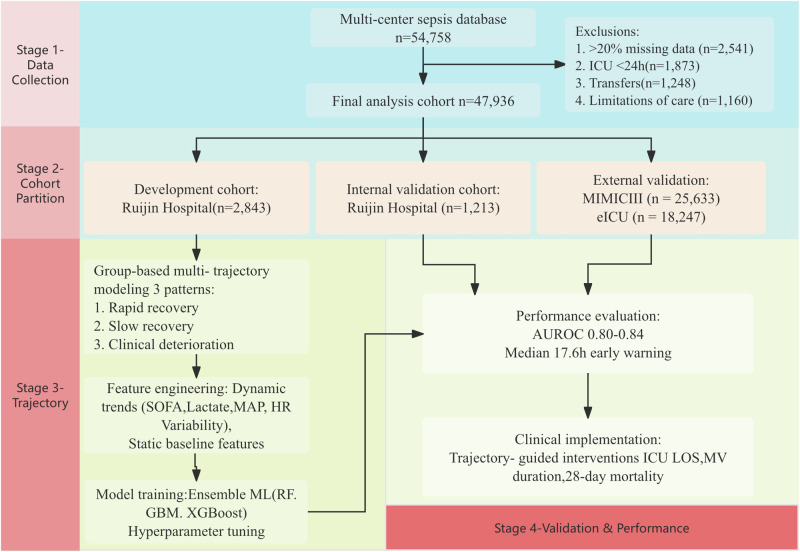
Sepsis has heterogeneous clinical trajectories, but conventional severity scores offer only static risk estimates. Timely, dynamic prediction could enable personalized intervention. In this multicenter retrospective study of 47,936 ICU patients meeting Sepsis-3 criteria from one institutional and two public datasets (MIMIC-III, eICU; sensitivity in MIMIC-IV), group-based trajectory modeling identified latent recovery patterns. An ensemble machine-learning model incorporating dynamic physiological variability was trained, temporally validated, and externally tested; clinical impact was assessed following implementation. Three trajectories emerged: rapid recovery (41.5%), slow recovery (36.4%), and clinical deterioration (22.1%). In the final binary classification task, AUROC was 0.92 (development), 0.89 (internal), 0.84 (MIMIC-III) and 0.77 (eICU); median warning time before deterioration was 17.6 h (Overall pooled across all cohorts). Reduced heart rate variability (SD < 10 bpm) predicted mortality (adjusted HR 2.17). Implementation reduced ICU stay by 1.8 days, machanical ventilation by 2.3 days, and 28-day mortality by 5.7%. This externally validated trajectory-based model offers accurate, early risk stratification for sepsis, supporting proactive, individualized critical care.
Overview
CoChat Summary
## TL;DR
This multicenter retrospective study developed and externally validated a trajectory-based machine-learning model to predict sepsis deterioration among 47,936 ICU patients meeting Sepsis-3 criteria. The model achieved AUROC 0.92 in development and 0.77 in eICU, identified three trajectories, and showed a median 17.6 h warning time before deterioration.
## Key findings
- Group-based trajectory modeling identified three sepsis trajectories: rapid recovery (41.5%, n = 19,883), slow recovery (36.4%, n = 17,449), and clinical deterioration (22.1%, n = 10,604).
- In the final binary classification task (clinical deterioration vs. non-deterioration), AUROC was 0.92 in development, 0.89 in internal validation, 0.84 in MIMIC-III, and 0.77 in eICU; corresponding AUPRC values were 0.87, 0.84, 0.80, and 0.73.
- The model provided a median warning time of 17.6 h before clinical deterioration; within the 12-hour window, sensitivity was 0.83 and specificity was 0.88.
- Reduced heart rate variability (HR SD < 10 bpm) was associated with higher 28-day mortality risk (adjusted HR 2.17, 95% CI 1.68–2.79); implementation was associated with reductions in ICU stay by 1.8 days, mechanical ventilation duration by 2.3 days, and 28-day mortality by 5.7%.
## Methods
- Multicenter retrospective cohort study using 47,936 adult ICU patients with sepsis-3 from one institutional dataset plus MIMIC-III and eICU; MIMIC-IV was used for sensitivity analysis.
- Patients had at least three observed time points (median 7); 45 candidate variables were narrowed using clinical relevance, missingness thresholds, LASSO, and random forest importance, with temporal features derived from vital signs, labs, SOFA, and treatment data.
- Group-based trajectory modeling selected a three-class solution; machine-learning models (including random forest, gradient boosting, and deep learning approaches) were trained with temporal validation, external validation, SHAP interpretation, Cox models, and propensity score-matched pre/post implementation analyses.
## Limitations
- The paper states that validation was limited to datasets from the United States and China, so broader geographic generalizability remains untested.
- The implementation analysis was non-randomized, so causality cannot be definitively established.
- The model requires high-resolution temporal data, which may limit applicability in resource-constrained settings.
- Evident from the text: the study is retrospective, so temporal bias and unmeasured confounding are concerns; the paper explicitly notes these in the Discussion.
Model-written summary. Check it against the paper before relying on it.
Integrity signals
Registry
Cites
Statistics
Figures


Verification
Claims the paper makes
9 Valid · 6 Not valid · 5 Not checked · 112 Own results and interpretations
The cited sources support only part of this claim — read each source’s verdict below.
In the paper
“However, existing studies have largely focused on binary outcome prediction (e.g., mortality) and less on dynamic prediction of patient recovery trajectories12,13.”
§ Machine learning predicts sepsis deterioration trajectories > Introduction
What the sources say
- Not checked — no full text of the sourcecites [12] Henry, K. E., Hager, D. N., Pronovost, P. J. & Saria, S. A targeted real-time early warning score (TREWScore) for septic shock. Sci. Transl. Med. 7, 299ra122 (2015). source
- Partly supportedcites [13] Desautels, T. et al. Prediction of sepsis in the intensive care unit with minimal electronic health record data: a machine learning approach. JMIR Med. Inform. 4, e28 (2016). sourceExperimental — accuracy not yet measured
The Methods (Machine Learning Methods; page unavailable) describe a binary classifier predicting whether an ICU patient will become septic, so this paper is an example of binary-outcome prediction. It does not establish that existing studies have largely focused on binary outcomes or rarely predict recovery trajectories. Its predictions concern sepsis onset at several time horizons, not mortality or recovery. (LLM, conf=0.86)
plain- Asserted: passes — The authors put it forward as true.
- Checkable: passes — It can be checked against evidence.
- Load-bearing: passes — The paper’s conclusions depend on it.
- Based: passes — The paper gives a reason why it holds.
The cited sources support only part of this claim — read each source’s verdict below.
In the paper
“Additionally, many prediction models lack external validation, particularly in real-world clinical settings14,15.”
§ Machine learning predicts sepsis deterioration trajectories > Introduction
What the sources say
- Not matchedcites [14] Futoma, J. et al. An improved multi-output Gaussian process RNN with real-time validation for early sepsis detection. Proc. Mach. Learn. Healthcare 68, 243–254 (2017).
Couldn’t be matched to a paper in Crossref, so it can’t be checked.
- Partly supportedcites [15] Wong, A. et al. External validation of a widely implemented proprietary sepsis prediction model in hospitalized patients. JAMA Intern. Med. 181, 1065–1070 (2021). sourceExperimental — accuracy not yet measured
The Introduction (page unavailable) says the widely used Epic Sepsis Model had no published independent validation before this study, and the Conclusions question whether proprietary model documents reflect real-world performance. The paper does not establish that many prediction models lack external validation, particularly in real-world clinical settings; its validation finding concerns one model. (LLM, conf=0.86)
plain- Asserted: passes — The authors put it forward as true.
- Checkable: passes — It can be checked against evidence.
- Load-bearing: passes — The paper’s conclusions depend on it.
- Based: passes — The paper gives a reason why it holds.
- Not matched
The cited sources support only part of this claim — read each source’s verdict below.
In the paper
“The clinical progression of sepsis exhibits significant heterogeneity, with patients potentially experiencing rapid recovery, gradual improvement, or continued deterioration4.”
§ Machine learning predicts sepsis deterioration trajectories > Introduction
What the sources say
- Partly supportedcites [4] Kennedy, M., Joyce, N., Howell, M. D., Lawrence Motley, J. & Shapiro, N. I. Identifying infected emergency department patients admitted to the hospital ward at risk of clinical deterioration and intensive care unit transfer. Acad. Emerg. Med. 17, 1080–1085 (2010). sourceExperimental — accuracy not yet measured
The Discussion (page unavailable) reports that some ED patients with suspected infection deteriorated and required early ICU transfer, while cellulitis was associated with a better outcome. It does not describe rapid recovery or gradual improvement as distinct clinical courses, and its study population had suspected infection rather than confirmed sepsis. (LLM, conf=0.82)
hedged- Asserted: passes — The authors put it forward as true.
- Checkable: passes — It can be checked against evidence.
- Load-bearing: passes — The paper’s conclusions depend on it.
- Based: passes — The paper gives a reason why it holds.
- Partly supported
The cited sources support only part of this claim — read each source’s verdict below.
In the paper
“This finding is consistent with the theory of “critical slowing down,” where decreasing variability in biological systems signals impending state transitions20.”
§ Machine learning predicts sepsis deterioration trajectories > Discussion
What the sources say
- Partly supportedcites [20] Ahmad, S., Tejuja, A., Newman, K. D., Zarychanski, R. & Seely, A. J. Clinical review: a review and analysis of heart rate variability and the diagnosis and prognosis of infection. Crit. Care. 13, 232 (2009). sourceExperimental — accuracy not yet measured
The Prognostication section links reduced HRV measures with deterioration and mortality, and the Discussion links decreased variation with infection severity. But the paper does not identify this pattern as “critical slowing down” or say that decreasing variability signals impending state transitions. (LLM, conf=0.83)
plainstates an association- Asserted: passes — The authors put it forward as true.
- Checkable: passes — It can be checked against evidence.
- Load-bearing: unclear — It is unclear whether the paper’s conclusions depend on it.
- Based: passes — The paper gives a reason why it holds.
- Partly supported
The cited sources that could be checked couldn’t confirm or dispute this claim.
In the paper
“This demonstrates the generalizability of our approach and suggests that the identified trajectory patterns represent fundamental aspects of sepsis pathophysiology rather than artifacts of local care patterns24,25.”
§ Machine learning predicts sepsis deterioration trajectories > Discussion
What the sources say
- Could not verifycites [24] Giannini, H. M. et al. A machine learning algorithm to predict severe sepsis and septic shock: development, implementation, and impact on clinical practice. Crit. Care Med. 47, 1485–1492 (2019). sourceExperimental — accuracy not yet measured
The Discussion (Algorithm Design and Future Algorithm Optimization; page unavailable) describes a sepsis prediction algorithm and says its criteria were not externally validated. Although it mentions a patient’s sepsis trajectory and changing practice patterns, it does not identify trajectory patterns or assess whether they reflect sepsis pathophysiology rather than local care. Searches for trajectory patterns, generalizability, and local care patterns found no passage addressing that distinction. (LLM, conf=0.76)
- Could not verifycites [25] Shimabukuro, D. W., Barton, C. W., Feldman, M. D., Mataraso, S. J. & Das, R. Effect of a machine learning-based severe sepsis prediction algorithm on patient survival and hospital length of stay: a randomised clinical trial. BMJ Open Respir. Res. 4, e000234 (2017). sourceExperimental — accuracy not yet measured
The Introduction defines sepsis, and the Methods describe care at UCSF, but neither addresses identified trajectory patterns or whether they reflect pathophysiology rather than local care. A search for trajectory patterns and cross-hospital generalizability found no passage making that comparison; the Discussion’s Limitations instead concern how far this single-centre trial’s algorithm results can be generalized. (LLM, conf=0.75)
hedged- Asserted: passes — The authors put it forward as true.
- Checkable: passes — It can be checked against evidence.
- Load-bearing: passes — The paper’s conclusions depend on it.
- Based: passes — The paper gives a reason why it holds.
- Could not verify
65 more claims · 4 with their cited sources checked
Create a free account to see all 132 claims and every source verdict.
- It may state two separate claims as one. 43
- Probably not a substantial claim. 24
- The quote only partly states this claim. 1
Citations
Cites
Breiman, L. (2001) · Machine Learning · doi:10.1023/a:1010933404324 · Cited by 133,538
Regression shrinkage and selection via the lasso
Tibshirani, R. (1996) · Journal of the Royal Statistical Society Series B: Statistical Methodology · doi:10.1111/j.2517-6161.1996.tb02080.x · Cited by 51,482 · cited 1×
“Feature selection was performed in three steps: (1) clinical relevance assessment; (2) data availability assessment (excluding variables with>30% missing values); and (3) statistical featureselectionusing LASSO regression and random forest importance ranking 34,35 .”
Charlson, M. E., Pompei, P., Ales, K. L., & MacKenzie, C. R. (1987) · Journal of Chronic Diseases · doi:10.1016/0021-9681(87)90171-8 · Cited by 49,742 · cited 1×
“The fi nal feature set included static features (demographics, baseline chronic diseases as measured by the Charlson Comorbidity Index 36 , admission type, and infection source) and dynamic features (vital signs, laboratory tests, organ function assessments, and treatment interventions).”
The third international consensus definitions for sepsis and septic shock (Sepsis-3).
Singer, M., Deutschman, C. S., Seymour, C. W., Shankar-Hari, M., Annane, D., Bauer, M., Bellomo, R., Bernard, G. R., Chiche, J.-D., Coopersmith, C. M., et al. (2016) · JAMA · doi:10.1001/jama.2016.0287 · Cited by 28,250
von Elm, E., Altman, D. G., Egger, M., Pocock, S. J., Gøtzsche, P. C., Vandenbroucke, J. P., & Initiative, F. T. S. (2007) · Annals of Internal Medicine · doi:10.7326/0003-4819-147-8-200710160-00010 · Cited by 17,796
mice: Multivariate Imputation by Chained Equations in R
Buuren, S. V., & Groothuis-Oudshoorn, K. (2011) · Journal of Statistical Software · doi:10.18637/jss.v045.i03 · Cited by 13,870 · cited 1×
“Missing data were handled using multiple imputation by chained equations for variables with <30% missingness 41 .”
Austin, P. C. (2011) · Multivariate Behavioral Research · doi:10.1080/00273171.2011.568786 · Cited by 12,242
Vincent, J. L., Moreno, R., Takala, J., Willatts, S., De Mendonça, A., Bruining, H., Reinhart, C. K., Suter, P. M., & Thijs, L. G. (1996) · Intensive Care Medicine · doi:10.1007/bf01709751 · Cited by 11,674 · cited 1×
“High temporal resolution data were collected: vital signs were recorded hourly, laboratory tests were performedaccording toclinical protocols, and SOFAscoreswere calculated every 6 h 37 .”
Rudd, K. E., Johnson, S. C., Agesa, K. M., Shackelford, K. A., Tsoi, D., Kievlan, D. R., Colombara, D. V., Ikuta, K. S., Kissoon, N., Finfer, S., et al. (2020) · The Lancet · doi:10.1016/s0140-6736(19)32989-7 · Cited by 7,971 · cited 2×
“Theprocessbeganwith45candidate variablesidenti fi ed through literature review and expert consultation (Supplementary note 1 – 5).”
Approximate entropy as a measure of system complexity.
Pincus, S. M. (1991) · Proceedings of the National Academy of Sciences · doi:10.1073/pnas.88.6.2297 · Cited by 5,811 · cited 1×
“…temporal features including raw and normalized values, rates of change (every 6, 12, and 24 h), variability indicators (standard deviation, coef fi cient of variation), trend features (linear regression slope), and fl uctuation complexity indicators (sample entropy, approximate entropy) 38 – 40 .”
Research works printed but not linked: 3
- Futoma, J. et al. An improved multi-output Gaussian process RNN with real-time validation for early sepsis detection. Proc. Mach. Learn. Healthcare 68, 243–254 (2017).
- Futoma, J., Hariharan, S. & Heller, K. Learning to detect sepsis with a multitask Gaussian process RNN classifier. Proc. 34th Int. Conf. Mach. Learn. 70, 1174–1182 (2017).
- Futoma, J. et al. An improved multi-output Gaussian process RNN with real-time validation for early sepsis detection. Proc. Mach. Learn. Healthcare. 68, 243–254 (2017).
Cited by
Căliman-Sturdza, O. A., Gheorghita, R. E., Filip, R., & Lobiuc, A. (2026) · Diagnostics · doi:10.3390/diagnostics16121827 · Cited by 4
“In infectious diseases, the application of AI integration can be viewed as a closed-loop socio-technical system in data capture, inference, human interpretation, action (antibiotics, isolation, and workup), outcomes, and feedback/model monitoring [41].”
Fu, X., Gao, X., Kong, L., & Tang, Y. (2026) · Journal of Affective Disorders · doi:10.1016/j.jad.2026.122213
Zhang, Y., Wu, X., Yang, Y., et al. (2026) · The American Journal of Emergency Medicine · doi:10.1016/j.ajem.2026.08.021
Luo, M., Zhou, J., Pang, Y., Xing, Z., Yuan, J., Zhang, Y., & 谢杰斌 (2026) · Frontiers in Oncology · doi:10.3389/fonc.2026.1915256
“To improve feature stability, we used an ensemble voting strategy that combined LASSO, RFMDA, SVM-RFE, and stepwise AIC (25).”
Kömürcü, Ö., Durmuşoğlu, Z. D. U., Gümüş, N. E., & Ceylan, T. (2026) · Trends in Anaesthesia and Critical Care · doi:10.1016/j.tacc.2026.101704
Metadata
- Authors
- Zhang, R., Long, F., Zhao, Z., Wu, J., Tan, R., Xu, W., Li, L., Long, Y., & Qu, H.
- Affiliations
- Chinese Academy of Medical Sciences & Peking Union Medical College (CN)
- Shanghai Jiao Tong University (CN)
- Corresponding author
- Wu, Jingyi
- Tan, Ruoming
- Xu, Wen
- Long, Yun
- Qu, Hongping
- Venue
- NPJ Digital Medicine
- Published
- 2026-03-26
- Volume
- 9
- Issue
- 1
- ISSN
- 2398-6352 (ISSN-L)
- PMC
- PMC13187286
- OpenAlex
- W7140750475
- Cited by
- 6
- References
- 40
- Citations by year
- 2026: 6
- FWCI
- 27.67
- Type
- journal article
- Language
- en
- Open access
- gold
- doi.org
- Licence
- cc-by-nc-nd
- creativecommons.org/licenses/by-nc-nd/4.0 (tdm)
- creativecommons.org/licenses/by-nc-nd/4.0 (vor, 55 d)
- Locations
- npj Digital Medicine (publishedVersion, cc-by-nc-nd)
- PubMed (publishedVersion)
- PubMed Central (publishedVersion, cc-by-nc-nd)
- DOAJ (DOAJ: Directory of Open Access Journals) (submittedVersion, cc-by-sa)
- Funders
- National Natural Science Foundation of China (82470088)
- Shanghai Science and Technology Commission Project (23Y11900100)
- science and technology commission of shanghai municipality (24ZR1447000)
- National High-Level Hospital Clinical Research Funding (2022- PUMCH-B-115)
- Topics
- Health Sciences › Medicine › Critical Care and Intensive Care Medicine › Sepsis Diagnosis and Treatment
- Physical Sciences › Computer Science › Artificial Intelligence › Machine Learning in Healthcare
- Health Sciences › Medicine › Endocrinology, Diabetes and Metabolism › Hyperglycemia and glycemic control in critically ill and hospitalized patients
- Keywords
- sepsis, clinical trajectories, group-based trajectory modeling, Sepsis-3, intensive care unit patients, heart rate variability, mortality prediction, risk stratification, ensemble learning, MIMIC-III, eICU
About these checks
Registry, retraction, Cites and statistics results are computed, not judged, with one exception: a printed reference that no index lists is read once by a model before it counts as a citation error. Claims are extracted by a model and kept only when their quote appears verbatim in the text; each cited source is then checked, with a model’s help, for whether it says what the claim relies on. Those verdicts can be wrong — read the claim’s quote and the cited source before relying on one.
The claim verdicts this report counts are experimental: their accuracy is not yet measured.
A language model drew the claims from the paper on 2026-10-10, under version 3 of the claim definition (model deepseek-v4.1-flash, prompt extract-v3).
A second model labelled each claim on 2026-10-10 (model jev-1.13-20260917, definition revision gold-guideline-v0.2).
Cited sources are checked with a language model’s help (gpt-6-sol).
Statistics and arithmetic are recomputed, not judged.
Confidence bands are shown only for fields calibrated on our annotated test set. None is calibrated yet, so no band is shown.
What counts as a claim ›How we measure confidence ›How we check this ›
Are you an author, or do you see a problem with this page? Request a review
How to cite
Cite CoChat for the checks on this page, and the paper for its own findings.
- This page
- CoChat. (2026). Citation check: Machine learning predicts sepsis deterioration trajectories. https://app.cochat.ai/papers/10.1038/s41746-026-02565-x
- The paper
- Zhang, R., Long, F., Zhao, Z., Wu, J., Tan, R., Xu, W., Li, L., Long, Y., & Qu, H. (2026). Machine learning predicts sepsis deterioration trajectories. NPJ Digital Medicine. https://doi.org/10.1038/s41746-026-02565-x
Data sources
Bibliographic data: Semantic Scholar, OpenAlex, Crossref.
Contains information from the Semantic Scholar Academic Graph Datasets, made available under the ODC Attribution License (ODC-BY 1.0).
Semantic Scholar’s data is described in: Kinney, R., et al. (2023). The Semantic Scholar Open Data Platform. arXiv:2301.10140.
