

Future growth and decline of high mountain Asia's ice-dammed lakes and associated risk
Open accessThe DOI matches its Crossref record; 66 of the 66 references it cites were found in a registry or an index.
Abstract
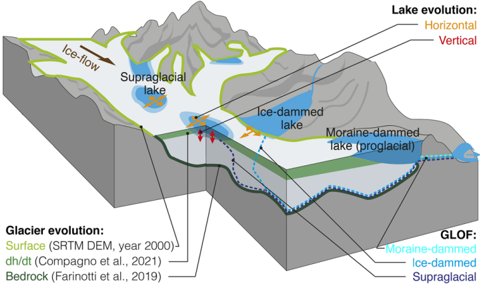
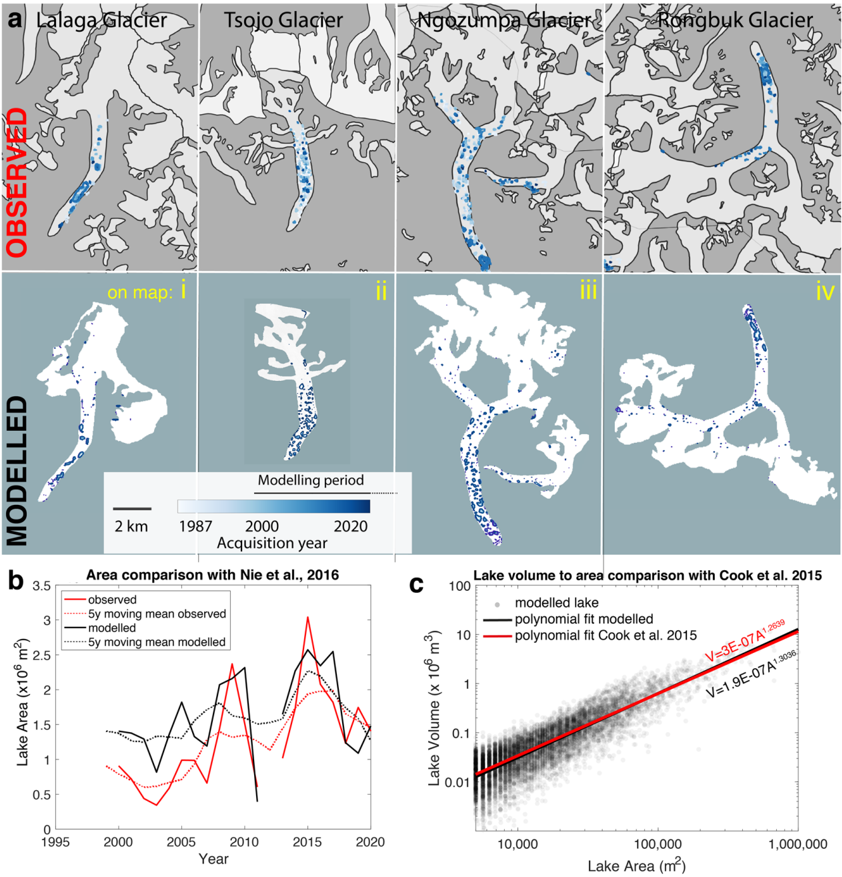
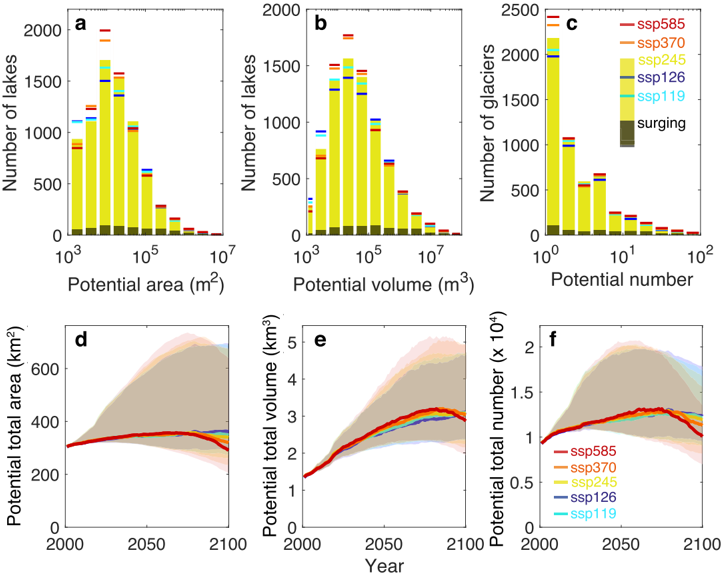
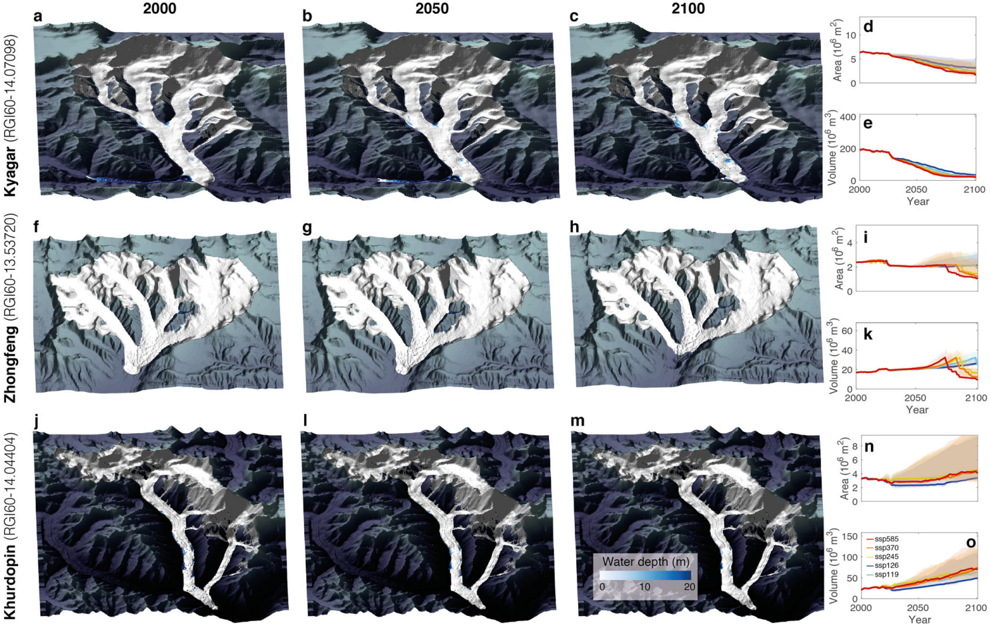
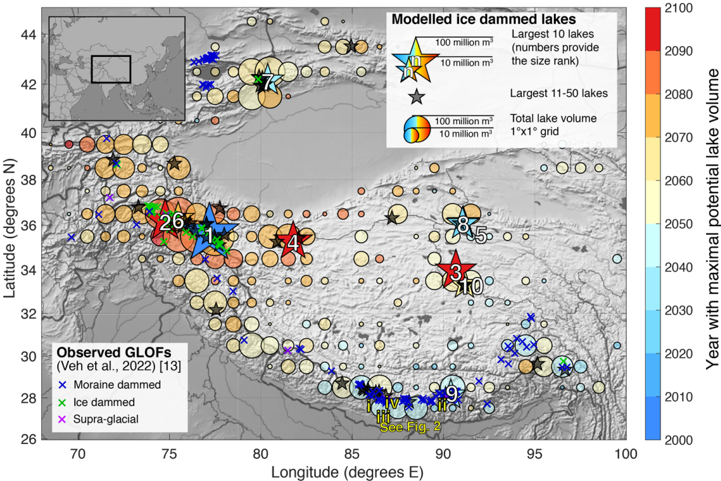
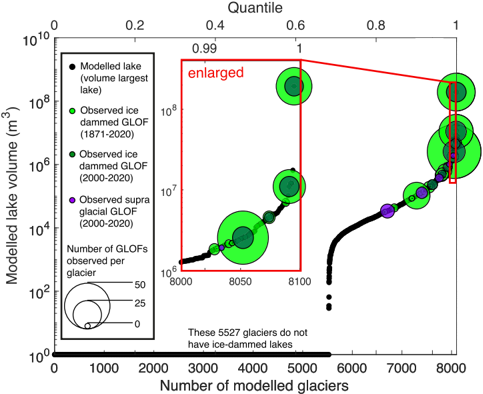
Glaciers around the world are shrinking rapidly and will continue to do so in the next decades. Anticipating the consequences resulting from such glacier changes is key to design and implement adequate mitigation measures. Here, we focus on the future evolution of potential ice-dammed and supraglacial lakes in High Mountain Asia, as such lakes are responsible for the majority of glacier lake outburst floods in the region. We identify 11,129 potential lakes at present, with a total maximum volume of 2070 million m 3. We find a strong correlation between large modelled lakes and historical outburst floods. By accounting for the evolution of glaciers under different climate change mitigation measures, we project that the number of potential ice-dammed lakes could increase by between 15 and 18% until 2080, with a concomitant 45–55% increase in their volume. Our findings thus suggest that a temporary increase of glacier lake outburst floods is to be expected in the coming decades.
Overview
The claims and statistics of this paper haven’t been checked yet.
Free: it reads the open-access text and checks the first 5 claims that cite a source we can check. Create a free account to check every claim.
Integrity signals
Registry
Cites
Statistics
Figures
Verification
Claims the paper makes
The claims and statistics of this paper haven’t been checked yet.
Free: it reads the open-access text and checks the first 5 claims that cite a source we can check. Create a free account to check every claim.
Claims other papers make about this one
Each is checked against this paper’s own text: does it say what the citing paper says it does?
In the citing paper
“During deglaciation, in addition to the emergence of bedrock depressions shaped by glacial erosion, the accumulation of materials can form topographical dams and lead to the formation of postglacial lakes (i.e.moraine-dammed, landslide-dammed, ice-dammed lakes, e.g.Carrivick & Tweed, 2013; Shugar et al., 2020; Compagno et al., 2022) or lagoons separated from the ocean by a sedimentary shoreline (e”
From Future emergence of new ecosystems caused by glacial retreat (2023) · cites this paper as Compagno et al., 2022
Self-check
Percentages, sums and reported differences re-computed from the paper’s own numbers.
The self-check needs the paper’s full text.
Citations
Cites
Eyring, V., Bony, S., Meehl, G. A., Senior, C. A., Stevens, B., Stouffer, R. J., & Taylor, K. E. (2016) · Geoscientific Model Development · doi:10.5194/gmd-9-1937-2016 · Cited by 11,981
The Shuttle Radar Topography Mission
Farr, T. G., Rosen, P. A., Caro, E., Crippen, R., Duren, R., Hensley, S., Kobrick, M., Paller, M., Rodriguez, E., Roth, L., et al. (2007) · Reviews of Geophysics · doi:10.1029/2005rg000183 · Cited by 8,927
Accelerated global glacier mass loss in the early twenty-first century
Hugonnet, R., McNabb, R., Berthier, E., Menounos, B., Nuth, C., Girod, L., Farinotti, D., Huss, M., Dussaillant, I., Brun, F., et al. (2021) · Nature · doi:10.1038/s41586-021-03436-z · Cited by 1,910
Self-citationA spatially resolved estimate of High Mountain Asia glacier mass balances from 2000 to 2016
Brun, F., Berthier, E., Wagnon, P., Kääb, A., & Treichler, D. (2017) · Nature Geoscience · doi:10.1038/ngeo2999 · Cited by 1,197
Impact of a global temperature rise of 1.5 degrees Celsius on Asia’s glaciers
Kraaijenbrink, P. D. A., Bierkens, M. F. P., Lutz, A. F., & Immerzeel, W. W. (2017) · Nature · doi:10.1038/nature23878 · Cited by 899
A consensus estimate for the ice thickness distribution of all glaciers on Earth
Farinotti, D., Huss, M., Fürst, J. J., Landmann, J., Machguth, H., Maussion, F., & Pandit, A. (2019) · Nature Geoscience · doi:10.1038/s41561-019-0300-3 · Cited by 891
Self-citationRapid worldwide growth of glacial lakes since 1990
Shugar, D. H., Burr, A., Haritashya, U. K., Kargel, J. S., Watson, C. S., Kennedy, M. C., Bevington, A. R., Betts, R. A., Harrison, S., & Strattman, K. (2020) · Nature Climate Change · doi:10.1038/s41558-020-0855-4 · Cited by 677 · cited 1×
“A rigorous validation against lake extents mapped from satellite imagery (see Methods) and two recent studies targeting the recent evolution of HMA’s glacier lakes2,29, shows that the model (1) correctly detects the majority of existing lakes, (2) has skill in reproducing the evolution of glacier lakes during the past…”
BackgroundA Systematic, Regional Assessment of High Mountain Asia Glacier Mass Balance
Shean, D. E., Bhushan, S., Montesano, P., Rounce, D. R., Arendt, A., & Osmanoglu, B. (2020) · Frontiers in Earth Science · doi:10.3389/feart.2019.00363 · Cited by 665
Benn, D. I., Bolch, T., Hands, K., Gulley, J., Luckman, A., Nicholson, L. I., Quincey, D., Thompson, S., Toumi, R., & Wiseman, S. (2012) · Earth-Science Reviews · doi:10.1016/j.earscirev.2012.03.008 · Cited by 632
Acceleration of ice loss across the Himalayas over the past 40 years
Maurer, J. M., Schaefer, J. M., Rupper, S., & Corley, A. (2019) · Science Advances · doi:10.1126/sciadv.aav7266 · Cited by 607
Research works printed but not linked: 2
- GAPHAZ. Assessment of Glacier and Permafrost Hazards in Mountain Regions - Technical Guidance Document. Prepared by Allen, S. et al. pp. 72 (Standing Group on Glacier and Permafrost Hazards in Mountains (GAPHAZ) of the International Association of Cryospheric Sciences (IACS) and the International Permafrost Association (IPA). Zurich, Switzerland/Lima, Peru, 2017).
- Sakai, A., Takeuchi, N., Fujita, K. & Nakawo, M. Role of supraglacial ponds in the ablation process of a debris-covered glacier in the nepal himalayas. Int. Assoc. Hydrol. Sci. 264, 119-130 (2000).
Cited by
Future emergence of new ecosystems caused by glacial retreat
Bosson, J. B., Huss, M., Cauvy-Fraunié, S., Clément, J. C., Costes, G., Fischer, M., Poulenard, J., & Arthaud, F. (2023) · Nature · doi:10.1038/s41586-023-06302-2 · Cited by 197
Self-citationCharacteristics and changes of glacial lakes and outburst floods
Zhang, G., Carrivick, J. L., Emmer, A., Shugar, D. H., Veh, G., Wang, X., Labedz, C. R., Mergili, M., Mölg, N., Huss, M., et al. (2024) · Nature Reviews Earth & Environment · doi:10.1038/s43017-024-00554-w · Cited by 185
“…can exist for vastly different timeframes: ice-dammed lakes can form and fail repeatedly as long as the ice dam is thick enough to impound a lake 33,64 ; bedrock-dammed lakes within overdeepenings can persist for tens of thousands of years 65–67 ; and moraine-dammed lakes can survive over…”
Self-citationA global database of historic glacier lake outburst floods
Lützow, N., Veh, G., & Korup, O. (2023) · Earth system science data · doi:10.5194/essd-15-2983-2023 · Cited by 157
“…of more and larger historic glacier lakes, estimates of whether GLOF hazard and risk have increased commensurately remain controversial (Richardson and Reynolds, 2000; Harrison et al., 2018; Nie et al., 2018; Veh et al., 2020; Bazai et al., 2021; Stuart-Smith et al., 2021; Compagno et al., 2022).”
BackgroundDrainage divide migration and implications for climate and biodiversity
He, C., Braun, J., Tang, H., Yuan, X., Acevedo‐Trejos, E., Ott, R. F., & de Quay, G. S. (2024) · Nature Reviews Earth & Environment · doi:10.1038/s43017-023-00511-z · Cited by 71
Zekollari, H., Huss, M., Schuster, L., Maussion, F., Rounce, D. R., Aguayo, R., Champollion, N., Compagno, L., Hugonnet, R., Marzeion, B., et al. (2024) · The Cryosphere · doi:10.5194/tc-18-5045-2024 · Cited by 79
Self-citationPeng, M., Wang, X., Zhang, G., Veh, G., Sattar, A., Chen, W., & Allen, S. (2023) · Journal of Hydrology · doi:10.1016/j.jhydrol.2023.130155 · Cited by 57
Progressively smaller glacier lake outburst floods despite worldwide growth in lake area
Veh, G., Wang, B. G., Zirzow, A., Schmidt, C., Lützow, N., Steppat, F., Zhang, G., Vogel, K., Geertsema, M., Clague, J. J., et al. (2025) · Nature Water · doi:10.1038/s44221-025-00388-w · Cited by 56
“https://doi.org/10.1038/s44221-025-00388-w This region could become a temporary hotspot of future GLOF activity should these ice-dammed lakes burst at similarly high rates to current ones 67 .”
InfluentialIrreversible glacier change and trough water for centuries after overshooting 1.5 °C
Schuster, L., Maussion, F., Rounce, D. R., Ultee, L., Schmitt, P., Lacroix, F. K. M., Frölicher, T. L., & Schleussner, C. (2025) · Nature Climate Change · doi:10.1038/s41558-025-02318-w · Cited by 47
“…the first studies including individual feedbacks in regional models indicated limited influence on regional projections (for example, debris cover 4 , calving 54 ), we expect the cumulative impact of all non-accounted feedbacks to increase the temporal irreversibility of glacier mass loss beyond…”
Zhou, Y., Wang, X., Chen, M., Fu, J., Zhu, T., Wang, C., Gong, P., Wang, L., & Ren, J. (2024) · Communications Earth & Environment · doi:10.1038/s43247-024-01223-y · Cited by 29
Age, climate and economic disparities drive the current state of global dam safety
Moreno-Rodenas, A., Mantilla-Jones, J. D., & Valero, D. (2025) · Nature Water · doi:10.1038/s44221-025-00402-1 · Cited by 31
“An associated risk are the glacier lake outburst floods, which are expected to increase in the high-mountain Asian region over the coming decades, associated to a 45–55% volume increase of ice-dammed lakes by 2080 87 .”
Wang, X., Ran, W., Wei, J., Yin, Y., Liu, S., Bolch, T., Zhang, Y., Xue, X., Ding, Y., Liu, Q., et al. (2024) · Journal of Hydrology · doi:10.1016/j.jhydrol.2024.130967 · Cited by 21
Tricht, L. V., & Huybrechts, P. (2023) · The Cryosphere · doi:10.5194/tc-17-4463-2023 · Cited by 18
“In these bedrock depressions, which will eventually become free of ice, it is very likely that (proglacial) lakes will form (Furian et al., 2022; Compagno et al., 2022).”
BackgroundLiu, Z., Yang, Z., He, N., Wei, L., Zhu, Y., Jiao, W., Wang, Z., Zhang, T., Zhang, J., & Zou, X. (2023) · Frontiers in Ecology and Evolution · doi:10.3389/fevo.2023.1296111 · Cited by 15
Akbar, S., Wang, J., Ullah, A., Latif, Y., & Muhammad, S. (2024) · Geomatics Natural Hazards and Risk · doi:10.1080/19475705.2024.2353838 · Cited by 13
“Global warming poses a threat to these glaciers (Compagno et al. 2022), resulting in rapid global retreat (Shean et al. 2020), while warming reported in the Himalayan region is higher than global mean warming (Negi et al. 2018;)”
A Monitoring Network for Mitigating Himalayan Glacial Lake Outburst Floods
Zhang, G., Yao, T., Huss, M., Carrivick, J. L., Bolch, T., Li, X., Zheng, G., Peng, M., Wang, X., Steiner, J. F., et al. (2025) · Bulletin of the American Meteorological Society · doi:10.1175/bams-d-24-0290.1 · Cited by 10
Self-citationUAS remote sensing applications to abrupt cold region hazards
Verfaillie, M., Cho, E., Dwyre, L., Khan, I., Wagner, C., Jacobs, J. M., & Hunsaker, A. G. (2023) · Frontiers in Remote Sensing · doi:10.3389/frsen.2023.1095275 · Cited by 13
Lu, J., Li, J., Menenti, M., Zheng, C., Hu, G., & Ji, D. (2025) · International Journal of Digital Earth · doi:10.1080/17538947.2025.2449706 · Cited by 12
“…of water resources along the Belt and Road is uneven, resulting in various water-related challenges, such as water scarcity, deforestation, drought, floods, air and water pollution, and habitat degradation (Compagno et al. 2022; Deng and Chen 2017; Dewan 2015; Dube et al. 2023; Hong et al. 2023).”
Will landscape responses reduce glacier sensitivity to climate change in High Mountain Asia?
Harrison, S., Racoviteanu, A. E., Shannon, S., Jones, D., Anderson, K., Glasser, N. F., Knight, J., Ranger, A., Mandal, A., Vishwakarma, B. D., et al. (2025) · The Cryosphere · doi:10.5194/tc-19-4113-2025 · Cited by 9
Dandabathula, G., Roy, S., Ghatage, O. S., Kolase, V. B., Satpute, S., Ghosh, K., Kaur, S., Pondari, S., Bera, A. K., & Srivastav, S. K. (2024) · Journal of Mountain Science · doi:10.1007/s11629-024-8820-8 · Cited by 5
“…Myanmar, Nepal, Pakistan, Tajikistan, and Uzbekistan hosts the most extensive distribution of glaciers, ice-dammed and supraglacial lakes, and permafrost and credited for originating major rivers for most of the Asian region (Immerzeel and Bierkens 2012; Compagno et al. 2022; Shen et al. 2022).”
Anthropogenic drivers and their impact on the hydrological regime of Nepal: a review
Sayedi, S. S., Singh, K. K., Fabrizio, M. C., & Nepal, S. (2026) · Environmental Research Letters · doi:10.1088/1748-9326/ae2ca8 · Cited by 7
“Rapid glacier retreat has increased the formation of glacial lakes (i.e. low-lying areas that accumulate meltwater), many of which are dammed by unstable moraines (figure 3; Compagno et al 2022).”
Patidar, P., Kumar, A., Reza, A., Sain, K., Haritashya, U. K., Kumar, N., Mishra, A., Verma, A., & Anand, S. (2025) · Hydrological Processes · doi:10.1002/hyp.70308 · Cited by 4
“…models to identify probable glacial lakes or over-deepening sites using advanced computing techniques and potential impact has been assessed using hydrodynamic modelling (Pandit and Ramsankaran 2020; Zheng et al. 2021; Compagno et al. 2022; Furian et al. 2022; Gantayat and Ramsankaran 2023).”
Positive glacial regulatory processes promote sustainability of Asian glacier water resources
Wang, Q., Wang, X., Duan, K., Liu, Q., Yin, Y., Ran, W., Shiyin, L. I. U., Bolch, T., Baldacchino, F., He, J., et al. (2026) · Communications Earth & Environment · doi:10.1038/s43247-026-03225-4 · Cited by 4
Li, Z., Wang, N., Chang, J., & Zhang, Q. (2023) · Remote Sensing · doi:10.3390/rs15112745 · Cited by 4
Zhang, L., Nie, Y., Hu, M., Wang, W., & Lyu, Q. (2026) · CATENA · doi:10.1016/j.catena.2026.110083 · Cited by 2
You, Y., Jiang, P., Wang, Y., Wang, W., Chen, D., & Hu, X. (2026) · Journal of Hydrology · doi:10.1016/j.jhydrol.2026.135285 · Cited by 2
Shrinkage and decreasing of lake water levels in Laut Tawar Lake, Aceh Province
Azwir, Azizah, C., Satriawan, H., Ernawita, Ridwansyah, I., & Robo, S. (2024) · IOP Conference Series Earth and Environmental Science · doi:10.1088/1755-1315/1436/1/012018 · Cited by 1
Severskiy, I., Kapitsa, V., Kasatkin, N., Usmanova, Z., Saks, T., Mattea, E., & Kissebayev, D. (2025) · Journal of Geography and Environmental Management · doi:10.26577/jgem.2024.v75.i4.2 · Cited by 1
Rani, S. (2023) · Advances in Asian human-environmental research · doi:10.1007/978-3-031-29525-6_1
Lützow, N. (2023) · Earth system science data · doi:10.5194/essd-2022-449-ac2
Lützow, N. (2023) · Earth system science data · doi:10.5194/essd-2022-449-ac1
Jie, D., Peng, Y., Wang, L., Kusky, T., Dong, S., Xing, K., & Dong, A. (2025) · Research Square · doi:10.21203/rs.3.rs-7242749/v1
ANALYSIS OF GLACIER AND MORAINE LAKE AREA CHANGES IN THE TURGEN RIVER BASIN
Amangeldi, A., Iskaliyeva, G., Merekeyev, A., & Sagat, M. (2025) · Hydrometeorology and ecology · doi:10.54668/2789-6323-2025-119-4-47-57
张, 太., 王, 伟., 汪, 鑫., 廖, 逸., & 安, 宝. (2026) · SCIENTIA SINICA Terrae · doi:10.1360/n072025-0447
Evolution and drainage of ice-dammed lakes in the interior Tibetan Plateau
Zhang, T., Wang, W., Wang, X., Liao, Y., & An, B. (2026) · Science China Earth Sciences · doi:10.1007/s11430-025-1769-2
“Ongoing glacier retreat in the Tibetan Plateau (Rounce et al., 2020; Zhao et al., 2023) is expected to coincide with the proliferation of ice-dammed lakes (Compagno et al., 2022).”
Shonazarovich, G. M., Xi, C. H. E. N., Safarov, M. S., Tie, L., Fazylov, A., & Navruzshoev, H. (2026) · Regional Sustainability · doi:10.1016/j.regsus.2026.100329
Xiaoen, L. I., Liu, Y., Pang, X., & Jiang, L. (2026) · IEEE Journal of Selected Topics in Applied Earth Observations and Remote Sensing · doi:10.1109/jstars.2026.3664708
“Researchers anticipate rapid expansion of proglacial lakes, with more new lakes likely to form [77], [78].”
Glacial Lakes – Archives of the Past Environmental Conditions From the Himalayan Region
Joshi, P., & Karthick, B. (2026) · Resonance · doi:10.1007/s12045-026-1923-5
“These studies utilise a range of climatic proxies, both biotic and abiotic, such as pollen analysis, diatom assemblages, and sediment cores with AMS chronology [6, 7].”
Ice-dammed lakes, outburst floods, and formation of the Gaccetávži ravine in Finnmark, NE Norway
Goodship, A., Anjar, J., Gjermundsen, E. F., & Alexanderson, H. (2026) · Geomorphology · doi:10.1016/j.geomorph.2026.110262
Ying, B., Xiong, Q., Zhu, X., Qi, W., Zhang, J., Zhao, X., & Cai, W. (2026) · Journal of Hydrology Regional Studies · doi:10.1016/j.ejrh.2026.103433
Lu, Y., Duan, K., Wang, Q., He, J., & Mao, X. (2026) · Chinese Science Bulletin (Chinese Version) · doi:10.1360/csb-2025-5905
Spatiotemporal glacier velocity variations in the Kashmir Himalaya during the past two decades
Ali, I., Garg, P. K., Shukla, A., Romshoo, S. A., & Lone, F. A. (2026) · Physics and Chemistry of the Earth Parts A/B/C · doi:10.1016/j.pce.2026.104486
Peng, Y., Dou, J., Kusky, T., Dong, S., Xing, K., & Dong, A. (2026) · Landslides · doi:10.1007/s10346-026-02827-5
“Understanding glacial lake outbursts as integrated mass-movement chains , rather than isolated flood events , is therefore essential for advancing hazard assessment and risk mitigation in high-altitude mountain environments (Compagno et al. 2022).”
Akbar, S., Wang, J., Ullah, A., & Muhammad, S. (2026) · Journal of Mountain Science · doi:10.1007/s11629-025-0294-9
“Regionally, parts of the Karakoram region have historically exhibited the so-called “Karakoram Anomaly”, characterized by advancing or stable glaciers, despite global warming (Farinotti et al. 2020; Compagno et al. 2022).”
Burton, J. W., Bernardin, M., & Albornoz, A. (2026) · Geomorphology · doi:10.1016/j.geomorph.2026.110481
Afzal, M. M., Xie, F., Zhu, Y., Nadeem, A. A., Hameed, F., Luo, Y., Yao, T., Sun, F., Wang, X., Liu, Q., et al. (2026) · Journal of Hydrology · doi:10.1016/j.jhydrol.2026.136205
Calving Mechanisms of Lake-Terminating Glaciers in the Southeastern Tibetan Plateau
Peng, M., Chen, W., Yang, W., Carrivick, J. L., Zhou, Y., Han, X., & Zhang, G. (2026) · Journal of Earth Science · doi:10.1007/s12583-025-0376-1 · Cited by 2
“As global temperatures rise, glaciers undergo accelerated ablation and retreat, creating a meltwater supply and landscape space for the formation and rapid expansion of glacial lakes (Zhang G Q et al., 2023; Compagno et al., 2022; Frey et al., 2010).”
Metadata
- Authors
- Compagno, L., Huss, M., Zekollari, H., Miles, E. S., & Farinotti, D.
- Affiliations
- Swiss Federal Institute for Forest, Snow and Landscape Research (CH)
- University of Fribourg (CH)
- Université Libre de Bruxelles (BE)
- Corresponding author
- Compagno, Loris
- Venue
- Communications Earth & Environment
- Published
- 2022-08-26
- Volume
- 3
- Issue
- 1
- Pages
- 191
- ISSN
- 2662-4435 (ISSN-L)
- OpenAlex
- W4293116182
- Cited by
- 43
- References
- 64
- Citations by year
- 2026: 17 · 2025: 8 · 2024: 8 · 2023: 9 · 2022: 1
- FWCI
- 2.49
- Type
- journal article
- Language
- en
- Open access
- gold
- doi.org
- Licence
- cc-by
- creativecommons.org/licenses/by/4.0 (tdm)
- creativecommons.org/licenses/by/4.0 (vor)
- Locations
- Communications Earth & Environment (publishedVersion, cc-by)
- DORA WSL (Swiss Federal Institute for Forest, Snow and Landscape Research) (submittedVersion, cc-by)
- HAL (submittedVersion, other-oa)
- Dépôt institutionnel de l'Université libre de Bruxelles (Université Libre de Bruxelles) (submittedVersion, other-oa)
- DOAJ (DOAJ: Directory of Open Access Journals) (submittedVersion, cc-by-sa)
- VUBIR (Vrije Universiteit Brussel) (submittedVersion)
- Repository for Publications and Research Data (ETH Zurich) (submittedVersion, cc-by)
- ETH Zürich Research Collection
- Funders
- National Science Foundation (184634)
- Schweizerischer Nationalfonds zur Förderung der Wissenschaftlichen Forschung (184634)
- Fonds De La Recherche Scientifique - FNRS (869304)
- H2020 European Research Council (772751)
- Topics
- Physical Sciences › Earth and Planetary Sciences › Atmospheric Science › Cryospheric studies and observations
- Physical Sciences › Earth and Planetary Sciences › Atmospheric Science › Geology and Paleoclimatology Research
- Physical Sciences › Environmental Science › Management, Monitoring, Policy and Law › Landslides and related hazards
- Keywords
- ice-dammed lakes, supraglacial lakes, glacial lake outburst floods, glacier shrinkage, High Mountain Asia, climate change mitigation scenarios, flood risk
About these checks
Registry, retraction, Cites and statistics results are computed, not judged, with one exception: a printed reference that no index lists is read once by a model before it counts as a citation error. Claims are extracted by a model and kept only when their quote appears verbatim in the text; each cited source is then checked, with a model’s help, for whether it says what the claim relies on. Those verdicts can be wrong — read the claim’s quote and the cited source before relying on one.
Statistics and arithmetic are recomputed, not judged.
Confidence bands are shown only for fields calibrated on our annotated test set. None is calibrated yet, so no band is shown.
What counts as a claim ›How we measure confidence ›How we check this ›
Are you an author, or do you see a problem with this page? Request a review
Data sources
Bibliographic data: Semantic Scholar, OpenAlex, Crossref.
Contains information from the Semantic Scholar Academic Graph Datasets, made available under the ODC Attribution License (ODC-BY 1.0).
Semantic Scholar’s data is described in: Kinney, R., et al. (2023). The Semantic Scholar Open Data Platform. arXiv:2301.10140.
