

U-Pb calcite age dating of fossil eggshell as an accurate deep time geochronometer
Open accessThe DOI matches its Crossref record; 60 of the 61 references it cites were found in a registry or an index, and 1 are not checked yet; none of the 53 sources its claims cite is checked for support yet.
Abstract
Earth’s sedimentary rock record is the primary archive for biotic, environmental, and climatic trends in deep time. Reconstructing these patterns requires a high-resolution geochronologic framework. This remains a significant challenge for many terrestrial ecosystems and an acute problem for some of the world’s most important Mesozoic and Cenozoic fossil records. Overcoming this issue requires frontier approaches, such as directly dating fossils, long considered untenable. Here, we test the reliability of novel LA-ICP-MS U-Pb calcite dating and elemental mapping of non-avian dinosaur eggshells to produce accurate “burial ages.” We directly dated fossilized dinosaur eggs recovered from the Western Interior Basin of North America, producing ages within 5% of high-precision ages from bracketing ash beds. We then directly dated dinosaur eggs from Upper Cretaceous strata within Mongolia’s famous yet poorly age-constrained Gobi Basin, providing the first radioisotopic age for these deposits. Geochemical data coupled with trace elemental mapping indicate early uptake of uranium (U) in non-avian dinosaur eggshells via sediment contact, consistent with findings from Quaternary avian eggs. Calcified eggs, having evolved over 250 million years ago, offers a promising experimental methodology for determining the age of globally distributed fossil assemblages and recovering temporal, environmental, and ecological data from a single fossil.
Checked 2026-11-23 · 1 reference not checked yet
Overview
CoChat Summary
TL;DR
LA-MC-ICP-MS U-Pb dating of fossil non-avian dinosaur eggshell calcite yields burial ages: Utah eggshells are within ~5% (4.9% younger) of bracketing CA-ID-TIMS ash ages, and Mongolian eggshells from Teel Ulaan Chaltsai give a combined 75.35 ± 0.74/1.5 Ma, the first radioisotopic age for those deposits. Trace-element mapping indicates early U uptake via sediment/meteoric contact, supporting fossil eggshell as a potential deep-time geochronometer.
Key findings
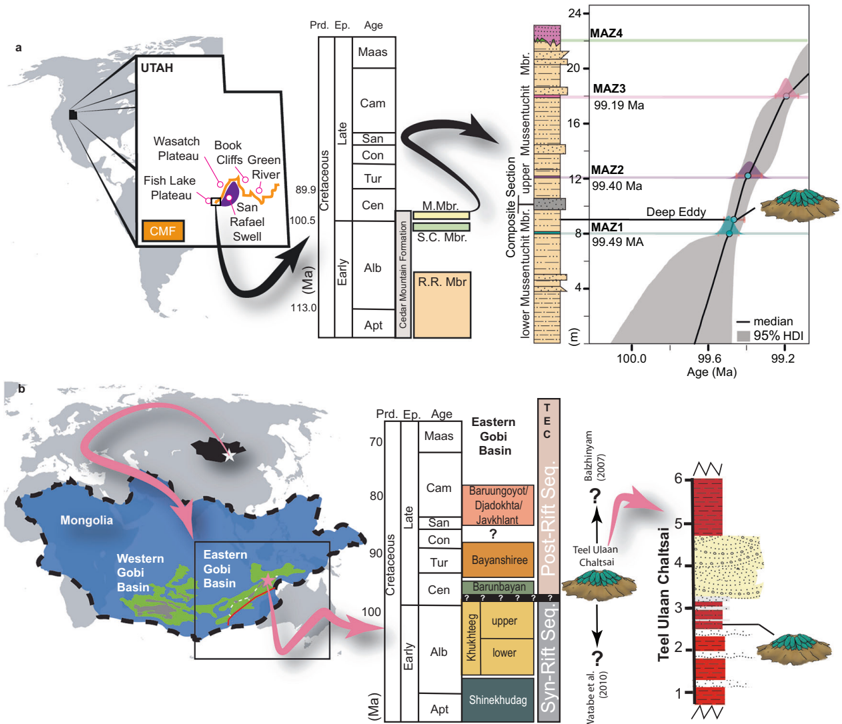
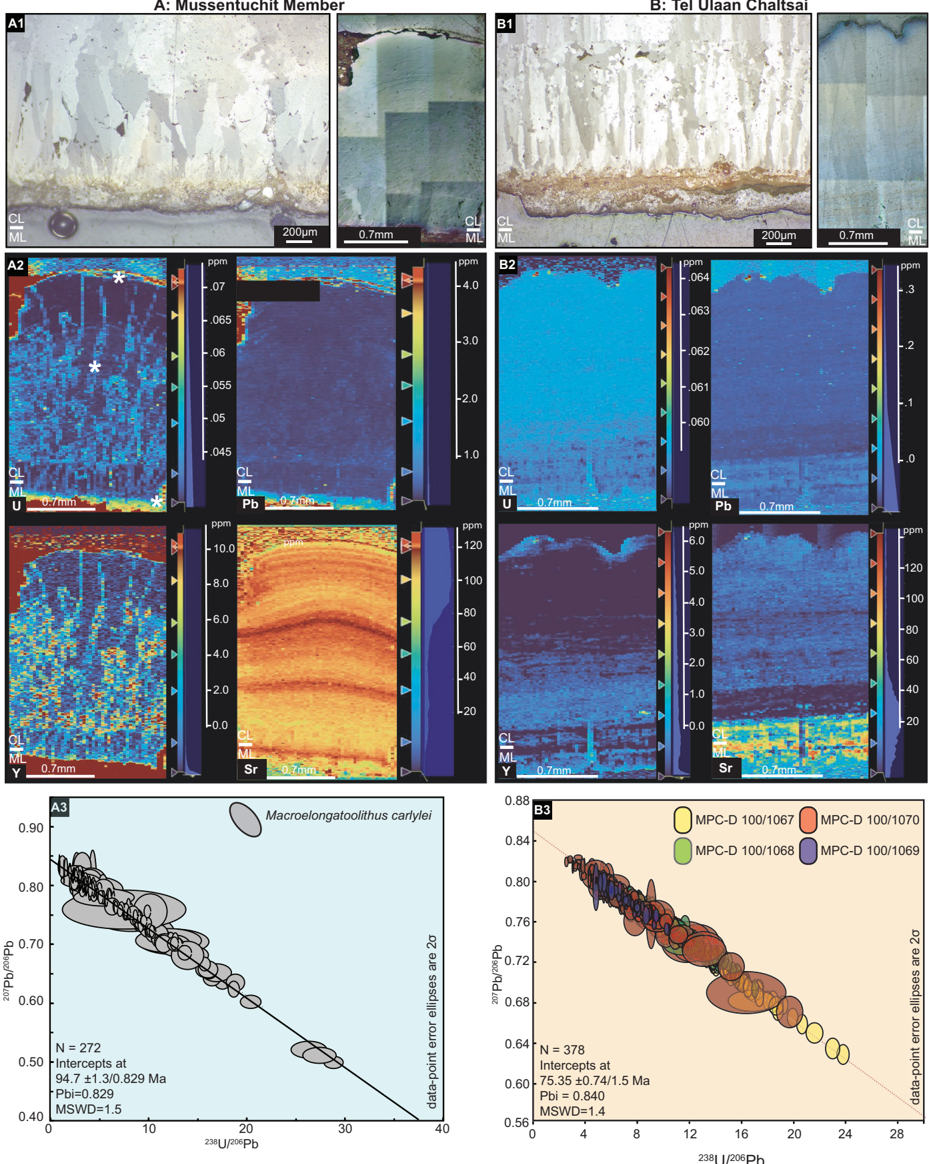
- Utah control site: eggshell from NCSM 33576 gave a LA-MC-ICP-MS U-Pb calcite age of 94.7 ± 1.3/2.3 Ma; bracketing ash beds are 99.490 +0.057/−0.050 Ma below and 99.401 +0.085/−0.066 Ma above, making the eggshell age roughly 4.9% younger than the ashfall ages; a conservative detrital zircon MDA of 97.1 ± 0.83 Ma is within ~3% and overlaps within uncertainty.
- Mongolia: individual Teel Ulaan Chaltsai eggshell ages were 75.8 ± 2.0 Ma (MSWD = 1.8), 75.6 ± 2.7 Ma (MSWD = 0.7), 77.1 ± 4.0 Ma (MSWD = 1.4), and 76.6 ± 1.4 Ma (MSWD = 0.31); the combined age is 75.35 ± 0.74/1.5 Ma (2σ, MSWD = 1.4, Pbi = 0.840), with only four spot analyses discarded due to very low U concentrations. The authors interpret this as the first radioisotopic age for these deposits and support for correlation with the Upper Cretaceous Baruungoyot Formation.
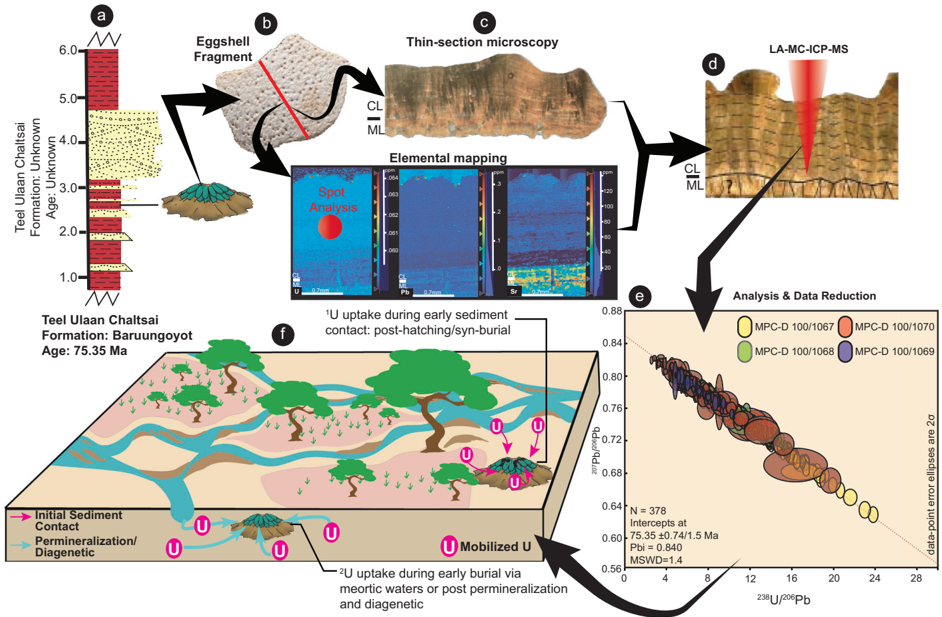
- Trace-element mapping showed Sr up to 120 ppm in sharp bands aligned with optical growth lines; U (0.045–0.75 ppm) and Y (0–10 ppm) broadly follow layering, while Pb remains low and spatially uniform. U uptake is interpreted as early, via sediment contact/meteoric transfer at or near initial burial, with more prominent alteration in Mussentuchit samples along microfractures and porous domains.
Methods
- U-Pb dating used LA-MC-ICP-MS (Thermo Neptune coupled to a Photon Machines 193 nm laser) at Universidade Federal de Ouro Preto, with 110 μm spots, 5 Hz repetition, 6 J cm⁻² fluence, WC-1 and NIST SRM-614 calibration, SATURN data reduction, Tera-Wasserburg regression, and 2σ uncertainties.
- Trace-element mapping used a Thermo Scientific Element 2 sector field ICP-MS coupled to a Resolution 193 nm excimer laser at Stellenbosch University, measuring isotopes including Mg, Si, Ca, Ti, Mn, Fe, Cu, Zn, Sr, Y, Zr, Ba, REEs, Pb, Th, and U; data were processed with Saturn TE Map, using NIST SRM-612 as primary standard and NIST SRM-614 and BHVO-2 as secondary quality-control materials.
- Samples: Utah material comprised three eggshell pieces from partial clutch NCSM 33576-324 A at the “Deep Eddy” locality, Mussentuchit Member, Cedar Mountain Formation, referable to ootype *Macroelongatoolithus carlylei* and laid by oviraptorosaurian dinosaurs. Mongolia material comprised eight eggshells from four localities, MPC-D 100/1067–1070, at Teel Ulaan Chaltsai, Eastern Gobi Basin, collected in 2022; two independent rounds of U-Pb analyses were performed.
Limitations
- The paper states that the Utah eggshell age is ~4.9% younger than the bracketing ash ages and attributes this to post-depositional U and Pb mobilization via meteoric waters through pores, fractures, and fissures; ootaxa with more porous original microstructure or more diagenetic fracturing may yield less accurate maximum depositional ages, but broad studies are needed.
- The paper recommends rigorous pre-screening via thin-section petrology and eggshell histology, meticulous geochemical screening and elemental mapping to identify reliable U concentrations, diagenetic alteration, and common Pb, plus assessment of REE patterns, Ce anomalies, and Sr-Mn ratios; cross-validation with lithostratigraphic, biostratigraphic, and independent dating methods is advised.
- The Mongolian age is treated as a maximum depositional age, and the paper notes an unresolved challenge: whether initial detectable U uptake occurred during initial soil contact in the nest or after complete burial; an endogenous U signature during in vivo mineralization is considered possible but unlikely based on U concentration differences within eggshell ultrastructure.
Model-written summary. Check it against the paper before relying on it.
Integrity signals
Registry
Cites
Statistics
Figures
Verification
Claims the paper makes
0 Valid · 0 Not valid · 23 Not checked · 45 Own results and interpretations
A result the paper reports from its own data — it cites no other source for it, so there is none to check. The quote shows it is in the paper.
In the paper
“Initial screening for uranium (U) concentration identified the most promising regions of the eggshells for dating, with elevated U concentrations, specifically the mammillae lining the internal surface and the high-relief ornamental nodes along the external surface of the eggshell, characteristic of elongatoolithid eggs (Fig. 3A).”
§ U-Pb calcite age dating of fossil eggshell as an accurate deep time geochronometer Check for updates > Geochronology
plainstates an association- Asserted: passes — The authors put it forward as true.
- Checkable: passes — It can be checked against evidence.
- Load-bearing: unclear — It is unclear whether the paper’s conclusions depend on it.
- Based: passes — The paper gives a reason why it holds.
A result the paper reports from its own data — it cites no other source for it, so there is none to check. The quote shows it is in the paper.
In the paper
“We then directly dated dinosaur eggs from Upper Cretaceous strata within Mongolia's famous yet poorly age-constrained Gobi Basin, providing the first radioisotopic age for these deposits.”
plain- Asserted: passes — The authors put it forward as true.
- Checkable: passes — It can be checked against evidence.
- Load-bearing: passes — The paper’s conclusions depend on it.
- Based: passes — The paper gives a reason why it holds.
A result the paper reports from its own data — it cites no other source for it, so there is none to check. The quote shows it is in the paper.
In the paper
“Whereas the NCSM 33576-324 A exhibits more prominent vertical enrichment along microfractures and porous domains, suggesting stronger and possibly prolonged exposure to sediment-derived fluids.”
§ U-Pb calcite age dating of fossil eggshell as an accurate deep time geochronometer Check for updates > Trace element mapping
hedgedstates a possible causeSingle case- Asserted: passes — The authors put it forward as true.
- Checkable: passes — It can be checked against evidence.
- Load-bearing: unclear — It is unclear whether the paper’s conclusions depend on it.
- Based: passes — The paper gives a reason why it holds.
A result the paper reports from its own data — it cites no other source for it, so there is none to check. The quote shows it is in the paper.
In the paper
“MPC-D 100/1067 eggshell displays subtle vertical diffusion in U and Y, likely caused by minor fluid infiltration during early diagenesis.”
§ U-Pb calcite age dating of fossil eggshell as an accurate deep time geochronometer Check for updates > Trace element mapping
hedgedstates a possible causeSingle case- Asserted: passes — The authors put it forward as true.
- Checkable: passes — It can be checked against evidence.
- Load-bearing: unclear — It is unclear whether the paper’s conclusions depend on it.
- Based: passes — The paper gives a reason why it holds.
A result the paper reports from its own data — it cites no other source for it, so there is none to check. The quote shows it is in the paper.
In the paper
“Hence, the LA-MC-ICP-MS U-Pb calcite age of 94.7 ± 1.3/2.3Ma on eggshells from the Mussentuchit nest site (NCSM 33576) is roughly 4.9% younger [((99.5-94.7)/(99.5 + 99.7/ 2))*100)] than the entombing ashfall U-Pb zircon CA-ID-TIMS ages.”
§ U-Pb calcite age dating of fossil eggshell as an accurate deep time geochronometer Check for updates > Discussion
plainSingle case- Asserted: passes — The authors put it forward as true.
- Checkable: passes — It can be checked against evidence.
- Load-bearing: passes — The paper’s conclusions depend on it.
- Based: passes — The paper gives a reason why it holds.
26 more claims
Create a free account to see all 68 claims and to verify the 53 references still open.
- It may state two separate claims as one. 24
- The quote only partly states this claim. 2
- Probably not a substantial claim. 16
Self-check
Percentages, sums and reported differences re-computed from the paper’s own numbers.
Each contradiction between two passages listed here was confirmed by an independent check.
Rated major: it would touch a result — a value a result rests on, reported and recomputed p-values on opposite sides of the significance level, two passages that conflict with no sign which is right, or a cited work retracted before this paper was published.
In the paper
§ U-Pb calcite age dating of fossil eggshell as an accurate deep time geochronometer Check for updates > Methods
“a 15-second washout period between analyses, and a 30-second ablation time.”
§ U-Pb calcite age dating of fossil eggshell as an accurate deep time geochronometer Check for updates > Methods
“Each study consisted of 20 s of background measurement, 20 s of sample ablation, and a 25-s washout.”
Rated minor: it would not touch a result — a value no result rests on, a p-value that stays on the same side of the significance level, or a conflict that is clerical, resolved elsewhere in the paper, or outside its own findings.
In the paper
§ U-Pb calcite age dating of fossil eggshell as an accurate deep time geochronometer Check for updates > Geochronology
“Three eggshell pieces were selected from a partial clutch of theropod dinosaur eggs (NCSM 33576-324 A)”
§ U-Pb calcite age dating of fossil eggshell as an accurate deep time geochronometer Check for updates > Geochronology
“Two independent rounds of U-Pb LA-MC-ICP-MS analysis were performed on seven eggshells (Round 1: 96 spot analyses on four eggshell pieces; and Round 2: 176 spot analyses).”
Rated minor: it would not touch a result — a value no result rests on, a p-value that stays on the same side of the significance level, or a conflict that is clerical, resolved elsewhere in the paper, or outside its own findings.
In the paper
§ U-Pb calcite age dating of fossil eggshell as an accurate deep time geochronometer Check for updates > Trace element mapping
“Trace element mapping of the dated eggshells from both sampled localities reveals a consistent pattern of well-preserved horizontal layering in Sr, U, and Y”
§ U-Pb calcite age dating of fossil eggshell as an accurate deep time geochronometer Check for updates > LA-MC-ICP-MS
“The homogeneous U distribution observed in LA-ICP-MS elemental mapping (Fig. 3), along with the absence of zoning”
Citations
Cites
A calcite reference material for LA‐ICP‐MS U‐Pb geochronology
Roberts, N. M. W., Rasbury, E. T., Parrish, R. R., Smith, C. J., Horstwood, M. S. A., & Condon, D. J. (2017) · Geochemistry, Geophysics, Geosystems · doi:10.1002/2016gc006784 · Cited by 524
Roberts, N. M. W., Drost, K., Horstwood, M., Condon, D. J., Chew, D., Drake, H., Milodowski, A. E., McLean, N. M., Smye, A. J., Walker, R. J., et al. (2020) · Geochronology · doi:10.5194/gchron-2-33-2020 · Cited by 351
The age of Homo naledi and associated sediments in the Rising Star Cave, South Africa
Dirks, P. H., Roberts, E. M., Hilbert-Wolf, H., Kramers, J. D., Hawks, J., Dosseto, A., Duval, M., Elliott, M., Evans, M., Grün, R., et al. (2017) · eLife · doi:10.7554/elife.24231 · Cited by 317
Self-citationSauropod dinosaur embryos from the Late Cretaceous of Patagonia
Chiappe, L. M., Coria, R. A., Dingus, L., Jackson, F., Chinsamy, A., & Fox, M. (1998) · Nature · doi:10.1038/24370 · Cited by 274
U-Pb age constraints on dinosaur rise from south Brazil
Langer, M. C., Ramezani, J., & Da Rosa, Á. A. S. (2018) · Gondwana Research · doi:10.1016/j.gr.2018.01.005 · Cited by 225
Tetravalent Uranium in Calcite
Sturchio, N. C., Antonio, M. R., Soderholm, L., Sutton, S. R., & Brannon, J. C. (1998) · Science · doi:10.1126/science.281.5379.971 · Cited by 213
Directly dating geologic events: U‐Pb dating of carbonates
Rasbury, E. T., & Cole, J. M. (2009) · Reviews of Geophysics · doi:10.1029/2007rg000246 · Cited by 202
Uranyl Incorporation in Natural Calcite
Kelly, S. D., Newville, M. G., Cheng, L., Kemner, K. M., Sutton, S. R., Fenter, P., Sturchio, N. C., & Spötl, C. (2003) · Environmental Science & Technology · doi:10.1021/es025962f · Cited by 165
Johnson, C. L. (2004) · Basin Research · doi:10.1111/j.1365-2117.2004.00221.x · Cited by 142
Irmis, R. B., Mundil, R., Martz, J. W., & Parker, W. G. (2011) · Earth and Planetary Science Letters · doi:10.1016/j.epsl.2011.07.015 · Cited by 133
Research works printed but not linked: 4
- Watabe, M., Tsogtbaatar, K., Suzuki, S. & Saneyoshi, M. Geology of dinosaur-fossil-bearing localities (Jurassic and Cretaceous: Mesozoic) in the Gobi Desert: results of the HMNS-MPC joint paleontological expedition. Hayashibara Mus. Nat. Sci. Res. Bull. 3, 41-118 (2010).
- Carpenter, K. Eggs, Nests, and Baby Dinosaurs: A Look at Dinosaur Reproduction (Indiana University Press, 1999).
- Tucker, R. T. et al. Geological and paleontological reconstruction of the Bayanshiree Formation, Eastern Gobi Basin, Mongolia. Sed. (SED--OA-032.) (2025) In Review.
- Benton, M. J., Shishkin, M. A., Unwin, D. M. & Kurochkin, E. N.) 256e278 (Cambridge University Press, 2000).
Cited by
Guihou, A., Suchéras-Marx, B., Tortosa, T., Deschamps, P., & Dutour, Y. (2026) · Comptes Rendus Géoscience · doi:10.5802/crgeos.338 · Cited by 1
Progress and future directions in dinosaur palaeontology
Xu, X., Upchurch, P., Zanno, L. E., McNamara, M. E., Qin, Z., & Benton, M. (2026) · Nature Reviews Biodiversity · doi:10.1038/s44358-026-00191-9
Self-citationThe morphology and systematics of Pinacosaurus
Penkalski, P. (2026) · Historical Biology · doi:10.1080/08912963.2026.2633178
Origins of biodiversity in eastern Tibet revealed by Eocene mammals and fossil tree rings
He, S., Ding, L., Mulch, A., Wang, C., Wang, T., Yue, Y., Xie, J., Yang, P., Zuo, L., Ren, J., et al. (2026) · Communications Earth & Environment · doi:10.1038/s43247-026-03967-1
From ash beds to eggshells: A new frontier in deep time continental U–Pb geochronology
Tucker, R. T., & LANA, C. D. C. (2026) · South African Journal of Science · doi:10.17159/sajs.2026/25425
Self-citation
Metadata
- Authors
- Tucker, R. T., Venter, K. E., Lana, C., Roberts, E. M., Chinzorig, T., Tsogtbaatar, K., & Zanno, L. E.
- Affiliations
- North Carolina Museum of Natural Sciences (US)
- Stellenbosch University (ZA)
- Universidade Federal de Ouro Preto (BR)
- Colorado School of Mines (US)
- Mongolian Academy of Sciences (MN)
- University of Utah (US)
- Corresponding author
- Tucker, Ryan T.
- ORCID
- Venue
- Communications Earth & Environment
- Published
- 2025-11-10
- Volume
- 6
- Issue
- 1
- Pages
- 872
- ISSN
- 2662-4435 (ISSN-L)
- OpenAlex
- W4416067209
- Semantic Scholar
- 9a4bf0c6a21355cf2643fa7bbc15ed0429c5f380
- Cited by
- 5
- References
- 57
- Citations by year
- 2026: 5
- FWCI
- 1.75
- Type
- journal article
- Language
- en
- Open access
- gold
- doi.org
- Licence
- cc-by-nc-nd
- creativecommons.org/licenses/by-nc-nd/4.0 (tdm)
- creativecommons.org/licenses/by-nc-nd/4.0 (vor)
- Locations
- Communications Earth & Environment (publishedVersion, cc-by-nc-nd)
- DOAJ (DOAJ: Directory of Open Access Journals) (submittedVersion)
- Funders
- National Science Foundation (1925973)
- National Geographic Society (NGS‐100601R‐23)
- North Carolina Museum of Natural Sciences
- Universiteit Stellenbosch
- U.S. Bureau of Land Management
- Topics
- Physical Sciences › Earth and Planetary Sciences › Geochemistry and Petrology › Geological and Geochemical Analysis
- Physical Sciences › Earth and Planetary Sciences › Paleontology › Paleontology and Stratigraphy of Fossils
- Physical Sciences › Earth and Planetary Sciences › Paleontology › Paleontology and Evolutionary Biology
- Keywords
- fossil eggshells, burial age, geochronology, Western Interior Basin, Upper Cretaceous, uranium adsorption, biogenic carbonates, Mesozoic, Cenozoic, ash beds
About these checks
Registry, retraction, Cites and statistics results are computed, not judged, with one exception: a printed reference that no index lists is read once by a model before it counts as a citation error. Claims are extracted by a model and kept only when their quote appears verbatim in the text; each cited source is then checked, with a model’s help, for whether it says what the claim relies on. Those verdicts can be wrong — read the claim’s quote and the cited source before relying on one.
A language model drew the claims from the paper on 2026-11-23, under version 3 of the claim definition (model deepseek-v4.1-flash, prompt extract-v3).
A second model labelled each claim on 2026-11-23 (model jev-1.13-20260917, definition revision gold-guideline-v0.2).
Statistics and arithmetic are recomputed, not judged.
Confidence bands are shown only for fields calibrated on our annotated test set. None is calibrated yet, so no band is shown.
What counts as a claim ›How we measure confidence ›How we check this ›
Are you an author, or do you see a problem with this page? Request a review
How to cite
Cite CoChat for the checks on this page, and the paper for its own findings.
- This page
- CoChat. (2026). Citation check: U-Pb calcite age dating of fossil eggshell as an accurate deep time geochronometer. https://app.cochat.ai/papers/10.1038/s43247-025-02895-w
- The paper
- Tucker, R. T., Venter, K. E., Lana, C., Roberts, E. M., Chinzorig, T., Tsogtbaatar, K., & Zanno, L. E. (2025). U-Pb calcite age dating of fossil eggshell as an accurate deep time geochronometer. Communications Earth & Environment. https://doi.org/10.1038/s43247-025-02895-w
Data sources
Bibliographic data: Semantic Scholar, OpenAlex, Crossref.
Contains information from the Semantic Scholar Academic Graph Datasets, made available under the ODC Attribution License (ODC-BY 1.0).
Semantic Scholar’s data is described in: Kinney, R., et al. (2023). The Semantic Scholar Open Data Platform. arXiv:2301.10140.
