

A framework to automatically detect near-falls using a wearable inertial measurement cluster
Open accessThe DOI matches its Crossref record; 30 of the 30 references it cites were found in a registry or an index.
Abstract
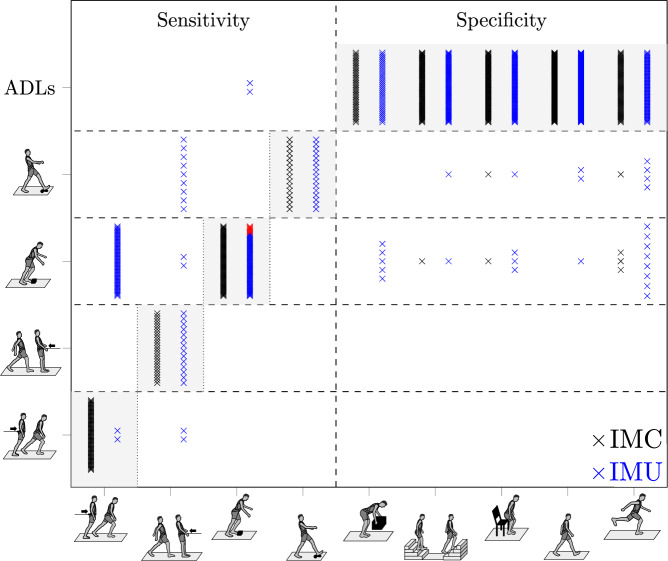
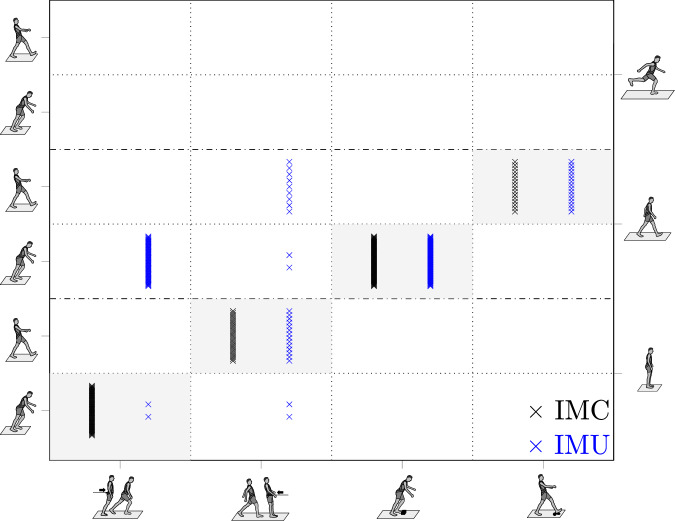
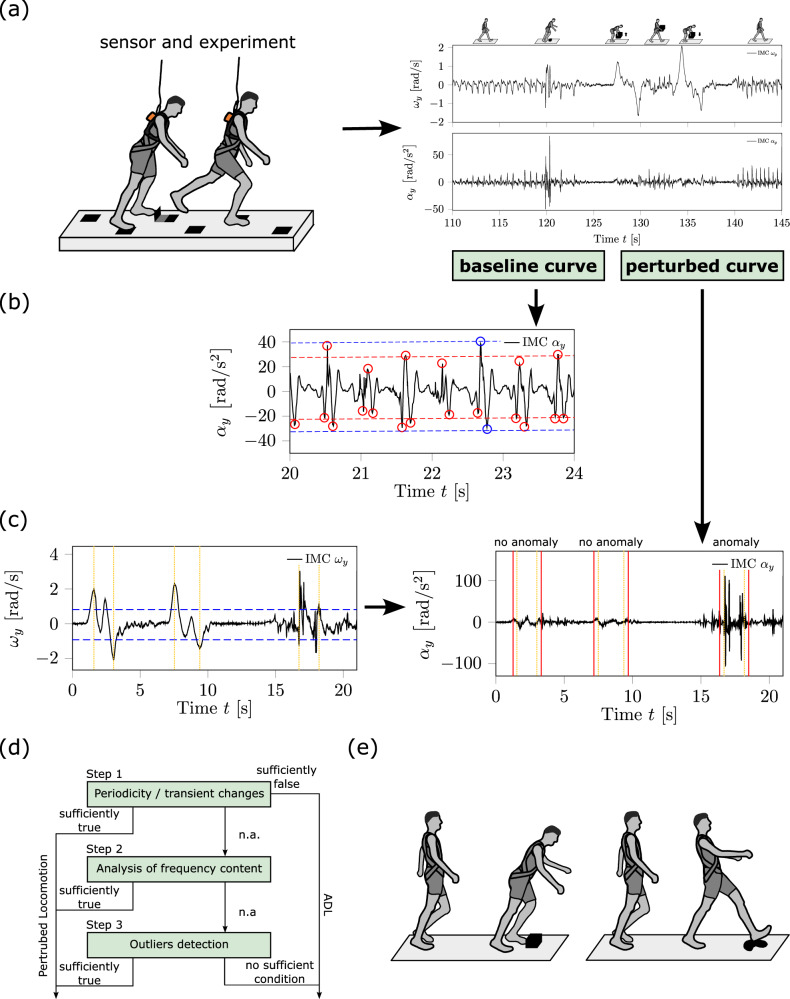
Accurate and automatic assessments of body segment kinematics via wearable sensors are essential to provide new insights into the complex interactions between active lifestyle and fall risk in various populations. To remotely assess near-falls due to balance disturbances in daily life, current approaches primarily rely on biased questionnaires, while contemporary data-driven research focuses on preliminary fall-related scenarios. Here, we worked on an automated framework based on accurate trunk kinematics, enabling the detection of near-fall scenarios during locomotion. Using a wearable inertial measurement cluster in conjunction with evaluation algorithms focusing on trunk angular acceleration, the proposed sensor-framework approach revealed accurate distinguishment of balance disturbances related to trips and slips, thereby minimising false detections during activities of daily living. An important factor contributing to the framework’s high sensitivity and specificity for automatic detection of near-falls was the consideration of the individual’s gait characteristics. Therefore, the sensor-framework presents an opportunity to substantially impact remote fall risk assessment in healthy and pathological conditions outside the laboratory.
Overview
The claims and statistics of this paper haven’t been checked yet.
Free: it reads the open-access text and checks the first 5 claims that cite a source we can check. Create a free account to check every claim.
Integrity signals
Registry
Cites
Statistics
Figures
Verification
Claims the paper makes
The claims and statistics of this paper haven’t been checked yet.
Free: it reads the open-access text and checks the first 5 claims that cite a source we can check. Create a free account to check every claim.
Self-check
Percentages, sums and reported differences re-computed from the paper’s own numbers.
The self-check needs the paper’s full text.
Citations
Cites
Medical Costs of Fatal and Nonfatal Falls in Older Adults
Florence, C. S., Bergen, G., Atherly, A., Burns, E., Stevens, J., & Drake, C. (2018) · Journal of the American Geriatrics Society · doi:10.1111/jgs.15304 · Cited by 1,436 · cited 1×
“Injuries not only result in physicalharmbutalsohavefar-reachingsocialand fi nancialimplications 1,2 .”
Falls and fall injuries among adults aged =65 years—United States, 2014.
Bergen, G., Stevens, M. R., & Burns, E. R. (2016) · MMWR Morbidity and Mortality Weekly Report · doi:10.15585/mmwr.mm6537a2 · Cited by 1,235 · cited 1×
“Given approximately every 10th adult over 40 years may fall at least once a year 3,4 , with the incidence reported majorly during locomotion (e.g. caused by trips, slips or stumbling 5,6 , precise monitoring of kinematic patterns during daily movement becomes crucial for both developing prevention…”
A catalog of biases in questionnaires.
Choi, B. C. K., & Pak, A. W. P. (2005) · Preventing Chronic Disease · Cited by 1,098
A Review of Accelerometry-Based Wearable Motion Detectors for Physical Activity Monitoring
Yang, C.-C., & Hsu, Y.-L. (2010) · Sensors · doi:10.3390/s100807772 · Cited by 1,058 · cited 1×
“To monitor the kinematics of human body segments during daily life locomotion, wearable sensors incorporating gyroscopes and/or linear accelerometers (so-called inertial measurement unit (IMU)) are commonly used 7,8 .”
Accurate, Fast Fall Detection Using Gyroscopes and Accelerometer-Derived Posture Information
Li, Q., Stankovic, J. A., Hanson, M. A., Barth, A. T., Lach, J., & Zhou, G. (2009) · 2009 Sixth International Workshop on Wearable and Implantable Body Sensor Networks · doi:10.1109/bsn.2009.46 · Cited by 584 · cited 1×
“Using parameter extractions from accelerometer and gyroscope readings, several studies 10 – 13, 24, 25 showed that Considering the limitations of this study, the ef fi cacy of the proposed approach was validated using standardised antero-posterior trip-and slip-like perturbations, along with a broad…”
A threshold-based fall-detection algorithm using a bi-axial gyroscope sensor
Bourke, A. K., & Lyons, G. M. (2008) · Medical Engineering & Physics · doi:10.1016/j.medengphy.2006.12.001 · Cited by 509 · cited 4×
“Wearable sensors combined with evaluation algorithms, in turn, have been extensively examined with the aim of achieving objective and automatic detection of falls and distinguishment of fall events from ADLs, respectively 10 – 13 .”
InfluentialDeaths from Falls Among Persons Aged ≥65 Years — United States, 2007–2016
Burns, E., & Kakara, R. (2018) · MMWR. Morbidity and Mortality Weekly Report · doi:10.15585/mmwr.mm6718a1 · Cited by 470 · cited 1×
“Injuries not only result in physicalharmbutalsohavefar-reachingsocialand fi nancialimplications 1,2 .”
Contribution of the support limb in control of angular momentum after tripping
Pijnappels, M., Bobbert, M. F., & van Dieën, J. H. (2004) · Journal of Biomechanics · doi:10.1016/j.jbiomech.2004.02.038 · Cited by 217 · cited 1×
“In addition, the regulation of trunk dynamics and whole-body angular momentum is an essential component of withstanding forward-directed fall initiations 19 – 21 .”
Walking cadence (steps/min) and intensity in 21–40 year olds: CADENCE-adults
Tudor-Locke, C., Aguiar, E. J., Han, H., Ducharme, S. W., Schuna, J. M., Barreira, T. V., Moore, C. C., Busa, M. A., Lim, J., Sirard, J. R., et al. (2019) · International Journal of Behavioral Nutrition and Physical Activity · doi:10.1186/s12966-019-0769-6 · Cited by 205
Distinguishing fall activities from normal activities by velocity characteristics
Wu, G. (2000) · Journal of Biomechanics · doi:10.1016/s0021-9290(00)00117-2 · Cited by 192 · cited 1×
“Using parameter extractions from accelerometer and gyroscope readings, several studies 10 – 13, 24, 25 showed that Considering the limitations of this study, the ef fi cacy of the proposed approach was validated using standardised antero-posterior trip-and slip-like perturbations, along with a broad…”
Fracture Risk Associated with a Fall According to Type of Fall Among the Elderly
Luukinen, H., Herala, M., Koski, K., Honkanen, R., Laippala, P., & Kivelä, S.-L. (2000) · Osteoporosis International · doi:10.1007/s001980070086 · Cited by 166
Use of wearable sensor technology in gait, balance, and range of motion analysis
Díaz, S., Stephenson, J. B., & Labrador, M. A. (2019) · Applied Sciences · doi:10.3390/app10010234 · Cited by 132 · cited 1×
“To monitor the kinematics of human body segments during daily life locomotion, wearable sensors incorporating gyroscopes and/or linear accelerometers (so-called inertial measurement unit (IMU)) are commonly used 7,8 .”
The circumstances, orientations, and impact locations of falls in community-dwelling older women
Crenshaw, J. R., Bernhardt, K. A., Achenbach, S. J., Atkinson, E. J., Khosla, S., Kaufman, K. R., & Amin, S. (2017) · Archives of Gerontology and Geriatrics · doi:10.1016/j.archger.2017.07.011 · Cited by 129 · cited 2×
“…over 40 years may fall at least once a year 3,4 , with the incidence reported majorly during locomotion (e.g. caused by trips, slips or stumbling 5,6 , precise monitoring of kinematic patterns during daily movement becomes crucial for both developing prevention strategies, e.g. advanced…”
Karamanidis, K., & Arampatzis, A. (2006) · European Journal of Applied Physiology · doi:10.1007/s00421-006-0318-2 · Cited by 84 · cited 2×
“Nevertheless, the variation of inclination angles from moderate to high elicited different perturbation magnitudes and thereby provoked single-step strategies as well as multiple-step strategies 29 .”
Self-citationLim, D., Park, C., Kim, N. H., Kim, S.-H., & Yu, Y. S. (2014) · Journal of Applied Mathematics · doi:10.1155/2014/896030 · Cited by 81
A review of wearable sensors based fall-related recognition systems
Liu, J., Li, X., Huang, S., Chao, R., Chao, R., Wang, S., Wang, S., & Liu, L. (2023) · Engineering Applications of Artificial Intelligence · doi:10.1016/j.engappai.2023.105993 · Cited by 62 · cited 1×
“14 aswell as Gomaa and Khamis 15 reviewed the potential of both classical machine-learning models and deep-learning architectures to enhance the accuracy and reliability of fall detection.”
Ihlen, E. A. F., van Schooten, K. S., Bruijn, S. M., van Dieën, J. H., Vereijken, B., Helbostad, J. L., & Pijnappels, M. A. G. M. (2018) · Frontiers in Aging Neuroscience · doi:10.3389/fnagi.2018.00044 · Cited by 59
A perspective on human activity recognition from inertial motion data
Gomaa, W., & Khamis, M. A. (2023) · Neural Computing and Applications · doi:10.1007/s00521-023-08863-9 · Cited by 54 · cited 2×
“Furthermore,recent ,particularlyinthe fi eld of automated fall detection, with improvements in the accuracy of wearable sensor-based detection systems 13 – 15 .”
Angular acceleration measurement: a review
Ovaska, S. J., & Väliviita, S. (2002) · Conference proceedings - IEEE Instrumentation/Measurement Technology Conference · doi:10.1109/imtc.1998.676850 · Cited by 33
Wang, S., Miranda, F., Wang, Y., Rasheed, R., & Bhatt, T. S. (2022) · Sensors · doi:10.3390/s22093334 · Cited by 31 · cited 2×
“Although wearable sensor-based machine-learning approachesfornear-falldetectionexistandhaveshownpromisingresultsin effectivelyclassifyingnear-fallevents 16,17 , there is a lack of information on their capability, particularly in distinguishing near-falls from ADLs in daily life.”
Schumacher, J., Pientka, L., Trampisch, U. S., Moschny, A., Hinrichs, T., & Thiem, U. (2013) · Zeitschrift für Gerontologie und Geriatrie · doi:10.1007/s00391-013-0503-y · Cited by 27
Kent, J. A., Takahashi, K. Z., & Stergiou, N. (2019) · Journal of NeuroEngineering and Rehabilitation · doi:10.1186/s12984-019-0497-9 · Cited by 27 · cited 1×
“In addition, the regulation of trunk dynamics and whole-body angular momentum is an essential component of withstanding forward-directed fall initiations 19 – 21 .”
Comparison of machine learning approaches for near-fall-detection with motion sensors
Hellmers, S., Krey, E., Gashi, A., Koschate, J., Schmidt, L., Stuckenschneider, T., Hein, A., & Zieschang, T. (2023) · Frontiers in Digital Health · doi:10.3389/fdgth.2023.1223845 · Cited by 27 · cited 2×
“Although wearable sensor-based machine-learning approachesfornear-falldetectionexistandhaveshownpromisingresultsin effectivelyclassifyingnear-fallevents 16,17 , there is a lack of information on their capability, particularly in distinguishing near-falls from ADLs in daily life.”
Real-time low-energy fall detection algorithm with a Programmable Truncated MAC
Solaz, M. D. L. G., Bourke, A. K., Conway, R., Nelson, J., & OLaighin, G. M. (2010) · Annual International Conference of the IEEE Engineering in Medicine and Biology Society (EMBC) · doi:10.1109/iembs.2010.5626244 · Cited by 16
Weber, A., Friemert, D., Hartmann, U., Epro, G., Seeley, J. R., Werth, J., Nickel, P., & Karamanidis, K. (2021) · Journal of Biomechanics · doi:10.1016/j.jbiomech.2021.110357 · Cited by 14 · cited 1×
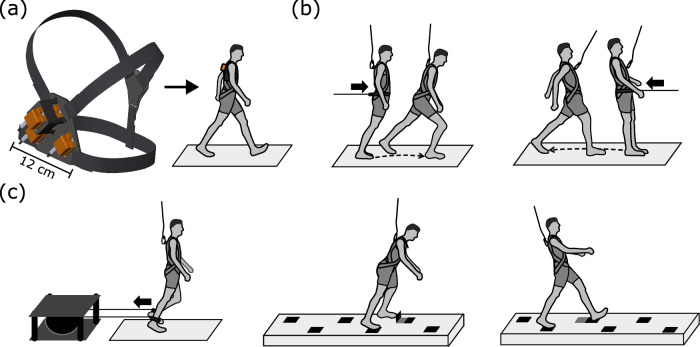
“Tofurthervarytrip-based balance disturbances we additionally applied posteriorly directed pulls on the swing leg during walking 27,28 .”
Self-citationEnhancement of Fall Detection Algorithm Using Convolutional Autoencoder and Personalized Threshold
Iguchi, Y., Lee, J. H., & Okamoto, S. (2021) · International Conference on Consumer Electronics · doi:10.1109/icce50685.2021.9427732 · Cited by 12 · cited 4×
“Wearable sensors combined with evaluation algorithms, in turn, have been extensively examined with the aim of achieving objective and automatic detection of falls and distinguishment of fall events from ADLs, respectively 10 – 13 .”
InfluentialGießler, M., & Waltersberger, B. (2023) · Autonomous Robots · doi:10.1007/s10514-023-10092-x · Cited by 12 · cited 1×
“However, an inherent limitation of current approaches to assess the angular acceleration vector of various body segments is the noise-amplifying numerical time derivative required 22,23 .”
Self-citationA wearable sensor and framework for accurate remote monitoring of human motion
Gießler, M., Werth, J., Waltersberger, B., & Karamanidis, K. (2024) · Communications Engineering · doi:10.1038/s44172-024-00168-6 · Cited by 10 · cited 13×
“18 ).”
InfluentialSelf-citationDifferences in motor response to stability perturbations limit fall-resisting skill transfer
Werth, J., Epro, G., König, M., Santuz, A., Seeley, J. R., Arampatzis, A., & Karamanidis, K. (2022) · Scientific Reports · doi:10.1038/s41598-022-26474-7 · Cited by 8 · cited 1×
“Tofurthervarytrip-based balance disturbances we additionally applied posteriorly directed pulls on the swing leg during walking 27,28 .”
Self-citation
Cited by
Chen, S., Peng, C., Yang, B., Lin, J., Zhou, L., Jiang, Z., Liu, Z., Liu, Y., & Tang, L. (2026) · npj Artificial Intelligence · doi:10.1038/s44387-026-00083-5 · Cited by 9
Gießler, M., Waltersberger, B., Goetz, T., & Rockenfeller, R. (2025) · Communications Engineering · doi:10.1038/s44172-025-00384-8 · Cited by 3
Self-citationSchneider, M., Seeser-Reich, K., Fiedler, A., & Frese, U. (2026) · Lecture notes in computer science · doi:10.1007/978-3-032-13187-4_24
Edge-Deployable Multimodal Fall Detection with INT8 Quantization on Rockchip RK3568Preprint
Zhang, T., Xiong, L., Zhou, H., Feng, Y., He, Z., & Zhang, X. (2026) · Research Square · doi:10.21203/rs.3.rs-9395963/v1
Kubiak, A., Boloori, F. H., & Zhuoyan (2026) · Research Square · doi:10.21203/rs.3.rs-10746145/v1
Metadata
- Authors
- Gießler, M., Werth, J., Waltersberger, B., & Karamanidis, K.
- Affiliations
- London South Bank University (GB)
- Offenburg University of Applied Sciences (DE)
- University of Koblenz and Landau (DE)
- Corresponding author
- Gießler, Maximilian
- Venue
- Communications Engineering
- Published
- 2024-12-16
- Volume
- 3
- Issue
- 1
- Pages
- 181-181
- ISSN
- 2731-3395 (ISSN-L)
- PMC
- PMC11649693
- OpenAlex
- W4405421621
- Cited by
- 6
- References
- 30
- Citations by year
- 2026: 6
- FWCI
- 5.24
- Type
- journal article
- Language
- en
- Open access
- gold
- doi.org
- Licence
- cc-by
- creativecommons.org/licenses/by/4.0 (tdm)
- creativecommons.org/licenses/by/4.0 (vor)
- Locations
- Communications Engineering (publishedVersion, cc-by)
- PubMed Central (publishedVersion, cc-by)
- PubMed (publishedVersion)
- Opus-HSO (Offenburg University of Applied Sciences) (submittedVersion, cc-by)
- DOAJ (DOAJ: Directory of Open Access Journals) (submittedVersion)
- Topics
- Health Sciences › Health Professions › Physical Therapy, Sports Therapy and Rehabilitation › Balance, Gait, and Falls Prevention
- Physical Sciences › Computer Science › Computer Vision and Pattern Recognition › Context-Aware Activity Recognition Systems
- Physical Sciences › Engineering › Biomedical Engineering › Gait Recognition and Analysis
- Keywords
- wearable inertial sensors, trunk kinematics, balance disorders, fall risk assessment, gait parameters, activities of daily living, remote monitoring
About these checks
Registry, retraction, Cites and statistics results are computed, not judged, with one exception: a printed reference that no index lists is read once by a model before it counts as a citation error. Claims are extracted by a model and kept only when their quote appears verbatim in the text; each cited source is then checked, with a model’s help, for whether it says what the claim relies on. Those verdicts can be wrong — read the claim’s quote and the cited source before relying on one.
Statistics and arithmetic are recomputed, not judged.
Confidence bands are shown only for fields calibrated on our annotated test set. None is calibrated yet, so no band is shown.
What counts as a claim ›How we measure confidence ›How we check this ›
Are you an author, or do you see a problem with this page? Request a review
Data sources
Bibliographic data: Semantic Scholar, OpenAlex, Crossref.
Contains information from the Semantic Scholar Academic Graph Datasets, made available under the ODC Attribution License (ODC-BY 1.0).
Semantic Scholar’s data is described in: Kinney, R., et al. (2023). The Semantic Scholar Open Data Platform. arXiv:2301.10140.
