

The DOI matches its Crossref record; 37 of the 38 references it cites were found in a registry or an index.
Chromosomal radiosensitivity in breast cancer patients with a known or putative genetic predisposition
Open accessAbstract
The chromosomal radiosensitivity of breast cancer patients with a known or putative genetic predisposition was investigated and compared to a group of healthy women. The chromosomal radiosensitivity was assessed with the G2 and the G0-micronucleus assay. For the G2 assay lymphocytes were irradiated in vitro with a dose of 0.4 Gy (60)Co gamma-rays after 71 h incubation, and chromatid breaks were scored in 50 metaphases. For the micronucleus assay lymphocytes were exposed in vitro to 3.5 Gy (60)Co gamma-rays at a high dose rate or low dose rate. 70 h post-irradiation cultures were arrested and micronuclei were scored in 1000 binucleate cells. The results demonstrated that the group of breast cancer patients with a known or putative genetic predisposition was on the average more radiosensitive than a population of healthy women, and this with the G2 as well as with the high dose rate and low dose rate micronucleus assay. With the G2 assay 43% of the patients were found to be radiosensitive. A higher proportion of the patients were radiosensitive with the micronucleus assay (45% with high dose rate and 61% with low dose rate). No correlation was found between the G2 and the G0-micronucleus chromosomal radiosensitivity. Out of the different subgroups considered, the group of the young breast cancer patients without family history showed the highest percentage of radiosensitive cases in the G2 (50%) as well as in the micronucleus assay (75-78%).
Overview
The claims and statistics of this paper haven’t been checked yet.
Run the check — free, no account needed. It reads the open-access text and checks the sources it cites.
Integrity signals
Registry
Cites
Statistics
Figures
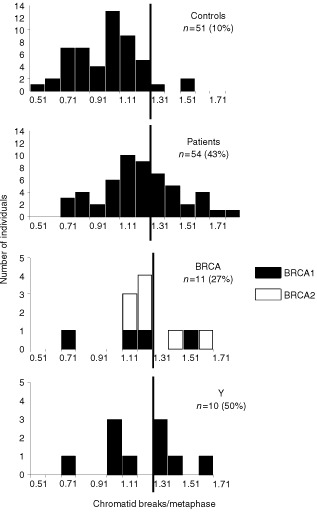
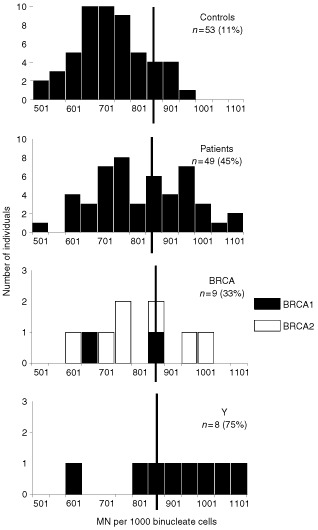
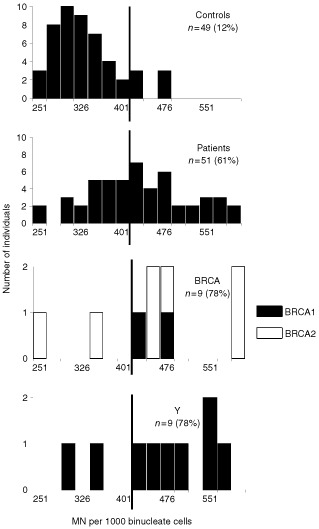
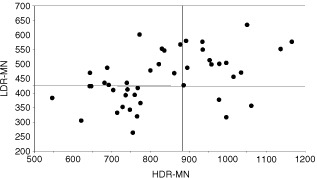
Verification
Claims the paper makes
The claims and statistics of this paper haven’t been checked yet.
Run the check — free, no account needed. It reads the open-access text and checks the sources it cites.
Claims other papers make about this one
Each is checked against this paper’s own text: does it say what the citing paper says it does?
In the citing paper
“The hypothesis that BRCA mutation is associated with increased radio sensitivity was supported by experimental and clinical data [12-19].”
From Is the breast-conserving treatment with radiotherapy appropriate in BRCA1/2 mutation carriers? Long-term results and review of the literature (2010) · cites this paper as [12]
In the citing paper
“Several studies suggest that BRCA gene mutation might influence response to radiation therapy because tumours in BRCA1/BRCA2 carriers are more sensitive to ionising radiation [5-12].”
From Is the breast-conserving treatment with radiotherapy appropriate in BRCA1/2 mutation carriers? Long-term results and review of the literature (2010) · cites this paper as [12]
Self-check
Percentages, sums and reported differences re-computed from the paper’s own numbers.
The self-check needs the paper’s full text.
Citations
Cites
Takata, M., Sasaki, M. S., Sonoda, E., Morrison, C., Hashimoto, M., Utsumi, H., Yamaguchi‐Iwai, Y., Shinohara, A., & Takeda, S. (1998) · The EMBO Journal · doi:10.1093/emboj/17.18.5497 · Cited by 1,229 · cited 3×
“…are essentially the result of misrepaired dsb (Wu et al, 1996; Boei et al, 2000; Fomina et al, 2000) by the NHEJ repair system (Jeggo, 1998; Takata et al, 1998; Rothkamm et al, 2001), the mechanisms involved in the formation of G2 chromatid breaks are not fully understood yet and different…”
BackgroundEstimates of the worldwide frequency of sixteen major cancers in 1980
Parkin, D. M., Läärä, E., & Muir, C. S. (1988) · International Journal of Cancer · doi:10.1002/ijc.2910410205 · Cited by 1,057 · cited 1×
“Breast cancer is the most common type of cancer in females, accounting for approximately 18% of all cancer cases in women worldwide (Parkin et al, 1988).”
BackgroundFenech, M. F. (1993) · Mutation research. Fundamental and molecular mechanisms of mutagenesis · doi:10.1016/0027-5107(93)90049-l · Cited by 985 · cited 2×
“Per slide 500 binucleate cells (BN) were scored (light microscopy, 4006) according to the criteria of Fenech (1993).”
MethodPrevalence of BRCA1 and BRCA2 gene mutations in patients with early-onset breast cancer.
Peto, J., Collins, N., Barfoot, R., Seal, S., Warren, W., Rahman, N., Easton, D., Evans, C., Deacon, J., & Stratton, M. R. (1999) · Journal of the National Cancer Institute · doi:10.1093/jnci/91.11.943 · Cited by 909 · cited 10×
“For further analysis we considered three subgroups in our total group of breast cancer patients: (1) a subgroup of patients that met criteria 1 and 2 (see Materials and Methods) and in which a mutation in BRCA1/2 was detected (BRCA1, n=4; BRCA2, n=7); (2) a subgroup of patients that met criteria 1 and 2 but without a…”
BackgroundInfluentialMolecular mechanisms of DNA double-strand break repair
Kanaar, R., Hoeijmakers, J. H. J., & van Gent, D. C. (1998) · Trends in Cell Biology · doi:10.1016/s0962-8924(98)01383-x · Cited by 527 · cited 4×
“Although recent studies have shown that G0/G1 chromosomal aberrations are essentially the result of misrepaired dsb (Wu et al, 1996; Boei et al, 2000; Fomina et al, 2000) by the NHEJ repair system (Jeggo, 1998; Takata et al, 1998; Rothkamm et al, 2001), the mechanisms involved in the formation of G2 chromatid breaks a…”
BackgroundInfluentialIdentification of Genes Involved in Repair of DNA Double-Strand Breaks in Mammalian Cells
Jeggo, P. A. (1998) · Radiation Research · doi:10.2307/3579810 · Cited by 283 · cited 1×
“…aberrations are essentially the result of misrepaired dsb (Wu et al, 1996; Boei et al, 2000; Fomina et al, 2000) by the NHEJ repair system (Jeggo, 1998; Takata et al, 1998; Rothkamm et al, 2001), the mechanisms involved in the formation of G2 chromatid breaks are not fully understood yet…”
BackgroundBRCA1, BRCA2, and Rad51 operate in a common DNA damage response pathway.
Chen, J. J., Silver, D. P., Cantor, S., Livingston, D. M., & Scully, R. (1999) · PubMed · Cited by 217
Rothfuß, A., Schütz, P., Bochum, S., Volm, T., Eberhardt, E., Kreienberg, R., Vogel, W., & Speit, G. (2000) · PubMed · Cited by 212
Increased chromosomal radiosensitivity in breast cancer patients: a comparison of two assays
Scott, D. A. (1999) · International Journal of Radiation Biology · doi:10.1080/095530099140744 · Cited by 209 · cited 12×
“Apart from the population characteristics, differences in the MN assay protocols may also be responsible for the differences between the results of Scott et al (1998, 1999) and present work.”
BackgroundMethodResultInfluentialDouble-Strand Break Repair Deficiency and Radiation Sensitivity in BRCA2 Mutant Cancer Cells
Abbott, D. W., Holt, J. T., & Freeman, M. L. (1998) · JNCI Journal of the National Cancer Institute · doi:10.1093/jnci/90.13.978 · Cited by 206 · cited 1×
“The exact role of BRCA1 and BRCA2 in repair of DNA damage by ionising radiation is not yet fully understood (Abbott et al, 1998; Wang et al, 2001).”
Background
Cited by
Sorted by citations
Kirsch‐Volders, M., Plas, G., Elhajouji, A., Lukamowicz‐Rajska, M., Gonzalez, L., Loock, K. V., & Decordier, I. (2011) · Archives of Toxicology · doi:10.1007/s00204-011-0691-4 · Cited by 268
The micronucleus assay as a biological dosimeter of in vivo ionising radiation exposure
Vral, A., Fenech, M. F., & Thierens, H. M. (2010) · Mutagenesis · doi:10.1093/mutage/geq078 · Cited by 262
Self-citationMicronuclei frequency in peripheral blood lymphocytes of cancer patients: A meta-analysis
Iarmarcovai, G., Ceppi, M., Botta, A., Orsière, T. G., & Bonassi, S. (2008) · Mutation Research/Reviews in Mutation Research · doi:10.1016/j.mrrev.2008.05.006 · Cited by 152
Kirova, Y. M., Stoppa-Lyonnet, D., Savignoni, A., Sigal-Zafrani, B., Fabre, N., & Fourquet, A. (2005) · European Journal of Cancer · doi:10.1016/j.ejca.2005.02.037 · Cited by 129
“It was shown that tumours in BRCA1/BRCA2 carriers are more sensitive to ionising radiation [48,49].”
BackgroundAn automated scoring procedure for the micronucleus test by image analysis
Varga, D. (2004) · Mutagenesis · doi:10.1093/mutage/geh047 · Cited by 124
Metadata
- Authors
- Baeyens, A., Thierens, H., Claes, K., Poppe, B., Messiaen, L., De Ridder, L., & Vral, A.
- Affiliations
- Ghent University (BE)
- Corresponding author
- Vral, A
- Venue
- British Journal of Cancer
- Published
- 2002-11-26
- Volume
- 87
- Issue
- 12
- Pages
- 1379-1385
- ISSN
- 0007-0920 (ISSN-L)
- 1532-1827
- PMC
- PMC2376291
- OpenAlex
- W2073895085
- Cited by
- 136
- References
- 38
- Citations by year
- 2026: 2 · 2025: 2 · 2024: 1 · 2023: 4 · 2021: 4 · 2020: 5 · 2019: 6 · 2018: 5 · 2017: 3 · 2016: 4 · 2015: 5 · 2014: 4 · 2013: 3 · 2012: 6
- FWCI
- 8.32
- Type
- journal article
- Language
- en
- Open access
- hybrid
- doi.org
- Licence
- cc-by-nc-sa
- www.springer.com/tdm (unspecified)
- Locations
- British Journal of Cancer (publishedVersion, cc-by-nc-sa)
- Europe PMC (PubMed Central) (publishedVersion, cc-by)
- PubMed Central (publishedVersion, cc-by)
- PubMed (publishedVersion)
- Ghent University Academic Bibliography (Ghent University) (submittedVersion)
- Lenus, The Irish Health Repository (Dr Steevens Hospital Library) (submittedVersion)
- Topics
- Health Sciences › Medicine › Radiology, Nuclear Medicine and Imaging › Effects of Radiation Exposure
- Life Sciences › Biochemistry, Genetics and Molecular Biology › Cancer Research › Carcinogens and Genotoxicity Assessment
- Physical Sciences › Physics and Astronomy › Radiation › Radiation Therapy and Dosimetry
- Keywords
- chromosomal radiosensitivity, breast cancer, genetic susceptibility, family history (medicine), micronucleus test, chromatid breaks, lymphocytes, gamma irradiation, dose rate, young patients
- MeSH terms
- Adult, Aged, Breast Neoplasms, Chromosome Aberrations, Female, Gamma Rays, Humans, Lymphocytes, Middle Aged, Mutation, Radiation Tolerance, X-Rays, Micronucleus Tests, Resting Phase, Cell Cycle, G2 Phase, BRCA1 Protein, Genetic Predisposition to Disease, BRCA2 Protein
About these checks
Registry, retraction, Cites and statistics results are computed, not judged, with one exception: a printed reference that no index lists is read once by a model before it counts as a citation error. Claims are extracted by a model and kept only when their quote appears verbatim in the text; each cited source is then checked, with a model’s help, for whether it says what the claim relies on. Those verdicts can be wrong — read the claim’s quote and the cited source before relying on one.
Statistics and arithmetic are recomputed, not judged.
Confidence bands are shown only for fields calibrated on our annotated test set. None is calibrated yet, so no band is shown.
What counts as a claim ›How we measure confidence ›How we check this ›
Are you an author, or do you see a problem with this page? Request a review
