

The DOI matches its Crossref record; 18 of the 18 references it cites were found in a registry or an index.
Missing covariate data within cancer prognostic studies: a review of current reporting and proposed guidelines.
Open accessAbstract
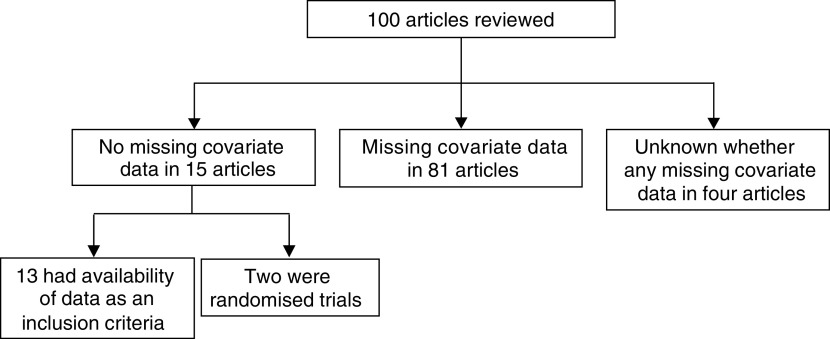
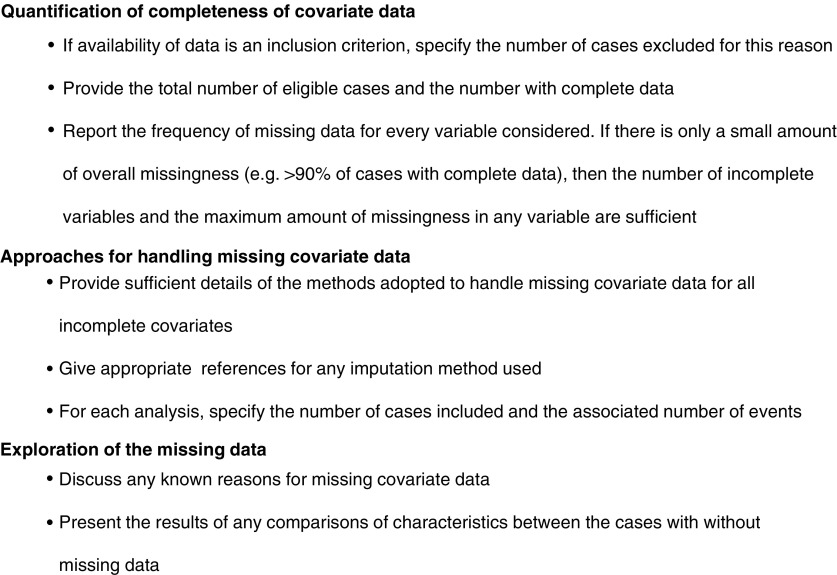
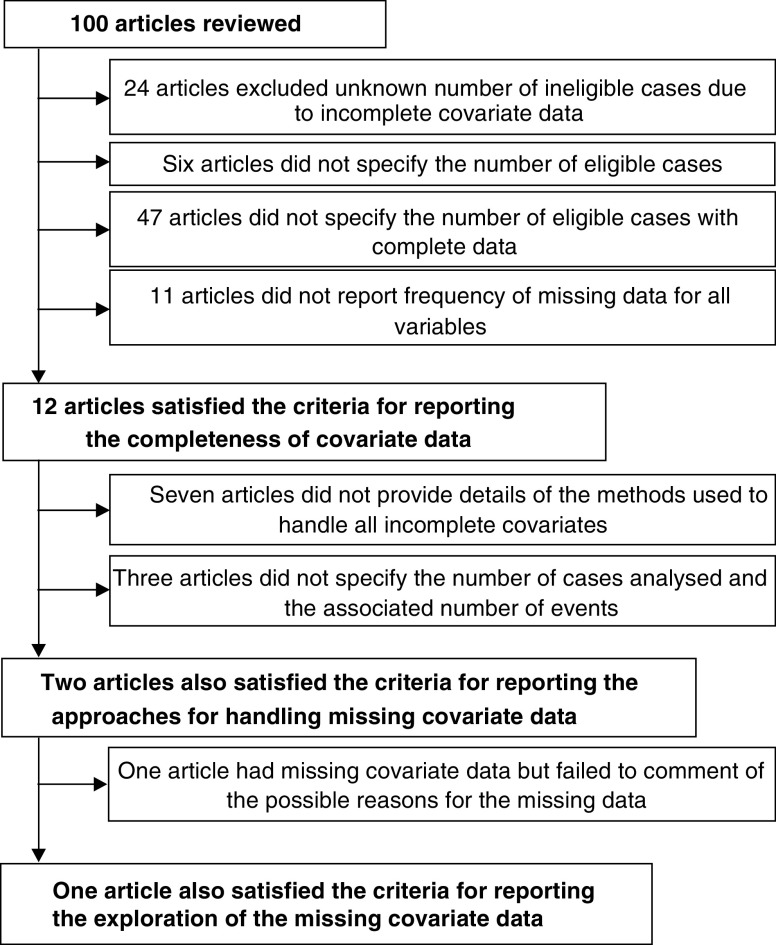
Prognostic models play a crucial role in the clinical decision-making process. Unfortunately, missing covariate data impede the construction of valid and reliable models, potentially introducing bias, if handled inappropriately. The extent of missing covariate data within reported cancer prognostic studies, the current handling and the quality of reporting this missing covariate data are unknown. Therefore, a review was conducted of 100 articles reporting multivariate survival analyses to assess potential prognostic factors, published within seven cancer journals in 2002. Missing covariate data is a common occurrence in studies performing multivariate survival analyses, being apparent in 81 of the 100 articles reviewed. The percentage of eligible cases with complete data was obtainable in 39 articles, and was <90% in 17 of these articles. The methods used to handle incomplete covariates were obtainable in 32 of the 81 articles with known missing data and the most commonly reported approaches were complete case and available case analysis. This review has highlighted deficiencies in the reporting of missing covariate data. Guidelines for presenting prognostic studies with missing covariate data are proposed, which if followed should clarify and standardise the reporting in future articles.
Overview
The claims and statistics of this paper haven’t been checked yet.
Run the check — free, no account needed. It reads the open-access text and checks the sources it cites.
Integrity signals
Registry
Cites
Statistics
Figures
Verification
Claims the paper makes
The claims and statistics of this paper haven’t been checked yet.
Run the check — free, no account needed. It reads the open-access text and checks the sources it cites.
Claims other papers make about this one
Each is checked against this paper’s own text: does it say what the citing paper says it does?
The source backs part of the claim, not all of it — or backs it for a different population, condition or comparison.
In the citing paper
“Commonly missing values are related to observed participant or disease characteristics.”
From Reporting and Methods in Clinical Prediction Research: A Systematic Review (2012) · cites this paper as [57]
Experimental — accuracy not yet measuredIn the citing paper
“Exclusion of participants with missing values will therefore not only lead to loss of statistical power, but often also to biased results 10,12,13,23,24,57,58.”
From Reporting and Methods in Clinical Prediction Research: A Systematic Review (2012) · cites this paper as [57]
In the citing paper
“Missing values in clinical study data rarely occur completely at random.”
From Reporting and Methods in Clinical Prediction Research: A Systematic Review (2012) · cites this paper as [57]
Self-check
Percentages, sums and reported differences re-computed from the paper’s own numbers.
The self-check needs the paper’s full text.
Citations
Cites
Multiple Imputation for Nonresponse in Surveys
Rubin, D. B. (1987) · Wiley Series in Probability and Statistics · doi:10.1002/9780470316696 · Cited by 20,701
Statistical Analysis With Missing Data
Lahiff, M., Little, R. J. A., & Rubin, D. B. (1989) · Journal of the American Statistical Association · doi:10.2307/2289883 · Cited by 17,385
Missing data: our view of the state of the art
Schafer, J. L., & Graham, J. W. (2002) · Psychological Methods · doi:10.1037/1082-989x.7.2.147 · Cited by 11,638
Regression Modeling Strategies
Harrell, F. E. (2001) · Springer series in statistics · doi:10.1007/978-1-4757-3462-1 · Cited by 9,270
Analysis of Incomplete Multivariate Data
Schafer, J. L. (1997) · doi:10.1201/9781439821862 · Cited by 6,012
Analysis of Incomplete Multivariate Data
Booth, D. E., & Schafer, J. L. (2000) · Technometrics · doi:10.2307/1271466 · Cited by 5,627
Statistical Analysis with Missing Data.
Chatfield, C., Little, R. J. A., & Rubin, D. B. (1988) · Journal of the Royal Statistical Society Series A (Statistics in Society) · doi:10.2307/2982783 · Cited by 2,203
Peduzzi, P., Concato, J., Feinstein, A. R., & Holford, T. R. (1995) · Journal of Clinical Epidemiology · doi:10.1016/0895-4356(95)00048-8 · Cited by 2,154
A critical look at methods for handling missing covariates in epidemiologic regression analyses.
Greenland, S., & Finkle, W. D. (1995) · American Journal of Epidemiology · doi:10.1093/oxfordjournals.aje.a117592 · Cited by 891 · cited 2×
“Other techniques, utilising all cases, include analysing the missing data as a separate category (Greenland and Finkle, 1995), single imputation (Little and Rubin, 1987), in which a single value is substituted for each missing value, and multiple imputation (Rubin, 1987; Schafer, 1997), where more than one independent…”
Statistical aspects of prognostic factor studies in oncology
Simon, R. M., & Altman, D. G. (1994) · British Journal of Cancer · doi:10.1038/bjc.1994.192 · Cited by 586
Cited by
Sorted by citations
Items 201–219 of 219
Ellis, S. D. (2019) · Carolina Digital Repository (University of North Carolina at Chapel Hill) · doi:10.17615/zt6n-qf14
Is Complete Case Analysis Appropriate for Cox Regression with Missing Covariate Data
Zhu, M. (2018) · UA Campus Repository (The University of Arizona)
Prognosis of Transient Ischemic Attack and Stroke
Lau, G. K. K., Pendlebury, S. T., & Rothwell, P. M. (2018)
Psychometric Evaluation of the Revised Iowa Pain Thermometer-Czech for Patients with Stroke
Mandysová, P., & Herr, K. (2021) · Journal of Nursing Measurement · doi:10.1891/jnm-d-20-00094
van Buuren, S. (2012) · Chapman & Hall/CRC machine learning & pattern recognition/Chapman & Hall/CRC machine learning & pattern recognition series · doi:10.1201/b11826-16
Methods of Determining Prognosis
Lau, G. K. K., Pendlebury, S. T., & Rothwell, P. M. (2018) · Cambridge University Press eBooks · doi:10.1017/9781316161609.015
Computational Methods and Tools for Decision Support in Biomedicine
Dimou, I. N., Zervakis, M., Lowe, D., & Tsiknakis, M. (2013) · IGI Global eBooks · doi:10.4018/978-1-4666-0879-5.ch5.7
Carpenito, T. (2022) · doi:10.17760/d20449633
Fang, X., Hu, H., Huang, X., Hao, M., Deng, J., Wu, Y. H., Cai, J., & Yan, D. (2022) · Research Square · doi:10.21203/rs.3.rs-1593967/v1
Zhong, L., Yang, F., Sun, S., Wang, L., Yu, H. Z., Nie, X., Liu, A., Xu, N., Zhang, L., Zhang, M., et al. (2024) · Figshare · doi:10.6084/m9.figshare.25045562
Butalia, S., Sigal, R. J., Shah, B. R., Benham, J. L., Wicklow, B. A., Yu, C. H. Y., Dasgupta, K., Chu, L. M., Amed, S., Constantinescu, C., et al. (2025) · Canadian Journal of Diabetes · doi:10.1016/j.jcjd.2025.03.008
Kwok, C. O. T., Luthra, S., DeVries, K. J., Bovill, E. S., Laeken, N. V., Macadam, S. A., Lennox, P. A., Doherty, C. D., & Isaac, K. V. (2025) · Plastic & Reconstructive Surgery Global Open · doi:10.1097/gox.0000000000007331
Mcizana, T., Adams, S., Khan, S., & Ntatamala, I. (2024) · Figshare · doi:10.6084/m9.figshare.26942916
McLernon, D. J., Nath, M., Shingshetty, L., & Bhattacharya, S. (2025) · Elsevier eBooks · doi:10.1016/b978-0-443-26745-1.00011-6
Rivoirard, R. (2019) · theses.fr (ABES) · doi:10.70675/bbd245c8z3efdz4412z99a9z55363bd4c4bf
Identification et validation des marqueurs protéiques en oncologie
Peyron, C. (2012) · theses.fr (ABES) · doi:10.70675/ac2da8f1za81ez4434zacd9zd863d2286a3e
Salleh, M. M. M., Kassim, S. S., Razak, T. R., Azahar, N., Ismail, N., Yusoff, M. Z. M., Khebir, M. H. A., Teruna, M. M. S., Rameli, N. A. C., Sallehhudin, M. I. M., et al. (2026) · doi:10.2196/preprints.102091
Irrigation and technical efficiency in Ethiopian crop production: a meta-analysis
Ehjeij, S., Heß, S., Boysen‐Urban, K., & Flaig, D. (2026) · Q Open · doi:10.1093/qopen/qoag024
Transient Ischemic Attack and Stroke: Methods of determining prognosis
Pendlebury, S., Giles, M., & Rothwell, P. (2009) · Cambridge University Press eBooks · doi:10.1017/cbo9780511575815.015
Metadata
- Authors
- Burton, A., & Altman, D. G.
- Affiliations
- Cancer Research UK (GB)
- Corresponding author
- Burton, A
- ORCID
- Venue
- British Journal of Cancer
- Published
- 2004-06-08
- Volume
- 91
- Issue
- 1
- Pages
- 4-8
- ISSN
- 0007-0920 (ISSN-L)
- 1532-1827
- PMC
- PMC2364743
- OpenAlex
- W2040958097
- Cited by
- 219
- References
- 18
- Citations by year
- 2026: 3 · 2025: 9 · 2024: 9 · 2023: 11 · 2022: 10 · 2021: 7 · 2020: 12 · 2019: 11 · 2018: 13 · 2017: 13 · 2016: 7 · 2015: 9 · 2014: 16 · 2013: 7 · 2012: 20
- FWCI
- 8.78
- Type
- journal article
- Language
- en
- Open access
- hybrid
- doi.org
- Licence
- cc-by-nc-sa
- www.springer.com/tdm (unspecified)
- Locations
- British Journal of Cancer (publishedVersion, cc-by-nc-sa)
- PubMed Central (publishedVersion, cc-by)
- PubMed (publishedVersion)
- University of Birmingham Research Portal (University of Birmingham) (submittedVersion)
- Funders
- Cancer Research UK
- Topics
- Physical Sciences › Mathematics › Statistics and Probability › Statistical Methods in Epidemiology
- Physical Sciences › Mathematics › Statistics and Probability › Statistical Methods and Bayesian Inference
- Social Sciences › Decision Sciences › Statistics, Probability and Uncertainty › Meta-analysis and systematic reviews
- Keywords
- missing covariates, reporting quality, multivariate survival analysis, complete case analysis, available case analysis, missing data handling, reporting guidelines, prognostic factors
- MeSH terms
- Decision Making, Humans, Models, Theoretical, Neoplasms, Prognosis, Reproducibility of Results, Multivariate Analysis, Guidelines as Topic, Sample Size
About these checks
Registry, retraction, Cites and statistics results are computed, not judged, with one exception: a printed reference that no index lists is read once by a model before it counts as a citation error. Claims are extracted by a model and kept only when their quote appears verbatim in the text; each cited source is then checked, with a model’s help, for whether it says what the claim relies on. Those verdicts can be wrong — read the claim’s quote and the cited source before relying on one.
Statistics and arithmetic are recomputed, not judged.
Confidence bands are shown only for fields calibrated on our annotated test set. None is calibrated yet, so no band is shown.
What counts as a claim ›How we measure confidence ›How we check this ›
Are you an author, or do you see a problem with this page? Request a review
