

The DOI matches its Crossref record; 28 of the 30 references it cites were found in a registry or an index.
What if cancer survival in Britain were the same as in Europe: how many deaths are avoidable?
Open accessAbstract
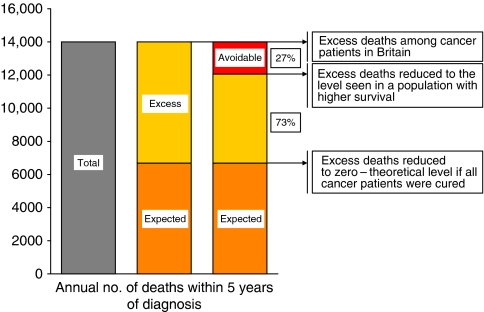
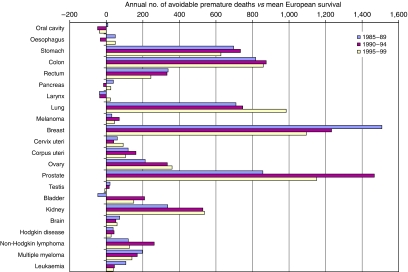
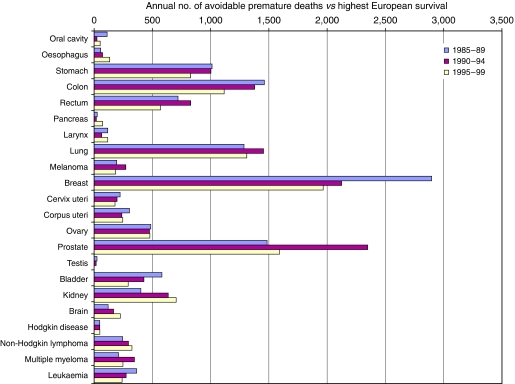
OBJECTIVE: To estimate the number of deaths among cancer patients diagnosed in Great Britain that would be avoidable within 5 years of diagnosis if the mean (or highest) survival in Europe for patients diagnosed during 1985-1989, 1990-1994 and 1995-1999 were achieved. DESIGN: Five-year relative survival for cancers in Great Britain compared with that from other countries in the EUROCARE-2, -3 and -4 studies. Calculation of excess deaths (those more than expected from mortality in the general population) that would be avoidable among cancer patients in Britain if relative survival were the same as in Europe. SETTING: Great Britain (England, Wales, Scotland) and 13 other European countries. SUBJECTS: 2.8 million adults diagnosed in Britain with 1 of 39 cancers during 1985-1989 (followed up to 1994), 1990-1994 (followed up to 1999) and 1995-1999 (followed up to 2003). MAIN OUTCOME MEASURE: Annual number of avoidable deaths within 5 years of diagnosis. Percentage of the excess (cancer-related) deaths among cancer patients that would be avoidable. RESULTS: Compared with the mean European 5-year relative survival, the largest numbers of avoidable deaths for patients diagnosed during 1985-1989 were for cancers of the breast (about 18% of the excess mortality from this cancer, 7541 deaths), prostate (14%, 4285), colon (9%, 4090), stomach (8%, 3483) and lung (2%, 3548). For 1990-1994, the largest numbers of avoidable deaths were for cancers of the prostate (20%, 7335), breast (15%, 6165), colon (9%, 4376), stomach (9%, 3672), lung (2%, 3735) and kidney (22%, 2644). For 1995-1999, most of the avoidable deaths were for cancers of the prostate (17%, 5758), breast (15%, 5475), lung (3%, 4923), colon (10%, 4295), stomach (9%, 3137) and kidney (21%, 2686).Overall, some 6600-7500 premature deaths would have been avoided each year among cancer patients diagnosed in Britain during 1985-1999 if the mean survival in Europe had been achieved. This represents 6-7% of cancer-related mortality. Compared with the highest European survival, avoidable premature mortality among cancer patients fell from about 12 800 deaths a year (12.2% of cancer-related mortality) to about 11 400 deaths a year (10.6%) over the same period.A large component of the avoidable mortality is due to prostate cancer: excluding this cancer from comparison with the European mean survival reduces the annual number of avoidable deaths by 1000-1500, and the percentage of excess mortality by up to 1%. Compared with the highest survival, the annual number of avoidable deaths would be 1500-2000 fewer, and 1-2% lower as a percentage of excess mortality, but the overall trend in avoidable premature mortality among cancer patients would be similar, falling from 11.4% (1985-1989) to 10.3% (1990-1994) and 9.7% for those diagnosed during 1995-1999.For several cancers, survival in Britain was slightly higher than the mean survival in Europe; this represented some 110-180 premature deaths avoided each year during the period 1985-2003. CONCLUSIONS: Avoidable premature mortality among cancer patients diagnosed in Britain during 1985-1999 has represented 6-7% of cancer-related mortality compared with the mean survival in Europe. Compared with the highest levels of survival in Europe, the reduction from 12.2% to 10.6% of cancer-related mortality reflects small but steady progress over the period 1985-2003.
Overview
The claims and statistics of this paper haven’t been checked yet.
Run the check — free, no account needed. It reads the open-access text and checks the sources it cites.
Integrity signals
Registry
Cites
Statistics
Figures
Verification
Claims the paper makes
The claims and statistics of this paper haven’t been checked yet.
Run the check — free, no account needed. It reads the open-access text and checks the sources it cites.
Claims other papers make about this one
Each is checked against this paper’s own text: does it say what the citing paper says it does?
In the citing paper
“which may be significantly associated with mortality.36”
From Smartphone applications for melanoma detection by community, patient and generalist clinician users: a review (2015) · cites this paper as [36]
Self-check
Percentages, sums and reported differences re-computed from the paper’s own numbers.
The self-check needs the paper’s full text.
Citations
Cites
Cancer Incidence in Five Continents
Doll, R., Muir, C. S., & Waterhouse, J. A. H. (1970) · Springer eBooks · doi:10.1007/978-3-642-85851-2 · Cited by 8,485
Statistical Methods in Cancer Research
Breslow, N. E. (1980) · Cited by 7,332
EUROCARE-3: survival of cancer patients diagnosed 1990–94—results and commentary
Sant, M., Aareleid, T., Berrino, F., Lasota, M. B., Carli, P., Faivre, J., Grosclaude, P., Hédelin, G., Matsuda, T., Møller, H., et al. (2003) · Annals of Oncology · doi:10.1093/annonc/mdg754 · Cited by 1,010
CALCULATION OF SURVIVAL RATES FOR CANCER
Berkson, J., & Gage, R. P. (1950) · Mayo Clinic Proceedings · doi:10.1016/s0025-6196(26)04443-5 · Cited by 944
Berrino, F., Angelis, R. D., Sant, M., Rosso, S., Bielska‐Lasota, M., Coebergh, J. W. W., & Santaquilani, M. (2007) · The Lancet Oncology · doi:10.1016/s1470-2045(07)70245-0 · Cited by 806
Steliarova‐Foucher, E., Stiller, C. A., Kaatsch, P., Berrino, F., Coebergh, J. W. W., Lacour, B., & Perkin, M. (2004) · The Lancet · doi:10.1016/s0140-6736(04)17550-8 · Cited by 562
EUROCARE-3 summary: cancer survival in Europe at the end of the 20th century
Coleman, M. P., Gatta, G., Verdecchia, A., Estève, J., Sant, M., Storm, H. H., Allemani, C., Ciccolallo, L., Santaquilani, M., & Berrino, F. (2003) · Annals of Oncology · doi:10.1093/annonc/mdg756 · Cited by 480
Self-citationStatistical methods in cancer research. Volume IV. Descriptive epidemiology.
Estève, J., Benhamou, E., & Raymond, L. (1994) · PubMed · Cited by 447
Relative survival and the estimation of net survival: Elements for further discussion
Estève, J., Benhamou, E., Croasdale, M., & Raymond, L. (1990) · Statistics in Medicine · doi:10.1002/sim.4780090506 · Cited by 421
Survival trends in European cancer patients diagnosed from 1988 to 1999
Verdecchia, A., Guzzinati, S., Francisci, S., Angelis, R. D., Bray, F., Allemani, C., Tavilla, A., Santaquilani, M., & Sant, M. (2009) · European Journal of Cancer · doi:10.1016/j.ejca.2008.11.029 · Cited by 146
Research works printed but not linked: 10
- Berrino F, Capocaccia R, Coleman MP, Estève J, Gatta G, Hakulinen T, Micheli A, Sant M, Verdecchia A (eds) (2003) EUROCARE-3: the survival of cancer patients diagnosed in Europe during 1990–1994. Ann Oncol 14 (Suppl 5): 1–155
- Berrino F, Capocaccia R, Estève J, Gatta G, Hakulinen T, Micheli A, Sant M, Verdecchia A, EUROCARE Working Group (1999a) Survival of Cancer Patients in Europe: the EUROCARE-2 Study (CDROM). International Agency for Research on Cancer (WHO): Lyon
- Berrino F, Capocaccia R, Estève J, Gatta G, Hakulinen T, Micheli M, Sant M, Verdecchia A (eds) (1999b) Survival of Cancer Patients in Europe: the EUROCARE-2 Study (IARC Scientific Publications No. 151). International Agency for Research on Cancer: Lyon
- Berrino F, Estève J, Coleman MP (1995a) Basic issues in the estimation and comparison of cancer patient survival. In Survival of Cancer Patients in Europe: the EUROCARE Study (IARC Scientific Publications No. 132), Berrino F, Sant M, Verdecchia A, Capocaccia R, Hakulinen T, Estève J (eds), pp 1–14. International Agency for Research on Cancer (WHO): Lyon
- Berrino F, Sant M, Verdecchia A, Capocaccia R, Hakulinen T, Estève J (eds) (1995b) Survival of Cancer Patients in Europe: the EUROCARE Study (IARC Scientific Publications No. 132). International Agency for Research on Cancer: Lyon
- Carrani E, Roazzi P, Capocaccia R (1999) Organization and use of the EUROCARE-2 compact disk. In Survival of Cancer Patients in Europe: the EUROCARE-2 Study (IARC Scientific Publications No. 151), Berrino F, Capocaccia R, Estève J, Gatta G, Hakulinen T, Micheli M, Sant M, Verdecchia A (eds), pp 569–572. International Agency for Research on Cancer: Lyon
- Coleman MP, Babb P, Damiecki P, Grosclaude PC, Honjo S, Jones J, Knerer G, Pitard A, Quinn MJ, Sloggett A, De Stavola BL (1999) Cancer Survival Trends in England and Wales 1971–1995: Deprivation and NHS Region (Studies on Medical and Population Subjects No. 61). The Stationery Office: London
- Curado MP, Edwards BK, Shin HR, Storm HH, Ferlay J, Heanue M, Boyle P (eds) (2007) Cancer Incidence in Five Continents. Vol. IX. IARC Scientific Publications No. 160. IARC: Lyon
- Micheli A, De Angelis G, Giorgi Rossi A, Capocaccia R (1999) General mortality and the survival of cancer patients in Europe. In Survival of Cancer Patients in Europe: the EUROCARE-2 Study (IARC Scientific Publications No. 151), Berrino F, Capocaccia R, Estève J, Gatta G, Hakulinen T, Micheli A, Sant M, Verdecchia A (eds), pp 63–71. International Agency for Research on Cancer: Lyon
- Threlfall AG, Collins S, Woodman CBJ (2001) ‘Avoided deaths’ may not be useful for predicting mortality reductions from cancer. Br Med J 321: 1470
Cited by
Sorted by citations
Allemani, C., Matsuda, T., Di Carlo, V., Harewood, R., Matz, M., Nikšić, M., Bonaventure, A., Valkov, M., Johnson, C. J., Estève, J., et al. (2018) · The Lancet · doi:10.1016/s0140-6736(17)33326-3 · Cited by 6,145
Self-citationColeman, M. P., Forman, D., Bryant, H., Butler, J., Rachet, B., Maringe, C., Nur, U., Tracey, E. A., Coory, M. D., Hatcher, J., et al. (2010) · The Lancet · doi:10.1016/s0140-6736(10)62231-3 · Cited by 1,114
Self-citationWalters, S., Maringe, C., Coleman, M. P., Peake, M. D., Butler, J., Young, N., Bergström, S. N., Hanna, L., Jakobsen, E. H., Kölbeck, K. G., et al. (2013) · Thorax · doi:10.1136/thoraxjnl-2012-202297 · Cited by 577
Self-citationRoutes to diagnosis for cancer – determining the patient journey using multiple routine data sets
Elliss‐Brookes, L., McPhail, S., Ives, A., Greenslade, M., Shelton, J., Hiom, S., & Richards, M. (2012) · British Journal of Cancer · doi:10.1038/bjc.2012.408 · Cited by 522
Lyratzopoulos, G., Neal, R. D., Barbiere, J. M., Rubin, G. P., & Abel, G. A. (2012) · The Lancet Oncology · doi:10.1016/s1470-2045(12)70041-4 · Cited by 425
Metadata
- Authors
- Abdel-Rahman, M., Stockton, D., Rachet, B., Hakulinen, T., & Coleman, M. P.
- Affiliations
- Cancer Research UK (GB)
- Finnish Cancer Registry (FI)
- Corresponding author
- Coleman, M P
- Venue
- British Journal of Cancer
- Published
- 2009-12
- Volume
- 101
- Issue
- S2
- Pages
- S115-S124
- ISSN
- 0007-0920 (ISSN-L)
- 1532-1827
- PMC
- PMC2790713
- OpenAlex
- W2153360645
- Cited by
- 160
- References
- 30
- Citations by year
- 2026: 2 · 2025: 1 · 2024: 1 · 2023: 4 · 2022: 3 · 2021: 6 · 2020: 7 · 2019: 4 · 2018: 5 · 2017: 10 · 2016: 13 · 2015: 23 · 2014: 17 · 2013: 21 · 2012: 18
- FWCI
- 7.16
- Type
- journal article
- Language
- en
- Open access
- hybrid
- doi.org
- Licence
- cc-by-nc-sa
- www.springer.com/tdm (unspecified)
- Locations
- British Journal of Cancer (publishedVersion, cc-by-nc-sa)
- PubMed Central (publishedVersion, cc-by)
- PubMed (publishedVersion)
- LSHTM Research Online (London School of Hygiene and Tropical Medicine) (acceptedVersion)
- Funders
- London School of Hygiene and Tropical Medicine
- Cancer Research UK (11700)
- Topics
- Health Sciences › Medicine › Oncology › Global Cancer Incidence and Screening
- Social Sciences › Economics, Econometrics and Finance › Economics and Econometrics › Economic and Financial Impacts of Cancer
- Health Sciences › Medicine › Oncology › Cutaneous Melanoma Detection and Management
- Keywords
- cancer survival, excess mortality, 5-year relative survival, EUROCARE, breast cancer, prostate cancer, colon cancer, gastric cancer, lung cancer, kidney cancer, Great Britain, European comparison, quality of cancer care, cancer treatment costs
- MeSH terms
- Adolescent, Adult, Aged, Aged, 80 and over, Europe, Female, United Kingdom, Humans, Male, Middle Aged, Neoplasms, Time Factors
About these checks
Registry, retraction, Cites and statistics results are computed, not judged, with one exception: a printed reference that no index lists is read once by a model before it counts as a citation error. Claims are extracted by a model and kept only when their quote appears verbatim in the text; each cited source is then checked, with a model’s help, for whether it says what the claim relies on. Those verdicts can be wrong — read the claim’s quote and the cited source before relying on one.
Statistics and arithmetic are recomputed, not judged.
Confidence bands are shown only for fields calibrated on our annotated test set. None is calibrated yet, so no band is shown.
What counts as a claim ›How we measure confidence ›How we check this ›
Are you an author, or do you see a problem with this page? Request a review
