

Quantum Transport Enhancement by Time-Reversal Symmetry Breaking
Open accessThe DOI matches its Crossref record; 34 of the 34 references it cites were found in a registry or an index.
Abstract
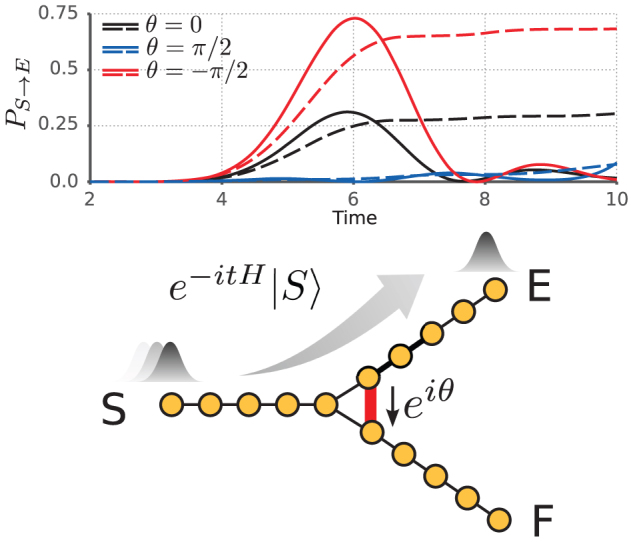
Quantum mechanics still provides new unexpected effects when considering the transport of energy and information. Models of continuous time quantum walks, which implicitly use time-reversal symmetric Hamiltonians, have been intensely used to investigate the effectiveness of transport. Here we show how breaking time-reversal symmetry of the unitary dynamics in this model can enable directional control, enhancement and suppression of quantum transport. Examples ranging from exciton transport to complex networks are presented. This opens new prospects for more efficient methods to transport energy and information.
Overview
The claims and statistics of this paper haven’t been checked yet.
Free: it reads the open-access text and checks the first 5 claims that cite a source we can check. Create a free account to check every claim.
Integrity signals
Registry
Cites
Statistics
Figures
Verification
Claims the paper makes
The claims and statistics of this paper haven’t been checked yet.
Free: it reads the open-access text and checks the first 5 claims that cite a source we can check. Create a free account to check every claim.
Claims other papers make about this one
Each is checked against this paper’s own text: does it say what the citing paper says it does?
The cited source doesn’t support the claim as written.
In the citing paper
“In the scenarios where the addition of complex phases affects transfer probabilities, the underlying system breaks timereversal symmetry and, consequently, the probability fl ow into the quantum system is biased.”
From Complex networks from classical to quantum (2019) · cites this paper as [65]
Checked by a reasoning model — may be wrong.
Experimental — accuracy not yet measuredThe cited source says what the claim attributes to it.
In the citing paper
“many works have compared properties of stochastic 68,69 and quantum random walks 63 -65 on complex networks 70 .”
From Complex networks from classical to quantum (2019) · cites this paper as [65]
The cited source says what the claim attributes to it.
In the citing paper
“Transport suppression is indeed possible however 65 .”
From Complex networks from classical to quantum (2019) · cites this paper as [65]
The cited source says what the claim attributes to it.
In the citing paper
“These results point to a subtle interplay between the topology of the underlying graph, giving rise to a new challenge for dynamical control of probability transfer when considering walks on complex networks 12,65,71,72 .”
From Complex networks from classical to quantum (2019) · cites this paper as [65]
The cited source says what the claim attributes to it.
In the citing paper
“These complex phases in many cases do not affect transfer probabilities: the theory explaining this fi nding was developed in refs. 12,65 , without relying on approximations or averaging.”
From Complex networks from classical to quantum (2019) · cites this paper as [65]
2 more claims about this paper
Create a free account to see every claim other papers make about this one.
Self-check
Percentages, sums and reported differences re-computed from the paper’s own numbers.
The self-check needs the paper’s full text.
Citations
Cites
Collective dynamics of ‘small-world’ networks
Watts, D. J., & Strogatz, S. H. (1998) · Nature · doi:10.1038/30918 · Cited by 43,060
Emergence of Scaling in Random Networks
Barabási, A.-L., & Albert, R. (1999) · Science · doi:10.1126/science.286.5439.509 · Cited by 36,135
Colloquium : Topological insulators
Hasan, M. Z., & Kane, C. L. (2010) · Reviews of Modern Physics · doi:10.1103/revmodphys.82.3045 · Cited by 19,930
On the generators of quantum dynamical semigroups
Lindblad, G. (1976) · Communications in Mathematical Physics · doi:10.1007/bf01608499 · Cited by 7,548
Energy levels and wave functions of Bloch electrons in rational and irrational magnetic fields
Hofstadter, D. R. (1976) · Physical Review B · doi:10.1103/physrevb.14.2239 · Cited by 3,495
Quantum Transport: Atom to Transistor
Datta, S. (2005) · Cambridge University Press eBooks · doi:10.1017/cbo9781139164313 · Cited by 3,227
On the evolution of random graphs
Erdös, P., & Rényi, A. (2011) · The Structure and Dynamics of Networks · doi:10.1515/9781400841356.38 · Cited by 1,757
Quantum random walks: An introductory overview
Kempe, J. (2003) · Contemporary Physics · doi:10.1080/00107151031000110776 · Cited by 1,413 · cited 2×
“In the standard literature on continuous time quantum walks [1, 2, 3, 4, 5], the time-independent walk Hamiltonian is defined by a real weighted adjacency matr ix J of an underlying undirected graph, HQW = sites”
BackgroundZur Theorie des Diamagnetismus von Leitungselektronen
Peierls, R. (1933) · Zeitschrift f�r Physik · doi:10.1007/bf01342591 · Cited by 1,380
Quantum computation and decision trees
Farhi, E., & Gutmann, S. (1998) · Physical Review A · doi:10.1103/physreva.58.915 · Cited by 1,215
Research works printed but not linked: 3
- Eisfeld A. Phase directed excitonic transport and its limitations due to environmental influence. J. Chem. Phys. 379, 33 (2011).
- Sarma S. D. & Pinczuk A. Perspectives in Quantum Hall Effects (Wiley-VCH, 2004).
- Dalibard J., Gerbier, F., Juzeliunas, G. & Öhberg, P. Topological Insulators. Rev. Mod. Phys. 82(4), 3045 (2011).
Cited by
Complex networks from classical to quantum
Biamonte, J., Faccin, M., & De Domenico, M. (2019) · Communications Physics · doi:10.1038/s42005-019-0152-6 · Cited by 149
Self-citationQuantum Simulation of Helium Hydride Cation in a Solid-State Spin Register
Wang, Y., Dolde, F., Biamonte, J., Babbush, R., Bergholm, V., Yang, S., Jakobi, I., Neumann, P., Aspuru-Guzik, A., Whitfield, J. D., et al. (2015) · ACS Nano · doi:10.1021/acsnano.5b01651 · Cited by 152
Self-citationSymmetry and the thermodynamics of currents in open quantum systems
Manzano, D., & Hurtado, P. I. (2014) · Physical Review B · doi:10.1103/physrevb.90.125138 · Cited by 80
Topologically protected excitons in porphyrin thin films
Yuen-Zhou, J., Saikin, S. K., Yao, N. Y., & Aspuru-Guzik, A. (2014) · Nature Materials · doi:10.1038/nmat4073 · Cited by 67
“Furthermore, connections between this work and theories of TRS breaking in quantum transport remain to be explored [53, 54].”
BackgroundHarnessing symmetry to control quantum transport
Manzano, D., & Hurtado, P. I. (2018) · Advances In Physics · doi:10.1080/00018732.2018.1519981 · Cited by 81
“Moreover, symmetries have been recently shown to constraint strongly the reduced density matrix associated to nonequilibrium steady states in open quantum systems [108], while violations of time-reversal symmetry lead to an enhancement of quantum transport in continuous-time quantum walks [109].”
BackgroundLu, D., Biamonte, J. D., Li, J., Li, H., Johnson, T. H., Bergholm, V., Faccin, M., Zimborás, Z., Laflamme, R., Baugh, J., et al. (2016) · Physical Review A · doi:10.1103/physreva.93.042302 · Cited by 58
“Since their recent introduction [13], continuous time chiral quantum walks have been studied in the context of energy transport in ultracold atoms and molecules [14], in non-equilibrium physics [15, 16], and as a method to achieve near perfect state transfer [13, 17].”
BackgroundSelf-citationDegree Distribution in Quantum Walks on Complex Networks
Faccin, M., Johnson, T., Biamonte, J., Kais, S., & Migdał, P. (2013) · Physical Review X · doi:10.1103/physrevx.3.041007 · Cited by 45
Self-citationCommunity Detection in Quantum Complex Networks
Faccin, M., Migdał, P., Johnson, T. H., Bergholm, V., & Biamonte, J. D. (2014) · Physical Review X · doi:10.1103/physrevx.4.041012 · Cited by 43
“Within the requirement of being Hermitian, in quantum mechanics the fact that the Hamiltonian may have complex elements leads to a range of phenomena not captured by real matrices, such as time-reversal symmetry breaking [19,65].”
BackgroundMethodInfluentialSelf-citationComplex quantum networks: a topical review
Nokkala, J., Piilo, J., & Bianconi, G. (2024) · Journal of Physics A Mathematical and Theoretical · doi:10.1088/1751-8121/ad41a6 · Cited by 74
Quantum Interference and Selectivity through Biological Ion Channels
Salari, V., Naeij, H. R., & Shafiee, A. (2017) · Scientific Reports · doi:10.1038/srep41625 · Cited by 46
The probe technique far from equilibrium: Magnetic field symmetries of nonlinear transport
Bedkihal, S., Bandyopadhyay, M., & Segal, D. (2013) · The European Physical Journal B · doi:10.1140/epjb/e2013-40971-7 · Cited by 43
Supersymmetric multiplex networks described by coupled Bose and Fermi statistics
Bianconi, G. (2015) · Physical Review E · doi:10.1103/physreve.91.012810 · Cited by 32
Quantum current in dissipative systems
Hovhannisyan, K. V., & Imparato, A. (2019) · New Journal of Physics · doi:10.1088/1367-2630/ab1731 · Cited by 34
“Indeed, although the probabilities to find the particle at given vertices are always well defined, defining transition rates between vertices is less straightforward: The classical protocol—measure at j, evolve, measure at j′—executed in the quantum regime [2, 7, 8, 11], excludes the coherent part of the dynamics, and…”
BackgroundUniversal state transfer on graphs
Cameron, S., Fehrenbach, S., Granger, L., Hennigh, O., Shrestha, S., & Tamon, C. (2014) · Linear Algebra and its Applications · doi:10.1016/j.laa.2014.05.004 · Cited by 26
“ices are real and flat. For other works which had studied graphs with complex Hermitian adjacency matrices, we refer the reader to Kay [18] (and some of the references therein) and to Zimbora´s et al. [23]. 2 Preliminaries We state some notation used in the rest of the paper. For a logical statement S, we let the Ivers…”
MethodQuantum walks in synthetic gauge fields with three-dimensional integrated photonics
Boada, O., Novo, L., Sciarrino, F., & Omar, Y. (2017) · Physical Review A · doi:10.1103/physreva.95.013830 · Cited by 31
Generalized quantum-classical correspondence for random walks on graphs
Frigerio, M., Benedetti, C., Olivares, S., & Paris, M. G. A. (2021) · Physical Review A · doi:10.1103/physreva.104.l030201 · Cited by 26
Faster quantum walk search on a weighted graph
Wong, T. G. (2015) · Physical Review A · doi:10.1103/physreva.92.032320 · Cited by 23
“[14] Zoltán Zimborás, Mauro Faccin, Zoltán Kádár, James D.”
BackgroundQuantum routing of information using chiral quantum walks
Bottarelli, A., Frigerio, M., & Paris, M. G. A. (2023) · AVS Quantum Science · doi:10.1116/5.0146805 · Cited by 25
Quantum walk search with time-reversal symmetry breaking
Wong, T. G. (2015) · Journal of Physics A Mathematical and Theoretical · doi:10.1088/1751-8113/48/40/405303 · Cited by 19
“introduced chiral quantum walks [10], which break time-reversal symmetry by walking on directed, weighted graphs, where transitioning in one direction has some phase e, and transitioning in the opposite direction has the conjugate phase e−iθ.”
BackgroundZero transfer in continuous-time quantum walks
Sett, A., Pan, H., Falloon, P. E., & Wang, J. B. (2019) · Quantum Information Processing · doi:10.1007/s11128-019-2267-9 · Cited by 17
“, where it was shown that complete suppression of information transfer can be achieved to diametrically opposite vertices of even cycles provided the phases satisfy certain conditions [24].”
InfluentialQuantum-classical distance as a tool to design optimal chiral quantum walks
Frigerio, M., Benedetti, C., Olivares, S., & Paris, M. G. A. (2022) · Physical Review A · doi:10.1103/physreva.105.032425 · Cited by 18
Chiral quantum router with Rydberg atoms
Palaiodimopoulos, N. E., Ohler, S., Fleischhauer, M., & Petrosyan, D. (2024) · Physical Review A · doi:10.1103/physreva.109.032622 · Cited by 16
“The direction of propagation of the wavepacket launched by the sender spin is determined by the total phase γ tot in the flux triangle [24].”
BackgroundWang, Q. Q., Ren, S., Yin, R., Ziegler, K., Barkai, E., & Tornow, S. (2024) · Entropy · doi:10.3390/e26100869 · Cited by 28
“First, we consider the stroboscopic measurement scheme [9], which we call the local measurement protocol or the on-site protocol.”
MethodControlling probability transfer in the discrete-time quantum walk by modulating the symmetries
Chen, T., Wang, B., & Zhang, X. (2017) · New Journal of Physics · doi:10.1088/1367-2630/aa8fe4 · Cited by 16
Irreconcilable difference between quantum walks and adiabatic quantum computing
Wong, T. G., & Meyer, D. A. (2016) · Physical Review A · doi:10.1103/physreva.93.062313 · Cited by 13
Optimal quantum search on truncated simplex lattices
Wang, Y., Wu, S., & Wang, W. (2020) · Physical Review A · doi:10.1103/physreva.101.062333 · Cited by 14
Quantum simulation of a quantum stochastic walk
Govia, L. C. G., Taketani, B. G., Schuhmacher, P. K., & Wilhelm, F. K. (2016) · Quantum Science and Technology · doi:10.1088/2058-9565/aa540b · Cited by 14
Engineering the success of quantum walk search using weighted graphs
Wong, T. G., & Philipp, P. (2016) · Physical Review A · doi:10.1103/physreva.94.022304 · Cited by 15
Perturbed graphs achieve unit transport efficiency without environmental noise
Cavazzoni, S., Razzoli, L., Bordone, P., & Paris, M. G. A. (2022) · Physical review. E · doi:10.1103/physreve.106.024118 · Cited by 15
Enhanced quantum transport in chiral quantum walks
Annoni, E., Frigerio, M., & Paris, M. G. A. (2024) · Quantum Information Processing · doi:10.1007/s11128-024-04331-y · Cited by 18
“In the even case, the optimal value of the phase is always 0 (corresponding to a non-chiral quantum walk), whereas transport suppression at all times is obtained for φ = π [11, 12, 32].”
InfluentialQuantum state transfer along a ring with time-reversal asymmetry
Liu, Y., & Zhou, D. L. (2015) · Physical Review A · doi:10.1103/physreva.91.052318 · Cited by 12
Wang, Y., Yu, X., Xue, S., Wang, Y., Zhan, J., Wu, C., Zhu, P., Zheng, Q., Yu, M., Liu, Y., et al. (2022) · Science China Physics Mechanics and Astronomy · doi:10.1007/s11433-022-1936-5 · Cited by 11
Why and how to add direction to a quantum walk
Chaves, R., Chagas, B., & Coutinho, G. (2023) · Quantum Information Processing · doi:10.1007/s11128-022-03746-9 · Cited by 13
“The answer is affirmative (see for instance [29]).”
BackgroundNon-adiabatic control of quantum energy transfer in ordered and disordered arrays
Xiang, P., Litinskaya, M., Shapiro, E. A., & Krems, R. V. (2013) · New Journal of Physics · doi:10.1088/1367-2630/15/6/063015 · Cited by 12
Continuous-time quantum walks on directed bipartite graphs
Tödtli, B., Laner, M., Semenov, J., Paoli, B., Blattner, M., & Kunegis, J. (2016) · Physical Review A · doi:10.1103/physreva.94.052338 · Cited by 9
Novo, L., & Ribeiro, S. (2021) · Physical Review A · doi:10.1103/physreva.103.042219 · Cited by 11
“This can be used to control the propagation direction of the walker and improve transport efficiency in specific graphs [27].”
BackgroundMethodInfluentialSupervised graph classification for chiral quantum walks
Kryukov, A., Abramov, R., Fedichkin, L. E., Alodjants, A. P., & Melnikov, A. A. (2022) · Physical Review A · doi:10.1103/physreva.105.022208 · Cited by 9
Frigerio, M., & Paris, M. G. A. (2023) · Linear Algebra and its Applications · doi:10.1016/j.laa.2023.05.007 · Cited by 10
Topological classification of time-asymmetry in unitary quantum processes
Turner, J., & Biamonte, J. (2021) · Journal of Physics A Mathematical and Theoretical · doi:10.1088/1751-8121/abf9d0 · Cited by 9
Self-citationControlled information transfer in continuous-time chiral quantum walks
Khalique, A., Sett, A., Wang, J. B., & Twamley, J. (2021) · New Journal of Physics · doi:10.1088/1367-2630/ac1551 · Cited by 10
Physical realizability of continuous-time quantum stochastic walks
Taketani, B. G., Govia, L. C. G., & Wilhelm, F. K. (2018) · Physical Review A · doi:10.1103/physreva.97.052132 · Cited by 6
“Directionality, in turn, can enhance transport [20], or speed-up memory access in artificial intelligence [18].”
BackgroundEfficient Quantum Transmission in Multiple-Source Networks
Luo, M.-X., Xu, G., Chen, X., Yang, Y., & Wang, X. (2014) · Scientific Reports · doi:10.1038/srep04571 · Cited by 5
RetractedMultiparameter estimation of continuous-time quantum walk Hamiltonians through machine learning
Gianani, I., & Benedetti, C. (2023) · AVS Quantum Science · doi:10.1116/5.0137398 · Cited by 8
Entanglement transfer via chiral and continuous-time quantum walks on a triangular chain
Sağlam, U., Paternostro, M., & Müstecaplıoğlu, Ö. E. (2023) · Physica A Statistical Mechanics and its Applications · doi:10.1016/j.physa.2023.128480 · Cited by 8
Fermionic networks: Modeling adaptive complex networks with fermionic gases
Javarone, M. A. (2015) · International Journal of Modern Physics C · doi:10.1142/s0129183116500212 · Cited by 6
“calling that a number of models ‘inspired from’/’based on’ quantum mechanics have been developed in the eld of complex networks, opening the way to the emerging eld of ’quantum complex networks’ {see [17, 18]. The remainder of the paper is organized as follows: Section II describes the model of bosonic networks and th…”
BackgroundExtractable energy from quantum superposition of current states
Perciavalle, F., Rossini, D., Polo, J., & Luigi Amico, A. (2025) · Quantum Science and Technology · doi:10.1088/2058-9565/adbf45 · Cited by 11
Scalable Structure for Chiral Quantum Routing
Ragazzi, G., Cavazzoni, S., Benedetti, C., Bordone, P., & Paris, M. G. A. (2025) · Entropy · doi:10.3390/e27050498 · Cited by 9
“In recent years, the impact of chirality [28–31] on quantum walk dynamics has been investigated, and exploited to improve quantum information tasks.”
2‐Adic Quantum Mechanics, Continuous‐Time Quantum Walks, and the Space Discreteness
Zúñiga-Galindo, W. A. (2025) · Fortschritte der Physik · doi:10.1002/prop.70019 · Cited by 10
“But all the efforts (especially from Born and Jordan) to construct physical theories with discrete space-times failed.”
Zúñiga-Galindo, W. A., & Chacón-Cortés, L. F. (2026) · Journal of Statistical Mechanics Theory and Experiment · doi:10.1088/1742-5468/ae9fd4 · Cited by 7
Quantum simulation of a discrete-time quantum stochastic walk
Schuhmacher, P. K., Govia, L. C. G., Taketani, B. G., & Wilhelm, F. K. (2021) · Europhysics Letters (EPL) · doi:10.1209/0295-5075/133/50003 · Cited by 5
“widely documented in literature [7, 17, 10, 18, 19, 20, 21, 22].”
Resonances of recurrence time of monitored quantum walks
Yin, R., Wang, Q. Q., Tornow, S., & Barkai, E. (2025) · The Journal of Chemical Physics · doi:10.1063/5.0265944 · Cited by 11
Short-time behavior of continuous-time quantum walks on graphs
Szigeti, B. E., Homa, G., Zimborás, Z., & Barankai, N. (2019) · Physical Review A · doi:10.1103/physreva.100.062320 · Cited by 6
Self-citationQuantum walk processes in quantum devices
Madhu, A. K., Melnikov, A. A., Fedichkin, L. E., Alodjants, A. P., & Lee, R. (2023) · Heliyon · doi:10.1016/j.heliyon.2023.e13416 · Cited by 4
“Note that A is not necessarily symmetric – the weights Aij are complex parameters and can, in general, lead to a chiral quantum walk on a weighted graph [41,42].”
BackgroundHow to suppress dark states in quantum networks and bio-engineered structures
Le, T. P., Donati, L., Severini, S., & Caruso, F. (2018) · Journal of Physics A Mathematical and Theoretical · doi:10.1088/1751-8121/aad3e6 · Cited by 5
Discrete-Time Quantum Walks on Oriented Graphs
Chagas, B., & Portugal, R. (2020) · Electronic Proceedings in Theoretical Computer Science · doi:10.4204/eptcs.315.3 · Cited by 4
Effective simulation of state distribution in qubit chains
Vlasov, A. Y. (2018) · Quantum Information Processing · doi:10.1007/s11128-018-2036-1 · Cited by 4
“19b can be treated as a “chiral” [30,31] or “spiral” [34] and may appear due to the Dzyaloshinskii–Moriya interaction [35].”
BackgroundOptimal quantum transport on a ring via locally monitored chiral quantum walks
Finocchiaro, S., Luilli, G. O., Benenti, G., Paris, M. G. A., & Razzoli, L. (2025) · Physical review. E · doi:10.1103/svrb-b72k · Cited by 10
“Chiral quantum walks leverage time-reversal symmetry breaking, typically through complex-valued edge weights [23, 24], to enable controlled directional transport [25– 27] or its suppression [28], with promising applications in routing [29].”
Bhandari, H., & Durganandini, P. (2023) · Quantum Information Processing · doi:10.1007/s11128-022-03782-5 · Cited by 3
“CTQWs with complex hopping strengths are also very relevant in the context of chiral transport for example, have also been studied and are shown to lead to novel effects like chiral propagation [40, 41], in quantum information because they allow for controlled information transfer in quantum systems and directional bi…”
BackgroundRojas-Rojas, S., Muñoz, C., Barriga, E., Solano, P., Delgado, A., & Hermann-Avigliano, C. (2024) · Physical Review Research · doi:10.1103/physrevresearch.6.033224 · Cited by 4
Perfect quantum excitation energy transport via single edge perturbation in a complete network
Bassereh, H., Salari, V., Shahbazi, F., & Ala-Nissilä, T. (2017) · The European Physical Journal B · doi:10.1140/epjb/e2017-80048-1 · Cited by 5
Controlled transport in chiral quantum walks on graphs
Yu, Y.-C., & Cai, X. (2023) · New Journal of Physics · doi:10.1088/1367-2630/acec90 · Cited by 3
Quantum control of dynamics of quasiparticles in periodic and disordered lattice potentials
Xiang, P. (2014) · cIRcle (University of British Columbia) · doi:10.14288/1.0165942 · Cited by 4
Transport in extended Kitaev chain with time reversal symmetry breaking and long-range interaction
Banerjee, A., Rahaman, S. R., & Bondyopadhaya, N. (2025) · Journal of Physics Condensed Matter · doi:10.1088/1361-648x/adda84 · Cited by 1
“The effect of TRS breaking on quantum transport has already been studied for different models like continuous-time quantum walk model [14, 15]; however, its effect on transport through the extended Kitaev chain is yet to be investigated systematically.”
State transfer in chiral quantum walks
Acuaviva, A., Chan, A., Eldridge, S., Godsil, C. D., How-Chun-Lun, M., Tamon, C., Wright, E., & Zhang, X. (2025) · Philosophical Transactions of the Royal Society A Mathematical Physical and Engineering Sciences · doi:10.1098/rsta.2024.0420 · Cited by 5
Inversion symmetry breaking and criticality in free fermionic latticesPreprint
Kádár, Z. (2016) · arXiv (Cornell University) · doi:10.48550/arxiv.1607.08594
“, in nonequilibrium states [2, 3], in the case of DzyaloshinskiiMoriya interactions [4–7], or in directed quantum transport [8].”
BackgroundSelf-citationDefining and generating current in open quantum systemsPreprint
Hovhannisyan, K. V., & Imparato, A. (2018) · arXiv (Cornell University)
Application of graph theory in quantum computer sciencePreprint
Glos, A. (2021) · arXiv (Cornell University) · doi:10.48550/arxiv.2109.12978
Demonstrating quantum transport enhancement in time-reversal asymmetric quantum walks
Long, G. (2022) · Science China Physics Mechanics and Astronomy · doi:10.1007/s11433-022-1934-5
Ximenes, J. J., Pires, M. A., & Villas-Bôas, J. M. (2026) · Physical Review A · doi:10.1103/h26t-g6c7
Quantum backflow in biased tight-binding systems
Arvizu, F. R. T., Ortega, A., & Larralde, H. (2026) · Physical Review A · doi:10.1103/v49b-zz68 · Cited by 1
“In the context of this work, from a transport perspective, their relevance lies in the fact that the imaginary part of the hopping parameter can be interpreted as a bias, analogous to that found in classical diffusive systems [32–34].”
Routing qubits on noisy networks
Benedetti, C., Ragazzi, G., Cavazzoni, S., Bordone, P., & Paris, M. G. A. (2026) · Journal of Physics Complexity · doi:10.1088/2632-072x/ae5439 · Cited by 2
“Moreover, chiral QWs have been employed in quantum transport and state transfer schemes [34, 38–42] as well as for quantum algorithms [43, 44].”
Quantum walks on a ring as a versatile single-parameter sensor
Zanoli, L., Ragazzi, G., Bordone, P., & Paris, M. G. A. (2026) · Frontiers in Quantum Science and Technology · doi:10.3389/frqst.2026.1894991
Metadata
- Authors
- Zimborás, Z., Faccin, M., Kádár, Z., Whitfield, J. D., Lanyon, B. P., & Biamonte, J.
- Affiliations
- Institute for Scientific Interchange (IT)
- Institute for Quantum Optics and Quantum Information Innsbruck (AT)
- Centre for Quantum Technologies (SG)
- Corresponding author
- Biamonte, Jacob
- Venue
- Scientific Reports
- Published
- 2013-08-06
- Volume
- 3
- Issue
- 1
- Pages
- 2361-2361
- ISSN
- 2045-2322 (ISSN-L)
- PMC
- PMC3734483
- OpenAlex
- W2122945217
- Cited by
- 64
- References
- 28
- Citations by year
- 2026: 4 · 2025: 7 · 2024: 5 · 2023: 8 · 2022: 5 · 2021: 5 · 2020: 2 · 2019: 4 · 2018: 4 · 2017: 4 · 2016: 5 · 2015: 5 · 2014: 4 · 2013: 2
- FWCI
- 5.89
- Type
- journal article
- Language
- en
- Open access
- gold
- doi.org
- Licence
- cc-by
- creativecommons.org/licenses/by/3.0/ (tdm)
- creativecommons.org/licenses/by/3.0/ (vor)
- Locations
- Scientific Reports (publishedVersion, cc-by)
- Europe PMC (PubMed Central) (publishedVersion, cc-by)
- PubMed Central (publishedVersion, cc-by)
- PubMed (publishedVersion)
- arXiv (Cornell University) (submittedVersion)
- National University of Singapore (submittedVersion)
- Phaidra (Universität Wien) (submittedVersion, cc-by-nc-nd)
- arXiv (Cornell University)
- Funders
- European Commission
- Engineering and Physical Sciences Research Council (EP/I038683/1)
- Topics
- Physical Sciences › Computer Science › Artificial Intelligence › Quantum Computing Algorithms and Architecture
- Physical Sciences › Physics and Astronomy › Condensed Matter Physics › Quantum and electron transport phenomena
- Physical Sciences › Physics and Astronomy › Atomic and Molecular Physics, and Optics › Quantum Mechanics and Applications
- Keywords
- time-reversal symmetry breaking, quantum transport, continuous-time quantum walks, transport enhancement, transport suppression, exciton transport, complex networks, unitary dynamics
- MeSH terms
- Algorithms, Computer Simulation, Energy Transfer, Models, Theoretical, Quantum Theory, Thermodynamics
About these checks
Registry, retraction, Cites and statistics results are computed, not judged, with one exception: a printed reference that no index lists is read once by a model before it counts as a citation error. Claims are extracted by a model and kept only when their quote appears verbatim in the text; each cited source is then checked, with a model’s help, for whether it says what the claim relies on. Those verdicts can be wrong — read the claim’s quote and the cited source before relying on one.
Statistics and arithmetic are recomputed, not judged.
Confidence bands are shown only for fields calibrated on our annotated test set. None is calibrated yet, so no band is shown.
What counts as a claim ›How we measure confidence ›How we check this ›
Are you an author, or do you see a problem with this page? Request a review
Data sources
Bibliographic data: Semantic Scholar, OpenAlex, Crossref.
Contains information from the Semantic Scholar Academic Graph Datasets, made available under the ODC Attribution License (ODC-BY 1.0).
Semantic Scholar’s data is described in: Kinney, R., et al. (2023). The Semantic Scholar Open Data Platform. arXiv:2301.10140.
