

Regional patterns of postglacial changes in the Palearctic mammalian diversity indicate retreat to Siberian steppes rather than extinction
Open accessThe DOI matches its Crossref record; 45 of the 45 references it cites were found in a registry or an index; none of the 51 sources its claims cite is checked for support yet.
Abstract
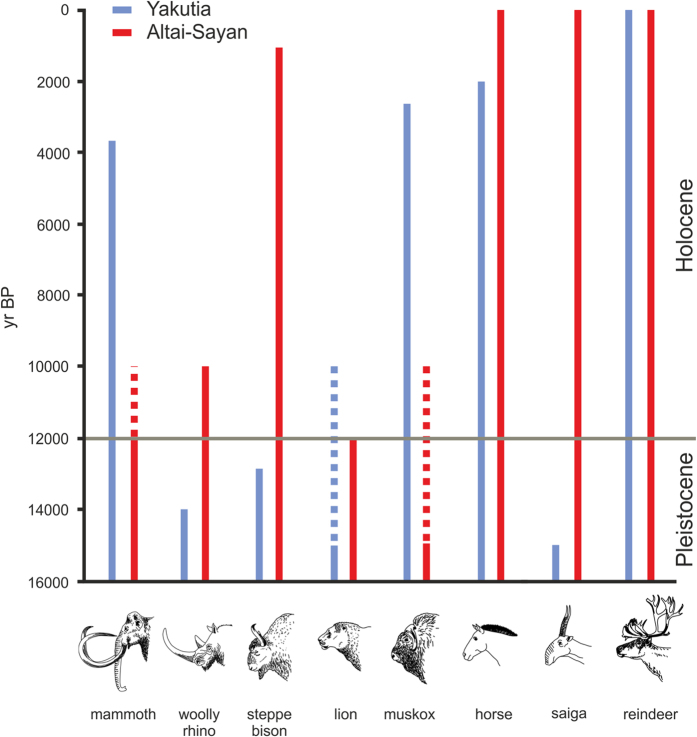
We examined the presence of possible Recent refugia of Pleistocene mammalian faunas in Eurasia by analysing regional differences in the mammalian species composition, occurrence and extinction rates between Recent and Last Glacial faunas. Our analyses revealed that most of the widespread Last Glacial species have survived in the central Palearctic continental regions, most prominently in Altai–Sayan (followed by Kazakhstan and East European Plain). The Recent Altai–Sayan and Kazakhstan regions show species compositions very similar to their Pleistocene counterparts. The Palearctic regions have lost 12% of their mammalian species during the last 109,000 years. The major patterns of the postglacial changes in Palearctic mammalian diversity were not extinctions but rather radical shifts of species distribution ranges. Most of the Pleistocene mammalian fauna retreated eastwards, to the central Eurasian steppes, instead of northwards to the Arctic regions, considered Holocene refugia of Pleistocene megafauna. The central Eurasian Altai and Sayan mountains could thus be considered a present-day refugium of the Last Glacial biota, including mammals.
Overview
CoChat Summary
TL;DR
Comparing Recent and Last Glacial mammalian faunas across 14 Palearctic regions, the paper finds that postglacial changes were dominated by eastward range retractions to central Eurasian steppes rather than extinction. Altai–Sayan, followed by Kazakhstan and the East European Plain, retained the most Last Glacial species and is proposed as a present-day refugium.
Key findings
- Of 364 mammalian species in the fossil record of the 14 examined regions, 44 species (12%) went extinct in the whole Palearctic during the Last Glacial and Holocene; 19 of the 44 extinctions (43%) occurred during the Last Glacial/Holocene transition.
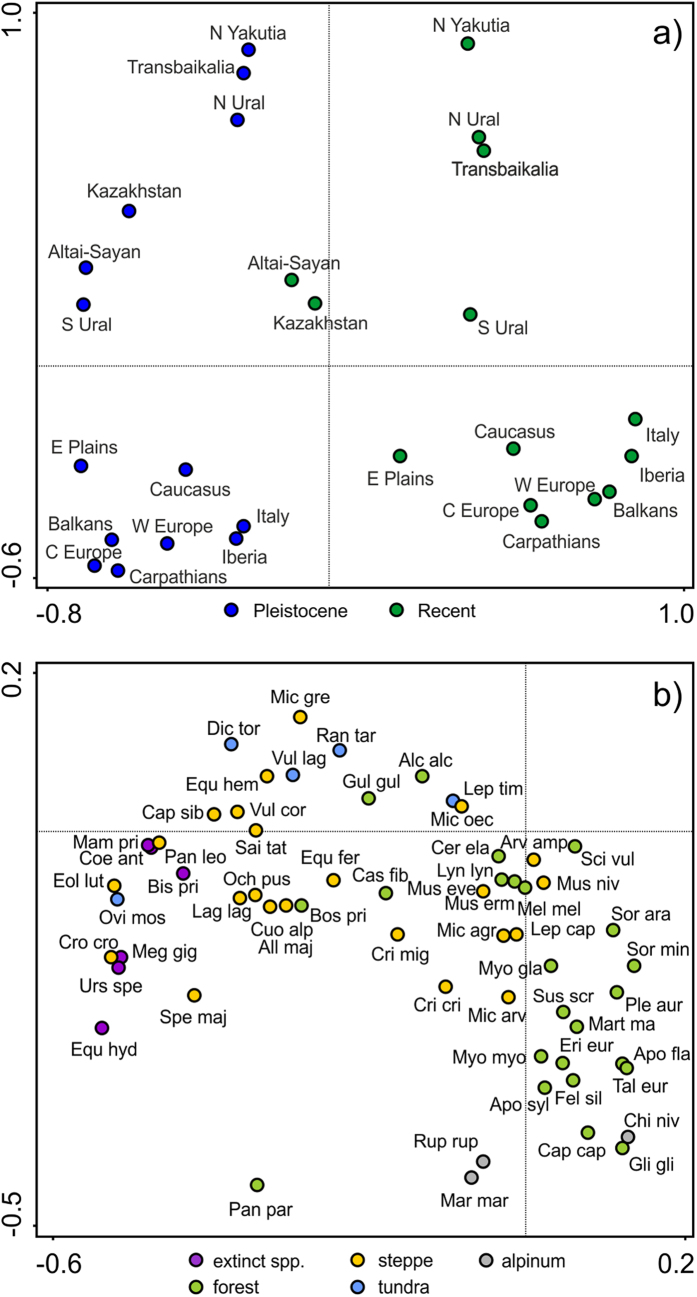
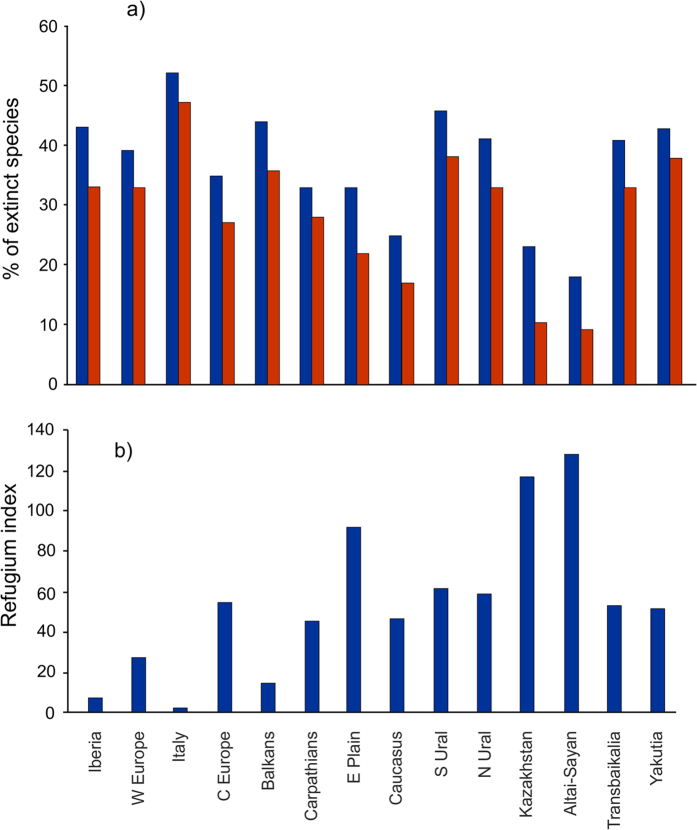
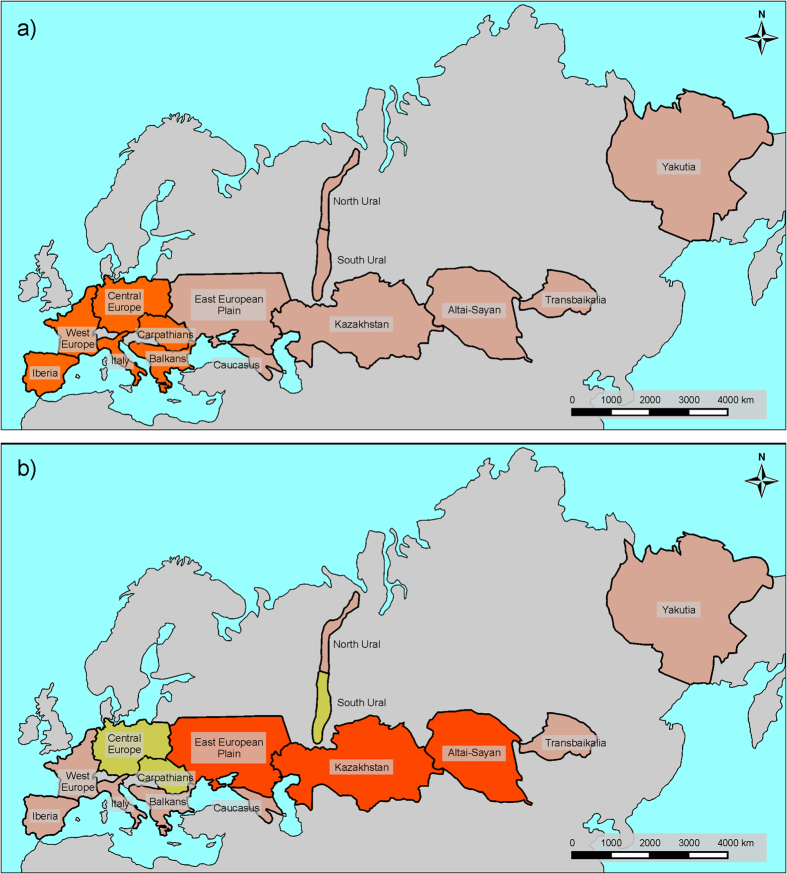
- The lowest extirpation was in Altai–Sayan (18% of Last Glacial species including globally extinct species; 9% excluding them), followed by Kazakhstan (23%; 10%) and Caucasus (25%; 17%); the highest was in Yakutia (43%; 38%), South Ural (46%; 38%) and Italy (52%; 47%). The refugium index was highest for Altai–Sayan (Ri = 128), Kazakhstan (Ri = 117) and East European Plain (Ri = 92), and lowest for Italy (Ri = 3; maximum possible = 153).
- Recent Altai–Sayan and Kazakhstan faunas showed species compositions very similar to their Pleistocene counterparts; most widespread Last Glacial species survived in central Palearctic continental regions. The major postglacial pattern was not extinction but radical shifts of species distribution ranges, with most Pleistocene mammalian fauna retreating eastwards to central Eurasian steppes rather than northwards to the Arctic.
- The central Eurasian Altai and Sayan mountains could be considered a present-day refugium of the Last Glacial biota, including mammals.
Methods
- Lists of mammalian species were collected for 14 regions covering most of the Palearctic Realm above 35° N, excluding regions close to the Sino-Japanese Realm, and including well-documented Last Glacial fossil localities. “Recent” referred to now to approximately the 16th century AD; “Last Glacial” referred to approximately 109,000–12,000 years BP (MIS 5d to MIS 2), limited to species documented around 12,000 years BP in at least one examined region.
- Presence/absence of 372 mammalian species in Recent and Last Glacial time periods of each region was recorded. Similarity analyses used PCA and PCoA with Bray-Curtis distances on 64 widely distributed Last Glacial species (present in at least seven regions), cluster analysis with Jaccard similarity, and ANOSIM.
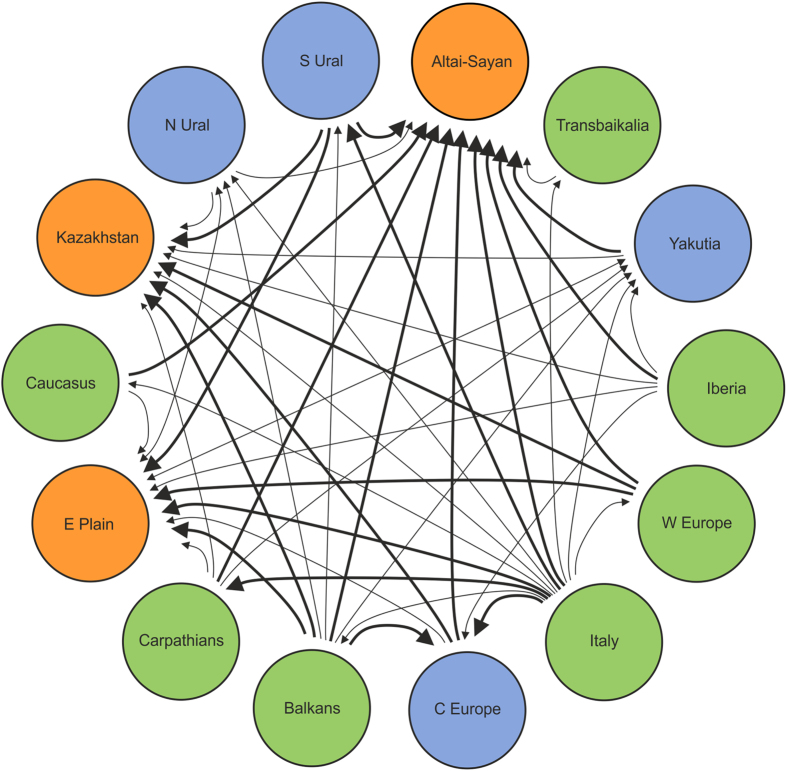
- The authors compared the proportion of Last Glacial species surviving in the Recent fauna per region, calculated a “refugium index” from 64 widespread Last Glacial species, and analysed 52 “core species” to count shared extinct/surviving species between region pairs and range-retraction patterns.
Limitations
- The paper states that continuity of glacial species occurrence in central Eurasia during the Holocene could not be reliably estimated from the fossil record; scarcity of Holocene data did not allow evaluation of distribution continuity for every species in presumed refugia; interpretation is impeded by lack of data on biotic responses to previous deglaciations; and Last Glacial and early-Holocene deposits of the refugial south-eastern, steppe parts of the Altai–Sayan region remain poorly investigated.
- Evident from the text: the conclusions rely on presence/absence data and regional fossil records, with the incompleteness of the fossil record explicitly acknowledged, and no phylogeographic data are presented to test Holocene continuity.
Model-written summary. Check it against the paper before relying on it.
Integrity signals
Registry
Cites
Statistics
Figures
Verification
Claims the paper makes
0 Valid · 1 Not valid · 29 Not checked · 37 Own results and interpretations
A result the paper reports from its own data — it cites no other source for it, so there is none to check. The quote shows it is in the paper.
In the paper
“The highest proportion of extirpated species was in the Yakutia (43%), South Ural (46%) and Italy (52%) regions (Supplementary Table S2).”
§ Regional patterns of postglacial changes in the Palearctic mammalian diversity indicate retreat to Siberian steppes rather than extinction > Results > Comparison of species extinctions between Last Glacial and Recent faunas
plain- Asserted: passes — The authors put it forward as true.
- Checkable: passes — It can be checked against evidence.
- Load-bearing: unclear — It is unclear whether the paper’s conclusions depend on it.
- Based: passes — The paper gives a reason why it holds.
- Rests on 2 assumptions not shown here.
A result the paper reports from its own data — it cites no other source for it, so there is none to check. The quote shows it is in the paper.
In the paper
“The PCA analysis revealed that Last Glacial and Recent faunas form two groups separated along the first (horizontal) axis (Fig. 1a).”
§ Regional patterns of postglacial changes in the Palearctic mammalian diversity indicate retreat to Siberian steppes rather than extinction > Results > Similarity of Recent and Last Glacial faunas
plainstates an association- Asserted: passes — The authors put it forward as true.
- Checkable: passes — It can be checked against evidence.
- Load-bearing: passes — The paper’s conclusions depend on it.
- Based: passes — The paper gives a reason why it holds.
A result the paper reports from its own data — it cites no other source for it, so there is none to check. The quote shows it is in the paper.
In the paper
“Comparison of Last Glacial and Recent complete mammalian faunas (including globally extinct species) revealed that the lowest number of extirpated species were in the Altai–Sayan region (18% of Last Glacial species), followed by Kazakhstan (23%) and Caucasus (25%).”
§ Regional patterns of postglacial changes in the Palearctic mammalian diversity indicate retreat to Siberian steppes rather than extinction > Results > Comparison of species extinctions between Last Glacial and Recent faunas
plain- Asserted: passes — The authors put it forward as true.
- Checkable: passes — It can be checked against evidence.
- Load-bearing: passes — The paper’s conclusions depend on it.
- Based: passes — The paper gives a reason why it holds.
- Rests on 2 assumptions not shown here.
A result the paper reports from its own data — it cites no other source for it, so there is none to check. The quote shows it is in the paper.
In the paper
“Both the Last Glacial and Recent faunas form three groups: (i) southern faunas including Mediterranean peninsulas, Caucasus, East European Plain, Carpathians, West and Central Europe; (ii) steppe group including Altai–Sayan, Kazakhstan and South Ural; (iii) eastern–Arctic group including North Yakutia, North Ural and Transbaikalia (Fig. 1a).”
§ Regional patterns of postglacial changes in the Palearctic mammalian diversity indicate retreat to Siberian steppes rather than extinction > Results > Similarity of Recent and Last Glacial faunas
plain- Asserted: passes — The authors put it forward as true.
- Checkable: passes — It can be checked against evidence.
- Load-bearing: unclear — It is unclear whether the paper’s conclusions depend on it.
- Based: passes — The paper gives a reason why it holds.
A result the paper reports from its own data — it cites no other source for it, so there is none to check. The quote shows it is in the paper.
In the paper
“The gradient between Last Glacial and Recent faunas (Fig. 1b) was determined by the presence/absence of globally extinct species (e.g. woolly mammoth Mammuthus primigenius, steppe bison Bison priscus), steppe species (e.g. wild horse Equus ferus, Siberian ibex Capra sibirica, steppe pika Ochotona pusilla), and forest species (e.g. Eurasian pygmy shrew Sorex minutus, yellow-necked field mouse Apod”
§ Regional patterns of postglacial changes in the Palearctic mammalian diversity indicate retreat to Siberian steppes rather than extinction > Results > Similarity of Recent and Last Glacial faunas
plainstates a cause- Asserted: passes — The authors put it forward as true.
- Checkable: passes — It can be checked against evidence.
- Load-bearing: passes — The paper’s conclusions depend on it.
- Based: passes — The paper gives a reason why it holds.
30 more claims
Create a free account to see all 67 claims and to verify the 47 references still open.
- It may state two separate claims as one. 26
- Probably not a substantial claim. 9
Self-check
Percentages, sums and reported differences re-computed from the paper’s own numbers.
Each contradiction between two passages listed here was confirmed by an independent check.
Rated minor: it would not touch a result — a value no result rests on, a p-value that stays on the same side of the significance level, or a conflict that is clerical, resolved elsewhere in the paper, or outside its own findings.
In the paper
§ Regional patterns of postglacial changes in the Palearctic mammalian diversity indicate retreat to Siberian steppes rather than extinction > Discussion
“The “refugium index” value of this central Eurasian region is almost twice as high as those of the other regions.”
§ Regional patterns of postglacial changes in the Palearctic mammalian diversity indicate retreat to Siberian steppes rather than extinction > Results > Refugium index
“Comparison of the “refugium index” (Ri) values among the examined regions revealed the highest value for the Altai–Sayan (Ri = 128), Kazakhstan (Ri = 117), and East European Plain (Ri = 92) regions (the maximum possible refugium index value is 153).”
Citations
Cites
A Pliocene‐Pleistocene stack of 57 globally distributed benthic δ18O records
Lisiecki, L. E., & Raymo, M. E. (2005) · Paleoceanography · doi:10.1029/2004pa001071 · Cited by 7,377
Mammal Species of the World: A Taxonomic and Geographic Reference
Schmid, R., Wilson, D. E., & Reeder, D. M. (1993) · Taxon · doi:10.2307/1223169 · Cited by 5,386
An Update of Wallace’s Zoogeographic Regions of the World
Holt, B. G., Lessard, J.-P., Borregaard, M. K., Fritz, S. A., Araújo, M. B., Dimitrov, D., Fabre, P.-H., Graham, C. H., Graves, G. R., Jønsson, K. A., et al. (2013) · Science · doi:10.1126/science.1228282 · Cited by 1,414
Refugia revisited: individualistic responses of species in space and time
Stewart, J. R., Lister, A. M., Barnes, I., & Dalén, L. (2010) · Proceedings of the Royal Society B: Biological Sciences · doi:10.1098/rspb.2009.1272 · Cited by 1,255
King, C. M. (1985) · Journal of the Royal Society of New Zealand · doi:10.1080/03036758.1985.10416849 · Cited by 984
Frozen Fauna of the Mammoth Steppe: The Story of Blue Babe
Guthrie, R. D. (1990) · University of Chicago Press eBooks · doi:10.7208/chicago/9780226159713.001.0001 · Cited by 450
Frozen fauna of the mammoth steppe: the story of Blue Babe
(1990) · Choice Reviews Online · doi:10.5860/choice.28-0295 · Cited by 373
Dale Guthrie, R. (2001) · Quaternary Science Reviews · doi:10.1016/s0277-3791(00)00099-8 · Cited by 345
The last interglacial in the marine and terrestrial records
Shackleton, N. J. (1969) · Proceedings of the Royal Society of London. Series B. Biological Sciences · doi:10.1098/rspb.1969.0085 · Cited by 336
Tarasov, P. E., Volkova, V. S., Webb, T., Guiot, J., Andreev, A. A., Bezusko, L. G., Bezusko, T. V., Bykova, G. V., Dorofeyuk, N. I., Kvavadze, E. V., et al. (2000) · Journal of Biogeography · doi:10.1046/j.1365-2699.2000.00429.x · Cited by 330
Research works printed but not linked: 7
- Martin P. S. & Klein R. G. Quaternary Extinctions: A Prehistoric Revolution (University of Arizona Press, 1984).
- Markova et al. Evolution of European Ecosystems during Pleistocene-Holocene Transition (24-8 kyr BP) (KMK Scientific Press, 2008).
- Horáček I. & Ložek V. Palaeozoology and the Mid-European Quaternary past: scope of the approach and selected results. Rozpravy ČSAV, řada matematických a přírodních věd 98, 1– 102 (1988).
- Řičánková V., Robovský J. & Pokorný P. in Tundras: Vegetation, Wildlife and Climate Trends (eds Gutierrez B. & Pena C.) Ch. 6, 151– 160 (Nova Science Publishers, 2010).
- Agadjanian A. K. & Serdyuk N. V. The history of mammalian communities and paleogeography of the Altai Mountains in the Paleolithic. Paleontol. J. 39, 645– 821 (2005).
- Vereschagin N. K. & Baryshnikov G. F. in Quaternary Extinctions: A Prehistoric Revolution (eds Martin P. S. & Klein R. G.) Ch. 22, 483– 516 (Arizona University Press, 1984).
- Lisiecki L. E. & Raymo M. E. A Pliocene‐Pleistocene stack of 57 globally distributed benthic δ18O records. Paleoceanography 20, 1– 17 (2005).
Cited by
Climate refugia of snow leopards in High Asia
Li, J., McCarthy, T. M., Wang, H., Weckworth, B., Schaller, G. B., Mishra, C., Lü, Z., & Beissinger, S. R. (2016) · Biological Conservation · doi:10.1016/j.biocon.2016.09.026 · Cited by 164
Novak, B. J. (2018) · Genes · doi:10.3390/genes9110548 · Cited by 109
Adapt or die—Response of large herbivores to environmental changes in Europe during the Holocene
Hofman‐Kamińska, E., Bocherens, H., Drucker, D. G., Fyfe, R., Gumiński, W., Makowiecki, D., Pacher, M., Piličiauskienė, G., Samojlik, T., Woodbridge, J., et al. (2019) · Global Change Biology · doi:10.1111/gcb.14733 · Cited by 83
Large‐scale migrations of brown bears in Eurasia and to North America during the Late Pleistocene
Anijalg, P., Ho, S. Y. W., Davison, J., Keis, M., Tammeleht, E., Bobowik, K., Леонидович, Т. И., Saveljev, A. P., LYAPUNOVA, E. A., VOROBIEV, A. A., et al. (2017) · Journal of Biogeography · doi:10.1111/jbi.13126 · Cited by 79
Jánská, V., Jiménez‐Alfaro, B., Chytrý, M., Divíšek, J., Anenkhonov, O. A., Korolyuk, A. Y., Lashchinskyi, N., & Culek, M. (2017) · Quaternary Science Reviews · doi:10.1016/j.quascirev.2017.01.011 · Cited by 78
Metadata
- Authors
- Řičánková, V. P., Robovský, J., Riegert, J., & Zrzavý, J.
- Affiliations
- University of South Bohemia in České Budějovice (CZ)
- Corresponding author
- Řičánková, Věra Pavelková
- Venue
- Scientific Reports
- Published
- 2015-08-06
- Volume
- 5
- Issue
- 1
- Pages
- 12682-12682
- ISSN
- 2045-2322 (ISSN-L)
- PMC
- PMC4526850
- OpenAlex
- W1476910531
- Cited by
- 38
- References
- 45
- Citations by year
- 2025: 3 · 2024: 5 · 2023: 4 · 2022: 1 · 2021: 4 · 2020: 6 · 2019: 6 · 2018: 2 · 2017: 5 · 2016: 2
- FWCI
- 1.28
- Type
- journal article
- Language
- en
- Open access
- gold
- doi.org
- Licence
- cc-by
- creativecommons.org/licenses/by/4.0 (tdm)
- creativecommons.org/licenses/by/4.0 (vor)
- Locations
- Scientific Reports (publishedVersion, cc-by)
- Europe PMC (PubMed Central) (publishedVersion, cc-by)
- PubMed Central (publishedVersion, cc-by)
- PubMed (publishedVersion)
- Funders
- Grantová Agentura České Republiky (GAP504/11/0454)
- Topics
- Physical Sciences › Earth and Planetary Sciences › Paleontology › Evolution and Paleontology Studies
- Physical Sciences › Environmental Science › Ecological Modeling › Species Distribution and Climate Change
- Physical Sciences › Environmental Science › Nature and Landscape Conservation › Ecology and Vegetation Dynamics Studies
- Keywords
- range shifts, Last Glacial Maximum, megafauna
- MeSH terms
- Animals, Kazakhstan, Mammals, Siberia, Biodiversity, Grassland
About these checks
Registry, retraction, Cites and statistics results are computed, not judged, with one exception: a printed reference that no index lists is read once by a model before it counts as a citation error. Claims are extracted by a model and kept only when their quote appears verbatim in the text; each cited source is then checked, with a model’s help, for whether it says what the claim relies on. Those verdicts can be wrong — read the claim’s quote and the cited source before relying on one.
A language model drew the claims from the paper on 2026-11-24, under version 3 of the claim definition (model deepseek-v4.1-flash, prompt extract-v3).
A second model labelled each claim on 2026-11-24 (model jev-1.13-20260917, definition revision gold-guideline-v0.2).
Statistics and arithmetic are recomputed, not judged.
Confidence bands are shown only for fields calibrated on our annotated test set. None is calibrated yet, so no band is shown.
What counts as a claim ›How we measure confidence ›How we check this ›
Are you an author, or do you see a problem with this page? Request a review
How to cite
Cite CoChat for the checks on this page, and the paper for its own findings.
- This page
- CoChat. (2026). Citation check: Regional patterns of postglacial changes in the Palearctic mammalian diversity indicate retreat to Siberian steppes rather than extinction. https://app.cochat.ai/papers/10.1038/srep12682
- The paper
- Řičánková, V. P., Robovský, J., Riegert, J., & Zrzavý, J. (2015). Regional patterns of postglacial changes in the Palearctic mammalian diversity indicate retreat to Siberian steppes rather than extinction. Scientific Reports. https://doi.org/10.1038/srep12682
Data sources
Bibliographic data: Semantic Scholar, OpenAlex, Crossref.
Contains information from the Semantic Scholar Academic Graph Datasets, made available under the ODC Attribution License (ODC-BY 1.0).
Semantic Scholar’s data is described in: Kinney, R., et al. (2023). The Semantic Scholar Open Data Platform. arXiv:2301.10140.
