

Complex Quantum Network Manifolds in Dimension d > 2 are Scale-Free
Open accessThe DOI matches its Crossref record; 49 of the 50 references it cites were found in a registry or an index; 2 of the 5 sources its claims cite were checked for support.
Abstract
In quantum gravity, several approaches have been proposed until now for the quantum description of discrete geometries. These theoretical frameworks include loop quantum gravity, causal dynamical triangulations, causal sets, quantum graphity and energetic spin networks. Most of these approaches describe discrete spaces as homogeneous network manifolds. Here we define Complex Quantum Network Manifolds (CQNM) describing the evolution of quantum network states and constructed from growing simplicial complexes of dimension "Equation missing". We show that in d = 2 CQNM are homogeneous networks while for d > 2 they are scale-free i.e. they are characterized by large inhomogeneities of degrees like most complex networks. From the self-organized evolution of CQNM quantum statistics emerge spontaneously. Here we define the generalized degrees associated with the "Equation missing"-faces of the "Equation missing"-dimensional CQNMs and we show that the statistics of these generalized degrees can either follow Fermi-Dirac, Boltzmann or Bose-Einstein distributions depending on the dimension of the "Equation missing"-faces.
Overview
CoChat Summary
TL;DR
Complex Quantum Network Manifolds (CQNMs) built from growing simplicial complexes are homogeneous with exponential degree distribution in dimension d = 2, but are scale-free for d > 2. Their generalized degrees can follow Fermi-Dirac, Boltzmann, or Bose-Einstein statistics depending on face dimension, with d = 3 being the minimal dimension for simultaneous emergence of all three.
Key findings
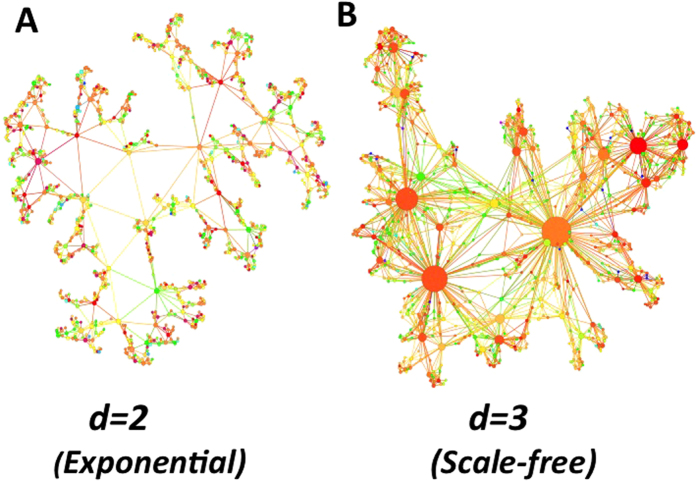
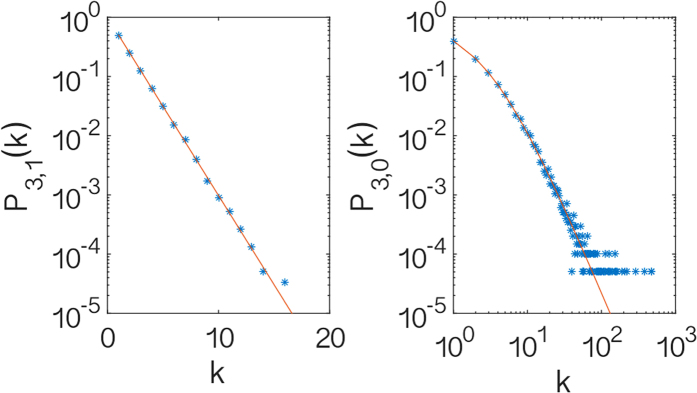
- In d = 2, CQNMs are homogeneous and have an exponential degree distribution; for d > 2, they are scale-free with large degree inhomogeneities and hub nodes.
- For β = 0, an effective linear preferential attachment operates for δ < d − 2, so d ≥ 3 and δ = 0 yield scale-free generalized degree distributions; in d = 2 there is no effective preferential attachment.
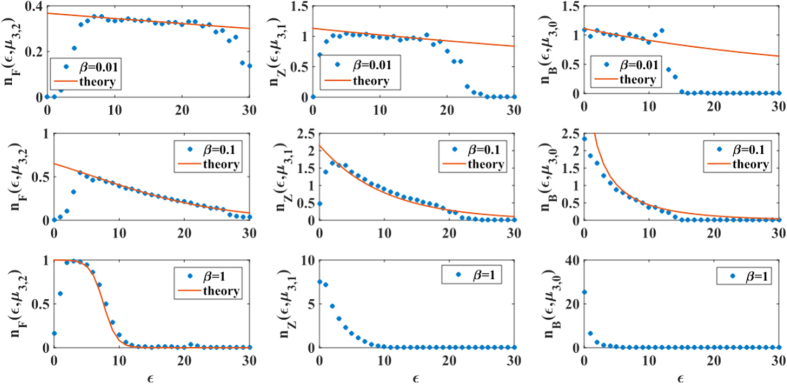
- For β > 0, CQNMs in d > 2 remain scale-free, and the average generalized degrees follow Fermi-Dirac, Boltzmann, or Bose-Einstein distributions depending on face dimension. In d = 3, triangular faces follow Fermi-Dirac, links follow Boltzmann, and nodes follow Bose-Einstein statistics.
- Simulations agree with theoretical expectations for β = 0 (Fig. 3) and for sufficiently low β (Fig. 4).
Methods
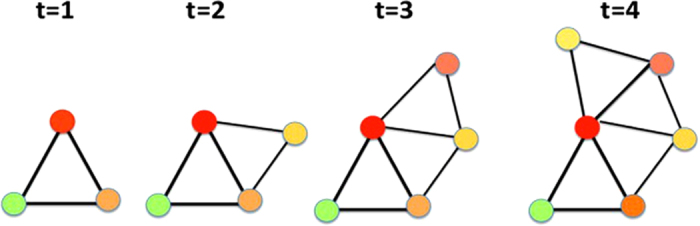
- The model grows d-dimensional simplicial complexes: at t = 1 there is a single d-simplex; at each later time a new d-simplex is glued to an unsaturated (d−1)-face chosen with probability Πα determined by face energy and inverse temperature β, with quenched node energies and N = t + d.
- Generalized degrees k_{d,δ} count incident d-dimensional simplices; master equations are solved for exact asymptotic generalized degree distributions for β = 0 and β > 0, with self-consistent chemical potentials for β > 0.
- The quantum network state is represented in a Hilbert space of fermionic oscillators and evolves by a Markovian unitary dynamics; Z(t) is interpreted as a path integral and partition function over CQNM evolutions.
Limitations
- The paper states that for β > 0 the chemical potentials are assumed to exist, and the self-consistent equations do not always give a solution; disagreement with simulations occurs at large β, and Bose-Einstein condensation can occur when Eq. (25) cannot be satisfied.
- Evident from the text: the results are theoretical and simulation-based, with no empirical data reported.
Model-written summary. Check it against the paper before relying on it.
Integrity signals
Registry
Cites
Statistics
Figures
Verification
Claims the paper makes
2 Valid · 0 Not valid · 3 Not checked · 33 Own results and interpretations
Every source the paper cites for this claim was checked and supports it.
In the paper
“When the transition occurs for the generalized degree with , the maximal degree in the network increases linearly in time similarly to the scenario described in27.”
§ Complex Quantum Network Manifolds in Dimension d > 2 are Scale-Free > Abstract
What the sources say
- Supportedcites [27] Bianconi G. & Barabási A.-L. Bose-Einstein condensation in complex networks. Phys. Rev. Lett. 86, 5632– 5635 (2001). 11415319 source
The passage on the Bose-Einstein phase (Abstract; page not provided) says that k_max(t)/mt is independent of time. With m fixed, this means the maximal degree grows linearly with time, as in the scenario the citation is used to identify. The δ = 0 condition describes the citing paper’s generalized-degree transition, not a condition attributed to this source. (LLM, conf=0.92)
plainstates a cause- Asserted: passes — The authors put it forward as true.
- Checkable: passes — It can be checked against evidence.
- Load-bearing: unclear — It is unclear whether the paper’s conclusions depend on it.
- Based: passes — The paper gives a reason why it holds.
- Rests on an assumption not shown here.
- Supported
Every source the paper cites for this claim was checked and supports it.
In the paper
“Therefore, as long as δ < d − 2, the generalized degree increases dynamically due to an effective “linear preferential attachment24”, according to which the generalized degree of a δ-face increases at each time by one, with a probability increasing linearly with the current value of its generalized degree.”
§ Complex Quantum Network Manifolds in Dimension d > 2 are Scale-Free > Abstract
What the sources say
- Supportedcites [24] Barabási A.-L. & Albert R. Emergence of scaling in random networks. Science 286, 509– 512 (1999). 10521342 source
The citation is attached specifically to the term "linear preferential attachment", and our copy of Barabási & Albert (1999) defines exactly that mechanism: the Discussion states "in the model we assumed linear preferential attachment, that is Π(k) ∼ k", the model section sets Π(k_i) = k_i / Σ_j k_j (probability of gaining a link proportional to current connectivity), and the analytic section gives ∂k_i/∂t = k_i/2t, i.e. degree grows one edge at a time with a rate linear in the current degree. The β = 0, δ < d − 2 and "generalized degree of a δ-face" elements are the citing paper's own higher-dimensional setup and are not attributed to this source, so nothing here falls outside the citation's scope. (LLM, conf=0.85)
boostedstates a cause- Asserted: passes — The authors put it forward as true.
- Checkable: passes — It can be checked against evidence.
- Load-bearing: passes — The paper’s conclusions depend on it.
- Based: passes — The paper gives a reason why it holds.
- Supported
A result the paper states — it cites no source for it, so there is none to check. The quote shows it is in the paper.
In the paper
“Here we show that as long as the dimension d is greater than two, i.e. d > 2, the CQNM is a scale-free network.”
- Also stated in: § Abstract · plain
“Using Eq. (14) we observe that for d ≥ 3 and δ = 0 we observe that the distribution of generalized degrees is always scale-free.”
§ Complex Quantum Network Manifolds in Dimension d > 2 are Scale-Free > Abstract
boostedstates a cause- Asserted: passes — The authors put it forward as true.
- Checkable: passes — It can be checked against evidence.
- Load-bearing: passes — The paper’s conclusions depend on it.
- Based: passes — The paper gives a reason why it holds.
- Also stated in: § Abstract · plain
A result the paper reports from its own data — it cites no other source for it, so there is none to check. The quote shows it is in the paper.
In the paper
“Here we define the generalized degrees associated with the -faces of the -dimensional CQNMs, and we show that the statistics of these generalized degrees can either follow Fermi-Dirac, Boltzmann or Bose-Einstein distributions depending on the dimension of the -faces.”
§ Complex Quantum Network Manifolds in Dimension d > 2 are Scale-Free > Abstract
plainstates an association- Asserted: passes — The authors put it forward as true.
- Checkable: passes — It can be checked against evidence.
- Load-bearing: passes — The paper’s conclusions depend on it.
- Based: passes — The paper gives a reason why it holds.
A result the paper states — it cites no source for it, so there is none to check. The quote shows it is in the paper.
In the paper
“In d = 3 the faces of the tetrahedra, the links and the nodes have an average of their generalized degree that follows respectively the Fermi-Dirac distribution, the Boltzmann distribution and the Bose-Einstein distribution.”
- Also stated in: § Abstract · plain
“In particular in d = 3 the average generalized degree of triangles of energy follows the Fermi-Dirac distribution, the average of the generalized degree of links of energy follows the Boltzmann distribution, while the generalized degree of nodes of energy follows the Bose-Einstein distribution.”
§ Complex Quantum Network Manifolds in Dimension d > 2 are Scale-Free > Abstract
plainstates an association- Asserted: passes — The authors put it forward as true.
- Checkable: passes — It can be checked against evidence.
- Load-bearing: passes — The paper’s conclusions depend on it.
- Based: passes — The paper gives a reason why it holds.
- Also stated in: § Abstract · plain
26 more claims
Create a free account to see all 38 claims and to verify the 3 references still open.
- It may state two separate claims as one. 5
- The quote only partly states this claim. 2
Claims other papers make about this one
Each is checked against this paper’s own text: does it say what the citing paper says it does?
The cited source says what the claim attributes to it.
In the citing paper
“Recently, using models formulated for describing emergent geometry [35], it was found that the relation between network and quantum statistics extends also to manifolds and to networks built starting from simplicial complexes [36,37].”
From Interdisciplinary and physics challenges of network theory (2015) · cites this paper as [37]
In the citing paper
“If instead of triangles, simplices of higher dimension, i.e. tetrahedra etc., are glued together, the growing manifolds are scale free for any dimension d > 2 [37].”
From Interdisciplinary and physics challenges of network theory (2015) · cites this paper as [37]
In the citing paper
“In fact, the quantum network states include fermionic and bosonic occupation numbers, and their average over the networks follow, respectively, Bose and Fermi statistics, also if the networks and the quantum network states do not obey equilibrium statistical mechanics.”
From Interdisciplinary and physics challenges of network theory (2015) · cites this paper as [37]
Self-check
Percentages, sums and reported differences re-computed from the paper’s own numbers.
Each contradiction between two passages listed here was confirmed by an independent check.
Rated minor: it would not touch a result — a value no result rests on, a p-value that stays on the same side of the significance level, or a conflict that is clerical, resolved elsewhere in the paper, or outside its own findings.
In the paper
§ Complex Quantum Network Manifolds in Dimension d > 2 are Scale-Free > Abstract
“Similarly in a CQNM of dimension d = 3, the generalized degrees k3,2, k3,2 and k3,0 indicate the number of tetrahedra incident respectively to a triangular face, a link or a node.”
§ Complex Quantum Network Manifolds in Dimension d > 2 are Scale-Free > Abstract
“For example, in a CQNM of dimension d = 2, the generalized degree k2,1(α) is the number of triangles incident to a link while the generalized degree k2,0(α) indicates the number of triangles incident to a node α.”
Rated minor: it would not touch a result — a value no result rests on, a p-value that stays on the same side of the significance level, or a conflict that is clerical, resolved elsewhere in the paper, or outside its own findings.
In the paper
§ Complex Quantum Network Manifolds in Dimension d > 2 are Scale-Free > Abstract
“Therefore for d = 2 the degree distribution of the CQNM has bounded fluctuations and is homogeneous while for d = 2 the CQNM has unbounded fluctuations in the degree distribution and its structure is dominated by hub nodes.”
§ Complex Quantum Network Manifolds in Dimension d > 2 are Scale-Free > Abstract
“Here we show that in d = 2 CQNMs are homogeneous and have an exponential degree distribution while the CQNMs are always scale-free for d > 2.”
Rated minor: it would not touch a result — a value no result rests on, a p-value that stays on the same side of the significance level, or a conflict that is clerical, resolved elsewhere in the paper, or outside its own findings.
In the paper
§ Complex Quantum Network Manifolds in Dimension d > 2 are Scale-Free > Methods > Generalized degree distribution for β = 0
“### Generalized degree distribution for β = 0 For β > 0 the probability that a given face of energy and generalized degree increases its generalized degree by one at time can be expressed in terms of self-consistent parameters called chemical potentials and defined in the Supplementary Material.”
§ Complex Quantum Network Manifolds in Dimension d > 2 are Scale-Free > Methods > Generalized degree distribution for β = 0
“### Generalized degree distribution for β = 0 The average number of faces of a -dimensional CQNM of generalized degree that are incident to the new -dimensional simplex at a given time t is given, for , by”
Citations
Cites
Emergence of Scaling in Random Networks
Barabási, A.-L., & Albert, R. (1999) · Science · doi:10.1126/science.286.5439.509 · Cited by 36,135
Statistical mechanics of complex networks
Albert, R., & Barabási, A.-L. (2002) · Reviews of Modern Physics · doi:10.1103/revmodphys.74.47 · Cited by 20,471
Complex networks: structure and dynamics
BOCCALETTI, S., LATORA, V, MORENO, Y., CHAVEZ, M., & HWANG, D. (2006) · Physics Reports · doi:10.1016/j.physrep.2005.10.009 · Cited by 11,010
Newman, M. (2010) · doi:10.1093/acprof:oso/9780199206650.001.0001 · Cited by 6,595
Fractal Concepts in Surface Growth
Barabási, A. L., & Stanley, H. E. (1995) · doi:10.1017/cbo9780511599798 · Cited by 3,925
Fractal Concepts in Surface Growth
Barabasi, A. L., Stanley, H. E., & Sander, L. M. (1995) · Physics Today · doi:10.1063/1.2808215 · Cited by 3,290
Dynamical Processes on Complex Networks
Barrat, A., Barthélemy, M., & Vespignani, A. (2008) · doi:10.1017/cbo9780511791383 · Cited by 2,704 · cited 1×
“Scale-free networks are known to be robust to random perturbation and there is a significant interplay between structure and dynamics, since critical phenomena such as in the Ising model, synchronization or epidemic spreading change their phase diagram when defined on them [25, 26].”
Critical phenomena in complex networks
Dorogovtsev, S. N., Goltsev, A. V., & Mendes, J. F. F. (2008) · Reviews of Modern Physics · doi:10.1103/revmodphys.80.1275 · Cited by 2,220
Dorogovtsev, S. N., & Mendes, J. F. F. (2003) · doi:10.1093/acprof:oso/9780198515906.001.0001 · Cited by 1,563
Punctuated equilibrium and criticality in a simple model of evolution
Bak, P., & Sneppen, K. (1993) · Physical Review Letters · doi:10.1103/physrevlett.71.4083 · Cited by 1,497
Research works printed but not linked: 2
- Smolin L. The life of the cosmos. (Oxford University Press, Oxford, 1997).
- Newman M. E. J. Networks: An introduction. (Oxford University Press, Oxford, 2010).
Cited by
Networks beyond pairwise interactions: Structure and dynamics
Battiston, F., Cencetti, G., Iacopini, I., Latora, V., Lucas, M., Patania, A., Young, J.-G., & Petri, G. (2020) · Physics Reports · doi:10.1016/j.physrep.2020.05.004 · Cited by 1,602
Networks beyond pairwise interactions: Structure and dynamics
Battiston, F., Cencetti, G., Iacopini, I., Latora, V., Lucas, M., Patania, A., Young, J., & Petri, G. (2020) · UCL Discovery (University College London) · Cited by 1,179
The structure and dynamics of networks with higher order interactions
Boccaletti, S., De Lellis, P., del Genio, C. I., Alfaro-Bittner, K., Criado, R., Jalan, S., & Romance, M. (2023) · Physics Reports · doi:10.1016/j.physrep.2023.04.002 · Cited by 364
Stability of synchronization in simplicial complexes
Gambuzza, L. V., Di Patti, F., Gallo, L., Lepri, S., Romance, M., Criado, R., Frasca, M., Latora, V., & Boccaletti, S. (2021) · Nature Communications · doi:10.1038/s41467-021-21486-9 · Cited by 344
Boguñá, M., Bonamassa, I., De Domenico, M., Havlin, S., Krioukov, D., & Serrano, M. Á. (2021) · Nature Reviews Physics · doi:10.1038/s42254-020-00264-4 · Cited by 213
Metadata
- Authors
- Bianconi, G., & Rahmede, C.
- Affiliations
- Queen Mary University of London (GB)
- Karlsruhe Institute of Technology (DE)
- Corresponding author
- Bianconi, Ginestra
- Venue
- Scientific Reports
- Published
- 2015-09-10
- Volume
- 5
- Issue
- 1
- ISSN
- 2045-2322 (ISSN-L)
- PMC
- PMC4564853
- OpenAlex
- W3100341972
- Semantic Scholar
- 7f156b49f1e11b71dfa44b41dd2f1c301ec9eb9a
- Cited by
- 61
- References
- 45
- Citations by year
- 2026: 3 · 2025: 4 · 2024: 2 · 2023: 6 · 2022: 4 · 2021: 6 · 2020: 8 · 2019: 7 · 2018: 5 · 2017: 5 · 2016: 7 · 2015: 4
- FWCI
- 4.41
- Type
- journal article
- Language
- en
- Open access
- gold
- doi.org
- Licence
- cc-by
- creativecommons.org/licenses/by/4.0 (tdm)
- creativecommons.org/licenses/by/4.0 (vor)
- Locations
- Scientific Reports (publishedVersion, cc-by)
- Repository KITopen (Karlsruhe Institute of Technology) (publishedVersion, cc-by)
- arXiv (Cornell University) (submittedVersion)
- arXiv (Cornell University)
- KITopen (cc-by)
- Topics
- Physical Sciences › Physics and Astronomy › Nuclear and High Energy Physics › Noncommutative and Quantum Gravity Theories
- Physical Sciences › Physics and Astronomy › Statistical and Nonlinear Physics › Complex Network Analysis Techniques
- Physical Sciences › Mathematics › Mathematical Physics › p-Adic Analysis and Mathematical Physics
- Keywords
- simplicial complexes, scale-free networks, combinatorial geometry, quantum gravity, loop quantum gravity, causal dynamical triangulations, causal sets, spin networks, degree distribution, Fermi-Dirac statistics, Bose-Einstein statistics, Boltzmann statistics, self-organizing networks
About these checks
Registry, retraction, Cites and statistics results are computed, not judged, with one exception: a printed reference that no index lists is read once by a model before it counts as a citation error. Claims are extracted by a model and kept only when their quote appears verbatim in the text; each cited source is then checked, with a model’s help, for whether it says what the claim relies on. Those verdicts can be wrong — read the claim’s quote and the cited source before relying on one.
A language model drew the claims from the paper on 2026-10-08, under version 3 of the claim definition (model deepseek-v4.1-flash, prompt extract-v3).
A second model labelled each claim on 2026-10-08 (model jev-1.13-20260917, definition revision gold-guideline-v0.2).
Cited sources are checked with a language model’s help (gpt-6-sol and qwen3.8-omni-flash).
Statistics and arithmetic are recomputed, not judged.
Confidence bands are shown only for fields calibrated on our annotated test set. None is calibrated yet, so no band is shown.
What counts as a claim ›How we measure confidence ›How we check this ›
Are you an author, or do you see a problem with this page? Request a review
Data sources
Bibliographic data: Semantic Scholar, OpenAlex, Crossref.
Contains information from the Semantic Scholar Academic Graph Datasets, made available under the ODC Attribution License (ODC-BY 1.0).
Semantic Scholar’s data is described in: Kinney, R., et al. (2023). The Semantic Scholar Open Data Platform. arXiv:2301.10140.
