

Colletotrichum species associated with jute (Corchorus capsularis L.) anthracnose in southeastern China
Open accessThe DOI matches its Crossref record; 29 of the 29 references it cites were found in a registry or an index.
Abstract
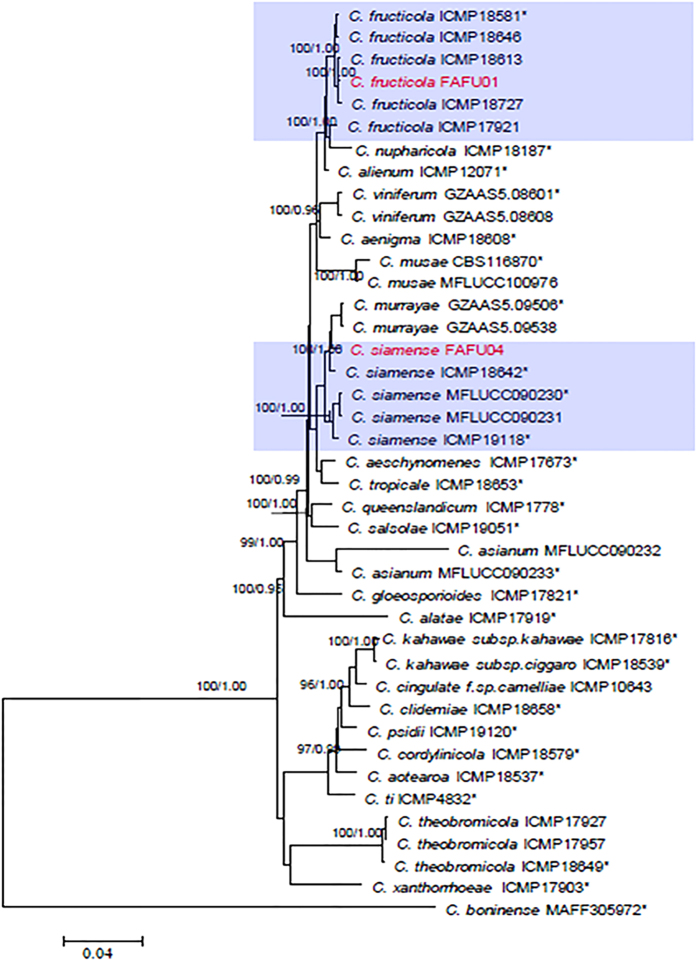
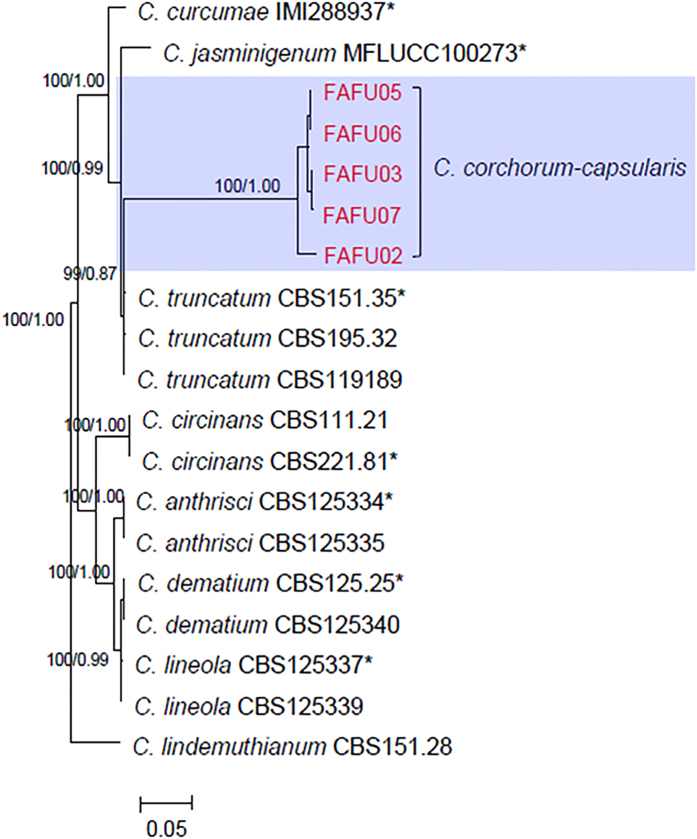
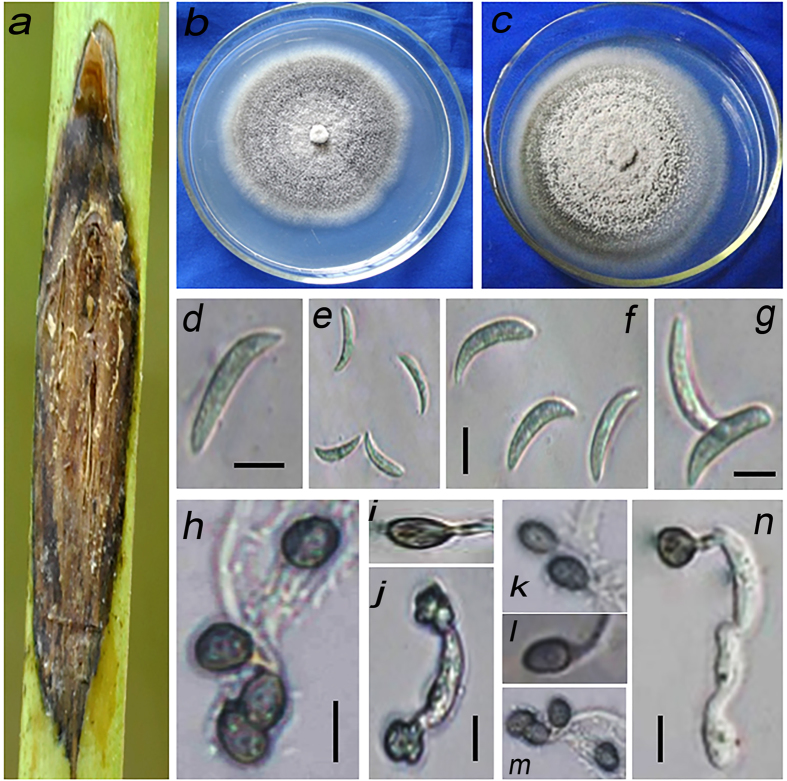
Anthracnose, caused by the Colletotrichum species of fungi, is one of the most serious diseases affecting jute in China. The disease causes chlorotic regions with black brown sunken necrotic pits on the surfaces of stems. In late stages of disease, plants undergo defoliation, dieback and blight, which make anthracnose a major threat to jute fiber production and quality in China. In this study, 7 strains of Colletotrichum fungi were isolated from diseased jute stems from Zhejiang, Fujian, Guangxi, and Henan plantations in China. Multi-locus sequence (ACT, TUB2, CAL, GS, GAPDH and ITS) analysis coupled with morphological assessment revealed that C. fructicola, C. siamense and C. corchorum-capsularis sp. nov. were associated with jute anthracnose in southeastern China. C. fructicola and C. siamense were previously not associated with jute anthracnose. C. corchorum-capsularis is a new species formally described here. Pathogenicity tests confirmed that all species can infect jute, causing anthracnose, however the virulence of the 3 species differed. This report is the first associating these three species with jute disease worldwide and is the first description of the pathogens responsible for jute anthracnose in China.
Overview
The claims and statistics of this paper haven’t been checked yet.
Free: it reads the open-access text and checks the first 5 claims that cite a source we can check. Create a free account to check every claim.
Integrity signals
Registry
Cites
Statistics
Figures
Verification
Claims the paper makes
The claims and statistics of this paper haven’t been checked yet.
Free: it reads the open-access text and checks the first 5 claims that cite a source we can check. Create a free account to check every claim.
Claims other papers make about this one
Each is checked against this paper’s own text: does it say what the citing paper says it does?
The source backs part of the claim, not all of it — or backs it for a different population, condition or comparison.
In the citing paper
“Colletotrichum corchorum-capsularis a pathogen on Corchorus capsularis in China was introduced in the truncatum complex (Niu et al. 2016).”
From Colletotrichum: lifestyles, biology, morpho-species, species complexes and accepted species (2021) · cites this paper as Niu et al. 2016
Experimental — accuracy not yet measured
Self-check
Percentages, sums and reported differences re-computed from the paper’s own numbers.
The self-check needs the paper’s full text.
Citations
Cites
Tamura, K., Peterson, D., Peterson, N., Stecher, G., Nei, M., & Kumar, S. (2011) · Molecular Biology and Evolution · doi:10.1093/molbev/msr121 · Cited by 39,969
MrBayes 3.2: Efficient Bayesian Phylogenetic Inference and Model Choice Across a Large Model Space
Ronquist, F., Teslenko, M., van der Mark, P., Ayres, D. L., Darling, A., Höhna, S., Larget, B., Liu, L., Suchard, M. A., & Huelsenbeck, J. P. (2012) · Systematic Biology · doi:10.1093/sysbio/sys029 · Cited by 27,843
MrModeltest 2.2. Program Distributed by the Author
Nylander, J. A. A., Nylander, J., & Nylander, J. A. A. (2004) · Medical Entomology and Zoology · Cited by 2,648
The Colletotrichum gloeosporioides species complex
Weir, B. S., Johnston, P. R., & Damm, U. (2012) · Studies in Mycology · doi:10.3114/sim0011 · Cited by 1,646
Colletotrichum – current status and future directions
Cannon, P. F., Damm, U., Johnston, P. R., & Weir, B. S. (2012) · Studies in Mycology · doi:10.3114/sim0014 · Cited by 1,105
The Colletotrichum acutatum species complex
Damm, U., Cannon, P. F., Woudenberg, J. H. C., & Crous, P. W. (2012) · Studies in Mycology · doi:10.3114/sim0010 · Cited by 979
Parallelization of the MAFFT multiple sequence alignment program
Katoh, K., & Toh, H. (2010) · Bioinformatics · doi:10.1093/bioinformatics/btq224 · Cited by 928
A polyphasic approach for studying Colletotrichum
Cai, L., Hyde, K. D., Taylor, P. W. J., Weir, B. S., Waller, J. M., Abang, M. M., Zhang, J. Z., Yang, Y., Phoulivong, S., Liu, Z. Y., et al. (2009) · Queensland Department of Agriculture and Fisheries archive of scientific and research publications (Queensland Department of Agriculture and Fisheries) · Cited by 674
Characterization of Colletotrichum Species Responsible for Anthracnose Diseases of Various Fruits
Freeman, S., Katan, T., & Shabi, E. (1998) · Plant Disease · doi:10.1094/pdis.1998.82.6.596 · Cited by 442
(2009) · KNAW research portal (Royal Academy of Art and Sciences (KNAW)) · Cited by 383
Research works printed but not linked: 4
- Hyde K. D. et al. Colletotrichum: a catalogue of confusion. Fungal Divers. 39, 1– 17 (2009).
- Prihastuti H., Cai L., Chen H., McKenzie E. H. C. & Hyde K. D. Characterization of Colletotrichum species associated with coffee berries in northern Thailand. Fungal Divers. 39, 89– 109 (2009).
- Shivas R. & Yu Y. A taxonomic re-assessment of Colletotrichum acutatum, introducing C. fioriniae comb. et stat. nov. and C. simmondsii sp. nov. Fungal Divers. 39, 111 (2009).
- Purkayastha R. & Sen-Gupta M. Studies on Colletotrichum gloeosporioides inciting anthracnose of jute. Indian phytopathol. 26, 650– 653 (1975).
Cited by
Colletotrichum species and complexes: geographic distribution, host range and conservation status
Talhinhas, P., & Baroncelli, R. (2021) · Fungal Diversity · doi:10.1007/s13225-021-00491-9 · Cited by 280
Colletotrichum: lifestyles, biology, morpho-species, species complexes and accepted species
Jayawardena, R. (2021) · Mycosphere · doi:10.5943/mycosphere/12/1/7 · Cited by 208
Liu, F., Tang, G., Zheng, X., Li, Y., Sun, X., Qi, X., Zhou, Y., Xu, J., Chen, H., Chang, X., et al. (2016) · Scientific Reports · doi:10.1038/srep32761 · Cited by 153
Self-citationOptimal markers for the identification of Colletotrichum species
Vieira, W. A. D. S., Bezerra, P. A., da Silva, A. C., Veloso, J. S., Câmara, M. P. S., & Doyle, V. P. (2019) · Molecular Phylogenetics and Evolution · doi:10.1016/j.ympev.2019.106694 · Cited by 179
Sharma, G., Maymon, M., & Freeman, S. (2017) · Scientific Reports · doi:10.1038/s41598-017-15946-w · Cited by 152
Colletotrichum Species Causing Anthracnose of Rubber Trees in China
Liu, X., Li, B., Cai, J., Zheng, X., Feng, Y., & Guixiu, H. (2018) · Scientific Reports · doi:10.1038/s41598-018-28166-7 · Cited by 107
Zhang, L., Song, L., Xu, X., Zou, X., Duan, K., & Gao, Q. (2020) · Plant Disease · doi:10.1094/pdis-10-19-2241-re · Cited by 104
Dolatabad, H. K., Javan-Nikkhah, M., & Shier, W. T. (2017) · Mycological Progress · doi:10.1007/s11557-017-1315-z · Cited by 59
“…rosea 17 KP641134 – MF000361 99%, 99% KT692584 (Comby et al. 2016), AF358166 (Schroers 2001) Colletotrichum fructicola 18 KP641148 – MF000362 99%, 99% KP641148 (Qin and Huang, unpublished), KT439339 (Niu et al. 2016) Coniothyrium sp. 1 MF000352 – – 99% KT269869 (Glynou et al. 2016) Curvularia…”
Majumder, S., Datta, K., Sarkar, C., Saha, S. C., & Datta, S. K. (2018) · Frontiers in Plant Science · doi:10.3389/fpls.2018.00920 · Cited by 40
“These pathogens cause huge fiber yield losses in India, Bangladesh, and China (Wadud and Ahmed, 1962; Bhattacharya, 2013; Niu et al., 2016).”
BackgroundInfluentialJian, Y., Li, Y., Tang, G., Zheng, X., Khaskheli, M. I., & Gong, G. (2021) · Plant Disease · doi:10.1094/pdis-10-20-2114-re · Cited by 38
Yu, Z., Jiang, X., Zheng, H., Zhang, H., & Qiao, M. (2022) · Journal of Fungi · doi:10.3390/jof8020185 · Cited by 34
“This increased understanding of Colletotrichum species can increase the effectiveness of plant disease control interventions [47].”
BackgroundXue, L., Zhang, L., Yang, X., Huang, X., Wu, W., Zhou, X., White, J. F., Liu, Y., & Li, C. (2019) · Plant Disease · doi:10.1094/pdis-06-18-0938-re · Cited by 37
“Therefore, in order to more accurately reflect the true virulence potential of these species, further research should be conducted to determine the pathogenicity according to natural infections rather than artificial inoculations (Niu et al. 2016; Prihastuti et al. 2009).”
BackgroundColletotrichum systematics: Past, present and prospects
Sharma, G. (2016) · Mycosphere · doi:10.5943/mycosphere/si/2c/2 · Cited by 28
“…Damm et al. 2013, Doyle et al. 2013, Lima et al. 2013, Liu et al. 2013a, b, 2015, Manamgoda et al. 2013, Udayanga et al. 2013, Liu et al. 2016b, Niu et al. 2016, Wang et al. 2016), out of which only 30 species are associated with Glomerella stage (Edgerton 1901, Spaulding & Schrenk 1903, Shear…”
BackgroundIdentification of Colletotrichum Species Associated with Blueberry Anthracnose in Sichuan, China
Liu, X., Zheng, X., Khaskheli, M. I., Sun, X., Chang, X., & Gong, G. (2020) · Pathogens · doi:10.3390/pathogens9090718 · Cited by 31
“To date, many anthracnose diseases have been diagnosed in various crops, such as apple [22], grapevine [23], pepper [24], jute [25], persimmon [26] and citrus [27].”
BackgroundMolecular Diagnostics and Pathogenesis of Fungal Pathogens on Bast Fiber Crops
Cheng, Y., Tang, X., Gao, C., Li, Z., Chen, J., Guo, L., Wang, T., & Xu, J. (2020) · Pathogens · doi:10.3390/pathogens9030223 · Cited by 29
“Yu et al. identified A. alternata as the agent of black leaf spot disease on ramie plants in China on the basis of morphology and DNA sequences at the ITS and GAPDH genes [47].”
BackgroundInfluentialSelf-citationColletotrichum species associated with cassava anthracnose in China
Liu, X., Shi, T., Li, B., Cai, J., Li, C., & Guixiu, H. (2018) · Journal of Phytopathology · doi:10.1111/jph.12765 · Cited by 29
Norphanphoun, C., & Hyde, K. D. (2023) · Pathogens · doi:10.3390/pathogens12121436 · Cited by 23
“Conidia (11.5–)12.5–13(–14.5) × (4–)4.5–5(–5.7) µm (mean ± SD = 13.1 ± 0.9 × China [96,97]; Cunninghamia lanceolata , China [98,99]; Curcuma phaeocaulis , China [100]; Cyclamen sp., Italy [93]; Cymbopogon citratus , Thailand [101,102]; Dalbergia hupeana , China [103]; Dendrobium spp. 4.5 ± 0.3 µm),…”
InfluentialElucidating the Colletotrichum spp. diversity responsible for papaya anthracnose in Brazil
Vieira, W. A. D. S., Veloso, J. S., da Silva, A. C., Nunes, A. D. S., Doyle, V. P., Castlebury, L. A., & Câmara, M. P. S. (2022) · Fungal Biology · doi:10.1016/j.funbio.2022.08.001 · Cited by 23
Aumentado, H. D., Armand, A., Phukhamsakda, C., Hyde, K. D., Jones, E. B. G., & Jayawardena, R. S. (2024) · European Journal of Plant Pathology · doi:10.1007/s10658-024-02819-y · Cited by 19
“However, the results of these assays did not necessarily indicate the entire virulence potential of these species as symptoms may vary due to several factors i.e., humidity, temperature, inoculum concentration, and the method of inoculation (Niu et al., 2016; Sanders & Korsten, 2003).”
Majumder, S., Datta, K., & Datta, S. K. (2023) · Industrial Crops and Products · doi:10.1016/j.indcrop.2023.117776 · Cited by 12
Zhang, M., Forte-Perri, V., Sun, W., Tang, L., Huang, S., Guo, T., Chen, X., & Li, Q. (2022) · Plant Disease · doi:10.1094/pdis-06-22-1372-sr · Cited by 11
Gomdola, D., Jeewon, R., McKenzie, E. H. C., Jayawardena, R. S., Al-Otibi, F. O., Tang, X., Wang, Y., Hyde, K. D., & Fu, L. (2025) · MycoKeys · doi:10.3897/mycokeys.119.152323 · Cited by 11
Wu, N., Du, H.-Z., Chethana, K. W. T., Khongphinitbunjong, K., Maharachchikumbura, S. S. N., Hyde, K. D., & Liu, J. (2024) · Journal of Fungi · doi:10.3390/jof10120872 · Cited by 5
Sousa, E. S., de Melo, M. P., Barguil, B. M., Matos, K. D. S., Pires, L. L., Silva, B. A., & Beserra, J. E. A. (2025) · Plant Pathology · doi:10.1111/ppa.70009 · Cited by 5
“The colony diameter was estimated by simple arithmetic mean; the value obtained was divided by the number of incubation days (Niu et al. 2016).”
Wang, R., Ouyang, D., Lu, M., Tang, L., Chen, X., Huang, S., Guo, T., Hsiang, T., & Li, Q. (2024) · Plant Disease · doi:10.1094/pdis-02-24-0424-re · Cited by 4
Jute under siege: A deep dive into stem rot disease caused by Macrophomina phaseolina (Tassi) Goid.
Mandal, K., Datta, S., De, R. K., & Sarkar, S. K. (2025) · Crop Protection · doi:10.1016/j.cropro.2025.107112 · Cited by 3
Prevalence of Seed-borne Fungal Invasion on Tossa Jute (Corchorus olitorius) Seeds
Talukder, F. U., Rahman, M. S., Haque, S. M. A., & Mukul, M. M. (2021) · Frontiers in Environmental Microbiology · doi:10.11648/j.fem.20210701.13 · Cited by 3
“They might affect the seed health of jute at storage [42].”
BackgroundLiu, X., Li, B., Cai, J., Shi, T., Yang, Y., Feng, Y., & Guixiu, H. (2022) · Fungal Genetics and Biology · doi:10.1016/j.fgb.2023.103801 · Cited by 3
Zhou, Z., Li, Y. L., & Yuan, C.-Y. (2016) · Plant Disease · doi:10.1094/pdis-05-16-0649-pdn · Cited by 3
Genomics for Biotic Stress Tolerance in Jute
Satya, P., Ray, S., Gotyal, B. S., Mandal, K., & Roy, S. K. (2022) · Springer eBooks · doi:10.1007/978-3-031-09293-0_7 · Cited by 2
Incidence of diseases in germplasms Corchorus olitorius L. and control of fungal pathogens
Nasim, A., Hosen, S., & Bashar, M. (2017) · Dhaka University Journal of Biological Sciences · doi:10.3329/dujbs.v26i2.46401 · Cited by 1
Genetics and Genomics of Biotic Stress Resistance of Jute
Amin, S., & Islam, T. (2022) · Compendium of plant genomes · doi:10.1007/978-3-030-91163-8_18
Brawijaya, U., Maknunin, L., Abadi, A. L., Brawijaya, U., Syib’li, M. A., & Brawijaya, U. (2024) · Research Journal of Life Science · doi:10.21776/ub.rjls.2023.010.03.4
Wu, N., Chi, M., Du, H.-Z., Chethana, K. W. T., Khongphinitbunjong, K., Chen, Y., Hyde, K. D., Al-Otibi, F. O., Dissanayake, A. J., & Liu, J. (2025) · MycoKeys · doi:10.3897/mycokeys.122.161816
“…noting that microfungi are a crucial factor affecting the quality of medicinal plants, including endophytes (Keshri et al. 2021; Purushotham et al. 2021; Zhang et al. 2024a), pathogens (Niu et al. 2016; Petrasch et al. 2019), and saprobes (Medina et al. 2020; Yang et al. 2022; Sun et al. 2025).”
Metadata
- Authors
- Niu, X., Gao, H., Qi, J., Chen, M., Tao, A., Xu, J., Dai, Z., & Su, J.
- Affiliations
- Fujian Agriculture and Forestry University (CN)
- Institute of Bast Fiber Crops (CN)
- Corresponding author
- Qi, Jianmin
- Venue
- Scientific Reports
- Published
- 2016-04-28
- Volume
- 6
- Issue
- 1
- Pages
- 25179-25179
- ISSN
- 2045-2322 (ISSN-L)
- PMC
- PMC4848545
- OpenAlex
- W2344591917
- Semantic Scholar
- 902eb45c83d95fdba3c543f537efff014c6a878e
- Cited by
- 34
- References
- 29
- Citations by year
- 2025: 4 · 2024: 4 · 2023: 2 · 2022: 6 · 2021: 4 · 2020: 3 · 2019: 2 · 2018: 3 · 2017: 3 · 2016: 3
- FWCI
- 3.90
- Type
- journal article
- Language
- en
- Open access
- gold
- doi.org
- Licence
- cc-by
- creativecommons.org/licenses/by/4.0 (tdm)
- creativecommons.org/licenses/by/4.0 (vor)
- Locations
- Scientific Reports (publishedVersion, cc-by)
- PubMed Central (publishedVersion, cc-by)
- PubMed (publishedVersion)
- Funders
- National Natural Science Foundation of China (31471549)
- Topics
- Life Sciences › Agricultural and Biological Sciences › Plant Science › Plant Pathogens and Fungal Diseases
- Life Sciences › Agricultural and Biological Sciences › Plant Science › Plant Disease Resistance and Genetics
- Life Sciences › Immunology and Microbiology › Microbiology › Yeasts and Rust Fungi Studies
- Keywords
- Colletotrichum, Corchorus capsularis, Colletotrichum fructicola, Colletotrichum siamense, new fungal species, plant pathogenic fungi, pathogenicity, virulence, multilocus sequence analysis, southeastern China
- MeSH terms
- China, DNA, Fungal, Fungal Proteins, Phylogeny, Plant Diseases, Cluster Analysis, Sequence Analysis, DNA, Colletotrichum, DNA, Ribosomal Spacer, Corchorus
About these checks
Registry, retraction, Cites and statistics results are computed, not judged, with one exception: a printed reference that no index lists is read once by a model before it counts as a citation error. Claims are extracted by a model and kept only when their quote appears verbatim in the text; each cited source is then checked, with a model’s help, for whether it says what the claim relies on. Those verdicts can be wrong — read the claim’s quote and the cited source before relying on one.
Statistics and arithmetic are recomputed, not judged.
Confidence bands are shown only for fields calibrated on our annotated test set. None is calibrated yet, so no band is shown.
What counts as a claim ›How we measure confidence ›How we check this ›
Are you an author, or do you see a problem with this page? Request a review
Data sources
Bibliographic data: Semantic Scholar, OpenAlex, Crossref.
Contains information from the Semantic Scholar Academic Graph Datasets, made available under the ODC Attribution License (ODC-BY 1.0).
Semantic Scholar’s data is described in: Kinney, R., et al. (2023). The Semantic Scholar Open Data Platform. arXiv:2301.10140.
