

The DOI matches its Crossref record.
Broadband diffuse terahertz wave scattering by flexible metasurface with randomized phase distribution
Open accessAbstract
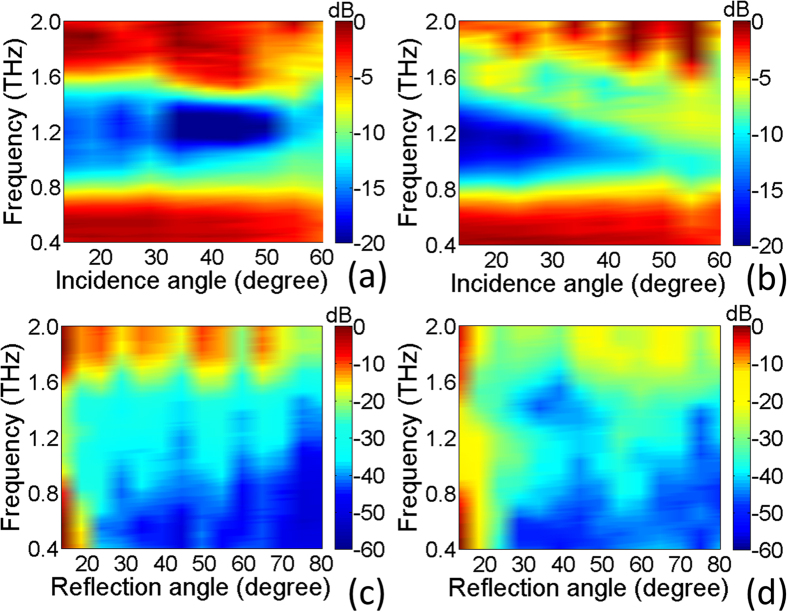
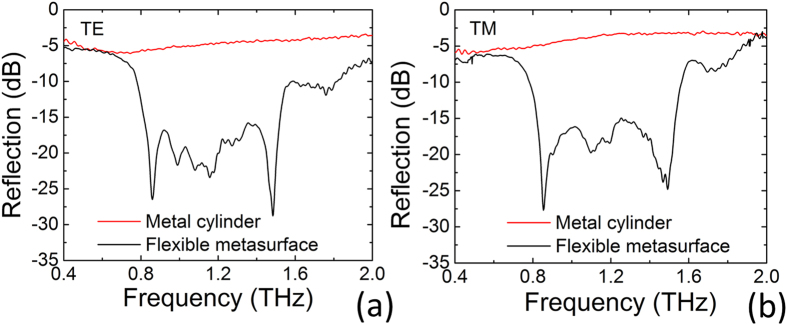
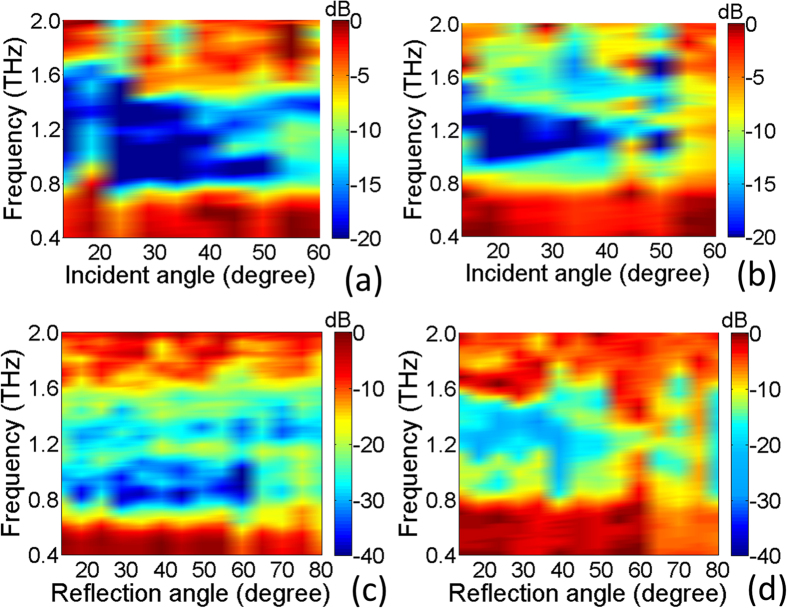
Suppressing specular electromagnetic wave reflection or backward radar cross section is important and of broad interests in practical electromagnetic engineering. Here, we present a scheme to achieve broadband backward scattering reduction through diffuse terahertz wave reflection by a flexible metasurface. The diffuse scattering of terahertz wave is caused by the randomized reflection phase distribution on the metasurface, which consists of meta-particles of differently sized metallic patches arranged on top of a grounded polyimide substrate simply through a certain computer generated pseudorandom sequence. Both numerical simulations and experimental results demonstrate the ultralow specular reflection over a broad frequency band and wide angle of incidence due to the re-distribution of the incident energy into various directions. The diffuse scattering property is also polarization insensitive and can be well preserved when the flexible metasurface is conformably wrapped on a curved reflective object. The proposed design opens up a new route for specular reflection suppression and may be applicable in stealth and other technology in the terahertz spectrum.
Overview
The claims and statistics of this paper haven’t been checked yet.
Run the check — free, no account needed. It reads the open-access text and checks the sources it cites.
Integrity signals
Registry
Cites
Statistics
Figures
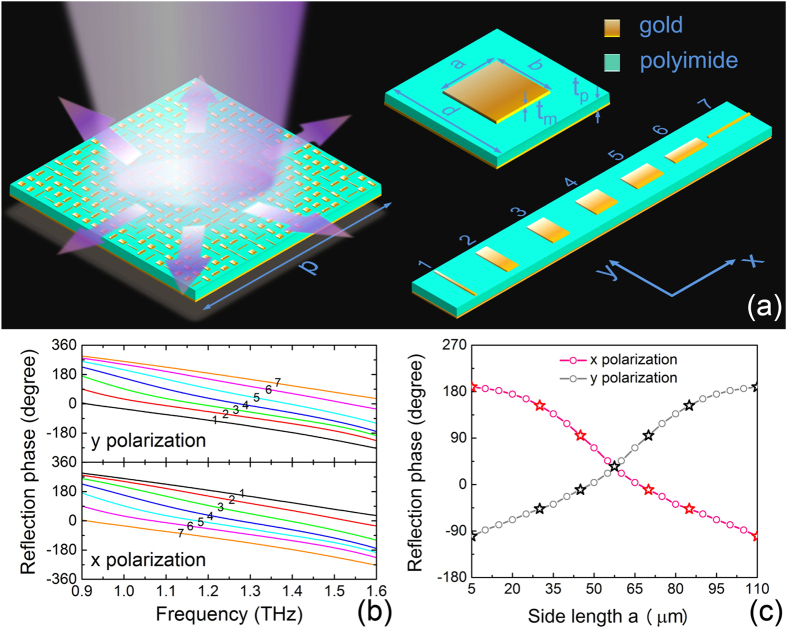
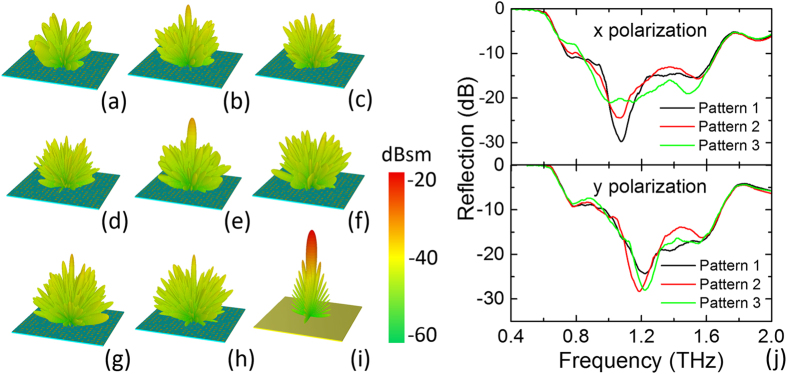
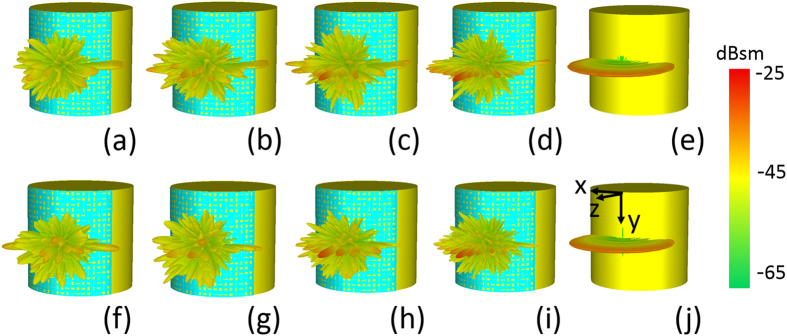
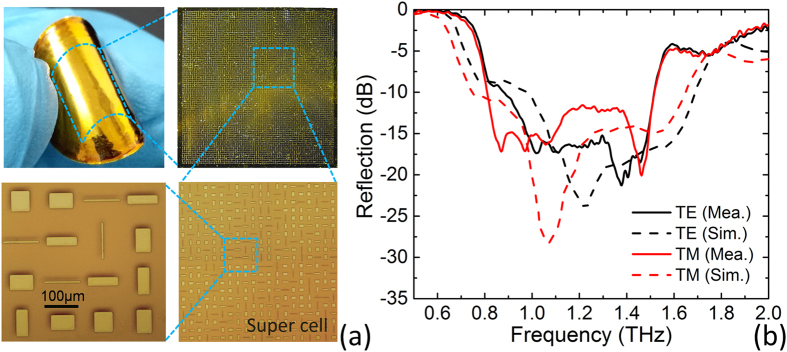
Verification
Claims the paper makes
The claims and statistics of this paper haven’t been checked yet.
Run the check — free, no account needed. It reads the open-access text and checks the sources it cites.
Claims other papers make about this one
Each is checked against this paper’s own text: does it say what the citing paper says it does?
The cited source says what the claim attributes to it.
In the citing paper
“For example, by randomly arranging metallic patches, the authors of [124], [125] showed that FIMs can significantly reduce specular reflection at various angles of incidence.”
From Emerging Technologies in Intelligent Metasurfaces: Shaping the Future of Wireless Communications (2026) · cites this paper as [124]
Self-check
Percentages, sums and reported differences re-computed from the paper’s own numbers.
The self-check needs the paper’s full text.
Citations
Cites
Still being checked.
Research works printed but not linked: 35
- Sirtori, C. Bridge for the terahertz gap. Nature 417, 132–133 (2002). · DOI
- Williams, G. P. Filling the THz gap-high power sources and applications. Rep. Prog. Phy. 69, 301–326 (2006). · DOI
- Tonouchi, M. Cutting-edge terahertz technology. Nature Photon. 1, 97–105 (2007). · DOI
- Song, H. J. & Nagatsuma, T. Present and future of terahertz communications. IEEE Tran. Terahertz Sci. Technol. 1, 256–263 (2011). · DOI
- Ueno, Y. & Ajito, K. Analytical terahertz spectroscopy. Anal. Sci. 24, 185–192 (2008). · DOI
- Piesiewicz, R. et al. Short-range ultra-broadband terahertz communications: Concepts and perspectives. IEEE Antennas and Propagation Magazine 49, 24–39 (2007). · DOI
- Cooper, K. B. et al. THz imaging radar for standoff personnel screening. IEEE Trans. Terahertz Sci. Technol. 1, 169–182 (2011). · DOI
- Koenig, S. et al. Wireless sub-THz communication system with high data rate. Nat. Photonics 7, 977–981 (2013). · DOI
- Yen, T. J. et al. Terahertz magnetic response from artificial materials. Science 303, 1494–1496 (2004). · DOI
- Choi, M. et al. A terahertz metamaterial with unnaturally high refractive index. Nature 470, 369–373 (2011). · DOI
- Withayachumnankul, W. & Abbott, D. Metamaterials in the terahertz regime. IEEE Photonics J. 1, 99–118 (2009). · DOI
- Tao, H. et al. A metamaterial absorber for the terahertz regime: Design, fabrication and characterization. Opt. Express 16, 7181–7188 (2008). · DOI
- Bingham, C. M. et al. Planar wallpaper group metamaterials for novel terahertz applications. Opt. Express 16, 18565–18575 (2008). · DOI
- Zhang, Y., Feng, Y., Zhu, B., Zhao, J. & Jiang, T. Graphene based tunable metamaterial absorber and polarization modulation in terahertz frequency. Opt. Express 22, 22743–22752 (2014). · DOI
- Chen, H. T. et al. Active terahertz metamaterial devices. Nature 444, 597–600 (2006). · DOI
- Cong, L. et al. Highly flexible broadband terahertz metamaterial quarter-wave plate. Laser & Photonics Rev. 8, 626–632 (2014). · DOI
- Liu, L. et al. Broadband metasurfaces with simultaneous control of phase and amplitude. Adv. Mater. 26, 5031–5036 (2014). · DOI · Paper page
- Zhang, Y., Feng, Y., Zhu, B., Zhao, J. & Jiang, T. Switchable quarter-wave plate with graphene based metamaterial for broadband terahertz wave manipulation. Opt. Express 23, 27230–27239 (2015). · DOI
- Wang, L. et al. Broadband tunable liquid crystal terahertz waveplates driven with porous graphene electrodes. Light: Science & Applications 4, e253 (2015). · DOI
- Yu, N. F. & Capasso, F. Flat optics with designer metasurfaces. Nat. Mater. 13, 139–150 (2014). · DOI · Paper page
- Holloway, C. L. et al. An Overview of the Theory and Applications of Metasurfaces: The Two-Dimensional Equivalents of Metamaterials. IEEE Antennas and Propagation Magazine 54, 10–35 (2012). · DOI
- Minovich, A. E. et al. Functional and nonlinear optical metasurfaces. Laser & Photonics Rev. 9, 195–213 (2015). · DOI
- Sun, S. et al. Gradient-index meta-surfaces as a bridge linking propagating waves and surface waves. Nat. Mater. 11, 426–431 (2012). · DOI
- Yu, N. et al. Light Propagation with Phase Discontinuities: Generalized Laws of Reflection and Refraction. Science 334, 333–337 (2011). · DOI · Paper page
- Aieta, F. et al. Out-of-plane reflection and refraction of light by anisotropic optical antenna metasurfaces with phase discontinuities. Nano letters 12, 1702–1706 (2012). · DOI
- Ni, X., Emani, N. K., Kildishev, A. V., Boltasseva, A. & Shalaev, V. M. Broadband light bending with plasmonic nanoantennas. Science 335, 427–427 (2012). · DOI
- Pfeiffer, C. & Grbic, A. Metamaterial Huygens’ surfaces: tailoring wave fronts with reflectionless sheets. Phys. Rev. Lett. 110, 197401 (2013). · DOI
- Zhu, B. O. et al. Dynamic control of electromagnetic wave propagation with the equivalent principle inspired tunable metasurface. Scientific reports 4, 4971 (2014). · DOI
- Zhu, B. O. & Feng, Y. Passive metasurface for reflectionless and arbitary control of electromagnetic wave transmission. IEEE Trans. Antennas Propag. 63, 5500–5511 (2015). · DOI
- Wang, K., Zhao, J., Cheng, Q. & Cui, T. J. Broadband and Broad-Angle Low-Scattering Metasurface Based on Hybrid Optimization Algorithm. Scientific Reports 4, 5935 (2014). · DOI
- Cui, T. J., Qi, M. Q., Wan, X., Zhao, J. & Cheng, Q. Coding metamaterials, digital metamaterials and programmable metamaterials. Light: Science & Applications 3, e218 (2014). · DOI · Paper page
- Liang, L. J. et al. Anomalous Terahertz Reflection and Scattering by Flexible and Conformal Coding Metamaterials. Adv. Optical Mater. 3, 1374–1380 (2015). · DOI
- Liu, S. et al. Anisotropic coding metamaterials and their powerful manipulation of differently polarized terahertz waves. Light: Science & Applications, accepted article preview 26 January 2016, doi: 10.1038/lsa.2016.76. · DOI
- Gao, L. H. et al. Broadband diffusion of terahertz waves by multi-bit coding metasurfaces. Light: Science & Applications 4, e324 (2015). · DOI
- Watts, C. M., Liu, X. & Padilla, W. J. Metamaterial electromagnetic wave absorbers. Adv. Mater. 24, OP98–OP120 (2012).
Cited by
Sorted by citations
Emerging Technologies in Intelligent Metasurfaces: Shaping the Future of Wireless Communications
An, J., Debbah, M., Cui, T. J., Chen, Z. N., & Yuen, C. (2026) · IEEE Transactions on Antennas and Propagation · doi:10.1109/tap.2025.3571069 · Cited by 72
“1) MIMO Capacity Enhancement: An et al. [30] explored the use of FIMs as transceiver arrays in point-to-point MIMO communications.”
Emerging Technologies in Intelligent Metasurfaces: Shaping the Future of Wireless Communications
An, J., Debbah, M., Cui, T. J., Chen, Z. N., & Yuen, C. (2024) · arXiv · Cited by 72
“1) MIMO Capacity Enhancement: An et al. [30] explored the use of FIMs as transceiver arrays in point-to-point MIMO communications.”
Metadata
- Authors
- Zhang, Y., Liang, L., Yang, J., Feng, Y., Zhu, B., Zhao, J., Jiang, T., Jin, B., & Liu, W.
- Affiliations
- Nanjing University (CN)
- Nankai University (CN)
- Corresponding author
- Feng, Yijun
- ORCID
- Venue
- Scientific Reports
- Published
- 2016-05-26
- Volume
- 6
- Issue
- 1
- Pages
- 26875-26875
- ISSN
- 2045-2322 (ISSN-L)
- PMC
- PMC4881048
- OpenAlex
- W2400732625
- Cited by
- 69
- References
- 0
- Citations by year
- 2026: 1 · 2025: 2 · 2024: 5 · 2023: 5 · 2022: 3 · 2021: 5 · 2020: 8 · 2019: 11 · 2018: 12 · 2017: 15 · 2016: 2
- FWCI
- 16.29
- Type
- journal article
- Language
- en
- Open access
- gold
- doi.org
- Locations
- Scientific Reports (publishedVersion, cc-by)
- Europe PMC (PubMed Central) (publishedVersion, cc-by)
- PubMed Central (publishedVersion, cc-by)
- PubMed (publishedVersion)
- Funders
- National Natural Science Foundation of China (61571216, 61371034, 61301017, 61571218)
- Ministry of Education of the People's Republic of China (20120091110032)
- Priority Academic Program Development of Jiangsu Higher Education Institutions
- Jiangsu Provincial Key Laboratory of Advanced Manipulating Technique of Electromagnetic Wave
- Topics
- Physical Sciences › Engineering › Electrical and Electronic Engineering › Advanced Antenna and Metasurface Technologies
- Physical Sciences › Materials Science › Electronic, Optical and Magnetic Materials › Metamaterials and Metasurfaces Applications
- Physical Sciences › Physics and Astronomy › Atomic and Molecular Physics, and Optics › Electromagnetic Scattering and Analysis
- Keywords
- terahertz metasurfaces, diffuse scattering, specular reflection suppression, flexible metasurface, polyimide substrate, pseudorandom sequences, polarization insensitivity, conformal metasurface, broadband scattering
About these checks
Registry, retraction, Cites and statistics results are computed, not judged, with one exception: a printed reference that no index lists is read once by a model before it counts as a citation error. Claims are extracted by a model and kept only when their quote appears verbatim in the text; each cited source is then checked, with a model’s help, for whether it says what the claim relies on. Those verdicts can be wrong — read the claim’s quote and the cited source before relying on one.
Statistics and arithmetic are recomputed, not judged.
Confidence bands are shown only for fields calibrated on our annotated test set. None is calibrated yet, so no band is shown.
What counts as a claim ›How we measure confidence ›How we check this ›
Are you an author, or do you see a problem with this page? Request a review
