

FFPred 3: feature-based function prediction for all Gene Ontology domains
Open accessThe DOI matches its Crossref record; 38 of the 38 references it cites were found in a registry or an index.
Abstract
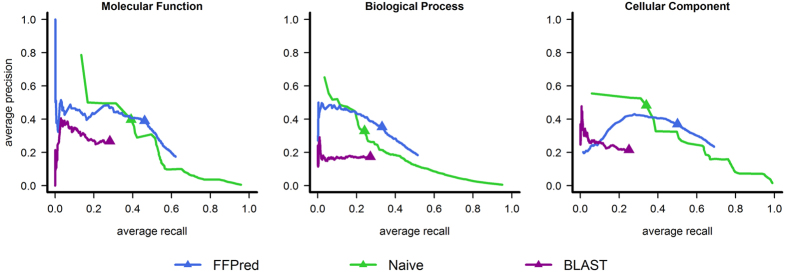
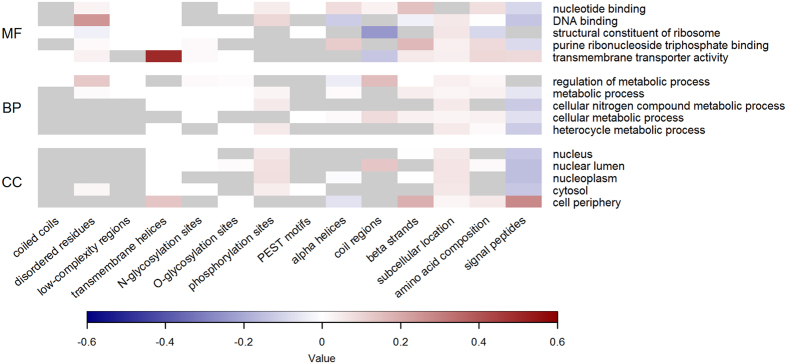
Predicting protein function has been a major goal of bioinformatics for several decades, and it has gained fresh momentum thanks to recent community-wide blind tests aimed at benchmarking available tools on a genomic scale. Sequence-based predictors, especially those performing homology-based transfers, remain the most popular but increasing understanding of their limitations has stimulated the development of complementary approaches, which mostly exploit machine learning. Here we present FFPred 3, which is intended for assigning Gene Ontology terms to human protein chains, when homology with characterized proteins can provide little aid. Predictions are made by scanning the input sequences against an array of Support Vector Machines (SVMs), each examining the relationship between protein function and biophysical attributes describing secondary structure, transmembrane helices, intrinsically disordered regions, signal peptides and other motifs. This update features a larger SVM library that extends its coverage to the cellular component sub-ontology for the first time, prompted by the establishment of a dedicated evaluation category within the Critical Assessment of Functional Annotation. The effectiveness of this approach is demonstrated through benchmarking experiments, and its usefulness is illustrated by analysing the potential functional consequences of alternative splicing in human and their relationship to patterns of biological features.
Overview
The claims and statistics of this paper haven’t been checked yet.
Free: it reads the open-access text and checks the first 5 claims that cite a source we can check. Create a free account to check every claim.
Integrity signals
Registry
Cites
Statistics
Figures




Verification
Claims the paper makes
The claims and statistics of this paper haven’t been checked yet.
Free: it reads the open-access text and checks the first 5 claims that cite a source we can check. Create a free account to check every claim.
Claims other papers make about this one
Each is checked against this paper’s own text: does it say what the citing paper says it does?
The cited source says what the claim attributes to it.
In the citing paper
“Thus, for many of the proteins where functions have been assigned, methods that are not dependent on homology were prevalent (e.g., FFPred316, Fig. 5 and S6).”
From Environmental conditions shape the nature of a minimal bacterial genome (2019) · cites this paper as [16]
Self-check
Percentages, sums and reported differences re-computed from the paper’s own numbers.
The self-check needs the paper’s full text.
Citations
Cites
Basic local alignment search tool
Altschul, S. F., Gish, W., Miller, W., Myers, E. W., & Lipman, D. J. (1990) · Journal of Molecular Biology · doi:10.1006/jmbi.1990.9999 · Cited by 98,669
Gene Ontology: tool for the unification of biology
Ashburner, M., Ball, C. A., Blake, J. A., Botstein, D., Butler, H., Cherry, J. M., Davis, A. P., Dolinski, K., Dwight, S. S., Eppig, J. T., et al. (2000) · Nature Genetics · doi:10.1038/75556 · Cited by 43,206
Probabilistic Outputs for Support vector Machines and Comparisons to Regularized Likelihood Methods
Platt, J. C. (1999) · Cited by 6,385
UniProt: a hub for protein information
The UniProt Consortium (2015) · Nucleic Acids Research · doi:10.1093/nar/gku989 · Cited by 5,106
Making Large-Scale SVM Learning Practical
Joachims, T. (1998) · RePEc: Research Papers in Economics · doi:10.17877/de290r-14262 · Cited by 4,411
Intrinsically unstructured proteins: re-assessing the protein structure-function paradigm
Wright, P. E., & Dyson, H. J. (1999) · Journal of Molecular Biology · doi:10.1006/jmbi.1999.3110 · Cited by 2,968
Intrinsically disordered proteins in cellular signalling and regulation
Wright, P. E., & Dyson, H. J. (2015) · Nature Reviews Molecular Cell Biology · doi:10.1038/nrm3920 · Cited by 2,401
Machine learning applications in genetics and genomics
Libbrecht, M. W., & Noble, W. S. (2015) · Nature Reviews Genetics · doi:10.1038/nrg3920 · Cited by 2,084
UniRef clusters: a comprehensive and scalable alternative for improving sequence similarity searches
Suzek, B. E., Wang, Y., Huang, H., McGarvey, P. B., Wu, C. H., & the UniProt Consortium (2015) · Bioinformatics · doi:10.1093/bioinformatics/btu739 · Cited by 1,928
Advances in Large-Margin Classifiers
(2000) · The MIT Press eBooks · doi:10.7551/mitpress/1113.001.0001 · Cited by 1,869
Cited by
A guide to machine learning for biologists
Greener, J. G., Kandathil, S. M., Moffat, L., & Jones, D. T. (2022) · Nature Reviews Molecular Cell Biology · doi:10.1038/s41580-021-00407-0 · Cited by 2,127
Self-citationThe PSIPRED Protein Analysis Workbench: 20 years on
Buchan, D. W. A., & Jones, D. T. (2019) · Nucleic Acids Research · doi:10.1093/nar/gkz297 · Cited by 1,351
Self-citationStructure-based protein function prediction using graph convolutional networks
Gligorijević, V., Renfrew, P. D., Kosciolek, T., Leman, J. K., Berenberg, D., Vatanen, T., Chandler, C., Taylor, B. C., Fisk, I. M., Vlamakis, H., et al. (2021) · Nature Communications · doi:10.1038/s41467-021-23303-9 · Cited by 906
Kulmanov, M., Khan, M. A., & Hoehndorf, R. (2018) · Bioinformatics · doi:10.1093/bioinformatics/btx624 · Cited by 558
The language of proteins: NLP, machine learning & protein sequences
Ofer, D., Brandes, N., & Linial, M. (2021) · Computational and Structural Biotechnology Journal · doi:10.1016/j.csbj.2021.03.022 · Cited by 339
PANNZER—A practical tool for protein function prediction
Törönen, P., & Holm, L. (2022) · Protein Science · doi:10.1002/pro.4193 · Cited by 193
UDSMProt: universal deep sequence models for protein classification
Strodthoff, N., Wagner, P., Wenzel, M., & Samek, W. (2020) · Bioinformatics · doi:10.1093/bioinformatics/btaa003 · Cited by 189
Zhang, C., Zheng, W., Mortuza, S. M., Li, Y., & Zhang, Y. (2020) · Bioinformatics · doi:10.1093/bioinformatics/btz863 · Cited by 182
Embeddings from deep learning transfer GO annotations beyond homology
Littmann, M., Heinzinger, M., Dallago, C., Olenyi, T., & Rost, B. (2021) · Scientific Reports · doi:10.1038/s41598-020-80786-0 · Cited by 175
Semantic similarity and machine learning with ontologies
Kulmanov, M., Smaili, F. Z., Gao, X., & Hoehndorf, R. (2021) · Briefings in Bioinformatics · doi:10.1093/bib/bbaa199 · Cited by 170
DEEPred: Automated Protein Function Prediction with Multi-task Feed-forward Deep Neural Networks
Sureyya Rifaioglu, A., Doğan, T., Jesus Martin, M., Cetin-Atalay, R., & Atalay, V. (2019) · Scientific Reports · doi:10.1038/s41598-019-43708-3 · Cited by 156
Machine learning techniques for protein function prediction
Bonetta, R., & Valentino, G. (2019) · Proteins Structure Function and Bioinformatics · doi:10.1002/prot.25832 · Cited by 183
Lai, B., & Xu, J. (2022) · Briefings in Bioinformatics · doi:10.1093/bib/bbab502 · Cited by 130
Villegas-Morcillo, A., Makrodimitris, S., van Ham, R. C. H. J., Gomez, A. M., Sanchez, V., & Reinders, M. J. T. (2021) · Bioinformatics · doi:10.1093/bioinformatics/btaa701 · Cited by 123
Zhang, F., Song, H., Zeng, M., Li, Y., Kurgan, L., & Li, M. (2019) · PROTEOMICS · doi:10.1002/pmic.201900019 · Cited by 120
Deep learning for the PSIPRED Protein Analysis Workbench
Buchan, D. W. A., Moffat, L., Lau, A. M., Kandathil, S. M., & Jones, D. T. (2024) · Nucleic Acids Research · doi:10.1093/nar/gkae328 · Cited by 125
Self-citationPredicting human protein function with multi-task deep neural networks
Fa, R., Cozzetto, D., Wan, C., & Jones, D. T. (2018) · PLoS ONE · doi:10.1371/journal.pone.0198216 · Cited by 84
Self-citationBoadu, F., Cao, H., & Cheng, J. (2023) · Bioinformatics · doi:10.1093/bioinformatics/btad208 · Cited by 81
Zhu, Y., Zhang, C., Yu, D., & Zhang, Y. (2022) · PLoS Computational Biology · doi:10.1371/journal.pcbi.1010793 · Cited by 84
The ortholog conjecture revisited: the value of orthologs and paralogs in function prediction
Stamboulian, M. H., Guerrero, R. F., Hahn, M. W., & Radivojac, P. (2020) · Bioinformatics · doi:10.1093/bioinformatics/btaa468 · Cited by 76
Structure-based protein function prediction using graph convolutional networks
Gligorijević, V., Renfrew, P. D., Kościółek, T., Leman, J. K., Berenberg, D., Vatanen, T., Chandler, C., Taylor, B. C., Fisk, I., Vlamakis, H. C., et al. (2021) · RePEc: Research Papers in Economics · Cited by 65
Environmental conditions shape the nature of a minimal bacterial genome
Antczak, M., Michaelis, M., & Wass, M. N. (2019) · Nature Communications · doi:10.1038/s41467-019-10837-2 · Cited by 55
TASOR epigenetic repressor cooperates with a CNOT1 RNA degradation pathway to repress HIV
Matkovic, R., Morel, M., Lanciano, S., Larrous, P., Martin, B., Bejjani, F., Vauthier, V., Hansen, M. M. K., Emiliani, S., Cristofari, G., et al. (2022) · Nature Communications · doi:10.1038/s41467-021-27650-5 · Cited by 62
Synthesizing Systems Biology Knowledge from Omics Using Genome‐Scale Models
Dahal, S., Yurkovich, J. T., Xu, H., Palsson, B. Ø., & Yang, L. (2020) · PROTEOMICS · doi:10.1002/pmic.201900282 · Cited by 60
DeepGOWeb: fast and accurate protein function prediction on the (Semantic) Web
Kulmanov, M., Zhapa-Camacho, F., & Hoehndorf, R. (2021) · Nucleic Acids Research · doi:10.1093/nar/gkab373 · Cited by 47
A Deep Learning Framework for Gene Ontology Annotations With Sequence- and Network-Based Information
Zhang, F., Song, H., Zeng, M., Wu, F., Li, Y., Pan, Y. F., & Li, M. (2020) · IEEE Transactions on Computational Biology and Bioinformatics · doi:10.1109/tcbb.2020.2968882 · Cited by 48
Near perfect protein multi-label classification with deep neural networks
Szalkai, B., & Grolmusz, V. I. (2017) · Methods · doi:10.1016/j.ymeth.2017.06.034 · Cited by 45
A Comprehensive Survey of Deep Learning Techniques in Protein Function Prediction
Dhanuka, R., Singh, J. P., & Tripathi, A. (2023) · IEEE Transactions on Computational Biology and Bioinformatics · doi:10.1109/tcbb.2023.3247634 · Cited by 43
Structure-Based Protein Function Prediction using Graph Convolutional Networks
Gligorijevic, V., Renfrew, P. D., Kosciolek, T., Leman, J. K., Berenberg, D., Vatanen, T., Chandler, C., Taylor, B. C., Fisk, I. M., Vlamakis, H., et al. (2019) · bioRxiv (Cold Spring Harbor Laboratory) · doi:10.1101/786236 · Cited by 33
DeepAdd: Protein function prediction from k-mer embedding and additional features
Du, Z., He, Y., Li, J., & Uversky, V. N. (2020) · Computational Biology and Chemistry · doi:10.1016/j.compbiolchem.2020.107379 · Cited by 35
Wu, F., Ma, J., Cha, Y., Lu, D., Li, Z., Zhuo, M., Luo, X., Li, S., & Zhu, M. (2020) · Process Biochemistry · doi:10.1016/j.procbio.2020.08.010 · Cited by 30
Functional characterization of a new ORF βV1 encoded by radish leaf curl betasatellite
Gupta, N., Reddy, K., Gnanasekaran, P., Zhai, Y., Chakraborty, S., & Pappu, H. R. (2022) · Frontiers in Plant Science · doi:10.3389/fpls.2022.972386 · Cited by 29
Barot, M., Gligorijević, V., Cho, K., & Bonneau, R. (2021) · Bioinformatics · doi:10.1093/bioinformatics/btab098 · Cited by 33
Protein function prediction with gene ontology: from traditional to deep learning models
Vu, T. T. D., & Jung, J. (2021) · PeerJ · doi:10.7717/peerj.12019 · Cited by 29
Cunha, E., Sousa, V. E. D. S., Geada, P., Teixeira, J. A., Vicente, A. A., & Dias, Ó. (2022) · Algal Research · doi:10.1016/j.algal.2022.102963 · Cited by 29
zu Belzen, J. U., Buergel, T., Holderbach, S., Bubeck, F., Adam, L., Gandor, C. L. A., Klein, M., Mathony, J., Pfuderer, P. L., Platz, L., et al. (2019) · Nature Machine Intelligence · doi:10.1038/s42256-019-0049-9 · Cited by 29
Miles, S., Portela, M., Cyrklaff, M., Ancarola, M. E., Frischknecht, F., Durán, R., Dematteis, S., & Mourglia‐Ettlin, G. (2019) · Journal of Cellular Biochemistry · doi:10.1002/jcb.28799 · Cited by 24
Kacsoh, B. Z., Barton, S., Jiang, Y., Zhou, N., Mooney, S. D., Friedberg, I., Predrag Radivojac, A., Greene, C. S., & Bosco, G. (2018) · G3 Genes Genomes Genetics · doi:10.1534/g3.118.200867 · Cited by 23
Saha, S., Prasad, A., Chatterjee, P., Basu, S., & Nasipuri, M. (2018) · Journal of Bioinformatics and Computational Biology · doi:10.1142/s0219720018500257 · Cited by 23
Deep_CNN_LSTM_GO: Protein function prediction from amino-acid sequences
Elhaj-Abdou, M. E. M., El-Dib, H., El-Helw, A., & El-Habrouk, M. (2021) · Computational Biology and Chemistry · doi:10.1016/j.compbiolchem.2021.107584 · Cited by 24
In silico protein function prediction: the rise of machine learning-based approaches
Chen, J., Gu, Z., Lai, L., & Pei, J. (2023) · Medical Review · doi:10.1515/mr-2023-0038 · Cited by 28
Anand, P. P., & Vardhanan, Y. S. (2020) · Scientific Reports · doi:10.1038/s41598-020-59169-y · Cited by 26
Dubiel, M., Coninck, T. D., Osterne, V. J. S., Verbeke, I., Damme, D. V., Smagghe, G. J., & Damme, E. J. M. V. (2020) · International Journal of Molecular Sciences · doi:10.3390/ijms21051659 · Cited by 20
Enzyme function and its evolution
Mitchell, J. B. O. (2017) · Current Opinion in Structural Biology · doi:10.1016/j.sbi.2017.10.004 · Cited by 18
A Semi-Supervised Autoencoder-Based Approach for Protein Function Prediction
Dhanuka, R., Tripathi, A., & Singh, J. P. (2022) · IEEE Journal of Biomedical and Health Informatics · doi:10.1109/jbhi.2022.3163150 · Cited by 18
UBTOR/KIAA1024 regulates neurite outgrowth and neoplasia through mTOR signaling
Zhang, H., Zhang, Q., Gao, G., Wang, X., Wang, T., Kong, Z., Wang, G., Zhang, C., Wang, Y., & Peng, G. (2018) · PLoS Genetics · doi:10.1371/journal.pgen.1007583 · Cited by 18
MMSMAPlus: a multi-view multi-scale multi-attention embedding model for protein function prediction
Wang, Z., Deng, Z., Zhang, W., Lou, Q., Choi, K., Wei, Z., Wang, L., & Wu, J. (2023) · Briefings Bioinform. · doi:10.1093/bib/bbad201 · Cited by 16
AAontology: An Ontology of Amino Acid Scales for Interpretable Machine Learning
Breimann, S., Kamp, F., Steiner, H., & Frishman, D. (2024) · Journal of Molecular Biology · doi:10.1016/j.jmb.2024.168717 · Cited by 15
Prakash, N. R., Chhabra, R., Zunjare, R. U., Muthusamy, V., & Hossain, F. (2020) · 3 Biotech · doi:10.1007/s13205-020-2052-6 · Cited by 18
Venko, K., Novič, M., Stoka, V., & Žerovnik, E. (2021) · Frontiers in Molecular Neuroscience · doi:10.3389/fnmol.2021.619496 · Cited by 15
Seyyedsalehi, S. F., Soleymani, M., Rabiee, H. R., & Mofrad, M. R. K. (2021) · PLoS ONE · doi:10.1371/journal.pone.0244430 · Cited by 15
Silva-Sousa, T., Usuda, J. N., Al-Arawe, N., Hinterseher, I., Catar, R. A., Luecht, C., Vallecillo-García, P., Riesner, K., Hackel, A. M., Schimke, L. F., et al. (2025) · Stem Cells Translational Medicine · doi:10.1093/stcltm/szaf037 · Cited by 19
The field of protein function prediction as viewed by different domain scientists
Ramola, R., Friedberg, I., & Predrag Radivojac, A. (2022) · Bioinformatics Advances · doi:10.1093/bioadv/vbac057 · Cited by 15
Enhanced metagenomic strategies for elucidating the complexities of gut microbiota: a review
Li, X., & Lu, H. (2025) · Frontiers in Microbiology · doi:10.3389/fmicb.2025.1626002 · Cited by 21
In silico analysis of missense mutations in exons 1–5 of the F9 gene that cause hemophilia B
Meléndez-Aranda, L., Jaloma‐Cruz, A. R., Pastor, N., & Romero‐Prado, M. M. D. J. (2019) · BMC Bioinformatics · doi:10.1186/s12859-019-2919-x · Cited by 13
The Genome3D Consortium for Structural Annotations of Selected Model Organisms
Waman, V., Blundell, T. L., Buchan, D. W. A., Gough, J., Jones, D. T., Kelley, L. A., Murzin, A. G., Pandurangan, A. P., Sillitoe, I., Sternberg, M. J. E., et al. (2020) · Methods in molecular biology · doi:10.1007/978-1-0716-0708-4_3 · Cited by 11
Self-citationDuo, H., Chhabra, R., Muthusamy, V., Zunjare, R. U., & Hossain, F. (2024) · Molecular Genetics and Genomics · doi:10.1007/s00438-024-02096-8 · Cited by 11
Differences in stability and calcium sensitivity of the Ig domains in titin's N2A region
Kelly, C. M., Manukian, S., Kim, E. J., & Gage, M. J. (2020) · Protein Science · doi:10.1002/pro.3848 · Cited by 11
Wan, C., Lees, J., Minneci, F., Orengo, C. A., & Jones, D. T. (2017) · PLoS Computational Biology · doi:10.1371/journal.pcbi.1005791 · Cited by 11
Self-citationUDSMProt: Universal Deep Sequence Models for Protein ClassificationPreprint
Strodthoff, N., Wagner, P., Wenzel, M., & Samek, W. (2019) · bioRxiv (Cold Spring Harbor Laboratory) · doi:10.1101/704874 · Cited by 15
Hartke, J., Ceron‐Noriega, A., Stoldt, M., Sistermans, T., Kever, M., Fuchs, J., Butter, F., & Foitzik, S. (2023) · Molecular Ecology · doi:10.1111/mec.17155 · Cited by 10
Consistent prediction of GO protein localization
Spetale, F. E., Arce, D. P., Krsticevic, F., Bulacio, P., & Tapia, E. (2018) · Scientific Reports · doi:10.1038/s41598-018-26041-z · Cited by 10
A hybrid deep learning model for classification of plant transcription factor proteins
Öncül, A. B., & Çelik, Y. (2022) · Signal Image and Video Processing · doi:10.1007/s11760-022-02419-5 · Cited by 10
HumDLoc: Human Protein Subcellular Localization Prediction Using Deep Neural Network
Semwal, R., & Varadwaj, P. K. (2020) · Current Genomics · doi:10.2174/1389202921999200528160534 · Cited by 9
Towards region-specific propagation of protein functions
Koo, D. C. E., & Bonneau, R. (2018) · Bioinformatics · doi:10.1093/bioinformatics/bty834 · Cited by 9
An Overview of Protein Function Prediction Methods: A Deep Learning Perspective
Ispano, E., Bianca, F., Lavezzo, E., & Toppo, S. (2023) · Current Bioinformatics · doi:10.2174/1574893618666230505103556 · Cited by 9
Pandey, V., Krishnan, V., Basak, N., Marathe, A., Thimmegowda, V., Dahuja, A., Jolly, M., & Sachdev, A. (2018) · 3 Biotech · doi:10.1007/s13205-017-1053-6 · Cited by 9
Ontology-based validation and identification of regulatory phenotypes
Kulmanov, M., Schofield, P. N., Gkoutos, G. V., & Hoehndorf, R. (2018) · Bioinformatics · doi:10.1093/bioinformatics/bty605 · Cited by 9
Structural and functional prediction, evaluation, and validation in the post-sequencing era
Li, C., Luo, Y., Xie, Y., Zhang, Z., Liu, Y., Zou, L., & Xiao, F. (2023) · Computational and Structural Biotechnology Journal · doi:10.1016/j.csbj.2023.12.031 · Cited by 9
DeepFusionGO: Protein function prediction by fusing heterogeneous features through deep learning
Huang, Z., Zheng, R., & Deng, L. (2022) · IEEE International Conference on Bioinformatics and Biomedicine (BIBM) · doi:10.1109/bibm55620.2022.9994899 · Cited by 7
Krishnamoorthy, S., Bharathi, M., Yu, J. R., Park, W., & Muthusami, S. (2023) · Computers in Biology and Medicine · doi:10.1016/j.compbiomed.2023.107592 · Cited by 7
Golenko, Y., Ismailova, A., Shaushenova, A., Mutalova, Z., Dossalyanov, D., Ainagulova, A., & Naizagarayeva, A. (2022) · Eastern-European Journal of Enterprise Technologies · doi:10.15587/1729-4061.2022.263270 · Cited by 6
Ahmad, E. M., Abdelsamad, A., El‐Shabrawi, H. M., El-Awady, M. A. M., Aly, M. A. M., & El‐Soda, M. (2024) · Plant Cell & Environment · doi:10.1111/pce.15104 · Cited by 6
Gharehbolagh, S. A., Mafakher, L., Salehi, Z., Asgari, Y., Hashemi, S. J., Mahmoudi, S., Nasimi, M., & Rezaie, S. (2021) · Journal of Molecular Modeling · doi:10.1007/s00894-021-04853-7 · Cited by 7
LSTM-GRU Based Deep Learning Model with Word2Vec for Transcription Factors in Primates
Öncül, A. B. (2023) · Balkan Journal of Electrical and Computer Engineering · doi:10.17694/bajece.1191009 · Cited by 6
Protein function prediction using functional inter-relationship
Dhanuka, R., & Singh, J. P. (2021) · Computational Biology and Chemistry · doi:10.1016/j.compbiolchem.2021.107593 · Cited by 6
Lin, Z., Bosch, M., & Franklin‐Tong, V. E. (2026) · The Plant Journal · doi:10.1111/tpj.70803 · Cited by 5
Raval, I., Labala, R. K., Raval, K., Chatterjee, S., & Haldar, S. (2020) · Journal of Biomolecular Structure and Dynamics · doi:10.1080/07391102.2020.1734486 · Cited by 4
Bozorgmehr, J. H. (2024) · Molecular Genetics and Genomics · doi:10.1007/s00438-023-02090-6 · Cited by 4
Structure and Evolution of DNA Transposons of the L31 Superfamily in Bivalves
Puzakov, M. V., & Puzakova, L. V. (2024) · Molecular Biology · doi:10.1134/s0026893324010114 · Cited by 4
A Leishmania-specific gene upregulated at the amastigote stage is crucial for parasite survival
Avishek, K., Ahuja, K., Pradhan, D., Gannavaram, S., Selvapandiyan, A., Nakhasi, H. L., & Salotra, P. (2018) · Parasitology Research · doi:10.1007/s00436-018-6020-6 · Cited by 4
SVM-Based Multi-Dividing Ontology Learning Algorithm and Similarity Measuring on Topological Indices
Zhu, L., Hua, G., Başkonuş, H. M., & Gao, W. D. (2020) · Frontiers in Physics · doi:10.3389/fphy.2020.547963 · Cited by 4
Li, J., Chen, X., Huang, H., Zeng, M., Yu, J., Gong, X., & Ye, Q. (2025) · Briefings in Bioinformatics · doi:10.1093/bib/bbaf120 · Cited by 5
Yang, H., Qiao, N., Song, Z., Chen, Y., Wang, G., Deng, Z., Zuo, Y., Ge, Y., & Hu, S. (2025) · Journal of Chemical Information and Modeling · doi:10.1021/acs.jcim.5c01142 · Cited by 3
Li, W., Yu, Y., Zhou, G., Hu, G., Li, B., Mā, H., Yan, W., & Pei, H. (2023) · Computational and Structural Biotechnology Journal · doi:10.1016/j.csbj.2023.10.040 · Cited by 3
Tariq, T. B., Munir, F., Jabeen, I., Gul, A., & Amir, R. (2025) · Scientific Reports · doi:10.1038/s41598-025-96485-7 · Cited by 3
Computational prediction of protein functional annotations
Kulmanov, M., & Hoehndorf, R. (2025) · Methods in molecular biology · doi:10.1007/978-1-0716-4662-5_1 · Cited by 2
Lal, K., Joshi, A., Saini, V., Mohammed, M., Sarma, P. V. S. R. N., & Dey, D. (2026) · Frontiers in Plant Science · doi:10.3389/fpls.2025.1665817 · Cited by 2
Lenin, K. L. D., Maharajan, T., Ceasar, S. A., & Antony, S. P. (2024) · Comparative Immunology Reports · doi:10.1016/j.cirep.2024.200180 · Cited by 2
Ye, B., & Liang, J. (2024) · Annual International Conference of the IEEE Engineering in Medicine and Biology Society (EMBC) · doi:10.1109/embc53108.2024.10782681 · Cited by 2
Yang, S., Su, Y., Lin, Y.-C., Lin, Q., & Chen, Z. (2025) · Bioinformatics · doi:10.1093/bioinformatics/btaf473 · Cited by 2
Gao, R., & Ye, K. (2022) · Research Square · doi:10.21203/rs.3.rs-1977097/v1 · Cited by 2
Ye, Q., li, J., Chen, X., Huang, H., Zeng, M., Yu, J., & Gong, X. (2024) · Research Square · doi:10.21203/rs.3.rs-4647798/v1 · Cited by 2
Exploring artificial intelligence through a biologist's lens
Shabir, S., & Hamadani, A. (2024) · Elsevier eBooks · doi:10.1016/b978-0-443-24001-0.00001-4 · Cited by 1
Proteome-wide analysis reveals G protein-coupled receptor-like proteins in rice ( Oryza sativa )
Yadav, D. K., Srivastava, G. P., Singh, A., Singh, M., Yadav, N., & Tuteja, N. (2024) · Plant Signaling & Behavior · doi:10.1080/15592324.2024.2365572 · Cited by 1
Multitask Learning-Based Approaches for Protein Function Prediction
Bahmani, S., Chaudhari, M., Carrier, C., Garrett, S., Pratyush, P., & KC, D. B. (2025) · Methods in molecular biology · doi:10.1007/978-1-0716-4662-5_4 · Cited by 1
DMMAFS: Protein Function Prediction Based on Multi-Modal Multi-Attention Fusion Features
He, L., Deng, Z., Hu, F., Wang, Z., Zuo, Y., Zhu, L. Z., Chen, H., Pan, X., Wei, Z., Wang, L., et al. (2025) · IEEE Transactions on Computational Biology and Bioinformatics · doi:10.1109/tcbbio.2025.3594648 · Cited by 2
Zhu, Y.-H., Zhu, S., Yu, X., Yan, H., Liu, Y., Xie, X., Yu, D., & Ye, R. (2025) · Briefings in Bioinformatics · doi:10.1093/bib/bbaf420 · Cited by 2
Pei, M., LIU, H. J., Liu, H.-N., Ampomah‐Dwamena, C., Wei, T., Feng, R.-P., Shi, Q.-F., & Guo, D. (2025) · Scientia Horticulturae · doi:10.1016/j.scienta.2025.114553 · Cited by 1
DeepFRI Demystified: Interpretability vs. Accuracy in AI Protein Function Prediction
Krishna, A., Simon, V., & Kohli, A. (2026) · Lecture notes in computer science · doi:10.1007/978-3-032-11381-8_14 · Cited by 1
Metadata
- Authors
- Cozzetto, D., Minneci, F., Currant, H., & Jones, D. T.
- Affiliations
- University College London (GB)
- Corresponding author
- Jones, David T.
- Venue
- Scientific Reports
- Published
- 2016-08-26
- Volume
- 6
- Issue
- 1
- Pages
- 31865-31865
- ISSN
- 2045-2322 (ISSN-L)
- PMC
- PMC4999993
- OpenAlex
- W2514044079
- Cited by
- 127
- References
- 38
- Citations by year
- 2026: 7 · 2025: 14 · 2024: 15 · 2023: 14 · 2022: 12 · 2021: 19 · 2020: 20 · 2019: 11 · 2018: 11 · 2017: 4
- FWCI
- 4.51
- Type
- journal article
- Language
- en
- Open access
- gold
- doi.org
- Licence
- cc-by
- creativecommons.org/licenses/by/4.0 (tdm)
- creativecommons.org/licenses/by/4.0 (vor)
- Locations
- Scientific Reports (publishedVersion, cc-by)
- PubMed Central (publishedVersion, cc-by)
- PubMed (publishedVersion)
- UCL Discovery (University College London) (submittedVersion)
- Funders
- University College London
- Directorate for Biological Sciences
- Biotechnology and Biological Sciences Research Council (BB/L002817/1, BB/L020505/1)
- Topics
- Life Sciences › Biochemistry, Genetics and Molecular Biology › Molecular Biology › Machine Learning in Bioinformatics
- Life Sciences › Biochemistry, Genetics and Molecular Biology › Molecular Biology › Bioinformatics and Genomic Networks
- Life Sciences › Biochemistry, Genetics and Molecular Biology › Molecular Biology › Protein Structure and Dynamics
- Keywords
- protein function prediction, Gene Ontology, support vector machine, feature-based prediction, secondary structure, transmembrane helices, intrinsically disordered regions, signal peptide, alternative splicing, human protein
- MeSH terms
- Humans, Computational Biology, Gene Ontology
About these checks
Registry, retraction, Cites and statistics results are computed, not judged, with one exception: a printed reference that no index lists is read once by a model before it counts as a citation error. Claims are extracted by a model and kept only when their quote appears verbatim in the text; each cited source is then checked, with a model’s help, for whether it says what the claim relies on. Those verdicts can be wrong — read the claim’s quote and the cited source before relying on one.
Statistics and arithmetic are recomputed, not judged.
Confidence bands are shown only for fields calibrated on our annotated test set. None is calibrated yet, so no band is shown.
What counts as a claim ›How we measure confidence ›How we check this ›
Are you an author, or do you see a problem with this page? Request a review
Data sources
Bibliographic data: Semantic Scholar, OpenAlex, Crossref.
Contains information from the Semantic Scholar Academic Graph Datasets, made available under the ODC Attribution License (ODC-BY 1.0).
Semantic Scholar’s data is described in: Kinney, R., et al. (2023). The Semantic Scholar Open Data Platform. arXiv:2301.10140.
