

Automatic Speech Recognition of Conversational Speech in Individuals With Disordered Speech
Open accessThe DOI matches its Crossref record; 28 of the 28 references it cites were found in a registry or an index.
Abstract
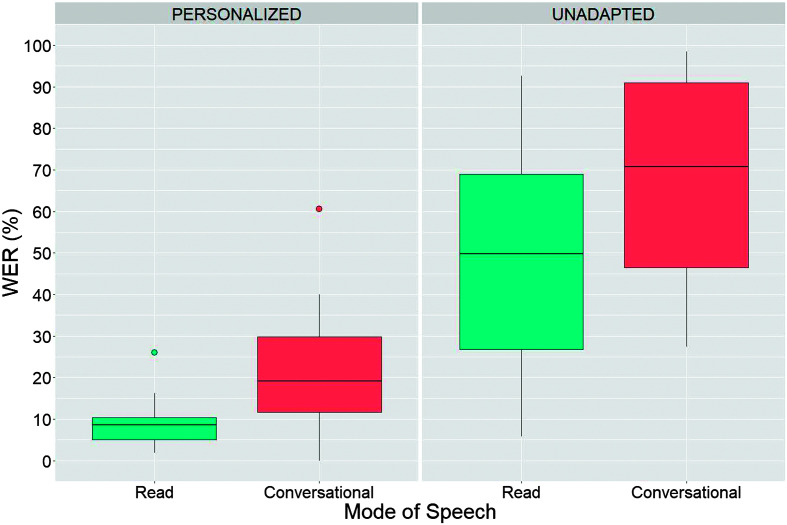
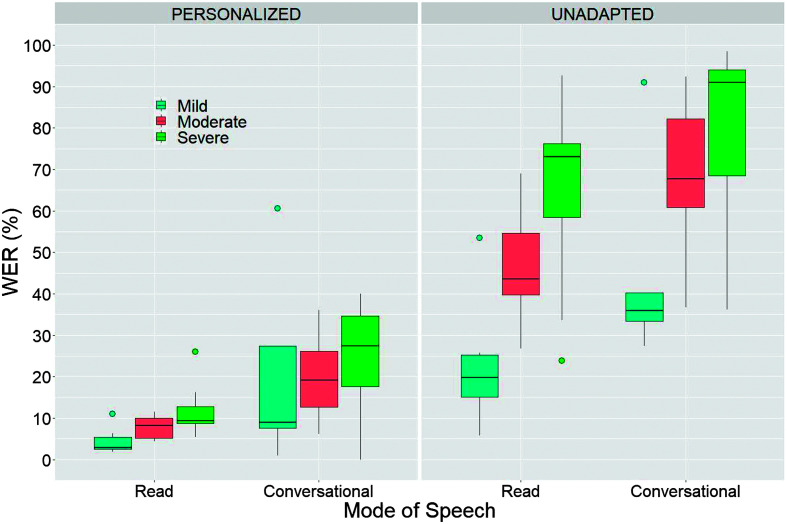
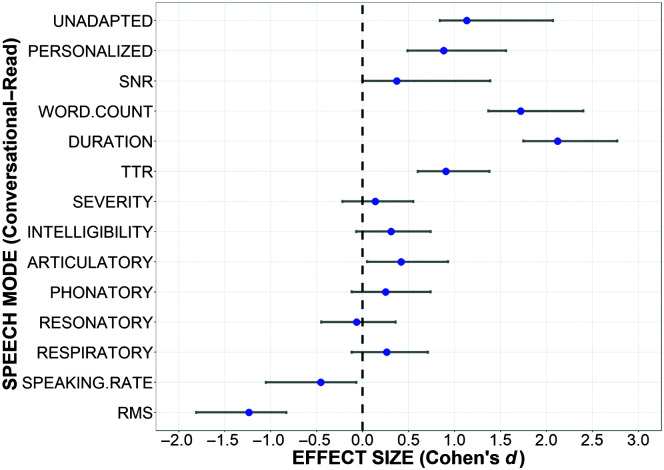
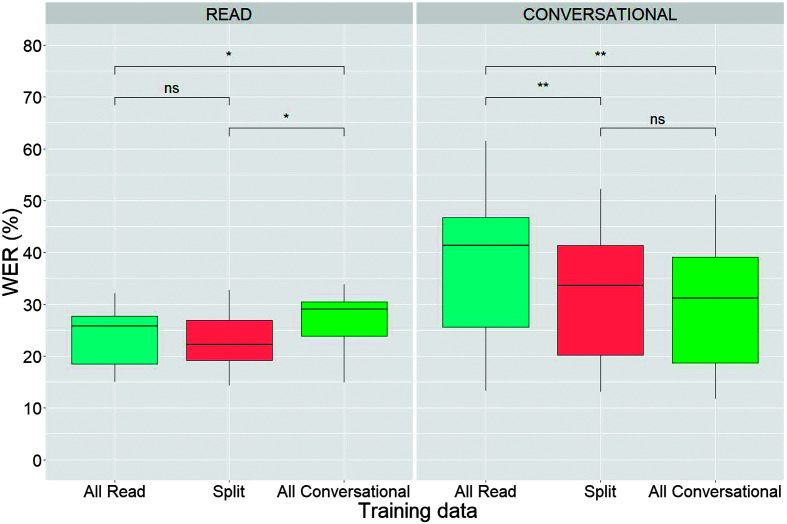
Purpose: This study examines the effectiveness of automatic speech recognition (ASR) for individuals with speech disorders, addressing the gap in performance between read and conversational ASR. We analyze the factors influencing this disparity and the effect of speech mode–specific training on ASR accuracy. Method: Recordings of read and conversational speech from 27 individuals with various speech disorders were analyzed using both (a) one speaker-independent ASR system trained and optimized for typical speech and (b) multiple ASR models that were personalized to the speech of the participants with disordered speech. Word error rates were calculated for each speech model, read versus conversational, and subject. Linear mixed-effects models were used to assess the impact of speech mode and disorder severity on ASR accuracy. We investigated nine variables, classified as technical, linguistic, or speech impairment factors, for their potential influence on the performance gap. Results: We found a significant performance gap between read and conversational speech in both personalized and unadapted ASR models. Speech impairment severity notably impacted recognition accuracy in unadapted models for both speech modes and in personalized models for read speech. Linguistic attributes of utterances were the most influential on accuracy, though atypical speech characteristics also played a role. Including conversational speech samples in model training notably improved recognition accuracy. Conclusions: We observed a significant performance gap in ASR accuracy between read and conversational speech for individuals with speech disorders. This gap was largely due to the linguistic complexity and unique characteristics of speech disorders in conversational speech. Training personalized ASR models using conversational speech significantly improved recognition accuracy, demonstrating the importance of domain-specific training and highlighting the need for further research into ASR systems capable of handling disordered conversational speech effectively.
Overview
The claims and statistics of this paper haven’t been checked yet.
Free: it reads the open-access text and checks the first 5 claims that cite a source we can check. Create a free account to check every claim.
Integrity signals
Registry
Cites
Statistics
Figures
Verification
Claims the paper makes
The claims and statistics of this paper haven’t been checked yet.
Free: it reads the open-access text and checks the first 5 claims that cite a source we can check. Create a free account to check every claim.
Claims other papers make about this one
Each is checked against this paper’s own text: does it say what the citing paper says it does?
The cited source says what the claim attributes to it.
In the citing paper
“These considerations align with broader observations that generic recognizers struggle with dysarthric speech, while speaker-specific adaptation consistently narrows the gap (20), a pattern that further motivates expanding personalized ASR evaluations to more heterogeneous listener and speaker populations.”
From Case Report: Tailored automatic speech recognition in global aphasia with dysarthria - a single case proof of concept (2026) · cites this paper as [20]
Self-check
Percentages, sums and reported differences re-computed from the paper’s own numbers.
The self-check needs the paper’s full text.
Citations
Cites
Adam: A Method for Stochastic Optimization
Kingma, D. P., & Ba, J. (2014) · arXiv · doi:10.48550/arxiv.1412.6980 · Cited by 98,946 · cited 1×
“For training, we employed the Adam optimizer (Kingma & Ba, 2015) with a low learning rate of 1e-5.”
A guideline of selecting and reporting intraclass correlation coefficients for reliability research
Koo, T. K., & Li, M. Y. (2016) · Journal of Chiropractic Medicine · doi:10.1016/j.jcm.2016.02.012 · Cited by 31,709 · cited 1×
“The results indicated that while most of the labels exhibited good to moderate agreement, the “ Consistency ” label demonstrated poor reliability (Koo & Li, 2016).”
SpecAugment: A Simple Data Augmentation Method for Automatic Speech Recognition
Park, D. S., Chan, W., Zhang, Y., Chiu, C.-C., Zoph, B., Cubuk, E. D., & Le, Q. V. (2019) · Interspeech 2019 · doi:10.21437/interspeech.2019-2680 · Cited by 3,558
Supervised Sequence Labelling with Recurrent Neural Networks
Graves, A. (2012) · Studies in Computational Intelligence · doi:10.1007/978-3-642-24797-2 · Cited by 3,120
Robust Speech Recognition via Large-Scale Weak Supervision
Radford, A., Kim, J. W., Xu, T., Brockman, G., McLeavey, C., & Sutskever, I. (2022) · arXiv · doi:10.48550/arxiv.2212.04356 · Cited by 1,953 · cited 1×
“…recognize untranscribed speech recordings of individuals with speech disorders with a reasonable degree of accuracy would allow researchers to utilize a vast amount of pseudolabeled speech recordings for semisupervised speaker-independent model training (Liao et al., 2013; Radford et al., 2023).”
The TORGO database of acoustic and articulatory speech from speakers with dysarthria
Rudzicz, F., Namasivayam, A. K., & Wolff, T. (2012) · Language Resources and Evaluation · doi:10.1007/s10579-011-9145-0 · Cited by 425 · cited 1×
“Most speech disorder corpora focus on speech that is produced during reading, with scant examples of spontaneous conversation (H. Kim et al., 2008; Rudzicz et al., 2012).”
Dysarthric speech database for universal access research
Kim, H., Hasegawa-Johnson, M., Perlman, A., Gunderson, J., Huang, T. S., Watkin, K., & Frame, S. (2008) · Interspeech 2008 · doi:10.21437/interspeech.2008-480 · Cited by 397 · cited 1×
“Most speech disorder corpora focus on speech that is produced during reading, with scant examples of spontaneous conversation (H. Kim et al., 2008; Rudzicz et al., 2012).”
Graves, A. (2012) · Studies in Computational Intelligence · doi:10.1007/978-3-642-24797-2_3 · Cited by 265
Between-speaker and within-speaker variation in speech tempo of American English
Jacewicz, E., Fox, R. A., & Wei, L. (2010) · The Journal of the Acoustical Society of America · doi:10.1121/1.3459842 · Cited by 196 · cited 2×
“…speech presents unique ASR challenges due to its distinct characteristics, such as less precise and faster articulation (DiCanio et al., 2015; Jacewicz et al., 2010; Kuo & Weismer, 2016), and the presence of irregularities such as interruptions, hesitations, repairs, and nonlexical sounds…”
Liao, H., McDermott, E., & Senior, A. (2013) · 2013 IEEE Workshop on Automatic Speech Recognition and Understanding · doi:10.1109/asru.2013.6707758 · Cited by 193 · cited 1×
“…recognize untranscribed speech recordings of individuals with speech disorders with a reasonable degree of accuracy would allow researchers to utilize a vast amount of pseudolabeled speech recordings for semisupervised speaker-independent model training (Liao et al., 2013; Radford et al., 2023).”
Cited by
Transforming Speech-Language Pathology with AI: Opportunities, Challenges, and Ethical Guidelines
Georgiou, G. P. (2025) · Healthcare · doi:10.3390/healthcare13192460 · Cited by 38
“Evidence shows that adapting models to conversational speech from individuals with speech-language disorders improves recognition performance [10].”
Artificial Intelligence in Communication Sciences and Disorders: Introduction to the Forum
Green, J. R. (2024) · Journal of Speech Language and Hearing Research · doi:10.1044/2024_jslhr-24-00594 · Cited by 25
Self-citationHe, Y., Seng, K. P., & Ang, L.-M. (2025) · IEEE Transactions on Neural Systems and Rehabilitation Engineering · doi:10.1109/tnsre.2025.3570383 · Cited by 22
“Tobin et al. [5] achieved modest WER improvements using domain-specific adaptations, but encountered limitations with severe prosodic disorders due to their reliance on pre-existing datasets.”
Variational Low-Rank Adaptation for Personalized Impaired Speech Recognition
Pokel, N., Moure, P., Boehringer, R., Liu, S., & Gao, Y. (2026) · IEEE International Conference on Acoustics Speech and Signal Processing · doi:10.1109/icassp55912.2026.11462593 · Cited by 6
Towards a Single ASR Model That Generalizes to Disordered Speech
Tobin, J., Tomanek, K., & Venugopalan, S. (2025) · IEEE International Conference on Acoustics Speech and Signal Processing · doi:10.1109/icassp49660.2025.10888895 · Cited by 10
“More details of the test set can be found in [18].”
Self-citationSpeech Recognition with LLMs Adapted to Disordered Speech Using Reinforcement Learning
Nagpal, C., Venugopalan, S., Tobin, J., Ladewig, M. A., Heller, K., & Tomanek, K. (2025) · IEEE International Conference on Acoustics Speech and Signal Processing · doi:10.1109/icassp49660.2025.10888006 · Cited by 9
“While they use a 62B parameter LLM for this task, we train a Gemma-2B reward model on the same binary classification task of meaning preservation introduced in [28] on 2840 pairs of predicted and gold transcripts using a cross-entropy loss on the 0-1 labels.”
Self-citationMills, J., Duffy, O. M., Pedlow, K., & Kernohan, G. W. (2025) · JMIR Rehabilitation and Assistive Technologies · doi:10.2196/75316 · Cited by 6
“Furthermore, research investigating the error rates of ASR, which underpins VAT, has shown that error rates are higher for conversational speech than for short phrases or read speech in people with speech disorders [34,35].”
Challenges in Automatic Speech Recognition for Adults with Cognitive Impairment
Cohn, M., Lanzi, A., Ishihara, Y., Chuah, C.-N., Zellou, G., & Weakley, A. (2026) · Proceedings of the 2026 CHI Conference on Human Factors in Computing Systems · doi:10.1145/3772318.3791581 · Cited by 4
“This is potentially the case for acoustic features as some of these features are the same ones that people adjust when talking to technology (e.g., rate)[19].”
BUCKLEY, A., O'Sullivan, B., McKean, C., & Frizelle, P. (2026) · International Journal of Language & Communication Disorders · doi:10.1111/1460-6984.70201 · Cited by 6
“For instance, Tobin et al. ( 2024 ) found that speech recognition models trained on read speech were less accurate when applied to conversational speech in children with speech disorders.”
Carl, M., & Icht, M. (2025) · Diagnostics · doi:10.3390/diagnostics15151892 · Cited by 4
“Nonetheless, recent studies have demonstrated optimistic results, with improvement in ASR accuracy noted following the training of the automated systems on related stimuli [30,31].”
MORA: Designing an AI-Mediated Role-Playing System for Child-Caregiver Speech Sound PracticePreprint
Hong, S., Yang, Y., Li, J., Briggs, X., Ansari, R., Zheng, Q., Xiong, J., Du, Y., & Li, T. J.-J. (2025) · arXiv (Cornell University) · doi:10.48550/arxiv.2510.23887 · Cited by 2
When Audio-Language Models Fail to Leverage Multimodal Context for Dysarthric Speech RecognitionPreprint
Moure, P., Pokel, N., Bounajma, B., Gao, Y., Boehringer, R., Cheng, L., & Liu, S. (2026) · arXiv (Cornell University) · doi:10.48550/arxiv.2605.02782 · Cited by 2
“Speakers with dysarthria, a motor speech disorder arising from neurological conditions such as cerebral palsy (CP), amyotrophic lateral sclerosis (ALS), Parkinson’s disease, and stroke, experience dramatically higher word error rates (WER) (Tobin et al., 2024).”
Automatic Speech Recognition for Intelligibility Assessment in Children With Dysarthria
Choi, J., Moya‐Galé, G., Hwang, K., Hirschberg, J., & Levy, E. S. (2026) · Journal of Speech Language and Hearing Research · doi:10.1044/2025_jslhr-25-00562 · Cited by 4
“Thus, despite their limitations, current speaker-independent ASR systems can provide immediate transcriptions that may support continuous monitoring of intelligibility and aid in assessing treatment efficacy (Gutz et al., 2023; Tobin et al., 2024).”
Irbe, A., & Etienne, E. M. (2026) · Annals of Computer Science and Information Systems · doi:10.15439/2026f1991 · Cited by 1
Mulfari, D., Cardile, D., Campana, S., Voci, L., Vicario, C. M., Calabrò, R. S., Corallo, F., Mulfari, S., & Tomaiuolo, F. (2026) · Frontiers in Rehabilitation Sciences · doi:10.3389/fresc.2026.1813312
“…align with broader observations that generic recognizers struggle with dysarthric speech, while speaker-specific adaptation consistently narrows the gap (20), a pattern that further motivates expanding personalized ASR evaluations to more heterogeneous listener and speaker populations.”
Kim, J. Y. (2024) · Audiology and Speech Research · doi:10.21848/asr.240159 · Cited by 1
Vineetha, K., V, Lakshmanan, R., Sindhu, L., Minimol, B., & Jacob, J. (2025) · International Conference on Trends in Engineering Systems and Technologies (ICTEST) · doi:10.1109/ictest64710.2025.11042465
“Project Euphonia, a Google Research initiative, identifies the performance gap of ASR in the read and conversational speech of individuals with atypical speech [6].”
Mills, J., Duffy, O. M., Pedlow, K., & Kernohan, G. W. (2025) · International Journal of Language & Communication Disorders · doi:10.1111/1460-6984.70140
Disordered Speech Recognition (Misarticulation) Using Similarity Algorithms
Ghadge, A. P., & Mahajan, S. P. (2025) · International Conference on Computing Communication Control and automation · doi:10.1109/iccubea65967.2025.11283750
“These trained models struggle to analyse fine grained motor coordination involved in speech production [5].”
Söderbäck, A. (2025) · Lund University Publications Student Papers (Lund University)
Assessing Smartphone Speech Recognition Across Diverse English Accents: A Preliminary Study
Soria, C., Nodari, R., & Calamai, S. (2025) · Use Siena air (University of Siena) · doi:10.69117/all.2025.3.04
Mills, J., Kernohan, G. W., Pedlow, K., & Duffy, O. M. (2026) · JMIR Rehabilitation and Assistive Technologies · doi:10.2196/84364 · Cited by 2
“Furthermore, ASR errors are often higher than expected for dysarthric speech, speakers of minority languages, and those with regional accents [78-80].”
Vora, J. (2025) · Journal of All India Institute of Speech and Hearing · doi:10.4103/jaiish.jaiish_16_25
AI-Based Early Learning Assistant Using Speech Recognition and Concept Mapping
Kumar, V. P., & Rajakumari, K. (2026) · Communications in computer and information science · doi:10.1007/978-3-032-17840-4_26
Sánchez-Sánchez, M. M., Armenta-Molina, A., Hernández-Gómez, L. H., & Márquez, R. T. R. (2026) · Advanced structured materials · doi:10.1007/978-3-032-13551-3_16
Wenn KI auf Fach und Sprache trifft
Busch-Lauer, I.-A. (2026) · Studien zu Fach, Sprache und Kultur · doi:10.57088/978-3-7329-8690-3
Ishikawa, K., Renkert, E., Baratz, H. Q., Yeatts, J. W., Montealegre, D. H., Bayan, S. L., Osland, D., McDaniel, J., Li, Y., Yin, L. X., et al. (2026) · Journal of Voice · doi:10.1016/j.jvoice.2026.02.004
How often do people with disabilities travel by certain modes? A study from California
Bhuiya, M. M. R., Barajas, J. M., & Venkataram, P. S. (2026) · Travel Behaviour and Society · doi:10.1016/j.tbs.2026.101277
Mobile-based speech-to-text and response application
Sangalang, T. K. M., Binalla, M. M. R., Francisco, P. F. Y., Garcia, J. N. M., Salongsongan, S. P., Lopez, A. K. M. D., Viaña, J. X. R., Bautista, J. N., Galay-Limos, J. A., & Rodil, M. V. B. (2026) · International Journal of Research Studies in Educational Technology · doi:10.5861/ijrset.2026.26009
Robustness of neural models for automatic speech processing
Maison, L. (2025) · theses.fr (ABES) · doi:10.70675/cd07449cz121az45b9zaa1bz82f77086939d
Traduction automatique de la parole vers des pictogrammes
Macaire, C. (2025) · theses.fr (ABES) · doi:10.70675/06c7e6b3z41b7z467cza019zc899470d6306
Korzin, A. S., Alekseeva, N. A., Shaleeva, E. F., Dmitrichenkova, S. V., & Kruglova, L. V. (2026) · Pedagogy Theory & Practice · doi:10.30853/ped20260082
Martínez, E. S. (2026) · Studien zu Fach, Sprache und Kultur · doi:10.57088/978-3-7329-8690-3_19
LLM-Based Post-ASR Error Correction for Disordered Speech
Wen, H., Assefa, M., Semsayan, A., & Flushing, E. F. (2026) · IEEE International Conference on Acoustics Speech and Signal Processing · doi:10.1109/icassp55912.2026.11465049
Neto, R. B., & Sablón, V. I. B. (2026) · International Journal of Environmental Research and Public Health · doi:10.3390/ijerph23050626
“Models such as Whisper demonstrate strong generalization in real-world clinical settings [36], while modern diarization and natural language processing techniques enable role identification, extraction of relevant clinical entities, and contextualization of discourse within large-scale semantic…”
InfluentialArtificial Intelligence and Communication Sciences and Disorders: A Bidirectional Frontier
Dattner, I. (2026) · Folia Phoniatrica et Logopaedica · doi:10.1159/000552551
Murdaugh, K. M., & Kwok, I. B. (2026) · Journal of Palliative Medicine · doi:10.1177/10966218261452780
Rethfeldt, W. S. (2026) · Media (https://www.suub.uni-bremen.de/) · doi:10.26092/elib/6141
Shahid, I., Pouriyeh, S., Xie, Y., Santopaolo, A., Giugliano, S., & Sannino, G. (2026) · Communications in computer and information science · doi:10.1007/978-3-032-29254-4_19
Beyond Silence Stripping: Robust Whisper-Based ASR for Dementia Speech
Ramos-Sanchez, G., Ortiz-Pérez, D., Ψαρρού, Α., & Garcia-Rodriguez, J. (2026) · Communications in computer and information science · doi:10.1007/978-3-032-29254-4_50
Communication Disability Divide in Digital Inclusion
Mackenzie-Phelan, R. (2026) · Springer eBooks · doi:10.1007/978-3-031-52643-5_213-1
Al-Tamimi, A.-K., Andrews, J. A., Benfield, J. K., Sweby, C., Gilmartin, C., Lindley, R., Trusson, D., Dziunka, M., Webster, D., & Radford, K. (2026) · Journal of Medical Internet Research · doi:10.2196/93518
“However, ASR systems have been trained on a largely nonimpaired speech dataset, and accuracy in interpreting impaired speech is much lower [18].”
Pokel, N., Zhao, Y., Moure, P., Gao, Y., & Boehringer, R. (2026) · ACM Conference on Conversational User Interfaces (CUI) · doi:10.1145/3816046.3816317
Age-Inclusive Cognitive Monitoring in CUIs: How ASR Errors Affect Text-Based Dementia Biomarkers
Murphy, A., Chen, Q., Forrest, K. I., & Bennett, C. C. (2026) · ACM Conference on Conversational User Interfaces (CUI) · doi:10.1145/3816046.3816217
“Moreover, ASR quality can vary systematically across older-adult speech profiles (e.g. accents or regional dialects), and recognition difficulty may be higher for dementia-impaired speech due to some of the aforementioned changes [17], which furthermore may vary by level of impairment [50].”
Lee, J., Worthy, P., Deslandes, R., Burton, B., Copland, D. A., Jamieson, P., Barron, K., Shrubsole, K., Togher, L., Hill, A. J., et al. (2026) · BMC Digital Health · doi:10.1186/s44247-026-00289-2
“Likewise, voice recognition technology that can be trained using an individual’s speech patterns has tended to be more successful [54, 55].”
Panda, A., Kumar, N., Sadhu, S., Silaparasetty, S., & Supriya, M. (2026) · International Conference on Intelligent Technologies (CONIT) · doi:10.1109/conit69683.2026.11621481
“Tobin et al. [20] found a critical ”performance gap” because systems trained on read speech could not understand spontaneous conversation.”
The Impact of Cluttering on Professional Life: A Qualitative Study
Dogan, S. C., Uysal, A. A., & Basaran, A. (2026) · Folia Phoniatrica et Logopaedica · doi:10.1159/fpl/acvag008
Ability adaptive AAC: toward a modular, open-source framework
Katz, D., Zisman, A., Johnston, A., Bennasar, M., Muhammad, A., & Muftah, A. (2026) · Augmentative and Alternative Communication · doi:10.1080/07434618.2026.2716643
Nafee, R., Zaid, I. A., Alnahhal, A., & Sbeih, A. H. (2026) · Biomedical Signal Processing and Control · doi:10.1016/j.bspc.2026.111434
Wang, F., Utianski, R. L., Barnard, L. R., Duffy, J. R., & Botha, H. (2026) · medRxiv · doi:10.64898/2026.09.19.26363478
Position Papers of the 21st Conference on Computer Science and Intelligence Systems
(2026) · Annals of Computer Science and Information Systems · doi:10.15439/978-83-977088-3-9
Anusha, J. A., & Reddy, S. C. M. (2026) · International Conference on Secure Information Systems and Technologies (ICSIST) · doi:10.1109/icsist70215.2026.11706356
“They allow machines to interpret spoken language or neural signals and convert them into text or commands, supporting applications in assistive communication, healthcare, smart devices, and voice-controlled systems [2].”
Automated Language Sample Analysis for Children With Developmental Language Disorder
Ortiz, J. A., Huang, Y. T., & Benway, N. R. (2026) · Journal of Speech Language and Hearing Research · doi:10.1044/2026_jslhr-25-00543
Language and Power: Critical Reflections from an HCI Researcher who Stutters
Kobenova, A. (2026) · International ACM SIGACCESS Conference on Computers and Accessibility (ASSETS) · doi:10.1145/3797867.3832755
“In retrospect, I understand that technologies simply mirrored typical language patterns and the atypical speech was not part of the training data, an area of machine learning and HCI that researchers are still actively working on decades later [30, 31].”
Parchure, S., Lin, F., Drachman, H., Vnenchak, L., Harvey, D. Y., Faseyitan, O. K., Coslett, H. B., & Hamilton, R. H. (2026) · Journal of Speech Language and Hearing Research · doi:10.1044/2026_jslhr-25-00882
Altaib, M. K., Alhaidar, R., Alsiddiqi, Z. A., Aldukair, L. M., Shalhoub, S. F. B., Dalil, G. B., Aldaghar, L., Alsunaid, H., Bashammakh, S. O., & AlKadhi, A. (2026) · Healthcare · doi:10.3390/healthcare14213717
Sunday, I. E., Nwogboji, E. U., & Bamigbola, P. I. (2026) · IIAR Journal of Disability Inclusion and Assistive Technologies · doi:10.68854/fr558873
Metadata
- Authors
- Tobin, J., Nelson, P., MacDonald, B., Heywood, R., Cave, R., Seaver, K., Desjardins, A., Jiang, P.-P., & Green, J. R.
- Affiliations
- Google (United States) (US)
- Motor Neurone Disease Association (GB)
- MGH Institute of Health Professions (US)
- Harvard University (US)
- Corresponding author
- Tobin, Jimmy
- ORCID
- Venue
- Journal of Speech, Language, and Hearing Research
- Published
- 2024-11-07
- Volume
- 67
- Issue
- 11
- Pages
- 4176-4185
- ISSN
- 1092-4388 (ISSN-L)
- 1558-9102
- PMC
- PMC12379580
- OpenAlex
- W4400316434
- Cited by
- 45
- References
- 26
- Citations by year
- 2026: 32 · 2025: 11 · 2024: 2
- FWCI
- 6.60
- Type
- journal article
- Language
- en
- Open access
- hybrid
- doi.org
- Licence
- cc-by
- Locations
- Journal of Speech Language and Hearing Research (publishedVersion, cc-by)
- Europe PMC (PubMed Central) (publishedVersion, cc-by)
- PubMed Central (publishedVersion, cc-by)
- PubMed (publishedVersion)
- Funders
- National Institutes of Health
- National Institute on Deafness and Other Communication Disorders (K24DC016312, R13DC003383)
- Topics
- Physical Sciences › Computer Science › Artificial Intelligence › Speech Recognition and Synthesis
- Health Sciences › Health Professions › Speech and Hearing › Voice and Speech Disorders
- Physical Sciences › Computer Science › Signal Processing › Speech and Audio Processing
- Keywords
- speech recognition, conversational speech, speech disorders, personalized speech recognition, domain-specific training, word error rate, linguistic complexity
- MeSH terms
- Adult, Aged, Female, Humans, Male, Middle Aged, Reading, Speech, Speech Disorders, Speech Recognition Software, Young Adult
About these checks
Registry, retraction, Cites and statistics results are computed, not judged, with one exception: a printed reference that no index lists is read once by a model before it counts as a citation error. Claims are extracted by a model and kept only when their quote appears verbatim in the text; each cited source is then checked, with a model’s help, for whether it says what the claim relies on. Those verdicts can be wrong — read the claim’s quote and the cited source before relying on one.
Statistics and arithmetic are recomputed, not judged.
Confidence bands are shown only for fields calibrated on our annotated test set. None is calibrated yet, so no band is shown.
What counts as a claim ›How we measure confidence ›How we check this ›
Are you an author, or do you see a problem with this page? Request a review
Data sources
Bibliographic data: Semantic Scholar, OpenAlex, Crossref.
Contains information from the Semantic Scholar Academic Graph Datasets, made available under the ODC Attribution License (ODC-BY 1.0).
Semantic Scholar’s data is described in: Kinney, R., et al. (2023). The Semantic Scholar Open Data Platform. arXiv:2301.10140.
