

Imperfect Captions Paired to Audiovisual Stimuli Improve Speech Recognition but Do Not Reduce Listening-Related Fatigue
Open accessThe DOI matches its Crossref record; 46 of the 46 references it cites were found in a registry or an index; 1 of the 55 sources its claims cite were checked for support.
Abstract
Purpose: Understanding speech in challenging environments can be fatiguing for individuals with and without hearing loss. Empirical research examining interventions to reduce such fatigue, however, is limited. Our study investigated the effects of imperfect captions, such as those created using automated speech recognition systems, on listening-related fatigue during a challenging speech task. Method: Twenty-two adults (aged 18–63 years) with essentially normal hearing completed a sustained dual task designed to induce listening-related fatigue. The primary task was audiovisual sentence recognition in quiet, with speech levels individually adjusted for ~70% correct performance (without captions). The secondary task was response time (RT) to topic words presented during the speech task. Participants completed the dual task with or without captions. Subjective fatigue ratings were obtained before, during, and after the dual task. Vigilant attention was measured via the secondary task and before and after the dual task using visual stimuli (RTs to a visual marker presented at random intervals). Results: Subjective fatigue ratings increased significantly over the course of the dual task. However, this increase was larger for the group who had captions, even though they had better sentence recognition overall. Evidence of behavioral fatigue (slowed RTs over time) was also present but only for those in the Caption group. Anecdotal reports from study participants suggest that the increased fatigue for the Caption group was related to the cognitive challenge of combining information from the time-locked audiovisual cues and the time-delayed, and imperfect, text captions. Conclusions: Even though they were time-delayed and contained inaccuracies, captions improved speech recognition. However, this benefit was accompanied by greater increases in subjective and behavioral fatigue. Therefore, in some conditions imperfect captions can have negative consequences for listening-related fatigue. Further research is needed to determine whether this pattern holds in different circumstances, such as with audio-only stimuli. Supplemental Material: https://doi.org/10.23641/asha.29646482
Overview
CoChat Summary
TL;DR
This study tested whether imperfect captions paired with audiovisual speech reduce listening-related fatigue in 22 adults with essentially normal hearing during a sustained dual task. Captions improved sentence recognition but were associated with greater subjective and behavioral fatigue, not less.
Key findings
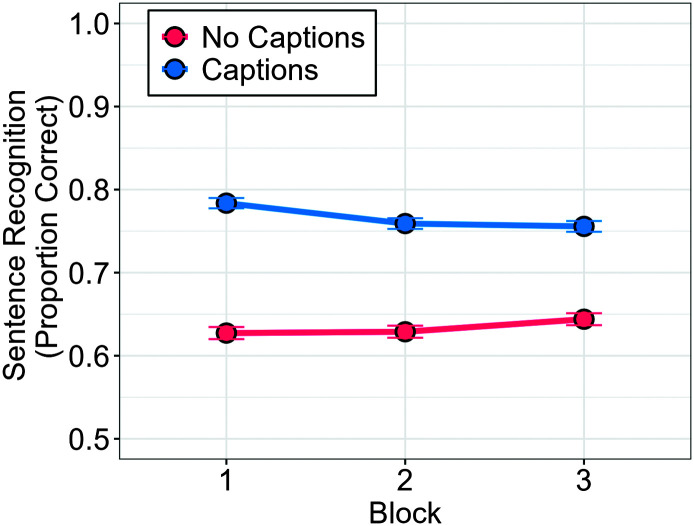
- Sentence recognition was better for the Caption group than the No Caption group (77% vs. 63% average across blocks; main effect of group: F(1, 20) = 5.30, p = .032, partial η² = .21), with a significant Group × Block interaction; the Caption group was better at Block 1 and Block 2 (15% and 13% better; p = .014, .037) but not Block 3 (11% better; p = .07).
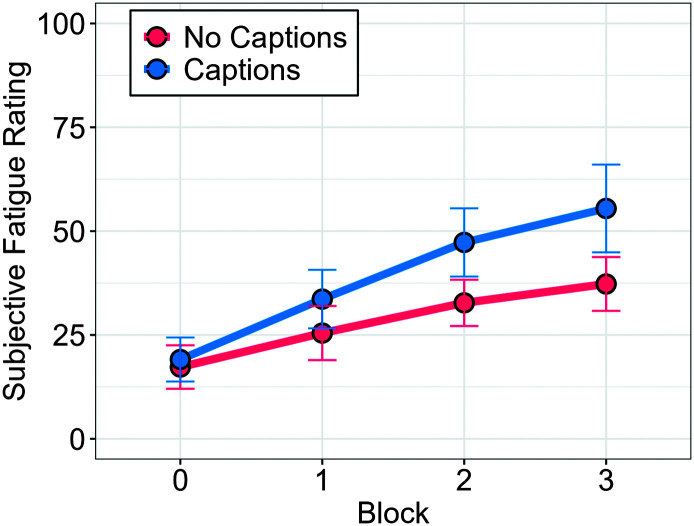
- Subjective fatigue increased over time for both groups, but more for the Caption group: estimated marginal mean increased by 36.36 points from Block 0 to Block 3 in the Caption group versus 20 points in the No Caption group (Group × Block: F(3, 60) = 2.89, p < .01, partial η² = .13).
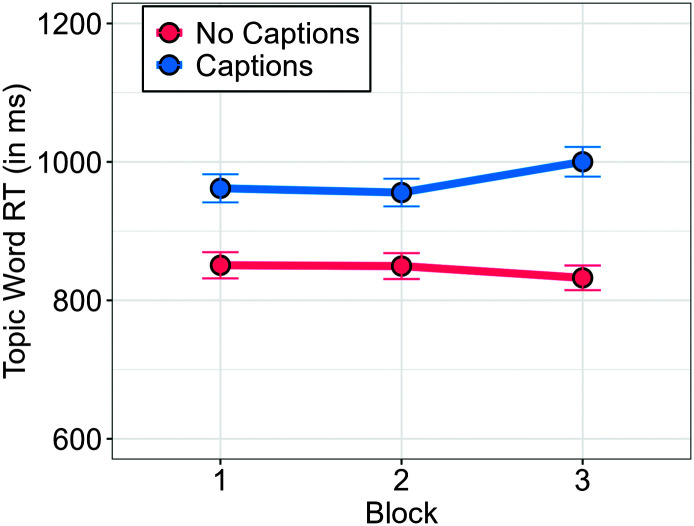
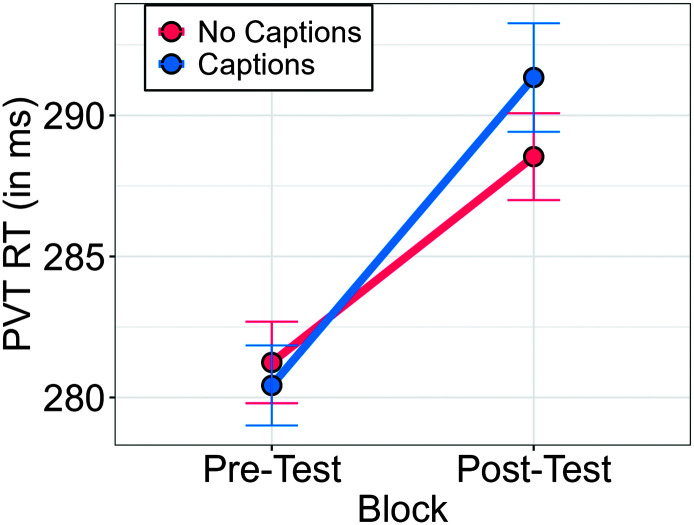
- Topic-word RTs increased significantly from Block 2 to Block 3 only for the Caption group (55 ms, p = .047; No Caption group: −1 ms, p = .99), suggesting behavioral fatigue in the Caption group. PVT RTs increased from pre- to post-dual task for both groups (F(1, 4423.8) = 28.94, p < .001), with no significant Group × Time interaction (F(1, 20) = 0.01, p = .921).
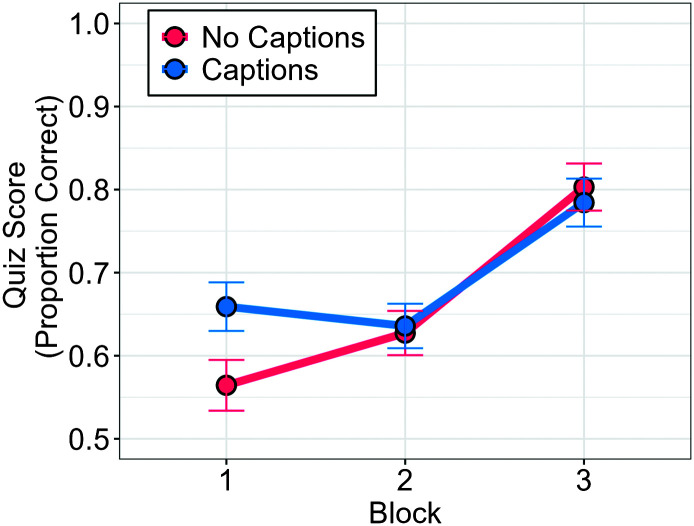
- Posttask quiz scores were higher for the Caption group overall (66% vs. 56%), but only for questions based on information presented early in the task, t(526) = −2.24, p = .026; later-block quiz questions were more likely correct for both groups.
Methods
- Twenty-two adults aged 18–63 years (18 women; M = 36 years) with normal to near-normal hearing (mean binaural three-frequency PTA = 11.6 dB HL; range 2–26 dB HL) were randomly assigned to a Caption group (n = 11) or No Caption group (n = 11) in a between-groups design.
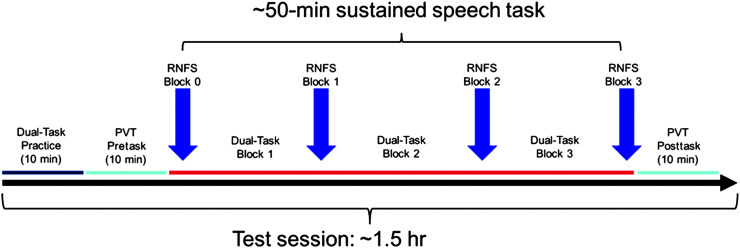
- Participants completed a sustained ~50-min audiovisual sentence recognition dual task (AV CST) in quiet at individually adjusted low speech levels targeting ~70% correct without captions; the secondary task was speeded button-press RT to topic words. Captions had a 500-ms delay and only 60% of scoring key words accurately captioned (86%–88% of all spoken words accurately captioned).
- Subjective fatigue was measured with the Right Now Fatigue Scale before, twice during, and after the dual task; behavioral measures included AV CST scores, topic-word RTs, and a Psychomotor Vigilance Task before and after the dual task, plus a posttask content quiz. Linear mixed-effects models included group, block, and their interaction as fixed factors and participant as a random intercept; RTs 3 SD above or below the mean were removed.
Limitations
- Stated by the authors: the quiet, low-sensation-level audiovisual test condition may not generalize to noisy classroom or conference settings; captions contained deletion errors and a 500-ms delay but no substitution errors; the between-groups design reduced statistical power and could allow between-group differences in motivation, cognitive ability, or motor RTs to confound behavioral effort/fatigue estimates; topic-word RTs embedded in sentences are novel and may not optimally assess fatigue; participants had normal/near-normal hearing, so effects for listeners with hearing loss are unknown.
- Evident from the text: the sample was small (n = 22; 11 per group), caption quality was fixed at one imperfect level, and there was no accurate-caption comparison, so the study cannot separate the effects of delay versus deletion errors or determine whether better captions would reduce fatigue.
Model-written summary. Check it against the paper before relying on it.
Integrity signals
Registry
Cites
Statistics
Figures
Verification
Claims the paper makes
0 Valid · 1 Not valid · 39 Not checked · 63 Own results and interpretations
None of the sources cited for this claim have been checked yet.
In the paper
“Individuals who reported a need for high levels of effort when listening in everyday settings were more likely to report experiencing higher fatigue in their daily lives.”
§ Imperfect Captions Paired to Audiovisual Stimuli Improve Speech Recognition but Do Not Reduce Listening-Related Fatigue > Listening-Related Fatigue
What the sources say
- Could not verifycites Alhanbali et al., 2017 matched to “Self-Reported Listening-Related Effort and Fatigue in Hearing-Impaired Adults” (2017) sourceExperimental — accuracy not yet measured
Our copy of Alhanbali et al. (2017) contains only the institutional-record landing page: the title/author header, journal and DOI metadata, citation exports (APA/BIBTEX/RIS sections labelled 'Abstract'), a ManCAD project entry and Altmetric counts — no abstract body, results or discussion text. Searches for the effort–fatigue association ('listening effort associated with fatigue', 'higher effort predicted greater fatigue', 'CLEEQ/fatigue questionnaire results', 'effort fatigue hearing aid users everyday listening settings') returned either nothing or only these metadata blocks. The title indicates the paper measures self-reported listening-related effort and fatigue in hearing-impaired adults, but nothing in our copy states the direction or existence of the association the citing sentence attributes to it, so the claim can be neither supported nor contradicted here. (LLM, conf=0.70)
- Not checked yetcites Hornsby et al., 2024 matched to “Listening-Related Fatigue in New and Experienced Adult Cochlear Implant Users” (2024) source
hedgedstates an association- Asserted: passes — The authors put it forward as true.
- Checkable: passes — It can be checked against evidence.
- Load-bearing: passes — The paper’s conclusions depend on it.
- Based: passes — The paper gives a reason why it holds.
- Could not verify
A result the paper reports from its own data — it cites no other source for it, so there is none to check. The quote shows it is in the paper.
In the paper
“However, this benefit was accompanied by greater increases in subjective and behavioral fatigue.”
§ Imperfect Captions Paired to Audiovisual Stimuli Improve Speech Recognition but Do Not Reduce Listening-Related Fatigue > Abstract > Conclusions:
plainstates an association- Asserted: passes — The authors put it forward as true.
- Checkable: passes — It can be checked against evidence.
- Load-bearing: passes — The paper’s conclusions depend on it.
- Based: passes — The paper gives a reason why it holds.
A result the paper reports from its own data — it cites no other source for it, so there is none to check. The quote shows it is in the paper.
In the paper
“However, this increase was larger for the group who had captions, even though they had better sentence recognition overall.”
§ Imperfect Captions Paired to Audiovisual Stimuli Improve Speech Recognition but Do Not Reduce Listening-Related Fatigue > Abstract > Results:
plainstates a cause- Asserted: passes — The authors put it forward as true.
- Checkable: passes — It can be checked against evidence.
- Load-bearing: passes — The paper’s conclusions depend on it.
- Based: passes — The paper gives a reason why it holds.
- Rests on an assumption not shown here.
A result the paper reports from its own data — it cites no other source for it, so there is none to check. The quote shows it is in the paper.
In the paper
“Subjective fatigue ratings increased significantly over the course of the dual task.”
§ Imperfect Captions Paired to Audiovisual Stimuli Improve Speech Recognition but Do Not Reduce Listening-Related Fatigue > Abstract > Results:
plainstates a cause- Asserted: passes — The authors put it forward as true.
- Checkable: passes — It can be checked against evidence.
- Load-bearing: passes — The paper’s conclusions depend on it.
- Based: passes — The paper gives a reason why it holds.
- Rests on an assumption not shown here.
30 more claims
Create a free account to see all 103 claims and to verify the 50 references still open.
- Probably not a substantial claim. 46
- It may state two separate claims as one. 29
- The quote only partly states this claim. 2
Statistics that don’t add up
Each reported p-value recomputed from its test statistic and degrees of freedom, each partial η² from its F, and each ratio, mean difference or B printed with a p checked against its own confidence interval.
Rated minor: it would not touch a result — a value no result rests on, a p-value that stays on the same side of the significance level, or a conflict that is clerical, resolved elsewhere in the paper, or outside its own findings.
In the paper
“F(3, 60) = 2.89, p < .01”
§ Imperfect Captions Paired to Audiovisual Stimuli Improve Speech Recognition but Do Not Reduce Listening-Related Fatigue > Results > Subjective Fatigue Ratings
Reported p < .01 · recomputed p = .043
Statistics recomputed
Every reported test result, recomputed from its test statistic and degrees of freedom. A result shows as not adding up only once an independent check has confirmed it.
- Doesn’t add upF(3, 60) = 2.89reported p < .01 · recomputed p = .043
“F(3, 60) = 2.89, p < .01”
- ConsistentF(1, 20) = 5.3reported p = .032 · recomputed p = .032
“F(1, 20) = 5.30, p = .032”
- ConsistentF(2, 481) = 3.63reported p = .027 · recomputed p = .027
“F(2, 481) = 3.63, p = .027”
- ConsistentF(3, 60) = 33.92reported p < .0001 · recomputed p < .001
“F(3, 60) = 33.92, p < .0001”
- ConsistentF(1, 4423.8) = 28.94reported p < .001 · recomputed p < .001
“F(1, 4423.8) = 28.94, p < .001”
3 more recomputed tests
Create a free account to see every test the Stats check recomputed.
Self-check
Percentages, sums and reported differences re-computed from the paper’s own numbers.
Each contradiction between two passages listed here was confirmed by an independent check.
Rated minor: it would not touch a result — a value no result rests on, a p-value that stays on the same side of the significance level, or a conflict that is clerical, resolved elsewhere in the paper, or outside its own findings.
In the paper
§ Imperfect Captions Paired to Audiovisual Stimuli Improve Speech Recognition but Do Not Reduce Listening-Related Fatigue > Method > Data Analysis
“Prior to analysis, the mean sentence recognition scores for each block were calculated for each participant.”
§ Imperfect Captions Paired to Audiovisual Stimuli Improve Speech Recognition but Do Not Reduce Listening-Related Fatigue > Results > Sentence Recognition
“The Group × Block interaction, however, was significant, F(2, 481) = 3.63, p = .027, partial η2 = .01.”
Rated minor: it would not touch a result — a value no result rests on, a p-value that stays on the same side of the significance level, or a conflict that is clerical, resolved elsewhere in the paper, or outside its own findings.
In the paper
§ Imperfect Captions Paired to Audiovisual Stimuli Improve Speech Recognition but Do Not Reduce Listening-Related Fatigue > Method > Participants
“mean binaural three-frequency pure-tone average [PTA; 500, 1000, and 2000 Hz] = 11.6 dB HL”
§ Imperfect Captions Paired to Audiovisual Stimuli Improve Speech Recognition but Do Not Reduce Listening-Related Fatigue > Method > Participants
“| PTA (dB HL) | 11.1 (4.7) | 10.4 (4.9) | 11.9 (4.7) | .47 |”
Citations
Cites
R: A Language and Environment for Statistical Computing
R Core Team (2025) · doi:10.32614/r.manuals · Cited by 352,181
Controlling the False Discovery Rate: A Practical and Powerful Approach to Multiple Testing
Benjamini, Y., & Hochberg, Y. (1995) · Journal of the Royal Statistical Society Series B: Statistical Methodology · doi:10.1111/j.2517-6161.1995.tb02031.x · Cited by 109,482
Fitting Linear Mixed-Effects Models Using lme4
Bates, D., Mächler, M., Bolker, B., & Walker, S. (2015) · Journal of Statistical Software · doi:10.18637/jss.v067.i01 · Cited by 86,835
Dinges, D. F., & Powell, J. W. (1985) · Behavior Research Methods, Instruments, & Computers · doi:10.3758/bf03200977 · Cited by 1,744
Hearing Impairment and Cognitive Energy: The Framework for Understanding Effortful Listening (FUEL)
Pichora-Fuller, M. K., Kramer, S. E., Eckert, M. A., Edwards, B., Hornsby, B. W. Y., Humes, L. E., Lemke, U., Lunner, T., Matthen, M., Mackersie, C. L., et al. (2016) · Ear & Hearing · doi:10.1097/aud.0000000000000312 · Cited by 1,318 · cited 1×
“…deliberate use of mental resources (e.g., attention, working memory) during a listening task, can increase when the listening situation is demanding (e.g., poor signal-to-noise ratio) and due to certain characteristics of the listener (e.g., hearing loss; Peele, 2018; Pichora-Fuller et al., 2016).”
Self-citationPeelle, J. E. (2018) · Ear & Hearing · doi:10.1097/aud.0000000000000494 · Cited by 672
McGarrigle, R., Munro, K. J., Dawes, P., Stewart, A. J., Moore, D. R., Barry, J. G., & Amitay, S. (2014) · International Journal of Audiology · doi:10.3109/14992027.2014.890296 · Cited by 532
Lim, J., Wu, W.-C., Wang, J., Detre, J. A., Dinges, D. F., & Rao, H. (2010) · NeuroImage · doi:10.1016/j.neuroimage.2009.11.020 · Cited by 418
Audiovisual Integration of Speech Falters under High Attention Demands
Alsius, A., Navarra, J., Campbell, R., & Soto-Faraco, S. (2005) · Current Biology · doi:10.1016/j.cub.2005.03.046 · Cited by 380
The Psychology of Fatigue: Work, Effort and Control
Hockey, R. (2013) · doi:10.1017/cbo9781139015394 · Cited by 350 · cited 6×
“If so, such high cognitive demands would require a large allocation of effort toward the task and thus increase the likelihood of fatigue development, consistent with Hockey ’ s (2013) model of fatigue.”
InfluentialHornsby, B. W. Y. (2013) · Ear & Hearing · doi:10.1097/aud.0b013e31828003d8 · Cited by 326
Self-citationKramer, S. E., Kapteyn, T. S., & Houtgast, T. (2006) · International Journal of Audiology · doi:10.1080/14992020600754583 · Cited by 241
Self-Reported Listening-Related Effort and Fatigue in Hearing-Impaired Adults
Alhanbali, S., Dawes, P., Lloyd, S., & Munro, K. J. (2017) · Ear & Hearing · doi:10.1097/aud.0000000000000361 · Cited by 237
Measures of Listening Effort Are Multidimensional
Alhanbali, S., Dawes, P., Millman, R. E., & Munro, K. J. (2019) · Ear and Hearing · doi:10.1097/aud.0000000000000697 · Cited by 227
Behavioral Assessment of Listening Effort Using a Dual-Task Paradigm: A Review
Gagné, J.-P., Besser, J., & Lemke, U. (2017) · Trends in Hearing · doi:10.1177/2331216516687287 · Cited by 195
A taxonomy of fatigue concepts and their relation to hearing loss.
Hornsby, B. W. Y., Naylor, G., & Bess, F. H. (2016) · Ear & Hearing · doi:10.1097/aud.0000000000000289 · Cited by 188 · cited 1×
“The construct of fatigue, like effort, is complex and can be defined and quantified using subjective, physiological, and behavioral measures (see Hornsby et al., 2016, for a review).”
Self-citationNachtegaal, J., Kuik, D. J., Anema, J. R., Goverts, S. T., Festen, J. M., & Kramer, S. E. (2009) · International Journal of Audiology · doi:10.1080/14992020902962421 · Cited by 168
Hughes, S. E., Hutchings, H. A., Rapport, F. L., McMahon, C. M., & Boisvert, I. (2018) · Ear & Hearing · doi:10.1097/aud.0000000000000553 · Cited by 131
Response times to speech stimuli as measures of benefit from amplification
Gatehouse, S., & Gordon, J. (1990) · British Journal of Audiology · doi:10.3109/03005369009077843 · Cited by 124
Measuring the Accuracy of Automatic Speech Recognition Solutions
Kuhn, K., Kersken, V., Reuter, B., Egger, N., & Zimmermann, G. (2023) · ACM Transactions on Accessible Computing · doi:10.1145/3636513 · Cited by 120 · cited 1×
“Captions for recorded media ( “ subtitles ” ) can, in theory, convey the auditory information with 100% accuracy but automated captions can vary wildly in their transcription accuracy (Kuhn et al., 2023) and timing relative to the visual material (Jiline et al., 2020).”
Cognitive methods for assessing mental energy
Lieberman, H. R. (2007) · Nutritional Neuroscience · doi:10.1080/10284150701722273 · Cited by 117
The Effect of Changing the Secondary Task in Dual-Task Paradigms for Measuring Listening Effort
Picou, E. M., & Ricketts, T. A. (2014) · Ear and Hearing · doi:10.1097/aud.0000000000000055 · Cited by 115
Self-citationListening effort: Are we measuring cognition or affect, or both
Francis, A. L., & Love, J. (2020) · WIREs Cognitive Science · doi:10.1002/wcs.1514 · Cited by 113
Rosemann, S., & Thiel, C. M. (2018) · NeuroImage · doi:10.1016/j.neuroimage.2018.04.023 · Cited by 112
McGarrigle, R., Gustafson, S. J., Hornsby, B. W. Y., & Bess, F. H. (2019) · Ear & Hearing · doi:10.1097/aud.0000000000000623 · Cited by 90
Self-citationUnderstanding Listening-Related Fatigue: Perspectives of Adults with Hearing Loss
Davis, H., Schlundt, D., Bonnet, K., Camarata, S., Bess, F. H., & Hornsby, B. (2021) · International Journal of Audiology · doi:10.1080/14992027.2020.1834631 · Cited by 88
Self-citationObjective Measurement of Cognitive Fatigue in Multiple Sclerosis.
Bryant, D., Chiaravalloti, N. D., & DeLuca, J. (2004) · Rehabilitation Psychology · doi:10.1037/0090-5550.49.2.114 · Cited by 81
Holman, J. A., Hornsby, B. W. Y., Bess, F. H., & Naylor, G. (2021) · International Journal of Audiology · doi:10.1080/14992027.2020.1853261 · Cited by 78
Self-citationDevelopment and validation of the Vanderbilt Fatigue Scale for Adults (VFS-A).
Hornsby, B. W. Y., Camarata, S., Cho, S.-J., Davis, H., McGarrigle, R., & Bess, F. H. (2021) · Psychological Assessment · doi:10.1037/pas0001021 · Cited by 62 · cited 1×
“Participants also completed the 40-item version of the Vanderbilt Fatigue Scale for Adults (VFS-A-40; Hornsby et al., 2021).”
Self-citationThe State of the Art of Feature Extraction Techniques in Speech Recognition
Gupta, D., Bansal, P., & Choudhary, K. (2017) · Advances in intelligent systems and computing · doi:10.1007/978-981-10-6626-9_22 · Cited by 61
The Connected Speech Test Version 3: Audiovisual Administration
Cox, R. M., Alexander, G. C., Gilrnore, C., & Pusakulich, K. M. (1989) · Ear and Hearing · doi:10.1097/00003446-198902000-00005 · Cited by 55
Hearing Aids Reduce Daily-Life Fatigue and Increase Social Activity: A Longitudinal Study
Holman, J. A., Drummond, A., & Naylor, G. (2021) · Trends in Hearing · doi:10.1177/23312165211052786 · Cited by 51
Neural mechanisms of mental fatigue elicited by sustained auditory processing
Moore, T. M., Key, A. P., Thelen, A., & Hornsby, B. W. Y. (2017) · Neuropsychologia · doi:10.1016/j.neuropsychologia.2017.10.025 · Cited by 48
Self-citationMoradi, S., Lidestam, B., & Rönnberg, J. (2016) · Trends in Hearing · doi:10.1177/2331216516653355 · Cited by 34
The accuracy of automatic and human live captions in English
Romero-Fresco, P., & Fresno, N. (2023) · Linguistica Antverpiensia New Series – Themes in Translation Studies · doi:10.52034/lans-tts.v22i.774 · Cited by 29
Hornsby, B. W. Y., Camarata, S., Cho, S., Davis, H., McGarrigle, R., & Bess, F. H. (2023) · Ear and Hearing · doi:10.1097/aud.0000000000001369 · Cited by 28
Self-citationAuditory Measures for the Next Billion Users
Slaney, M., Lyon, R. F., Garcia, R. A., Kemler, B., Gnegy, C. N., Wilson, K., Kanevsky, D., Savla, S., & Cerf, V. G. (2020) · Ear and Hearing · doi:10.1097/aud.0000000000000955 · Cited by 27
Listening-Related Fatigue in New and Experienced Adult Cochlear Implant Users
Hornsby, B. W. Y., Picou, E. M., Ricketts, T. A., & Gifford, R. (2024) · Ear & Hearing · doi:10.1097/aud.0000000000001488 · Cited by 26
Self-citationSeparating the effects of task load and task motivation on the effort–fatigue relationship
Earle, F., Hockey, B., Earle, K., & Clough, P. (2015) · Motivation and Emotion · doi:10.1007/s11031-015-9481-2 · Cited by 17
Zekveld, A. A., Kramer, S. E., Kessens, J. M., Vlaming, M. S. M. G., & Houtgast, T. (2009) · Trends in Amplification · doi:10.1177/1084713808330207 · Cited by 14
Note on the Dual-Task Paradigm and its Use to Measure Listening Effort
Kuchinsky, S. E., Gallun, F. J., & Lee, A. K. C. (2024) · Trends in Hearing · doi:10.1177/23312165241292215 · Cited by 14
Payne, B. R., Silcox, J. W., Crandell, H. A., Lash, A., Ferguson, S. H., & Lohani, M. (2022) · Ear & Hearing · doi:10.1097/aud.0000000000001079 · Cited by 13
Zhong, L., Noud, B. P., Pruitt, H., Marcrum, S. C., & Picou, E. M. (2021) · International Journal of Audiology · doi:10.1080/14992027.2021.1937346 · Cited by 10
Self-citationHuang, H., Oosthuizen, I., & Picou, E. M. (2023) · Seminars in Hearing · doi:10.1055/s-0043-1766140 · Cited by 9
Self-citationCrandell, H. A., Silcox, J. W., Ferguson, S. H., Lohani, M., & Payne, B. R. (2022) · Journal of Speech, Language, and Hearing Research · doi:10.1044/2022_jslhr-21-00416 · Cited by 6
Zhong, L., Ricketts, T. A., Roberts, R. A., & Picou, E. M. (2023) · Ear & Hearing · doi:10.1097/aud.0000000000001316 · Cited by 1
Self-citation
Research works printed but not linked: 1
- Jiline, M., Kirk, D., Quirk, G., Sandler, M., & Monette, M. (2020). A review of state-of-the-art automatic speech recognition services for CART and CC applications. In Proceedings of the 2020 Broadcast Engineering and IT Conference.
Cited by
Matava, C. T., Voit, B., Schmitz, A., & Engelhardt, T. (2026) · Pediatric Anesthesia · doi:10.1002/pan.70288
Metadata
- Authors
- Esser, K., Picou, E. M., & Hornsby, B. W. Y.
- Affiliations
- Towson University (US)
- Vanderbilt University Medical Center (US)
- Corresponding author
- Hornsby, Benjamin W. Y.
- Venue
- American Journal of Audiology
- Published
- 2025-09-02
- Volume
- 34
- Issue
- 3
- Pages
- 661-675
- ISSN
- 1059-0889 (ISSN-L)
- 1558-9137
- PMC
- PMC12418375
- OpenAlex
- W4413116510
- Cited by
- 1
- References
- 46
- Citations by year
- 2026: 1
- FWCI
- 1.22
- Type
- journal article
- Language
- en
- Open access
- hybrid
- doi.org
- Licence
- cc-by-nc
- Locations
- American Journal of Audiology (publishedVersion, cc-by-nc)
- PubMed (publishedVersion)
- PubMed Central (publishedVersion, cc-by-nc)
- Figshare (submittedVersion, cc-by)
- figshare ASHA Publications (cc-by)
- Funders
- Vanderbilt University
- Vanderbilt University Medical Center
- National Institutes of Health
- National Institute on Deafness and Other Communication Disorders (T35DC008763)
- Topics
- Social Sciences › Arts and Humanities › Language and Linguistics › Subtitles and Audiovisual Media
- Health Sciences › Health Professions › Speech and Hearing › Hearing Loss and Rehabilitation
- Social Sciences › Psychology › Developmental and Educational Psychology › Hearing Impairment and Communication
- Keywords
- captions, audio-visual speech recognition, speech recognition (audiology), dual-task performance, speech intelligibility, auditory fatigue, sustained attention
- MeSH terms
- Adolescent, Adult, Attention, Fatigue, Female, Humans, Male, Middle Aged, Photic Stimulation, Reaction Time, Speech Perception, Speech Recognition Software, Young Adult
About these checks
Registry, retraction, Cites and statistics results are computed, not judged, with one exception: a printed reference that no index lists is read once by a model before it counts as a citation error. Claims are extracted by a model and kept only when their quote appears verbatim in the text; each cited source is then checked, with a model’s help, for whether it says what the claim relies on. Those verdicts can be wrong — read the claim’s quote and the cited source before relying on one.
The claim verdicts this report counts are experimental: their accuracy is not yet measured.
A language model drew the claims from the paper on 2026-11-19, under version 3 of the claim definition (model deepseek-v4.1-flash, prompt extract-v3).
A second model labelled each claim on 2026-11-19 (model jev-1.13-20260917, definition revision gold-guideline-v0.2).
Cited sources are checked with a language model’s help (qwen3.8-omni-flash).
Statistics and arithmetic are recomputed, not judged.
Confidence bands are shown only for fields calibrated on our annotated test set. None is calibrated yet, so no band is shown.
What counts as a claim ›How we measure confidence ›How we check this ›
Are you an author, or do you see a problem with this page? Request a review
Data sources
Bibliographic data: Semantic Scholar, OpenAlex, Crossref.
Contains information from the Semantic Scholar Academic Graph Datasets, made available under the ODC Attribution License (ODC-BY 1.0).
Semantic Scholar’s data is described in: Kinney, R., et al. (2023). The Semantic Scholar Open Data Platform. arXiv:2301.10140.
