

The DOI matches its Crossref record; 2 of the 2 references it cites were found in a registry or an index.
Space Solar Cells – 3G30 and Next Generation Radiation Hard Products
Open accessAbstract
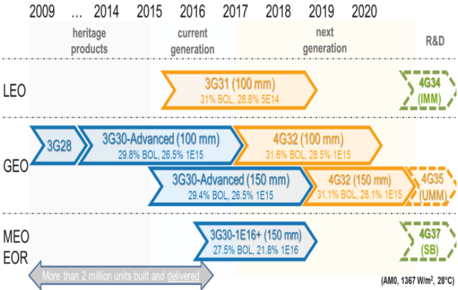
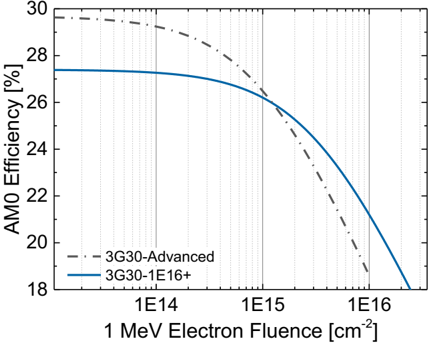
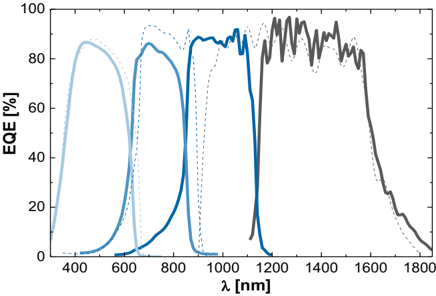
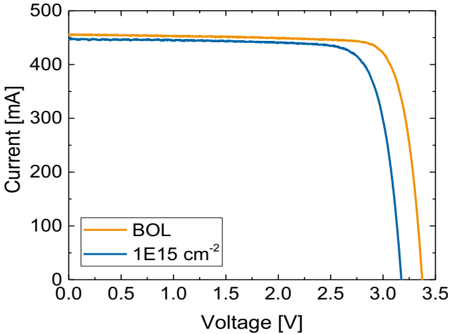
The 3G30-Advanced, AZUR SPACE’s latest qualified solar cell product, provides highest end-of-life efficiencies in space. The cell reaches 27.8% at a fluence of 5 E14 cm−2 and 26.5% at a fluence of 1 E15 cm−2 1 MeV electrons.
Overview
The claims and statistics of this paper haven’t been checked yet.
Run the check — free, no account needed. It reads the open-access text and checks the sources it cites.
Integrity signals
Registry
Cites
Statistics
Figures
Verification
Claims the paper makes
The claims and statistics of this paper haven’t been checked yet.
Run the check — free, no account needed. It reads the open-access text and checks the sources it cites.
Claims other papers make about this one
Each is checked against this paper’s own text: does it say what the citing paper says it does?
The check wasn’t confident either way, so it gives no verdict — never disputed.
In the citing paper
“the primary batteries (e.g., pyro batteries) are not rechargeable; they are used for short mission requirements (approximately from a single day to a week), after usage they are disposed-off [123].”
From A Comprehensive Review on Small Satellite Microgrids (2022) · cites this paper as [123]
Experimental — accuracy not yet measuredThe check wasn’t confident either way, so it gives no verdict — never disputed.
In the citing paper
“The energy density of 18650 cells is 762 Wh/l and 252 Wh/kg [123].”
From A Comprehensive Review on Small Satellite Microgrids (2022) · cites this paper as [123]
Experimental — accuracy not yet measured
Self-check
Percentages, sums and reported differences re-computed from the paper’s own numbers.
The self-check needs the paper’s full text.
Citations
Cites
Geisz, J. F., Kurtz, S., Wanlass, M. W., Ward, J. S., Duda, A., Friedman, D. J., Olson, J. M., McMahon, W. E., Moriarty, T. E., & Kiehl, J. T. (2007) · Applied Physics Letters · doi:10.1063/1.2753729 · Cited by 400
Brandt, C., Baur, C. V., Caon, A., Müller‐Buschbaum, P., Zimmermann, C. G., & Andreev, T. (2013) · IEEE Journal of Photovoltaics · doi:10.1109/jphotov.2013.2242958 · Cited by 17
Research works printed but not linked: 6
- Guter W., Ebel L., Fuhrmann D., Köstler W. & Meusel M. (2014). Development, Qualification and Production of Space Solar Cells with 30% EOL Efficiency, Proc. of the European Space Power Conference, Noordwijkerhout.
- Geisz, 2007, APL, 91, 23502
- Meusel M., Bensch W., Fuhrmann D., Guter W., Kern R., Köstler W, Löckenhoff R., Strobl G.F.X., Klinger V., Siefer G., Welser E., Dimroth F. & Bett A. (2010). III-V Multijunction Solar Cells - From Current Space and Terrestrial Products, Proc. of the 25th EUPVSEC, Valencia, p. 18.
- Strobl G.F.X., Fuhrmann D., Guter W., Khorenko V., Köstler W. & Meusel M. (2012). About AZUR’s “3G30-advanced” Space Solar Cell and Next Generation Product, Proc. of the 27th EUPVSEC, Frankfurt, p. 1BO10.3.
- Zazoui M., Warner J.H., Summers G.P., Messenger S.R. & Lorentzen J.R. (2005). Radiation response mechanisms in multifunction III/V space solar cells, Conf. Rec. 35th IEEE Photovoltaic Spec. Conf., 2005, pp. 542–547.
- Khorenko V., Strobl G.F.X., Guter W., Fuhrmann D., Ebel L., Kern R., Meusel M. & Köstler W. (2014). Roadmap for the next generations of European Space Solar Cells, Proc. of the 29th EU PVSEC, Amsterdam, 4DO.13.1
Cited by
Sorted by citations
A Brief Review of High Efficiency III-V Solar Cells for Space Application
Li, J., Aierken, A., Liu, Y., Zhuang, Y., Yang, X. Y., Mo, J., Fan, R. K., Chen, Q. Y., Zhang, S. Y., Huang, Y. M., et al. (2021) · Frontiers in Physics · doi:10.3389/fphy.2020.631925 · Cited by 233
A Comprehensive Review on Small Satellite Microgrids
Yaqoob, M., Lashab, A., Vasquez, J. C., Guerrero, J. M., Orchard, M. E., & Bintoudi, A. D. (2022) · IEEE Transactions on Power Electronics · doi:10.1109/tpel.2022.3175093 · Cited by 93
Proton‐Radiation Tolerant All‐Perovskite Multijunction Solar Cells
Lang, F., Eperon, G. E., Frohna, K., Tennyson, E. M., Al‐Ashouri, A., Kourkafas, G., Bundesmann, J., Denker, A., West, K. G., Hirst, L. C., et al. (2021) · Advanced Energy Materials · doi:10.1002/aenm.202102246 · Cited by 81
Li, J., Aierken, A., Zhuang, Y., Xu, P., Wu, H. Q., Zhang, Q. Y., Wang, X. B., Mo, J., Yang, X., Chen, Q., et al. (2021) · Solar Energy Materials and Solar Cells · doi:10.1016/j.solmat.2021.111022 · Cited by 48
Schön, J., Bissels, G. M. M. W., Mulder, P., van Leest, R. H., Gruginskie, N., Vlieg, E., Chojniak, D., & Lackner, D. (2022) · Progress in Photovoltaics Research and Applications · doi:10.1002/pip.3542 · Cited by 46
Metadata
- Authors
- Guter, W., Dunzer, F., Ebel, L., Hillerich, K., Köstler, W., Kubera, T., Meusel, M., Postels, B., & Wächter, C.
- Affiliations
- Azur Space Solar Power (DE)
- Venue
- E3S Web of Conferences
- Publisher
- EDP Sciences
- Published
- 2017
- Volume
- 16
- Pages
- 03005
- ISSN
- 2267-1242 (ISSN-L)
- OpenAlex
- W2619112236
- Cited by
- 51
- References
- 2
- Citations by year
- 2026: 3 · 2025: 6 · 2024: 4 · 2023: 8 · 2022: 9 · 2021: 12 · 2020: 3 · 2019: 3 · 2018: 3
- FWCI
- 3.48
- Type
- conference paper
- Language
- en
- Open access
- diamond
- doi.org
- Licence
- cc-by
- Locations
- E3S Web of Conferences (publishedVersion, cc-by)
- Springer Link (Chiba Institute of Technology) (submittedVersion)
- DOAJ (DOAJ: Directory of Open Access Journals) (submittedVersion)
- Funders
- European Space Agency
- Topics
- Physical Sciences › Engineering › Electrical and Electronic Engineering › solar cell performance optimization
- Physical Sciences › Engineering › Electrical and Electronic Engineering › Silicon and Solar Cell Technologies
- Physical Sciences › Energy › Nuclear Energy and Engineering › Advanced Energy Technologies and Civil Engineering Innovations
- Keywords
- space solar cells, radiation hardening, space radiation effects, electron fluence, solar cells
About these checks
Registry, retraction, Cites and statistics results are computed, not judged, with one exception: a printed reference that no index lists is read once by a model before it counts as a citation error. Claims are extracted by a model and kept only when their quote appears verbatim in the text; each cited source is then checked, with a model’s help, for whether it says what the claim relies on. Those verdicts can be wrong — read the claim’s quote and the cited source before relying on one.
Statistics and arithmetic are recomputed, not judged.
Confidence bands are shown only for fields calibrated on our annotated test set. None is calibrated yet, so no band is shown.
What counts as a claim ›How we measure confidence ›How we check this ›
Are you an author, or do you see a problem with this page? Request a review
