

Performance Evaluation of Concrete Using Recycled Coarse Aggregate and Sea Sand as Sustainable Alternatives
Open accessThe DOI matches its Crossref record; 14 of the 14 references it cites were found in a registry or an index; 1 of the 14 sources its claims cite were checked for support.
Abstract
With growing environmental concerns over the depletion of natural resources and the adverse impact of excessive sand mining, there is an increasing demand for sustainable alternatives in concrete production. This study investigates the performance of concrete incorporating recycled coarse aggregate (RCA) and sea sand as replacements for natural aggregates, aiming to reduce environmental impact while maintaining strength and durability. Recycled coarse aggregate addresses the waste management issue in construction, while sea sand offers a plentiful alternative to natural river sand, though it requires treatment to mitigate chloride contamination. The experimental program included a comprehensive evaluation of concrete properties, such as workability, compressive strength, water absorption, porosity, and resistance to aggressive environments. The results showed that the use of RCA slightly reduced workability but had minimal impact on compressive strength, especially in mixes with treated sea sand (R40-T). The treated sea sand improved workability and enhanced durability by reducing water absorption, porosity, and resistance to acid and sulphate attacks. The mix R40-T-30 demonstrated the best overall performance in terms of both strength and durability. This study demonstrates that the combination of recycled coarse aggregate and treated sea sand provides a sustainable solution for concrete production, balancing environmental benefits with structural performance.
Overview
CoChat Summary
TL;DR
This study evaluates M30 concrete with 40% recycled coarse aggregate (RCA) and treated or untreated sea sand as replacements for natural aggregates. The mix with 40% RCA and 30% treated sea sand (R40-T-30) showed the best overall strength and durability, while untreated sea sand generally reduced performance.
Key findings
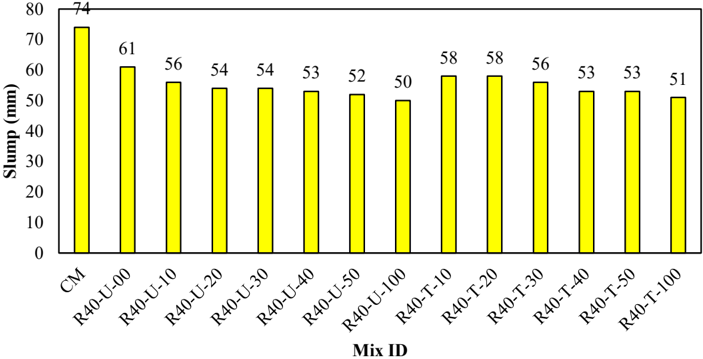
- Workability decreased with sea sand replacement: the conventional mix had 74 mm slump; untreated sea sand mixes ranged from 61 mm (R40-U-00) to 50 mm (R40-U-100), while treated sea sand mixes ranged from 58 mm (R40-T-10 and R40-T-20) to 51 mm (R40-T-100). The paper recommends limiting sea sand replacement to 30%–40% for acceptable workability.
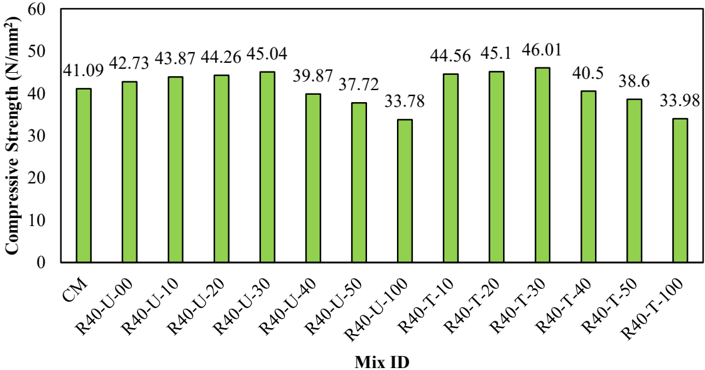
- Compressive strength peaked at 30% sea sand replacement: conventional mix 41.09 N/mm²; R40-U-30 45.04 N/mm²; R40-T-30 46.01 N/mm². At 100% replacement, strengths fell to 33.78 N/mm² (R40-U-100) and 33.98 N/mm² (R40-T-100).
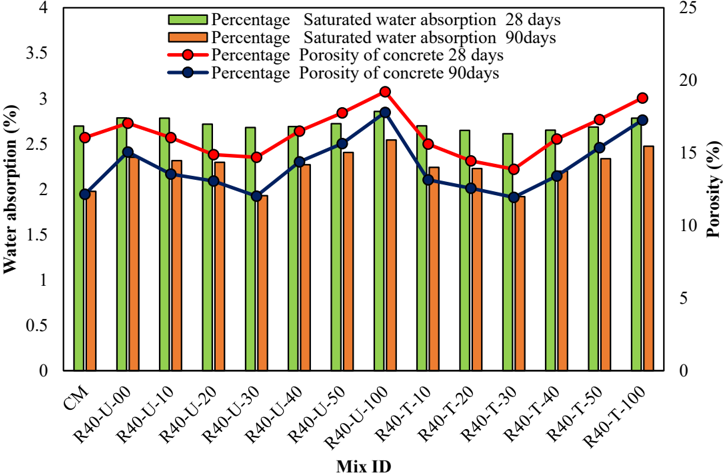
- Treated sea sand reduced water absorption and porosity: control mix had 2.696% water absorption at 28 days and 1.976% at 90 days, with porosity 16.06% and 12.16%; R40-T-30 had 2.612% and 1.918% water absorption, with porosity 13.88% and 11.94%. R40-U-100 had the highest values: 2.857% and 2.543% water absorption, and 19.22% and 17.79% porosity.
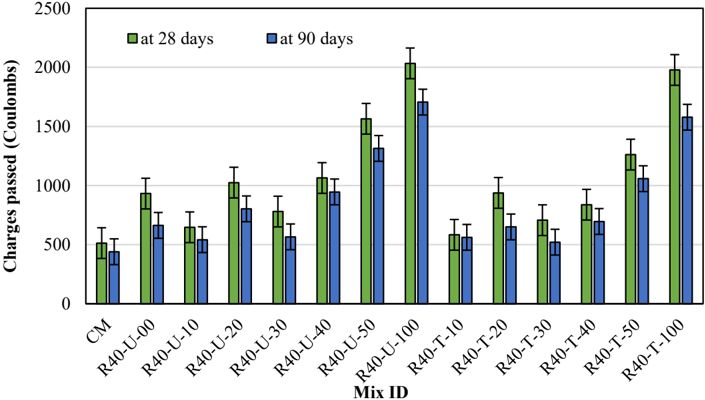
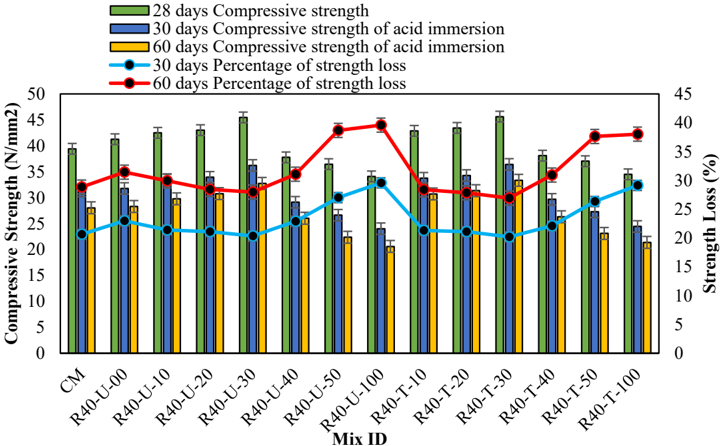
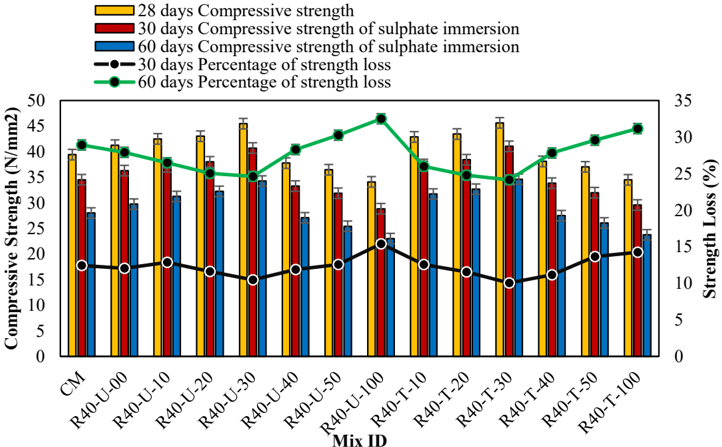
- Durability improved with treated sea sand: RCPT for control was 513 Coulombs at 28 days and 440 at 90 days (“Very Low”); R40-T-30 was 707 and 521 Coulombs (“Very Low”), while R40-U-100 was 2034 and 1706 Coulombs. In acid attack, R40-T-30 lost 20.2% strength at 30 days and 26.92% at 60 days, versus R40-U-100 losses of 29.57% and 39.59%. In sulphate attack, R40-T-30 lost 10.04% at 30 days and 24.14% at 60 days, versus R40-U-100 losses of 15.4% and 32.5%.
Methods
- The experimental programme used M30 grade concrete with OPC 53 grade cement, river sand, sea sand from Kodiyampalayam, Cuddalore District, Tamil Nadu, natural coarse aggregate, and RCA from demolished buildings at SRM Madurai College of Engineering and Technology, Sivagangai. RCA was manually crushed and sieved to 20 mm and 10 mm, treated with 1% acetic acid, and fixed at 40% replacement in all experimental mixes. Sea sand was either untreated or treated by atmospheric exposure for one year; replacement levels were 0%, 10%, 20%, 30%, 40%, 50%, and 100%.
- Tests included slump (IS 1199:1959), compressive strength on 150 mm cubes cured 28 days (IS 516:1959), water absorption (ASTM C 642-97), porosity, rapid chloride penetration (ASTM C1202, 6 hours), acid resistance in 5% sulfuric acid for 30 days (ASTM C 1898), and sulphate attack in 5% sodium sulphate for 30 and 60 days (ASTM C 1012-04).
- The study compared fresh, hardened, and durability properties across mixes; no statistical analysis is reported in the text.
Limitations
- The paper does not state a dedicated limitations section. It identifies research gaps in the introduction, including limited research on the combined effects of RCA and sea sand and a need for more comprehensive long-term performance evaluations.
- Evident from the text: the study is limited to M30 grade concrete and a fixed 40% RCA replacement, so findings may not generalize to other grades or RCA proportions. The sea sand treatment was natural atmospheric exposure for one year rather than a controlled desalination process.
- Evident from the text: durability testing is short-term (28/90 days for water absorption and RCPT; 30/60 days for acid and sulphate exposure) and does not include steel reinforcement corrosion or long-term field performance, despite the paper’s concern about chloride-induced corrosion.
Model-written summary. Check it against the paper before relying on it.
Integrity signals
Registry
Cites
Statistics
Figures
Verification
Claims the paper makes
1 Valid · 1 Not valid · 13 Not checked · 60 Own results and interpretations
The cited sources support only part of this claim — read each source’s verdict below.
In the paper
“González and Etxeberria (2017) investigated the durability of RCA concrete and observed that it exhibits higher porosity and water absorption than conventional concrete due to the attached mortar from the previous application [7].”
§ Performance Evaluation of Concrete Using Recycled Coarse Aggregate and Sea Sand as Sustainable Alternatives > 1 Introduction
What the sources say
- Partly supportedcites [7] A. Gonzalez-Corominas and M. Etxeberria, "Effects of using recycled concrete aggregates on the shrinkage of high performance concrete," Constr. Build. Mater., vol. 115, pp. 32-41, 2016, doi: 10.1016/j.conbuildmat.2016.04.031. sourceExperimental — accuracy not yet measured
Our copy does carry the attributed observation: the Conclusions state that 'the water absorption and the porosity increased when the quality of the RCA employed was reduced and their replacement ratio was increased' (relative to NAC), the Introduction states RCA have 'higher water absorption and porosity (the latter due to the old mortar attached to the aggregates)' (Sec. 1), and Sec. 3.5 attributes the higher concrete porosity to 'the higher amount of cement paste (taking into consideration both the old and new paste)'. However, the source bounds this conditionally: Sec. 3.2 reports that RAC100-100 made with the highest-quality RCA showed significantly LOWER porosity and smaller pores than NAC at 1 day and pore structures similar to NAC at 28 and 90 days, so an unqualified 'RCA concrete exhibits higher porosity and water absorption than conventional concrete' overstates it. The part the source does not support is also the framing of this work as an investigation of 'durability': our copy is a shrinkage/physical-properties study of high performance concrete (drying, plastic and autogenous shrinkage, pore size distribution), not a durability study, and the generic attached-mortar cause it quotes for aggregates is credited in the Introduction to Silva et al. [2] and Agrela et al. [3]. (LLM, conf=0.72)
plainstates a cause- Asserted: passes — The authors put it forward as true.
- Checkable: passes — It can be checked against evidence.
- Load-bearing: unclear — It is unclear whether the paper’s conclusions depend on it.
- Based: passes — The paper gives a reason why it holds.
- Partly supported
A result the paper reports from its own data — it cites no other source for it, so there is none to check. The quote shows it is in the paper.
In the paper
“The mix R40-T-30 demonstrated the best overall performance in terms of both strength and durability.”
§ Performance Evaluation of Concrete Using Recycled Coarse Aggregate and Sea Sand as Sustainable Alternatives > Abstract
plain- Asserted: passes — The authors put it forward as true.
- Checkable: passes — It can be checked against evidence.
- Load-bearing: passes — The paper’s conclusions depend on it.
- Based: passes — The paper gives a reason why it holds.
A result the paper reports from its own data — it cites no other source for it, so there is none to check. The quote shows it is in the paper.
In the paper
“The conventional mix had the highest slump value of 74 mm, indicating superior workability due to the use of river sand and natural coarse aggregate.”
§ Performance Evaluation of Concrete Using Recycled Coarse Aggregate and Sea Sand as Sustainable Alternatives > 3.1 Slump (Workability)
plain- Asserted: passes — The authors put it forward as true.
- Checkable: passes — It can be checked against evidence.
- Load-bearing: unclear — It is unclear whether the paper’s conclusions depend on it.
- Based: passes — The paper gives a reason why it holds.
A result the paper reports from its own data — it cites no other source for it, so there is none to check. The quote shows it is in the paper.
In the paper
“Despite this improvement, the slump still decreased as the sea sand content increased.”
§ Performance Evaluation of Concrete Using Recycled Coarse Aggregate and Sea Sand as Sustainable Alternatives > 3.1 Slump (Workability)
plainstates a cause- Asserted: passes — The authors put it forward as true.
- Checkable: passes — It can be checked against evidence.
- Load-bearing: passes — The paper’s conclusions depend on it.
- Based: passes — The paper gives a reason why it holds.
A result the paper reports from its own data — it cites no other source for it, so there is none to check. The quote shows it is in the paper.
In the paper
“For mixes with untreated sea sand (R40-U series), the slump decreased progressively as the percentage of sea sand increased, ranging from 61 mm in the R40-U-00 mix (0% sea sand) to 50 mm in R40-U-100 (100% sea sand).”
§ Performance Evaluation of Concrete Using Recycled Coarse Aggregate and Sea Sand as Sustainable Alternatives > 3.1 Slump (Workability)
plainstates a cause- Asserted: passes — The authors put it forward as true.
- Checkable: passes — It can be checked against evidence.
- Load-bearing: passes — The paper’s conclusions depend on it.
- Based: passes — The paper gives a reason why it holds.
25 more claims
Create a free account to see all 75 claims and to verify the 13 references still open.
- It may state two separate claims as one. 36
- Probably not a substantial claim. 15
Self-check
Percentages, sums and reported differences re-computed from the paper’s own numbers.
Each contradiction between two passages listed here was confirmed by an independent check.
Rated minor: it would not touch a result — a value no result rests on, a p-value that stays on the same side of the significance level, or a conflict that is clerical, resolved elsewhere in the paper, or outside its own findings.
In the paper
§ Performance Evaluation of Concrete Using Recycled Coarse Aggregate and Sea Sand as Sustainable Alternatives > 1 Introduction
“González and Etxeberria (2017) investigated the durability of RCA concrete and observed that it exhibits higher porosity and water absorption than conventional concrete due to the attached mortar from the previous application [7].”
§ Performance Evaluation of Concrete Using Recycled Coarse Aggregate and Sea Sand as Sustainable Alternatives > References
“7. A. Gonzalez-Corominas and M. Etxeberria, "Effects of using recycled concrete aggregates on the shrinkage of high performance concrete," Constr. Build. Mater., vol. 115, pp. 32-41, 2016”
Rated minor: it would not touch a result — a value no result rests on, a p-value that stays on the same side of the significance level, or a conflict that is clerical, resolved elsewhere in the paper, or outside its own findings.
In the paper
§ Performance Evaluation of Concrete Using Recycled Coarse Aggregate and Sea Sand as Sustainable Alternatives > 1 Introduction
“Poon and Chan (2020) highlighted that the use of RCA in concrete improves sustainability and can reduce landfill waste significantly [6].”
§ Performance Evaluation of Concrete Using Recycled Coarse Aggregate and Sea Sand as Sustainable Alternatives > References
“6. C. S. Poon and D. Chan, "The use of recycled aggregate in concrete in Hong Kong," Resour. Conserv. Recycl., vol. 50, no. 3, pp. 293-305, 2007”
Rated minor: it would not touch a result — a value no result rests on, a p-value that stays on the same side of the significance level, or a conflict that is clerical, resolved elsewhere in the paper, or outside its own findings.
In the paper
§ Performance Evaluation of Concrete Using Recycled Coarse Aggregate and Sea Sand as Sustainable Alternatives > 3.1 Slump (Workability)
“The CM achieved a compressive strength of 41.09 N/mm², which serves as the reference point for all other mixes.”
§ Performance Evaluation of Concrete Using Recycled Coarse Aggregate and Sea Sand as Sustainable Alternatives > 3.6 Sulphate attack
“For the control mix, the compressive strength dropped from 39.42 N/mm² at 28 days to 34.52 N/mm² after 30 days of sulphate exposure”
Rated minor: it would not touch a result — a value no result rests on, a p-value that stays on the same side of the significance level, or a conflict that is clerical, resolved elsewhere in the paper, or outside its own findings.
In the paper
§ Performance Evaluation of Concrete Using Recycled Coarse Aggregate and Sea Sand as Sustainable Alternatives > 1 Introduction
“D. Kalaimani and G. Srinivasan (202) evaluated the durability of concrete made with RCA and sea sand under Sulphate and acid attacks [13].”
§ Performance Evaluation of Concrete Using Recycled Coarse Aggregate and Sea Sand as Sustainable Alternatives > References
“13. D. Kalaimani and G. Srinivasan, "Strength and durability properties of concrete made with recycled coarse aggregate and seashore sand," Sinergi (Indonesia), vol. 28, no. 1, pp. 115-128, 2024”
Rated minor: it would not touch a result — a value no result rests on, a p-value that stays on the same side of the significance level, or a conflict that is clerical, resolved elsewhere in the paper, or outside its own findings.
In the paper
§ Performance Evaluation of Concrete Using Recycled Coarse Aggregate and Sea Sand as Sustainable Alternatives > 4 Conclusion
“with R40-T-30 showing the highest slump value”
§ Performance Evaluation of Concrete Using Recycled Coarse Aggregate and Sea Sand as Sustainable Alternatives > 3.1 Slump (Workability)
“Conversely, the treated sea sand mixes (R40-T series) exhibited better workability, with slump values ranging from 58 mm for R40-T-10 and R40-T-20 to 51 mm for R40-T-100.The natural treatment process, which reduced the salinity of the sea sand, contributed to improved workability by lowering internal friction within the mix.Despite this improvement, the slump still decreased as the sea sand content increased.”
Citations
Cites
The use of recycled aggregate in concrete in Hong Kong
Poon, C.-S., & Chan, D. (2007) · Resources, Conservation and Recycling · doi:10.1016/j.resconrec.2006.06.005 · Cited by 321
Sand, gravel, and UN Sustainable Development Goals: Conflicts, synergies, and pathways forward
Bendixen, M., Iversen, L. L., Best, J., Franks, D. M., Hackney, C. R., Latrubesse, E. M., & Tusting, L. S. (2021) · One Earth · doi:10.1016/j.oneear.2021.07.008 · Cited by 242
Effects of using recycled concrete aggregates on the shrinkage of high performance concrete
Gonzalez-Corominas, A., & Etxeberria, M. (2016) · Construction and Building Materials · doi:10.1016/j.conbuildmat.2016.04.031 · Cited by 213
Makul, N., Fediuk, R., Amran, M., Zeyad, A. M., Murali, G., Vatin, N., Klyuev, S., Ozbakkaloglu, T., & Vasilev, Y. (2021) · Crystals · doi:10.3390/cryst11030232 · Cited by 145
Khan, Z. A., Balunaini, U., Costa, S., & Nguyen, N. H. T. (2024) · Cleaner Materials · doi:10.1016/j.clema.2024.100266 · Cited by 100
Dinh, H. L., Liu, J., Ong, D. E. L., & Doh, J. (2022) · Cleaner Materials · doi:10.1016/j.clema.2022.100140 · Cited by 87
Zhang, M., Xu, R., Liu, K., & Sun, S. (2022) · REVIEWS ON ADVANCED MATERIALS SCIENCE · doi:10.1515/rams-2022-0049 · Cited by 64
Feng, W., Tang, Y., Yang, Y., Cheng, Y., Qiu, J., Zhang, H., Isleem, H. F., Tayeh, B. A., & Namdar, A. (2023) · Construction and Building Materials · doi:10.1016/j.conbuildmat.2022.130010 · Cited by 50
Feasibility assessment and application of sea sand in concrete production: A review
Wang, Q.-Z., Li, L.-J., Zhao, Y.-X., Song, Y., & Zhang, C.-L. (2024) · Structures · doi:10.1016/j.istruc.2024.105891 · Cited by 35
Impact assessment of river sand resource shortage under different policy scenarios in China
Xiao, J., Zhang, H., Xiao-long, H., Ding, T., & Xiao, X. R. (2023) · Low-carbon Materials and Green Construction · doi:10.1007/s44242-023-00015-5 · Cited by 35
Cited by
Venugopal, B., & Padmajan, P. (2026) · Emerald Group Publishing Limited eBooks · doi:10.1108/978-1-80686-919-020261021
Metadata
- Authors
- Chidambaram, P., & D, K.
- Corresponding author
- Chidambaram, Prithiviraj
- Venue
- E3S Web of Conferences
- Publisher
- EDP Sciences
- Published
- 2025
- Volume
- 621
- Pages
- 01013
- ISSN
- 2267-1242 (ISSN-L)
- OpenAlex
- W4408632500
- Cited by
- 1
- References
- 13
- Citations by year
- 2026: 1
- FWCI
- 1.87
- Type
- conference paper
- Language
- en
- Open access
- diamond
- doi.org
- Licence
- Locations
- E3S Web of Conferences (publishedVersion, cc-by)
- DOAJ (DOAJ: Directory of Open Access Journals) (submittedVersion)
- Topics
- Physical Sciences › Engineering › Building and Construction › Recycled Aggregate Concrete Performance
- Physical Sciences › Engineering › Building and Construction › Materials Engineering and Processing
- Physical Sciences › Engineering › Civil and Structural Engineering › Concrete and Cement Materials Research
- Keywords
- recycled coarse aggregate, sea sand, concrete durability, compressive strength, chloride contamination, acid attack, sulfate attack, water absorption, porosity, workability, sustainable concrete, sand mining, construction waste
About these checks
Registry, retraction, Cites and statistics results are computed, not judged, with one exception: a printed reference that no index lists is read once by a model before it counts as a citation error. Claims are extracted by a model and kept only when their quote appears verbatim in the text; each cited source is then checked, with a model’s help, for whether it says what the claim relies on. Those verdicts can be wrong — read the claim’s quote and the cited source before relying on one.
The claim verdicts this report counts are experimental: their accuracy is not yet measured.
A language model drew the claims from the paper on 2026-11-27, under version 3 of the claim definition (model deepseek-v4.1-flash, prompt extract-v3).
A second model labelled each claim on 2026-11-27 (model jev-1.13-20260917, definition revision gold-guideline-v0.2).
Cited sources are checked with a language model’s help (qwen3.8-omni-flash).
Statistics and arithmetic are recomputed, not judged.
Confidence bands are shown only for fields calibrated on our annotated test set. None is calibrated yet, so no band is shown.
What counts as a claim ›How we measure confidence ›How we check this ›
Are you an author, or do you see a problem with this page? Request a review
Data sources
Bibliographic data: Semantic Scholar, OpenAlex, Crossref.
Contains information from the Semantic Scholar Academic Graph Datasets, made available under the ODC Attribution License (ODC-BY 1.0).
Semantic Scholar’s data is described in: Kinney, R., et al. (2023). The Semantic Scholar Open Data Platform. arXiv:2301.10140.
