

A healing-centered approach to preventing urban gun violence: The Advance Peace Model
Open accessThe DOI matches its Crossref record; 29 of the 31 references it cites were found in a registry or an index; 8 of the 38 sources its claims cite were checked for support.
Abstract
Urban gun violence is the result of and contributes to trauma for both individuals and communities. This commentary describes a program called Advance Peace that aims to explicitly use a healing-centered approach to address the traumas associated with violence as a means to reduce gun crime in urban communities.
Overview
CoChat Summary
TL;DR
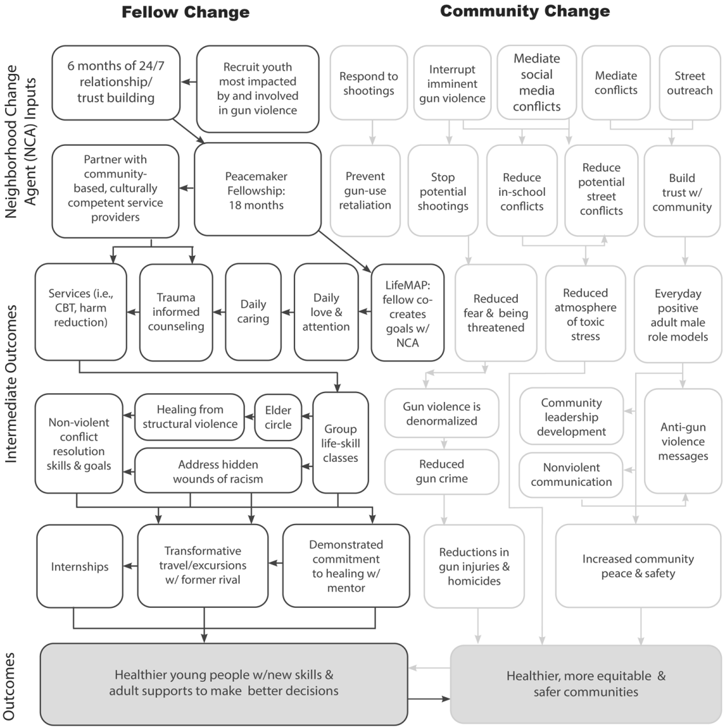
Advance Peace is a community-based urban gun violence prevention model that uses credible street outreach workers and an 18-month Peacemaker Fellowship to provide healing-centered, trauma-informed mentorship and supports to individuals at the center of gun violence. The commentary describes the model and reports descriptive and previously published reductions in gun violence alongside participant healing indicators.
Key findings
- AP distinguishes itself from Cure Violence by not requiring gang affiliation, not affiliating with law enforcement, combining violence interruption and mentorship in Neighborhood Change Agents, focusing on individual trauma healing, and using an intensive 18-month Fellowship.
- In Sacramento, gun homicides and assaults fell 21% during the June 2018–December 2019 Fellowship compared with the average for the same 18-month period in the previous 4 years; Sacramento also had no juvenile homicide in the 2 years since AP started. In Stockton in 2019, NCAs helped prevent 32 murders, mediated 136 community conflicts, and responded to 72 shootings. In Richmond, 97% of fellows were still alive, 83% had not been injured by a firearm, and 66% had no new firearm activity. A 2019 study cited by the authors found AP contributed to a 55% reduction in gun homicides and assaults in Richmond.
- Among 103 Sacramento Fellows (2018–2020), intake was 94.2% African American, 87.3% male, 84.2% previously incarcerated, and 85.4% previously injured by a gunshot. Post-fellowship, 98.0% were alive, 2.0% had new gun injuries, 9.7% had a new gun arrest/charge, 71.8% reported improved outlook on life, 84.2% reported a caring adult to talk to, and 85.4% rated their AP outreach worker as one of the most important adults in their life.
Methods
- Commentary/descriptive program description using AP documents, participant and staff voices, and previously published evaluations.
- Quantitative data come from 103 Fellows enrolled in AP Sacramento from 2018 to 2020: intake questions based on the Life Stressor Checklist-Revised, weekly NCA tracking of adverse events and services, and post-fellowship questions on conflict resolution, outlook, safety, and program rating.
- Analysis is descriptive percentages; no formal causal or comparison design is reported for the new Sacramento data.
Limitations
- The paper states that more work is needed to capture the actual impacts of AP on participants and practitioners, and that broader impacts on community healing are difficult to determine.
- Evident from the text: the Sacramento findings are descriptive, rely on program tracking and self-report, and not all participants answered all questions; the commentary also cites prior evaluations rather than presenting a controlled outcome study.
Model-written summary. Check it against the paper before relying on it.
Integrity signals
Registry
Cites
Statistics
Figures
Verification
Claims the paper makes
5 Valid · 3 Not valid · 25 Not checked · 27 Own results and interpretations
The cited sources support only part of this claim — read each source’s verdict below.
In the paper
“Yet, few of these approaches explicitly aim to also address the traumas of structural violence that contribute to gun crime, including dehumanizing policing, extreme poverty, and institutional racism.”
- Also stated in: § A healing-centered approach to preventing urban gun violence: The Advance Peace Model · p. 2 · plain
“these programs rarely if ever report on whether or not the participants or communities are healing from decades of dehumanization, trauma, racism and other forms of structural violence”
What the sources say
- Partly supportedcites Braga et al., 2019 matched to “Focused deterrence strategies effects on crime: A systematic review” (2019) sourceExperimental — accuracy not yet measured
The Background section ('How the intervention might work'; page not provided) describes focused deterrence as targeting offender behavior through enforcement, community action, and social services. It also describes community members challenging explanations that invoke racism and poverty. This supports a narrower point about the aims of the approaches reviewed, but the paper does not establish that few community-based gun violence programs address structural-violence trauma or assess the listed harms as contributors to gun crime. (LLM, conf=0.75)
- Partly supportedcites Butts et al., 2015 matched to “Cure Violence: A Public Health Model to Reduce Gun Violence” (2015) sourceExperimental — accuracy not yet measured
The Introduction says enforcement-based approaches do not necessarily produce deeper social change, and the Conclusion recognizes broad economic and political forces behind gun violence. Neither passage establishes that few community-based programs address structural trauma or identifies dehumanizing policing, extreme poverty, and institutional racism as the traumas those programs neglect. (LLM, conf=0.72)
- Could not verifycites Garvin et al., 2013 matched to “Greening vacant lots to reduce violent crime: a randomised controlled trial” (2013) sourceExperimental — accuracy not yet measured
The Introduction and Conclusions discuss vacant-lot greening as a place-based approach to violence prevention, not whether community-based gun violence programs address structural violence. Searches for structural violence, dehumanizing policing, extreme poverty, and institutional racism found no passage supporting the attributed claim. Page numbers are unavailable in our copy. (LLM, conf=0.77)
plain- Asserted: passes — The authors put it forward as true.
- Checkable: passes — It can be checked against evidence.
- Load-bearing: passes — The paper’s conclusions depend on it.
- Based: passes — The paper gives a reason why it holds.
- Also stated in: § A healing-centered approach to preventing urban gun violence: The Advance Peace Model · p. 2 · plain
The cited sources support only part of this claim — read each source’s verdict below.
In the paper
“Community-based approaches that use credible, street-level outreach workers to interrupt conflicts, mentor the small number of offenders in each community, and offer them alternatives to violent conflict resolution, have demonstrated success in reducing firearm homicides.”
What the sources say
- Partly supportedcites Braga et al., 2019 matched to “Focused deterrence strategies effects on crime: A systematic review” (2019) sourceExperimental — accuracy not yet measured
Split into 2 atoms — 0 confirmed, 2 partially supported, 0 disputed, 0 misattributed, 0 unverifiable. Expand the claim to see per-atom verdicts.
- Partly supportedcites Butts et al., 2015 matched to “Cure Violence: A Public Health Model to Reduce Gun Violence” (2015) sourceExperimental — accuracy not yet measured
Split into 2 atoms — 1 confirmed, 1 partially supported, 0 disputed, 0 misattributed, 0 unverifiable. Expand the claim to see per-atom verdicts.
- Not checked — no full text of the sourcecites Friedson and Sharkey, 2015 matched to “Violence and Neighborhood Disadvantage after the Crime Decline” (2015) source
boostedstates a cause- Asserted: passes — The authors put it forward as true.
- Checkable: passes — It can be checked against evidence.
- Load-bearing: passes — The paper’s conclusions depend on it.
- Based: passes — The paper gives a reason why it holds.
- Partly supported
In the paper
“mediated 136 community con fl icts that could have escalated into gun violence”
What the sources say
- Not matchedcites Corburn and Fukutome, 2019
An author–year citation the paper’s reference list doesn’t settle. We don’t search these by name.
hedgedstates a cause- Asserted: passes — The authors put it forward as true.
- Checkable: passes — It can be checked against evidence.
- Load-bearing: passes — The paper’s conclusions depend on it.
- Based: passes — The paper gives a reason why it holds.
- Not matched
In the paper
“in Sacramento gun homicides and assaults were reduced by 21% in the 18-month fellowship from June 2018 through December 2019, compared to the average number of gun homicides and assaults from the same 18month period in the previous 4 years (Corburn and FututomeLopez, 2020).”
What the sources say
- Not matchedcites Corburn and Fututome-Lopez, 2020
An author–year citation the paper’s reference list doesn’t settle. We don’t search these by name.
plainstates a cause- Asserted: passes — The authors put it forward as true.
- Checkable: passes — It can be checked against evidence.
- Load-bearing: passes — The paper’s conclusions depend on it.
- Based: passes — The paper gives a reason why it holds.
- Not matched
In the paper
“In Stockton, during 2019, the fi rst year of the Fellowship, AP NCAs helped prevent thirty-two murders through interrupting imminent gun con fl icts”
What the sources say
- Not matchedcites Corburn and Fukutome, 2019
An author–year citation the paper’s reference list doesn’t settle. We don’t search these by name.
plainstates a cause- Asserted: passes — The authors put it forward as true.
- Checkable: passes — It can be checked against evidence.
- Load-bearing: passes — The paper’s conclusions depend on it.
- Based: passes — The paper gives a reason why it holds.
- Not matched
20 more claims
Create a free account to see all 60 claims and every source verdict.
- It may state two separate claims as one. 22
- Probably not a substantial claim. 21
Citations
Cites
Adverse childhood experiences, allostasis, allostatic load and age-related disease
Danese, A., & McEwen, B. S. (2012) · Physiology & Behavior · doi:10.1016/j.physbeh.2011.08.019 · Cited by 2,140
Aggressive Policing and the Mental Health of Young Urban Men
Geller, A., Fagan, J., Tyler, T., & Link, B. G. (2014) · American Journal of Public Health · doi:10.2105/ajph.2014.302046 · Cited by 575
Rootshock: how tearing up city neighborhoods hurts America, and what we can do about it
(2005) · Choice Reviews Online · doi:10.5860/choice.42-3733 · Cited by 546
Social Structure, Adversity, Toxic Stress, and Intergenerational Poverty: An Early Childhood Model
McEwen, C. A., & McEwen, B. S. (2017) · Annual Review of Sociology · doi:10.1146/annurev-soc-060116-053252 · Cited by 472
Cure Violence: A Public Health Model to Reduce Gun Violence
Butts, J. A., Roman, C. G., Bostwick, L., & Porter, J. R. (2015) · Annual Review of Public Health · doi:10.1146/annurev-publhealth-031914-122509 · Cited by 398
Global Mortality From Firearms, 1990-2016
Collaborators, T. G. B. O. D. 2. I., Naghavi, M., Marczak, L. B., Kutz, M., Shackelford, K. A., Arora, M., Miller-Petrie, M., Aichour, M. T. E., Akseer, N., Al-Raddadi, R. M., et al. (2018) · JAMA · doi:10.1001/jama.2018.10060 · Cited by 363
Ellis, W. R., & Dietz, W. H. (2017) · Academic Pediatrics · doi:10.1016/j.acap.2016.12.011 · Cited by 331
Greening vacant lots to reduce violent crime: a randomised controlled trial
Garvin, E. C., Cannuscio, C. C., & Branas, C. C. (2013) · Injury Prevention · doi:10.1136/injuryprev-2012-040439 · Cited by 293
Geronimus, A. T., & Thompson, J. P. (2004) · Du Bois Review: Social Science Research on Race · doi:10.1017/s1742058x04042031 · Cited by 170
for the FACTS Consortium, Ranney, M., Karb, R., Ehrlich, P., Bromwich, K., Cunningham, R., & Beidas, R. S. (2019) · Journal of Behavioral Medicine · doi:10.1007/s10865-019-00035-2 · Cited by 168 · cited 2×
“…the participants or communities are healing from decades of dehumanization, trauma, racism and other forms of structural violence (Braga et al., 2019; Butts et al., 2015; Friedson and Sharkey, 2015; Garvin et al., 2013; PicardFritsche and Cerniglia, 2013; Ranney et al., 2019; Skogan et al., 2008).”
BackgroundLeBel, T. P., Richie, M., & Maruna, S. (2015) · Criminal Justice and Behavior · doi:10.1177/0093854814550029 · Cited by 165 · cited 1×
“Thus, the credible messengers within AP might be considered “wounded healers” (LeBel et al., 2015).”
BackgroundRhythms of gentrification: eventfulness and slow violence in a happening neighbourhood
Kern, L. (2016) · cultural geographies · doi:10.1177/1474474015591489 · Cited by 160
Evaluation of CeaseFire-Chicago
Skogan, W. G., Hartnett, S. M., & Bump, N. (2012) · Cited by 151
Network Exposure and Homicide Victimization in an African American Community
Papachristos, A. V., & Wildeman, C. (2014) · American Journal of Public Health · doi:10.2105/ajph.2013.301441 · Cited by 123
An Integrated Public Health Approach to Interpersonal Violence and Suicide Prevention and Response
Decker, M. R., Wilcox, H. C., Holliday, C. N., & Webster, D. W. (2018) · Public Health Reports® · doi:10.1177/0033354918800019 · Cited by 115
Violence and Neighborhood Disadvantage after the Crime Decline
Friedson, M., & Sharkey, P. (2015) · The ANNALS of the American Academy of Political and Social Science · doi:10.1177/0002716215579825 · Cited by 104
(2013) · Reclaiming Children and Youth · Cited by 100
Trauma-Informed Care: An Ecological Response
DeCandia, C. J., & Guarino, K. (2020) · Journal of Child and Youth Care Work · doi:10.5195/jcycw.2015.69 · Cited by 99 · cited 1×
“This ‘ecologic approach’ to healing involves identifying the historic public policies and social practices that have contributed to the harm, such as housing discrimination, workplace segregation, and dumping of toxic waste in communities of color (DeCandia and Guarino, 2015).”
BackgroundLife Stressor Checklist--Revised
Wolfe, J., Kimerling, R. E., Brown, P. J., Chrestman, K. R., & Levin, K. (1996) · PsycTESTS Dataset · doi:10.1037/t04534-000 · Cited by 92
Focused deterrence strategies effects on crime: A systematic review
Braga, A. A., Weisburd, D., & Turchan, B. (2019) · Campbell Systematic Reviews: Better Evidence for a Better World · doi:10.1002/cl2.1051 · Cited by 92
Neighborhood Trauma Due to Violence: A Multilevel Analysis
Lane, S. D., Rubinstein, R. A., Bergen-Cico, D., Jennings-Bey, T., Fish, L. S., Larsen, D. A., Fullilove, M. T., Schimpff, T. R., Ducre, K. A., & Robinson, J. A. (2017) · Journal of Health Care for the Poor and Underserved · doi:10.1353/hpu.2017.0033 · Cited by 76
A Narrative Inquiry Into the Experience of Being a Victim of Gun Violence
Francis, M. (2018) · Journal of Trauma Nursing · doi:10.1097/jtn.0000000000000406 · Cited by 51
Assessing Adult Exposure to Community Violence: A Review of Definitions and Measures
DeCou, C. R., & Lynch, S. M. (2017) · Trauma, Violence, & Abuse · doi:10.1177/1524838015590590 · Cited by 48 · cited 1×
“…the ‘pair of ACEs’: such as emotional and physical neglect, sexual abuse, and exposure to domestic violence—and, Adverse Community Environments—such as racism, poverty, insecure housing, environmental pollution, heavy-handed policing, and prior exposure to gun violence (Ellis and Dietz, 2017).”
BackgroundMatthay, E. C., Farkas, K., Rudolph, K. E., Zimmerman, S., Barragan, M., Goin, D. E., & Ahern, J. (2019) · American Journal of Public Health · doi:10.2105/ajph.2019.305288 · Cited by 39
Firearm-Related Mortality: A Global Public Health Problem
Rivara, F. P., Studdert, D. M., & Wintemute, G. J. (2018) · JAMA · doi:10.1001/jama.2018.9942 · Cited by 27 · cited 2×
“In cities across the US, young Black men are most likely to be both victims and perpetrators of gun violence (Abt and Winship, 2016; Kalesan et al., 2019; Rivera et al., 2018; GBD, 2016).”
BackgroundUntil We Reckon: Violence, Mass Incarceration, and a Road to Repair
Sered, D. (2019) · doi:10.1515/9781620974803 · Cited by 26
Kalesan, B., Vyliparambil, M. A., Zuo, Y., Siracuse, J. J., Fagan, J. A., Branas, C. C., & Galea, S. (2019) · BMJ Evidence-Based Medicine · doi:10.1136/bmjebm-2018-111103 · Cited by 24
Das, D. (2015) · CUNY Academic Works (City University of New York) · Cited by 23
No Ordinary Life: Complex Narratives of Trauma and Resilience in Under-Resourced Communities
Pressley, J., & Smith, R. (2017) · Journal of Aggression, Maltreatment & Trauma · doi:10.1080/10926771.2016.1246500 · Cited by 14
An Introduction to Trauma and Health
Gerber, M. R., & Gerber, E. B. (2019) · Trauma-Informed Healthcare Approaches · doi:10.1007/978-3-030-04342-1_1 · Cited by 14
Research works printed but not linked: 4
- Akbar M (2017) Urban trauma: a legacy of racism. Purpose Driven Publishing, Hartford
- Corburn J, Fukutome A (2019) Advance Peace Stockton: 2018 -19 progress report. Institute of Urban & Regional Development, UC Berkeley
- Norris T (2020) We keep us safe: building secure, just and inclusive communities. Beacon Press, Boston
- Wolf AM, Del Prado Lippman A, Glesmann C, Castro E (2015) Process evaluation for the Of fi ce of Neighborhood Safety. National Council of Crime and Delinquency, Oakland
Cited by
Suslovic, B. J., & Lett, E. (2023) · Community Health Equity Research & Policy · doi:10.1177/2752535x231159721 · Cited by 151
Albert, A. (2023) · Punishment & Society · doi:10.1177/14624745231208183 · Cited by 14
Mental Health and Violence in Children and Adolescents
Kemal, S., Nwabuo, A., & Hoffmann, J. A. (2023) · Pediatric Clinics of North America · doi:10.1016/j.pcl.2023.06.011 · Cited by 22
Codeveloping theories of change for improved community-based violence intervention evaluation
Schleimer, J. P., Lyons, V. H., Smith, D., Ali, F., Averett, L., Baugh, M., Benson, L. R., Colon, J., Cook, J., Davis, D., et al. (2024) · The Journal of Trauma: Injury, Infection, and Critical Care · doi:10.1097/ta.0000000000004277 · Cited by 13
Corburn, J., Boggan, D., Muttaqi, K., & Vaughn, S. (2022) · Journal of Urban Health · doi:10.1007/s11524-022-00660-4 · Cited by 10
Self-citation
Metadata
- Authors
- Corburn, J., Boggan, D., Muttaqi, K., Vaughn, S., Houston, J., Thibodeaux, J., & Muhammad, B.
- Affiliations
- University of California, Berkeley (US)
- Corresponding author
- Corburn, Jason
- ORCID
- Corburn, Jason
- Venue
- Humanities and Social Sciences Communications
- Published
- 2021-06-09
- Volume
- 8
- Issue
- 1
- ISSN
- 2055-1045 (ISSN-L)
- 2662-9992
- OpenAlex
- W3168036392
- Cited by
- 23
- References
- 31
- Citations by year
- 2026: 6 · 2025: 5 · 2024: 4 · 2023: 4 · 2022: 3 · 2021: 1
- FWCI
- 1.49
- Type
- journal article
- Language
- en
- Open access
- gold
- doi.org
- Licence
- cc-by
- creativecommons.org/licenses/by/4.0 (tdm)
- creativecommons.org/licenses/by/4.0 (vor)
- Locations
- Humanities and Social Sciences Communications (publishedVersion, cc-by)
- RePEc: Research Papers in Economics (submittedVersion)
- DOAJ (DOAJ: Directory of Open Access Journals) (submittedVersion, cc-by-sa)
- Topics
- Social Sciences › Health › Gun Ownership and Violence Research
- Social Sciences › Sociology and Political Science › Crime Patterns and Interventions
- Social Sciences › Sociology and Political Science › Criminal Justice and Corrections Analysis
- Keywords
- gun violence prevention, trauma-informed care, community outreach, structural violence, African American men, Black and Brown communities, institutional racism, incarceration, firearm homicide, conflict resolution
About these checks
Registry, retraction, Cites and statistics results are computed, not judged, with one exception: a printed reference that no index lists is read once by a model before it counts as a citation error. Claims are extracted by a model and kept only when their quote appears verbatim in the text; each cited source is then checked, with a model’s help, for whether it says what the claim relies on. Those verdicts can be wrong — read the claim’s quote and the cited source before relying on one.
The claim verdicts this report counts are experimental: their accuracy is not yet measured.
A language model drew the claims from the paper on 2026-10-10, under version 3 of the claim definition (model deepseek-v4.1-flash, prompt extract-v3).
A second model labelled each claim on 2026-10-10 (model jev-1.13-20260917, definition revision gold-guideline-v0.2).
Cited sources are checked with a language model’s help (gpt-6-sol).
Statistics and arithmetic are recomputed, not judged.
Confidence bands are shown only for fields calibrated on our annotated test set. None is calibrated yet, so no band is shown.
What counts as a claim ›How we measure confidence ›How we check this ›
Are you an author, or do you see a problem with this page? Request a review
Data sources
Bibliographic data: Semantic Scholar, OpenAlex, Crossref.
Contains information from the Semantic Scholar Academic Graph Datasets, made available under the ODC Attribution License (ODC-BY 1.0).
Semantic Scholar’s data is described in: Kinney, R., et al. (2023). The Semantic Scholar Open Data Platform. arXiv:2301.10140.
