

Detecting contact in language trees: a Bayesian phylogenetic model with horizontal transfer
Open accessPublished version of a preprint
The DOI matches its Crossref record; 78 of the 79 references it cites were found in a registry or an index, and 1 are not checked yet; none of the 30 sources its claims cite is checked for support yet.
Abstract
Phylogenetic trees are a central tool for studying language evolution and have wide implications for understanding cultural evolution as a whole. For example, they have been the basis of studies on the evolution of musical instruments, religious beliefs and political complexity. Bayesian phylogenetic methods are transparent regarding the data and assumptions underlying the inference. One of these assumptions—that languages change independently—is incompatible with the reality of language evolution, particularly with language contact. When speakers interact, languages frequently borrow linguistic traits from each other. Phylogenetic methods ignore this issue, which can lead to errors in the reconstruction. More importantly, they neglect the rich history of language contact. A principled way of integrating language contact in phylogenetic methods is sorely missing. We present , a Bayesian phylogenetic model with horizontal transfer for language evolution. The model efficiently infers the phylogenetic tree of a language family and contact events between its clades. The implementation is available as a package for the phylogenetics software BEAST 2. We apply in a simulation study and a case study on a subset of well-documented Indo-European languages. The simulation study demonstrates that correctly reconstructs the history of a simulated language family, including simulated contact events. Moreover, it shows that ignoring contact can lead to systematic errors in the estimated tree height, rate of change and tree topology, which can be avoided with . The case study confirms that reconstructs known contact events in the history of Indo-European and finds known loanwords, demonstrating its practical potential. The model has a higher statistical fit to the data than a conventional phylogenetic reconstruction, and the reconstructed tree height is significantly closer to well-attested estimates. Our method closes a long-standing gap between the theoretical and empirical models of cultural evolution. The implications are especially relevant for less documented language families, where our knowledge of past contacts and linguistic borrowings is limited. Since linguistic phylogenies have become the backbone of many studies of cultural evolution, the addition of this integral piece of the puzzle is crucial in the endeavour to understand the history of human culture.
Checked 2026-11-24 · 1 reference not checked yet
Overview
CoChat Summary
TL;DR
contacTrees is a Bayesian phylogenetic model with horizontal transfer that jointly infers a language tree and contact edges between its branches. In simulations it reconstructs simulated borrowing and reduces bias, and in a Celtic-Germanic-Romance case study it finds known contact events and improves statistical fit over a no-contact model.
Key findings
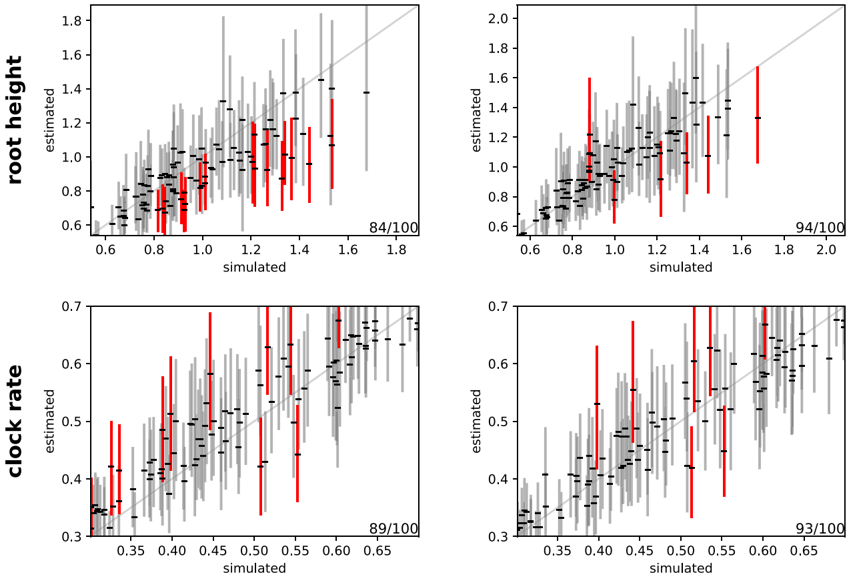
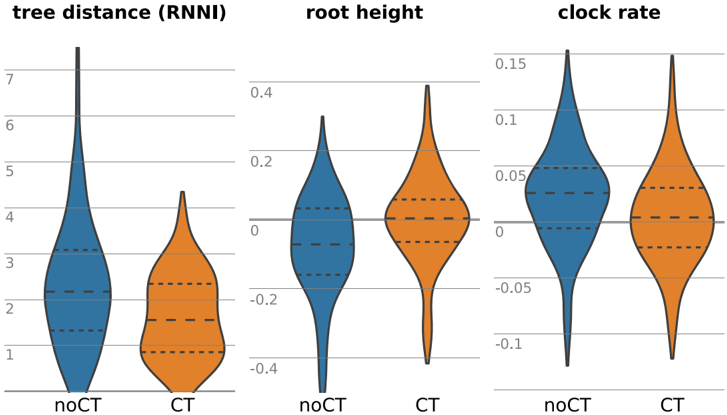
- In 100 simulation runs, contacTrees credible intervals covered the simulated root height in 94 runs and clock rate in 93 runs, within the expected 91–99 range; without contact, only 84 and 89 runs covered them, with bias toward lower root heights and higher clock rates. The expected RNNI distance to the simulated tree was 2.35 without contacTrees and 1.64 with contacTrees.
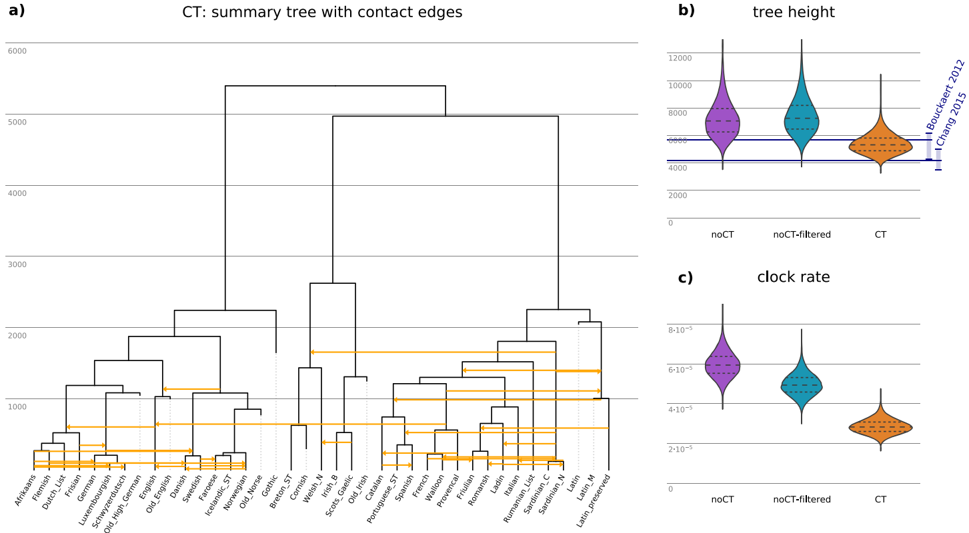
- In the case study on 39 Celtic-Germanic-Romance languages (1419 cognates, 206 meaning classes), the Bayes factor for a model with contact over one without was 1056.24, indicating decisive support. The CT model estimated a mean root height of 5384.0 years before present versus 7206.2 (noCT) and 7449.8 (noCT-filtered), and mean clock rates of 2.84 × 10⁻⁵ versus 5.97 × 10⁻⁵ and 4.96 × 10⁻⁵ substitutions per year.
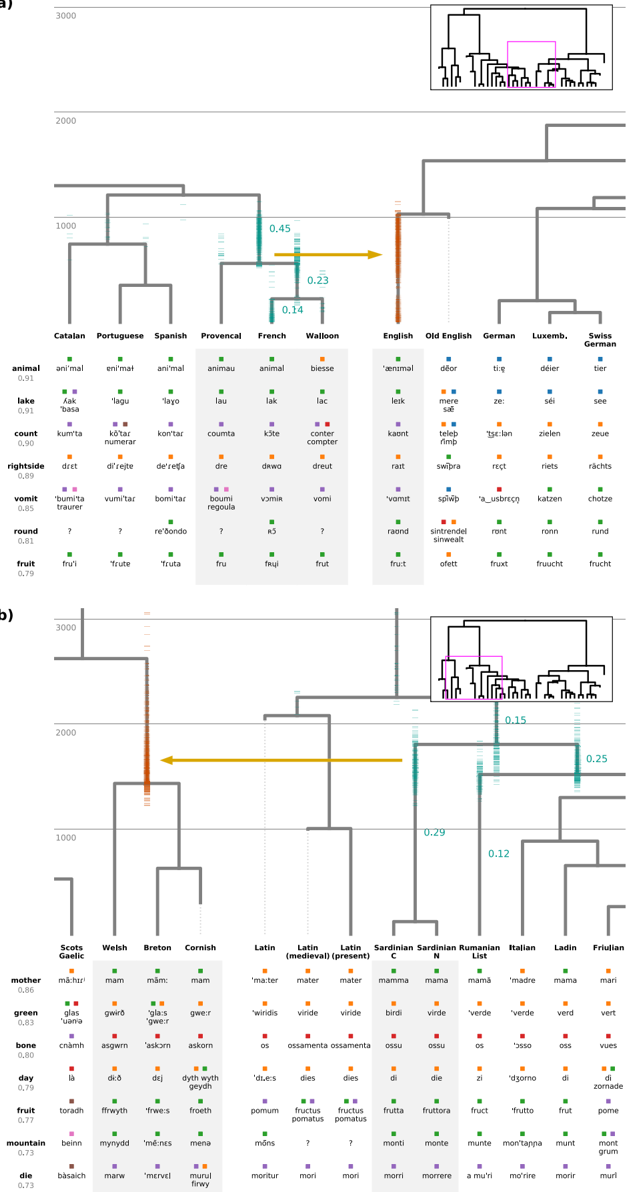
- The CT reconstruction found 32 contact edges: only two connect different top-level clades (Gallo-Romance > English; Romance > Brittonic), with 14 in Germanic, 15 in Romance, and 1 in Celtic. Known events include an Old French > Middle English edge about 640 years before present and a Romance > Proto-Brittonic edge about 1670 years before present.
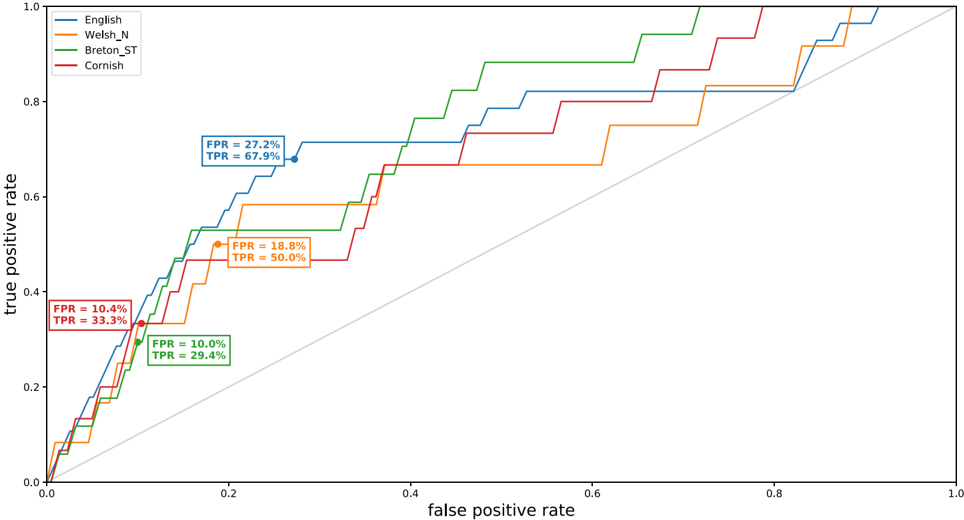
- At a posterior probability threshold of 0.33, the model recovered 67.9% of known loanwords in the English data while marking 27.2% of non-loanwords as loans; the ROC curve was above the diagonal.
Methods
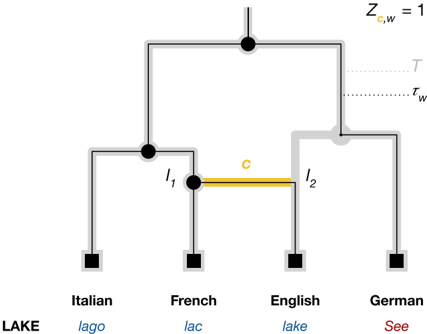
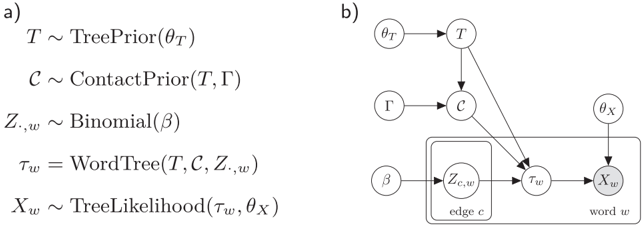
- contacTrees builds on the ClonalOrigin model: a rooted binary language tree T is complemented by contact edges C and binary borrowing indicators Z, so each word follows a word tree that can deviate from the language tree. It uses a Poisson contact prior, a Bernoulli borrowing prior, and MCMC operators implemented in BEAST 2.
- The simulation study used 100 runs with a 25-language Yule tree, expected contact edges 6.0, borrowing probability β = 0.25, 100 words with 20 sites each, binary CTMC evolution, and log-normal rate variation with standard deviation 0.3; reconstructions were compared with and without contacTrees.
- The case study used IELex data (Chang et al. 2015 version) for 39 Indo-European languages from Celtic, Germanic, and Romance, with a birth-death skyline tree prior, uncorrelated relaxed clock, binary covarion substitution model, Γ = 0.25, β = 0.1, and three settings: CT, noCT, and noCT-filtered. Contact events were reported with tree topology fixed to the Chang et al. summary tree.
Limitations
- Stated in the paper: there is no exact ground truth for loanwords, the loanword reference is likely incomplete, and there is no comparable reference to evaluate inferred contact events. Data coding by meaning classes, synonym selection, semantic shifts, and parallel innovations or shared retentions can cause contacTrees to mistake non-borrowing processes for contact; semantic loans and latent contact effects are difficult to verify, and not every kind of contact leaves the same traces (e.g., an expected Germanic-Celtic edge was not found). The expected number of contact edges Γ = 0.25 is a regularising prior, not a true expectation.
- Evident from the text: the case-study contact-edge results are reported under a fixed tree topology, so topological uncertainty is not jointly interpreted for those results. The model uses a fixed borrowing probability β across words/features, and the paper notes future work could allow β to vary. The contact prior is not geographically or phylogenetically informed, so the data cannot always exclude geographically implausible contact, as with contact edges having Afrikaans as a donor.
Model-written summary. Check it against the paper before relying on it.
Integrity signals
Registry
Cites
Statistics
Figures
Verification
Claims the paper makes
0 Valid · 6 Not valid · 19 Not checked · 155 Own results and interpretations
A result the paper reports from its own data — it cites no other source for it, so there is none to check. The quote shows it is in the paper.
In the paper
“in the simulation, the bias was towards younger trees”
§ Detecting contact in language trees: a Bayesian phylogenetic model with horizontal transfer > Discussion
plainstates an association- Asserted: passes — The authors put it forward as true.
- Checkable: passes — It can be checked against evidence.
- Load-bearing: passes — The paper’s conclusions depend on it.
- Based: passes — The paper gives a reason why it holds.
A result the paper states — it cites no source for it, so there is none to check. The quote shows it is in the paper.
In the paper
“has a lower clock rate (see Fig. 5)”
§ Detecting contact in language trees: a Bayesian phylogenetic model with horizontal transfer > Discussion
plainstates an associationSingle case- Asserted: passes — The authors put it forward as true.
- Checkable: passes — It can be checked against evidence.
- Load-bearing: passes — The paper’s conclusions depend on it.
- Based: passes — The paper gives a reason why it holds.
A result the paper reports from its own data — it cites no other source for it, so there is none to check. The quote shows it is in the paper.
In the paper
“The parameters of the model suggest that without CT, the covarion needs to give room for more variable substitution rates, with α ≈ 0.044 for the CT model and a much lower α ≈ 0.006 for the noCT model.”
§ Detecting contact in language trees: a Bayesian phylogenetic model with horizontal transfer > Simulation study.
hedgedstates a cause- Asserted: passes — The authors put it forward as true.
- Checkable: passes — It can be checked against evidence.
- Load-bearing: unclear — It is unclear whether the paper’s conclusions depend on it.
- Based: passes — The paper gives a reason why it holds.
A result the paper reports from its own data — it cites no other source for it, so there is none to check. The quote shows it is in the paper.
In the paper
“In the phylogenetic reconstruction of the Celtic, Germanic, and Romance (CGR) languages, we see that the inclusion of contact in the model significantly impacts the reconstruction.”
§ Detecting contact in language trees: a Bayesian phylogenetic model with horizontal transfer > Discussion
plainstates a causeSingle case- Asserted: passes — The authors put it forward as true.
- Checkable: passes — It can be checked against evidence.
- Load-bearing: passes — The paper’s conclusions depend on it.
- Based: passes — The paper gives a reason why it holds.
A result the paper reports from its own data — it cites no other source for it, so there is none to check. The quote shows it is in the paper.
In the paper
“Two of the Germanic edges represent the known historical influence of Norse speakers on the English language, including multiple known loanwords.”
§ Detecting contact in language trees: a Bayesian phylogenetic model with horizontal transfer > Discussion
plainstates a cause- Asserted: passes — The authors put it forward as true.
- Checkable: passes — It can be checked against evidence.
- Load-bearing: passes — The paper’s conclusions depend on it.
- Based: passes — The paper gives a reason why it holds.
82 more claims
Create a free account to see all 180 claims and to verify the 24 references still open.
- It may state two separate claims as one. 51
- Probably not a substantial claim. 53
- The quote only partly states this claim. 1
Citations
Cites
Application of Phylogenetic Networks in Evolutionary Studies
Huson, D. H., & Bryant, D. (2006) · Molecular Biology and Evolution · doi:10.1093/molbev/msj030 · Cited by 8,830
Relaxed Phylogenetics and Dating with Confidence
Drummond, A. J., Ho, S. Y. W., Phillips, M. J., & Rambaut, A. (2006) · PLoS Biology · doi:10.1371/journal.pbio.0040088 · Cited by 6,463 · cited 2×
“We use an uncorrelated relaxed clock model (Drummond et al., 2006), which we calibrate through the ancient languages in our data set and through clade age priors on internal nodes (adapted from Bouckaert et al.”
MethodBEAST 2.5: An advanced software platform for Bayesian evolutionary analysis
Bouckaert, R., Vaughan, T. G., Barido-Sottani, J., Duchêne, S., Fourment, M., Gavryushkina, A., Heled, J., Jones, G., Kühnert, D., De Maio, N., et al. (2019) · PLOS Computational Biology · doi:10.1371/journal.pcbi.1006650 · Cited by 4,556 · cited 2×
“Ordinal models (Bouckaert, 2019) can be used to model the evolution of ordinal characters, e.g. the complexity of tonal systems ranging from “ no tones ” to “ highly complex tone system ” .”
MethodSelf-citationLanguage Contact, Creolization, and Genetic Linguistics
Thomason, S. G., & Kaufman, T. (1988) · University of California Press eBooks · doi:10.1525/9780520912793 · Cited by 3,221
Bayesian Coalescent Inference of Past Population Dynamics from Molecular Sequences
Drummond, A. J. (2005) · Molecular Biology and Evolution · doi:10.1093/molbev/msi103 · Cited by 3,143
Bayesian inference of species trees from multilocus data
Heled, J., & Drummond, A. J. (2010) · Molecular Biology and Evolution · doi:10.1093/molbev/msp274 · Cited by 2,453 · cited 1×
“This idea is similar to that of gene-trees within a species-tree in the multispecies coalescent (MSC) model (Heled and Drummond, 2009), which solves the problem of genetic polymorphism within species.”
ResultII.—A mathematical theory of evolution, based on the conclusions of Dr. J. C. Willis, F. R. S
Yule, G. U. (1925) · Philosophical Transactions of the Royal Society of London. Series B, Containing Papers of a Biological Character · doi:10.1098/rstb.1925.0002 · Cited by 1,718
Linguistic Diversity in Space and Time
Nichols, J. (1992) · University of Chicago Press eBooks · doi:10.7208/chicago/9780226580593.001.0001 · Cited by 1,654
Language-tree divergence times support the Anatolian theory of Indo-European origin
Gray, R. D., & Atkinson, Q. D. (2003) · Nature · doi:10.1038/nature02029 · Cited by 1,296
Language as shaped by the brain
Christiansen, M. H., & Chater, N. (2008) · Behavioral and Brain Sciences · doi:10.1017/s0140525x08004998 · Cited by 1,063
Research works printed but not linked: 3
- Bauer B (2015) Intra-Celtic loanwords, Ph.D. thesis, Wien, A, Universität, Wien
- Jackson KH (1953) Language and history in early Britain. University Press, Edinburgh
- Maurits L, de Heer M, Dunn M, Vesakoski O (2019) Using contact linguistics for relative calibration of phylogenies. In: International Conference on Historical Linguistics 24, Canberra, Australia
Cited by
Language Phylogenies: Modelling the Evolution of Language
Greenhill, S. J. (2023) · Oxford University Press eBooks · doi:10.1093/oxfordhb/9780198869252.013.61 · Cited by 48
Computational thematics: comparing algorithms for clustering the genres of literary fiction
Sobchuk, O., & Šeļa, A. (2024) · Humanities and Social Sciences Communications · doi:10.1057/s41599-024-02933-6 · Cited by 29
Language follows a distinct mode of extra-genomic evolution
Bickel, B., Giraud, A., Zuberbühler, K., & van Schaik, C. P. (2024) · Physics of Life Reviews · doi:10.1016/j.plrev.2024.08.003 · Cited by 26
Cultural evolution of music and language
Ozaki, Y., Kloots, M. D. H., Ravignani, A., & Savage, P. E. (2026) · Oxford University Press eBooks · doi:10.1093/oxfordhb/9780192894700.013.0028 · Cited by 21
Sense and Nonsense: Evolutionary Perspectives on Human Behaviour
Brown, G. R., & Laland, K. N. (2024) · doi:10.1093/oso/9780198908203.001.0001 · Cited by 19
Metadata
- Authors
- Neureiter, N., Ranacher, P., Efrat-Kowalsky, N., Kaiping, G. A., Weibel, R., Widmer, P., & Bouckaert, R. R.
- Affiliations
- University of Zurich (CH)
- University of Auckland (NZ)
- Corresponding author
- Neureiter, Nico
- ORCID
- Venue
- Humanities and Social Sciences Communications
- Published
- 2022-06-17
- Volume
- 9
- Issue
- 1
- Pages
- 205
- ISSN
- 2055-1045 (ISSN-L)
- 2662-9992
- OpenAlex
- W4283023587
- Cited by
- 96
- References
- 77
- Citations by year
- 2026: 7 · 2025: 51 · 2024: 28 · 2023: 9 · 2022: 1
- FWCI
- 45.29
- Type
- journal article
- Language
- en
- Open access
- gold
- doi.org
- Licence
- cc-by
- creativecommons.org/licenses/by/4.0 (tdm)
- creativecommons.org/licenses/by/4.0 (vor)
- Locations
- Humanities and Social Sciences Communications (publishedVersion, cc-by)
- Research Square (submittedVersion, cc-by)
- HAL (submittedVersion, cc-by)
- RePEc: Research Papers in Economics (submittedVersion)
- DOAJ (DOAJ: Directory of Open Access Journals) (submittedVersion)
- Zurich Open Repository and Archive (University of Zurich) (submittedVersion, cc-by)
- Zurich Open Repository and Archive (University of Zurich)
- Funders
- National Science Foundation
- Royal Society
- Royal Society Te Apārangi (18-UOA-096)
- Universität Zürich
- Topics
- Social Sciences › Cultural Studies › Language and cultural evolution
- Social Sciences › Arts and Humanities › Language and Linguistics › Linguistics and language evolution
- Social Sciences › Arts and Humanities › Language and Linguistics › Linguistics, Language Diversity, and Identity
- Keywords
- language contact, horizontal transfer, language evolution, Indo-European languages, cultural evolution, lexical borrowing, loanwords, BEAST2, tree height estimation
About these checks
Registry, retraction, Cites and statistics results are computed, not judged, with one exception: a printed reference that no index lists is read once by a model before it counts as a citation error. Claims are extracted by a model and kept only when their quote appears verbatim in the text; each cited source is then checked, with a model’s help, for whether it says what the claim relies on. Those verdicts can be wrong — read the claim’s quote and the cited source before relying on one.
A language model drew the claims from the paper on 2026-11-24, under version 3 of the claim definition (model deepseek-v4.1-flash, prompt extract-v3).
A second model labelled each claim on 2026-11-24 (model jev-1.13-20260917, definition revision gold-guideline-v0.2).
Statistics and arithmetic are recomputed, not judged.
Confidence bands are shown only for fields calibrated on our annotated test set. None is calibrated yet, so no band is shown.
What counts as a claim ›How we measure confidence ›How we check this ›
Are you an author, or do you see a problem with this page? Request a review
How to cite
Cite CoChat for the checks on this page, and the paper for its own findings.
- This page
- CoChat. (2026). Citation check: Detecting contact in language trees: a Bayesian phylogenetic model with horizontal transfer. https://app.cochat.ai/papers/10.1057/s41599-022-01211-7
- The paper
- Neureiter, N., Ranacher, P., Efrat-Kowalsky, N., Kaiping, G. A., Weibel, R., Widmer, P., & Bouckaert, R. R. (2022). Detecting contact in language trees: a Bayesian phylogenetic model with horizontal transfer. Humanities and Social Sciences Communications. https://doi.org/10.1057/s41599-022-01211-7
Data sources
Bibliographic data: Semantic Scholar, OpenAlex, Crossref.
Contains information from the Semantic Scholar Academic Graph Datasets, made available under the ODC Attribution License (ODC-BY 1.0).
Semantic Scholar’s data is described in: Kinney, R., et al. (2023). The Semantic Scholar Open Data Platform. arXiv:2301.10140.
