

The route to immersion: a conceptual framework for cross-disciplinary immersive theatre and experiences
Open accessThe DOI matches its Crossref record; 43 of the 45 references it cites were found in a registry or an index; 5 of the 45 sources its claims cite were checked for support.
Abstract
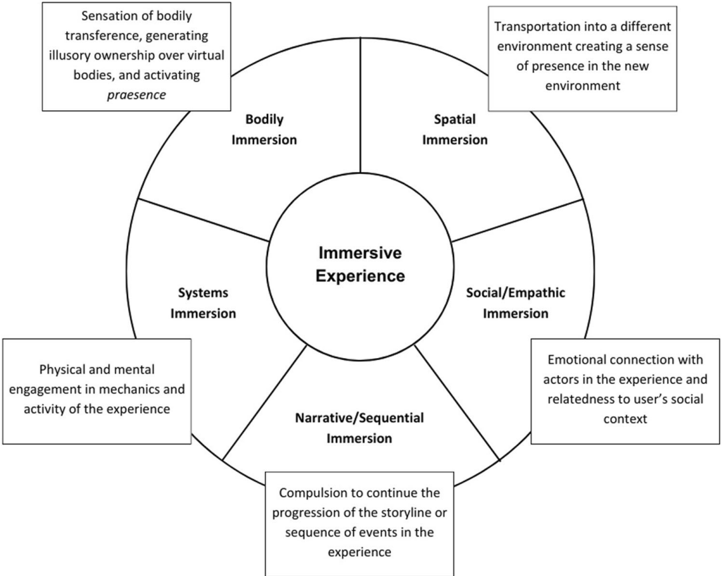
This paper aims to provide a revised conceptual framework from the context of design through technologies with an addition of bodily immersion, or a sensation of bodily transference, creating illusory ownership over a virtual body, and activating praesence, a lived experience of the physical body responding within an imaginative, sensual environment.
Overview
CoChat Summary
## TL;DR
This conceptual paper revises an existing immersive-experience framework by adding a fifth element, “bodily immersion,” drawing on theatre/performance scholarship alongside immersive technologies. It argues that complete immersion is best understood through five interacting elements: systems, spatial, social/empathic, narrative/sequential, and bodily immersion.
## Key findings
- The paper proposes a revised framework for immersive experiences that adds bodily immersion to the four elements in Han, Melissen, and Haggis-Burridge (2023): systems, spatial, social/empathic, and narrative/sequential.
- Bodily immersion is defined as a sensation of bodily transference, creating illusory ownership over virtual bodies and activating praesence; the paper links this especially to VR.
- The authors argue that the earlier four-part framework, focused on design through technology, does not include theatre/performance perspectives and may not capture immersive theatre forms that rely on physical spaces and site-specificity.
- The paper says the framework can help creators, participants, academics, and students by improving understanding, setting expectations, and supporting evaluation and analysis.
## Methods
- This is a conceptual/theoretical paper; it does not report new empirical data and states that no data were generated or analysed.
- The paper synthesizes perspectives from theatre and performance, immersive communication, and immersive technologies, especially by revisiting earlier work by Machon, Jarvis, Li, and Han et al.
- The main analysis is a literature-based framework revision that compares immersive theatre, immersive communication, and VR/AR/MR-based immersive experiences.
## Limitations
- The paper explicitly notes that its emphasis on VR technology to enable complete immersion significantly limits the concept of immersive experience; this is the authors’ stated limitation.
- It also states that the revised framework may imply that many self-defined “immersive” experiences, including some examples from Thailand and elsewhere, cannot offer true immersion without immersive technologies such as VR or MR; this is an interpretive constraint built into the framework.
- Evident from the text: the paper is conceptual rather than empirical, so it does not test the framework with participants or measure outcomes in a study.
Model-written summary. Check it against the paper before relying on it.
Integrity signals
Registry
Cites
Statistics
Figures
Verification
Claims the paper makes
5 Valid · 14 Not valid · 31 Not checked · 28 Own results and interpretations
In the paper
“the immersive theatre experiences that have been offered in Thailand so far align with the four types of immersive theatre outlined by Warren (2017, x-xiii), which include exploration theatre, guided experiences, interactive worlds, and game theatre.”
What the sources say
- Not matchedcites Warren (2017, x-xiii)
An author–year citation the paper’s reference list doesn’t settle. We don’t search these by name.
plainstates an association- Asserted: passes — The authors put it forward as true.
- Checkable: passes — It can be checked against evidence.
- Load-bearing: unclear — It is unclear whether the paper’s conclusions depend on it.
- Based: passes — The paper gives a reason why it holds.
- Not matched
A claim is checked only against the cited paper’s full text, never its abstract, and none is available for its sources.
In the paper
“There are also a number of established art forms that focus on audience participation prior to the fi rst immersive theatre production, such as happenings, environmental theatre, installation art, live art, site-speci fi c art and performance (Machon 2013, 30 -35; Alston 2016a, 6).”
What the sources say
plain- Asserted: passes — The authors put it forward as true.
- Checkable: passes — It can be checked against evidence.
- Load-bearing: passes — The paper’s conclusions depend on it.
- Based: passes — The paper gives a reason why it holds.
A statement the paper makes itself — it cites no source for it, so there is none to check. The quote shows it is in the paper.
In the paper
“However, by 2016, this style of theatre was already fi rmly established within the contemporary theatre landscape in the UK, USA and Europe.”
boosted- Asserted: passes — The authors put it forward as true.
- Checkable: passes — It can be checked against evidence.
- Load-bearing: unclear — It is unclear whether the paper’s conclusions depend on it.
- Based: passes — The paper gives a reason why it holds.
A conclusion the paper draws from its own results — it cites no other source for it, so there is none to check. The quote shows it is in the paper.
In the paper
“literature and the input of experts in the fi eld of theatre and performance are absent from the study conducted by Han, Melissen, and Haggis-Burridge, as the focus is on the context of design through technology”
plain- Asserted: passes — The authors put it forward as true.
- Checkable: passes — It can be checked against evidence.
- Load-bearing: passes — The paper’s conclusions depend on it.
- Based: passes — The paper gives a reason why it holds.
In the paper
“For Machon, no matter the scale of the immersive event, both types of immersion can be established.”
What the sources say
- Not checked — no full text of the sourcecites Machon (2013) matched to “Immersive Theatres” (2013) source
plain- Asserted: passes — The authors put it forward as true.
- Checkable: passes — It can be checked against evidence.
- Load-bearing: unclear — It is unclear whether the paper’s conclusions depend on it.
- Based: passes — The paper gives a reason why it holds.
2 more claims
Create a free account to see all 78 claims and to verify the 3 references still open.
- Probably not a substantial claim. 67
- It may state two separate claims as one. 31
- The quote only partly states this claim. 1
Citations
Cites
A grounded investigation of game immersion
Brown, E., & Cairns, P. (2004) · CHI '04 Extended Abstracts on Human Factors in Computing Systems · doi:10.1145/985921.986048 · Cited by 1,159 · cited 1×
“However, Brown and Cairns (2004) assert that even though it is considered an important subject in the game context, ‘ it is not clear exactly what is meant by immersion and exactly what is causing it ’ (1297).”
Augmented reality applications in design and manufacturing
Nee, A. Y. C., Ong, S. K., Chryssolouris, G., & Mourtzis, D. (2012) · CIRP Annals · doi:10.1016/j.cirp.2012.05.010 · Cited by 762 · cited 1×
“Nee et al. (2012) asserts that new AR applications are being created nearly every day, and that AR technology has outperformed VR, due to its capacity to deliver high user intuition and relative simplicity of implementation.”
Augmented reality technology in the manufacturing industry: A review of the last decade
Bottani, E., & Vignali, G. (2019) · IISE Transactions · doi:10.1080/24725854.2018.1493244 · Cited by 441 · cited 3×
“…Kiyokawa, and Takemura 2017, 133 – 134), such as when scientists at the Boeing Corporation developed an AR system to help workers put together wiring harnesses (Orlosky, Kiyokawa, and Takemura 2017; Bottani and Vignali 2019), and when it was used for image-guided surgery (Syed et al. 2023).”
Mütterlein, J. (2018) · Proceedings of the Annual Hawaii International Conference on System Sciences · doi:10.24251/hicss.2018.174 · Cited by 238 · cited 2×
“…however, some researchers view immersion as a sense of being caught up in and immersed by the virtual world, while others see it as a technological capability of computer displays to deliver an extensive illusion of reality (Mütterlein 2018; Berkman and Akan 2019; Slater et al. 2009).”
Machon, J. (2013) · doi:10.1007/978-1-137-01985-1 · Cited by 236 · cited 6×
“The inclusion of bodily immersion could lead not only to a sense of presence, but the state of praesence , a lived experience of the ‘ physical body responding within an imaginative, sensual environment ’ (Machon 2013, 61).”
InfluentialPresence in immersive virtual environments
Slater, M., & Usoh, M. (2002) · Proceedings of IEEE Virtual Reality Annual International Symposium · doi:10.1109/vrais.1993.380793 · Cited by 226
Syed, T. A., Siddiqui, M. S., Abdullah, H. B., Jan, S., Namoun, A., Alzahrani, A., Nadeem, A., & Alkhodre, A. B. (2022) · Sensors · doi:10.3390/s23010146 · Cited by 194 · cited 1×
“…Kiyokawa, and Takemura 2017, 133 – 134), such as when scientists at the Boeing Corporation developed an AR system to help workers put together wiring harnesses (Orlosky, Kiyokawa, and Takemura 2017; Bottani and Vignali 2019), and when it was used for image-guided surgery (Syed et al. 2023).”
Audience Participation and Neoliberal Value: Risk, agency and responsibility in immersive theatre
Alston, A. (2013) · Performance Research · doi:10.1080/13528165.2013.807177 · Cited by 145 · cited 5×
“20 This is when the audience-participants are able to create their own journey and recognise their own ‘ praesence ’ (Machon 2016b, a, 2013) within it.”
InfluentialPresence and Immersion in Virtual Reality
Berkman, M. I., & Akan, E. (2019) · Encyclopedia of Computer Graphics and Games · doi:10.1007/978-3-319-08234-9_162-1 · Cited by 132 · cited 1×
“…however, some researchers view immersion as a sense of being caught up in and immersed by the virtual world, while others see it as a technological capability of computer displays to deliver an extensive illusion of reality (Mütterlein 2018; Berkman and Akan 2019; Slater et al. 2009).”
The Road to Immersive Communication
Apostolopoulos, J. G., Chou, P. A., Culbertson, B., Kalker, T., Trott, M. D., & Wee, S. (2012) · Proceedings of the IEEE · doi:10.1109/jproc.2011.2182069 · Cited by 124 · cited 1×
“There is transparency, fl uidity of interaction, a sense of presence ’ (Apostolopoulos et al. 2012, 975).”
Toward immersive communications in 6G
Shen, X. (., Gao, J., Li, M., Zhou, C., Hu, S., He, M., & Zhuang, W. (2023) · Frontiers in Computer Science · doi:10.3389/fcomp.2022.1068478 · Cited by 124 · cited 2×
“…are part of the much larger fi eld of immersive communications, with a myriad of technologies, platforms, and products being developed to ful fi l the potential of immersive communications and revolutionise media functions, as well as how people interact, work, and entertain (Shen et al. 2023).”
White, G. (2012) · Theatre Research International · doi:10.1017/s0307883312000880 · Cited by 111 · cited 2×
“Gareth White (2012) even goes so far as to claim that immersive theatre cannot accomplish more than any other type of performance, and that the ‘ realms of experience ’ it offers are already available in other kinds of work.”
Alston, A. (2016) · doi:10.1057/978-1-137-48044-6 · Cited by 109 · cited 7×
“In their books, both released in 2016, Adam Alston urges us to consider what lies ‘ beyond ’ immersive theatre, whereas James Frieze says that this genre needs to be ‘ reframed ’ .”
InfluentialVirtual and Augmented Reality on the 5G Highway
Orlosky, J., Kiyokawa, K., & Takemura, H. (2017) · Journal of Information Processing · doi:10.2197/ipsjjip.25.133 · Cited by 107 · cited 3×
“…Kiyokawa, and Takemura 2017, 133 – 134), such as when scientists at the Boeing Corporation developed an AR system to help workers put together wiring harnesses (Orlosky, Kiyokawa, and Takemura 2017; Bottani and Vignali 2019), and when it was used for image-guided surgery (Syed et al. 2023).”
Baía Reis, A., & Ashmore, M. (2022) · International Journal of Performance Arts and Digital Media · doi:10.1080/14794713.2021.2024398 · Cited by 99
Immersive Theatre and Audience Experience
Biggin, R. (2017) · doi:10.1007/978-3-319-62039-8 · Cited by 86 · cited 7×
“In the fi eld of theatre, Rose Biggin (2017, 27) refers to the experience of immersion in immersive theatre as: an intense, temporary experience, with spatial and temporal boundaries that are strongly de fi ned and must be adhered to.”
InfluentialImmersive experience framework: a Delphi approach
Han, D. D., Melissen, F. W., & Haggis, M. (2023) · Behaviour and Information Technology · doi:10.1080/0144929x.2023.2183054 · Cited by 86
Klich, R., & Scheer, E. (2012) · doi:10.1007/978-0-230-35759-4 · Cited by 83
(2013) · Canadian Theatre Review · doi:10.3138/ctr · Cited by 81
Machon, J. (2009) · Palgrave Macmillan UK eBooks · doi:10.1057/9780230236950 · Cited by 73
A history of virtual reality in performance
Dixon, S. (2006) · International Journal of Performance Arts and Digital Media · doi:10.1386/padm.2.1.23/1 · Cited by 63 · cited 4×
“In the realm of theatre, examples of an immersive experience consisting of all fi ve elements are: Punchdrunk ’ s ‘ Believe Your Eyes ’ (2006 – 2007), featuring a live cast of four actors, a 360-degree fi lm timed to the performance, and an immersive environment with sensory special effects and dramatic sound design, 23…”
InfluentialWatching, Attending, Sense-making: Spectatorship in Immersive Theatres
Machon, J. (2016) · Journal of Contemporary Drama in English · doi:10.1515/jcde-2016-0004 · Cited by 59 · cited 8×
“20 This is when the audience-participants are able to create their own journey and recognise their own ‘ praesence ’ (Machon 2016b, a, 2013) within it.”
InfluentialReframing Immersive Theatre: The Politics and Pragmatics of Participatory Performance
Frieze, J. (2016) · Palgrave Macmillan UK eBooks · doi:10.1057/978-1-137-36604-7_1 · Cited by 58 · cited 1×
“The word ‘ immersive ’ earned such a signi fi cant amount of commercial value that it was used extensively in every ‘ performance event in which the audience moved, or in which they were somehow surrounded or emplaced by the performance ’ (Frieze 2016b, 1).”
Decolonizing Immersion: Translation, spectatorship,rasatheory and contemporary British dance
Mitra, R. (2016) · Performance Research · doi:10.1080/13528165.2016.1215399 · Cited by 39 · cited 1×
“…(Alston 2016a), experience economies (Biggin 2017; O ’ Hara 2017), environment-behavior studies (Gezgin and Imamo ğ lu 2023), democratisation (Wilson 2016), Indian aesthetic theory, rasa (Mitra 2016), and performer training (Middleton and Núñez 2018; Hogarth, Bramley, and Howson-Grif fi ths 2018).”
Making Mistakes in Immersive Theatre: Spectatorship and Errant Immersion
Alston, A. (2016) · Journal of Contemporary Drama in English · doi:10.1515/jcde-2016-0006 · Cited by 35 · cited 8×
“In their books, both released in 2016, Adam Alston urges us to consider what lies ‘ beyond ’ immersive theatre, whereas James Frieze says that this genre needs to be ‘ reframed ’ .”
InfluentialImmersive Embodiment: Theatres of Mislocalized Sensation
Jarvis, L. (2019) · doi:10.1007/978-3-030-27971-4 · Cited by 31 · cited 5×
“By integrating the viewpoints on immersion offered by Jarvis (2019) Machon (2016b, 2013), and Li (2020) with the framework by Han, Melissen, and Haggis-Burridge (2023), this paper proposes a revised conceptual framework for the creation of an immersive experience across many contexts, with a…”
InfluentialReframing Immersive Theatre: The Politics and Pragmatics of Participatory Performance
(2016) · doi:10.1057/978-1-137-36604-7 · Cited by 29 · cited 1×
“The word ‘ immersive ’ earned such a signi fi cant amount of commercial value that it was used extensively in every ‘ performance event in which the audience moved, or in which they were somehow surrounded or emplaced by the performance ’ (Frieze 2016b, 1).”
Virtual Reality and the Theatre: Immersion in Virtual Worlds
Reaney, M. (1999) · Digital Creativity · doi:10.1076/digc.10.3.183.3244 · Cited by 26
Ramos, J. L., Dunne-Howrie, J., Maravala, P. J., & Simon, B. (2020) · International Journal of Performance Arts and Digital Media · doi:10.1080/14794713.2020.1766282 · Cited by 16
Hogarth, S., Bramley, E., & Howson-Griffiths, T. (2018) · Journal of Theatre Dance and Performance Training · doi:10.1080/19443927.2018.1450780 · Cited by 12
Immersive Communication: The Communication Paradigm of the Third Media Age
Li, Q. (2019) · doi:10.4324/9780429355530 · Cited by 12
Burns, P., Klukas, E., Sims-Gomillia, C. E., Omondi, A., Bender, M., & Poteat, T. (2022) · Community Health Equity Research & Policy · doi:10.1177/0272684x221115920 · Cited by 10
Pearlman, E. (2017) · PAJ A Journal of Performance and Art · doi:10.1162/pajj_a_00367 · Cited by 9
Frieze (2016) · doi:10.1057/978-1-137-36604-7_2 · Cited by 6 · cited 8×
“20 This is when the audience-participants are able to create their own journey and recognise their own ‘ praesence ’ (Machon 2016b, a, 2013) within it.”
InfluentialExperience Economies: Immersion, Disposability, and Punchdrunk Theatre
O'Hara, M. (2017) · Contemporary Theatre Review · doi:10.1080/10486801.2017.1365289 · Cited by 6 · cited 2×
“…theatre has been critically examined from a wide range of perspectives, including neoliberalism (Alston 2016a), experience economies (Biggin 2017; O ’ Hara 2017), environment-behavior studies (Gezgin and Imamo ğ lu 2023), democratisation (Wilson 2016), Indian aesthetic theory, rasa (Mitra 2016),…”
Gezgin, Ö., & Imamoğlu, Ç. (2024) · Studies in Theatre and Performance · doi:10.1080/14682761.2023.2185928 · Cited by 5 · cited 1×
“…wide range of perspectives, including neoliberalism (Alston 2016a), experience economies (Biggin 2017; O ’ Hara 2017), environment-behavior studies (Gezgin and Imamo ğ lu 2023), democratisation (Wilson 2016), Indian aesthetic theory, rasa (Mitra 2016), and performer training (Middleton and Núñez…”
Immersive Theatre and the Reception Process
Carlson, M. (2012) · Forum Modernes Theater · doi:10.1353/fmt.2012.0002 · Cited by 4 · cited 2×
“Similarly, Marvin Carlson (2012) states that immersive productions that placed ‘ seated audiences in unusual surroundings or untraditional con fi gurations [ … ] were not as revolutionary as many of their promoters or devotees have claimed ’ (19), referring to promenade theatre, and performance…”
BRANTWOOD: Canada’s Largest Experiment in Immersive Theatre
Tepperman, J., & Cushman, M. (2018) · Canadian Theatre Review · doi:10.3138/ctr.173.002 · Cited by 4
Space for the Unexpected: Serendipity in Immersive Theatre
Turner, R., & Kasperczyk, H. (2022) · Springer eBooks · doi:10.1007/978-3-030-84478-3_5 · Cited by 3 · cited 1×
“…to be engaged intellectually and critically, like Artaud ’ s idea of the ‘ total spectacle ’ (Artaud 1958, 86 – 87) and Bertolt Brecht ’ s epic theatre (Turner and Kasperczyk 2022, 107; Alston 2016a, 6), or physically participate and interact, as seen in the Forum Theatre of Augusto Boal,…”
Estreet, A., Johnson, N., & Archibald, P. (2021) · Journal of Social Work Education · doi:10.1080/10437797.2021.1969303 · Cited by 3
Middleton, D., & Núñez, N. G. (2018) · Journal of Theatre Dance and Performance Training · doi:10.1080/19443927.2018.1462252 · Cited by 3 · cited 1×
“…(Alston 2016a), experience economies (Biggin 2017; O ’ Hara 2017), environment-behavior studies (Gezgin and Imamo ğ lu 2023), democratisation (Wilson 2016), Indian aesthetic theory, rasa (Mitra 2016), and performer training (Middleton and Núñez 2018; Hogarth, Bramley, and Howson-Grif fi ths 2018).”
Punchdrunk, participation and the political: democratisation withinMasque of the Red Death?
Wilson, A. (2016) · Studies in Theatre and Performance · doi:10.1080/14682761.2016.1157748 · Cited by 3 · cited 1×
“…(Alston 2016a), experience economies (Biggin 2017; O ’ Hara 2017), environment-behavior studies (Gezgin and Imamo ğ lu 2023), democratisation (Wilson 2016), Indian aesthetic theory, rasa (Mitra 2016), and performer training (Middleton and Núñez 2018; Hogarth, Bramley, and Howson-Grif fi ths…”
Gargantuan: The Thrills and Challenges of Creating Immersive Theatre
Hopkins, M., & Netto, C. (2018) · Canadian Theatre Review · doi:10.3138/ctr.173.009 · Cited by 1
Labours of Seduction in Immersive and Interactive Performance
Biggin, R. (2020) · New Theatre Quarterly · doi:10.1017/s0266464x20000111 · Cited by 1
How immersive communication guides the formation of “the third media age”
Li, Q. (2019) · Immersive Communication · doi:10.4324/9780429355530-7
Research works printed but not linked: 6
- Artaud A (1958) The theatre and its double. Translated by Mary Caroline Richards. Grove Press, New York
- Cambridge Advanced Learner ' s Dictionary & Thesaurus (2023) Immerse. Cambridge University Press. https://dictionary.cambridge.org/dictionary/english/ immerse
- Chatchawan C, Wonghakeaw P, Suriyadong S, Kittikong T (2022) LOOP: the creation of immersive theatre on whodunit. Burapha Arts. Journal 25(1):9 -32
- Kearns RM (2020) Nostrovia: methods in creating immersive theatre for audiences. Masters of Fine Arts Master ' s Degree Thesis, Graduate Program in Dance, York University
- Nelson R, Vanhoutte K, Barton B, Fewster R, Wynants N (2010) Node: modes of experience. In: Mapping Intermediality in Performance, edited by Robin Nelson, Sarah Bay-Cheng, Chiel Kattenbelt and Andy Lavender, 45-48. Amsterdam University Press, Amsterdam
- Peterson AC (2020) Reconsidering liveness: interactivity and presence in hybrid virtual reality theatre. Graduate Program in Theatre Master’s Degree Thesis, Theatre, The Ohio State University – Columbus
Cited by
Conceptualising audience immersion in tourism performing arts: Definition and characteristics
Feng, M., & Xu, Y. H. (2025) · Annals of Tourism Research · doi:10.1016/j.annals.2025.103956 · Cited by 19
Turning stories into learning journeys: the principles and methods of Immersive Education
Brunetti, R., Ferrante, S., Avella, A. M., Indraccolo, A., & Gatto, C. D. (2024) · Frontiers in Psychology · doi:10.3389/fpsyg.2024.1471459 · Cited by 32
The dramaturgy of interactive marketing: a conceptual framework for immersive consumer engagement
Yu, K., & Li, Y. (2025) · Journal of Research in Interactive Marketing · doi:10.1108/jrim-04-2025-0210 · Cited by 11
Enhancing Customer Immersion in Online Shopping
Paananen, T., Kemppainen, T., Ström, J., & Frank, L. (2025) · Smart innovation, systems and technologies · doi:10.1007/978-981-96-3081-3_57 · Cited by 2
McConnell, J., Wynn, C. L., Clara, A., Singh, P., Carey, J., Nicolaides, R., Horn, N. L. V., & Francis, J. K. R. (2026) · Simulation in Healthcare The Journal of the Society for Simulation in Healthcare · doi:10.1097/sih.0000000000000972
Metadata
- Authors
- Punpeng, G., & Yodnane, P.
- Affiliations
- Chulalongkorn University (TH)
- Corresponding author
- Punpeng, Grisana
- ORCID
- Punpeng, Grisana
- Venue
- Humanities and Social Sciences Communications
- Published
- 2023-12-15
- Volume
- 10
- Issue
- 1
- ISSN
- 2055-1045 (ISSN-L)
- 2662-9992
- OpenAlex
- W4389785288
- Cited by
- 15
- References
- 42
- Citations by year
- 2026: 4 · 2025: 8 · 2024: 3
- FWCI
- 42.80
- Type
- journal article
- Language
- en
- Update notices
- correction (2024-11-05)
- Open access
- gold
- doi.org
- Licence
- cc-by
- creativecommons.org/licenses/by/4.0 (tdm)
- creativecommons.org/licenses/by/4.0 (vor)
- Locations
- Humanities and Social Sciences Communications (publishedVersion, cc-by)
- RePEc: Research Papers in Economics (submittedVersion)
- DOAJ (DOAJ: Directory of Open Access Journals) (submittedVersion, cc-by-sa)
- Funders
- Chulalongkorn University
- Topics
- Social Sciences › Arts and Humanities › Visual Arts and Performing Arts › Theatre and Performance Studies
- Physical Sciences › Computer Science › Human-Computer Interaction › Virtual Reality Applications and Impacts
- Social Sciences › Arts and Humanities › Visual Arts and Performing Arts › Art, Technology, and Culture
- Keywords
- immersive theatre, immersive experience, conceptual framework, presence, immersive technologies, theatre and performance
About these checks
Registry, retraction, Cites and statistics results are computed, not judged, with one exception: a printed reference that no index lists is read once by a model before it counts as a citation error. Claims are extracted by a model and kept only when their quote appears verbatim in the text; each cited source is then checked, with a model’s help, for whether it says what the claim relies on. Those verdicts can be wrong — read the claim’s quote and the cited source before relying on one.
The claim verdicts this report counts are experimental: their accuracy is not yet measured.
A language model drew the claims from the paper on 2026-10-10, under version 3 of the claim definition (model deepseek-v4.1-flash, prompt extract-v3).
A second model labelled each claim on 2026-10-10 (model jev-1.13-20260917, definition revision gold-guideline-v0.2).
Statistics and arithmetic are recomputed, not judged.
Confidence bands are shown only for fields calibrated on our annotated test set. None is calibrated yet, so no band is shown.
What counts as a claim ›How we measure confidence ›How we check this ›
Are you an author, or do you see a problem with this page? Request a review
Data sources
Bibliographic data: Semantic Scholar, OpenAlex, Crossref.
Contains information from the Semantic Scholar Academic Graph Datasets, made available under the ODC Attribution License (ODC-BY 1.0).
Semantic Scholar’s data is described in: Kinney, R., et al. (2023). The Semantic Scholar Open Data Platform. arXiv:2301.10140.
