

Learning probabilistic neural representations with randomly connected circuits
Open accessPublished version of a preprint
The DOI matches its Crossref record; 76 of the 76 references it cites were found in a registry or an index.
Abstract
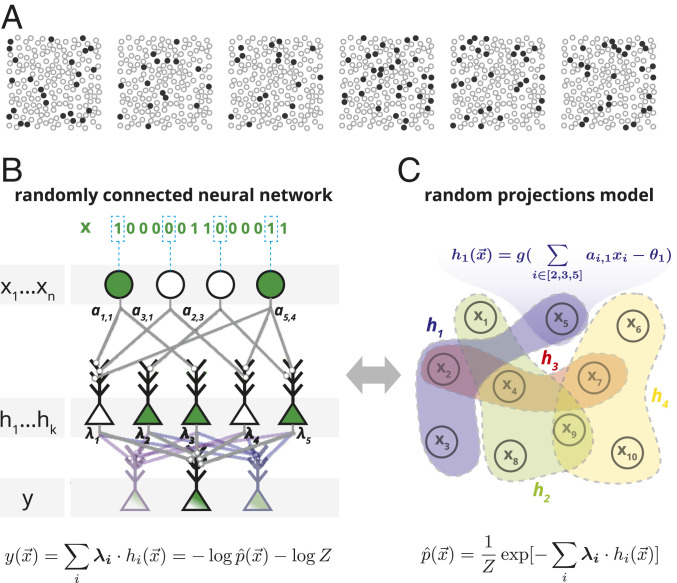
Significance: We present a theory of neural circuits’ design and function, inspired by the random connectivity of real neural circuits and the mathematical power of random projections. Specifically, we introduce a family of statistical models for large neural population codes, a straightforward neural circuit architecture that would implement these models, and a biologically plausible learning rule for such circuits. The resulting neural architecture suggests a design principle for neural circuit—namely, that they learn to compute the mathematical surprise of their inputs, given past inputs, without an explicit teaching signal. We applied these models to recordings from large neural populations in monkeys’ visual and prefrontal cortices and show them to be highly accurate, efficient, and scalable.
Overview
The claims and statistics of this paper haven’t been checked yet.
Free: it reads the open-access text and checks the first 5 claims that cite a source we can check. Create a free account to check every claim.
Integrity signals
Registry
Cites
Statistics
Figures
Verification
Claims the paper makes
The claims and statistics of this paper haven’t been checked yet.
Free: it reads the open-access text and checks the first 5 claims that cite a source we can check. Create a free account to check every claim.
Self-check
Percentages, sums and reported differences re-computed from the paper’s own numbers.
The self-check needs the paper’s full text.
Citations
Cites
Advances in neural information processing systems 7
Cios, K., & Shields, M. (1997) · Neurocomputing · doi:10.1016/s0925-2312(97)90018-7 · Cited by 22,059
Reducing the dimensionality of data with neural networks
Hinton, G. E., & Salakhutdinov, R. R. (2006) · Science · doi:10.1126/science.1127647 · Cited by 20,928
Neural networks and physical systems with emergent collective computational abilities.
Hopfield, J. J. (1982) · Proceedings of the National Academy of Sciences · doi:10.1073/pnas.79.8.2554 · Cited by 19,270 · cited 1×
“Top-down approaches suggest biologically plausible circuits that solve particular computational tasks but often rely on explicit “teaching signals” or do not even specify how learning could take place (8–14).”
BackgroundGuide for the Care and Use of Laboratory Animals: Eighth Edition
(2011) · doi:10.17226/12910 · Cited by 16,199
Information theory and statistical mechanics
Jaynes, E. T. (1957) · Physical Review · doi:10.1103/physrev.106.620 · Cited by 12,931 · cited 12×
“Construction of RPs.”
InfluentialAdvances in Neural Information Processing Systems 25
Zhang, Y., Sutton, C. A., Storkey, A., & Zoubin Ghahramani, A. (2012) · Cited by 12,653
A neural substrate of prediction and reward
Schultz, W., Dayan, P., & Montague, P. R. (1997) · Science · doi:10.1126/science.275.5306.1593 · Cited by 9,388 · cited 1×
“The idea that the brain computes the probability of its inputs is supported by evidence of responses to novel inputs or events (28, 29) and has been explored in different contexts such as the hippocampal (30), olfactory (31), and visual (32) systems, as well as in the role of dopamine (33).”
BEAST 2: a software platform for Bayesian evolutionary analysis
Bouckaert, R., Heled, J., Kühnert, D., Vaughan, T., Wu, C.-H., Xie, D., Suchard, M. A., Rambaut, A., & Drummond, A. J. (2014) · PLoS Computational Biology · doi:10.1371/journal.pcbi.1003537 · Cited by 6,527
A method for solving the convex programming problem with convergence rate O(1/k^2)
Nesterov, Y. E. (1983) · Доклады Академии наук · Cited by 6,318
Rao, R. P. N., & Ballard, D. H. (1999) · Nature Neuroscience · doi:10.1038/4580 · Cited by 5,483 · cited 1×
“The idea that the brain computes the probability of its inputs is supported by evidence of responses to novel inputs or events (28, 29) and has been explored in different contexts such as the hippocampal (30), olfactory (31), and visual (32) systems, as well as in the role of dopamine (33).”
Background
Research works printed but not linked: 2
- Gibbs J. W., Elementary Principles of Statistical Mechanics (Dover Publications, NY; Reprint Edition, 2014).
- Nesterov Y., A method of solving a convex programming problem with convergence rate O (1/k2). Soviet Mathematics Doklady 27, 372– 376 (1983).
Cited by
Alhamrouni, I., Abdul Kahar, N. H., Salem, M., Swadi, M., Zahroui, Y., Kadhim, D. J., Mohamed, F. A., & Alhuyi Nazari, M. (2024) · Applied Sciences · doi:10.3390/app14146214 · Cited by 217
“An artificial neural network (ANN) [38] is a system inspired by biology that converts one set of inputs into another set of outputs using a network of neurons.”
BackgroundSequential and efficient neural-population coding of complex task information
Koay, S. A., Charles, A. S., Thiberge, S. Y., Brody, C. D., & Tank, D. W. (2021) · Neuron · doi:10.1016/j.neuron.2021.10.020 · Cited by 91
A neuroscience-inspired spiking neural network for EEG-based auditory spatial attention detection
Faghihi, F., Cai, S., & Moustafa, A. A. (2022) · Neural Networks · doi:10.1016/j.neunet.2022.05.003 · Cited by 45
Rational thoughts in neural codes
Wu, Z., Kwon, M., Daptardar, S., Schrater, P., & Pitkow, X. (2020) · Proceedings of the National Academy of Sciences · doi:10.1073/pnas.1912336117 · Cited by 27
Toward Principles of Brain Network Organization and Function
Kulkarni, S., & Bassett, D. S. (2025) · Annual Review of Biophysics · doi:10.1146/annurev-biophys-030722-110624 · Cited by 37
Cohen, Y., Schneidman, E., & Paz, R. (2021) · Neuron · doi:10.1016/j.neuron.2020.12.027 · Cited by 29
“This complements the recent emphasis on neural ensembles to decode behavior from mixed representations (Golub et al., 2018; Grewe et al., 2017; Gr€ undemann et al., 2019; Karpas et al., 2019; Levy et al., 2019; Mante et al., 2013; Maoz et al., 2020; Rigotti et al., 2013).”
BackgroundSelf-citationModelling the neural code in large populations of correlated neurons
Sokoloski, S., Aschner, A., & Coen-Cagli, R. (2021) · eLife · doi:10.7554/elife.64615 · Cited by 14
“Firstly, for recordings of binary spikecounts, pairwise-maximum entropy models (Schneidman et al., 2006; Lyamzin et al., 2010; Granot-Atedgi et al., 2013; Tkačik et al., 2013; Meshulam et al., 2017; Maoz et al., 2020) have been used to investigate the structure of the retinal code (Ganmor et al.”
MethodClustering of Neural Activity: A Design Principle for Population Codes
Berry, M. J., & Tkačik, G. (2020) · Frontiers in Computational Neuroscience · doi:10.3389/fncom.2020.00020 · Cited by 21
Self-citationLearning the Architectural Features That Predict Functional Similarity of Neural Networks
Haber, A., & Schneidman, E. (2022) · Physical Review X · doi:10.1103/physrevx.12.021051 · Cited by 21
Self-citationStatistical mechanics for networks of real neurons
Meshulam, L., & Bialek, W. (2025) · Reviews of Modern Physics · doi:10.1103/jcrn-3nrc · Cited by 32
Nejatbakhsh, A., Fumarola, F., Esteki, S., Toyoizumi, T., Kiani, R., & Mazzucato, L. (2023) · Physical Review Research · doi:10.1103/physrevresearch.5.043211 · Cited by 19
“Alter-natives such as inverse methods based on Ising models utilize time-consuming learning schemes [64] though recently faster algorithms have been proposed [65,66].”
MethodSelf-citationStrongly correlated spatiotemporal encoding and simple decoding in the prefrontal cortexPreprint
Karpas, E. D., Maoz, O., Kiani, R., & Schneidman, E. (2019) · bioRxiv (Cold Spring Harbor Laboratory) · doi:10.1101/693192 · Cited by 11
Self-citationInferring Higher-Order Couplings with Neural Networks
Decelle, A., Gómez, A. D. J. N., & Seoane, B. (2025) · Physical Review Letters · doi:10.1103/lyny-6r9y · Cited by 20
How Different are Self and Nonself?
Tiffeau-Mayer, A., Levine, J., Russo, C. J., Marcou, Q., Bialek, W., & Greenbaum, B. D. (2026) · PRX Life · doi:10.1103/fbct-vzwm · Cited by 14
The structure and function of neural connectomes are shaped by a small number of design principlesPreprint
Haber, A., Wanner, A. A., Friedrich, R. W., & Schneidman, E. (2023) · bioRxiv (Cold Spring Harbor Laboratory) · doi:10.1101/2023.03.15.532611 · Cited by 14
“The generality of this mathematical framework means that we can naturally extend it to learn a model for the connectome that relies on any combination of the different featuresets simultaneously (as in (38)).”
BackgroundSelf-citationConnectivity Structure and Dynamics of Nonlinear Recurrent Neural Networks
Clark, D. G., Marschall, O., van Meegen, A., & Litwin-Kumar, A. (2025) · Physical Review X · doi:10.1103/2jt7-c8cq · Cited by 18
“This is similar to approaches in statistical physics that aim to recover higher-order correlations by constraining lower-order statistics [38,77,78].”
A thermodynamical model of non-deterministic computation in cortical neural networks
Stoll, E. A. (2023) · Physical Biology · doi:10.1088/1478-3975/ad0f2d · Cited by 9
“Researchers have previously modeled this inherently probabilistic computation with Bayesian statistics [1], random-connection models [2], or Fano factor analysis of spike variance over time [3].”
BackgroundMethodStoll, E. A. (2022) · bioRxiv (Cold Spring Harbor Laboratory) · doi:10.1101/2022.12.03.518989 · Cited by 7
“Meanwhile, signaling outcomes for cortical neurons are highly unpredictable [14, 15].”
BackgroundThe Mechanics Underpinning Non-Deterministic Computation in Cortical Neural Networks
Stoll, E. A. (2024) · AppliedMath · doi:10.3390/appliedmath4030043 · Cited by 7
Simplest Model of Nervous System. I. FormalismPreprint
Sinitskiy, A. V. (2023) · bioRxiv (Cold Spring Harbor Laboratory) · doi:10.1101/2023.11.23.568481 · Cited by 6
Stoll, E. A. (2024) · Frontiers in Cognition · doi:10.3389/fcogn.2023.1171273 · Cited by 5
“This relationship is provided in Equation 1: Yet in cortical neural networks, a statistically random ensemble of cells fires synchronously at periodic intervals (Beck et al., 2008; Maoz et al., 2020).”
InfluentialHahn, M. A., Lendner, J. D., Anwander, M., Slama, S. J. K., Knight, R. T., Lin, J. J., & Helfrich, R. F. (2024) · Progress in Neurobiology · doi:10.1016/j.pneurobio.2024.102672 · Cited by 6
“M.A. Hahn et al. Progress in Neurobiology 242 (2024) 102672”
BackgroundLong- and short-term history effects in a spiking network model of statistical learning
Maes, A., Barahona, M., & Clopath, C. (2023) · Scientific Reports · doi:10.1038/s41598-023-39108-3 · Cited by 5
“Previous studies have proposed, similarly, plasticity mechanisms in feedforward excitatory synapses (Park and Geffen 2020; Maoz et al. 2020).”
ResultHomeostatic synaptic normalization optimizes learning in network models of neural population codes
Mayzel, J., & Schneidman, E. (2024) · eLife · doi:10.7554/elife.96566.3 · Cited by 7
Self-citationPreserving predictive information under biologically plausible compression
Durian, S. C. L., Bojanek, K., Marre, O., & Palmer, S. E. (2026) · PNAS Nexus · doi:10.1093/pnasnexus/pgag224 · Cited by 3
“This result is along the same lines as recent findings showing that random projections preserve input information in cortex (16, 19).”
Consciousness, Exascale Computational Power, Probabilistic Outcomes, and Energetic Efficiency
Stoll, E. A. (2023) · Cognitive Science · doi:10.1111/cogs.13272 · Cited by 3
Subunit-specific behavioral modulation of sensory tuning in the visual cortex
Mayer, J. M., & Młynarski, W. F. (2026) · PLoS Computational Biology · doi:10.1371/journal.pcbi.1014123 · Cited by 2
“Third, random grouping requires less fine-tuning, and the nervous system could easily implement such a pooling scheme [24,25].”
Random-with-constraints: Constructing minimal models for high-dimensional biology
Nemenman, I. M., & Mehta, P. (2026) · Proceedings of the National Academy of Sciences · doi:10.1073/pnas.2526777123 · Cited by 3
Thermodynamic analog of integrate-and-fire neuronal networks by maximum entropy modelling
Simões, T. D. S. A. D. N., Filho, C. I. N. S., Herrmann, H. J., Andrade, J. S., & de Arcangelis, L. (2024) · Scientific Reports · doi:10.1038/s41598-024-60117-3 · Cited by 3
“Similar MEM procedures allow the study of much larger sizes, such as the so-called restricted Boltzmann Machine 59 or a random projection model 60 , but the resulting maximum entropy distributions from these approaches are no longer analogous to that of an Ising model, and the thermodynamical…”
MethodProbabilistic Models, Compressible Interactions, and Neural Coding
Ramirez, L., Bialek, W., Palmer, S. E., & Schwab, D. J. (2026) · PRX Life · doi:10.1103/pj4s-g4jc · Cited by 5
“The maximum entropy approach has been extended to match global features of the data [26], subsets of higher–order correlations [33], nonlinear transformations of the effective energy [34], or the expectation values of thresholded projections of the data as might be computed by real neurons [35].”
BioMotion-SNN: Spiking neural network modeling for visual motion processing
Liu, Y., Mei, J., Feng, T., Zhang, T., Qu, H., & Zhang, Y. (2025) · Neural Networks · doi:10.1016/j.neunet.2025.108239 · Cited by 3
A Simple Self-Decoding Model for Neural Coding
Bui, T. V. (2024) · IEEE International Symposium on Information Theory (ISIT) · doi:10.1109/isit57864.2024.10619397 · Cited by 2
“Followed that work, Maoz et al. [37] proposed a neural code based on the sparse and random connectivity of real neural circuits to estimate spiking patterns in brain.”
BackgroundHomeostatic synaptic normalization optimizes learning in network models of neural population codesPreprint
Mayzel, J., & Schneidman, E. (2024) · eLife · doi:10.7554/elife.96566.2 · Cited by 4
Self-citationHomeostatic synaptic normalization optimizes learning in network models of neural population codesPreprint
Mayzel, J., & Schneidman, E. (2024) · eLife · doi:10.7554/elife.96566.1 · Cited by 4
Self-citationA non-memory-based functional neural framework for animal caching behavior
Mordechay, S., & Forkosh, O. (2024) · Scientific Reports · doi:10.1038/s41598-024-68003-8
Mayzel, J., & Schneidman, E. (2024) · eLife · doi:10.7554/elife.96566.3.sa2
Self-citationLow-dimensional prefrontal representations of objects during working memoryPreprint
Sakelliadou, D. G., Brincat, S. L., Lundqvist, M., & Miller, E. K. (2026) · bioRxiv (Cold Spring Harbor Laboratory) · doi:10.64898/2026.06.03.729348 · Cited by 1
Kirkeby-Hinrup, A., & Stoll, E. A. (2026) · Frontiers in Human Neuroscience · doi:10.3389/fnhum.2026.1816314
“In fact, it is impossible to effectively model cortical neuron activity without incorporating this random electrical noise (Faisal et al., 2008; Maoz et al., 2020; S. Ostojic et al., 2009; Roxin et al., 2011; Stacey et al., 2011).”
Ethological variability shapes the structure and content of sensory population codesPreprint
Yuan, A. (., Li, H., Katzner, S., Busse, L., & Młynarski, W. F. (2026) · bioRxiv (Cold Spring Harbor Laboratory) · doi:10.64898/2026.10.13.758815
“Because the number of possible spike patterns grows exponentially with population size, quantifying dLGN coding during behavior requires a statistical model that captures the essential structure of population activity [34, 35, 37, 39].”
Metadata
- Authors
- Maoz, O., Tkačik, G., Esteki, M. S., Kiani, R., & Schneidman, E.
- Affiliations
- Weizmann Institute of Science (IL)
- Institute of Science and Technology Austria (AT)
- Center for Neural Science, New York University, New York, NY 10003;
- NYU Langone Health (US)
- Corresponding author
- Kiani, Roozbeh
- Schneidman, Elad
- Venue
- Proceedings of the National Academy of Sciences
- Publisher
- National Academy of Sciences
- Published
- 2020-09-18
- Volume
- 117
- Issue
- 40
- Pages
- 25066-25073
- ISSN
- 0027-8424 (ISSN-L)
- 1091-6490
- PMC
- PMC7547210
- OpenAlex
- W3087227179
- Cited by
- 44
- References
- 76
- Citations by year
- 2026: 8 · 2025: 5 · 2024: 13 · 2023: 6 · 2022: 4 · 2021: 4 · 2020: 3
- FWCI
- 2.28
- Type
- journal article
- Language
- en
- Open access
- hybrid
- doi.org
- Licence
- Locations
- Proceedings of the National Academy of Sciences (publishedVersion, cc-by-nc-nd)
- bioRxiv (Cold Spring Harbor Laboratory) (acceptedVersion)
- PubMed Central (publishedVersion, cc-by-nc-nd)
- PubMed (publishedVersion)
- Funders
- EC | FP7 | FP7 Ideas: European Research Council (311238)
- Israel Science Foundation (1629/12)
- HHS | NIH | National Institute of Mental Health (R01MH109180)
- Simons Foundation (542997)
- United States - Israel Binational Science Foundation (2014607)
- Pew Charitable Trusts (0)
- Topics
- Life Sciences › Neuroscience › Cognitive Neuroscience › Neural dynamics and brain function
- Physical Sciences › Computer Science › Artificial Intelligence › Neural Networks and Applications
- Life Sciences › Neuroscience › Cognitive Neuroscience › Memory and Neural Mechanisms
- Keywords
- spike-based computation, local learning rules, neural noise, monkey visual cortex, prefrontal cortex
- MeSH terms
- Machine Learning, Action Potentials, Algorithms, Brain, Humans, Models, Neurological, Nerve Net, Neuronal Plasticity, Neurons, Neural Networks, Computer
About these checks
Registry, retraction, Cites and statistics results are computed, not judged, with one exception: a printed reference that no index lists is read once by a model before it counts as a citation error. Claims are extracted by a model and kept only when their quote appears verbatim in the text; each cited source is then checked, with a model’s help, for whether it says what the claim relies on. Those verdicts can be wrong — read the claim’s quote and the cited source before relying on one.
Statistics and arithmetic are recomputed, not judged.
Confidence bands are shown only for fields calibrated on our annotated test set. None is calibrated yet, so no band is shown.
What counts as a claim ›How we measure confidence ›How we check this ›
Are you an author, or do you see a problem with this page? Request a review
Data sources
Bibliographic data: Semantic Scholar, OpenAlex, Crossref.
Contains information from the Semantic Scholar Academic Graph Datasets, made available under the ODC Attribution License (ODC-BY 1.0).
Semantic Scholar’s data is described in: Kinney, R., et al. (2023). The Semantic Scholar Open Data Platform. arXiv:2301.10140.
