

One model for the learning of language
Open accessThe DOI matches its Crossref record; 193 of the 193 references it cites were found in a registry or an index.
Abstract
Significance: It has long been hypothesized that language acquisition may be impossible without innate knowledge of the structures that occur in natural language. Here, we show that a domain general learning setup, originally developed in cognitive psychology to model rule learning, is able to acquire key pieces of natural language from relatively few examples of sentences. This develops a new approach to formalizing linguistic learning and highlights some features of language and language acquisition that may arise from general cognitive processes.
Overview
The claims and statistics of this paper haven’t been checked yet.
Free: it reads the open-access text and checks the first 5 claims that cite a source we can check. Create a free account to check every claim.
Integrity signals
Registry
Cites
Statistics
Figures
Verification
Claims the paper makes
The claims and statistics of this paper haven’t been checked yet.
Free: it reads the open-access text and checks the first 5 claims that cite a source we can check. Create a free account to check every claim.
Claims other papers make about this one
Each is checked against this paper’s own text: does it say what the citing paper says it does?
The source backs part of the claim, not all of it — or backs it for a different population, condition or comparison.
In the citing paper
“This pattern is highly characteristic of more traditional symbolic systems, which also prefer solutions with low description length [63] and have been engineered specifically to ‘refactor’ their representations during training to decrease description length of more general concepts [64].”
From Symbols and grounding in large language models (2023) · cites this paper as [63]
Experimental — accuracy not yet measured
Self-check
Percentages, sums and reported differences re-computed from the paper’s own numbers.
The self-check needs the paper’s full text.
Citations
Cites
LeCun, Y., Bengio, Y., & Hinton, G. (2015) · Nature · doi:10.1038/nature14539 · Cited by 84,126
Parallel Distributed Processing: Explorations in the Microstructure of Cognition: Foundations
Rumelhart, D. E., McClelland, J. L., & AU (1986) · doi:10.7551/mitpress/5236.001.0001 · Cited by 15,686
Elman, J. L. (1990) · Cognitive Science · doi:10.1207/s15516709cog1402_1 · Cited by 11,212
Introduction to automata theory, languages and computation
(1981) · Mathematics and Computers in Simulation · doi:10.1016/0378-4754(81)90068-9 · Cited by 10,699
Foundations of statistical natural language processing
Manning, C. D., & Schütze, H. (1999) · Cited by 9,816
Chomsky, N. (2014) · The MIT Press eBooks · doi:10.7551/mitpress/9780262527347.001.0001 · Cited by 8,244 · cited 1×
“The functions pair and append are similar in spirit to “merge” in minimalist linguistics (89, 90), except they come with none of the associated machinery that is required in those theories; here, they only concatenate.”
Chomsky, N. (1957) · doi:10.1515/9783112316009 · Cited by 7,885
Statistical learning by 8-month-old infants
Saffran, J. R., Aslin, R. N., & Newport, E. L. (1996) · Science · doi:10.1126/science.274.5294.1926 · Cited by 5,659
The faculty of language: what is it, who has it, and how did it evolve?
Hauser, M. D., Chomsky, N., & Fitch, W. T. (2002) · Science · doi:10.1126/science.298.5598.1569 · Cited by 5,189
Language identification in the limit
Gold, E. M. (1967) · Information and Control · doi:10.1016/s0019-9958(67)91165-5 · Cited by 3,572 · cited 2×
“Perhaps the most influential formal result is Gold’s Theorem (1), which implies that there are classes of even regular languages (2) which contain members that cannot be identified by learners who rely on positive examples alone.”
Research works printed but not linked: 34
- N. Chomsky, Aspects of the Theory of Syntax (MIT Press, Cambridge, MA, 1965).
- D. N. Osherson, M. Stob, S. Weinstein, Systems that Learn: An Introduction to Learning Theory for Cognitive and Computer Scientists (MIT Press, 1986).
- J. J. Horning, “A study of grammatical inference,” PhD thesis, Stanford University, Stanford, CA (1969).
- A. Clark, S. Lappin, Linguistic Nativism and the Poverty of the Stimulus (John Wiley, 2010).
- R. Siegler, J. Shrager, “ Strategy choices in addition and subtraction: How do children know what to do?” in Origins of Cognitive Skills, C. Sophian, Ed. (Lawrence Erlbaum Associates, 1984), pp. 229– 293.
- R. Siegler, E. Jenkins, How Children Discover New Strategies (Lawrence Erlbaum Associates, 1989).
- A. Gopnik, A. N. Meltzoff, P. K. Kuhl, The Scientist in the Crib: What Early Learning Tells Us about the Mind (Perennial, New York, NY, 2001).
- P. Langley, G. L. Bradshaw, H. A. Simon, BACON.5: The discovery of conservation laws. IJCAI 81, 121– 126 (1981).
- J. Koza, Genetic Programming: On the Programming of Computers by Means of Natural Selection (MIT Press, Cambridge, MA, 1992).
- G. Boole, An Investigation of the Laws of Thought: On Which Are Founded the Mathematical Theories of Logic and Probabilities (Walton and Maberly, London, United Kingdom, 1854).
- J. Fodor, The Language of Thought (Harvard University Press, Cambridge, MA, 1975).
- I. Heim, A. Kratzer, Semantics in Generative Grammar (Wiley-Blackwell, Malden, MA, 1998).
- S. T. Piantadosi, “Learning and the language of thought,” PhD thesis, Massachusetts Institute of Technology, Cambridge, MA (2011).
- N. D. Goodman, J. B. Tenenbaum, T. Gerstenberg, Concepts in a Probabilistic Language of Thought (MIT Press, 2015).
- M. C. Corballis, The Recursive Mind: The Origins of Human Language, Thought, and Civilization (Princeton University Press, 2011).
- R. Huybregts, “ The weak inadequacy of context-free phrase structure grammars” in Van periferie naar kern, G.J. de Haan, M. Trommelen, W. Zonneveld, Eds. (Foris, Dordrecht, The Netherlands, 1984), pp. 81– 99.
- Y. Bar-Hillel, E. Shamir, Finite-state languages: Formal representations and adequacy problems. Bull. Res. Counc. Isr. 8F, 155– 166 (1960).
- P. M. Postal, “ Limitations of phrase-structure grammars” in The Structure of Language: Readings in the Philosophy of Language, J. Fodor, J. Katz, Eds. (Prentice-Hall, Englewood Cliffs, NJ, 1964), pp. 137– 151.
- C. Yang, The Infinite Gift (Simon and Schuster, New York, NY, 2006).
- A. Carnie, Syntax: A Generative Introduction (John Wiley, 2013).
- E. W. Bach, Discontinuous constituents in generalized categorial grammar. North East Linguistic Soc. 11, 1– 12 (1981).
- D. Marr, Vision: A Computational Investigation into the Human Representation and Processing of Visual Information (W.H. Freeman, 1982).
- G. F. Marcus, The Algebraic Mind: Integrating Connectionism and Cognitive Science (MIT Press, 2003).
- N. Chomsky., Language and Problems of Knowledge: The Managua Lectures (MIT Press, 1988).
- C. L. Baker, Syntactic theory and the projection problem. Linguist. Inq. 10, 533– 581 (1979).
- S. Crain, “ The semantic subset principle in the acquisition of quantification” in Workshop on the Acquisition of WH-Extraction and Related Work on Quantification (University of Massachusetts, Amherst, MA, 1992).
- M. Bowerman, “ The ‘no negative evidence’ problem: How do children avoid constructing an overly general grammar?” in Explaining Language Universals, J.A. Hawkins, Ed. (Basil Blackwell, 1988), pp. 73– 101.
- A. E. Goldberg, Constructions at Work: The Nature of Generalization in Language (Oxford University Press on Demand, 2006).
- B. MacWhinney, The CHILDES Project: Tools for Analyzing Talk (Lawrence Erlbaum, Hillsdale, NJ, 2000).
- J. Borges, The Library of Babel in Labyrinths (Penguin, Harmondsworth, United Kingdom, 1970).
- P. Smolensky, G. Legendre, The Harmonic Mind (MIT Press, Cambridge, MA, 2006).
- T. Hunter, “ The Chomsky Hierarchy” in A Companion to Chomsky, N. Allott, T. Lohndal, G. Rey, Eds. (Blackwell, 2020), pp. 74– 95.
- M. Tomasello, Constructing a Language: A Usage-Based Theory of Language Acquisition (Harvard University Press, 2009).
- O. Tange, Gnu parallel – The command-line power tool.; login. The USENIX Mag. 36, 42– 47 (2011).
Cited by
Building machines that learn and think with people
Collins, K. M., Sucholutsky, I., Bhatt, U., Chandra, K., Wong, L., Lee, M., Zhang, C. E., Zhi-Xuan, T., Ho, M., Mansinghka, V., et al. (2024) · Nature Human Behaviour · doi:10.1038/s41562-024-01991-9 · Cited by 73
“…word learning 160 , to visual perception 161,162 , physical reasoning 99,163,164 , concept learning 165–167 , language processing and acquisition 158,168–170 , causal inference in children 171,172 and adults 173,174 , memory reconstruction 175 , and theory formation 176,177 , among many others.”
Symbols and mental programs: a hypothesis about human singularity
Dehaene, S., Al Roumi, F., Lakretz, Y., Planton, S., & Sablé-Meyer, M. (2022) · Trends in Cognitive Sciences · doi:10.1016/j.tics.2022.06.010 · Cited by 189
“Recent simulations suggest that a single Bayesian selection algorithm may learn many different languages and data structures [93,136].”
BackgroundUsing Computational Models to Test Syntactic Learnability
Wilcox, E. G., Futrell, R., & Levy, R. (2024) · Linguistic Inquiry · doi:10.1162/ling_a_00491 · Cited by 62
What Artificial Neural Networks Can Tell Us about Human Language Acquisition
Warstadt, A., & Bowman, S. R. (2022) · Algebraic Structures in Natural Language · doi:10.1201/9781003205388-2 · Cited by 111
How linguistics learned to stop worrying and love the language models
Futrell, R., & Mahowald, K. (2025) · Behavioral and Brain Sciences · doi:10.1017/s0140525x2510112x · Cited by 104
Symbols and grounding in large language models
Pavlick, E. (2023) · Philosophical Transactions of the Royal Society A: Mathematical, Physical and Engineering Sciences · doi:10.1098/rsta.2022.0041 · Cited by 95
“This pattern is highly characteristic of more traditional symbolic systems, which also prefer solutions with low description length [63] and have been engineered specifically to ‘refactor’ their representations during training to decrease description length of more general concepts [64].”
BackgroundA critical review of large language models: Sensitivity, bias, and the path toward specialized AI
Hajikhani, A., & Cole, C. H. (2024) · Quantitative Science Studies · doi:10.1162/qss_a_00310 · Cited by 95
“5’s performance on prescribed descriptions versus GPT description, firms founded after September 2021 were removed from the sample.”
BackgroundUniquely human intelligence arose from expanded information capacity
Cantlon, J. F., & Piantadosi, S. T. (2024) · Nature Reviews Psychology · doi:10.1038/s44159-024-00283-3 · Cited by 76
“Domain-general pattern learning models are able to find concise algorithmic descriptions of discrete data sequences 303 .”
Self-citationModeling rapid language learning by distilling Bayesian priors into artificial neural networks
McCoy, R. T., & Griffiths, T. L. (2025) · Nature Communications · doi:10.1038/s41467-025-59957-y · Cited by 70
Hosseini, E. A., Schrimpf, M., Zhang, Y., Bowman, S., Zaslavsky, N., & Fedorenko, E. (2024) · Neurobiology of Language · doi:10.1162/nol_a_00137 · Cited by 63
The relational bottleneck as an inductive bias for efficient abstraction
Webb, T. W., Frankland, S., Altabaa, A., Segert, S., Krishnamurthy, K., Campbell, D. I., Russin, J., Giallanza, T., O’Reilly, R. C., Lafferty, J., et al. (2024) · Trends in Cognitive Sciences · doi:10.1016/j.tics.2024.04.001 · Cited by 57
An s-frame agenda for behavioral public policy research
Connolly, D. J., Loewenstein, G. F., & Chater, N. (2024) · Behavioural Public Policy · doi:10.1017/bpp.2024.58 · Cited by 53
Symbolic metaprogram search improves learning efficiency and explains rule learning in humans
Rule, J., Piantadosi, S. T., Cropper, A., Ellis, K., Nye, M., & Tenenbaum, J. B. (2024) · Nature Communications · doi:10.1038/s41467-024-50966-x · Cited by 46
“We compare MPL to a variety of symbolic, neural, and neurosymbolic models of learning, namely Fleet 42 , Enumerate 71 , Metagol 81 , RobustFill 82 , and Codex 83 (See Methods for additional motivation and details oneachmodel).”
MethodInfluentialSelf-citationRitonga, M., Hakim, R., Nurdianto, T., & Ritonga, A. W. (2023) · Education and Information Technologies · doi:10.1007/s10639-022-11575-7 · Cited by 41
“Arabic learning media for children at this age which is quite effective and efficient is used in various learning models such as vocabulary recognition, choosing sentence structures, and using the right words (Yang & Piantadosi, 2022).”
MethodMeta-learned models of cognition
Binz, M., Dasgupta, I., Jagadish, A. K., Botvinick, M., Wang, J. X., & Schulz, E. (2024) · Behavioral and Brain Sciences · doi:10.1017/s0140525x23003266 · Cited by 38
Wong, L., Grand, G., Lew, A. K., Goodman, N. D., Mansinghka, V. K., Andreas, J., & Tenenbaum, J. B. (2023) · arXiv · doi:10.48550/arxiv.2306.12672 · Cited by 36
Bayes in the Age of Intelligent Machines
Griffiths, T. L., Zhu, J.-Q., Grant, E., & McCoy, R. T. (2024) · Current Directions in Psychological Science · doi:10.1177/09637214241262329 · Cited by 35
“The resulting neural network can learn new formal languages from the same amount of data as a Bayesian model that uses a prior distribution defined over symbolic grammars (Yang & Piantadosi, 2022).”
Minimum Description Length Recurrent Neural Networks
Lan, N., Geyer, M., Chemla, E., & Katzir, R. (2022) · Transactions of the Association for Computational Linguistics · doi:10.1162/tacl_a_00489 · Cited by 31
Origins of numbers: a shared language-of-thought for arithmetic and geometry?
Dehaene, S., Sablé-Meyer, M., & Ciccione, L. (2025) · Trends in Cognitive Sciences · doi:10.1016/j.tics.2025.03.001 · Cited by 32
Algorithms of adaptation in inductive inference
Fränken, J.-P., Theodoropoulos, N. C., & Bramley, N. R. (2022) · Cognitive Psychology · doi:10.1016/j.cogpsych.2022.101506 · Cited by 28
Enhancing Contextual Understanding of Mistral LLM with External Knowledge BasesPreprint
Sasaki, M., Watanabe, N., & Komanaka, T. (2024) · Research Square · doi:10.21203/rs.3.rs-4215447/v1 · Cited by 39
Trustworthy AI Alone Is Not Enough.
y Madrid, A. P., & Wright, C. (2023) · Dykinson eBooks · doi:10.2307/jj.8500773 · Cited by 26
Kidd, E., Arciuli, J., Christiansen, M. H., & Smithson, M. J. (2023) · Cognitive Development · doi:10.1016/j.cogdev.2023.101335 · Cited by 27
“Such findings support the suggestion that SL abilities support language acquisition (Arciuli & Conway, 2018; Christiansen & Chater, 2016; McCauley & Christiansen, 2019; Saffran et al., 1996; Tomasello, 2003; Yang & Piantadosi, 2022).”
Humans and language models diverge when predicting repeating text
Vaidya, A. R., Turek, J. S., & Huth, A. G. (2023) · Conference on Computational Natural Language Learning · doi:10.18653/v1/2023.conll-1.5 · Cited by 22
Nefdt, R. M. (2025) · Cambridge University Press eBooks · doi:10.1017/9781009491952 · Cited by 29
A model for learning strings is not a model of language
Murphy, E., & Leivada, E. (2022) · Proceedings of the National Academy of Sciences · doi:10.1073/pnas.2201651119 · Cited by 18
The algorithmic origins of counting
Piantadosi, S. T. (2023) · Child Development · doi:10.1111/cdev.14031 · Cited by 17
Self-citationLanguages with more speakers tend to be harder to (machine-)learn
Koplenig, A., & Wolfer, S. (2023) · Scientific Reports · doi:10.1038/s41598-023-45373-z · Cited by 15
Are Large Language Models Reliable AI Scientists? Assessing Reverse-Engineering of Black-Box SystemsPreprint
Geng, J., Chen, H., Arumugam, D., & Griffiths, T. L. (2025) · arXiv (Cornell University) · doi:10.48550/arxiv.2505.17968 · Cited by 16
“We define 46 distinct black boxes each based on a language from Yang & Piantadosi [79] or McCoy & Griffiths [48].”
Origins of Hierarchical Logical Reasoning
Dedhe, A. M., Clatterbuck, H., Piantadosi, S. T., & Cantlon, J. F. (2023) · Cognitive Science · doi:10.1111/cogs.13250 · Cited by 14
“Machines also struggle to learn hierarchical structures (Elman, 1990; Kirov & Frank, 2012; Larketz et al., 2021; though see Murty et al., 2022; Yang & Piantadosi, 2022).”
BackgroundSelf-citationRelational Decomposition for Program Synthesis
Hocquette, C., & Cropper, A. (2025) · International Joint Conference on Artificial Intelligence · doi:10.24963/ijcai.2025/504 · Cited by 14
In-Context Learning Dynamics with Random Binary Sequences
Bigelow, E., Lubana, E. S., Dick, R. P., Tanaka, H., & Ullman, T. D. (2024) · International Conference on Learning Representations · doi:10.48550/arxiv.2310.17639 · Cited by 13
“Our method of studying learning as probabilistic inference over formal languages with varying | x | is also similar to Goodman et al. (2008); Piantadosi et al. (2012); Yang & Piantadosi (2022); Bigelow & Piantadosi (2016), who use more sophisticated grammar-based models of concept learning.”
Biolinguistics and biological systems: a complex systems analysis of language
Nefdt, R. M. (2023) · Biology & Philosophy · doi:10.1007/s10539-023-09903-3 · Cited by 12
“See Yang and Piantadosi (2022) for a recent empiricist model of language learning which uses data from 74 languages.”
BackgroundMultiplicative processing in the modeling of cognitive activities in large neural networks
Valle-Lisboa, J. C., Pomi, A., & Mizraji, E. (2023) · Biophysical Reviews · doi:10.1007/s12551-023-01074-5 · Cited by 12
“But before that, we want to notice that, interestingly, tensor product nets became recently part of the computational tools of deep learning models (see, for example Yu et al. (2012); Cohen et al.”
BackgroundProgram-Based Strategy Induction for Reinforcement LearningPreprint
Correa, C. G., Griffiths, T. L., & Daw, N. D. (2024) · arXiv (Cornell University) · doi:10.48550/arxiv.2402.16668 · Cited by 12
“Pro-posal distributions are subtree-regeneration (Goodman et al., 2008), and resampling a primitive (retaining arguments), swapping arguments, inserting a subtree between a parent and child, and deleting a subtree while retaining an ancestor (Yang & Piantadosi, 2022).”
BackgroundMethodInfluentialCognitive Mechanisms Underlying Recursive Pattern Processing in Human Adults
Dedhe, A. M., Piantadosi, S. T., & Cantlon, J. F. (2023) · Cognitive Science · doi:10.1111/cogs.13273 · Cited by 10
“Furthermore, connectionist models tested with comparable sequencing tasks show limited capacity for recursive rule implementation and often struggle with long-range dependencies (Elman, 1990; Kirov & Frank, 2012; Lakretz et al., 2021; but see Yang & Piantadosi, 2022).”
BackgroundSelf-citationModeling Other Minds: A Computational Account of Social Cognition and Its Development
Wang, Z., Davis, I., & Jara‐Ettinger, J. (2025) · Annual Review of Developmental Psychology · doi:10.1146/annurev-devpsych-111323-112016 · Cited by 10
“How this system then proposes and evaluates modifications to the causal model is one of the biggest open questions in computational cognitive science (Griffiths et al. 2024, Ullman et al. 2012, Yang & Piantadosi 2022).”
Acquiring a language vs. inducing a grammar
Dupré, G. (2024) · Cognition · doi:10.1016/j.cognition.2024.105771 · Cited by 9
Human languages trade off complexity against efficiency
Koplenig, A., Wolfer, S., Rüdiger, J. O., & Meyer, P. (2025) · PLOS complex systems. · doi:10.1371/journal.pcsy.0000032 · Cited by 9
Stochastic Lazy Knowledge Compilation for Inference in Discrete Probabilistic Programs
Bowers, M., Lew, A. K., Tenenbaum, J. B., Solar-Lezama, A., & Mansinghka, V. K. (2025) · Proceedings of the ACM on Programming Languages · doi:10.1145/3729325 · Cited by 7
“To evaluate whether LPSMC strikes an e " ective balance between e # ciency and accuracy, we consider its use as a component within a downstream task: probabilistic program synthesis from input-output examples [42, 49, 59].”
20-month-olds can use negative evidence while learning word meanings
de Carvalho, A., & Dautriche, I. (2025) · Cognition · doi:10.1016/j.cognition.2025.106171 · Cited by 6
“…and forms of the language (Angluin, 1980; Christiansen & Chater, 1999; Elman, 1993; Gold, 1967; McMurray, Horst, & Samuelson, 2012; Vong, Wang, Orhan, & Lake, 2024; Xu & Tenenbaum, 2007; Yang & Piantadosi, 2022), leaving aside the role that negative evidence might play in this process.”
Another model not for the learning of language
Kodner, J., Caplan, S., & Yang, C. D. (2022) · Proceedings of the National Academy of Sciences · doi:10.1073/pnas.2204664119 · Cited by 6
Stone tools, predictive processing and the evolution of language
Pain, R. (2022) · Mind & Language · doi:10.1111/mila.12419 · Cited by 4
Distilling Symbolic Priors for Concept Learning into Neural NetworksPreprint
Marinescu, I., McCoy, R. T., & Griffiths, T. L. (2024) · arXiv (Cornell University) · doi:10.48550/arxiv.2402.07035 · Cited by 5
“However, we reran their experiments using the package Fleet (Yang & Piantadosi, 2022) and were able to replicate their results only when including the top rules.”
MethodDo Humans Use Push‐Down Stacks When Learning or Producing Center‐Embedded Sequences?
Ferrigno, S., Cheyette, S., & Carey, S. E. (2025) · Cognitive Science · doi:10.1111/cogs.70112 · Cited by 3
Modeling Infant Object Perception as Program Induction
Fränken, J.-P., Bramley, N. R., Lucas, C. G., & Piantadosi, S. T. (2023) · Conference on Cognitive Computational Neuroscience (CCN) · doi:10.32470/ccn.2023.1073-0 · Cited by 3
“D Inspired by recent advances in Bayesian program learning (Ellis et al., 2021; Tang & Ellis, 2022; Yang & Piantadosi, 2022) and intuitive physics (Piloto, Weinstein, Battaglia, & Botvinick, 2022), we present an idealized model (Figure 1) that discovers object representations and their physical…”
MethodSelf-citationBootstrapping in Geometric Puzzle Solving
Cognitive Science Society 2025, Bramley, N., He, X., & Zhao, B. (2025) · eScholarship (California Digital Library) · doi:10.48448/6nsn-ss79 · Cited by 2
Slow mapping words as incremental meaning refinement
Markham, E., Rabagliati, H., & Bramley, N. R. (2024) · eScholarship (California Digital Library) · Cited by 2
The Application of Deep Learning-Based Natural Language Processing Models in Sentiment Analysis
Liu, Q., & Wang, X. (2024) · International Conference on Electronic Communication and Artificial Intelligence (ICECAI) · doi:10.1109/icecai62591.2024.10674860 · Cited by 2
“A language model represents the probability of any given sentence or sequence occurring in the form of a probability distribution[6].”
BackgroundIs it the end of (generative) linguistics as we know it?Preprint
Chesi, C. (2024) · arXiv (Cornell University) · doi:10.48550/arxiv.2412.12797 · Cited by 2
Learning Model SuccessorsPreprint
Chang, Y., & Bisk, Y. (2025) · arXiv (Cornell University) · doi:10.48550/arxiv.2502.00197 · Cited by 2
“MLP approximates MAP inference in a Bayesian posterior over metaprograms [55, 181].”
Overcoming the Expressivity-Efficiency Tradeoff in Program Induction
Acquaviva, S. (2024) · DSpace@MIT (Massachusetts Institute of Technology) · Cited by 2
Cognitive Models and AI Algorithms Provide Templates for Designing Language AgentsPreprint
Liu, R. W., Arumugam, D., Zhang, C. E., Escola, S., Pitkow, X., & Griffiths, T. L. (2026) · arXiv (Cornell University) · doi:10.48550/arxiv.2602.22523 · Cited by 3
Modeling regularization in language acquisition as noise-tolerant grammar selection
Perkins, L., & Hunter, T. (2025) · Cognition · doi:10.1016/j.cognition.2025.106352 · Cited by 1
Three Tiers of Computation in Transformers and in Brain Architectures
Graham, E., & Granger, R. (2026) · ACM Transactions on Intelligent Systems and Technology · doi:10.1145/3844612 · Cited by 2
Successive-cyclic movement in humans and neural language models: testing wh-filler-gap dependencies
Koo, K., & Kim, H. I. (2026) · Frontiers in Psychology · doi:10.3389/fpsyg.2025.1699740 · Cited by 1
“…grammatical and ungrammatical structures, their findings suggest that models can acquire abstract constraints from raw distributional input alone— relying on domain-general learning mechanisms (Clark and Lappin, 2010; Yang and Piantadosi, 2022), rather than requiring innate syntactic knowledge.”
Children use algorithm induction to discover patterns in data
Pitt, B., Leib, E. R., O’Shaughnessy, D. M., Gallardo, C., Ferrigno, S., & Piantadosi, S. T. (2026) · Nature Communications · doi:10.1038/s41467-026-73029-9 · Cited by 1
“48 to infer the program most likely to have produced each response pattern, regardless of its accuracy (full model available osf.io/eawkh).”
InfluentialSelf-citationMeta-learning as a bridge between neural networks and symbolic Bayesian models
McCoy, R. T., & Griffiths, T. L. (2024) · Behavioral and Brain Sciences · doi:10.1017/s0140525x24000116 · Cited by 1
Reply to Murphy and Leivada: Program induction can learn language
Piantadosi, S. T., & Yang, Y. (2022) · Proceedings of the National Academy of Sciences · doi:10.1073/pnas.2202925119 · Cited by 1
Self-citationOpening the black box of language acquisitionPreprint
Michaud, J., & Jon-And, A. (2024) · arXiv (Cornell University) · doi:10.48550/arxiv.2402.11681 · Cited by 1
“In a recent study a learning model discovers the underlying system in a number of context-free and context-sensitive formal languages through exposure to these languages without any pre-defined hypothesis (Yang and Piantadosi 2022).”
BackgroundNo Such Thing as a General Learner: Language models and their dual optimizationPreprint
Chemla, E., & Nefdt, R. M. (2024) · arXiv (Cornell University) · doi:10.48550/arxiv.2408.09544 · Cited by 1
Towards a Cognitive Science of Large Language Models
Bigelow, E. (2026) · Digital Access to Scholarship at Harvard (DASH) (Harvard University) · Cited by 1
Reply to Kodner et al.: Fundamental misunderstanding of both model and methods
Piantadosi, S. T., & Yang, Y. (2022) · Proceedings of the National Academy of Sciences · doi:10.1073/pnas.2204944119
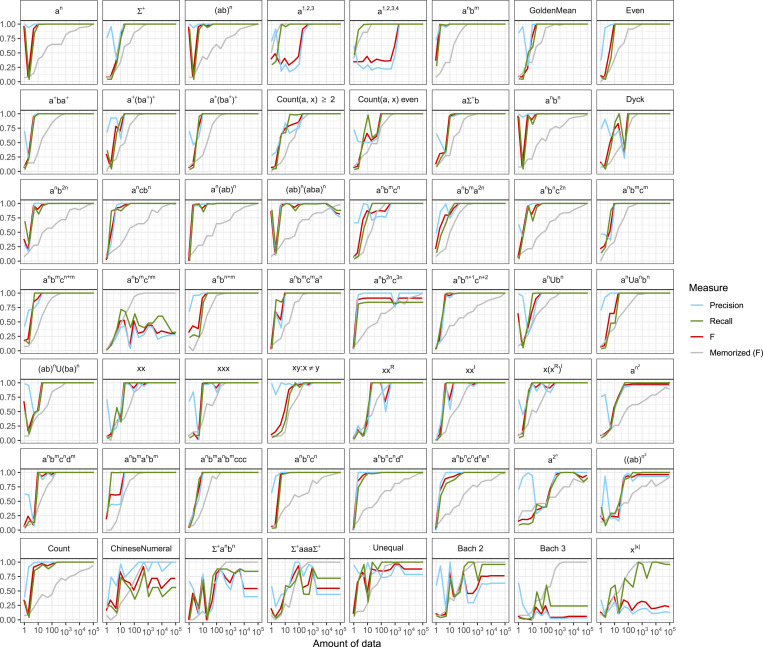
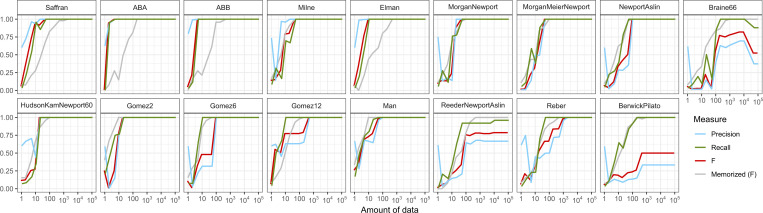
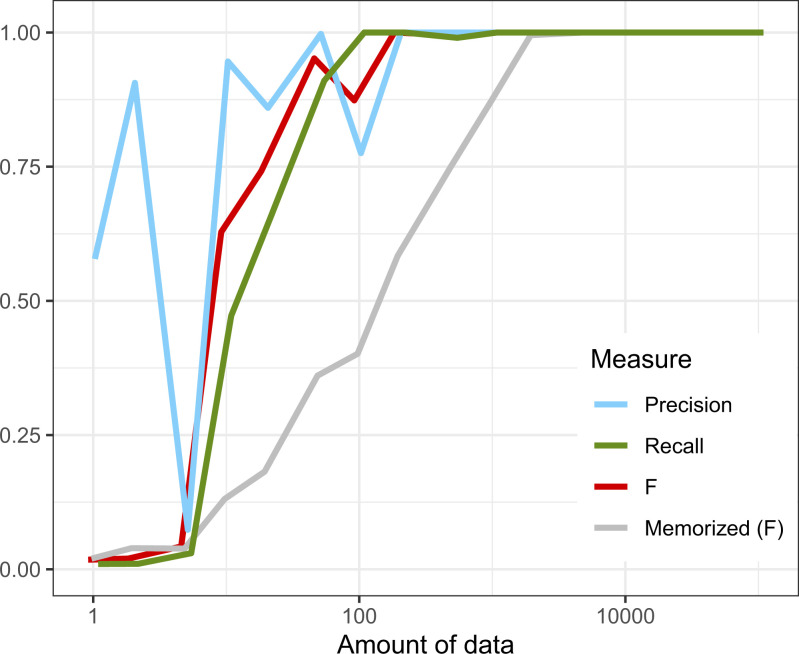
“F-scores (y axis) as a function of amount of data (x axis) for Yang and Piantadosi’s (1) learning model (red), a learner who memorizes data (gray), and the n-gram model suggested by Kodner et al.”
BackgroundMethodSelf-citationLehfeldt, S., Mueller, J. L., & Pipa, G. (2022) · Frontiers in Cognition · doi:10.3389/fcogn.2022.1026819
“Taken together, we argue in favor of views on language acquisition that assign statistical processes an important role, either as sole, unitary mechanisms or as important contributors in concert with other cognitive strategies (Marcus et al., 1999; Endress and Bonatti, 2007; Thiessen et al., 2013; Christiansen and Cha…”
BackgroundSimplicity and learning to distinguish arguments from modifiers
Bergen, L., Gibson, E. A. F., & O’Donnell, T. J. (2022) · Journal of Language Modelling · doi:10.15398/jlm.v10i2.263
Tackling Language Learning: One Model that Rules (Dr. Steven Piantadosi)
Guan, G., Niyogi, A., Palayur, A., & Wiltshire, A. (2022) · Berkeley Scientific Journal · doi:10.5070/bs327161282
Syntax and Geometry of Information
Bailly, R., Leblond, L., & Gábor, K. (2023) · Proceedings of the conference - Association for Computational Linguistics. Meeting · doi:10.18653/v1/2023.acl-long.590
The End of Radical Concept NativismPreprint
Rule, J., & Piantadosi, S. T. (2025) · PsyArXiv (OSF Preprints) · doi:10.31234/osf.io/zs9f6_v1
Self-citationLi, D., & Waxman, S. R. (2025) · Elsevier eBooks · doi:10.1016/b978-0-323-95504-1.00857-7
Pescaru, G.-M., & Pescaru, G.-M. (2025) · UA Campus Repository (The University of Arizona)
Málfregnir 32, 1. tölublað, 21. árgangur
Þorbergsdóttir, Á. (2023) · Opin vísindi (Opin vísindi)
Word embeddings from text corpora: a simulation study on the representation of underlying structures
Otte, W. M., Van Wieringen, A. L. H. M., & Koet, B. J. (n.d.) · PhilPapers (PhilPapers Foundation)
(2025) · The MIT Press eBooks · doi:10.7551/mitpress/15535.003.0018
Cole, C. (2026) · LUTPub (LUT University)
Quantifiers that are more monotone are easier to learn
Haberland, C., & Steinert‐Threlkeld, S. (2025) · Proceedings from Semantics and Linguistic Theory · doi:10.3765/6qa95941 · Cited by 1
Compositionality and the lexicon in evolutionary semanticsPreprint
Carcassi, F. (2026) · arXiv (Cornell University) · doi:10.48550/arxiv.2606.27228 · Cited by 1
Selectivity for high-level language processing is highly localized in individual brainsPreprint
Belisle, R. M., Scott, T. L., & Perrachione, T. K. (2026) · bioRxiv (Cold Spring Harbor Laboratory) · doi:10.64898/2026.07.16.738967
“…with respect to its underlying mental operations (Drakoulaki et al., 2024; Federmeier et al., 2020; Glucksberg et al., 1973; Petkov et al., 2020; Yang & Piantadosi, 2022) and their neurobiological implementation (Fedorenko & Shain, 2021; Fedorenko & Varley, 2016; Fedorenko et al., 2024;…”
Use of symbolic inductive biases for few-shot learning in humans and machines
Marupudi, V., & Piantadosi, S. T. (2026) · eScholarship (California Digital Library)
Self-citationThe attitude filter hypothesis: how strong opinions influence text processing
Deshaies, S.-E. M. (2022) · Illinois Digital Environment for Access to Learning and Scholarship (University of Illinois at Urbana-Champaign)
A Reverse-Gold Theorem: Positive-Data Identification by Substrate-Bounded Contrastive LearnersPreprint
Sengupta, R. (2026) · arXiv (Cornell University) · doi:10.48550/arxiv.2610.28747
“This is the same boundary that separates “fits the closure of the sample” from “identifies the target” (Kodner, Caplan, & Yang, 2022; Yang & Piantadosi, 2022); the right response is to name the criterion exactly, which the theorem does.”
Synthesizing symbolic models of human and machine reasoning at scalePreprint
LeGris, S., Mondorf, P., Jin, J., Jagadish, A. K., Lake, B. M., & Gureckis, T. M. (2026) · arXiv (Cornell University) · doi:10.48550/arxiv.2611.07088
Metadata
- Authors
- Yang, Y., & Piantadosi, S. T.
- Affiliations
- Georgia Institute of Technology (US)
- University of California, Berkeley (US)
- Corresponding author
- Piantadosi, Steven T.
- Venue
- Proceedings of the National Academy of Sciences
- Publisher
- National Academy of Sciences
- Published
- 2022-01-24
- Volume
- 119
- Issue
- 5
- ISSN
- 0027-8424 (ISSN-L)
- 1091-6490
- PMC
- PMC8812683
- OpenAlex
- W2768443630
- Cited by
- 50
- References
- 187
- Citations by year
- 2026: 1 · 2025: 11 · 2024: 12 · 2023: 12 · 2022: 14
- FWCI
- 18.65
- Type
- journal article
- Language
- en
- Open access
- hybrid
- doi.org
- Licence
- Locations
- Proceedings of the National Academy of Sciences (publishedVersion, cc-by)
- PubMed Central (publishedVersion, cc-by)
- PubMed (publishedVersion)
- arXiv (Cornell University) (submittedVersion)
- eScholarship (California Digital Library) (submittedVersion, cc-by)
- arXiv (Cornell University)
- Funders
- NSF (1760874)
- NIH (1R01HD085996)
- Topics
- Social Sciences › Psychology › Developmental and Educational Psychology › Language Development and Disorders
- Social Sciences › Psychology › Experimental and Cognitive Psychology › Categorization, perception, and language
- Social Sciences › Arts and Humanities › Language and Linguistics › Syntax, Semantics, Linguistic Variation
- Keywords
- language acquisition, linguistic learning, rule induction, domain-general learning, formalization of language, cognitive processes
- MeSH terms
- Humans, Language, Learning, Linguistics
About these checks
Registry, retraction, Cites and statistics results are computed, not judged, with one exception: a printed reference that no index lists is read once by a model before it counts as a citation error. Claims are extracted by a model and kept only when their quote appears verbatim in the text; each cited source is then checked, with a model’s help, for whether it says what the claim relies on. Those verdicts can be wrong — read the claim’s quote and the cited source before relying on one.
Statistics and arithmetic are recomputed, not judged.
Confidence bands are shown only for fields calibrated on our annotated test set. None is calibrated yet, so no band is shown.
What counts as a claim ›How we measure confidence ›How we check this ›
Are you an author, or do you see a problem with this page? Request a review
Data sources
Bibliographic data: Semantic Scholar, OpenAlex, Crossref.
Contains information from the Semantic Scholar Academic Graph Datasets, made available under the ODC Attribution License (ODC-BY 1.0).
Semantic Scholar’s data is described in: Kinney, R., et al. (2023). The Semantic Scholar Open Data Platform. arXiv:2301.10140.
