

Neural representational geometry underlies few-shot concept learning
Open accessThe DOI matches its Crossref record; 71 of the 71 references it cites were found in a registry or an index.
Abstract
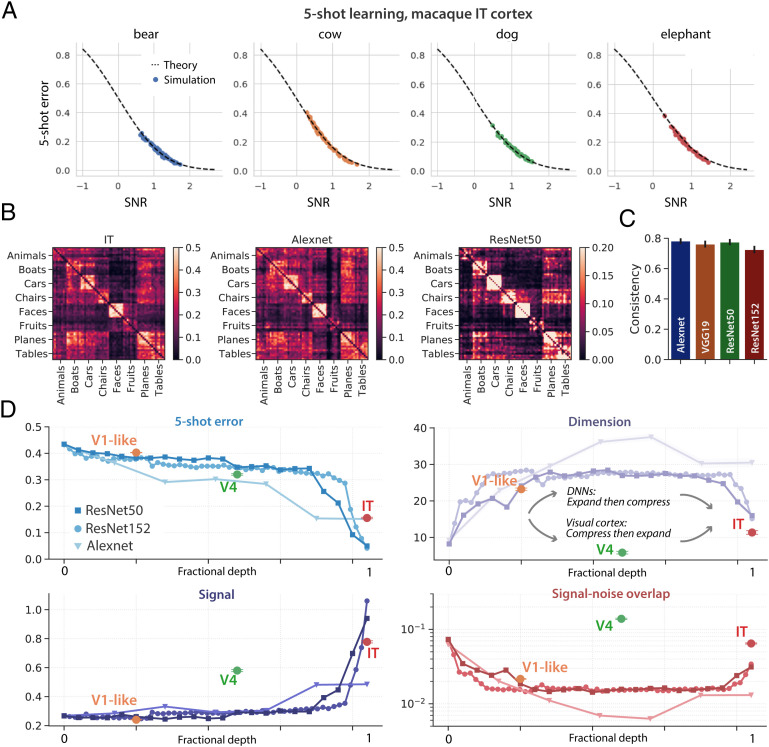
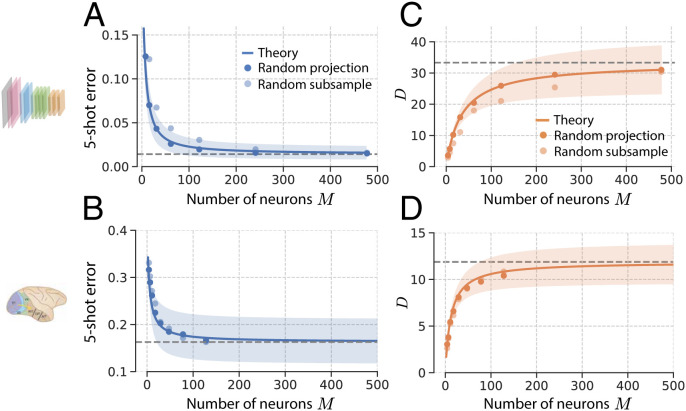
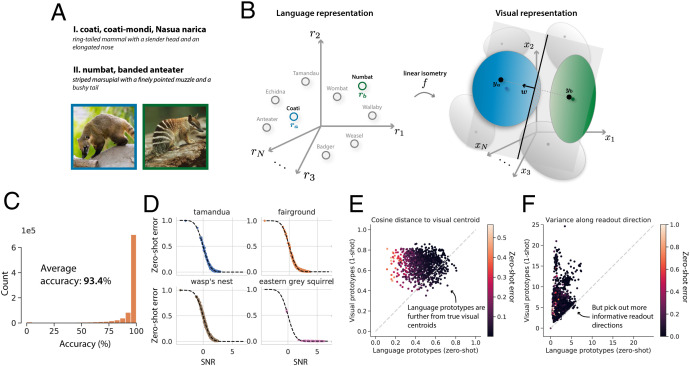
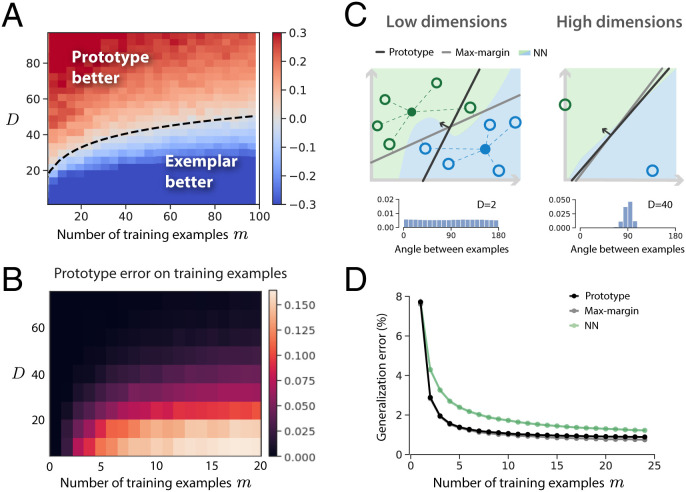
Understanding the neural basis of the remarkable human cognitive capacity to learn novel concepts from just one or a few sensory experiences constitutes a fundamental problem. We propose a simple, biologically plausible, mathematically tractable, and computationally powerful neural mechanism for few-shot learning of naturalistic concepts. We posit that the concepts that can be learned from few examples are defined by tightly circumscribed manifolds in the neural firing-rate space of higher-order sensory areas. We further posit that a single plastic downstream readout neuron learns to discriminate new concepts based on few examples using a simple plasticity rule. We demonstrate the computational power of our proposal by showing that it can achieve high few-shot learning accuracy on natural visual concepts using both macaque inferotemporal cortex representations and deep neural network (DNN) models of these representations and can even learn novel visual concepts specified only through linguistic descriptors. Moreover, we develop a mathematical theory of few-shot learning that links neurophysiology to predictions about behavioral outcomes by delineating several fundamental and measurable geometric properties of neural representations that can accurately predict the few-shot learning performance of naturalistic concepts across all our numerical simulations. This theory reveals, for instance, that high-dimensional manifolds enhance the ability to learn new concepts from few examples. Intriguingly, we observe striking mismatches between the geometry of manifolds in the primate visual pathway and in trained DNNs. We discuss testable predictions of our theory for psychophysics and neurophysiological experiments.
Overview
The claims and statistics of this paper haven’t been checked yet.
Free: it reads the open-access text and checks the first 5 claims that cite a source we can check. Create a free account to check every claim.
Integrity signals
Registry
Cites
Statistics
Figures
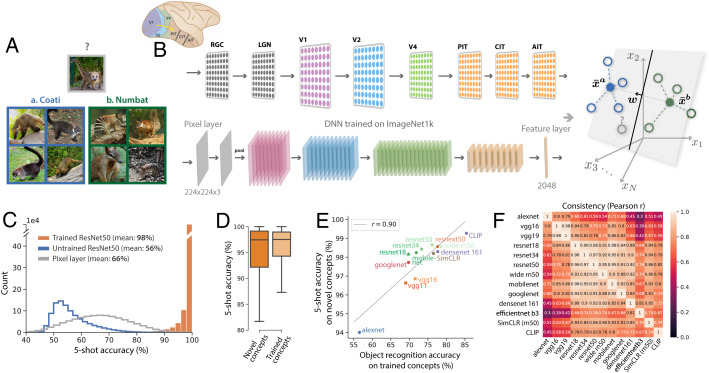
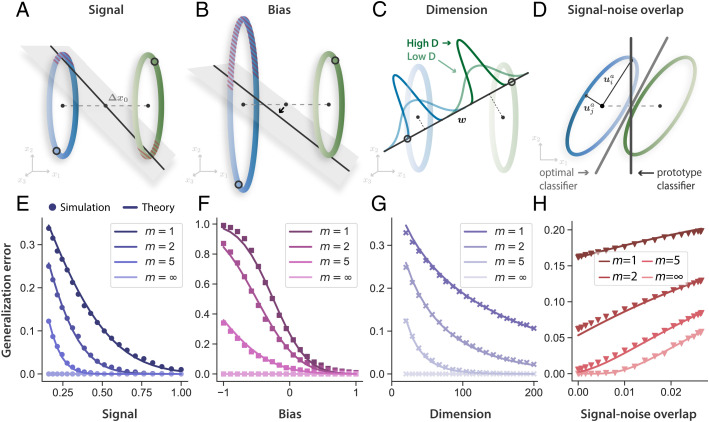
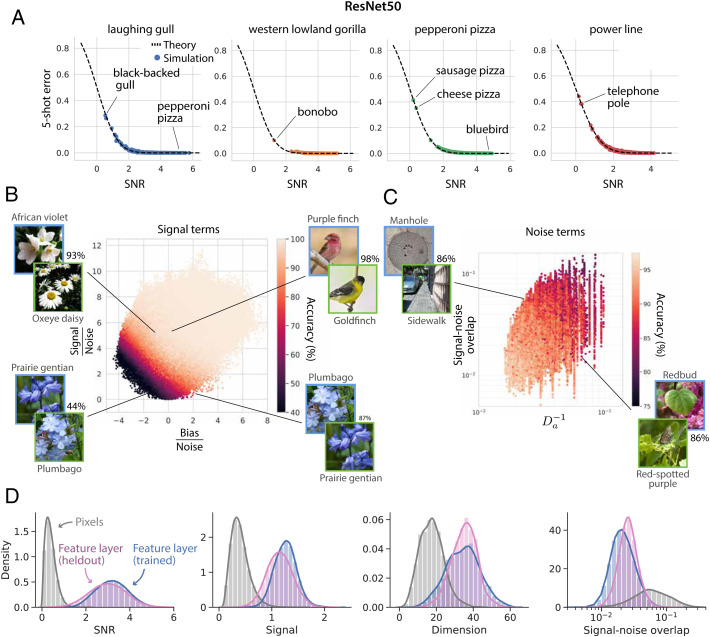
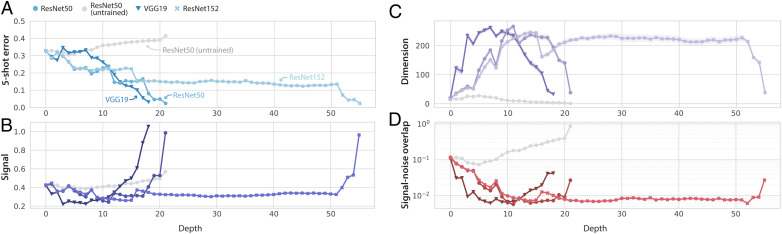
Verification
Claims the paper makes
The claims and statistics of this paper haven’t been checked yet.
Free: it reads the open-access text and checks the first 5 claims that cite a source we can check. Create a free account to check every claim.
Claims other papers make about this one
Each is checked against this paper’s own text: does it say what the citing paper says it does?
The source backs part of the claim, not all of it — or backs it for a different population, condition or comparison.
In the citing paper
“Furthermore, recent studies have found a striking representational alignment between a wide variety of ANNs and the human brain, despite their having different architectures, network initializations, learning objectives, and even different modalities such as language and vision [12,15–22]”
From The Umwelt Representation Hypothesis: rethinking Universality (2026) · cites this paper as [17]
Experimental — accuracy not yet measuredThe cited source says what the claim attributes to it.
In the citing paper
“Sorscher et al. (2022) show a setting in which word embeddings of visual concept names can be isometrically mapped to image embeddings for those same concepts.”
From The Platonic Representation Hypothesis (2024) · cites this paper as Sorscher et al. (2022)
Self-check
Percentages, sums and reported differences re-computed from the paper’s own numbers.
The self-check needs the paper’s full text.
Citations
Cites
ImageNet: A large-scale hierarchical image database
Deng, J., Dong, W., Socher, R., Li, L.-J., Li, K., & Fei-Fei, L. (2009) · 2009 IEEE Conference on Computer Vision and Pattern Recognition · doi:10.1109/cvpr.2009.5206848 · Cited by 65,333 · cited 1×
“A subset of 1,000 concepts comprises the standard ImageNet1k training set used in the ImageNet Large Scale Visual Recognition Challenge (68).”
MethodGlove: Global Vectors for Word Representation
Pennington, J., Socher, R., & Manning, C. (2014) · Proceedings of the 2014 Conference on Empirical Methods in Natural Language Processing (EMNLP) · doi:10.3115/v1/d14-1162 · Cited by 34,071 · cited 2×
“To test this hypothesis, we obtain language representations for the names of the 1,000 familiar visual concepts used to train our DNN, from a standard word-vector embedding model (44) trained to produce a neural representation of all words in English based on cooccurrence statistics in a large corpus (Section P).”
MethodPyTorch: An Imperative Style, High-Performance Deep Learning Library
Paszke, A., Gross, S., Massa, F., Lerer, A., Bradbury, J., Chanan, G., Killeen, T., Lin, Z., Gimelshein, N., Antiga, L., et al. (2019) · arXiv · doi:10.48550/arxiv.1912.01703 · Cited by 31,473 · cited 1×
“All DNNs studied throughout this work are standard architectures available in the PyTorch library (69) and are pretrained on the ImageNet1k dataset.”
MethodLearning Transferable Visual Models From Natural Language Supervision
Radford, A., Kim, J. W., Hallacy, C., Ramesh, A., Goh, G., Agarwal, S., Sastry, G., Askell, A., Mishkin, P., Clark, J., et al. (2021) · arXiv · doi:10.48550/arxiv.2103.00020 · Cited by 15,293 · cited 2×
“, SimCLR (34) or CLIP (27)] manner also achieve high performance (Fig.”
BackgroundAdvances in Neural Information Processing Systems 25
Zhang, Y., Sutton, C. A., Storkey, A., & Zoubin Ghahramani, A. (2012) · Cited by 12,653
A training algorithm for optimal margin classifiers
Boser, B. E., Guyon, I. M., & Vapnik, V. N. (1992) · Proceedings of the fifth annual workshop on Computational learning theory · doi:10.1145/130385.130401 · Cited by 11,992 · cited 2×
“An intermediate model between prototype and exemplar learning is max-margin learning (50) (Fig.”
BackgroundA simple framework for contrastive learning of visual representations
Chen, T., Kornblith, S., Norouzi, M., & Hinton, G. (2020) · arXiv · doi:10.48550/arxiv.2002.05709 · Cited by 10,857 · cited 2×
“, SimCLR (34) or CLIP (27)] manner also achieve high performance (Fig.”
BackgroundFamily resemblances: Studies in the internal structure of categories
Rosch, E., & Mervis, C. B. (1975) · Cognitive Psychology · doi:10.1016/0010-0285(75)90024-9 · Cited by 5,933 · cited 1×
“Two such foundational theories include prototype learning, which posits that features of previously encountered examples are averaged into a set of “prototypical” features (14), and exemplar learning, which posits that the features of all previously encountered examples are simply stored in memory (8).”
BackgroundPrototypical Networks for Few-shot Learning
Snell, J., Swersky, K., & Zemel, R. S. (2017) · arXiv (Cornell University) · doi:10.48550/arxiv.1703.05175 · Cited by 4,755 · cited 2×
“Drawing inspiration from previous works that have trained mappings between visual embeddings and word embeddings (33, 45) or between word embeddings in multiple languages (46), we seek to learn a simple mapping between the language and vision domains (Fig.”
BackgroundMethodHierarchical models of object recognition in cortex
Riesenhuber, M., & Poggio, T. (1999) · Nature Neuroscience · doi:10.1038/14819 · Cited by 3,309
Research works printed but not linked: 4
- 4. S. Carey, E. Bartlett, Acquiring a single new word in Papers and reports on child language development (1978), vol. 15, pp. 17– 29.
- 13. Aristotle, Categories (Princeton University Press, Princeton, NJ, 1984).
- 10.1037/0096-1523.21.1.128 · DOI
- 71. B. Sorscher, Code for: Neural representational geometry underlies few-shot concept learning. GitHub. https://github.com/bsorsch/geometry-fewshot-learning. Deposited 16 June 2021. 10.1073/pnas.2200800119 PMC9618072 36251997
Cited by
Conwell, C., Prince, J. S., Kay, K. N., Alvarez, G. A., & Konkle, T. (2022) · doi:10.1101/2022.03.28.485868 · Cited by 160
“Importantly, however, we do not consider this a claim on the importance of similar model-agnostic metrics more generally: the intersection of manifold statistics and neural coding schemes is an emerging field (Cohen et al., 2020; Sorscher et al., 2022a; Yerxa et al., 2023), which we believe will be fruitful for the ne…”
BackgroundConwell, C., Prince, J. S., Kay, K. N., Alvarez, G. A., & Konkle, T. (2024) · Nature Communications · doi:10.1038/s41467-024-53147-y · Cited by 100
Goldstein, A., Grinstein-Dabush, A., Schain, M., Wang, H., Hong, Z., Aubrey, B., Nastase, S. A., Zada, Z., Ham, E., Feder, A., et al. (2024) · Nature Communications · doi:10.1038/s41467-024-46631-y · Cited by 64
Dimension of Activity in Random Neural Networks
Clark, D. G., Abbott, L. F., & Litwin-Kumar, A. (2023) · Physical Review Letters · doi:10.1103/physrevlett.131.118401 · Cited by 82
High-performing neural network models of visual cortex benefit from high latent dimensionality
Elmoznino, E., & Bonner, M. F. (2024) · PLOS Computational Biology · doi:10.1371/journal.pcbi.1011792 · Cited by 49
Development of visual object recognition
Ayzenberg, V., & Behrmann, M. (2023) · Nature Reviews Psychology · doi:10.1038/s44159-023-00266-w · Cited by 41
“…might serve as a crucial mechanism for rapid object learning more generally: deep neural network models that emphasize object prototypes demonstrate better performance on few-shot categorization tasks and also reveal infant-like signatures of categorization, such as category asymmetries 164 .”
The geometry of representational drift in natural and artificial neural networks
Aitken, K., Garrett, M., Olsen, S. R., & Mihalaş, Ş. (2022) · PLoS Computational Biology · doi:10.1371/journal.pcbi.1010716 · Cited by 56
Desbordes, T., Lakretz, Y., Chanoine, V., Oquab, M., Badier, J., Trébuchon, A., Carron, R., Bénar, C., Dehaene, S., & King, J.-R. (2023) · Journal of Neuroscience · doi:10.1523/jneurosci.1163-22.2023 · Cited by 40
Robust Saliency-Aware Distillation for Few-Shot Fine-Grained Visual Recognition
Liu, H., Chen, C. L. P., Gong, X., & Zhang, T. (2024) · IEEE Transactions on Multimedia · doi:10.1109/tmm.2024.3369870 · Cited by 38
“It is rational that simple salient patterns can easily generalize to unseen sub-categories [16].”
BackgroundA model of conceptual bootstrapping in human cognition
Zhao, B., Lucas, C. G., & Bramley, N. R. (2023) · Nature Human Behaviour · doi:10.1038/s41562-023-01719-1 · Cited by 30
“Recent research in neuroscience is starting to unravel how the brain may perform non-parametric Bayesian computations and latent causal inference 53 , and has uncovered representational similarities between artificial neural networks and brain activity 54,55 .”
BackgroundRepresentations and generalization in artificial and brain neural networks
Li, Q., Sorscher, B., & Sompolinsky, H. (2024) · Proceedings of the National Academy of Sciences · doi:10.1073/pnas.2311805121 · Cited by 27
Self-citationThe Platonic Representation Hypothesis
Huh, M., Cheung, B., Wang, T., & Isola, P. (2024) · arXiv · doi:10.48550/arxiv.2405.07987 · Cited by 35
“Sorscher et al. (2022) show a setting in which word embeddings of visual concept names can be isometri-cally mapped to image embeddings for those same concepts.”
Semi-orthogonal subspaces for value mediate a binding and generalization trade-off
Johnston, W. J., Fine, J. M., Yoo, S. B. M., Ebitz, R. B., & Hayden, B. Y. (2024) · Nature Neuroscience · doi:10.1038/s41593-024-01758-5 · Cited by 40
“…between representational geometry and generalization to novel samples from the same distribution (for example, novel trials, same position) 21,45 , our work provides a link between this geometry and generalization to samples from a systematically different distribution (for example, novel…”
Esparza, J., Quintanilla, J. P., Cid, E., Medeiros, A. C., Gallego, J. Á., & de la Prida, L. M. (2025) · Neuron · doi:10.1016/j.neuron.2025.01.022 · Cited by 35
Mechanisms of human dynamic object recognition revealed by sequential deep neural networks
Sörensen, L. K. A., Bohté, S. M., de Jong, D., Slagter, H. A., & Scholte, H. S. (2023) · PLoS Computational Biology · doi:10.1371/journal.pcbi.1011169 · Cited by 24
“In many ways, this challenge resembles few-shot learning as discussed by Sorscher and colleagues [65] in which the pre-trained representational space is leveraged to perform untrained, categorical distinctions (also see [66]).”
BackgroundPopulation encoding of stimulus features along the visual hierarchy
Dyballa, L., Rudzite, A. M., Hoseini, M. S., Thapa, M., Stryker, M. P., Field, G. D., & Zucker, S. W. (2024) · Proceedings of the National Academy of Sciences · doi:10.1073/pnas.2317773121 · Cited by 19
The topology and geometry of neural representations
Lin, B., & Kriegeskorte, N. (2024) · Proceedings of the National Academy of Sciences · doi:10.1073/pnas.2317881121 · Cited by 42
Linear Classification of Neural Manifolds with Correlated Variability
Wakhloo, A. J., Sussman, T. J., & Chung, S. (2023) · Physical Review Letters · doi:10.1103/physrevlett.131.027301 · Cited by 25
On the importance of severely testing deep learning models of cognition
Bowers, J. S., Malhotra, G., Adolfi, F., Dujmović, M., Montero, M. L., Biscione, V., Puebla, G., Hummel, J. H., & Heaton, R. F. (2023) · Cognitive Systems Research · doi:10.1016/j.cogsys.2023.101158 · Cited by 26
Revealing emergent human-like conceptual representations from language prediction
Xu, N., Zhang, Q., Du, C., Luo, Q., Qiu, X., Huang, X., & Zhang, M. (2025) · Proceedings of the National Academy of Sciences · doi:10.1073/pnas.2512514122 · Cited by 36
Manifold learning for fMRI time-varying functional connectivity
González-Castillo, J., Fernandez, I. S., Lam, K. C., Handwerker, D. A., Pereira, F., & Bandettini, P. A. (2023) · Frontiers in Human Neuroscience · doi:10.3389/fnhum.2023.1134012 · Cited by 14
“, 2019), and to explain why humans can learn certain concepts from just a few sensory experiences (i.e., “few-shot” concept learning; Sorscher et al., 2022).”
BackgroundRevisiting the high-dimensional geometry of population responses in the visual cortex
Pospisil, D. A., & Pillow, J. W. (2025) · Proceedings of the National Academy of Sciences · doi:10.1073/pnas.2506535122 · Cited by 22
Coding schemes in neural networks learning classification tasks
van Meegen, A., & Sompolinsky, H. (2025) · Nature Communications · doi:10.1038/s41467-025-58276-6 · Cited by 24
Self-citationFactorized visual representations in the primate visual system and deep neural networks
Lindsey, J. W., & Issa, E. B. (2024) · eLife · doi:10.7554/elife.91685 · Cited by 16
“Relatedly, another recent study found that orthogonal encoding of class and non-class information is one of several factors that determines few-shot classification performance ( Sorscher et al., 2022 ).”
BackgroundEEG spectral attractors identify a geometric core of brain dynamics
Pourdavood, P., & Jacob, M. (2024) · Patterns · doi:10.1016/j.patter.2024.101025 · Cited by 13
“34,50 57 A ‘‘redundancy core’’ has been hypothesized for older adults, a putative link between dynamic core models, the loss of complexity, and loss of differentiation.”
Leveraging insights from neuroscience to build adaptive artificial intelligence
Mathis, M. W. (2025) · Nature Neuroscience · doi:10.1038/s41593-025-02169-w · Cited by 21
Computing a human-like reaction time metric from stable recurrent vision modelsPreprint
Goetschalckx, L., Govindarajan, L. N., Ashok, A. K., Ahuja, A., Sheinberg, D. L., & Serre, T. (2023) · arXiv (Cornell University) · doi:10.48550/arxiv.2306.11582 · Cited by 9
“Additionally, performant computational vision models that operate directly on high-dimensional sensory inputs have shown great promise for scientific discovery through the generation of testable hypotheses for neuroscience [12, 13].”
BackgroundLinguistic features of AI mis/disinformation and the detection limits of LLMs
Ma, Y., Zhang, X., Ren, J., Wang, R., Wang, M., & Chen, Y. (2025) · Nature Communications · doi:10.1038/s41467-025-67145-1 · Cited by 18
“Exemplar theory in psycholinguistics posits that human language use relies on memory of speci fi c instances, with high-frequency exemplars being more readily accessed 51 .”
Robust query performance prediction for dense retrievers via adaptive disturbance generation
Saleminezhad, A., Arabzadeh, N., Rad, R. H., Beheshti, S., & Bagheri, E. (2025) · Machine Learning · doi:10.1007/s10994-024-06659-z · Cited by 8
“Previous studies have shown that the geometric properties of neural representations can be useful for various tasks such as specificity quantification and analogical reasoning [46, 47].”
What neuroscience can tell AI about learning in continuously changing environments
Durstewitz, D., Averbeck, B. B., & Koppe, G. (2025) · Nature Machine Intelligence · doi:10.1038/s42256-025-01146-z · Cited by 12
“Third, performance relies on previously learned task elements, rules, natural biases, task schemata and concepts 40,83–85 .”
Neural population geometry and optimal coding of tasks with shared latent structure
Wakhloo, A. J., Slatton, W., & Chung, S. (2026) · Nature Neuroscience · doi:10.1038/s41593-025-02183-y · Cited by 33
“Our d = 24 dimensional latent variables z ∈ ℝ 24 consisted of the ( x , y ) coordinates (in pixels, normalized to an image size of 563 × 384) of the 12 body markers of the adult mouse.”
InfluentialThe cortical critical power law balances energy and information in an optimal fashion
Tatsukawa, T., & Teramae, J.-N. (2025) · Proceedings of the National Academy of Sciences · doi:10.1073/pnas.2418218122 · Cited by 13
Exploring strategy differences between humans and monkeys with recurrent neural networks
Tsuda, B., Richmond, B. J., & B, T. J. S. A. (2023) · PLoS Computational Biology · doi:10.1371/journal.pcbi.1011618 · Cited by 5
High-dimensional structure underlying individual differences in naturalistic visual experience
Han, C., & Bonner, M. F. (2026) · Current Biology · doi:10.1016/j.cub.2025.12.039 · Cited by 5
“8,33,34 Our work extends this framework to the neural basis of individual differences and, contrasting with earlier findings of organization along a small number of dimensions based on leading high-variance components, 35–37 demonstrates that neural population codes leverage their high-dimensional…”
The Limited Place in Cognitive Space
Hodgetts, C. J., & Hahn, U. (2025) · Topics in Cognitive Science · doi:10.1111/tops.70001 · Cited by 5
Ivanova, A. A., Sathe, A., Lipkin, B., Kumar, U., Radkani, S., Clark, T. H., Kauf, C., Hu, J., Pramod, R. T., Grand, G., et al. (2025) · Transactions of the Association for Computational Linguistics · doi:10.1162/tacl.a.38 · Cited by 39
How well do rudimentary plasticity rules predict adult visual object learning?
Lee, M. J., & DiCarlo, J. J. (2023) · PLoS Computational Biology · doi:10.1371/journal.pcbi.1011713 · Cited by 8
Neural and computational mechanisms underlying one-shot perceptual learning in humans
Hachisuka, A., Shor, J. D., Liu, X. C., Friedman, D. J., Dugan, P. C., Sáez, I., Panov, F. E., Wang, Y., Doyle, W., Devinsky, O., et al. (2026) · Nature Communications · doi:10.1038/s41467-026-68711-x · Cited by 11
Variation in the geometry of concept manifolds across human visual cortex
St-Yves, G., Kay, K., & Naselaris, T. (2025) · PLoS Computational Biology · doi:10.1371/journal.pcbi.1013416 · Cited by 4
“Such sets of points in brain activity space have been referred to as “con-cept manifolds” [6].”
InfluentialYin, J., Wang, B., Wang, T., & Tang, Z. (2025) · Fundamental Research · doi:10.1016/j.fmre.2025.09.014 · Cited by 4
“…as through meta-learning mechanisms that teach the model to rapidly adjust to novel tasks or via metric learning techniques that assess sample similarity (e.g., cosine similarity) within an embedding space, allowing classification of query instances based on minimal support examples [ 194–196 ].”
From retinotopic to ordinal coding: Dissecting the cortical stages of visual word recognition
Agrawal, A., & Dehaene, S. (2025) · Proceedings of the National Academy of Sciences · doi:10.1073/pnas.2507291122 · Cited by 6
Statistical mechanics of deep learning
Behrens, F., Mainali, N., Marullo, C., Lee, S., Sorscher, B., & Sompolinsky, H. (2024) · Journal of Statistical Mechanics Theory and Experiment · doi:10.1088/1742-5468/ad3a60 · Cited by 5
“[13] for details).”
InfluentialSelf-citationRL Perceptron: Generalization Dynamics of Policy Learning in High Dimensions
Patel, N., Lee, S., Mannelli, S. S., Goldt, S., & Saxe, A. (2025) · Physical Review X · doi:10.1103/physrevx.15.021051 · Cited by 14
“For example, we would like to explain how problem properties and algorithmic choices impact how quickly a model will learn, or how effectively it will generalise.”
The Umwelt Representation Hypothesis: rethinking Universality
Bosch, V., Sommers, R. P., Doerig, A., & Kietzmann, T. C. (2026) · Trends in Cognitive Sciences · doi:10.1016/j.tics.2026.07.004 · Cited by 2
Developing artificial mechanics intuitions from extremely small data
Peng, J., & Zhu, S. (2025) · Extreme Mechanics Letters · doi:10.1016/j.eml.2025.102371 · Cited by 4
“Currently, few-shot learning algorithms mainly involve classification 22,25–27 .”
Multimodal Affect Perception With Large Language Model Enhancement Network
Yang, K., Luo, Y., Zhang, Z., Chen, C. L. P., & Zhang, T. (2025) · IEEE Transactions on Affective Computing · doi:10.1109/taffc.2025.3607727 · Cited by 4
“Restrictions apply. facilitates modality alignment, and constrains representational complexity, which are analytically associated with improved classification and generalization [64], [65], [66].”
Ma, C., Jia, J., Huang, J., Wu, L., & Wang, X. (2024) · Machine Vision and Applications · doi:10.1007/s00138-024-01529-z · Cited by 2
Vargas, R., & Verstynen, T. (2025) · Communications Psychology · doi:10.1038/s44271-025-00186-w · Cited by 3
Kalinowski, A., Datta, D., & An, Y. (2023) · IEEE International Conference on Big Data (BigData) · doi:10.1109/bigdata59044.2023.10386670 · Cited by 4
“Linear maps present a simple, scalable alignment methodology and are amenable to cross-modality alignment [26], yet face numerous issues such as their restriction to injective (one-to-one) maps and their dependence on supervised data sets.”
BackgroundSaxena, R., & McNaughton, B. L. (2025) · PubMed Central · Cited by 2
Ivanova, A. A., Sathe, A., Lipkin, B., Kumar, U., Radkani, S., Clark, T. H., Kauf, C., Hu, J., Pramod, R. T., Grand, G., et al. (2024) · arXiv · doi:10.48550/arxiv.2405.09605 · Cited by 2
“EW O K is designed around domains of general world knowledge, with the current set of 11 domains shown in Table 1.”
Summary statistics of learning link changing neural representations to behavior
Zavatone-Veth, J. A., Bordelon, B., & Pehlevan, C. (2025) · Frontiers in Neural Circuits · doi:10.3389/fncir.2025.1618351 · Cited by 5
What Do Visual Neural Networks Learn?
Har-Shalom, D., & Weiss, Y. (2025) · Annual Review of Vision Science · doi:10.1146/annurev-vision-110323-112903 · Cited by 2
VCE: Visual concept embedding for open-set fine-grained image retrieval
Wang, Y., Ye, S., Hou, W., & Chen, S. (2025) · Knowledge-Based Systems · doi:10.1016/j.knosys.2025.114311 · Cited by 2
Model-informed oracle training for enhancing active learning without external knowledge
Cha, Y. (2025) · Machine Learning with Applications · doi:10.1016/j.mlwa.2025.100775 · Cited by 1
Morfoisse, T., Becuwe-Desmidt, S., Palu, M., Watkins, C. P., Dehaene‐Lambertz, G., & Dehaene, S. (2026) · Proceedings of the National Academy of Sciences · doi:10.1073/pnas.2602515123 · Cited by 3
“Assuming that words, and sentences are represented as neural vectors embedded in a high - dimensional manifold (64–67), how does this manifold change as new concepts are added to the semantic lexicon?”
Scientists Invent New Hypotheses, Do Brains?
Fresco, N., & Elber‐Dorozko, L. (2024) · Cognitive Science · doi:10.1111/cogs.13400 · Cited by 1
Deciphering the mysteries of the neural code
Sompolinsky, H. (2024) · Danish Medical Journal · doi:10.61409/a300006 · Cited by 2
Self-citationNonlinear classification of neural manifolds with contextual information
Mignacco, F., Chou, C.-N., & Chung, S. (2025) · Physical review. E · doi:10.1103/physreve.111.035302 · Cited by 4
Heterogeneous Riemannian Few-Shot Learning Network
Chen, J., Li, L., Jiao, L., Liu, F., Liu, X., Guo, Y., Chen, P., & Ma, W. (2025) · IEEE Transactions on Neural Networks and Learning Systems · doi:10.1109/tnnls.2025.3561930 · Cited by 1
“Sorscher et al. [19] modeled the mathematical theory of human few-shot learning by studying the concept learning process in neural circuits, indicating that high few-shot learning accuracy can be achieved by 2162-237X © 2025 IEEE.”
Manifold Learning for fMRI time-varying FCPreprint
González-Castillo, J., Fernandez, I. S., Lam, K. C., Handwerker, D. A., Pereira, F., & Bandettini, P. A. (2023) · bioRxiv (Cold Spring Harbor Laboratory) · doi:10.1101/2023.01.14.523992 · Cited by 1
“In biomedical research, ID has also been used to characterize the amount of variability present in protein sequence evolution (Facco et al., 2019), and to explain why humans can learn certain concepts from just a few sensory experiences (i.e., “few-shot” concept learning; (Sorscher et al., 2022)).”
BackgroundFactorized visual representations in the primate visual system and deep neural networksPreprint
Lindsey, J. W., & Issa, E. B. (2024) · eLife · doi:10.7554/elife.91685.1 · Cited by 7
Lindsey, J. W., & Issa, E. B. (2024) · eLife · doi:10.7554/elife.91685.1.sa1
Geometric Structure of Features Underlies Human Vtc Object RecognitionPreprint
Wen, B., Zhang, C., Du, C., Chang, L., & He, H. (2024) · SSRN Electronic Journal · doi:10.2139/ssrn.4808933
Factorized visual representations in the primate visual system and deep neural networksPreprint
Lindsey, J. W., & Issa, E. B. (2024) · eLife · doi:10.7554/elife.91685.2 · Cited by 1
Unraveling the geometry of visual relational reasoning
Shang, J., Kreiman, G., & Sompolinsky, H. (2026) · Scientific Reports · doi:10.1038/s41598-026-47123-3 · Cited by 2
“To investigate how neural networks achieve relational reasoning and generalize their learned representations to unseen relational rules, we leveraged a geometrical theory of few-shot learning ( 18 ).”
InfluentialSelf-citationBidirectional Active Learning for Information AmplificationPreprint
Cha, Y. (2025) · SSRN Electronic Journal · doi:10.2139/ssrn.5257239
Toward Disentangled and Controllable Deep Metric Learning With Human-Like Concept Decomposition
Chen, S., Chen, S., Ye, S., Wang, Y., & You, X. (2025) · IEEE Transactions on Neural Networks and Learning Systems · doi:10.1109/tnnls.2025.3587907 · Cited by 1
“The study of human concept learning can be traced back to Aristotle, who proposed that concepts in the mind are represented by a set of precise definitions [20].”
Signal-to-Noise Difference as a Correlate of Class Learning in Neural Networks
Pascual-Estrugo, B., & Ardid, S. (2025) · Lecture notes in computer science · doi:10.1007/978-3-032-04558-4_49
Kataoka, A., Nagano, Y., & Oizumi, M. (2025) · Frontiers in Computational Neuroscience · doi:10.3389/fncom.2025.1613291 · Cited by 2
“The supervised model showed a broadly similar pattern, except that a clear cluster corresponding to the “reptiles” category, which was observed in the self-supervised model, was missing.”
InfluentialOn intrinsic dimension of point clouds by a persistent homology approach: computational tips
Bandiziol, C., Marchi, S. D., & Allegra, M. (2025) · Modern Mathematical Methods · doi:10.64700/mmm.89
“While artificial neural networks trained to replicate real brains often exhibit low-dimensional activity [56], biological neural activity is typically high-dimensional [5, 55], which has sparked a wide debate.”
When predict can also explain: Few-shot prediction to select better neural latents
Dabholkar, K., & Barak, O. (2025) · PLoS Computational Biology · doi:10.1371/journal.pcbi.1013789
The Limitations of Image Features from Satellite Imagery Training Datasets
Algire, C., Israel, S. A., & Palaniappan, K. (2026) · Lecture notes in computer science · doi:10.1007/978-3-032-18474-0_30
As High As Eyes Can See : A Moderate Liberalism for the Admissible Contents of Perception
Coudray, Q. (2024) · theses.fr (ABES) · doi:10.70675/fc9f02efz1150z4e4ezb5e5z05f2b1d4b178 · Cited by 15
Human brains construct individualized global rankings from identical few-shot learning input
Liu, D., Wang, M., & Luo, H. (2026) · PLoS Biology · doi:10.1371/journal.pbio.3003756
“Although a complete ranking formally requires either scalar values for each item or exhaustive pairwise comparisons, real-world learning typically relies on sparse samples of local pairwise relations [1,2,10–12].”
Predictive coding yields a brain-like code for shape from motionPreprint
Bai, Y., O’Connell, T. P., Friedman, Y., Ayvazian‐Hancock, A., Maver, H., Tenenbaum, J. B., & DiCarlo, J. J. (2026) · bioRxiv (Cold Spring Harbor Laboratory) · doi:10.64898/2026.05.13.724755 · Cited by 1
“Second, multivariate prediction of representational geometry, which captures the population structure that could be utilized for downstream readout [41, 42].”
InfluentialComputing inspired by the brain: a journey from algorithms to organoids
Brown, P., & Varghese, S. (2026) · Nature Computational Science · doi:10.1038/s43588-026-01012-x · Cited by 5
“They can rewire synaptic connections 105 , form new connections 106 , and generalize from sparse or new data 107 .”
Unifying the structures of language in a neural population code
Nastase, S. A., Zada, Z., Goldberg, A., & Hasson, U. (2026) · Neuron · doi:10.1016/j.neuron.2026.07.024 · Cited by 4
Issa, H. A., Liu, S., Ballé, J., & Klindt, D. A. (2026) · bioRxiv (Cold Spring Harbor Laboratory) · doi:10.64898/2026.09.05.748439
“Finally, template matching [23–25] defines a series of canonical population-wide responses (‘templates’) to pre-defined stimulus classes, then computes the distance of each neural response vector to a given template to construct distance-based population codes.”
Metadata
- Authors
- Sorscher, B., Ganguli, S., & Sompolinsky, H.
- Affiliations
- Stanford University (US)
- Harvard University (US)
- Corresponding author
- Sompolinsky, Haim
- Venue
- Proceedings of the National Academy of Sciences
- Publisher
- National Academy of Sciences
- Published
- 2022-10-17
- Volume
- 119
- Issue
- 43
- Pages
- e2200800119-e2200800119
- ISSN
- 0027-8424 (ISSN-L)
- 1091-6490
- PMC
- PMC9618072
- OpenAlex
- W4306643150
- Cited by
- 78
- References
- 70
- Citations by year
- 2026: 12 · 2025: 31 · 2024: 20 · 2023: 13 · 2022: 2
- FWCI
- 5.43
- Type
- journal article
- Language
- en
- Open access
- hybrid
- doi.org
- Licence
- Locations
- Proceedings of the National Academy of Sciences (publishedVersion, cc-by-nc-nd)
- PubMed Central (publishedVersion, cc-by-nc-nd)
- PubMed (publishedVersion)
- Funders
- National Institute of Neurological Disorders and Stroke (U19NS104653)
- Topics
- Physical Sciences › Computer Science › Artificial Intelligence › Domain Adaptation and Few-Shot Learning
- Life Sciences › Neuroscience › Cognitive Neuroscience › Memory and Neural Mechanisms
- Life Sciences › Neuroscience › Cognitive Neuroscience › Visual perception and processing mechanisms
- Keywords
- few-shot learning, concept learning, neural manifolds, inferotemporal cortex, synaptic plasticity, high-dimensional manifolds
- MeSH terms
- Animals, Concept Formation, Humans, Learning, Macaca, Plastics, Primates, Visual Pathways, Neural Networks, Computer
About these checks
Registry, retraction, Cites and statistics results are computed, not judged, with one exception: a printed reference that no index lists is read once by a model before it counts as a citation error. Claims are extracted by a model and kept only when their quote appears verbatim in the text; each cited source is then checked, with a model’s help, for whether it says what the claim relies on. Those verdicts can be wrong — read the claim’s quote and the cited source before relying on one.
Statistics and arithmetic are recomputed, not judged.
Confidence bands are shown only for fields calibrated on our annotated test set. None is calibrated yet, so no band is shown.
What counts as a claim ›How we measure confidence ›How we check this ›
Are you an author, or do you see a problem with this page? Request a review
Data sources
Bibliographic data: Semantic Scholar, OpenAlex, Crossref.
Contains information from the Semantic Scholar Academic Graph Datasets, made available under the ODC Attribution License (ODC-BY 1.0).
Semantic Scholar’s data is described in: Kinney, R., et al. (2023). The Semantic Scholar Open Data Platform. arXiv:2301.10140.
