

Cleaner fish recognize self in a mirror via self-face recognition like humans
Open accessThe DOI matches its Crossref record; 57 of the 57 references it cites were found in a registry or an index; 51 of the 106 sources its claims cite were checked for support.
Abstract
Some animals have the remarkable capacity for mirror self-recognition (MSR), yet any implications for self-awareness remain uncertain and controversial. This is largely because explicit tests of the two potential mechanisms underlying MSR are still lacking: mental image of the self and kinesthetic visual matching. Here, we test the hypothesis that MSR ability in cleaner fish, Labroides dimidiatus , is associated with a mental image of the self, in particular the self-face, like in humans . Mirror-naive fish initially attacked photograph models of both themselves and unfamiliar strangers. In contrast, after all fish had passed the mirror mark test, fish did not attack their own (motionless) images, but still frequently attacked those of unfamiliar individuals. When fish were exposed to composite photographs, the self-face/unfamiliar body were not attacked, but photographs of unfamiliar face/self-body were attacked, demonstrating that cleaner fish with MSR capacity recognize their own facial characteristics in photographs. Additionally, when presented with self-photographs with a mark placed on the throat, unmarked mirror-experienced cleaner fish demonstrated throat-scraping behaviors. When combined, our results provide clear evidence that cleaner fish recognize themselves in photographs and that the likely mechanism for MSR is associated with a mental image of the self-face, not a kinesthetic visual-matching model. Humans are also capable of having a mental image of the self-face, which is considered an example of private self-awareness. We demonstrate that combining mirror test experiments with photographs has enormous potential to further our understanding of the evolution of cognitive processes and private self-awareness across nonhuman animals.
Overview
CoChat Summary
TL;DR
Cleaner fish that passed the mirror mark test recognized themselves in motionless photographs via self-face recognition, not kinesthetic visual matching. After mirror self-recognition, they reduced aggression toward self-face images but continued attacking unfamiliar faces, and most scraped their throat when shown a marked self-photograph.
Key findings
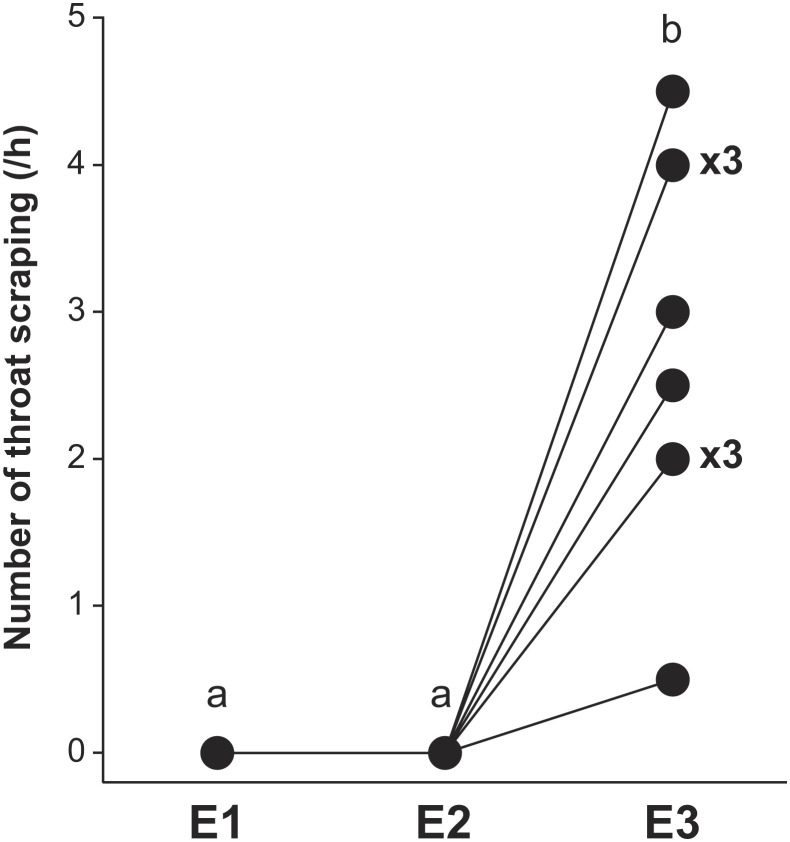
- All focal cleaner fish (n = 10) passed the mirror mark test: throat-scraping occurred at 2.85 ± 0.40 SEM/h when marked with the mirror visible, versus 0.00 ± 0.00 in both control conditions (Friedman test, χ² = 20.00, P < 0.0001, Kendall W = 1.000).
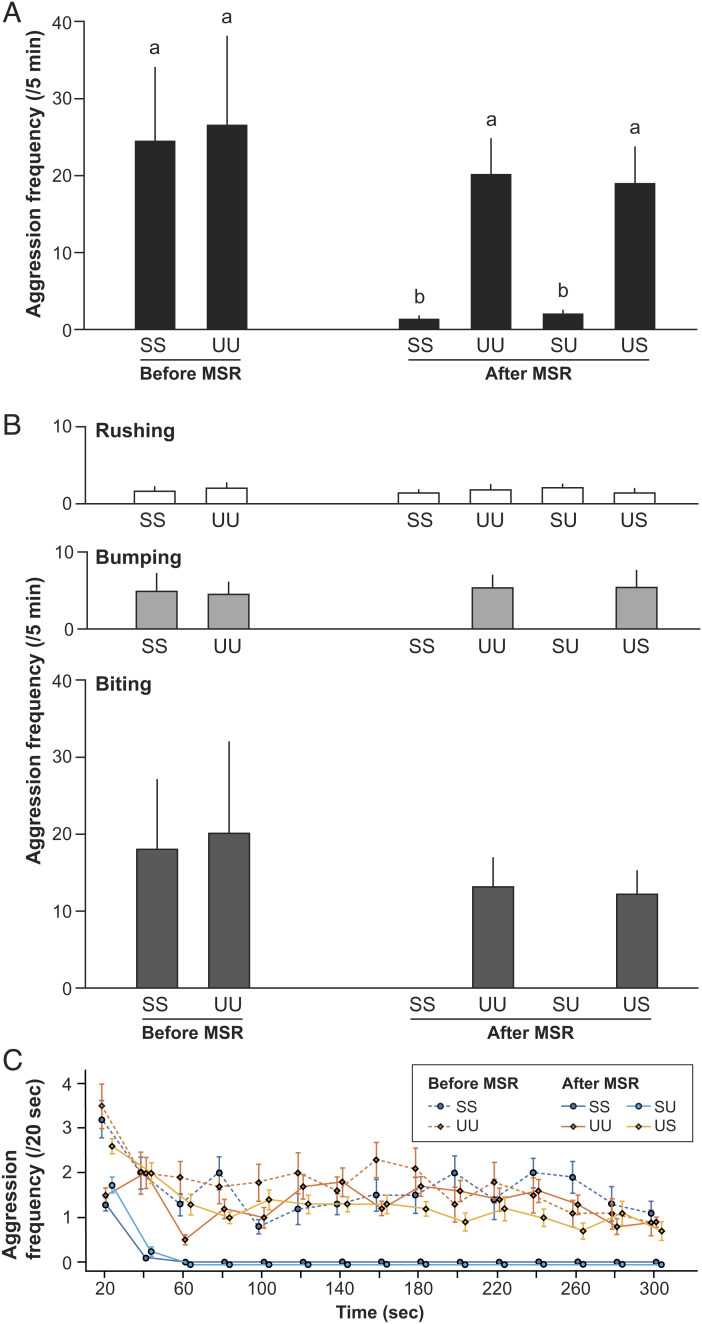
- Before mirror self-recognition, mirror-naïve fish attacked their own and unfamiliar photographs similarly: self-photograph 24.5 ± 9.5 SEM times/5 min; unfamiliar photograph 26.6 ± 11.5.
- After passing the mark test, aggression declined toward self-face/self-body photographs (1.4 ± 0.3) and self-face/unfamiliar-body composites (2.1 ± 0.4), but remained high toward unfamiliar-face/unfamiliar-body (20.2 ± 4.6) and unfamiliar-face/self-body (19.0 ± 4.7) photographs.
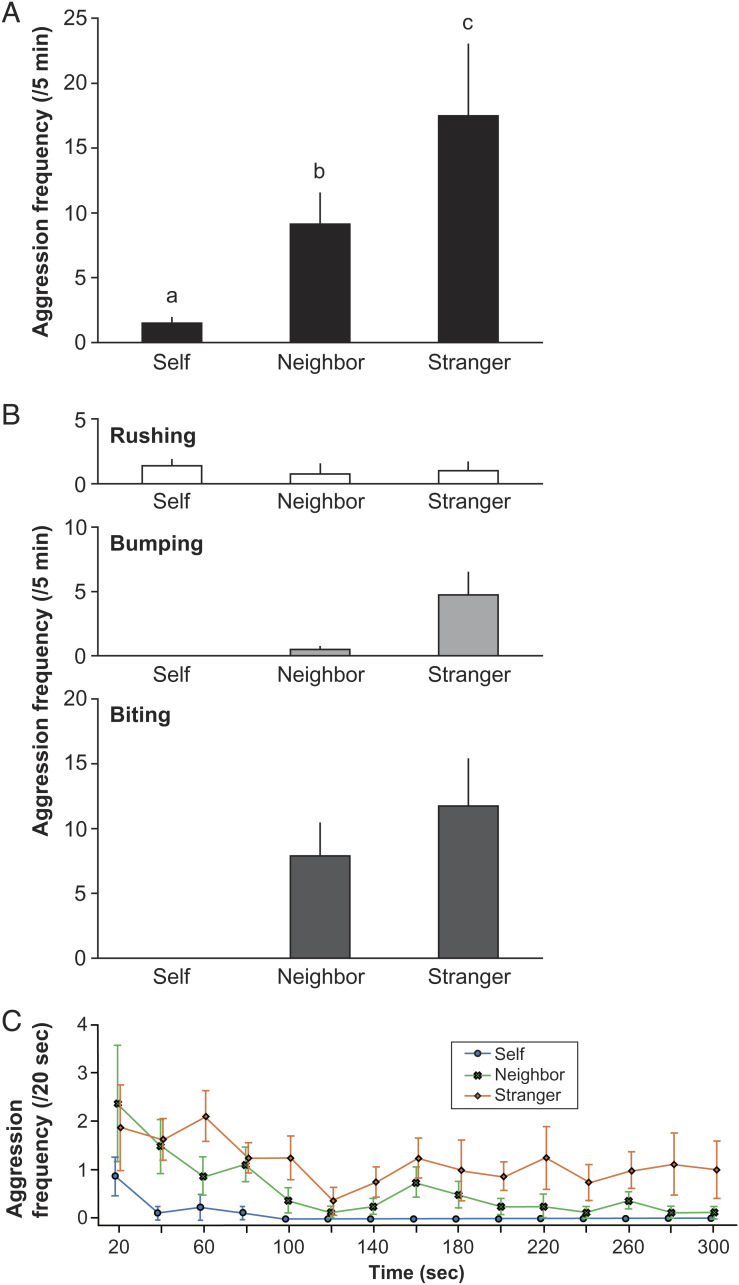
- In the photograph mark test, 6 of 8 mark-naïve fish (75%) scraped their throat after viewing a marked self-photograph; no fish scraped when viewing an unmarked self-photograph or a marked familiar-individual photograph (total throat scrapes: 22 for marked self, 0 for both controls).
Methods
- Wild-captured cleaner fish, *Labroides dimidiatus* (26 fish total; 61–78 mm TL), were housed individually in laboratory tanks. Mirror mark tests used n = 10 fish; Experiment 1 used n = 10; Experiment 2 used n = 8; Experiment 3 used n = 8.
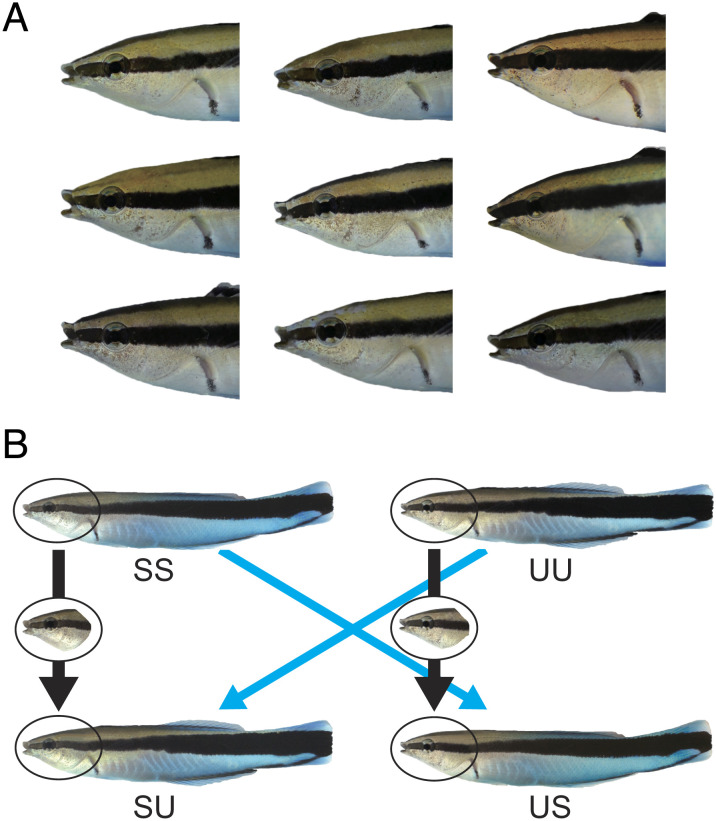
- Fish were exposed to mirrors and tested with size-matched composite photographs: self-face/self-body (SS), unfamiliar-face/unfamiliar-body (UU), self-face/unfamiliar-body (SU), and unfamiliar-face/self-body (US). The mirror mark test used a brown visual implant elastomer mark on the throat; the photograph mark test placed a brown mark on a self-photograph.
- Aggression and throat-scraping were video-recorded and analyzed with ELAN. Statistical tests included Friedman tests, exact Wilcoxon signed-rank tests with sequential Bonferroni correction, and a linear mixed model for swimming speed; a subset of videos was analyzed blind to assess observer bias.
Limitations
- The paper states that advanced cognitive abilities and self-awareness in nonprimate animals, particularly fish, remain controversial; that the original mirror mark test was devised for primates and may yield false-negative results in other taxa; and that it remains untested how quickly the association between visual matching and a mental image of the self-face forms, and whether MSR is possible in the visual-matching phase or requires a mental image of self-face.
- The paper acknowledges a possible sequence effect in Experiment 2, though it reports no significant order effect in Experiment 1 (negative binomial GLMM: treatment × order, χ² = 10.64, df = 10, P = 0.39; order, χ² = 6.29, df = 4, P = 0.18).
- Evident from the text: sample sizes are small (n = 10, n = 8, n = 8; Experiment 3 had 2 of 8 fish classified as “unclear”), and the study uses captive, wild-caught fish under laboratory conditions. The claims about private self-awareness and mental states are inferential and described as speculation rather than directly measured.
Model-written summary. Check it against the paper before relying on it.
Integrity signals
Registry
Cites
Statistics
Figures
Verification
Claims the paper makes
23 Valid · 5 Not valid · 11 Not checked · 46 Own results and interpretations
Some cited sources support this claim and some don’t — read each source’s verdict below.
In the paper
“We found that all focal fish (n = 10) passed the mirror mark test (Fig. 1 as per refs. 18 and 19).”
§ Cleaner fish recognize self in a mirror via self-face recognition like humans > Results and Discussion > Mirror Mark Test.
What the sources say
- Disputedcites [18] M. Kohda, If a fish can pass the mark test, what are the implications for consciousness and self-awareness testing in animals? PLOS Biol. 17, e3000021 (2019). 30730878 PMC6366756 sourceExperimental — accuracy not yet measured
The Results and discussion section says that three of the ten fish did not pass through the preliminary phases and that the authors concluded those fish failed the test. It also reports throat-scraping responses in three of four throat-marked fish, not all ten. No page number is available in our copy. (LLM, conf=0.92)
Checked by a reasoning model — may be wrong.
- Partly supportedcites [19] M. Kohda, Further evidence for the capacity of mirror self-recognition in. cleaner fish and the significance of ecologically relevant marks. PLOS Biol. 20, e3001529 (2022). 35176032 PMC8853551 sourceExperimental — accuracy not yet measured
The Results section reports that all eight fish in Experiment 1 scraped the mark when the mirror was exposed and that all 14 fish subjected to the standard test passed. It supports use of the mirror mark test, but does not report a group of 10 focal fish or establish that all 10 in the citing study passed. (LLM, conf=0.88)
plainn = 10- Asserted: passes — The authors put it forward as true.
- Checkable: passes — It can be checked against evidence.
- Load-bearing: passes — The paper’s conclusions depend on it.
- Based: passes — The paper gives a reason why it holds.
- Disputed
At least one cited source doesn’t support this claim or points to a different paper, and none confirmed it — see the verdicts below.
In the paper
“That is, all fish displayed throat-scraping behaviors on tank substrate after observing in a mirror reflection a mark resembling an ectoparasite, which had been placed on their throat (2.85 times ± 0.40 SEM/h, E3; similar result to a previous study 3.11 ± 1.26, n = 4, exact Wilcoxon rank sum test, W = 19.00, P = 0.93, and effect size = 0.038; Fig. 1 and ref. 18).”
§ Cleaner fish recognize self in a mirror via self-face recognition like humans > Results and Discussion > Mirror Mark Test.
What the sources say
- Disputedcites [18] M. Kohda, If a fish can pass the mark test, what are the implications for consciousness and self-awareness testing in animals? PLOS Biol. 17, e3000021 (2019). 30730878 PMC6366756 sourceExperimental — accuracy not yet measured
The Results and discussion section (Fig. 3; page not provided) says three of four throat-marked fish scraped against the substrate when exposed to the mirror in E5, not all fish. It also reports no throat scraping by any of the four fish in E3, the period named in the citing sentence. (LLM, conf=0.94)
Checked by a reasoning model — may be wrong.
plainstates a causen = 10- Asserted: passes — The authors put it forward as true.
- Checkable: passes — It can be checked against evidence.
- Load-bearing: passes — The paper’s conclusions depend on it.
- Based: passes — The paper gives a reason why it holds.
- Disputed
Some cited sources support this claim and some don’t — read each source’s verdict below.
In the paper
“Cleaner fish show the highest passing rate (94% of 17/18 fish) of the mirror mark test among species with large sample sizes.”
§ Cleaner fish recognize self in a mirror via self-face recognition like humans > Materials and Methods > Procedure of Mirror Mark Test.
What the sources say
- Disputedcites [18] M. Kohda, If a fish can pass the mark test, what are the implications for consciousness and self-awareness testing in animals? PLOS Biol. 17, e3000021 (2019). 30730878 PMC6366756 sourceExperimental — accuracy not yet measured
The Results and discussion (page unavailable) report that three of four throat-marked cleaner wrasse scraped their throats when exposed to a mirror, not 17 of 18. Materials and methods (page unavailable) says the study used 10 fish. The cited paper therefore does not support the claimed 94% passing rate or the ranking among species with large samples. (LLM, conf=0.86)
Checked by a reasoning model — may be wrong.
- Supportedcites [19] M. Kohda, Further evidence for the capacity of mirror self-recognition in. cleaner fish and the significance of ecologically relevant marks. PLOS Biol. 20, e3001529 (2022). 35176032 PMC8853551 source
The Results and discussion section, under “Replication of mark test using 8 new fish” (page not provided), explicitly reports the highest passing rate among species tested with a large sample: 94%, or 17 of 18 cleaner wrasse. (LLM, conf=0.95)
plain- Asserted: passes — The authors put it forward as true.
- Checkable: passes — It can be checked against evidence.
- Load-bearing: passes — The paper’s conclusions depend on it.
- Based: passes — The paper gives a reason why it holds.
- Disputed
The cited sources support only part of this claim — read each source’s verdict below.
In the paper
“Cleaner fish are initially aggressive toward both their own mirror image and unknown individuals (18, 19).”
§ Cleaner fish recognize self in a mirror via self-face recognition like humans > Results and Discussion > Experiment 1: Self-Face Recognition.
What the sources say
- Partly supportedcites [18] M. Kohda, If a fish can pass the mark test, what are the implications for consciousness and self-awareness testing in animals? PLOS Biol. 17, e3000021 (2019). 30730878 PMC6366756 sourceExperimental — accuracy not yet measured
The Results and discussion report that seven of ten cleaner wrasse attacked their reflection immediately after first seeing the mirror. They also report some aggression toward real conspecifics behind glass, but say it was generally low and do not establish that those fish were unknown individuals. Page numbers are unavailable in our copy. (LLM, conf=0.82)
- Supportedcites [19] M. Kohda, Further evidence for the capacity of mirror self-recognition in. cleaner fish and the significance of ecologically relevant marks. PLOS Biol. 20, e3001529 (2022). 35176032 PMC8853551 source
The Materials and methods section (Description of fish behavior before mark test; page not specified) reports aggressive mouth–mouth fighting during the first three days of mirror exposure. The Results and discussion section (Experiment 5; page not specified) reports that paired cleaner fish showed substantially less aggression toward each other after two to three days, supporting the claim of initial aggression toward another individual. (LLM, conf=0.87)
plain- Asserted: passes — The authors put it forward as true.
- Checkable: passes — It can be checked against evidence.
- Load-bearing: passes — The paper’s conclusions depend on it.
- Based: passes — The paper gives a reason why it holds.
- Partly supported
The cited sources support only part of this claim — read each source’s verdict below.
In the paper
“The cleaner fish, Labroides dimidiatus, uses visual cues to identify between different individual members within social groups (30) and has demonstrated MSR ability [passing rate of 94% (17/18 fish tested); refs. 18 and 19].”
§ Cleaner fish recognize self in a mirror via self-face recognition like humans > Abstract
What the sources say
- Partly supportedcites [18] M. Kohda, If a fish can pass the mark test, what are the implications for consciousness and self-awareness testing in animals? PLOS Biol. 17, e3000021 (2019). 30730878 PMC6366756 sourceExperimental — accuracy not yet measured
The Results and discussion (page unavailable) interpret the cleaner wrasse’s behaviour as evidence of passing the mark test. But this paper reports that three of four throat-marked fish scraped their throats when shown a mirror, and Materials and methods (page unavailable) says the study used 10 fish. It does not support the claimed 94% passing rate (17/18). (LLM, conf=0.92)
- Supportedcites [19] M. Kohda, Further evidence for the capacity of mirror self-recognition in. cleaner fish and the significance of ecologically relevant marks. PLOS Biol. 20, e3001529 (2022). 35176032 PMC8853551 source
The Results and discussion section (‘Replication of mark test using 8 new fish’) explicitly reports a 94% pass rate (17/18) across cleaner wrasse tested in this study and the earlier study. The General discussion says the accumulated results support self-recognition in the mirror task, while acknowledging that interpretation remains under discussion. (LLM, conf=0.94)
boosted- Asserted: passes — The authors put it forward as true.
- Checkable: passes — It can be checked against evidence.
- Load-bearing: passes — The paper’s conclusions depend on it.
- Based: passes — The paper gives a reason why it holds.
- Partly supported
34 more claims · 5 with their cited sources checked
Create a free account to see all 85 claims and every source verdict.
- Probably not a substantial claim. 20
- It may state two separate claims as one. 34
Claims other papers make about this one
Each is checked against this paper’s own text: does it say what the citing paper says it does?
The cited source says what the claim attributes to it.
In the citing paper
“One fish species, the cleaner wrasse (Labroides dimidiatus) [12] has shown aspects of this ability as well.”
From Evidence for mirror self-recognition in beluga whales (Delphinapterus leucas) (2026) · cites this paper as [12]
Self-check
Percentages, sums and reported differences re-computed from the paper’s own numbers.
Each contradiction between two passages listed here was confirmed by an independent check.
Rated minor: it would not touch a result — a value no result rests on, a p-value that stays on the same side of the significance level, or a conflict that is clerical, resolved elsewhere in the paper, or outside its own findings.
In the paper
§ Cleaner fish recognize self in a mirror via self-face recognition like humans > Results and Discussion > Experiment 1: Self-Face Recognition.
“As predicted, all focal fish acted aggressively toward photographs of unknown individuals (UU before MSR: 20.2 ± 4.6; Fig. 3A) but not toward their own image (SS before MSR: 1.4 ± 0.3).”
§ Cleaner fish recognize self in a mirror via self-face recognition like humans > Results and Discussion > Experiment 1: Self-Face Recognition.
“As predicted, prior to the mirror mark test, focal cleaner fish also acted aggressively toward their own (Fig. 2) (SS before MSR: 24.5 times/5 min ± 9.5 SEM) and unfamiliar individual photographic images (UU before MSR: 26.6 ± 11.5; Fig. 3A).”
Rated minor: it would not touch a result — a value no result rests on, a p-value that stays on the same side of the significance level, or a conflict that is clerical, resolved elsewhere in the paper, or outside its own findings.
In the paper
§ Cleaner fish recognize self in a mirror via self-face recognition like humans > Results and Discussion > Experiment 1: Self-Face Recognition.
“Figure: Fig. 3. Frequency of aggressive behavior directed toward photographic models in experiment 3.”
§ Cleaner fish recognize self in a mirror via self-face recognition like humans > Materials and Methods > Statistical Analyses.
“In experiment 1 (n = 10), we compared the frequencies of attacks by focal fish directed toward the various composite photographs before (SS and UU) and after fish passed the mirror mark test (model types: SS, SU, US, and UU).”
Citations
Cites
Gallup, G. G. (1970) · Science · doi:10.1126/science.167.3914.86 · Cited by 1,794 · cited 1×
“According to Gallup 1970 (5), animals with MSR capacity are likely to have a private self-awareness.”
Self‐awareness and the emergence of mind in primates
Gallup, G. G. (1982) · American Journal of Primatology · doi:10.1002/ajp.1350020302 · Cited by 793
Individual recognition: it is good to be different
Tibbetts, E. A., & Dale, J. (2007) · Trends in Ecology & Evolution · doi:10.1016/j.tree.2007.09.001 · Cited by 779
The cognitive functions of language
Carruthers, P. (2002) · Behavioral and Brain Sciences · doi:10.1017/s0140525x02000122 · Cited by 728
Mirror self-recognition in the bottlenose dolphin: a case of cognitive convergence
Reiss, D., & Marino, L. (2001) · Proceedings of the National Academy of Sciences · doi:10.1073/pnas.101086398 · Cited by 711
Self-recognition in an Asian elephant
Plotnik, J. M., de Waal, F. B. M., & Reiss, D. (2006) · Proceedings of the National Academy of Sciences · doi:10.1073/pnas.0608062103 · Cited by 709 · cited 1×
“This phase of the contingency examination is also documented in other animals that demonstrate MSR, such as chimpanzees, dolphins, and Asian elephants (5, 16, 17, 41).”
Mirror-Induced Behavior in the Magpie (Pica pica): Evidence of Self-Recognition
Prior, H., Schwarz, A., & Güntürkün, O. (2008) · PLoS Biology · doi:10.1371/journal.pbio.0060202 · Cited by 586
Fish intelligence, sentience and ethics
Brown, C. (2015) · Animal Cognition · doi:10.1007/s10071-014-0761-0 · Cited by 419 · cited 1×
“2208420120 7 of 9 There is an increasing number of examples of advanced cognitive capacity in fishes (47, 48).”
Mental models of mirror-self-recognition: Two theories
Mitchell, R. W. (1993) · New Ideas in Psychology · doi:10.1016/0732-118x(93)90002-u · Cited by 365
Self-recognition and the right hemisphere
Keenan, J. P., Nelson, A., O'Connor, M., & Pascual-Leone, A. (2001) · Nature · doi:10.1038/35053167 · Cited by 321 · cited 1×
“Humans can also rapidly recognize faces in mirrors and photographs by comparing the image against a mental image of the face (1, 25, 37, 38).”
Research works printed but not linked: 1
- G. S. Losey, G. L. Rosenquist, J. L. Mahon, J. Zamzow, “ Cleaning symbiosis” in A review in Behaviour and Conservation of Littoral Fishes, Grutter (ISPA, Lisboa, Portugal, ed. A, 1999), pp. 379– 395.
Cited by
Evaluating animal consciousness
Andrews, K., Birch, J., & Sebo, J. (2025) · Science · doi:10.1126/science.adp4990 · Cited by 46
Roosters do not warn the bird in the mirror: The cognitive ecology of mirror self-recognition
Hillemacher, S., Ocklenburg, S., Güntürkün, O., & Tiemann, I. (2023) · PLoS ONE · doi:10.1371/journal.pone.0291416 · Cited by 40
Cognitive enrichment to increase fish welfare in aquaculture: A review
Kleiber, A., Stomp, M., Rouby, M., Ferreira, V. H. B., Bégout, M., Benhaïm, D., Labbé, L., Tocqueville, A., Levadoux, M., Calandreau, L., et al. (2023) · Aquaculture · doi:10.1016/j.aquaculture.2023.739654 · Cited by 44
Kobayashi, T., Kohda, M., Awata, S., Bshary, R., & Sogawa, S. (2024) · Scientific Reports · doi:10.1038/s41598-024-70138-7 · Cited by 21
“Recently, Kohda et al. showed that cleaner fish construct a mental image of their face by attaining MSR 33 .”
InfluentialSelf-citationEmbodied cognitive evolution and the limits of convergence
Barton, R. A., & Barrett, L. (2025) · Philosophical Transactions of the Royal Society B Biological Sciences · doi:10.1098/rstb.2024.0255 · Cited by 18
Individuality really matters for fish welfare
Maia, C. M. (2023) · Veterinary Quarterly · doi:10.1080/01652176.2023.2270653 · Cited by 14
“…they are also capable of tool use (Brown 2012), storing long term memory (Csányi et al. 1989; triki and Bshary 2020), and recognizing themselves (Kohda et al. 2023) or even human faces (Newport et al. 2018). the consensus amongst scientists increasingly indicates that fishes can suffer,…”
BackgroundThe fish challenge to vertebrate cognitive evolution
Triki, Z., van Schaik, C. P., & Bshary, R. (2025) · Philosophical Transactions of the Royal Society B Biological Sciences · doi:10.1098/rstb.2024.0124 · Cited by 16
Self-citationKang, J., Ramirez‐Calero, S., Paula, J. R., Chen, Y., & Schunter, C. (2023) · BMC Biology · doi:10.1186/s12915-023-01682-3 · Cited by 15
“Thus, L. dimidiatus are used as a prime example of sophisticated fish cognition, due to their capacity to display self-recognition [22, 23], remember their previous interactions with clients [24], social tool use [25], social learning [26] and reputation management [27].”
BackgroundKohda, M., Sogawa, S., & Sowersby, W. (2024) · Frontiers in Psychology · doi:10.3389/fpsyg.2024.1497386 · Cited by 12
Self-citationGeorgiev, D. D. (2023) · Life · doi:10.3390/life14010048 · Cited by 13
“We share this sense of selfhood and self-recognition with other animals, including great apes [5], monkeys [6], elephants [7], dolphins [8], and cleaner fish [9].”
BackgroundInfluentialMale Guppies Recognize Familiar Conspecific Males by Their Face
Sogawa, S., Fukushima, R., Sowersby, W., Awata, S., Kawasaka, K., & Kohda, M. (2023) · ZOOLOGICAL SCIENCE · doi:10.2108/zs220088 · Cited by 12
“Interestingly, other cichlids, damselfishes, a wrasse, and a medaka that have demonstrated the ability to visually distinguish between conspecific individuals via face recognition also have color patches with individual variation similarly located near the eye on the operculum (Siebeck et al., 2010; Satoh et al., 2016…”
BackgroundResultInfluentialSelf-citationAlteration of cleaner wrasse cognition and brain morphology under marine heatwaves
Pereira, B. P., Cascalheira, L., Rosa, R., & Paula, J. R. (2025) · Functional Ecology · doi:10.1111/1365-2435.70014 · Cited by 11
Do insects have an inner life? Animal consciousness needs a rethink
Lenharo, M. (2024) · Nature · doi:10.1038/d41586-024-01144-y · Cited by 9
Coss, R. G., & Tyler, C. L. (2023) · Animal Cognition · doi:10.1007/s10071-023-01790-1 · Cited by 6
A Review and Critique of Studies Examining Empathy in Infants
Ruffman, T., Imuta, K., & Slaughter, V. P. (2025) · Human Development · doi:10.1159/000546896 · Cited by 7
“…that have passed the MSR task includes bonobos (Westergaard & Hyatt, 1994), dolphins (Reiss & Marino, 2001), orcas (Delfour & Marten, 2001), elephants (Plotnik et al., 2006), magpies (Prior et al., 2008), and almost inconceivably, fish (Kohda et al., 2023) and ants (Cammaerts & Cammaerts, 2015).”
On the mirror test and the evolutionary origin of self-awareness in vertebrates
Kohda, M., Sogawa, S., & Bshary, R. (2025) · Philosophical Transactions of the Royal Society B Biological Sciences · doi:10.1098/rstb.2024.0312 · Cited by 8
Self-citationCleaner wrasse failed in early testing stages of both visual and spatial working memory paradigms
Bonin, L., Manrique, H. M., & Bshary, R. (2025) · Animal Cognition · doi:10.1007/s10071-025-01959-w · Cited by 9
“…circumstances, Bonin and Bshary 2023; Hotta et al. 2020), generalized rule learning (Wismer et al. 2016), chaining and configurational learning (Prat et al. 2022; Quiñones et al. 2020), true mirror self-recognition (Kohda et al. 2019, 2022, 2023) and reversal learning (Triki and Bshary 2021).”
Self-citationThe value of ecologically irrelevant animal cognition research
Howard, S. R. (2025) · Trends in Cognitive Sciences · doi:10.1016/j.tics.2025.03.005 · Cited by 7
Morin, A. (2023) · Proceedings of the National Academy of Sciences · doi:10.1073/pnas.2303377120 · Cited by 6
Ghost crab (Ocypode quadrata) modify their behavior during mirror exposure
Robinson, T. (2024) · Behavioural Processes · doi:10.1016/j.beproc.2024.105076 · Cited by 4
Alvero, A., & Peña, C. (2023) · Journal of Social Computing · doi:10.23919/jsc.2023.0021 · Cited by 11
Causes and Consequences of Cognitive Variation in Fishes
Gonçalves, I. B., Ashton, B. J., & Fischer, S. (2023) · Fishes · doi:10.3390/fishes8060277 · Cited by 4
He, Y., Zhang, Z., Xiao, Z., Liang, B., Mo, J., Zhu, B., & Liu, W. (2025) · Aquaculture · doi:10.1016/j.aquaculture.2025.743376 · Cited by 3
The influence of sleep disruption on learning and memory in fish
Sowersby, W., Kobayashi, T., Awata, S., Sogawa, S., & Kohda, M. (2025) · Journal of Sleep Research · doi:10.1111/jsr.70005 · Cited by 4
“Cleaner fish are highly amenable to captive experimental conditions and have demonstrated several complex cognitive abilities, some which may be impacted by sleep quality (e.g. Bshary & Brown 2014; Kohda et al. 2019, 2023).”
Self-citationThree-spined sticklebacks recognise familiar individuals by facial recognitionPreprint
Sogawa, S., Inoue, I., Awata, S., Ikeya, K., Kawasaka, K., & Kohda, M. (2024) · bioRxiv (Cold Spring Harbor Laboratory) · doi:10.1101/2024.10.23.619764 · Cited by 3
“…social fishes have been reported thus far, including prediction of the behaviour of others based on an individual’s own experience during coordinated hunting [52], transitive inference in social dominance [53, 54], use of prosocial and antisocial choices [55], and mirror self-recognition [56-58].”
BackgroundSelf-citationBeyond the mark: Signatures of self-recognition in fish
Kakrada, E., & Colombo, M. (2023) · Learning & Behavior · doi:10.3758/s13420-023-00586-0 · Cited by 3
“The Kohda et al. (2023) study highlights the importance of tailoring cognitive tests to species’ ecology.”
InfluentialRethinking self-awareness: insights and biases from self-recognition research
Priestley, A., & Wascher, C. A. F. (2026) · Animal Behaviour · doi:10.1016/j.anbehav.2026.123510 · Cited by 2
One Biology and the Status of Humans
Broom, D. M. (2025) · Animals · doi:10.3390/ani16010086 · Cited by 4
“Cleaner fish Labroides dimidiatus given experience of a mirror were able to use it to distinguish themselves from images of other fish [83], to evaluate their own size, and to respond accordingly to photographs of conspecifics [84].”
Rapid self-recognition ability in the cleaner fish
Sogawa, S., Kobayashi, T., Bshary, R., Sowersby, W., Awata, S., Kubo, N., Nakai, Y., & Kohda, M. (2025) · Scientific Reports · doi:10.1038/s41598-025-25837-0 · Cited by 3
“It had been assumed that MSR in non-human animals first required days or weeks of mirror exposure 1,3,5 .”
InfluentialSelf-citationEvolutionary Trajectories of Consciousness: From Biological Foundations to Technological Horizons
Gusev, E., Sarapultsev, A., & Komelkova, M. V. (2025) · Brain Sciences · doi:10.3390/brainsci15070734 · Cited by 6
“Some authors suggest that even certain species of fish may possess this ability [52,53].”
Three-spined sticklebacks recognize familiar individuals by facial recognition
Sogawa, S., Inoue, I., Awata, S., Ikeya, K., Kawasaka, K., & Kohda, M. (2025) · Royal Society Open Science · doi:10.1098/rsos.241888 · Cited by 6
“…fishes have been reported thus far, including the prediction of the behaviour of others based on an individual’s own experience during coordinated hunting [52], transitive inference of social dominance [53,54], the use of prosocial and antisocial choices [55] and mirror self-recognition [56–58].”
Self-citationAraújo-Silva, S. L., da Rocha, V. M., Skorupa, K., Magnotti, C. C. F., Rodrigues, G. D., Pinto, J. R. D. S., Moraes, H. R. L., & Tsuzuki, M. Y. (2025) · Aquaculture International · doi:10.1007/s10499-025-02017-5 · Cited by 4
“…the pigmentation assessment, larvae photographs were analyzed in the GIMP software (GNU Image Manipulation Program, version 2.10.32), adapted from (Kohda et al. 2023; Trigo et al. 2023), to obtain the parameters of the CIELab system (Colorimetry 1986), commonly used in fish research (Cheng et al.…”
InfluentialClient reef fish prefer more blue-saturated cleaner wrasses Labroides dimidiatus
Cacela-Rodrigues, I., Trigo, S., Araujo‐Silva, H., et al. (2025) · Journal of Experimental Biology · doi:10.1242/jeb.249694 · Cited by 2
Cleaner wrasse failed in early testing stages of both visual and spatial Working Memory paradigms
(2025) · doi:10.1101/2025.01.16.633362 · Cited by 2
Self-citationAgrillo, C., & Pecunioso, A. (2024) · Animals · doi:10.3390/ani14223187 · Cited by 2
“Fish were found to show cognitive flexibility [4,5], to use numerical information [6–10], to orient in a complex environment [11,12], and, also, some fish showed evidence of self-recognition [13].”
Jägers, P., Frischmuth, T., & Herlitze, S. (2024) · BMC Ecology and Evolution · doi:10.1186/s12862-024-02283-6 · Cited by 2
“The perception of an attracting signal is most likely (similar to [36]; also note self-recognition in other species [51]).”
BackgroundAshouri, S., Hubbard, P. C., & Canário, A. V. M. (2024) · Journal of Fish Biology · doi:10.1111/jfb.15823 · Cited by 2
HOTT and heavy: higher-order thought theory and the theory-heavy approach to animal consciousness
Berger, J., & Mylopoulos, M. I. (2024) · Synthese · doi:10.1007/s11229-024-04529-8 · Cited by 4
“And many creatures, including apes, elephants, and even creatures as low down on the phylogenetic ladder as cleaner fish, have been demonstrated to have this sort of awareness (on elephants and fish, see respectively, e.g., Plotnik, 2006 ; Kohda et al., 2023 ).”
The Self Course: Lessons Learned from Students’ Weekly QuestionsPreprint
Morin, A. (2023) · Preprints.org · doi:10.20944/preprints202305.0402.v1 · Cited by 2
Dreams, Jokes, and Songs: How Brains Build Consciousness
Thagard, P. R. (2025) · doi:10.1093/9780198962373.001.0001 · Cited by 2
The Evolutionary Origin of Self-Awareness in Vertebrates: The “Self-Awareness Homology Hypothesis”
Kohda, M. (2025) · Philosophia · doi:10.1007/s11406-025-00910-0 · Cited by 3
“Thus, self-recognition of cleaner fish was exclusively face-based, as in humans (Kohda et al., 2023).”
InfluentialSelf-citationSocial benefits of facial experssion in a cichlid fish: Testing the face concentration hypothesisPreprint
Satoh, S., Fukuda, K., Matsui, H., Kawasaka, K., Matsuo, S., Banda, T., Kanbe, K., Konno, A., Takei, S., Kohda, M., et al. (2024) · bioRxiv (Cold Spring Harbor Laboratory) · doi:10.1101/2024.10.17.618800 · Cited by 2
Self-citationThe Self Course: Lessons Learned from Students’ Weekly Questions
Morin, A. (2023) · Behavioral Sciences · doi:10.3390/bs13070525 · Cited by 4
Green, A., Andersen, L., Berenguer, A., & Zeyl, C. (2026) · Animal Cognition · doi:10.1007/s10071-026-02095-9
Zhao, S.-Y., Luo, K.-W., Guo, H.-Y., et al. (2026) · Molecular Biology Reports · doi:10.1007/s11033-026-12517-z
“Cleaner wrasses are capable of self-face recognition, allowing them to form a mental representation of their own body size and exhibit aggressive behavior towards models displaying a different face [14 ].”
Sensorimotor Complexity and Cognition as Predictors of Primate Brain Size
Song, Z., Heldstab, S. A., Kay, R. F., Kirk, E. C., & van Schaik, C. P. (2026) · American Journal of Biological Anthropology · doi:10.1002/ajpa.70281 · Cited by 1
Evidence for mirror self-recognition in beluga whales (Delphinapterus leucas)
Mildener, A., Buchman, D., Ragir, S., & Reiss, D. (2026) · PLOS One · doi:10.1371/journal.pone.0348287
“One fish species, the cleaner wrasse ( Labroides dimidiatus) [12] has shown aspects of this ability as well.”
Valence, Mirror Self-Recognition, and the Gradualist Evolution of Consciousness
Veit, W. (2026) · Philosophia · doi:10.1007/s11406-026-00994-2
“Following mirror self-recognition tests, Kohda notes that their photograph self-recognition experiments revealed that cleaner wrasses refrain from attacking their own photographs while displaying strong aggression toward images of unfamiliar fish (Kohda et al., 2023).”
Agrillo, C., & Pecunioso, A. (2026) · Cognition · doi:10.1016/j.cognition.2026.106438
Measuring fish cognition: empirical‐based guidance for designing cognition assays
Jones, N. A. R., Frommen, J. G., Fuss, T., Newport, C., DePasquale, C., Webster, M., Pouca, C. V., Závorka, L., & Salvanes, A. G. V. (2025) · Journal of Fish Biology · doi:10.1111/jfb.70240 · Cited by 1
A Unified Framework for Self-Recognition Across Monkeys, Infants, and RobotsPreprint
Zhang, W., Chen, K., Zhang, T., Sun, Q., Sun, Y., Jia, Y., Chang, L., Liu, J., Qian, H., Qin, P., et al. (2025) · bioRxiv (Cold Spring Harbor Laboratory) · doi:10.1101/2025.09.18.677057
“Yet, cumulating evidence suggests that various non-primate animals, including elephants ( 15 ), dolphins ( 16 ), birds ( 17-19 ), even rodents ( 20 ) and fish ( 21-23 ), can also display mirror-induced self-directed behaviors.”
Characteristics of the sleep structure in a teleost cleaner wrasse Labroides dimidiatusPreprint
Yoshida, M., Izumi, A., Sogawa, S., et al. (2025) · Research Square · doi:10.21203/rs.3.rs-7503470/v1
Self-citationThagard, P. R. (2025) · Oxford University Press eBooks · doi:10.1093/9780198962373.003.0002
Religion, Sports, and Other Domains of Consciousness
Thagard, P. R. (2025) · Oxford University Press eBooks · doi:10.1093/9780198962373.003.0006
Thagard, P. R. (2025) · Oxford University Press eBooks · doi:10.1093/9780198962373.002.0005
Thagard, P. R. (2025) · Oxford University Press eBooks · doi:10.1093/9780198962373.003.0003
Thagard, P. R. (2025) · Oxford University Press eBooks · doi:10.1093/9780198962373.003.0011
Thagard, P. R. (2025) · Oxford University Press eBooks · doi:10.1093/9780198962373.003.0008
Thagard, P. R. (2025) · Oxford University Press eBooks · doi:10.1093/9780198962373.002.0008
Thagard, P. R. (2025) · Oxford University Press eBooks · doi:10.1093/9780198962373.003.0009
Thagard, P. R. (2025) · Oxford University Press eBooks · doi:10.1093/9780198962373.002.0006
Thagard, P. R. (2025) · Oxford University Press eBooks · doi:10.1093/9780198962373.003.0007
Alternative Theories of Consciousness
Thagard, P. R. (2025) · Oxford University Press eBooks · doi:10.1093/9780198962373.003.0010
Thagard, P. R. (2025) · Oxford University Press eBooks · doi:10.1093/9780198962373.003.0012
Thagard, P. R. (2025) · Oxford University Press eBooks · doi:10.1093/9780198962373.003.0004
Thagard, P. R. (2025) · Oxford University Press eBooks · doi:10.1093/9780198962373.003.0005
Thagard, P. R. (2025) · Oxford University Press eBooks · doi:10.1093/9780198962373.002.0007
Rungs on the Ladder to Consciousness
Thagard, P. R. (2025) · Oxford University Press eBooks · doi:10.1093/9780198962373.003.0001
Thagard, P. R. (2025) · Oxford University Press eBooks · doi:10.1093/9780198962373.002.0002
Study of mirror self-recognition: Animals’ self-awareness and its evolution
Sogawa, S. (2025) · Hikaku seiri seikagaku(Comparative Physiology and Biochemistry) · doi:10.3330/hikakuseiriseika.42.57
Self-citationWhen Exactly Do Cleaner Wrasse Recognize the Mirror Image as the Self?
Kohda, M., & Sogawa, S. (2025) · Springer eBooks · doi:10.1007/978-981-96-7163-2_8
Self-citationStudy of Eureka-Moments in Fish
Kohda, M., & Sogawa, S. (2025) · Springer eBooks · doi:10.1007/978-981-96-7163-2_9
Self-citationFishes’ Meta Self-awareness and Issues Related to MSR
Kohda, M., & Sogawa, S. (2025) · Springer eBooks · doi:10.1007/978-981-96-7163-2_7
Self-citationDo Fish Recognize Their Mirror Images as Itself via Face-Recognition Like Humans?
Kohda, M., & Sogawa, S. (2025) · Springer eBooks · doi:10.1007/978-981-96-7163-2_6
Self-citationSelf-Awareness and Personhood in Non-Human Animals
Browning, H., & Veit, W. (2025) · The Palgrave Macmillan animal ethics series · doi:10.1007/978-3-031-88233-3_22
Šekrst, K. (2025) · Springer eBooks · doi:10.1007/978-3-032-05562-0_11
A fishy perspective on the social brain hypothesis
Bshary, R., & Triki, Z. (2025) · Behavioral and Brain Sciences · doi:10.1017/s0140525x25101453
Self-citationNitta, H., Uto, Y., Chaya, K., & Hashiya, K. (2024) · Consciousness and Cognition · doi:10.1016/j.concog.2024.103803
1. Unraveling complex societies in fish from the perspective of “Cognitive Evolutionary Ecology”
Awata, S. (2024) · NIPPON SUISAN GAKKAISHI · doi:10.2331/suisan.wa3140-1
Self-citation4. How we should treat fish that will have self-awareness and “mind”
Kohda, M. (2024) · NIPPON SUISAN GAKKAISHI · doi:10.2331/suisan.wa3140-4
Self-citationde Vignemont, F. (2024) · doi:10.21428/e2759450.3d8f2887
Jägers, P., Frischmuth, T., & Herlitze, S. (2024) · bioRxiv (Cold Spring Harbor Laboratory) · doi:10.1101/2024.02.21.581075
The cytoarchitecture of the telencephalon of Labroides dimidiatus (Labridae)Preprint
Chojnacka, D., Boguszewski, P. M., Barski, J. J., & Bshary, R. (2024) · EcoEvoRxiv · doi:10.32942/x21k62
Self-citationNitta, H., Uto, Y., Chaya, K., & Hashiya, K. (2024) · SSRN Electronic Journal · doi:10.2139/ssrn.4687772
Dritter Gipfel – Fische und der Vertrackte Spiegel
Lehmann, K. (2024) · Springer eBooks · doi:10.1007/978-3-662-69274-5_6
Specific Rights in Nonhuman Animal Rights Declarations (Part 2)
Schneeberger, D. (2024) · The Palgrave Macmillan animal ethics series · doi:10.1007/978-3-031-75332-9_12
Antropocentryzm, uprzedmiotowienie i animalizacja w języku polskim
Piórczyńska-Krawczyńska, N. (2023) · Językoznawstwo · doi:10.25312/2391-5137.ns23_npan
Reply to Morin: Cleaner fish have a concept of the self
Kohda, M., Sowersby, W., Awata, S., & Sogawa, S. (2023) · Proceedings of the National Academy of Sciences · doi:10.1073/pnas.2303923120 · Cited by 1
Self-citationThis fish knows its own face in a mirror
(2023) · Nature · doi:10.1038/d41586-023-00352-2
Ansichten zur Evolution der Zelle im Wandel der Zeit – vom Ursprung zur Vielfalt
Plattner, H. (2023) · Springer eBooks · doi:10.1007/978-3-662-66740-8_17
Metadata
- Authors
- Kohda, M., Bshary, R., Kubo, N., Awata, S., Sowersby, W., Kawasaka, K., Kobayashi, T., & Sogawa, S.
- Affiliations
- Osaka City University (JP)
- University of Neuchâtel (CH)
- Corresponding author
- Kohda, Masanori
- Sogawa, Shumpei
- ORCID
- Venue
- Proceedings of the National Academy of Sciences
- Publisher
- National Academy of Sciences
- Published
- 2023-02-06
- Volume
- 120
- Issue
- 7
- Pages
- e2208420120-e2208420120
- ISSN
- 0027-8424 (ISSN-L)
- 1091-6490
- PMC
- PMC9963968
- OpenAlex
- W4319303766
- Semantic Scholar
- 93c8bdec4637b73c71432836dee85bd33c771d21
- Cited by
- 90
- References
- 56
- Citations by year
- 2026: 8 · 2025: 45 · 2024: 21 · 2023: 16
- FWCI
- 13.89
- Type
- journal article
- Language
- en
- Open access
- hybrid
- doi.org
- Licence
- Locations
- Proceedings of the National Academy of Sciences (publishedVersion, cc-by)
- PubMed Central (publishedVersion, cc-by)
- PubMed (publishedVersion)
- Funders
- MEXT | Japan Society for the Promotion of Science (20K20630, 19H03306, 17K18712)
- Swiss Science Foundation (310030_192673 / 1)
- Topics
- Life Sciences › Neuroscience › Cognitive Neuroscience › Face Recognition and Perception
- Life Sciences › Agricultural and Biological Sciences › Ecology, Evolution, Behavior and Systematics › Primate Behavior and Ecology
- Social Sciences › Psychology › Developmental and Educational Psychology › Child and Animal Learning Development
- Keywords
- mirror self-recognition, self-face recognition, private self-awareness, cleaner fish, Labroides dimidiatus, animal cognition, cognitive evolution
- MeSH terms
- Facial Recognition, Animals, Behavior, Animal, Fishes, Humans, Self Concept, Recognition, Psychology
About these checks
Registry, retraction, Cites and statistics results are computed, not judged, with one exception: a printed reference that no index lists is read once by a model before it counts as a citation error. Claims are extracted by a model and kept only when their quote appears verbatim in the text; each cited source is then checked, with a model’s help, for whether it says what the claim relies on. Those verdicts can be wrong — read the claim’s quote and the cited source before relying on one.
The claim verdicts this report counts are experimental: their accuracy is not yet measured.
A language model drew the claims from the paper on 2026-10-01, under version 3 of the claim definition (model deepseek-v4.1-flash, prompt extract-v3).
A second model labelled each claim on 2026-10-01 (model jev-1.13-20260917, definition revision gold-guideline-v0.2).
Cited sources are checked with a language model’s help (gpt-6-sol).
Statistics and arithmetic are recomputed, not judged.
Confidence bands are shown only for fields calibrated on our annotated test set. None is calibrated yet, so no band is shown.
What counts as a claim ›How we measure confidence ›How we check this ›
Are you an author, or do you see a problem with this page? Request a review
Data sources
Bibliographic data: Semantic Scholar, OpenAlex, Crossref.
Contains information from the Semantic Scholar Academic Graph Datasets, made available under the ODC Attribution License (ODC-BY 1.0).
Semantic Scholar’s data is described in: Kinney, R., et al. (2023). The Semantic Scholar Open Data Platform. arXiv:2301.10140.
