

The DOI matches its Crossref record; 4 of the 4 references it cites were found in a registry or an index.
General features of transmembrane beta barrels from a large database
Open accessPublished version of a preprint
Abstract
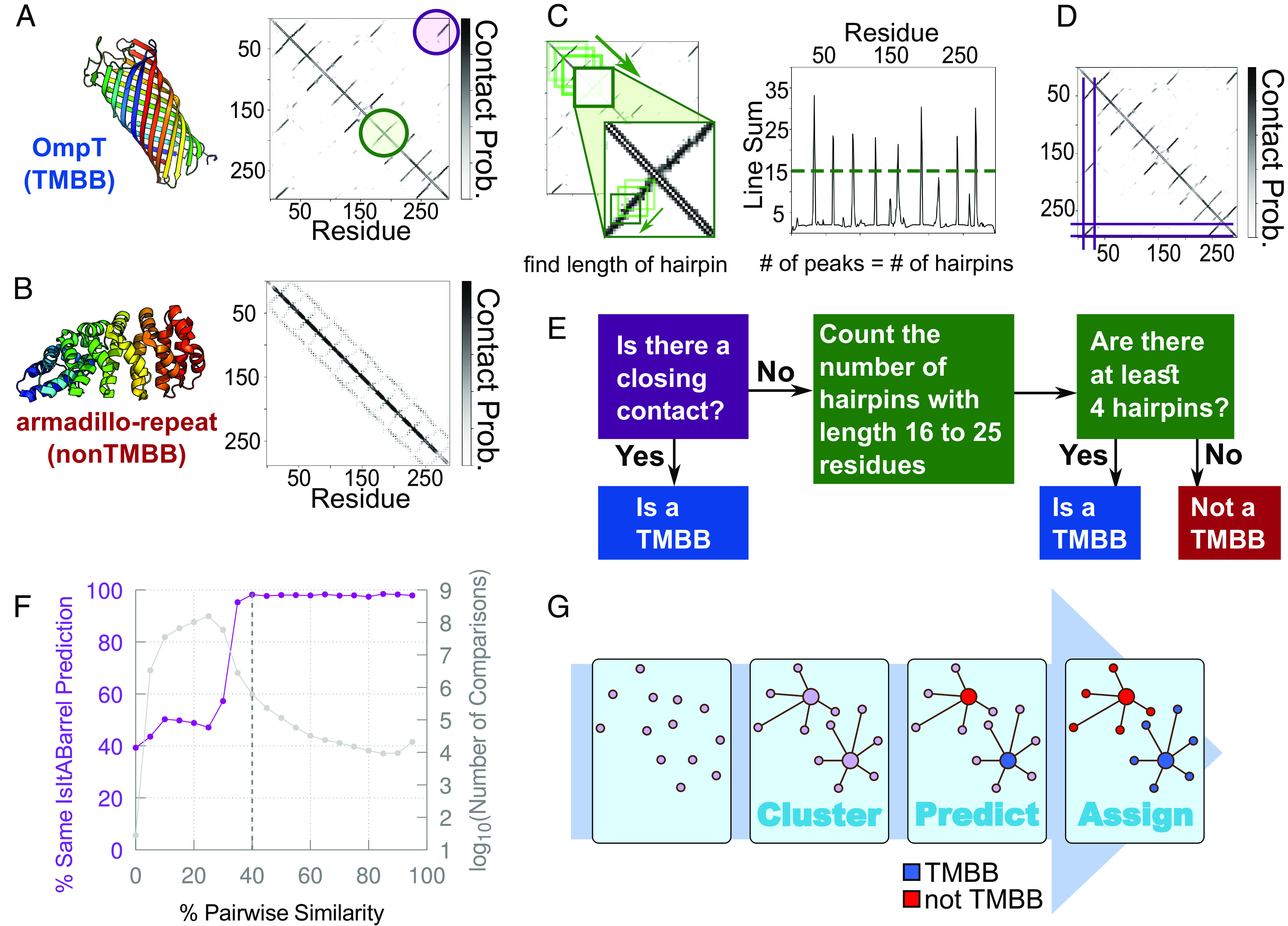
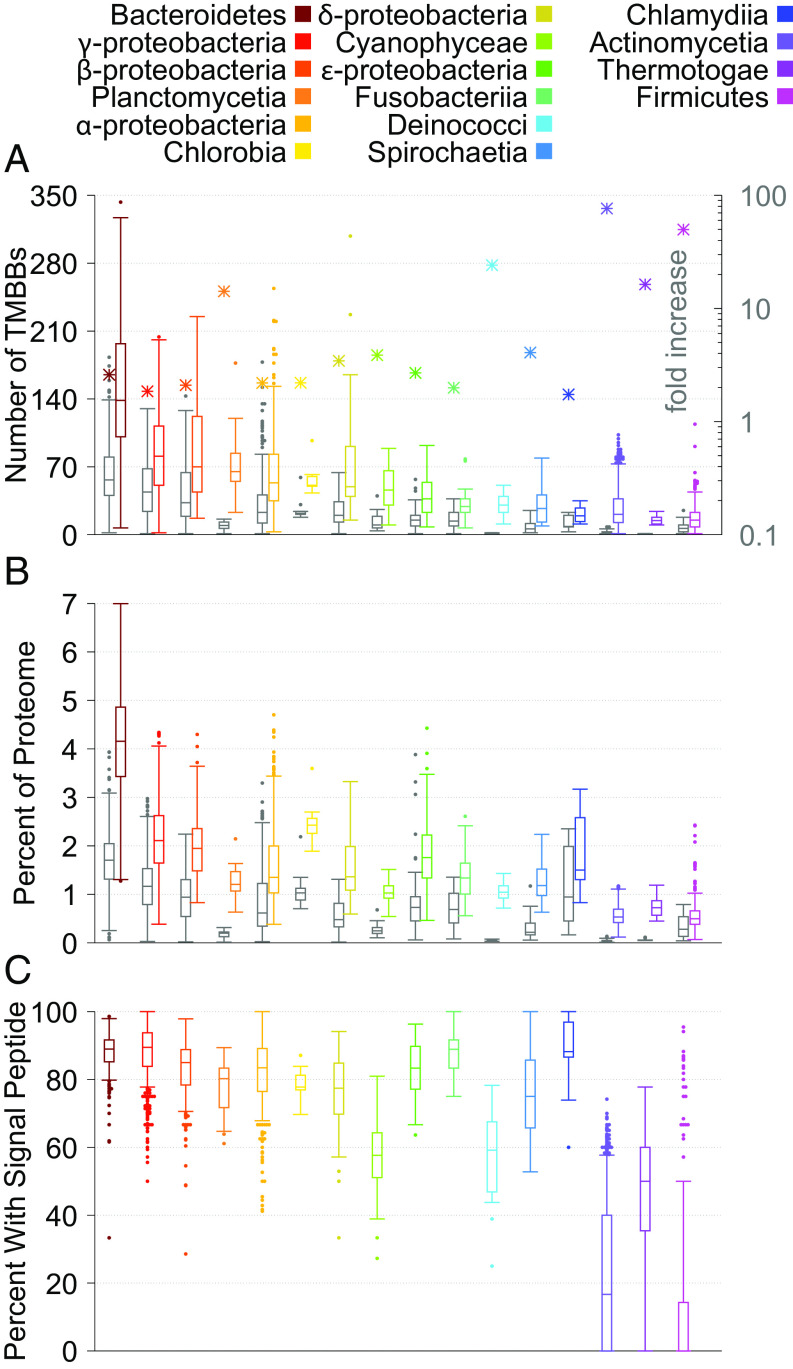
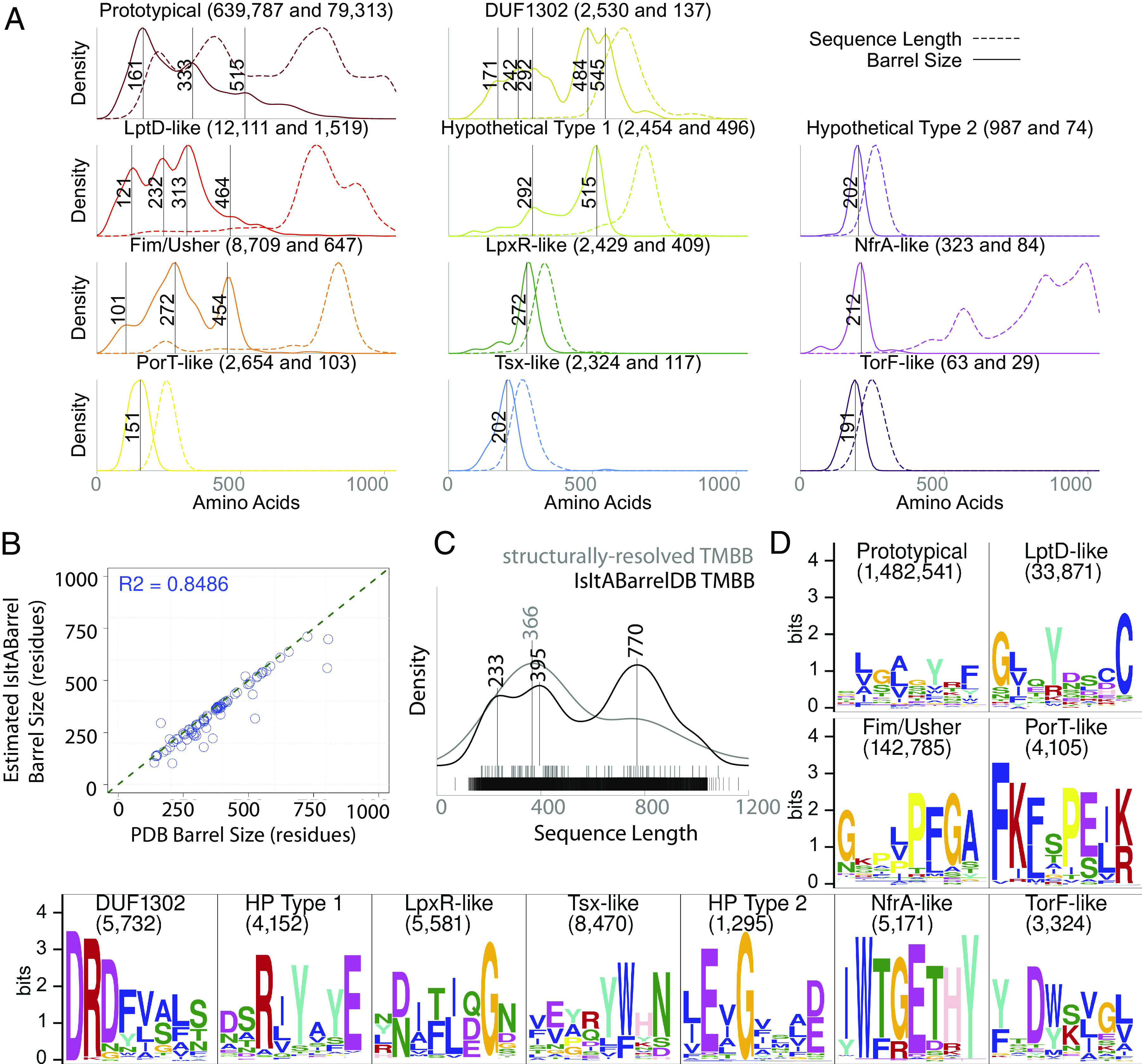
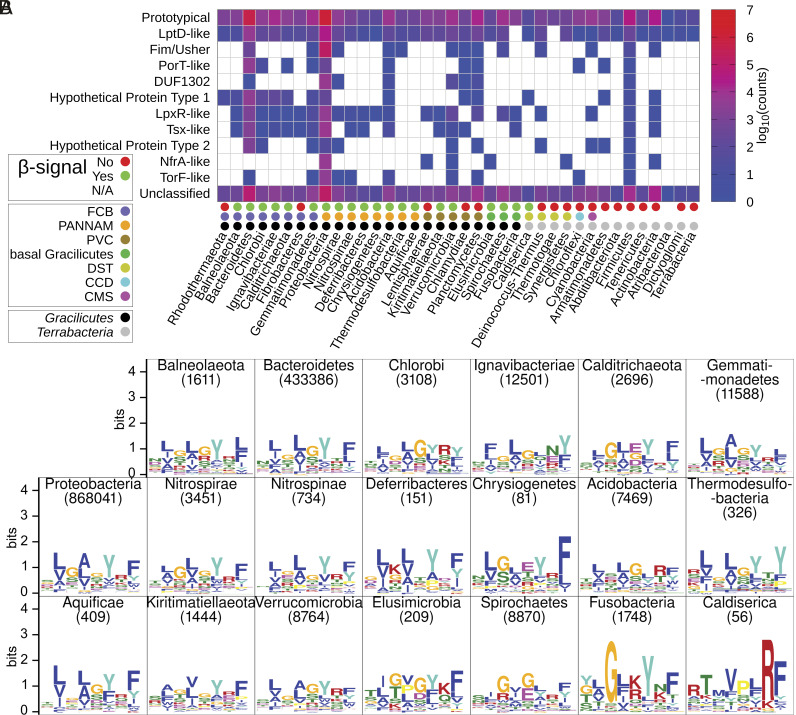
Large datasets contribute new insights to subjects formerly investigated by exemplars. We used coevolution data to create a large, high-quality database of transmembrane β-barrels (TMBB). By applying simple feature detection on generated evolutionary contact maps, our method (IsItABarrel) achieves 95.88% balanced accuracy when discriminating among protein classes. Moreover, comparison with IsItABarrel revealed a high rate of false positives in previous TMBB algorithms. In addition to being more accurate than previous datasets, our database (available online) contains 1,938,936 bacterial TMBB proteins from 38 phyla, respectively, 17 and 2.2 times larger than the previous sets TMBB-DB and OMPdb. We anticipate that due to its quality and size, the database will serve as a useful resource where high-quality TMBB sequence data are required. We found that TMBBs can be divided into 11 types, three of which have not been previously reported. We find tremendous variance in proteome percentage among TMBB-containing organisms with some using 6.79% of their proteome for TMBBs and others using as little as 0.27% of their proteome. The distribution of the lengths of the TMBBs is suggestive of previously hypothesized duplication events. In addition, we find that the C-terminal β-signal varies among different classes of bacteria though its consensus sequence is LGLGYRF. However, this β-signal is only characteristic of prototypical TMBBs. The ten non-prototypical barrel types have other C-terminal motifs, and it remains to be determined if these alternative motifs facilitate TMBB insertion or perform any other signaling function.
Overview
The claims and statistics of this paper haven’t been checked yet.
Run the check — free, no account needed. It reads the open-access text and checks the sources it cites.
Integrity signals
Registry
Cites
Statistics
Figures
Verification
Claims the paper makes
The claims and statistics of this paper haven’t been checked yet.
Run the check — free, no account needed. It reads the open-access text and checks the sources it cites.
Self-check
Percentages, sums and reported differences re-computed from the paper’s own numbers.
The self-check needs the paper’s full text.
Citations
Cites
Highly accurate protein structure prediction with AlphaFold
Jumper, J., Evans, R., Pritzel, A., Green, T., Figurnov, M., Ronneberger, O., Tunyasuvunakool, K., Bates, R., Žídek, A., Potapenko, A., et al. (2021) · Nature · doi:10.1038/s41586-021-03819-2 · Cited by 43,764
Protein 3D Structure Computed from Evolutionary Sequence Variation
Marks, D. S., Colwell, L. J., Sheridan, R., Hopf, T. A., Pagnani, A., Zecchina, R., & Sander, C. (2011) · PLoS ONE · doi:10.1371/journal.pone.0028766 · Cited by 1,144
Clustering predicted structures at the scale of the known protein universe
Barrio-Hernandez, I., Yeo, J., Jänes, J., Mirdita, M., Gilchrist, C. L. M., Wein, T., Varadi, M., Velankar, S., Beltrao, P., & Steinegger, M. (2023) · Nature · doi:10.1038/s41586-023-06510-w · Cited by 362
Genome-wide analysis of the Firmicutes illuminates the diderm/monoderm transition
Taib, N., Megrian, D., Witwinowski, J., Adam, P., Poppleton, D., Borrel, G., Beloin, C., & Gribaldo, S. (2020) · Nature Ecology & Evolution · doi:10.1038/s41559-020-01299-7 · Cited by 82
Research works printed but not linked: 56
- 10.1016/S0005-2736(02)00577-1 · DOI
- 10.1093/molbev/msq017 · DOI
- M. W. Franklin Evolutionary pathways of repeat protein topology in bacterial outer membrane proteins. Elife 7 e40308 (2018). e40308 · DOI
- 10.1016/j.str.2018.06.007 · DOI
- 10.1098/rstb.2015.0023 · DOI
- 10.1021/acs.jpcb.1c00878 · DOI
- 10.1110/ps.29402 · DOI
- 10.1002/pro.758 · DOI
- 10.1016/j.jmb.2005.09.094 · DOI
- 10.1002/prot.20929 · DOI
- 10.1016/S1476-9271(02)00085-3 · DOI
- 10.1110/ps.0209002 · DOI
- 10.1093/bioinformatics/btq308 · DOI
- 10.1093/bioinformatics/btw025 · DOI
- 10.1093/nar/gkh351 · DOI
- 10.1016/j.bpc.2005.04.005 · DOI
- 10.1093/bioinformatics/bts233 · DOI
- 10.1093/nar/gkl205 · DOI
- 10.1002/prot.21788 · DOI
- 10.1093/bioinformatics/btw444 · DOI
- 10.1073/pnas.1716817115 · DOI
- 10.1093/nar/gkl262 · DOI
- 10.1186/1471-2105-6-56 · DOI
- 10.1093/nar/gkp325 · DOI
- 10.1002/prot.20092 · DOI
- 10.1093/bioinformatics/btm548 · DOI
- 10.1093/bioinformatics/18.suppl_1.S46 · DOI
- 10.1186/1471-2105-5-29 · DOI
- 10.1093/bioinformatics/btr549 · DOI
- 10.1142/S0219720020500341 · DOI
- 10.1093/bioinformatics/bts478 · DOI
- 10.1093/nar/gkq863 · DOI
- 10.1093/bioinformatics/btu500 · DOI
- 10.1073/pnas.1314045110 · DOI
- 10.1016/0005-2795(75)90109-9 · DOI · Paper page
- 10.1111/mmi.14469 · DOI
- 10.1038/s41587-019-0036-z · DOI
- 10.1016/0022-2836(91)90880-F · DOI
- 10.1038/s41467-019-11230-9 · DOI
- 10.1073/pnas.1322473111 · DOI
- X. Wang J. H. Peterson H. D. Bernstein Bacterial outer membrane proteins are targeted to the Bam complex by two parallel mechanisms. mBio 12 e00597-21 (2021). e00597-21 · DOI
- 10.1371/journal.pbio.0040377 · DOI
- 10.1093/nar/gkv416 · DOI
- 10.1073/pnas.1415955112 · DOI
- 10.1038/s41564-022-01257-y · DOI
- 10.1038/s41564-022-01066-3 · DOI
- 10.1093/bioinformatics/btt355 · DOI
- 10.1021/ja209895m · DOI
- 10.1016/S0959-440X(03)00099-X · DOI
- 10.1038/nature12447 · DOI
- 10.1186/1471-2164-13-510 · DOI
- 10.1016/S0092-8674(03)00203-4 · DOI
- 10.1038/nmicrobiol.2016.64 · DOI
- 10.1093/bioinformatics/btv472 · DOI
- 10.1093/nar/gki402 · DOI
- 10.1093/nar/gkp786 · DOI
Metadata
- Authors
- Montezano, D., Bernstein, R., Copeland, M. M., & Slusky, J. S. G.
- Affiliations
- University of Kansas (US)
- Corresponding author
- Slusky, Joanna S. G.
- Venue
- Proceedings of the National Academy of Sciences
- Publisher
- National Academy of Sciences
- Published
- 2023-07-11
- Volume
- 120
- Issue
- 29
- Pages
- e2220762120-e2220762120
- ISSN
- 0027-8424 (ISSN-L)
- 1091-6490
- PMC
- PMC10629564
- OpenAlex
- W4383874614
- Cited by
- 17
- References
- 4
- Citations by year
- 2026: 8 · 2025: 3 · 2024: 6
- FWCI
- 1.51
- Type
- journal article
- Language
- en
- Open access
- hybrid
- doi.org
- Licence
- Locations
- Proceedings of the National Academy of Sciences (publishedVersion, cc-by-nc-nd)
- bioRxiv (Cold Spring Harbor Laboratory) (acceptedVersion)
- PubMed Central (publishedVersion, cc-by-nc-nd)
- PubMed (publishedVersion)
- eScholarship (California Digital Library) (submittedVersion, cc-by-nc-nd)
- Funders
- HHS | NIH | National Institute of General Medical Sciences (DP2 GM128201, P20GM103418)
- National Science Foundation (2226804)
- American-Scandinavian Foundation (Fellowship)
- KU | Office of Research, University of Kansas (Startup)
- Topics
- Life Sciences › Biochemistry, Genetics and Molecular Biology › Molecular Biology › Machine Learning in Bioinformatics
- Life Sciences › Biochemistry, Genetics and Molecular Biology › Genetics › Bacterial Genetics and Biotechnology
- Life Sciences › Biochemistry, Genetics and Molecular Biology › Molecular Biology › Protein Structure and Dynamics
- Keywords
- transmembrane beta-barrel, bacterial membrane proteins, protein coevolution, protein databases, proteome composition
- MeSH terms
- Algorithms, Bacterial Proteins, Biological Evolution, Humans, Consensus Sequence, Proteome
About these checks
Registry, retraction, Cites and statistics results are computed, not judged, with one exception: a printed reference that no index lists is read once by a model before it counts as a citation error. Claims are extracted by a model and kept only when their quote appears verbatim in the text; each cited source is then checked, with a model’s help, for whether it says what the claim relies on. Those verdicts can be wrong — read the claim’s quote and the cited source before relying on one.
Statistics and arithmetic are recomputed, not judged.
Confidence bands are shown only for fields calibrated on our annotated test set. None is calibrated yet, so no band is shown.
What counts as a claim ›How we measure confidence ›How we check this ›
Are you an author, or do you see a problem with this page? Request a review
