

Representations and generalization in artificial and brain neural networks
Open accessThe DOI matches its Crossref record; 75 of the 75 references it cites were found in a registry or an index.
Abstract
Humans and animals excel at generalizing from limited data, a capability yet to be fully replicated in artificial intelligence. This perspective investigates generalization in biological and artificial deep neural networks (DNNs), in both in-distribution and out-of-distribution contexts. We introduce two hypotheses: First, the geometric properties of the neural manifolds associated with discrete cognitive entities, such as objects, words, and concepts, are powerful order parameters. They link the neural substrate to the generalization capabilities and provide a unified methodology bridging gaps between neuroscience, machine learning, and cognitive science. We overview recent progress in studying the geometry of neural manifolds, particularly in visual object recognition, and discuss theories connecting manifold dimension and radius to generalization capacity. Second, we suggest that the theory of learning in wide DNNs, especially in the thermodynamic limit, provides mechanistic insights into the learning processes generating desired neural representational geometries and generalization. This includes the role of weight norm regularization, network architecture, and hyper-parameters. We will explore recent advances in this theory and ongoing challenges. We also discuss the dynamics of learning and its relevance to the issue of representational drift in the brain.
Overview
The claims and statistics of this paper haven’t been checked yet.
Free: it reads the open-access text and checks the first 5 claims that cite a source we can check. Create a free account to check every claim.
Integrity signals
Registry
Cites
Statistics
Figures
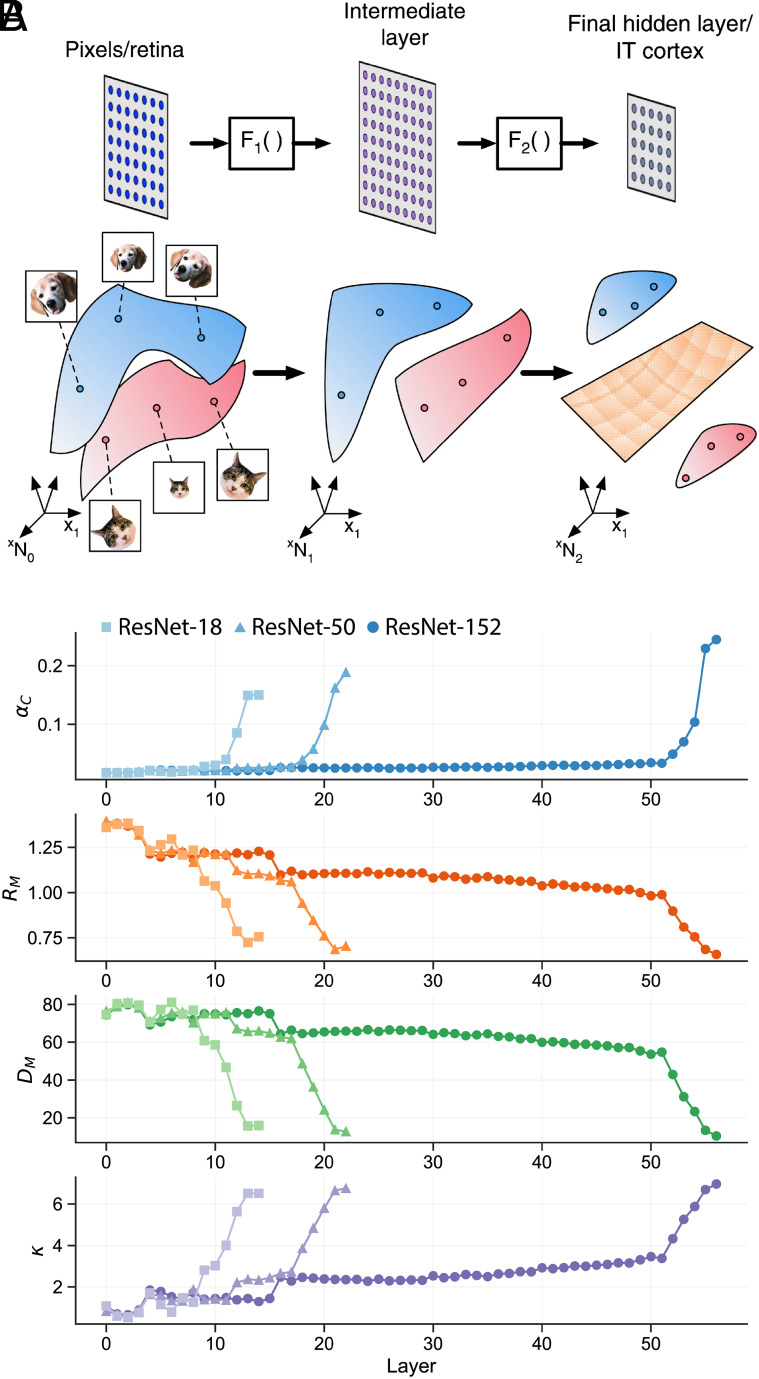
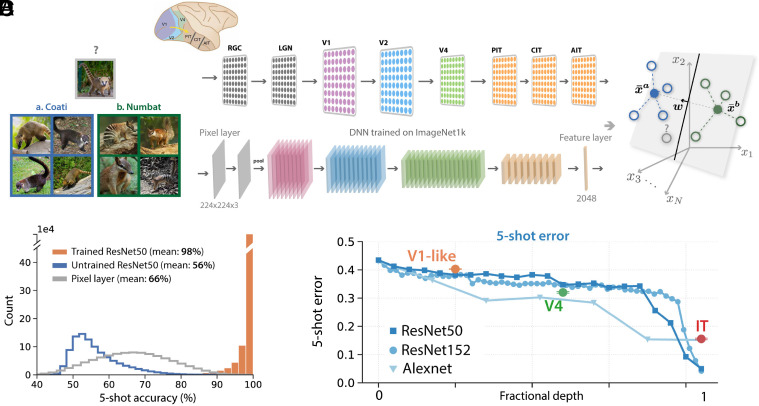
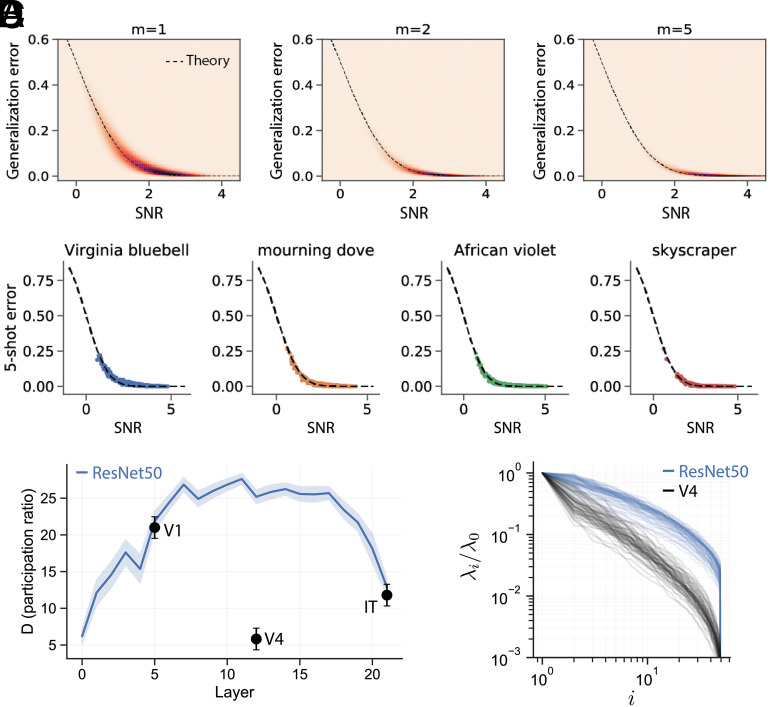
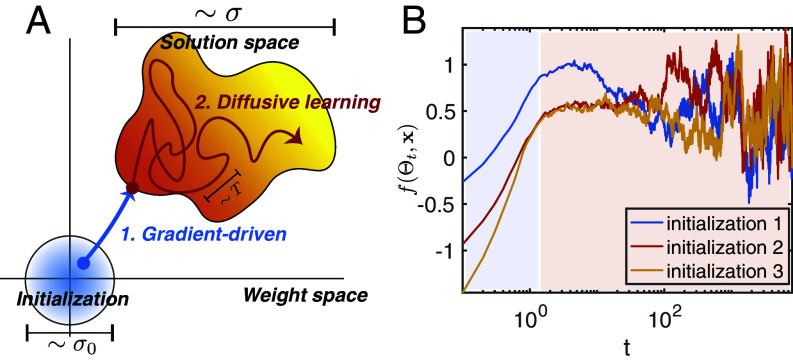
Verification
Claims the paper makes
The claims and statistics of this paper haven’t been checked yet.
Free: it reads the open-access text and checks the first 5 claims that cite a source we can check. Create a free account to check every claim.
Claims other papers make about this one
Each is checked against this paper’s own text: does it say what the citing paper says it does?
The source backs part of the claim, not all of it — or backs it for a different population, condition or comparison.
In the citing paper
“Furthermore, recent studies have found a striking representational alignment between a wide variety of ANNs and the human brain, despite their having different architectures, network initializations, learning objectives, and even different modalities such as language and vision [12,15–22]”
From The Umwelt Representation Hypothesis: rethinking Universality (2026) · cites this paper as [16]
Experimental — accuracy not yet measured
Self-check
Percentages, sums and reported differences re-computed from the paper’s own numbers.
The self-check needs the paper’s full text.
Citations
Cites
Deep Residual Learning for Image Recognition
He, K., Zhang, X., Ren, S., & Sun, J. (2016) · 2016 IEEE Conference on Computer Vision and Pattern Recognition (CVPR) · doi:10.1109/cvpr.2016.90 · Cited by 235,474
Very Deep Convolutional Networks for Large-Scale Image Recognition
Simonyan, K., & Zisserman, A. (2014) · arXiv · doi:10.48550/arxiv.1409.1556 · Cited by 114,148
ImageNet classification with deep convolutional neural networks
Krizhevsky, A., Sutskever, I., & Hinton, G. E. (2017) · Communications of the ACM · doi:10.1145/3065386 · Cited by 112,155
ImageNet: A large-scale hierarchical image database
Deng, J., Dong, W., Socher, R., Li, L.-J., Li, K., & Fei-Fei, L. (2009) · 2009 IEEE Conference on Computer Vision and Pattern Recognition · doi:10.1109/cvpr.2009.5206848 · Cited by 65,333
Cortes, C., & Vapnik, V. (1995) · Machine Learning · doi:10.1007/bf00994018 · Cited by 59,421
The MNIST Database of Handwritten Digit Images for Machine Learning Research [Best of the Web]
Deng, L. (2012) · IEEE Signal Processing Magazine · doi:10.1109/msp.2012.2211477 · Cited by 4,836
A Survey on Deep Transfer Learning
Tan, C., Sun, F., Kong, T., Zhang, W., Yang, C., & Liu, C. (2018) · Lecture Notes in Computer Science · doi:10.1007/978-3-030-01424-7_27 · Cited by 3,165
Generalizing from a Few Examples: A Survey on Few-shot Learning
Wang, Y., Yao, Q., Kwok, J. T., & Ni, L. M. (2021) · ACM Computing Surveys · doi:10.1145/3386252 · Cited by 3,165
MCMC Using Hamiltonian Dynamics
Neal, R. M. (2011) · Handbook of Markov Chain Monte Carlo · doi:10.1201/b10905-6 · Cited by 2,574
Neural Tangent Kernel: Convergence and Generalization in Neural Networks
Jacot, A., Gabriel, F., & Hongler, C. (2018) · arXiv · doi:10.48550/arxiv.1806.07572 · Cited by 1,562
Research works printed but not linked: 5
- L. Petrini, F. Cagnetta, U. M. Tomasini, A. Favero, M. Wyart, How deep neural networks learn compositional data: The random hierarchy model. arXiv [Preprint] (2023). http://arxiv.org/abs/2307.02129 (Accessed 28 November 2023). · arXiv
- C. Gerbelot, E. Troiani, F. Mignacco, F. Krzakala, L. Zdeborova, Rigorous dynamical mean field theory for stochastic gradient descent methods. arXiv [Preprint] (2022). http://arxiv.org/abs/2210.06591 (Accessed 28 November 2023). · arXiv
- S. Ariosto., Statistical mechanics of deep learning beyond the infinite-width limit. arXiv [Preprint] (2022). http://arxiv.org/abs/2209.04882 (Accessed 28 November 2023). · arXiv
- S. Dubova, Y. M. Lu, B. McKenna, H. T. Yau, Universality for the global spectrum of random inner-product kernel matrices in the polynomial regime. arXiv [Preprint] (2023). http://arxiv.org/abs/2310.18280 (Accessed 28 November 2023). · arXiv
- E. Sezener., A rapid and efficient learning rule for biological neural circuits. BioRxiv [Preprint] (2021). https://www.biorxiv.org/content/10.1101/2021.03.10.434756v1 (Accessed 28 November 2023). · doi:10.1101/2021.03.10.434756v1
Cited by
Nachtane, M., Idrissi, M. E. F., Tarfaoui, M., Qarssis, Y., Abichou, A., & Faik, A. (2024) · Composites Communications · doi:10.1016/j.coco.2024.102079 · Cited by 41
Machine learning meets physics: A two-way street
Levine, H., & Tu, Y. (2024) · Proceedings of the National Academy of Sciences · doi:10.1073/pnas.2403580121 · Cited by 37
Enhanced visibility graph for EEG classification
Belhadi, A., Lind, P. G., Djenouri, Y., & Yazidi, A. (2025) · Frontiers in Neuroscience · doi:10.3389/fnins.2025.1541062 · Cited by 22
Statistical Mechanics of Transfer Learning in Fully Connected Networks in the Proportional Limit
Ingrosso, A., Pacelli, R., Rotondo, P., & Gerace, F. (2025) · Physical Review Letters · doi:10.1103/physrevlett.134.177301 · Cited by 15
“Finally, it is reasonable to expect that the proposed effective theory breaks down in the large P regime [45, 41, 46], i.e. when the number of training patterns is proportional to the total number of parameters of the network.”
BackgroundGazehi, W., Loukil, R., & Besbes, M. (2025) · Expert Systems with Applications · doi:10.1016/j.eswa.2025.126518 · Cited by 15
Kumar, A. V., Rohullah, M., Chosenyah, M., Sindhuja, G., & Chandrasekar, R. (2025) · Angewandte Chemie International Edition · doi:10.1002/anie.202502122 · Cited by 14
The Use of AI in Elementary School Learning: A Systematic Literature Review
Purba, N., Pujiati, D., Sihombing, P. S. R., Simanjuntak, H., & Sijabat, D. (2025) · QALAMUNA Jurnal Pendidikan Sosial dan Agama · doi:10.37680/qalamuna.v17i1.6761 · Cited by 22
“This aligns with adaptive learning theory, which emphasizes personalized learning approaches based on individual student progress (Li et al., 2024a; Sun, 2020).”
InfluentialUnified theoretical framework for wide neural network learning dynamics
Avidan, Y., Li, Q., & Sompolinsky, H. (2025) · Physical review. E · doi:10.1103/physreve.111.045310 · Cited by 16
Self-citationMeasuring and Controlling Solution Degeneracy across Task-Trained Recurrent Neural Networks
Huang, A., Singh, S. H., Martinelli, F., & Rajan, K. (2025) · neural information processing systems · doi:10.52202/085713-3517 · Cited by 21
“This highlights the need for further empirical and theoretical work on how generalization depends on the internal structure of task-trained networks [83, 84, 85].”
IoMT encryption using homogeneous lattice of coexisting neuronal chaos
Wang, J., Zhang, S., Wang, L., Qi, X., & Li, C. (2025) · Chaos Solitons & Fractals · doi:10.1016/j.chaos.2025.116943 · Cited by 10
Zhang, Q., Xu, Z., Zou, Y., & Li, D. (2026) · Expert Systems with Applications · doi:10.1016/j.eswa.2026.132292 · Cited by 12
Practice reshapes the geometry and dynamics of task-tailored representations
Kikumoto, A., Shibata, K., Nishio, T., & Badre, D. (2025) · Cerebral Cortex · doi:10.1093/cercor/bhaf125 · Cited by 10
Robust measurement of surface tension and contact angle using physics-informed autoencoders
Pan, C., Qiao, C., Feng, S., Li, Y., Zheng, Y., & Ye, H. (2025) · Colloids and Surfaces A Physicochemical and Engineering Aspects · doi:10.1016/j.colsurfa.2025.138972 · Cited by 7
Probabilistic and deep learning approaches for conductivity-driven nanocomposite classification
Gazehi, W., Loukil, R., & Besbes, M. (2025) · Scientific Reports · doi:10.1038/s41598-025-91057-1 · Cited by 7
A zero-shot tree-structured multi-objective evolutionary Neural Architecture Search
Dai, Y., Wei, L., Hu, Z., Sun, H., Xu, Q., Zhang, K., & Zhao, B. (2026) · Engineering Applications of Artificial Intelligence · doi:10.1016/j.engappai.2025.113703 · Cited by 5
Data variability in neural network Bayesian inference
Lindner, J., Dahmen, D., Krämer, M., & Helias, M. (2025) · Physical Review Research · doi:10.1103/r1s3-lr3g · Cited by 5
Orbitofrontal-sensory cortical interactions in learning and adaptive decision-making
Rao, R., Six, H., Cortese, A., & Banerjee, A. (2025) · Trends in Cognitive Sciences · doi:10.1016/j.tics.2025.10.017 · Cited by 5
“While some mechanisms – like concept-specific units [119] – can arise in deep learning models, others, such as top-down modulation of sensory representations, are not easily captured by standard backpropagation.”
Wang, S., Gordon, S. L., French, C. R., Unnithan, R. R., & Sun, D. (2025) · Frontiers in Synaptic Neuroscience · doi:10.3389/fnsyn.2025.1732955 · Cited by 6
Barra, J., Shahbazi, S., Birri, A., Chahal, R., Isah, I., Anwar, M. N., Starkus, T., Balaprakash, P., & Lam, S. (2025) · ChemPhysChem · doi:10.1002/cphc.202500273 · Cited by 4
Variation in the geometry of concept manifolds across human visual cortex
St-Yves, G., Kay, K., & Naselaris, T. (2025) · PLoS Computational Biology · doi:10.1371/journal.pcbi.1013416 · Cited by 4
“The geometry of concept manifolds is currently a topic of intense investigation [8–10].”
Kumar, A. V., Rohullah, M., Chosenyah, M., Sindhuja, G., & Chandrasekar, R. (2025) · Angewandte Chemie · doi:10.1002/ange.202502122 · Cited by 3
Tian, F., & Yuan, D. (2025) · Kybernetes · doi:10.1108/k-09-2024-2603 · Cited by 3
The Umwelt Representation Hypothesis: rethinking Universality
Bosch, V., Sommers, R. P., Doerig, A., & Kietzmann, T. C. (2026) · Trends in Cognitive Sciences · doi:10.1016/j.tics.2026.07.004 · Cited by 2
Endress, A. D. (2024) · Memory & Cognition · doi:10.3758/s13421-024-01665-x · Cited by 3
Cardiac Heterogeneity Prediction by Cardio-Neural Network Simulation
Mehmood, A., Ilyas, A., & Ilyas, H. (2025) · Neuroinformatics · doi:10.1007/s12021-025-09717-6 · Cited by 2
“The coincidence factor Γ (Li et al., 2024) can be, defined as: The parameters in Eq.”
Microscopic and collective signatures of feature learning in neural networks
Corti, A., Pacelli, R., Rotondo, P., & Gherardi, M. (2026) · Physical review. E · doi:10.1103/k7rs-ysyf · Cited by 3
Simplified derivations for high-dimensional convex learning problems
Clark, D., & Sompolinsky, H. (2025) · SciPost Physics Lecture Notes · doi:10.21468/scipostphyslectnotes.105 · Cited by 4
“Tools from statistical physics have elucidated important properties of artificial and biological neural networks [1–3] such as storage-capacity limits [4–8], generalization characteristics [9–11], and network dynamics [12–14].”
Self-citationBaglioni, P., Giambagli, L., Vezzani, A., Burioni, R., Rotondo, P., & Pacelli, R. (2025) · Physical review. E · doi:10.1103/9pkk-d4bm · Cited by 3
Exploring neural manifolds across a wide range of intrinsic dimensions
Fadanni, J., Pacelli, R., Zucchetta, A., Rotondo, P., & Allegra, M. (2026) · PLoS Computational Biology · doi:10.1371/journal.pcbi.1014162 · Cited by 1
Recurrent circuitry stabilizes representational geometry across neural circuitsPreprint
Raju, P. C. (2026) · Research Square · doi:10.21203/rs.3.rs-9581425/v1 · Cited by 1
Kernel Shape Renormalization In Bayesian Shallow Networks: a Gaussian Process Perspective
Pacelli, R., Giambagli, L., & Baglioni, P. (2024) · Complexity in Engineering (COMPENG) · doi:10.1109/compeng60905.2024.10741461
“Furthermore, the elements of the matrix Q possess a straightforward physical interpretation that we elucidated, consistently with what was previously identified in similar settings [9], [13], [25].”
ResultYe, Z., & Weßel, R. (2025) · bioRxiv (Cold Spring Harbor Laboratory) · doi:10.1101/2025.04.23.650305
“This capability for out -of- distribution (OOD) generalization is thought to rely on specific formats of neural representation 1–3 .”
InfluentialBeyond single neurons: population response geometry in digital twins of mouse visual cortex*
Liscai, D., Luconi, E., Vargas, A. M., & Sanzeni, A. (2025) · Journal of Statistical Mechanics Theory and Experiment · doi:10.1088/1742-5468/adde43
Retinotopy constrains the topology of neural manifolds in macaque visual cortexPreprint
Ardalani, R., Kurth, A. C., & Morales-Gregorio, A. (2025) · bioRxiv (Cold Spring Harbor Laboratory) · doi:10.64898/2025.12.22.695909
Artificial intelligence integration in livestock reproductive omics
Hossein‐Zadeh, N. G. (2026) · Elsevier eBooks · doi:10.1016/b978-0-443-45663-3.00003-8
Predictive coding networks capture human neural representations missing in supervised DNNsPreprint
Gütlin, D., Kittelmann, D., & Auksztulewicz, R. (2026) · bioRxiv (Cold Spring Harbor Laboratory) · doi:10.64898/2026.09.18.752626 · Cited by 1
Path Integration Promotes Flexible Navigational Decision MakingPreprint
Grgurich, R., Wang, S., Wang, S., Pimenta, J., Delafraz, K., & Blair, H. T. (2026) · bioRxiv (Cold Spring Harbor Laboratory) · doi:10.64898/2026.10.01.756060
Metadata
- Authors
- Li, Q., Sorscher, B., & Sompolinsky, H.
- Affiliations
- Harvard University (US)
- Stanford University (US)
- Corresponding author
- Li, Qianyi
- Sorscher, Ben
- Sompolinsky, Haim
- Venue
- Proceedings of the National Academy of Sciences
- Publisher
- National Academy of Sciences
- Published
- 2024-06-24
- Volume
- 121
- Issue
- 27
- Pages
- e2311805121-e2311805121
- ISSN
- 0027-8424 (ISSN-L)
- 1091-6490
- PMC
- PMC11228472
- OpenAlex
- W4399940446
- Cited by
- 27
- References
- 64
- Citations by year
- 2026: 4 · 2025: 19 · 2024: 4
- FWCI
- 0.93
- Type
- journal article
- Language
- en
- Open access
- hybrid
- doi.org
- Licence
- Locations
- Proceedings of the National Academy of Sciences (publishedVersion, cc-by)
- PubMed Central (publishedVersion, cc-by)
- PubMed (publishedVersion)
- Funders
- DOD | USN | Office of Naval Research (No.N0014-23-1-2051)
- Topics
- Physical Sciences › Computer Science › Artificial Intelligence › Neural Networks and Applications
- Physical Sciences › Computer Science › Artificial Intelligence › Domain Adaptation and Few-Shot Learning
- Life Sciences › Neuroscience › Cognitive Neuroscience › Neural dynamics and brain function
- Keywords
- generalization, neural manifolds, representational geometry, deep neural network, out-of-distribution generalization, visual object recognition, thermodynamic limit, wide neural networks, representational drift, mental representation
- MeSH terms
- Animals, Artificial Intelligence, Brain, Cognition, Generalization, Psychological, Humans, Models, Neurological, Neural Networks, Computer
About these checks
Registry, retraction, Cites and statistics results are computed, not judged, with one exception: a printed reference that no index lists is read once by a model before it counts as a citation error. Claims are extracted by a model and kept only when their quote appears verbatim in the text; each cited source is then checked, with a model’s help, for whether it says what the claim relies on. Those verdicts can be wrong — read the claim’s quote and the cited source before relying on one.
Statistics and arithmetic are recomputed, not judged.
Confidence bands are shown only for fields calibrated on our annotated test set. None is calibrated yet, so no band is shown.
What counts as a claim ›How we measure confidence ›How we check this ›
Are you an author, or do you see a problem with this page? Request a review
Data sources
Bibliographic data: Semantic Scholar, OpenAlex, Crossref.
Contains information from the Semantic Scholar Academic Graph Datasets, made available under the ODC Attribution License (ODC-BY 1.0).
Semantic Scholar’s data is described in: Kinney, R., et al. (2023). The Semantic Scholar Open Data Platform. arXiv:2301.10140.
