

Micro-offline gains do not reflect offline learning during early motor skill acquisition in humans
Open accessThe DOI matches its Crossref record; 53 of the 54 references it cites were found in a registry or an index; none of the 111 sources its claims cite is checked for support yet.
Abstract
While practicing a new motor skill, resting for a few seconds can improve performance immediately after the rest. This improvement, referred to as “micro-offline gains” (MOGs), has been interpreted as rapid offline learning and is thought to be supported by neural replay of the trained movement sequence during rest. Here, we provide evidence that MOGs reflect only transient performance benefits, partially mediated by motor planning, and not offline learning. In five experiments, participants trained to produce a sequence of finger movements as many times as possible. When participants trained during 10-s practice periods, interleaved with 10-s rest periods, they produced more correct keypresses during training than participants who trained continuously without taking breaks. However, this benefit vanished within seconds after training, when both groups performed under comparable conditions, revealing similar levels of skill acquisition. This challenges the idea that MOGs reflect offline learning, which, if present, should result in sustained performance benefits, compared to training without breaks. Furthermore, we observed persistent MOGs even when participants produced random, nonrepeating sequences, indicating that MOGs do not relate to the offline consolidation of a sequence-specific memory. Rather, sequence-specific learning was only evident online, during practice. Finally, MOGs were diminished when participants could not preplan the first few movements of an upcoming practice period. Our results suggest that MOG are simply an effect of slowing during practice, combined with the possibility of preplanning the initial movements after rest, and therefore do not serve as a reliable metric for offline learning or skill-related consolidation.
Overview
CoChat Summary
TL;DR
Across six behavioral experiments (including supplementary S1), short rest breaks during early motor sequence training produced micro-offline gains (MOGs), but these gains did not reflect offline learning or consolidation. MOGs were not sequence-specific, did not yield better skill than no-break training, and were partly explained by preplanning, fatigue/reactive-inhibition recovery, and transient performance dynamics.
Key findings
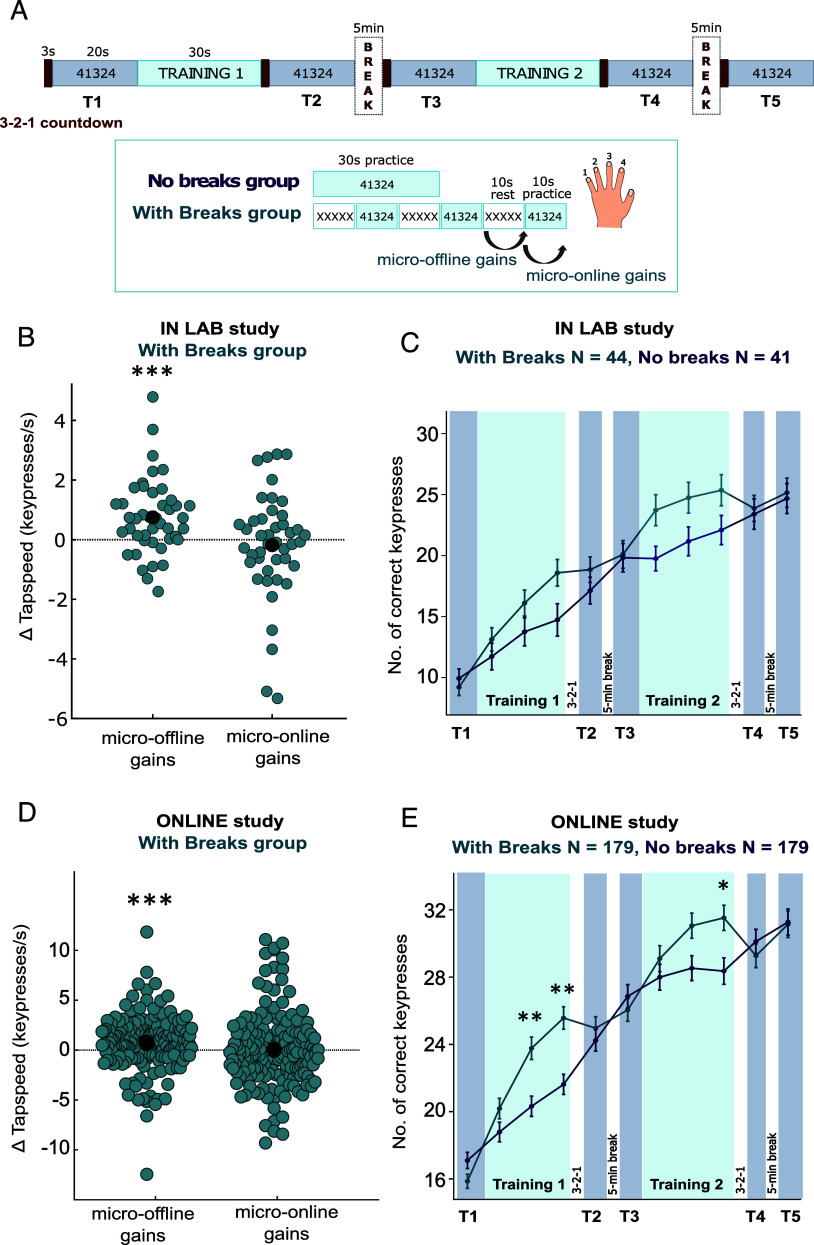
- Training with breaks produced significant MOGs in Experiment 1 (in-lab: t(43) = 3.92, P < 0.001, d = 0.59, BF10 = 84.73) and Experiment 2 (online: t(178) = 3.53, P < 0.001, d = 0.26, BF10 = 30.99), but no lasting skill advantage: test sessions T1–T5 showed no significant group main effect (in-lab: F(1,83) = 0.09, P = 0.761; online: F(1,356) = 0.30, P = 0.584) and no significant between-group differences at any test session (all pcorr > 0.2, all BF10 ≤ 0.97). The S1 replication also found no group differences after a 3-min rest despite MOGs.
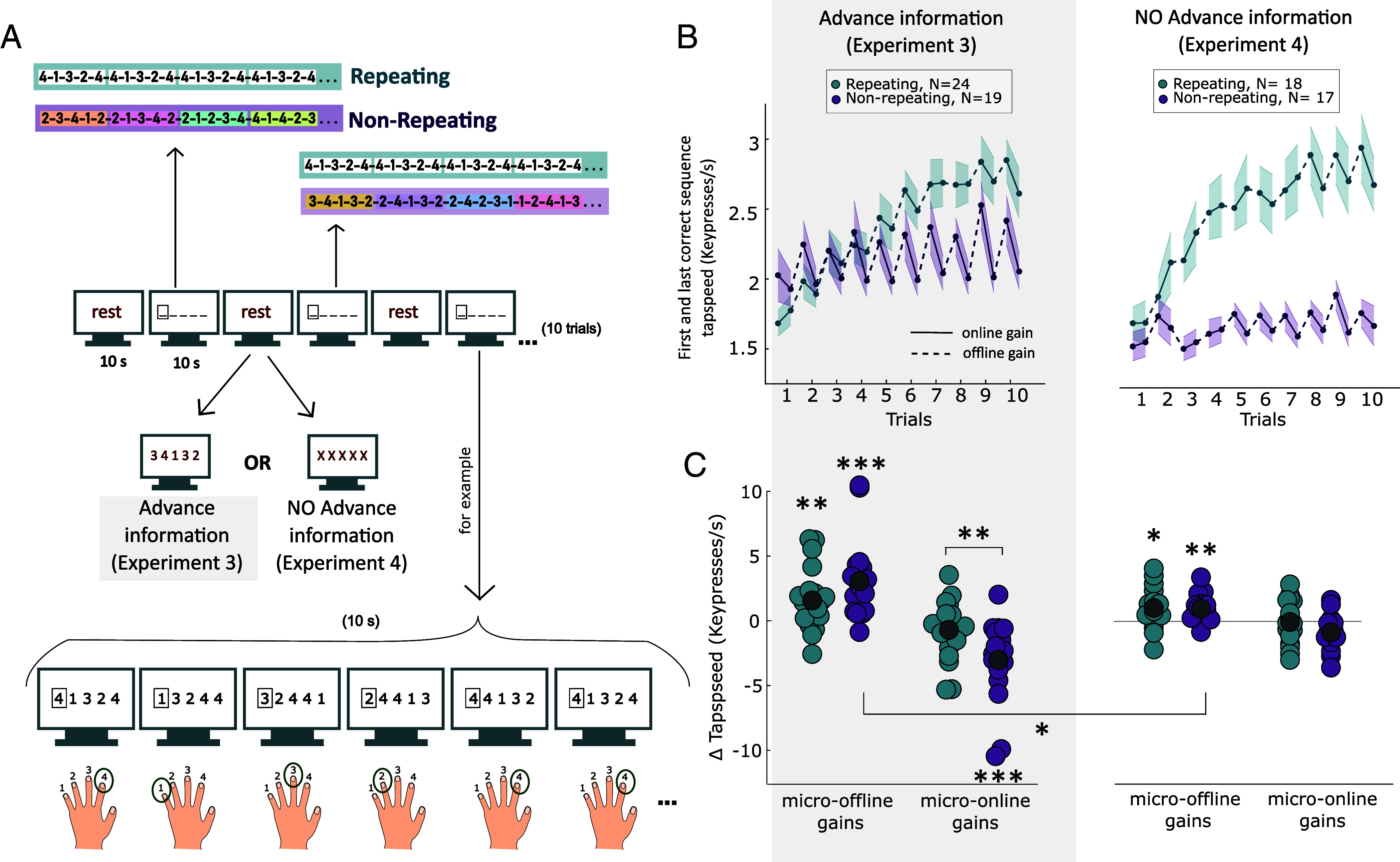
- MOGs were not sequence-specific: Experiment 3 found significant MOGs in both the Repeating group (N = 24; t(23) = 3.53, P = 0.002, d = 0.72, BF10 = 21.22) and the Nonrepeating group (N = 19; t(18) = 4.52, P < 0.001, d = 1.04, BF10 = 117.14), with similar magnitude (t(41) = −1.90, P = 0.968, d = −0.58; BF10 = 0.12). Sequence-specific learning appeared during practice, not rest (group × trial: F(3.6,146.9) = 13.75, P < 0.001, η2partial = 0.25; micro-online gains: t(41) = 3.00, P = 0.005, d = 0.92, BF10 = 9.08).
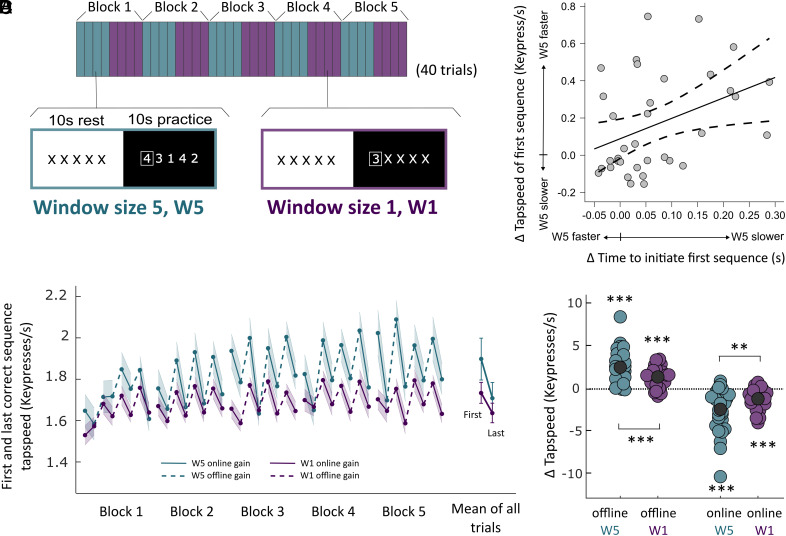
- MOGs partly reflect preplanning: Experiment 4 without advance cueing still showed MOGs in Repeating (t(17) = 2.85, P = 0.011, d = 0.67, BF10 = 4.84) and Nonrepeating groups (t(16) = 4.02, P < 0.001, d = 0.98, BF10 = 38.26), with Nonrepeating MOGs reduced versus Experiment 3 (t(22.4) = 2.91, P = 0.008, d = 0.95, BF10 = 11.20). In Experiment 5 (N = 35), allowing preplanning of five movements (W5) versus one (W1) slowed initiation (796 ± 126 ms vs. 728 ± 122 ms; t(34) = 4.34, P < 0.001, d = 0.73, BF10 = 212.87) but sped the first correct sequence (t(34) = 3.66, pcorr < 0.001, d = 0.62, BF10 = 36.87); MOGs were larger in W5 than W1 (t(34) = 3.69, P < 0.001, d = 0.62, BF10 = 39.25), yet remained significant in both W5 and W1.
- The authors conclude MOGs are transient performance effects around breaks—driven by recovery from fatigue/reactive inhibition plus preplanning—rather than offline consolidation; sequence-specific replay is not necessary for MOGs.
Methods
- Across five main experiments, 631 participants (270 females) took part: Experiment 1, 89 (analyzed 85); Experiment 2, 413 (analyzed 358); Experiment 3, 49; Experiment 4, 37; Experiment 5, 43 (with exclusions). Participants trained left-hand five-finger sequences (e.g., 4-1-3-2-4) as fast and accurately as possible. Experiments 1 and 2 compared training with breaks (10-s practice/10-s rest) versus no breaks (continuous 30-s practice, binned into 10-s bins), with 20-s test sessions at T1–T5 and 5-min breaks; Experiment 2 was online. Experiments 3 and 4 compared repeating versus nonrepeating sequences over 10 trials of 10-s practice/10-s rest, with (Experiment 3) or without (Experiment 4) advance sequence cueing during rest. Experiment 5 was within-subject, used nonrepeating sequences, and manipulated planning horizon (W5 vs. W1) across 40 trials.
- Main measures: MOGs = difference in tapping speed between the last correct sequence before rest and the first correct sequence after rest; micro-online gains = difference between first and last correct sequence within a practice period; skill = number of correct keypresses. Analyses used one-sample t tests against zero, repeated-measures ANOVAs, independent-samples t tests, Bayesian tests, and Pearson correlation, with Greenhouse–Geisser correction and Holm–Bonferroni correction where applicable.
Limitations
- The paper states that the Experiment 3 versus Experiment 4 comparison of Nonrepeating groups was a cross-experiment between-subject comparison, which limits interpretation; baseline performance also differed between those Nonrepeating groups, perhaps owing to sampling bias.
- The authors state their findings do not rule out the possibility of neural replay during rest; they show that sequence-specific replay is not necessary for MOGs to occur.
- The study targets early motor sequence learning over short timescales (seconds, first few trials); the authors say their findings do not support a spacing effect in early motor sequence learning on this short timescale, at least during the first few trials. Experiments 3 and 4 were run during a science communication event with no participation criteria except right-handedness and age for analysis, and modest samples; Experiment 2 used self-reported handedness.
Model-written summary. Check it against the paper before relying on it.
Integrity signals
Registry
Cites
Statistics
Figures
Verification
Claims the paper makes
0 Valid · 0 Not valid · 42 Not checked · 107 Own results and interpretations
A result the paper reports from its own data — it cites no other source for it, so there is none to check. The quote shows it is in the paper.
In the paper
“We provide evidence that MOGs are neither sequence-specific, nor associated with enhanced skill acquisition.”
§ Micro-offline gains do not reflect offline learning during early motor skill acquisition in humans > Abstract
plain- Asserted: passes — The authors put it forward as true.
- Checkable: passes — It can be checked against evidence.
- Load-bearing: passes — The paper’s conclusions depend on it.
- Based: passes — The paper gives a reason why it holds.
A result the paper reports from its own data — it cites no other source for it, so there is none to check. The quote shows it is in the paper.
In the paper
“We provide evidence that MOGs are neither sequence-specific, nor associated with enhanced skill acquisition.”
§ Micro-offline gains do not reflect offline learning during early motor skill acquisition in humans > Abstract
plainstates an association- Asserted: passes — The authors put it forward as true.
- Checkable: passes — It can be checked against evidence.
- Load-bearing: passes — The paper’s conclusions depend on it.
- Based: passes — The paper gives a reason why it holds.
A result the paper reports from its own data — it cites no other source for it, so there is none to check. The quote shows it is in the paper.
In the paper
“Furthermore, these gains also occur with random sequences, which cannot be learned”
§ Micro-offline gains do not reflect offline learning during early motor skill acquisition in humans > Abstract
plain- Asserted: passes — The authors put it forward as true.
- Checkable: passes — It can be checked against evidence.
- Load-bearing: passes — The paper’s conclusions depend on it.
- Based: passes — The paper gives a reason why it holds.
- Rests on an assumption not shown here.
A result the paper reports from its own data — it cites no other source for it, so there is none to check. The quote shows it is in the paper.
In the paper
“and they are partially driven by preplanning”
§ Micro-offline gains do not reflect offline learning during early motor skill acquisition in humans > Abstract
plainstates a cause- Asserted: passes — The authors put it forward as true.
- Checkable: passes — It can be checked against evidence.
- Load-bearing: passes — The paper’s conclusions depend on it.
- Based: passes — The paper gives a reason why it holds.
- Rests on an assumption not shown here.
A result the paper reports from its own data — it cites no other source for it, so there is none to check. The quote shows it is in the paper.
In the paper
“Indeed, across Experiments 3, 4, and 5, the groups performing nonrepeating sequences exhibited slowing of motor performance during practice (Figs. 2B and 3B).”
§ Micro-offline gains do not reflect offline learning during early motor skill acquisition in humans > Discussion
plainstates a cause- Asserted: passes — The authors put it forward as true.
- Checkable: passes — It can be checked against evidence.
- Load-bearing: passes — The paper’s conclusions depend on it.
- Based: passes — The paper gives a reason why it holds.
64 more claims
Create a free account to see all 149 claims and to verify the 111 references still open.
- It may state two separate claims as one. 42
- Probably not a substantial claim. 53
Statistics recomputed
Every reported test result, recomputed from its test statistic and degrees of freedom. A result shows as not adding up only once an independent check has confirmed it.
- Consistentt(43) = 3.92reported p < .001 · recomputed p < .001
“t(43) = 3.92, p < .001”
- Consistentt(178) = 3.53reported p < .001 · recomputed p < .001
“t(178) = 3.53, p < .001”
- ConsistentF(2.4, 199.8) = 78.54reported p < .001 · recomputed p < .001
“F(2.4,199.8) = 78.54, p < .001”
- ConsistentF(2.9, 1036.9) = 189.82reported p < .001 · recomputed p < .001
“F(2.9,1036.9) = 189.82, p < .001”
- ConsistentF(2.4, 199.8) = 7.6reported p < .001 · recomputed p < .001
“F(2.4,199.8) = 7.60, p < .001”
22 more recomputed tests
Create a free account to see every test the Stats check recomputed.
Self-check
Percentages, sums and reported differences re-computed from the paper’s own numbers.
Each contradiction between two passages listed here was confirmed by an independent check.
Rated minor: it would not touch a result — a value no result rests on, a p-value that stays on the same side of the significance level, or a conflict that is clerical, resolved elsewhere in the paper, or outside its own findings.
In the paper
§ Micro-offline gains do not reflect offline learning during early motor skill acquisition in humans > Results > Experiments 4 and 5: MOGs Partially Reflect Motor Preplanning.
“t(22.4) = 2 .91, P = 0.008, d = 0.95, BF10 = 11.20, Welch’s t test, Bayesian Welch’s t test, to account for unequal variances across groups”
§ Micro-offline gains do not reflect offline learning during early motor skill acquisition in humans > Methods > General Task Design.
“For statistical comparison of MOGs between the Nonrepeating groups of Experiments 3 and 4, a Mann–Whitney U test was used to account for unequal variances between the groups of the two experiments”
Citations
Cites
The assessment and analysis of handedness: The Edinburgh inventory
Oldfield, R. C. (1971) · Neuropsychologia · doi:10.1016/0028-3932(71)90067-4 · Cited by 35,900
Brainard, D. H. (1997) · Spatial Vision · doi:10.1163/156856897x00357 · Cited by 19,702
PsychoPy2: Experiments in behavior made easy
Peirce, J., Gray, J. R., Simpson, S., MacAskill, M., Höchenberger, R., Sogo, H., Kastman, E., & Lindeløv, J. K. (2019) · Behavior Research Methods · doi:10.3758/s13428-018-01193-y · Cited by 5,166
The human hippocampus and spatial and episodic memory
Burgess, N., Maguire, E. A., & O'Keefe, J. (2002) · Neuron · doi:10.1016/s0896-6273(02)00830-9 · Cited by 2,401
Distributed practice in verbal recall tasks: A review and quantitative synthesis.
Cepeda, N. J., Pashler, H., Vul, E., Wixted, J. T., & Rohrer, D. (2006) · Psychological Bulletin · doi:10.1037/0033-2909.132.3.354 · Cited by 1,888
Knowledge of results and motor learning: A review and critical reappraisal.
Salmoni, A. W., Schmidt, R. A., & Walter, C. B. (1984) · Psychological Bulletin · doi:10.1037/0033-2909.95.3.355 · Cited by 1,438 · cited 1×
“…an important distinction in motor skill learning, as described by Kantak et al. ( 25 ), between motor performance, i.e., observable changes during training, such as MOGs, and motor learning, defined as the longer - term retention and stability of skills developed through training ( 25 , 44 , 45 ).”
The hippocampus and memory: insights from spatial processing
Bird, C. M., & Burgess, N. (2008) · Nature Reviews Neuroscience · doi:10.1038/nrn2335 · Cited by 1,313
Kantak, S. S., & Winstein, C. J. (2012) · Behavioural Brain Research · doi:10.1016/j.bbr.2011.11.028 · Cited by 450
Component-levels theory of the effects of spacing of repetitions on recall and recognition
Glenberg, A. M. (1979) · Memory & Cognition · doi:10.3758/bf03197590 · Cited by 444
Spacing effects in memory: Evidence for a two-process account.
Greene, R. L. (1989) · Journal of Experimental Psychology: Learning, Memory, and Cognition · doi:10.1037//0278-7393.15.3.371 · Cited by 338
Research works printed but not linked: 2
- R. A. Schmidt, T. D. Lee, C. Winstein, G. Wulf, H. N. Zelaznik, Motor Control and Learning: A Behavioral Emphasis (Human Kinetics, 2018).
- A. Das, A. Karagiorgis, J. Diedrichsen, M. Stenner, E. Azañón, Data for: Micro-offline gains do not reflect offline learning during early motor skill acquisition in humans. Open Science Framework. https://osf.io/5d6ew/?view_only=bae01453135847bbb3526b731271f86a. Deposited 15 October 2024. PMC12595466 41150724
Cited by
Hippocampal Ripples during Offline Periods Predict Human Motor Sequence Learning
Chen, P., Stritzelberger, J., Walther, K., Hamer, H. M., & Staresina, B. P. (2025) · Journal of Neuroscience · doi:10.1523/jneurosci.1502-25.2025 · Cited by 17
Sequence action representations contextualize during early skill learning
Dash, D., Iwane, F., Hayward, W., Salamanca-Giron, R., Bönstrup, M., Buch, E. R., & Cohen, L. G. (2025) · eLife · doi:10.7554/elife.102475 · Cited by 10
Offline contributions to early skill learning
Brooks, E., Hendrikse, J. J., Buch, E. R., Censor, N., Cohen, L. G., & Coxon, J. D. (2026) · Trends in Cognitive Sciences · doi:10.1016/j.tics.2026.02.006 · Cited by 9
Impaired Online and Enhanced Offline Motor Sequence Learning in Individuals with Parkinson's Disease
Roy, A. V., Dan, X., Micca, L., Gilat, M., Chan, P., Doyon, J., Albouy, G., & King, B. R. (2025) · Journal of Neuroscience · doi:10.1523/jneurosci.2193-24.2025 · Cited by 7
Kim, K. S., Kitchen, N. M., Mitsuya, T., & Max, L. (2025) · Communications Psychology · doi:10.1038/s44271-025-00304-8 · Cited by 4
Metadata
- Authors
- Das, A., Karagiorgis, A., Diedrichsen, J., Stenner, M.-P., & Azañón, E.
- Affiliations
- Otto-von-Guericke-Universität Magdeburg (DE)
- Western University (CA)
- Center for Behavioral Brain Sciences (DE)
- Corresponding author
- Das, Anwesha
- Diedrichsen, Jörn
- Stenner, Max-Philipp
- Azañón, Elena
- Venue
- Proceedings of the National Academy of Sciences
- Publisher
- National Academy of Sciences
- Published
- 2025-10-28
- Volume
- 122
- Issue
- 44
- Pages
- e2509233122-e2509233122
- ISSN
- 0027-8424 (ISSN-L)
- 1091-6490
- PMC
- PMC12595466
- OpenAlex
- W4415626502
- Cited by
- 24
- References
- 52
- Citations by year
- 2026: 13 · 2025: 9
- FWCI
- 6.82
- Type
- journal article
- Language
- en
- Open access
- hybrid
- doi.org
- Licence
- Locations
- Proceedings of the National Academy of Sciences (publishedVersion, cc-by)
- bioRxiv (Cold Spring Harbor Laboratory) (submittedVersion)
- Europe PMC (PubMed Central) (publishedVersion, cc-by)
- PubMed Central (publishedVersion, cc-by)
- PubMed (publishedVersion)
- PUBLISSO (German National Library of Medicine) (submittedVersion, cc-by)
- Funders
- Deutsche Forschungsgemeinschaft (425899996)
- Volkswagen Foundation (92977)
- Topics
- Life Sciences › Neuroscience › Cognitive Neuroscience › Motor Control and Adaptation
- Life Sciences › Neuroscience › Cognitive Neuroscience › Memory and Neural Mechanisms
- Life Sciences › Neuroscience › Cognitive Neuroscience › Sleep and Wakefulness Research
- Keywords
- offline learning, motor skill learning, motor planning, neural replay, motor sequence learning, rest periods
- MeSH terms
- Adult, Female, Fingers, Humans, Learning, Male, Motor Skills, Psychomotor Performance, Young Adult
About these checks
Registry, retraction, Cites and statistics results are computed, not judged, with one exception: a printed reference that no index lists is read once by a model before it counts as a citation error. Claims are extracted by a model and kept only when their quote appears verbatim in the text; each cited source is then checked, with a model’s help, for whether it says what the claim relies on. Those verdicts can be wrong — read the claim’s quote and the cited source before relying on one.
A language model drew the claims from the paper on 2026-11-24, under version 3 of the claim definition (model deepseek-v4.1-flash, prompt extract-v3).
A second model labelled each claim on 2026-11-24 (model jev-1.13-20260917, definition revision gold-guideline-v0.2).
Statistics and arithmetic are recomputed, not judged.
Confidence bands are shown only for fields calibrated on our annotated test set. None is calibrated yet, so no band is shown.
What counts as a claim ›How we measure confidence ›How we check this ›
Are you an author, or do you see a problem with this page? Request a review
Data sources
Bibliographic data: Semantic Scholar, OpenAlex, Crossref.
Contains information from the Semantic Scholar Academic Graph Datasets, made available under the ODC Attribution License (ODC-BY 1.0).
Semantic Scholar’s data is described in: Kinney, R., et al. (2023). The Semantic Scholar Open Data Platform. arXiv:2301.10140.
