

The DOI matches its Crossref record; 88 of the 88 references it cites were found in a registry or an index; none of the 56 sources its claims cite is checked for support yet.
Genomes of the Golden Horde elites and their implications for the rulers of the Mongol Empire
Open accessAbstract
The Golden Horde, the northwestern extension of the Mongol Empire ruled by Genghis Khan’s descendants, holds a pivotal place in the history of Central Eurasia and Eastern Europe. Consequently, understanding the genetic legacy of Genghis Khan and his lineage has long been of both academic and public interest, especially concerning the hypothesized association of his Y-chromosome with haplogroup C3*. Here, we present ancient DNA data from four archaeological individuals—three males and one female—from medieval elite mausoleums of the Golden Horde in the Ulitau region of Kazakstan. Our genomic analyses reveal that the three male individuals are paternally related and share the Y-chromosome haplogroup C3*, confirming the association between the Y-chromosome haplogroup C3* and the Mongol Empire, supporting the long-standing hypothesis about the genetic legacy of Mongols. Additionally, our findings demonstrate that the Golden Horde elites primarily derive their genomes from Ancient Northeast Asians (ANA), with an additional ancestral component from either Ancient North Eurasians (ANE) or a Berel Scythian related population, e.g., the Kipchaks. Archaeological evidence, in turn, sheds light on a medieval population undergoing religious and cultural transition, offering insights into the societal changes experienced by Mongolian conquerors. Furthermore, through constructing an Identity by Descent (IBD) network, we successfully identify medieval relatives of these individuals on the Mongolian Plateau, linking genetic data to broader population dynamics. In essence, this study provides ancient DNA evidence that advances our understanding of the genetic background of the Mongolian elites and the population dynamics in Central Eurasia.
Overview
CoChat Summary
Written by AI from the paper’s full text.
TL;DR
Ancient DNA from four elite medieval mausoleum burials in Ulitau, central Kazakstan, supports a Mongolian Plateau origin for Golden Horde elites and links three males to the C3* Y-chromosome lineage previously hypothesized for Genghis Khan. The study cannot confirm the identity of the individual buried in the Mausoleum of Joshi or the exact paternal lineage of Genghis Khan.
Key findings
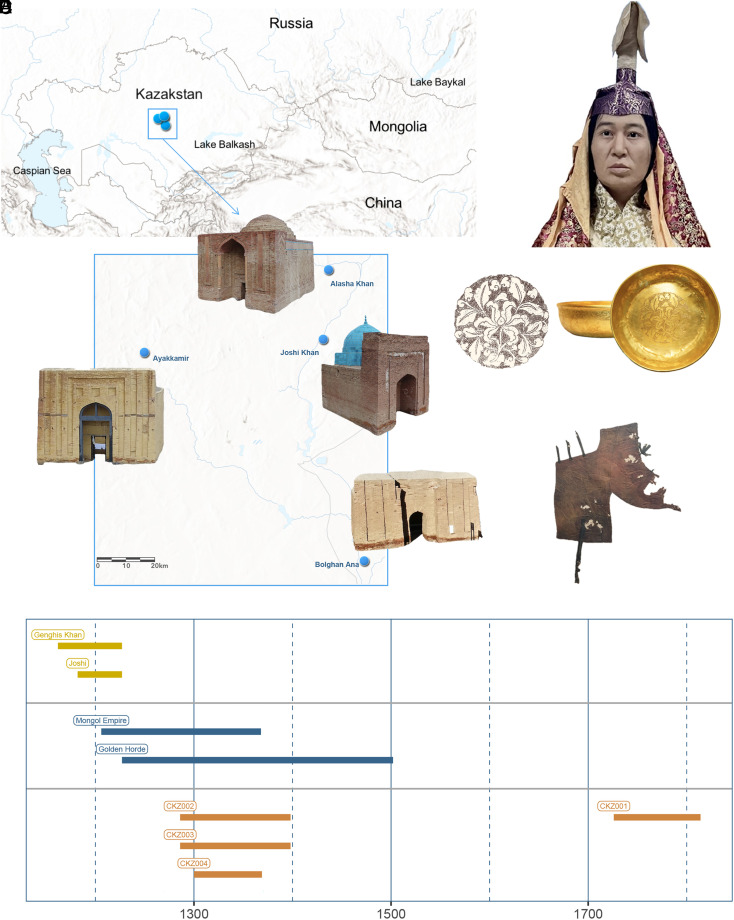
- The four Kenggir individuals — CKZ001 (male, Alasha Khan), CKZ002 (male, Joshi), CKZ003 (male, Ayakkamir), and CKZ004 (female, Bolghan Ana) — were dated to 1286–1398 cal AD for CKZ002/CKZ003, 1300–1369 cal AD for CKZ004, and 1726–1814 cal AD for CKZ001. The three males shared paternal lineage C2a1a3 (C3*/C2a1a3-F1918), defined by the authors as C2a1a3a6-ZQ369; mtDNA lineages were D4c2b, C4a2a1, C4a1a+195, and G2a1g, respectively.
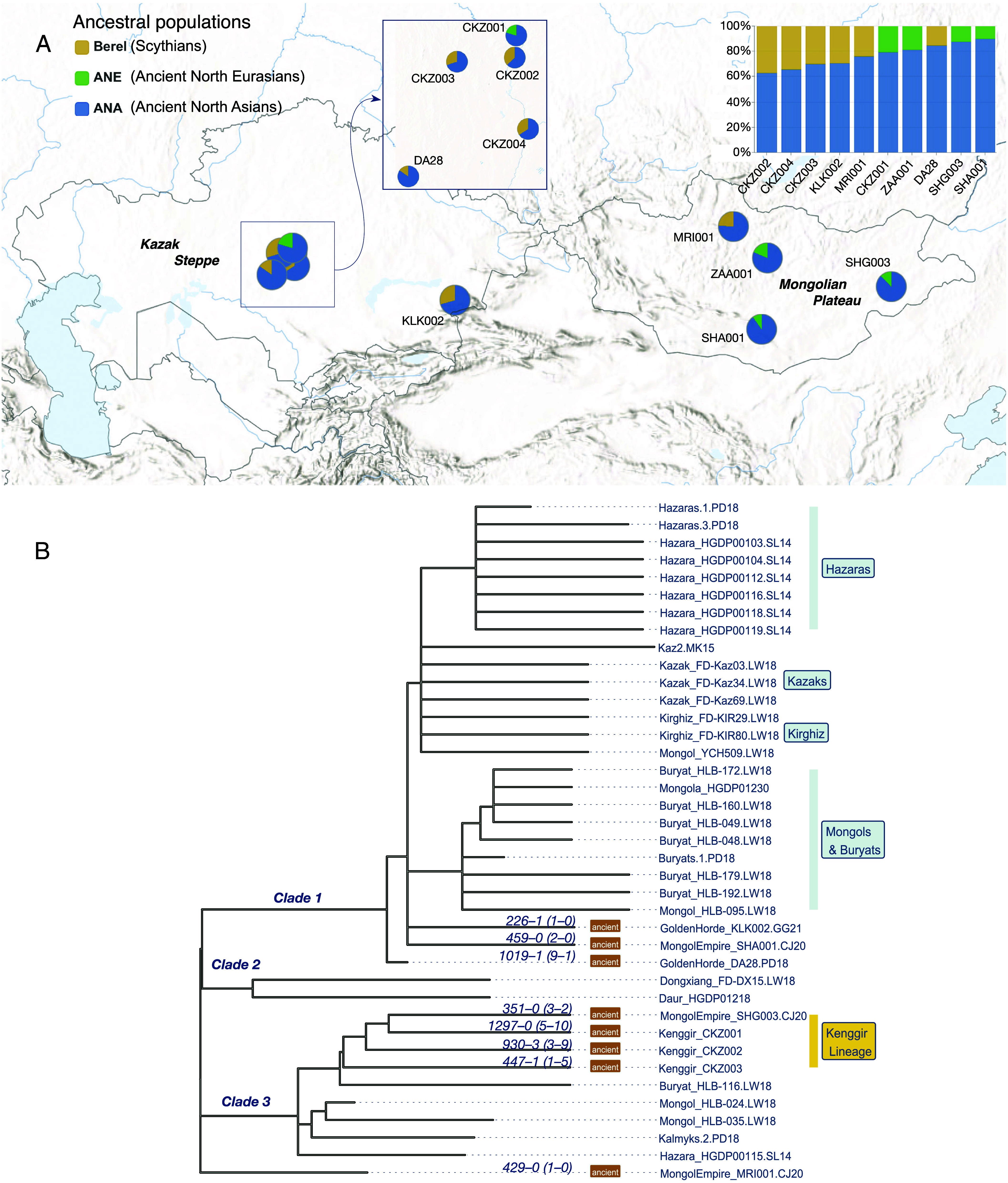
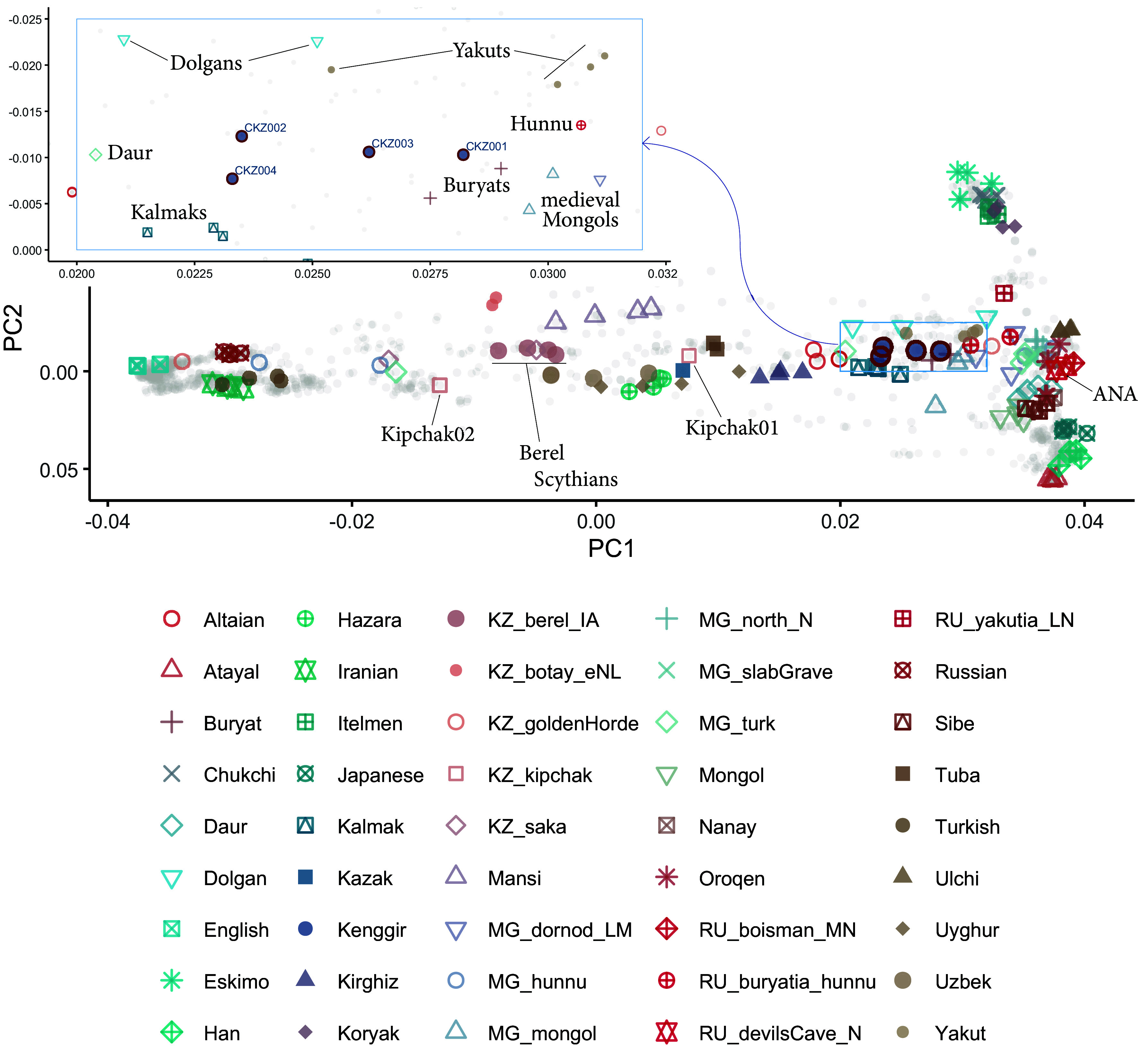
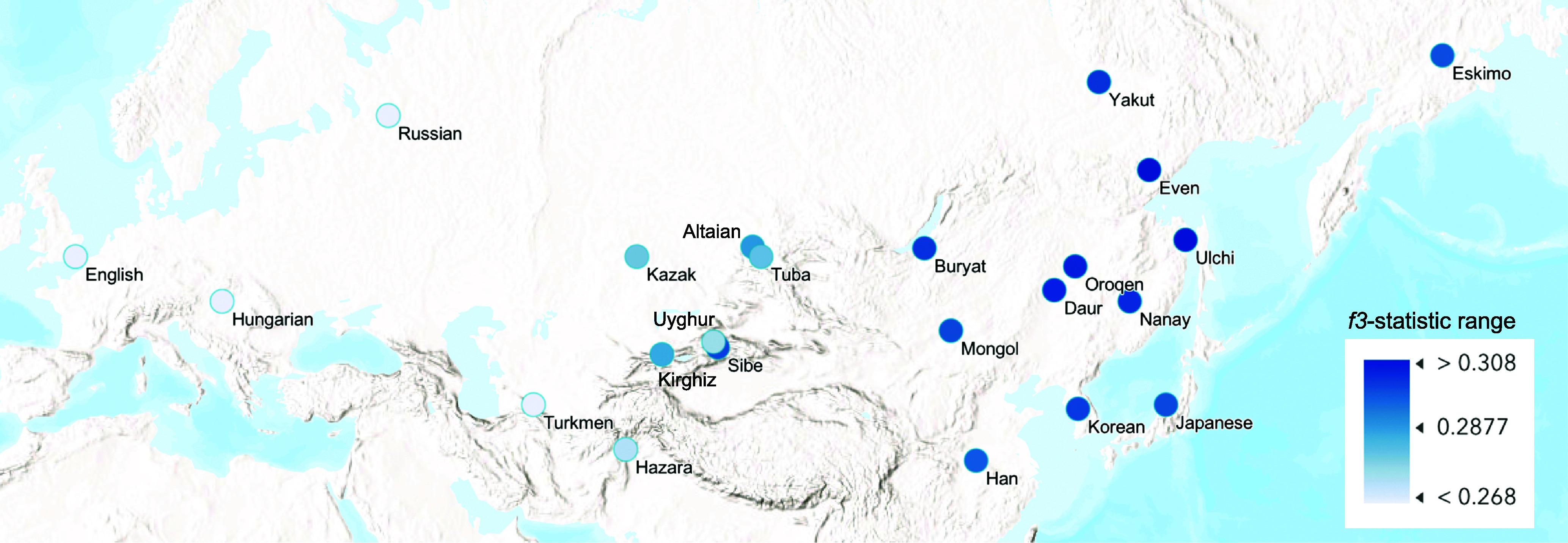
- Autosomal analyses showed the Kenggir individuals derived most of their genetic makeup from Ancient Northeast Asians (ANA), with a second component resembling Berel Scythians for all but CKZ001; CKZ001 was modeled with Ancient North Eurasian (ANE) ancestry. They could also be modeled as ANA plus Kipchaks, and PCA placed them near modern Altaic-speaking Siberian/northeast Asian groups.
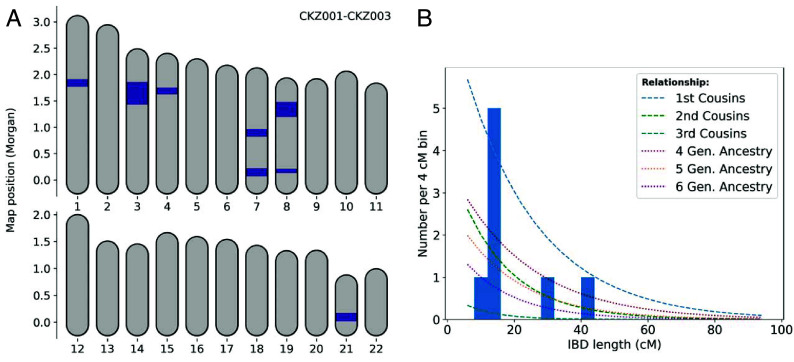
- Kinship analyses found no first- or second-degree relationships among the four. CKZ003 was closely related to CKZ001 and CKZ002; CKZ001 and CKZ003 shared six IBD segments totaling 121.6 cM, while CKZ001 and CKZ002 shared only one ~9 cM segment. The claim that CKZ004 was the daughter of CKZ002 was not supported.
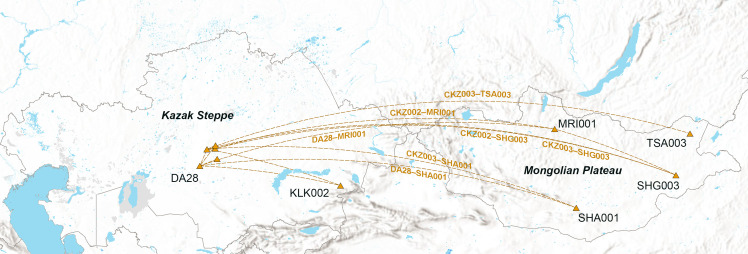
- A medieval IBD network connected the Kazak Steppe and Mongolian Plateau: pairs CKZ003–DA28, DA28–MRI001, CKZ002–CKZ003, and CKZ002–SHG003 shared 2–3 IBD segments, each at least 10 cM on average. CKZ001 had 9 ROH segments totaling 83.2 Mb, comparable to a Yakut individual.
Methods
- Ancient DNA was extracted from tooth, petrous bone, talus, and fibula samples of four individuals excavated from medieval mausoleums in the Ulitau Massif, central Kazakstan; two sites were excavated in this study and two Soviet-era sites were re-excavated. Radiocarbon dating was performed by Beta Analytic, and sequencing/library preparation was done in Japan.
- Genotypes were called at 1,240 K SNP capture sites; read depths were ~14.6× (CKZ001), ~3.9× (CKZ002), ~0.79× (CKZ003), and ~3.9× (CKZ004). The four individuals were merged with 400 AADR individuals for a 404-individual dataset, and PCA projected them onto a space calculated from 997 modern Eurasian individuals.
- Analyses included smartPCA; outgroup f3 and f4 statistics via qp3Pop/qpDstat; qpAdm ancestry modeling with nine reference populations; Y-chromosome haplotype placement via pathPhynder; mtDNA haplotype calling via Haplogrep and RAxML-NG; kinship via READ and ancIBD; IBD analysis after GLIMPSE2 imputation; and ROH analysis via hapROH.
Limitations
- The paper states it could not reach an unambiguous conclusion about the true identity of the male buried in the Mausoleum of Joshi and had insufficient evidence to support or refute his descent from Genghis Khan; this would require genetic data from the 12th–13th century pedigree of Genghis Khan. It also notes that CKZ001 dated to the 18th century CE, not the Golden Horde period, and that radiocarbon dates are not infallible.
- The paper states that Y-chromosome tree external node positions can be prone to error because ancient samples have missingness; CKZ003 had the lowest read depth, and more markers contradicted than supported the terminal branches of CKZ001 and CKZ002. It also notes qpAdm can produce equally likely ancestry models with different reference/source combinations, and that only two Kipchak samples were available and they were genetically distinct.
- The paper states IBD cannot identify exact relationships beyond third-degree relatives. Evident from the text: the Mausoleum of Joshi may not house Joshi himself, and the Kenggir individuals might belong to a lineage other than the Altan Urug; the authors also note no consensus on Genghis Khan’s paternal lineage and that the specific Kenggir lineage proposed remains unconfirmed.
Model-written summary. Check it against the paper before relying on it.
Integrity signals
Registry
Cites
Statistics
Figures
Verification
Claims the paper makes
43 Own result · 29 Own interpretation · 18 Not checked yet · 13 Check pending · 6 Sources not found · 5 Own method · 2 No full text of the sources
A result the paper reports from its own data — it cites no other source for it, so there is none to check. The quote shows it is in the paper.
In the paper
“By analyzing individuals from medieval elite mausoleums in central Kazakstan, we confirm the association between the Y-chromosome haplogroup C3* and the Mongol Empire, supporting the long-standing hypothesis about the genetic legacy of Mongols.”
§ Genomes of the Golden Horde elites and their implications for the rulers of the Mongol Empire > Abstract
boostedstates an association- Asserted: passes — The authors put it forward as true.
- Checkable: passes — It can be checked against evidence.
- Load-bearing: passes — The paper’s conclusions depend on it.
- Based: passes — The paper gives a reason why it holds.
A result the paper reports from its own data — it cites no other source for it, so there is none to check. The quote shows it is in the paper.
In the paper
“The genomic ancestry of these individuals shows that they had genetic affinity with medieval individuals from the Mongolian Plateau, clearly indicating their Mongolian origin.”
§ Genomes of the Golden Horde elites and their implications for the rulers of the Mongol Empire > Abstract
boostedstates an associationn = 4- Asserted: passes — The authors put it forward as true.
- Checkable: passes — It can be checked against evidence.
- Load-bearing: passes — The paper’s conclusions depend on it.
- Based: passes — The paper gives a reason why it holds.
A result the paper reports from its own data — it cites no other source for it, so there is none to check. The quote shows it is in the paper.
In the paper
“Except for CKZ001, the radiocarbon dating results agree with the period of the Golden Horde.”
§ Genomes of the Golden Horde elites and their implications for the rulers of the Mongol Empire > Results > Radiocarbon Dating.
plainn = 3- Asserted: passes — The authors put it forward as true.
- Checkable: passes — It can be checked against evidence.
- Load-bearing: passes — The paper’s conclusions depend on it.
- Based: passes — The paper gives a reason why it holds.
A result the paper reports from its own data — it cites no other source for it, so there is none to check. The quote shows it is in the paper.
In the paper
“One intriguing observation about the IBD network is that the medieval Mongolians apparently derived from a wide geographic area, encompassing the North, South, and East of Mongolia.”
§ Genomes of the Golden Horde elites and their implications for the rulers of the Mongol Empire > Results > Medieval IBD Network Connects the Kazak Steppe and the Mongolian Plateau.
hedgedstates an association- Asserted: passes — The authors put it forward as true.
- Checkable: passes — It can be checked against evidence.
- Load-bearing: passes — The paper’s conclusions depend on it.
- Based: passes — The paper gives a reason why it holds.
A result the paper reports from its own data — it cites no other source for it, so there is none to check. The quote shows it is in the paper.
In the paper
“For the f4-statistic (SI Appendix, Fig. S10), the Altaic-speaking modern populations (e.g., Daur, Nanay, and Yakut) exhibited f4-values and corresponding Z-scores that did not significantly deviate from zero, indicating a possible clade relationship with the Kenggir individuals.”
§ Genomes of the Golden Horde elites and their implications for the rulers of the Mongol Empire > Results > f-Statistics.
hedged- Asserted: passes — The authors put it forward as true.
- Checkable: passes — It can be checked against evidence.
- Load-bearing: passes — The paper’s conclusions depend on it.
- Based: passes — The paper gives a reason why it holds.
- It may state two separate claims as one. 37
- Probably not a substantial claim. 16
Create a free account to see these claims.
Create a free account to see these assumptions.
63 more claims
Create a free account to see all 116 claims and to verify the 37 references still open.
Citations
Cites
Basic local alignment search tool
Altschul, S. F., Gish, W., Miller, W., Myers, E. W., & Lipman, D. J. (1990) · Journal of Molecular Biology · doi:10.1006/jmbi.1990.9999 · Cited by 98,669
The Sequence Alignment/Map format and SAMtools
Li, H., Handsaker, B., Wysoker, A., Fennell, T., Ruan, J., Homer, N., Marth, G., Abecasis, G., Durbin, R., & 1000 Genome Project Data Processing Subgroup (2009) · Bioinformatics · doi:10.1093/bioinformatics/btp352 · Cited by 62,041
Fast and accurate short read alignment with Burrows-Wheeler transform
Li, H., & Durbin, R. (2009) · Bioinformatics · doi:10.1093/bioinformatics/btp324 · Cited by 58,607
MAFFT Multiple Sequence Alignment Software Version 7: Improvements in Performance and Usability
Katoh, K., & Standley, D. M. (2013) · Molecular Biology and Evolution · doi:10.1093/molbev/mst010 · Cited by 46,209
Wickham, H. (2016) · Use R! · doi:10.1007/978-3-319-24277-4 · Cited by 34,984
PLINK: a tool set for whole-genome association and population-based linkage analyses.
Purcell, S., Neale, B., Todd-Brown, K., Thomas, L., Ferreira, M. A. R., Bender, D., Maller, J., Sklar, P., de Bakker, P. I. W., Daly, M. J., et al. (2007) · The American Journal of Human Genetics · doi:10.1086/519795 · Cited by 34,089
MAFFT: a novel method for rapid multiple sequence alignment based on fast Fourier transform
Katoh, K. (2002) · Nucleic Acids Research · doi:10.1093/nar/gkf436 · Cited by 17,027
Twelve years of SAMtools and BCFtools
Danecek, P., Bonfield, J., Liddle, J., Marshall, J., Ohan, V., Pollard, M., Whitwham, A., Keane, T., McCarthy, S., Davies, R. M., et al. (2021) · GigaScience · doi:10.1093/gigascience/giab008 · Cited by 16,449
Second-generation PLINK: rising to the challenge of larger and richer datasets
Chang, C. C., Chow, C. C., Tellier, L. C., Vattikuti, S., Purcell, S. M., & Lee, J. J. (2015) · Gigascience · doi:10.1186/s13742-015-0047-8 · Cited by 12,709
Wickham, H. (2016) · Use R! · doi:10.1007/978-3-319-24277-4_9 · Cited by 12,675
Research works printed but not linked: 18
- R. Grousset, N. Walford, The Empire of the Steppes: A history of Central Asia (Rutgers University Press, ed. 1, 1970).
- J. de P. Carpini, “The Travels of John de Plano Carpini, and other Friars, into Tartary in the Year 1246” in A New General Collection of Voyages and Travels (Thomas Astley, 1745), pp. 544–619.
- Z. Kiynayatuli, Қазақ мемлекеті және Жошы хан (Kazak Statehood and Joshi Khan, in Kazak), H. M. Äbjanov, Ed. (Steppe & World Publishing, 2020).
- E. R. Usmanova, K. Z. Uskenbay, M. B. Kozha, I. P. Panyushkina, Мавзолей Джочи Хана: История исследования (The Mausoleum of Juchi Khan: History of Research, in Russian) (International Institute for Central Asian Studies, 2024).
- I. de Rachewiltz, The Secret History of the Mongols: A Mongolian Epic Chronicle of the Thirteenth Century, N. di Cosmo, D. Deweese, C. Humphrey, Eds. (Brill, ed. 1, 2004).
- Ötemis-Kaji, Шыңғыс-нама (Chingiz-name) in Қазақстан Тарихы Туралы Түркі Деректемелері (Turkic Sources about the History of Kazakstan, in Kazak), M. Abuseitova, Ed. (Daik-Press, 2005).
- G. G. Gerasimov, Памятники архитектуры долины реки Кара-Кенгир в Центральном Казахстане (Architectural monuments of the Kara-Kenggir river valley in Central Kazakstan, in Russian) (Academy of Science, The Kazak SSR, 1957).
- A. Margulan, Археологические разведки в Центральном Казахстане (1946 г.) (Archaeological Explorations in Central Kazakhstan in 1946, in Russian). Proc. Acad. Sci. Kazak SSR: History Series 119–145 (1948).
- V. Ginsburg “Ancient populations of eastern and central Kazak SSR from anthropological data (in Russian)” in Proceedings of Muklukho-Maklaya Institute of Ethnography (1956) pp. 239–266.
- S. Yessen, Сарыарқаның ортағасырлық жерлеу ескерткіштерін пәнаралық байланыстар негізінде зерттеу (Study of the medieval burial monuments in Sararka on the basis of interdisciplinary connections, Doctoral dissertation in Kazak) (L. N. Gumilev Eurasian National University, Astana, 2023).
- J. M. Rogers, Recent archaeological work on the Golden Horde. Bull. Asia Inst. 14, 135–146 (2000).
- E. Usmanova, M. Kozha, K. Uskenbai, G. Akhatov, D. Dzhumabekov, “К вопросу о тайных погребениях золотоордынской эпохи в Улытау (On the question of secret burials from the Golden Horde period in Ulitau, in Russian)” in Древние Культуры Монголии, Южной Сибири и Северного Китая: Материалы XI Международной Научной Конференции, A. Polyakov, M. Kashuba, A. Tsibiktarov, Eds. (Institute for the History of Material Culture, RAS, 2021), pp. 249–257.
- U. Onon, The Secret History of the Mongols: The Life and Times of Ghinggis Khan (RoutledgeCurzon, ed. 1, 2011).
- Sharengaowa , Paternal origins of Mongolic-speaking populations. Hum. Biol. 93, 269 (2021).
- Rashīd al-Dīn Tabīb, The Successors of Genghis Khan (Columbia University Press, 1971).
- V. V. Barthold, J. M. Rogers, The burial rites of the Turks and the Mongols. Cent. Asiatic J. 14, 195–227 (1970).
- 10.1093/molbev/msac017 · DOI
- E. W. Sayers , GenBank. Nucleic Acids Res. 48, D84–D86 (2020).
Cited by
High-resolution present-day Y-chromosome phylogeny refines golden horde lineage placement
Zhabagin, M. K., & Sabitov, Z. (2026) · Proceedings of the National Academy of Sciences · doi:10.1073/pnas.2607193123 · Cited by 2
Askapuli, A. (2026) · Proceedings of the National Academy of Sciences · doi:10.1073/pnas.2609024123
Self-citationChinggis Khan and the Contact Zone Between Mongolic and Tungusic
Janhunen, J. (2026) · International Journal of Eurasian Linguistics · doi:10.1163/25898833-20260090
Zhabagin, M. K., Bukayev, A., Mailenova, A., Zhunussova, A., Dyussenova, Z., Toxanbayev, A., & Sabitov, Z. (2026) · International Journal of Molecular Sciences · doi:10.3390/ijms27198641
Genetic Basis of Social Structure in the Pastoral Nomads of Central Eurasia
Askapuli, A., Vilar, M. G., Zhabagin, M. K., Sabitov, Z., Zhumadilov, Z., Ragsdale, A. P., Schurr, T. G., Hawks, J. D., & Saitou, N. (2026) · Genome Biology and Evolution · doi:10.1093/gbe/evag249
Self-citation
Metadata
- Authors
- Askapuli, A., Kanzawa-Kiriyama, H., Kakuda, T., Kassenali, A., Yessen, S., Schamiloglu, U., Schrodi, S. J., Hawks, J., & Saitou, N.
- Affiliations
- University of Wisconsin–Madison (US)
- Department of Anthropology, National Museum of Nature and Science
- University of Yamanashi (JP)
- Center for the Study and Preservation of Cultural Heritage
- Astana International University (KZ)
- Nazarbayev University (KZ)
- National Institute of Genetics (JP)
- Corresponding author
- Askapuli, Ayken
- Saitou, Naruya
- Venue
- Proceedings of the National Academy of Sciences
- Publisher
- National Academy of Sciences
- Published
- 2026-02-19
- Volume
- 123
- Issue
- 8
- Pages
- e2531003123-e2531003123
- ISSN
- 0027-8424 (ISSN-L)
- 1091-6490
- PMC
- PMC12933120
- OpenAlex
- W7130549537
- Semantic Scholar
- f03887ef5d49c722b46d4359c35b6fb16f994752
- Cited by
- 5
- References
- 88
- Citations by year
- 2026: 5
- FWCI
- 10.07
- Type
- journal article
- Language
- en
- Open access
- hybrid
- doi.org
- Licence
- Locations
- Proceedings of the National Academy of Sciences (publishedVersion, cc-by-nc-nd)
- bioRxiv (Cold Spring Harbor Laboratory) (submittedVersion)
- PubMed (publishedVersion)
- PubMed Central (publishedVersion, cc-by-nc-nd)
- Nazarbayev University Repository (Nazarbayev University) (submittedVersion)
- Funders
- Nazarbayev University (091019CRP2119)
- National Institute of Genetics (NA)
- Topics
- Life Sciences › Biochemistry, Genetics and Molecular Biology › Genetics › Forensic and Genetic Research
- Social Sciences › Arts and Humanities › History › Eurasian Exchange Networks
- Life Sciences › Biochemistry, Genetics and Molecular Biology › Genetics › Genetic diversity and population structure
- Keywords
- Golden Horde, Mongol Empire, ancient DNA, elite burials, Kipchaks, population dynamics, Central Eurasia
- MeSH terms
- DNA, Ancient, East Asian People, Female, Genetics, Population, Haplotypes, Humans, Male, Mongolia, Genome, Human, Chromosomes, Human, Y
About these checks
Registry, retraction, Cites and statistics results are computed, not judged, with one exception: a printed reference that no index lists is read once by a model before it counts as a citation error. Claims are extracted by a model and kept only when their quote appears verbatim in the text; each cited source is then checked, with a model’s help, for whether it says what the claim relies on. Those verdicts can be wrong — read the claim’s quote and the cited source before relying on one.
A language model drew the claims from the paper on 2026-11-12, under version 3 of the claim definition (model deepseek-v4.1-flash, prompt extract-v3).
A second model labelled each claim on 2026-11-12 (model jev-1.13-20260917, definition revision gold-guideline-v0.2).
Statistics and arithmetic are recomputed, not judged.
Confidence bands are shown only for fields calibrated on our annotated test set. None is calibrated yet, so no band is shown.
What counts as a claim ›How we measure confidence ›How we check this ›
Are you an author, or do you see a problem with this page? Request a review
How to cite
Cite CoChat for the checks on this page, and the paper for its own findings.
- This page
- CoChat. (2026). Citation check: Genomes of the Golden Horde elites and their implications for the rulers of the Mongol Empire. https://app.cochat.ai/papers/10.1073/pnas.2531003123
- The paper
- Askapuli, A., Kanzawa-Kiriyama, H., Kakuda, T., Kassenali, A., Yessen, S., Schamiloglu, U., Schrodi, S. J., Hawks, J., & Saitou, N. (2026). Genomes of the Golden Horde elites and their implications for the rulers of the Mongol Empire. Proceedings of the National Academy of Sciences. https://doi.org/10.1073/pnas.2531003123
