

The DOI matches its Crossref record.
The recombination signals for adeno-associated virus site-specific integration.
Abstract
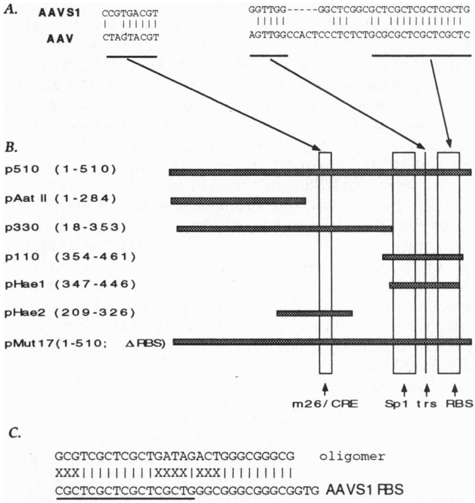
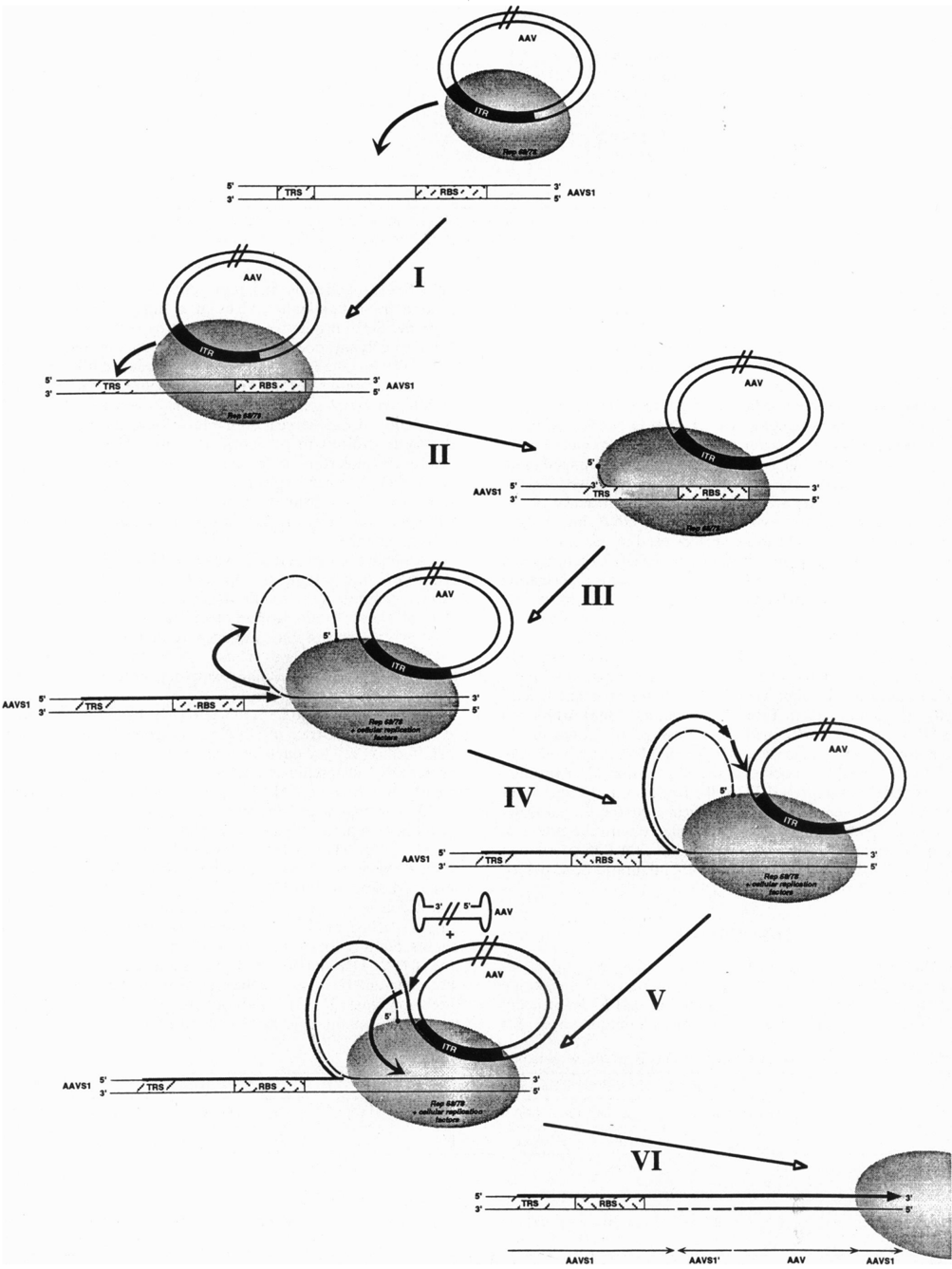
The adeno-associated virus (AAV) genome integrates site specifically into a defined region of human chromosome 19 (termed AAVS1). Using a functional assay for AAV integration into AAVS1 DNA propagated as an episome, we obtained evidence that a 33-nucleotide AAVS1 DNA sequence contains the minimum signal required for targeted integration. The recombination signal comprises a DNA-binding motif for the AAV regulatory Rep protein [Rep binding site (RBS)] separated by an eight-nucleotide spacer from a sequence that can act as a substrate for Rep endonucleolytic activity [terminal resolution site (TRS)]. Mutations in either the AAVS1-encoded RBS or TRS elements abort targeted integration. Since both the RBS and TRS elements are present in the viral origin of replication and are required for AAV replication, targeted integration into chromosome 19 AAVS1 DNA may involve a replicative type of recombination that is discussed. An additional chromosome 19 element, which is responsible for DNA rearrangements in episomes propagating AAVS1 DNA, was identified and shown not to be required for AAV episomal integration, despite its location adjacent to the recombination signal.
Overview
The claims and statistics of this paper haven’t been checked yet.
Run the check — free, no account needed. It reads the open-access text and checks the sources it cites.
Integrity signals
Registry
Cites
Statistics
Figures
Verification
Claims the paper makes
The claims and statistics of this paper haven’t been checked yet.
Run the check — free, no account needed. It reads the open-access text and checks the sources it cites.
Claims other papers make about this one
Each is checked against this paper’s own text: does it say what the citing paper says it does?
The source backs part of the claim, not all of it — or backs it for a different population, condition or comparison.
In the citing paper
“After transduction, AAV DNA remains mostly episomal besides integrating into hotspots in mitochondrial DNA and a specific location on chromosome 19 termed AAVS1 [14,15,16].”
From Viral Delivery Systems for CRISPR (2019) · cites this paper as [16]
Experimental — accuracy not yet measured
Self-check
Percentages, sums and reported differences re-computed from the paper’s own numbers.
The self-check needs the paper’s full text.
Citations
Cites
No references could be resolved yet.
Research works printed but not linked: 9
- [3]Hoggan, M. D., Blacklow, N. R. & Rowe, W. P. (1966) Proc. Natl. Acad. Sci. USA 55, 1467–1471.
- [12]Hoggan, M. D., Thomas, G. F. & Johnson, F. B. (1972) Continuous "carriage" of Adenovirus-Associated Virus Genomes in Cell Cultures in the Ábsence of Helper Adenovirus. (North-Holland, Amsterdam), pp. 243–249.
- [15]Berns, K. I. (1996) in Parvoviridae: The Viruses and Their Replication, eds. Fields, B. N., Knipe, D. M. & Howley, P. M. (Lippincott-Raven, Philadelphia), Vol. 2, pp. 2173–2220.
- [17]Kotin, R. M., Siniscalco, M., Šamulski, R. J., Zhu, X. D., Hunter, L., Laughlin, C. A., McLaughlin, S., Muzyczka, N., Rocchi, M. & Berns, K. I. (1990) Proc. Natl. Acad. Sci. USA 87, 2211–2215.
- [22]Giraud, C., Winocour, E. & Berns, K. I. (1994) Proc. Natl. Acad. Sci. USA 91, 10039–10043.
- [24]Straus, S. E., Sebring, E. D. & Rose, J. A. (1976) Proc. Natl. Acad. Sci. USA 73, 742–746.
- [30]Weitzman, M. D., Kyostio, S. R., Kotin, R. M. & Owens, R. A. (1994) Proc. Natl. Acad. Sci. USA 91, 5808–5812.
- [36]Felgner, P. L., Gadek, T. R., Holm, M., Roman, R., Chan, H. W., Wenz, M., Northrop, J. P., Ringold, G. M. & Danielsen, M. (1987) Proc. Natl. Acad. Sci. USÀ 84, 7413–7417.
- [39]Ward, P. J. & Berns, K. I. (1996) J. Virol., in press.
Cited by
Sorted by citations
Adeno-associated virus vector as a platform for gene therapy delivery
Wang, D., Tai, P. W. L., & Gao, G. (2019) · Nature Reviews Drug Discovery · doi:10.1038/s41573-019-0012-9 · Cited by 2,444
Viral Delivery Systems for CRISPR
Xu, C. L., Ruan, M. Z. C., Mahajan, V. B., & Tsang, S. H. (2019) · Viruses · doi:10.3390/v11010028 · Cited by 277
Characterization of Adeno-Associated Virus Genomes Isolated from Human Tissues
Schnepp, B. C., Jensen, R. L., Chen, C.-L., Johnson, P. R., & Clark, K. R. (2005) · Journal of Virology · doi:10.1128/jvi.79.23.14793-14803.2005 · Cited by 231
Adeno-Associated Virus Integration: Virus versus Vector
Smith, R. H. (2008) · Gene Therapy · doi:10.1038/gt.2008.55 · Cited by 178
Adeno‐associated virus vectors and hematology
Russell, D. W., & Kay, M. A. (1999) · Blood · doi:10.1182/blood.v94.3.864.415k34_864_874 · Cited by 104
Adeno-associated Virus: A Key to the Human Genome?
Henckaerts, E., & Linden, R. M. (2010) · Future Virology · doi:10.2217/fvl.10.48 · Cited by 71
Self-citationCortés, M. L., Oehmig, A., Saydam, O., Sanford, J. D., Perry, K. F., Fraefel, C., & Breakefield, X. O. (2008) · Molecular Therapy · doi:10.1038/sj.mt.6300338 · Cited by 37
Hendrie, P. C., Hirata, R. K., & Russell, D. W. (2003) · Journal of Virology · doi:10.1128/jvi.77.24.13136-13145.2003 · Cited by 33
McAlister, V. J., & Owens, R. A. (2010) · Virology Journal · doi:10.1186/1743-422x-7-218 · Cited by 5
Metadata
- Authors
- Linden, R. M., Winocour, E., & Berns, K. I.
- Affiliations
- Department of Microbiology, Hearst Microbiology Research Center, Cornell University Medical College, NY 10021, USA.
- Venue
- Proceedings of the National Academy of Sciences
- Publisher
- National Academy of Sciences
- Published
- 1996-07-23
- Volume
- 93
- Issue
- 15
- Pages
- 7966-7972
- ISSN
- 0027-8424
- 1091-6490
- Cited by
- 211
- References
- 0
- Language
- en
About these checks
Registry, retraction, Cites and statistics results are computed, not judged, with one exception: a printed reference that no index lists is read once by a model before it counts as a citation error. Claims are extracted by a model and kept only when their quote appears verbatim in the text; each cited source is then checked, with a model’s help, for whether it says what the claim relies on. Those verdicts can be wrong — read the claim’s quote and the cited source before relying on one.
Statistics and arithmetic are recomputed, not judged.
Confidence bands are shown only for fields calibrated on our annotated test set. None is calibrated yet, so no band is shown.
What counts as a claim ›How we measure confidence ›How we check this ›
Are you an author, or do you see a problem with this page? Request a review
