

The DOI matches its Crossref record; 26 of the 26 references it cites were found in a registry or an index.
Mt-Hsp70 Homolog, Ssc2p, Required for Maturation of Yeast Frataxin and Mitochondrial Iron Homeostasis
Open accessAbstract
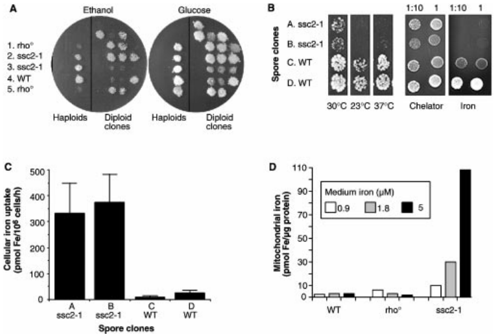
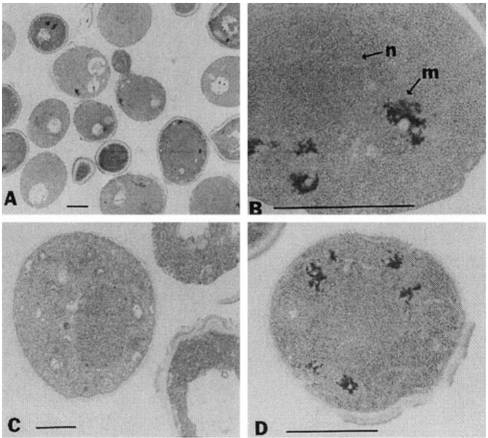
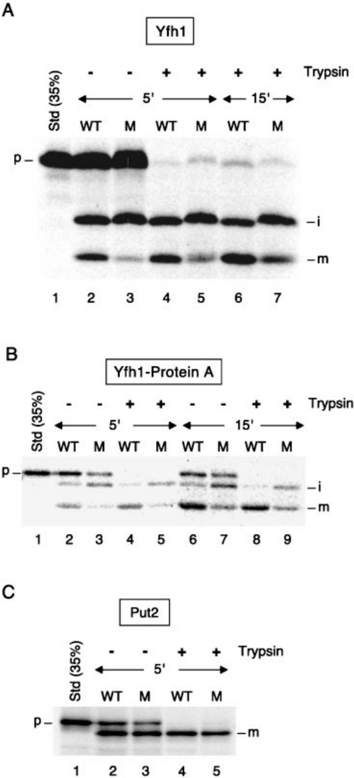
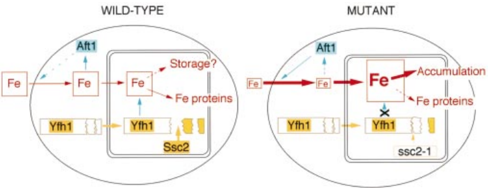
Here we show that the yeast mitochondrial chaperone Ssc2p, a homolog of mt-Hsp70, plays a critical role in mitochondrial iron homeostasis. Yeast with ssc2-1 mutations were identified by a screen for altered iron-dependent gene regulation and mitochondrial dysfunction. These mutants exhibit increased cellular iron uptake, and the iron accumulates exclusively within mitochondria. Yfh1p is homologous to frataxin, the human protein implicated in the neurodegenerative disease, Friedreich's ataxia. Like mutants of yfh1, ssc2-1 mutants accumulate vast quantities of iron in mitochondria. Furthermore, using import studies with isolated mitochondria, we demonstrate a specific role for Ssc2p in the maturation of Yfh1p within this organelle. This function for a mitochondrial Hsp70 chaperone is likely to be conserved, implying that a human homolog of Ssc2p may be involved in iron homeostasis and in neurodegenerative disease.
Overview
The claims and statistics of this paper haven’t been checked yet.
Run the check — free, no account needed. It reads the open-access text and checks the sources it cites.
Integrity signals
Registry
Cites
Statistics
Figures
Verification
Claims the paper makes
The claims and statistics of this paper haven’t been checked yet.
Run the check — free, no account needed. It reads the open-access text and checks the sources it cites.
Claims other papers make about this one
Each is checked against this paper’s own text: does it say what the citing paper says it does?
In the citing paper
“iron depletion by iron chelators was also shown to enhance lysosome-mediated ferritin degradation (165).”
From Intracellular iron transport and storage: from molecular mechanisms to health implications (2008) · cites this paper as [165]
Self-check
Percentages, sums and reported differences re-computed from the paper’s own numbers.
The self-check needs the paper’s full text.
Citations
Cites
Scanning Electron Microscopy and X-Ray Microanalysis
Goldstein, J. I., Newbury, D. E., Michael, J. R., Ritchie, N. W. M., Scott, J. H. J., & Joy, D. C. (2017) · Springer eBooks · doi:10.1007/978-1-4939-6676-9 · Cited by 5,391
Friedreich's Ataxia: Autosomal Recessive Disease Caused by an Intronic GAA Triplet Repeat Expansion
Campuzano, V., Montermini, L., Moltò, M. D., Pianese, L., Cossée, M., Cavalcanti, F., Monros, E., Rodius, F., Duclos, F., Monticelli, A., et al. (1996) · Science · doi:10.1126/science.271.5254.1423 · Cited by 2,786
Guide to Yeast Genetics and Molecular Biology
Kurtzman, C. P., Guthrie, C., & Fink, G. R. (1993) · Mycologia · doi:10.2307/3760517 · Cited by 2,363
The Biology of heat shock proteins and molecular chaperones.
Morimoto, R. I., Tissieres, A., & Georgopoulos, C. P. (1994) · Cited by 1,244
A Saccharomyces cerevisiae genomic plasmid bank based on a centromere-containing shuttle vector
Rose, M. D., Novick, P., Thomas, J. H., Botstein, D., & Fink, G. R. (1987) · Gene · doi:10.1016/0378-1119(87)90232-0 · Cited by 1,126
Scanning Electron Microscopy and X-Ray Microanalysis
Goldstein, J. I., Newbury, D. E., Echlin, P., Joy, D. C., Fiori, C. E., & Lifshin, E. (1981) · Springer eBooks · doi:10.1007/978-1-4613-3273-2 · Cited by 1,012
Aconitase and mitochondrial iron–sulphur protein deficiency in Friedreich ataxia
Rötig, A., de Lonlay, P., Chretien, D., Foury, F., Koenig, M., Sidi, D., Munnich, A., & Rustin, P. (1997) · Nature Genetics · doi:10.1038/ng1097-215 · Cited by 991
Regulation of Mitochondrial Iron Accumulation by Yfh1p, a Putative Homolog of Frataxin
Babcock, M., de Silva, D., Oaks, R., Davis-Kaplan, S., Jiralerspong, S., Montermini, L., Pandolfo, M., & Kaplan, J. (1997) · Science · doi:10.1126/science.276.5319.1709 · Cited by 921
Kang, P. J., Ostermann, J., Shilling, J., Neupert, W., Craig, E. A., & Pfanner, N. (1990) · Nature · doi:10.1038/348137a0 · Cited by 761
Crichton, R. R., & CHARLOTEAUX‐WAUTERS, M. (1987) · European Journal of Biochemistry · doi:10.1111/j.1432-1033.1987.tb11155.x · Cited by 682
Research works printed but not linked: 1
- Dancis, 1990, Mol. Cell. Biol., 10, 2294
Cited by
Sorted by citations
Structure, function, and formation of biological iron-sulfur clusters
Johnson, D. C., Dean, D. R., Smith, A. D., & Johnson, M. K. (2005) · Annual Review of Biochemistry · doi:10.1146/annurev.biochem.74.082803.133518 · Cited by 1,438
The mitochondrial proteins Atm1p and Nfs1p are essential for biogenesis of cytosolic Fe/S proteins
Kispál, G., Csere, P., Prohl, C., & Lill, R. (1999) · The EMBO Journal · doi:10.1093/emboj/18.14.3981 · Cited by 699
I RON R EGULATORY P ROTEINS AND THE M OLECULAR C ONTROL OF M AMMALIAN I RON M ETABOLISM
Eisenstein, R. S. (2000) · Annual Review of Nutrition · doi:10.1146/annurev.nutr.20.1.627 · Cited by 655
Verghese, J., Abrams, J., Wang, Y., & Morano, K. A. (2012) · Microbiology and Molecular Biology Reviews · doi:10.1128/mmbr.05018-11 · Cited by 575
Intracellular iron transport and storage: from molecular mechanisms to health implications
Mackenzie, E. L., Iwasaki, K., & Tsuji, Y. (2008) · Antioxidants & Redox Signaling · doi:10.1089/ars.2007.1893 · Cited by 526
Metadata
- Authors
- Knight, S. A. B., Sepuri, N. B. V., Pain, D., & Dancis, A.
- Affiliations
- University of Pennsylvania (US)
- Corresponding author
- Dancis, Andrew
- Venue
- Journal of Biological Chemistry
- Publisher
- Elsevier BV
- Published
- 1998-07
- Volume
- 273
- Issue
- 29
- Pages
- 18389-18393
- ISSN
- 0021-9258 (ISSN-L)
- OpenAlex
- W1976493565
- Cited by
- 173
- References
- 26
- Citations by year
- 2024: 4 · 2023: 2 · 2022: 1 · 2021: 2 · 2020: 1 · 2019: 4 · 2018: 3 · 2017: 7 · 2016: 2 · 2015: 5 · 2014: 6 · 2013: 2 · 2012: 8
- FWCI
- 6.17
- Type
- journal article
- Language
- en
- Open access
- hybrid
- doi.org
- Licence
- Locations
- Journal of Biological Chemistry (publishedVersion, cc-by)
- PubMed (publishedVersion)
- Funders
- American Heart Association
- W. W. Smith Charitable Trust
- University of Pennsylvania
- Topics
- Life Sciences › Biochemistry, Genetics and Molecular Biology › Molecular Biology › Heat shock proteins research
- Life Sciences › Biochemistry, Genetics and Molecular Biology › Molecular Biology › Mitochondrial Function and Pathology
- Life Sciences › Neuroscience › Neurology › Neurological diseases and metabolism
- Keywords
- mitochondrial Hsp70, frataxin, mitochondrial iron homeostasis, protein maturation, mitochondrial chaperone, Friedreich's ataxia, iron accumulation, iron absorption, mitochondrial dysfunction, Saccharomyces cerevisiae
- MeSH terms
- Frataxin, Fungal Proteins, Homeostasis, Iron, Mitochondria, Models, Biological, Saccharomyces cerevisiae, Gene Library, Mutagenesis, Site-Directed, Phosphotransferases (Alcohol Group Acceptor), Molecular Chaperones, HSP70 Heat-Shock Proteins, Mitochondrial Proteins, Saccharomyces cerevisiae Proteins, Iron-Binding Proteins
About these checks
Registry, retraction, Cites and statistics results are computed, not judged, with one exception: a printed reference that no index lists is read once by a model before it counts as a citation error. Claims are extracted by a model and kept only when their quote appears verbatim in the text; each cited source is then checked, with a model’s help, for whether it says what the claim relies on. Those verdicts can be wrong — read the claim’s quote and the cited source before relying on one.
Statistics and arithmetic are recomputed, not judged.
Confidence bands are shown only for fields calibrated on our annotated test set. None is calibrated yet, so no band is shown.
What counts as a claim ›How we measure confidence ›How we check this ›
Are you an author, or do you see a problem with this page? Request a review
