Student or educator? Sign up with your school email and get 6 months of Pro free.
Cited by 57

The DOI matches its Crossref record; 49 of the 49 references it cites were found in a registry or an index.

Ras-related GTPase RhoB Represses NF-κB Signaling

Fritz, Gerhard, Kaina, Bernd·2001·Journal of Biological Chemistry

Abstract

rhoB encoding a Ras-related GTPase is immediate-early inducible by genotoxic treatments, indicating that it is part of the cellular stress response. Here, we investigated the influence of RhoB on signal pathways that are rapidly evoked by genotoxic compounds. The data obtained show that wild-type RhoB neither affects activation of mitogen-activated protein kinases nor AP-1-dependent gene expression. However, RhoB inhibited both basal and genotoxic agent-stimulated activity of the transcription factor nuclear factor kappaB (NF-kappaB). Thus, RhoB attenuated alkylation-induced increase in the DNA binding activity of NF-kappaB and abrogated NF-kappaB-driven gene expression. Furthermore, RhoB inhibited decrease in the cellular amount of IkappaBalpha after genotoxic stress as well as after tumor necrosis factor alpha and 12-O-tetradecanoylphorbol acetate treatment. This indicates that RhoB represses NF-kappaB activation by inhibiting dissociation and subsequent degradation of IkappaBalpha. On the basis of the data, we suggest that RhoB is a novel negative regulator of NF-kappaB signaling.

Overview

The claims and statistics of this paper haven’t been checked yet.

Run the check — free, no account needed. It reads the open-access text and checks the sources it cites.

A few free checks a day · papers already verified open instantly · results are public

Integrity signals

Registry

Crossref · 10.1074/jbc.m005058200

Cites

49 of 49 references verified0 citation errors · 0 not checkable

Statistics

Figures

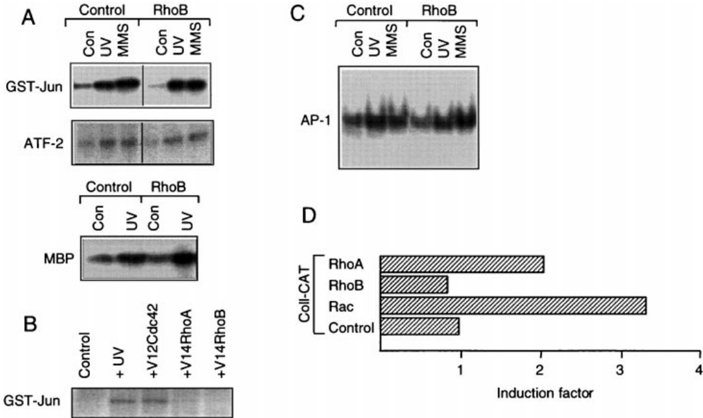
FIG. 1 RhoB does not influence genotoxic stress-induced signaling to MAP kinases and AP-1-regulated gene expression. A , logarithmically growing cells were treated with UV light (40 J/m 2 ) or MMS (1 mM). After an incubation period of 15 min for UV light and 30 min for MMS, respectively, cells were harvested for determination of JNK1, p38 MAP kinase, and ERK2 activity as described under 'Experimental Procedures.' Control , NIH 3T3neo cells; RhoB , RhoB-overexpressing cells. B , COS cells were transiently transfected with the HA-JNK1 expression construct without ( Control ) or together with an expression vector harboring the cDNA sequence for constitutively activated RhoB ( V14RhoB ), RhoA ( V14RhoA ), or Cdc42 ( V12Cdc42 ). 24 h after transfection, HA-JNK1 was immunoprecipitated by use of an HA-specific antibody (Roche Molecular Biochemicals), and JNK1 activity was analyzed as described under 'Experimental Procedures.' As a positive control, HA-JNK1-transfected cells were treated with UV light (40 J/m 2 ). C , Cells were treated as described under A . After an incubation period of 4 h, AP-1 binding activity was determined by gel retardation analysis as described under 'Experimental Procedures.' D , NIH 3T3 wild-type cells were transiently transfected with a human collagenase promoter CAT construct ( Coll-CAT ; 2 73/ 1 63) without ( Control ) or together with expression vectors containing cDNA sequences encoding wild-type RhoB ( RhoB ), Rac ( Rac ), or constitutively activated RhoA ( RhoA ). 24 h after transfection, cells were harvested, and the amount of CAT protein was determined using an enzyme-linked immunosorbent assay-based assay.
FIG. 1 RhoB does not influence genotoxic stress-induced signaling to MAP kinases and AP-1-regulated gene expression. A , logarithmically growing cells were treated with UV light (40 J/m 2 ) or MMS (1 mM). After an incubation period of 15 min for UV light and 30 min for MMS, respectively, cells were harvested for determination of JNK1, p38 MAP kinase, and ERK2 activity as described under 'Experimental Procedures.' Control , NIH 3T3neo cells; RhoB , RhoB-overexpressing cells. B , COS cells were transiently transfected with the HA-JNK1 expression construct without ( Control ) or together with an expression vector harboring the cDNA sequence for constitutively activated RhoB ( V14RhoB ), RhoA ( V14RhoA ), or Cdc42 ( V12Cdc42 ). 24 h after transfection, HA-JNK1 was immunoprecipitated by use of an HA-specific antibody (Roche Molecular Biochemicals), and JNK1 activity was analyzed as described under 'Experimental Procedures.' As a positive control, HA-JNK1-transfected cells were treated with UV light (40 J/m 2 ). C , Cells were treated as described under A . After an incubation period of 4 h, AP-1 binding activity was determined by gel retardation analysis as described under 'Experimental Procedures.' D , NIH 3T3 wild-type cells were transiently transfected with a human collagenase promoter CAT construct ( Coll-CAT ; 2 73/ 1 63) without ( Control ) or together with expression vectors containing cDNA sequences encoding wild-type RhoB ( RhoB ), Rac ( Rac ), or constitutively activated RhoA ( RhoA ). 24 h after transfection, cells were harvested, and the amount of CAT protein was determined using an enzyme-linked immunosorbent assay-based assay.CC-BY-NC-ND · From the PDF
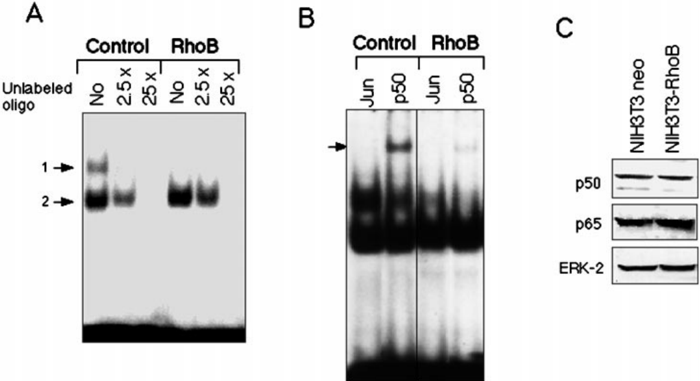
FIG. 2 RhoB overexpression changes basal DNA binding activity of NFk B. A , NFk B binding activity of extracts from logarithmically growing NIH 3T3neo ( Control ) and RhoB-overexpressing cells ( RhoB ) was analyzed by gel retardation experiments. To this end, 2 m g of protein from the corresponding extracts was incubated with a 32 P-labeled NFk B-specific oligonucleotide for 30 min at room temperature. Afterward, reaction products were separated on a 5% nondenaturing polyacrylamide gel. For competition experiments, 2.5- and 25-fold molar excesses of unlabeled oligonucleotide were added to the reaction mixture 5 min before addition of 32 P-labeled oligonucleotide. Shown is the autoradiography of the dried gel. 1 3 , p50/p65 heterodimer; 2 3 , p50/p50 homodimer. Control , NIH 3T3neo cells; RhoB , RhoB-overexpressing cells. B , Gel retardation analysis was performed as described under A . The reaction was preincubated in the presence of either a p50-specific antibody (1 m g) or a c-Jun-AP-1 antibody (1 m g) for 2 h at 4 °C. Binding of an antibody to proteins involved in DNA-protein complex formation becomes visible by formation of a supershift. Arrow indicates the position of the p50-induced supershift. Shown is the autoradiogram. C , 50 m g of protein from total cell extracts was analyzed for p50 and p65 protein expression by Western blot analysis. As a loading control, the filter was rehybridized with an ERK2-specific antibody.
FIG. 2 RhoB overexpression changes basal DNA binding activity of NFk B. A , NFk B binding activity of extracts from logarithmically growing NIH 3T3neo ( Control ) and RhoB-overexpressing cells ( RhoB ) was analyzed by gel retardation experiments. To this end, 2 m g of protein from the corresponding extracts was incubated with a 32 P-labeled NFk B-specific oligonucleotide for 30 min at room temperature. Afterward, reaction products were separated on a 5% nondenaturing polyacrylamide gel. For competition experiments, 2.5- and 25-fold molar excesses of unlabeled oligonucleotide were added to the reaction mixture 5 min before addition of 32 P-labeled oligonucleotide. Shown is the autoradiography of the dried gel. 1 3 , p50/p65 heterodimer; 2 3 , p50/p50 homodimer. Control , NIH 3T3neo cells; RhoB , RhoB-overexpressing cells. B , Gel retardation analysis was performed as described under A . The reaction was preincubated in the presence of either a p50-specific antibody (1 m g) or a c-Jun-AP-1 antibody (1 m g) for 2 h at 4 °C. Binding of an antibody to proteins involved in DNA-protein complex formation becomes visible by formation of a supershift. Arrow indicates the position of the p50-induced supershift. Shown is the autoradiogram. C , 50 m g of protein from total cell extracts was analyzed for p50 and p65 protein expression by Western blot analysis. As a loading control, the filter was rehybridized with an ERK2-specific antibody.CC-BY-NC-ND · From the PDF
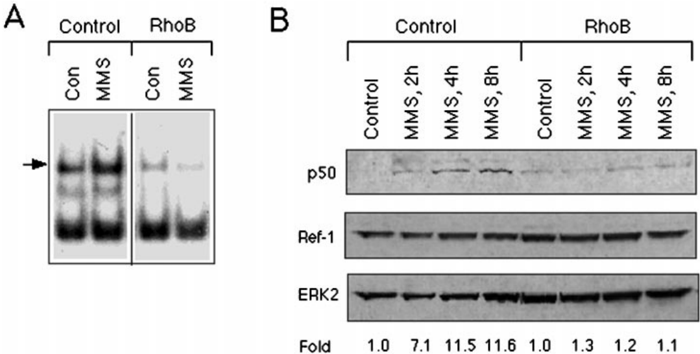
FIG. 3 RhoB inhibits alkylating agent-induced stimulation of the DNA binding activity of NFk B and impairs nuclear translocation of p50. A , 2 h after treatment with the alkylating agent MMS (2 mM), cell extract was prepared for gel retardation analysis using NFk B-specific 32 P-labeled oligonucleotide. Shown is the autoradiogram. Control , NIH 3T3neo cells; RhoB , RhoB-overexpressing cells. B , control and RhoB-overexpressing cells were treated with MMS (2 mM, 1 h). Up to 8 h after exposure, the amount of p50 protein in the nuclear fraction was analyzed by Western blot analysis using a p50-specific antibody. For internal control, the filter was rehybridized with Ref-1- and ERK2-specific antibodies. The amount of p50 protein was related to that of ERK2, giving the relative level of p50. The relative amount of p50 in the corresponding nontreated control was set to 1.0.
FIG. 3 RhoB inhibits alkylating agent-induced stimulation of the DNA binding activity of NFk B and impairs nuclear translocation of p50. A , 2 h after treatment with the alkylating agent MMS (2 mM), cell extract was prepared for gel retardation analysis using NFk B-specific 32 P-labeled oligonucleotide. Shown is the autoradiogram. Control , NIH 3T3neo cells; RhoB , RhoB-overexpressing cells. B , control and RhoB-overexpressing cells were treated with MMS (2 mM, 1 h). Up to 8 h after exposure, the amount of p50 protein in the nuclear fraction was analyzed by Western blot analysis using a p50-specific antibody. For internal control, the filter was rehybridized with Ref-1- and ERK2-specific antibodies. The amount of p50 protein was related to that of ERK2, giving the relative level of p50. The relative amount of p50 in the corresponding nontreated control was set to 1.0.CC-BY-NC-ND · From the PDF
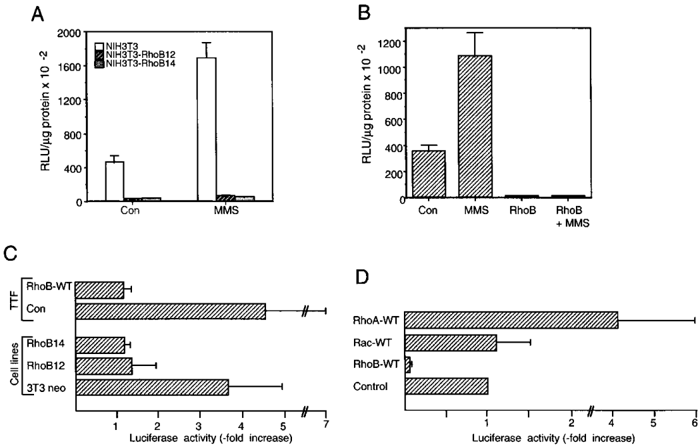
FIG. 4 RhoB blocks basal and MMS-stimulated NFk B-dependent gene expression. A , NIH 3T3 and RhoB-overexpressing cell variants ( NIH 3T3-RhoB12 and NIH 3T3-RhoB14 ) were transfected with 5 m g of NFk B specific reporter gene construct (3xNFk B-luciferase). 24 h after transfection, cells were treated with MMS (0.75 mM, 3 h). After a further incubation period of 24 h, cells were harvested, and luciferase activity was determined as described under 'Experimental Procedures.' Con , not treated; MMS , treated with the mutagen. B , NIH 3T3 wild-type cells were transfected with 5 m g of the NFk B-specific reporter gene construct together with (or without) 5 m g of expression vector encoding wild-type RhoB. 24 h after transfection, cells were exposed to MMS and harvested a further 24 h for determination of luciferase activity. Data shown in A and B are mean values 6 S.D. from at least two independent experiments, each performed in duplicate ( n $ 4). C , NIH 3T3neo ( 3T3neo ) and RhoB-overexpressing ( RhoB12 and RhoB14 ) cells were transfected with the NFk B-specific reporter construct. Furthermore, NIH 3T3 wild-type cells were transiently transfected ( TTF ) with the NFk Bspecific reporter without ( Con ) or together with expression vector encoding wild-type RhoB ( RhoB-WT ). 24 h after transfection, cells were treated with MMS as described under A . Shown is the MMS-induced x -fold increase in luciferase activity. Relative luciferase activity in the corresponding untreated controls was set to 1.0. D , NIH 3T3 wild-type cells were transfected with the NFk B-specific reporter without ( Control ) or together with expression vectors encoding wild-type RhoB ( RhoB-WT ), Rac ( Rac-WT ), or RhoA ( RhoA-WT ). 24 h after transfection, cells were harvested for determination of luciferase activity, which was set to 1.0 in the control. Data shown in C and D are mean values 6 S.D. from at least two independent experiments, each performed in duplicate ( n $ 4). RLU , relative light units.
FIG. 4 RhoB blocks basal and MMS-stimulated NFk B-dependent gene expression. A , NIH 3T3 and RhoB-overexpressing cell variants ( NIH 3T3-RhoB12 and NIH 3T3-RhoB14 ) were transfected with 5 m g of NFk B specific reporter gene construct (3xNFk B-luciferase). 24 h after transfection, cells were treated with MMS (0.75 mM, 3 h). After a further incubation period of 24 h, cells were harvested, and luciferase activity was determined as described under 'Experimental Procedures.' Con , not treated; MMS , treated with the mutagen. B , NIH 3T3 wild-type cells were transfected with 5 m g of the NFk B-specific reporter gene construct together with (or without) 5 m g of expression vector encoding wild-type RhoB. 24 h after transfection, cells were exposed to MMS and harvested a further 24 h for determination of luciferase activity. Data shown in A and B are mean values 6 S.D. from at least two independent experiments, each performed in duplicate ( n $ 4). C , NIH 3T3neo ( 3T3neo ) and RhoB-overexpressing ( RhoB12 and RhoB14 ) cells were transfected with the NFk B-specific reporter construct. Furthermore, NIH 3T3 wild-type cells were transiently transfected ( TTF ) with the NFk Bspecific reporter without ( Con ) or together with expression vector encoding wild-type RhoB ( RhoB-WT ). 24 h after transfection, cells were treated with MMS as described under A . Shown is the MMS-induced x -fold increase in luciferase activity. Relative luciferase activity in the corresponding untreated controls was set to 1.0. D , NIH 3T3 wild-type cells were transfected with the NFk B-specific reporter without ( Control ) or together with expression vectors encoding wild-type RhoB ( RhoB-WT ), Rac ( Rac-WT ), or RhoA ( RhoA-WT ). 24 h after transfection, cells were harvested for determination of luciferase activity, which was set to 1.0 in the control. Data shown in C and D are mean values 6 S.D. from at least two independent experiments, each performed in duplicate ( n $ 4). RLU , relative light units.CC-BY-NC-ND · From the PDF
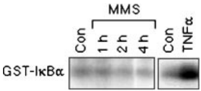
FIG. 5 MMS does not stimulate IKK activity. Logarithmically growing HeLa cells were treated with 2 mM MMS. 1-4 h after exposure, cells were harvested for determination of IKK activity as described under 'Experimental Procedures.' For positive control, cells were treated with TNF a , and IKK activity was analyzed 10 min later. Shown is the autoradiography. Con , untreated cells.
FIG. 5 MMS does not stimulate IKK activity. Logarithmically growing HeLa cells were treated with 2 mM MMS. 1-4 h after exposure, cells were harvested for determination of IKK activity as described under 'Experimental Procedures.' For positive control, cells were treated with TNF a , and IKK activity was analyzed 10 min later. Shown is the autoradiography. Con , untreated cells.CC-BY-NC-ND · From the PDF
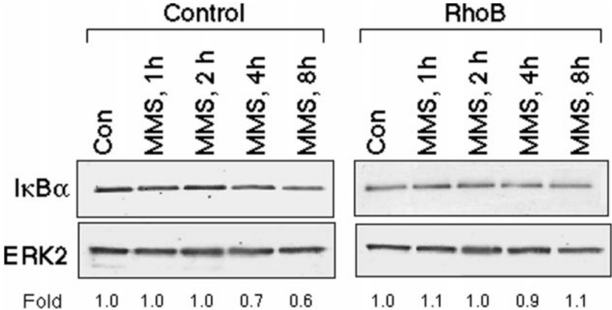
FIG. 6 RhoB inhibits MMS-induced degradation of I k B a . Up to 8 h after exposure to MMS (1 mM), total cell extract was prepared and analyzed by Western blot analysis with regard to the level of I k B a protein. As control for the amounts of protein loaded, filters were rehybridized with an ERK2-specific antibody. Autoradiograms were densitometrically analyzed, and the relative amount of I k B a protein in the untreated control was set to 1.0. Control , NIH 3T3neo cells; RhoB , RhoB-overexpressing cells. Con , untreated cells.
FIG. 6 RhoB inhibits MMS-induced degradation of I k B a . Up to 8 h after exposure to MMS (1 mM), total cell extract was prepared and analyzed by Western blot analysis with regard to the level of I k B a protein. As control for the amounts of protein loaded, filters were rehybridized with an ERK2-specific antibody. Autoradiograms were densitometrically analyzed, and the relative amount of I k B a protein in the untreated control was set to 1.0. Control , NIH 3T3neo cells; RhoB , RhoB-overexpressing cells. Con , untreated cells.CC-BY-NC-ND · From the PDF
Image 7
CC-BY-NC-ND · From the PDF
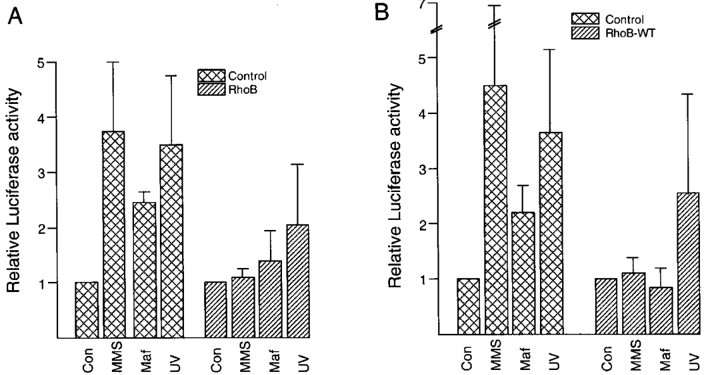
FIG. 8 RhoB attenuates genotoxic stress-stimulated gene expression regulated by NFk B. A , NIH 3T3 ( Control ) and RhoB-overexpressing ( RhoB ) cells were transfected with 5 m g of the NFk B-specific reporter gene construct (3xNFk B-luciferase). 24 h after transfection, cells were treated with MMS (0.75 mM, 3 h), UV light (60 J/m 2 ), and mafosfamide ( Maf ; 60 m M, 3 h), respectively. After a further incubation period of 24 h, cells were harvested, and luciferase activity was determined as described under 'Experimental Procedures.' Data shown are mean values 6 S.D. from at least two independent experiments, each performed in duplicate ( n $ 4). Con , untreated cells. B , NIH 3T3 wild-type cells were transfected with 5 m g of the NFk B-specific reporter gene construct (3xNFk B-luciferase) without ( Control ) or together with 5 m g of expression vector encoding wild-type RhoB ( RhoB-WT ). 24 h later, cells were exposed to genotoxic agents as described under A . Data shown are mean values 6 S.D. from at least two independent experiments, each performed in duplicate ( n $ 4). Con , untreated cells.
FIG. 8 RhoB attenuates genotoxic stress-stimulated gene expression regulated by NFk B. A , NIH 3T3 ( Control ) and RhoB-overexpressing ( RhoB ) cells were transfected with 5 m g of the NFk B-specific reporter gene construct (3xNFk B-luciferase). 24 h after transfection, cells were treated with MMS (0.75 mM, 3 h), UV light (60 J/m 2 ), and mafosfamide ( Maf ; 60 m M, 3 h), respectively. After a further incubation period of 24 h, cells were harvested, and luciferase activity was determined as described under 'Experimental Procedures.' Data shown are mean values 6 S.D. from at least two independent experiments, each performed in duplicate ( n $ 4). Con , untreated cells. B , NIH 3T3 wild-type cells were transfected with 5 m g of the NFk B-specific reporter gene construct (3xNFk B-luciferase) without ( Control ) or together with 5 m g of expression vector encoding wild-type RhoB ( RhoB-WT ). 24 h later, cells were exposed to genotoxic agents as described under A . Data shown are mean values 6 S.D. from at least two independent experiments, each performed in duplicate ( n $ 4). Con , untreated cells.CC-BY-NC-ND · From the PDF
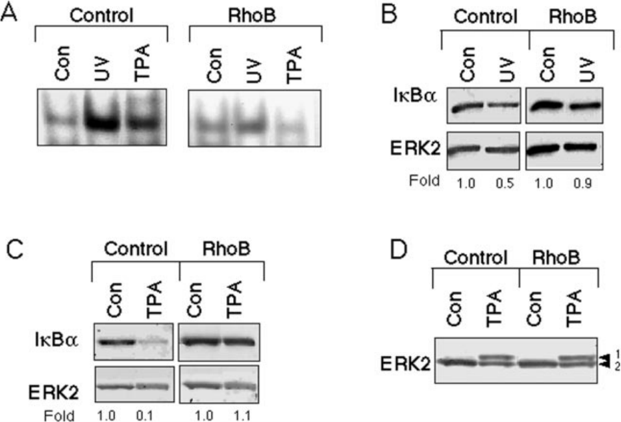
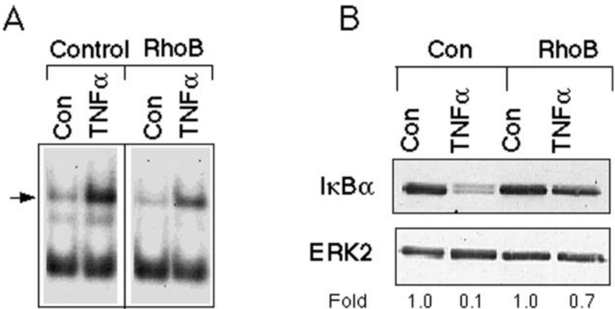
FIG. 9 Activation of NFk BbyTNF a is attenuated by RhoB. A , 2 h after addition of TNF a (10 ng/ml), NIH 3T3 ( Control ) and RhoB-overexpressing ( RhoB ) cells were harvested, and extracts were analyzed for DNA binding activity of NFk B as described under 'Experimental Procedures.' Con , untreated cells. B , 15 min after TNF a treatment (10 ng/ml), the amount of I k B a protein was determined by Western blot analysis. The relative amount of I k B a in the corresponding untreated control was set to 1.0.
FIG. 9 Activation of NFk BbyTNF a is attenuated by RhoB. A , 2 h after addition of TNF a (10 ng/ml), NIH 3T3 ( Control ) and RhoB-overexpressing ( RhoB ) cells were harvested, and extracts were analyzed for DNA binding activity of NFk B as described under 'Experimental Procedures.' Con , untreated cells. B , 15 min after TNF a treatment (10 ng/ml), the amount of I k B a protein was determined by Western blot analysis. The relative amount of I k B a in the corresponding untreated control was set to 1.0.CC-BY-NC-ND · From the PDF

Verification

Claims the paper makes

The claims and statistics of this paper haven’t been checked yet.

Run the check — free, no account needed. It reads the open-access text and checks the sources it cites.

A few free checks a day · papers already verified open instantly · results are public

Claims other papers make about this one

Each is checked against this paper’s own text: does it say what the citing paper says it does?

Self-check

Percentages, sums and reported differences re-computed from the paper’s own numbers.

The self-check needs the paper’s full text.

Citations

Cites

Show all 49 references

Research works printed but not linked: 6

  1. Prendergast, 1995, Oncogene, 10, 2289
  2. Esteve, 1995, Oncogene, 11, 2657
  3. Jimenez, 1995, Oncogene, 10, 811
  4. Jähner, 1991, Mol. Cell. Biol., 11, 3682
  5. Zalcman, 1995, Oncogene, 10, 1935
  6. Angel, 1987, Mol. Cell. Biol., 7, 2256

Cited by

See all 57

Metadata

Authors
Fritz, G., & Kaina, B.
Venue
Journal of Biological Chemistry
Publisher
Elsevier BV
Published
2001-02
Volume
276
Issue
5
Pages
3115-3122
ISSN
0021-9258
Cited by
57
References
49
Language
en
Licence

About these checks

Registry, retraction, Cites and statistics results are computed, not judged, with one exception: a printed reference that no index lists is read once by a model before it counts as a citation error. Claims are extracted by a model and kept only when their quote appears verbatim in the text; each cited source is then checked, with a model’s help, for whether it says what the claim relies on. Those verdicts can be wrong — read the claim’s quote and the cited source before relying on one.

Statistics and arithmetic are recomputed, not judged.

Confidence bands are shown only for fields calibrated on our annotated test set. None is calibrated yet, so no band is shown.

What counts as a claim ›How we measure confidence ›How we check this ›

Are you an author, or do you see a problem with this page? Request a review

How to cite

Cite CoChat for the checks on this page, and the paper for its own findings.

This page
CoChat. (2026). Citation check: Ras-related GTPase RhoB Represses NF-κB Signaling. https://app.cochat.ai/papers/10.1074/jbc.m005058200
The paper
Fritz, G., & Kaina, B. (2001). Ras-related GTPase RhoB Represses NF-κB Signaling. Journal of Biological Chemistry. https://doi.org/10.1074/jbc.m005058200

Data sources

Bibliographic data: Semantic Scholar, OpenAlex, Crossref.

Contains information from the Semantic Scholar Academic Graph Datasets, made available under the ODC Attribution License (ODC-BY 1.0).

Semantic Scholar’s data is described in: Kinney, R., et al. (2023). The Semantic Scholar Open Data Platform. arXiv:2301.10140.