

The DOI matches its Crossref record; 36 of the 36 references it cites were found in a registry or an index.
Ataxin-3 Deubiquitination Is Coupled to Parkin Ubiquitination via E2 Ubiquitin-conjugating Enzyme
Abstract
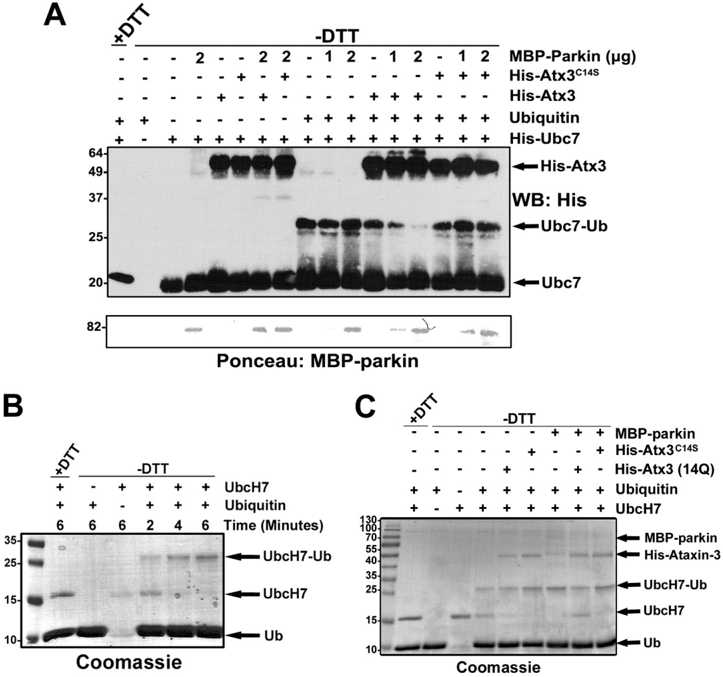
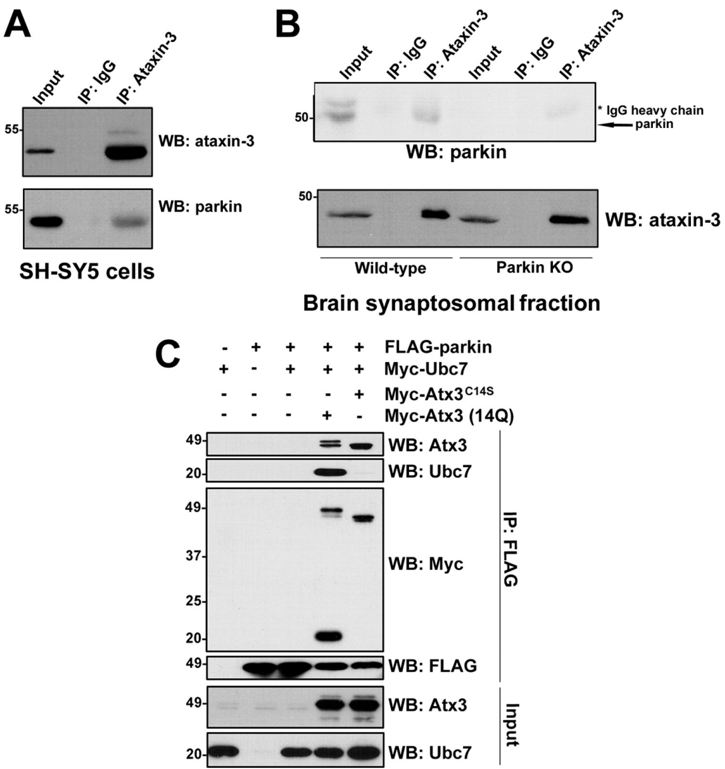
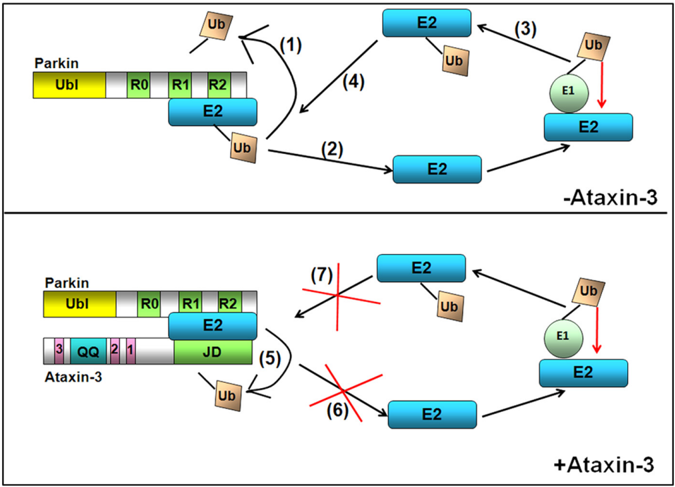
We reported previously that parkin, a Parkinson disease-associated E3 ubiquitin-ligase interacts with ataxin-3, a deubiquitinating enzyme associated with Machado-Joseph disease. Ataxin-3 was found to counteract parkin self-ubiquitination both in vitro and in cells. Moreover, ataxin-3-dependent deubiquitination of parkin required the catalytic cysteine 14 in ataxin-3, although the precise mechanism remained unclear. We report here that ataxin-3 interferes with the attachment of ubiquitin (Ub) onto parkin in real-time during conjugation but is unable to hydrolyze previously assembled parkin-Ub conjugates. The mechanism involves an ataxin-3-dependent stabilization of the complex between parkin and the E2 Ub-conjugating enzyme, which impedes the efficient charging of the E2 with Ub. Moreover, within this complex, the transfer of Ub from the E2 is diverted away from parkin and onto ataxin-3, further explaining how ataxin-3 deubiquitination is coupled to parkin ubiquitination. Taken together, our findings reveal an unexpected convergence upon the E2 Ub-conjugating enzyme in the regulation of an E3/deubiquitinating enzyme pair, with important implications for the function of parkin and ataxin-3, two proteins responsible for closely related neurodegenerative diseases.
Overview
The claims and statistics of this paper haven’t been checked yet.
Run the check — free, no account needed. It reads the open-access text and checks the sources it cites.
Integrity signals
Registry
Cites
Statistics
Figures
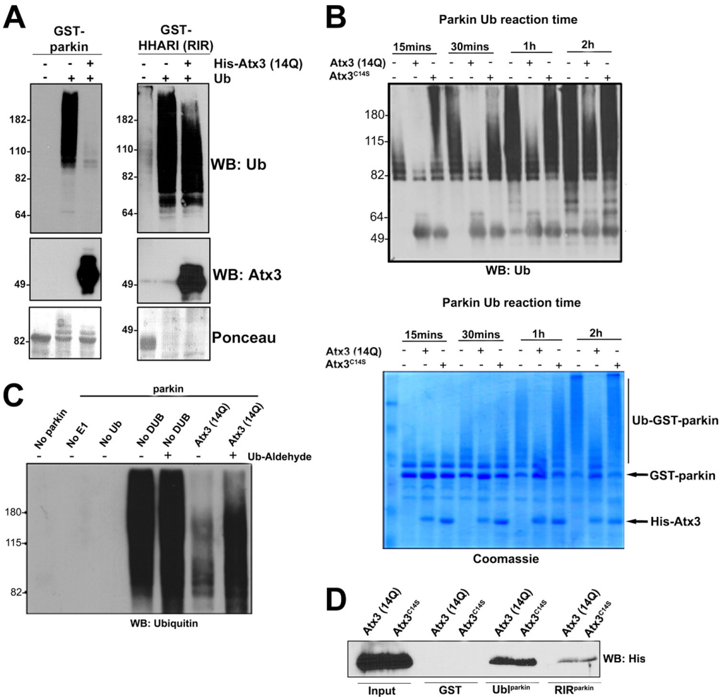
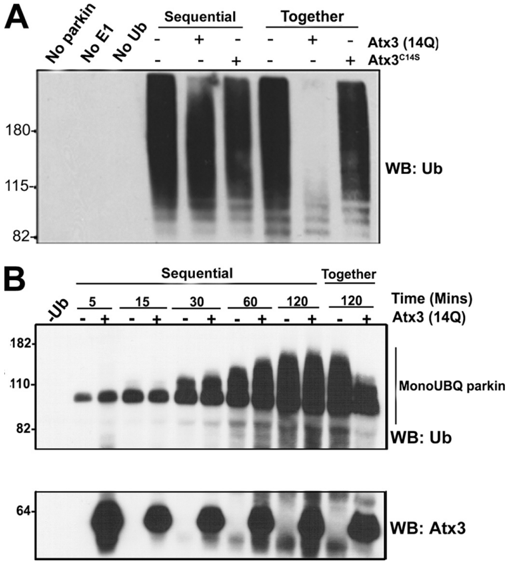
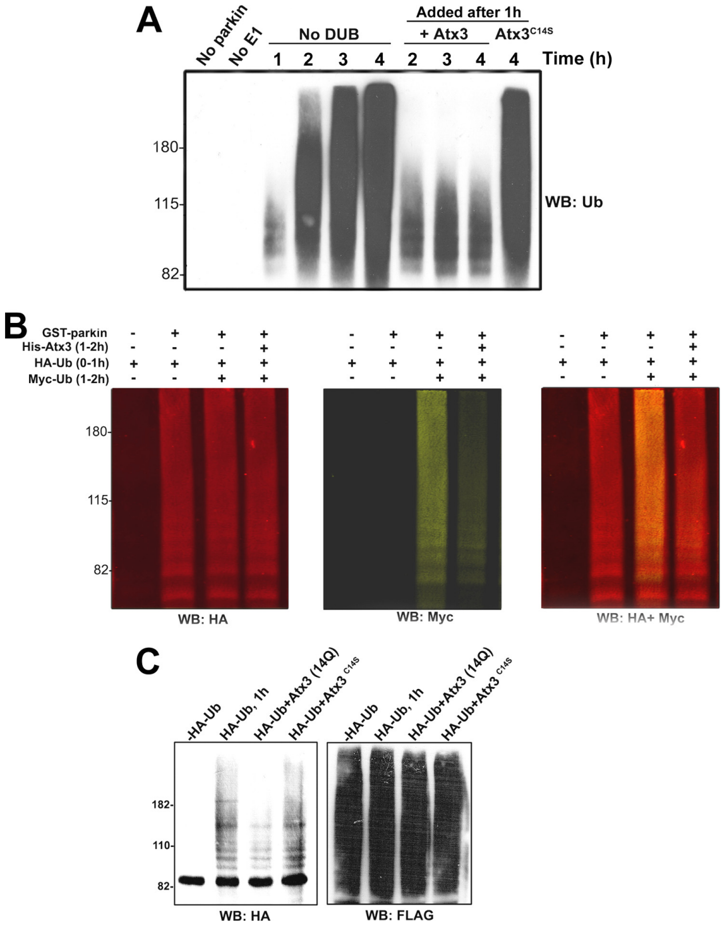
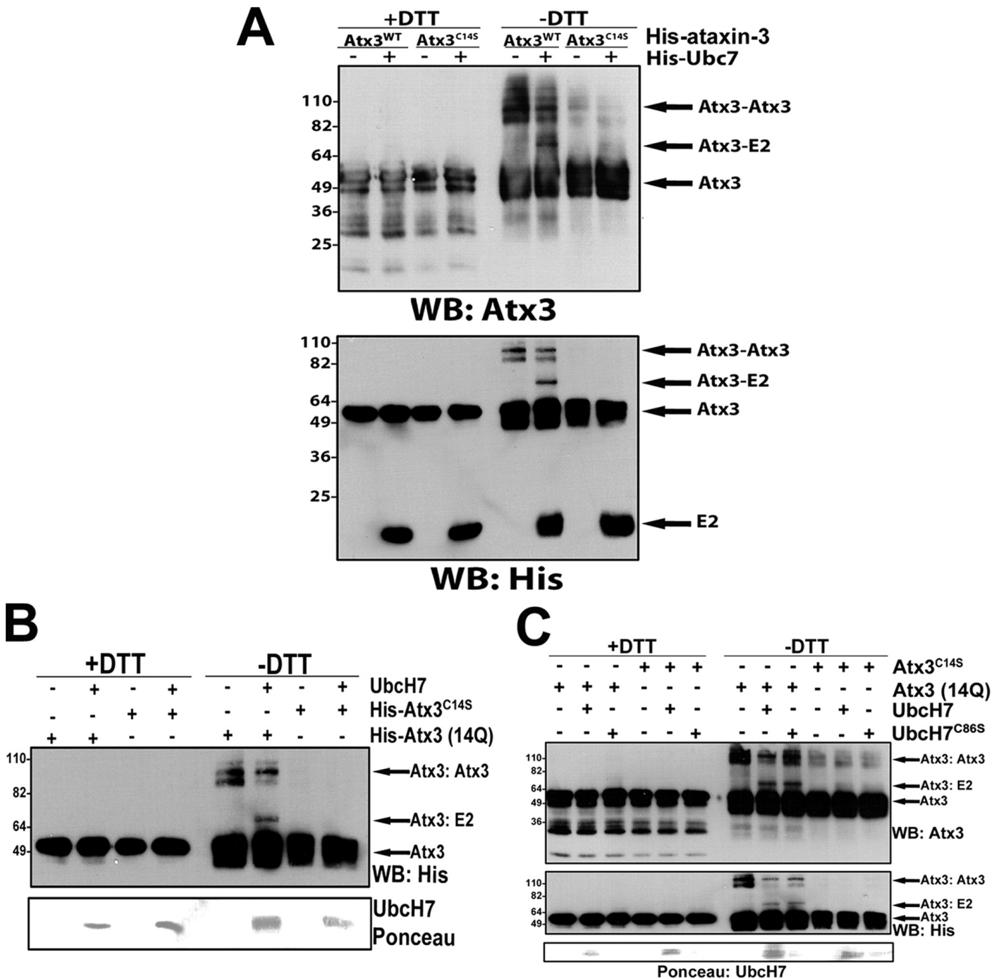
Verification
Claims the paper makes
The claims and statistics of this paper haven’t been checked yet.
Run the check — free, no account needed. It reads the open-access text and checks the sources it cites.
Claims other papers make about this one
Each is checked against this paper’s own text: does it say what the citing paper says it does?
The cited source says what the claim attributes to it.
In the citing paper
“We recently reported that ataxin-3, a DUB responsible for Machado-Joseph's disease, can deubiquitinate parkin (Durcan et al, 2011(Durcan et al, , 2012)).”
From USP8 regulates mitophagy by removing K6‐linked ubiquitin conjugates from parkin (2014) · cites this paper as Durcan et al, 2012
Self-check
Percentages, sums and reported differences re-computed from the paper’s own numbers.
The self-check needs the paper’s full text.
Citations
Cites
Parkin is recruited selectively to impaired mitochondria and promotes their autophagy
Narendra, D., Tanaka, A., Suen, D.-F., & Youle, R. J. (2008) · The Journal of Cell Biology · doi:10.1083/jcb.200809125 · Cited by 4,026
PINK1/Parkin-mediated mitophagy is dependent on VDAC1 and p62/SQSTM1
Geisler, S., Holmström, K. M., Skujat, D., Fiesel, F. C., Rothfuss, O. C., Kahle, P. J., & Springer, W. (2010) · Nature Cell Biology · doi:10.1038/ncb2012 · Cited by 2,835
Familial Parkinson disease gene product, parkin, is a ubiquitin-protein ligase
Shimura, H., Hattori, N., Kubo, S.-I., Mizuno, Y., Asakawa, S., Minoshima, S., Shimizu, N., Iwai, K., Chiba, T., Tanaka, K., et al. (2000) · Nature Genetics · doi:10.1038/77060 · Cited by 2,024
A genomic and functional inventory of deubiquitinating enzymes.
Nijman, S. M. B., Luna-Vargas, M. P. A., Velds, A., Brummelkamp, T. R., Dirac, A. M. G., Sixma, T. K., & Bernards, R. (2005) · Cell · doi:10.1016/j.cell.2005.11.007 · Cited by 1,854
CAG expansions in a novel gene for Machado-Joseph disease at chromosome 14q32.1
Kawaguchi, Y., Okamoto, T., Taniwaki, M., Aizawa, M., Inoue, M., Katayama, S., Kawakami, H., Nakamura, S., Nishimura, M., Akiguchi, I., et al. (1994) · Nature Genetics · doi:10.1038/ng1194-221 · Cited by 1,753
Modification of Proteins by Ubiquitin and Ubiquitin-Like Proteins
Kerscher, O., Felberbaum, R., & Hochstrasser, M. (2006) · Annual Review of Cell and Developmental Biology · doi:10.1146/annurev.cellbio.22.010605.093503 · Cited by 1,517
Ubiquitin: structures, functions, mechanisms
Pickart, C. M., & Eddins, M. J. (2004) · Biochimica et Biophysica Acta (BBA) - Molecular Cell Research · doi:10.1016/j.bbamcr.2004.09.019 · Cited by 1,407
Proteasome and p97 mediate mitophagy and degradation of mitofusins induced by Parkin
Tanaka, A., Cleland, M. M., Xu, S., Narendra, D. P., Suen, D.-F., Karbowski, M., & Youle, R. J. (2010) · Journal of Cell Biology · doi:10.1083/jcb.201007013 · Cited by 1,369
Polyubiquitin chains: polymeric protein signals
Pickart, C. M., & Fushman, D. (2004) · Current Opinion in Chemical Biology · doi:10.1016/j.cbpa.2004.09.009 · Cited by 1,049
Mdm2 Is a RING Finger-dependent Ubiquitin Protein Ligase for Itself and p53
Fang, S., Jensen, J. P., Ludwig, R. L., Vousden, K. H., & Weissman, A. M. (2000) · Journal of Biological Chemistry · doi:10.1074/jbc.275.12.8945 · Cited by 1,044
Cited by
The role of autophagy in neurodegenerative disease
Nixon, R. A. (2013) · Nature Medicine · doi:10.1038/nm.3232 · Cited by 2,059
Deubiquitylating enzymes and drug discovery: emerging opportunities
Harrigan, J. A., Jacq, X., Martin, N. M., & Jackson, S. P. (2018) · Nature Reviews Drug Discovery · doi:10.1038/nrd.2017.152 · Cited by 940
The three ‘P’s of mitophagy: PARKIN.; PINK1.; and post-translational modifications
Durcan, T. M., & Fon, E. A. (2015) · Genes & Development · doi:10.1101/gad.262758.115 · Cited by 400
Self-citationUSP8 regulates mitophagy by removing K6‐linked ubiquitin conjugates from parkin
Durcan, T. M., Tang, M. Y., Pérusse, J. R., Dashti, E. A., Aguileta, M. A., McLelland, G., Gros, P., Shaler, T. A., Faubert, D., Coulombe, B., et al. (2014) · The EMBO Journal · doi:10.15252/embj.201489729 · Cited by 375
Self-citation
Metadata
- Authors
- Durcan, T. M., Kontogiannea, M., Bedard, N., Wing, S. S., & Fon, E. A.
- Venue
- Journal of Biological Chemistry
- Publisher
- Elsevier BV
- Published
- 2012-01
- Volume
- 287
- Issue
- 1
- Pages
- 531-541
- ISSN
- 0021-9258
- Cited by
- 79
- References
- 36
- Language
- en
- Licence
- www.elsevier.com/tdm/userlicense/1.0/ (tdm)
- creativecommons.org/licenses/by/4.0/ (vor, 3278 d)
About these checks
Registry, retraction, Cites and statistics results are computed, not judged, with one exception: a printed reference that no index lists is read once by a model before it counts as a citation error. Claims are extracted by a model and kept only when their quote appears verbatim in the text; each cited source is then checked, with a model’s help, for whether it says what the claim relies on. Those verdicts can be wrong — read the claim’s quote and the cited source before relying on one.
Statistics and arithmetic are recomputed, not judged.
Confidence bands are shown only for fields calibrated on our annotated test set. None is calibrated yet, so no band is shown.
What counts as a claim ›How we measure confidence ›How we check this ›
Are you an author, or do you see a problem with this page? Request a review
Data sources
Bibliographic data: Semantic Scholar, OpenAlex, Crossref.
Contains information from the Semantic Scholar Academic Graph Datasets, made available under the ODC Attribution License (ODC-BY 1.0).
Semantic Scholar’s data is described in: Kinney, R., et al. (2023). The Semantic Scholar Open Data Platform. arXiv:2301.10140.
