

Shared ancestry and language contact in Northern Samoyedic: Phonological and morphological innovations
Open accessThe DOI matches its Crossref record; 63 of the 65 references it cites were found in a registry or an index, and 2 are not checked yet; none of the 47 sources its claims cite is checked for support yet.
Abstract
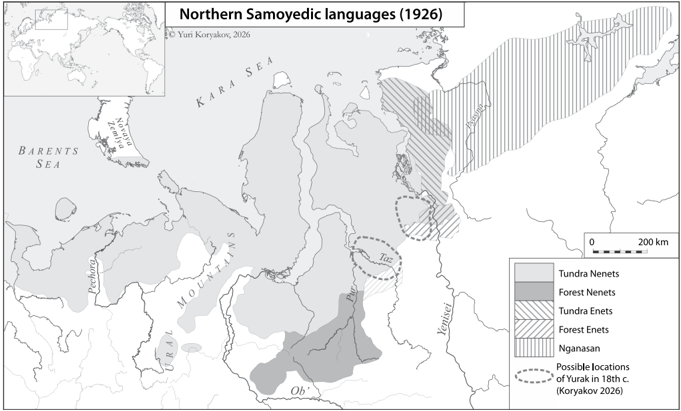
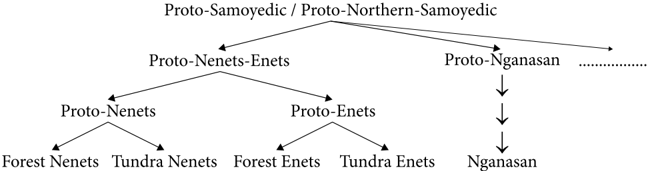
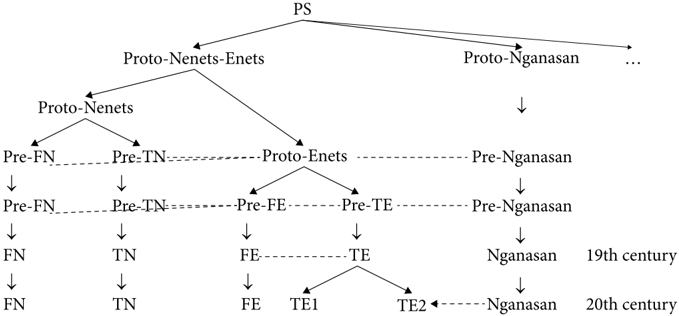
Using the Northern Samoyedic languages, Uralic languages spoken by nomads of Northern Siberia, we propose a new method to reconstruct histories of related languages in contact. The method consists of clustering languages by sets of shared innovations which happened after the breakup of their common proto-language. A discrepancy in how dozens of phonological and morphological innovations are distributed by sets of Northern Samoyedic languages is striking: we suggest this discrepancy points to social rearrangements of the past. The phonological changes predominantly join the sets of languages that were in contact long ago, while morphological patterns also spread across those languages which were spoken nearer each other more recently. We identify the sociolinguistic ecology of the nomadic communities as a driving force for the intermittent wave-like spread of innovations. Previous research on the phonological innovations of Northern Samoyedic is concisely synthesised, while the morphological innovations are presented in full for the first time.
Checked 2026-11-24 · 2 references not checked yet
Overview
CoChat Summary
TL;DR
The paper proposes a method for reconstructing histories of related languages in contact by clustering them by shared post-proto-language innovations, applied to Northern Samoyedic. It finds a striking discrepancy: phonological innovations mostly follow older contact groupings, while morphological innovations spread more across recently neighbouring languages, which the authors attribute to intermittent contact and social rearrangements among nomadic communities.
Key findings
- Of 42 post-Proto-Samoyedic morphological patterns justified as innovations, 22 (52%) are shared within branches of the traditional genealogical tree, 17 (41%) are shared by neighbouring languages across branches, and only three do not belong to either category.
- For phonology, 26 changes (74%) support the traditional family tree, while 9 (26%) are attributable to contact.
- In Enets, a total of 20 morphological innovations connect one or both Enets to a language that is not its immediate sister in the tree; the Nenets-Enets group has the largest number of shared innovational morphological patterns (12).
- Three suffixes shared by both Enets and Nganasan — Mild/Future Imperative, Probabilitive, and Anterior Converb — show irregular vowel correspondences and may represent borrowings or parallel borrowings from the same substrate.
Methods
- The authors establish regular sound correspondences among Northern Samoyedic languages using the Comparative Method, code each affix for relatedness, identify phonological and morphological innovations since Proto-Samoyedic, describe their distribution, cluster languages by shared innovations, and infer possible historical and sociolinguistic contexts.
- The sample is the Northern Samoyedic languages: Forest Nenets, Tundra Nenets, Forest Enets, Tundra Enets, and Nganasan. Data come from the authors’ own field data, corpora, dictionaries, descriptive grammars, and existing Proto-Samoyedic/Proto-Uralic reconstructions; the study focuses on innovations attested in more than one but not all Northern Samoyedic languages.
- The main analysis compares the distribution of phonological versus morphological innovations, contrasts the resulting groupings with the traditional genealogical tree, and reconstructs a scenario of splits, contacts, and wave-like spread; lexical data from Kaheinen (2023) and Urmanchieva (2023a) are said to align with the scenario.
Limitations
- Stated in the paper: Forest Nenets has the least available data, so the authors rely on existing publications and learning materials; they may have overlooked a phenomenon present in both Nenets languages or in one of them, though they consider this unlikely to have noticeably influenced results. Not all sound changes have been discovered yet, especially post-Proto-Enets changes; one change (B-6) is considered less certain and is not discussed; no chronological stratification of shared morphology based on sound changes is proposed, so all cognate suffixes except three could in principle go back to Proto-Samoyedic; it is impossible to determine whether Enets contacts with separate Nenets languages occurred before and/or after the Proto-Enets split; and little can be said about the timing of splits and reunifications before recent centuries.
- Stated in the paper: it remains an open question whether new cognate suffixes represent post-Proto-Samoyedic innovations spread wave-like or retentions from Proto-Samoyedic lost elsewhere; parallel independent innovations are also an alternative to consider; and the three Enets–Nganasan suffixes could be borrowings or parallel substrate borrowings.
- Evident from the text: morphological coverage is uneven, with Enets and Nganasan treated more thoroughly than Nenets, and several conclusions depend on reconstructions and limited documentation for languages such as Mator.
Model-written summary. Check it against the paper before relying on it.
Integrity signals
Registry
Cites
Statistics
Figures
Verification
Claims the paper makes
0 Valid · 14 Not valid · 37 Not checked · 127 Own results and interpretations
A result the paper states — it cites no source for it, so there is none to check. The quote shows it is in the paper.
In the paper
“The first three sets of shared sound changes correspond to branches of the widely accepted genealogical tree and are given in Tables (A) to (C).”
§ Shared ancestry and language contact in Northern Samoyedic Phonological and morphological innovations > 3. Shared sound changes in Northern Samoyedic
plainstates an association- Asserted: passes — The authors put it forward as true.
- Checkable: passes — It can be checked against evidence.
- Load-bearing: passes — The paper’s conclusions depend on it.
- Based: passes — The paper gives a reason why it holds.
A result the paper reports from its own data — it cites no other source for it, so there is none to check. The quote shows it is in the paper.
In the paper
“A discrepancy in how dozens of phonological and morphological innovations are distributed by sets of Northern Samoyedic languages is striking”
§ Shared ancestry and language contact in Northern Samoyedic Phonological and morphological innovations > Abstract
plain- Asserted: passes — The authors put it forward as true.
- Checkable: passes — It can be checked against evidence.
- Load-bearing: passes — The paper’s conclusions depend on it.
- Based: passes — The paper gives a reason why it holds.
The paper states this without a source or data behind it here, so there is nothing to check it against. The quote shows it is in the paper.
In the paper
“The merger in (F) has not been reported for any other Samoyedic language, or any language in the wider area, even though it is not so rare typologically.”
§ Shared ancestry and language contact in Northern Samoyedic Phonological and morphological innovations > Commentary on (G)
plain- Asserted: passes — The authors put it forward as true.
- Checkable: passes — It can be checked against evidence.
- Load-bearing: passes — The paper’s conclusions depend on it.
- Based: unclear — It is unclear why the paper says it holds.
A result the paper reports from its own data — it cites no other source for it, so there is none to check. The quote shows it is in the paper.
In the paper
“The phonological changes predominantly join the sets of languages that were in contact long ago”
§ Shared ancestry and language contact in Northern Samoyedic Phonological and morphological innovations > Abstract
plainstates an association- Asserted: passes — The authors put it forward as true.
- Checkable: passes — It can be checked against evidence.
- Load-bearing: passes — The paper’s conclusions depend on it.
- Based: passes — The paper gives a reason why it holds.
A result the paper reports from its own data — it cites no other source for it, so there is none to check. The quote shows it is in the paper.
In the paper
“while morphological patterns also spread across those languages which were spoken nearer each other more recently”
§ Shared ancestry and language contact in Northern Samoyedic Phonological and morphological innovations > Abstract
plainstates an association- Asserted: passes — The authors put it forward as true.
- Checkable: passes — It can be checked against evidence.
- Load-bearing: passes — The paper’s conclusions depend on it.
- Based: passes — The paper gives a reason why it holds.
82 more claims
Create a free account to see all 178 claims and to verify the 19 references still open.
- It may state two separate claims as one. 56
- Probably not a substantial claim. 44
- The quote only partly states this claim. 6
Self-check
Percentages, sums and reported differences re-computed from the paper’s own numbers.
Each contradiction between two passages listed here was confirmed by an independent check.
Rated minor: it would not touch a result — a value no result rests on, a p-value that stays on the same side of the significance level, or a conflict that is clerical, resolved elsewhere in the paper, or outside its own findings.
In the paper
§ Shared ancestry and language contact in Northern Samoyedic Phonological and morphological innovations > Commentary on (L)
“M. Post-PS morphology shared by both Enets and Nganasan (cf.(D) for their four common sound changes)”
§ Shared ancestry and language contact in Northern Samoyedic Phonological and morphological innovations > Commentary on (A)
“D. Sound changes shared by both Enets and Nganasan PS FN TN FE TE Ng D-1 *w > b word-initially *wet 'water' w'ĭʔ -yiʔ + biʔ + biʔ + bɨʔ D-2 *w > zero intervocalically *kawo-jt 'ear-GEN.PL' kăwu-ʔ xawo-ʔ + koo-ʔ + kuu-ʔ + kou-ʔ”
Citations
Cites
Language Contact and Grammatical Change
Heine, B., & Kuteva, T. (2005) · Cambridge University Press eBooks · doi:10.1017/cbo9780511614132 · Cited by 1,743
Evolutionary Phonology: The Emergence of Sound Patterns
Blevins, J. (2004) · Cambridge University Press eBooks · doi:10.1017/cbo9780511486357 · Cited by 842
Language Classification by Numbers
McMahon, A., & McMahon, R. (2005) · doi:10.1093/oso/9780199279012.001.0001 · Cited by 480
Nikolaeva, I. (2014) · De Gruyter eBooks · doi:10.1515/9783110320640 · Cited by 336
Historical Phonology of the Uralic Languages: With Special Reference to Samoyed, Ugric, and Permic
Sammallahti, P. (1988) · BRILL eBooks · doi:10.1163/9789004492493_021 · Cited by 304
Language Contact and Deliberate Change
Thomason, S. G. (2007) · Journal of Language Contact · doi:10.1163/000000007792548387 · Cited by 286
Kümmel, M. J. (2007) · Cited by 220
On the Limits of the Comparative Method
Harrison, S. P. (2003) · Wiley eBooks · doi:10.1002/9780470756393.ch2 · Cited by 218
Descent and Diffusion: The Complexity of the Pilbara Situation
Dench, A. (2001) · Areal Diffusion and Genetic Inheritance · doi:10.1093/oso/9780198299813.003.0005 · Cited by 171
Heggarty, P., Maguire, W., & McMahon, A. (2010) · Philosophical Transactions of the Royal Society B Biological Sciences · doi:10.1098/rstb.2010.0099 · Cited by 159
Research works printed but not linked: 33
- Aikhenvald, Alexandra Y. 2002. Language contact in Amazonia. Oxford: Oxford University Press.
- Aikio, Ante (Luobbal Sámmol Sámmol Ante). 2022. Proto-Uralic. In Marianne Bakró-Nagy, Johanna Laakso & Elena Skribnik (eds.), The Oxford guide to the Uralic languages, 3-27. Oxford: Oxford University Press.
- Campbell, Lyle. 2004. Historical linguistics: An introduction. Cambridge, MA: MIT Press.
- Castrén, Matthias Alexander. 1855. Wörterverzeichnisse aus den samojedischen Sprachen (bearbeitet von Anton Schiefner). St. Petersburg: Buchdruckerei der kaiserlichen Akademie der Wissenschaften.
- Castrén, Matthias Alexander. Forthc. Jenisei-Samoiedica (ed. by Olesya Khanina). (Manuscripta Castreniana, Linguistica VI). Helsinki: Finno-Ugrian Society.
- Dolgikh, Boris. 1960. Rodovoj i plemennoj sostav Sibiri v XVII v [Clan and tribes in the 17th century Siberia]. Moscow: Izdatelstvo AN SSSR.
- Dolgikh, Boris. 1970. Očerki po etničeskoj istorii nencev i èncev [Essays on the ethnic history of the Nenets and the Enets]. Moscow: Nauka.
- Epps, Patience, John Huehnergard & Na'ama Pat-El (eds.), 2013a. Journal of Language Contact 6(2), Special Issue "Contact among genetically related languages".
- Garrett, Andrew. 2006. Convergence in the formation of Indo-European subgroups: Phylogeny and chronology. In Peter Forster & Colin Renfrew (eds.). Phylogenetic methods and the prehistory of languages, 139-151. Cambridge: McDonald Institute for Archaeological Research. mzino [Reflexes of Proto-Samoyedic *a and *ä and the Nganasan vowel harmony]. In Valentin Gusev, Anna Urmanchieva & Alexander Anikin (eds.), 2022. Siberica et Uralica: To the memory of Eugen Helimski (Studia Uralo-Altaica 56). Szeged: University of Szeged, 39-62.
- Gusev, Valentin. Forthc. G. F. Müller's Northern Samoyedic wordlists from the 18th century. Finnisch-Ugrische Mitteilungen.
- Helimski, Eugen. 1982. Drevnejshie vengero-samodijskie jazykovye paralleli [The oldest parallels between Hungarian and Samoyedic]. Moscow: Nauka.
- Helimski, Eugen. 1997. Die matorische Sprache: Wörterverzeichnis -Grundzüge der Grammatik -Sprachgeschichte (Studia Uralo-Altaica 41). Szeged: University of Szeged.
- Helimski, Eugen. 2000. Komparativistika. Uralistika [Comparative historical studies. Uralic studies]. Moscow: Jazyki russkoj kul'tury.
- Helimski, Eugen. 2005. The 13th Proto-Samoyedic vowel. In Beáta Wagner-Nagy (ed.), Mikola- konferencia 2004, 27-39. Szeged: University of Szeged.
- Helimski, Eugen. 2007. Fonetika i (morfo)fonologija èneckogo jazyka v uslovijax jazykogo sdviga [Phonetics and (morpho)phonology of Enets during the language switch]. In
- Janhunen, Juha. 1975-1976. Adalékok az északi-szamojéd hangtörténethez. Vokalizmus: az első szótagi magánhangzók. [Additions to the phonological history of Northern Samoyed. Vocalism: Initial syllabic vowels.] Néprajz és Nyelvtudomány 19-20. 165-188.
- Janhunen, Juha. 1998. Samoyedic. In Daniel Abondolo (ed.), The Uralic languages, 457-479. London: Routledge.
- Khanina, Olesya. 2017. Two indigenous languages of Siberia in contact: Enets and Nganasan in the 20th century. Paper presented at the conference "Contact-driven Multilingual Practices", organized by the University of Helsinki, 1-2 June 2017.
- Khanina, Olesya, Yuri Koryakov & Andrey Shluinsky. 2018. Enets in space and time: A case- study in linguistic geography. Finnisch-Ugrische Mitteilungen 42. 109-135.
- Khlobystin, Leonid P. 1973. Drevnie kultury Tajmyra i krupnye etnicheskie obschnosti Sibir [Ancient Tajmyr cultures and large ethnic communities of Siberia] In Proishozhdenie aborigenov Sibiri i ih jazykov [Origin of indigenous Siberians and of their languages], 163-166. Tomsk.
- Körtvély, Erika. 2005. Verb conjugation in Tundra Nenets (Studia uralo-altaica 46). Szeged: SzTE Finnugor Tanszék.
- Koshkareva, Natal'ja. 2005. Ocherki po sintaksisu lesnogo neneckogo jazyka. Chast' pervaja: Sintaksicheskie svjazi [Essays on Forest Nenets syntax. Part 1: syntactic relationship]. Novosibirsk.
- Lehtisalo, Toivo. 1956. Juraksamojedisches Wörterbuch. (Lexica Societatis Fenno-Ugricae XIII). Helsinki.
- Salminen, Tapani. 1997. Tundra Nenets inflection (Suomalais-Ugrilaisen Seuran Toimituksia 227). Helsinki: Suomalais-ugrilainen seura.
- Salminen, Tapani. 1998. A morphological dictionary of Tundra Nenets. Helsinki.
- Salminen, Tapani. 2023. An introduction to the Nenets languages. A lecture series taught in the Autumn semester of 2023 at the University of Helsinki, https://www.mv.helsinki.fi/home /tasalmin/inl.html (accessed on 18 July, 2024).
- Sammallahti, Pekka. 1974. Material from Forest Nenets (Castrenianumin toimitteita 2). Helsinki: SUS.
- Urmanchieva, Anna 2023a. Rekonstrukcija lingvicticheskogo landshafta Zapadnoj Sibiri (na materiale samodijskix jazykov) [Reconstructing the linguistic landscape of Western Siberia (based on the Samoyedic languages)]. Moscow: HSE University habilitation dissertation.
- Urmanchieva, Anna 2023b. K etimologii probabilitivnogo pokazatel'a tundrovogo neneckogo -qxiə [On the etymology of the probabilitative marker -qxiə in Tundra Nenets]. Tomsk Journal of Linguistics and Anthropology) 1(39). 43-54.
- Urmanchieva, Anna 2023c. Rekonstrukcija glagol'nogo sprjazhenija v samodijskix jazykax [Reconstruction of the verb conjugation in the Samoyedic languages]. Acta Linguistica Petropolitana 19 (1). 256-300.
- Urmanchieva, Anna. 2024a. Kontakty rodstvennyx jazykov kak faktor formirovanija eneckix idiomov [The role of contacts within genetically related languages in the formation of Enets idioms]. Voprosy Jazykoznanija 5. 25-59. Guest (guest) IP: 67.227.7.6 On: Sat, 11 Jul 2026 19:29:01
- Urmanchieva, Anna 2024b. Jesche raz o proisxozhdenii jurackogo jazyka [Once again about the origin of the Yurak language]. In: Izvestijja Rossijskoj akademii nauk. Serija literatury i jazyka. Vol 83, no. 3: 45-50.
- Verbov, Grigorij D. 1973. Dialekt lesnyx nencev [Forest Nenets dialect]. In Aleksej P. Okladnikov (ed.), Samodijskij Sbornik [Samoyedic Volume], 3-190. Novosibirsk.
Cited by
Still being checked.
Metadata
- Authors
- Khanina, O., & Gusev, V.
- Affiliations
- University of Helsinki (FI)
- Universität Hamburg (DE)
- Venue
- Diachronica
- Publisher
- John Benjamins Publishing Company
- Published
- 2026-07-11
- Volume
- 43
- Issue
- 3
- Pages
- 301-348
- ISSN
- 0176-4225 (ISSN-L)
- 1569-9714
- OpenAlex
- W7168052760
- Semantic Scholar
- 1bfdf62e317b98bad0fe6cfacc495a80be232492
- Cited by
- 0
- References
- 63
- FWCI
- 0.00
- Type
- journal article
- Language
- en
- Open access
- hybrid
- doi.org
- Licence
- Locations
- Diachronica (publishedVersion, cc-by-nc)
- Helda - University of Helsinki Institutional Repository (publishedVersion)
- Topics
- Social Sciences › Arts and Humanities › Language and Linguistics › Linguistics and language evolution
- Social Sciences › Arts and Humanities › Language and Linguistics › Turkic and Altaic Linguistics
- Social Sciences › Arts and Humanities › Language and Linguistics › Linguistics, Language Diversity, and Identity
- Keywords
- Uralic languages, language contact, shared ancestry, phonological innovation, morphological innovation, language reconstruction, nomadic peoples, diffusion of innovations
About these checks
Registry, retraction, Cites and statistics results are computed, not judged, with one exception: a printed reference that no index lists is read once by a model before it counts as a citation error. Claims are extracted by a model and kept only when their quote appears verbatim in the text; each cited source is then checked, with a model’s help, for whether it says what the claim relies on. Those verdicts can be wrong — read the claim’s quote and the cited source before relying on one.
A language model drew the claims from the paper on 2026-11-24, under version 3 of the claim definition (model deepseek-v4.1-flash, prompt extract-v3).
A second model labelled each claim on 2026-11-24 (model jev-1.13-20260917, definition revision gold-guideline-v0.2).
Statistics and arithmetic are recomputed, not judged.
Confidence bands are shown only for fields calibrated on our annotated test set. None is calibrated yet, so no band is shown.
What counts as a claim ›How we measure confidence ›How we check this ›
Are you an author, or do you see a problem with this page? Request a review
How to cite
Cite CoChat for the checks on this page, and the paper for its own findings.
- This page
- CoChat. (2026). Citation check: Shared ancestry and language contact in Northern Samoyedic: Phonological and morphological innovations. https://app.cochat.ai/papers/10.1075/dia.24067.kha
- The paper
- Khanina, O., & Gusev, V. (2026). Shared ancestry and language contact in Northern Samoyedic: Phonological and morphological innovations. Diachronica. https://doi.org/10.1075/dia.24067.kha
Data sources
Bibliographic data: Semantic Scholar, OpenAlex, Crossref.
Contains information from the Semantic Scholar Academic Graph Datasets, made available under the ODC Attribution License (ODC-BY 1.0).
Semantic Scholar’s data is described in: Kinney, R., et al. (2023). The Semantic Scholar Open Data Platform. arXiv:2301.10140.
