

Suicide prevention training: self-perceived competence among primary healthcare professionals
Open accessThe DOI matches its Crossref record; 27 of the 27 references it cites were found in a registry or an index.
Abstract
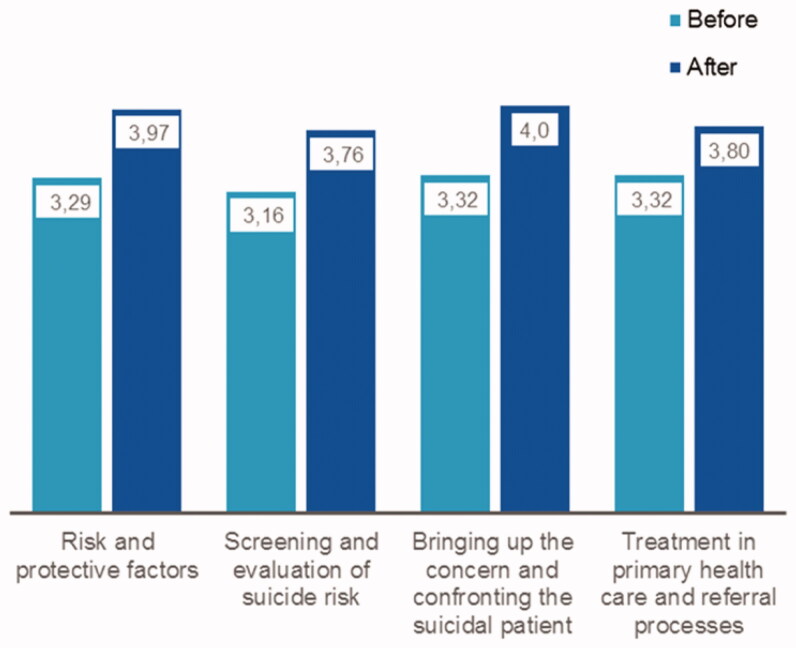
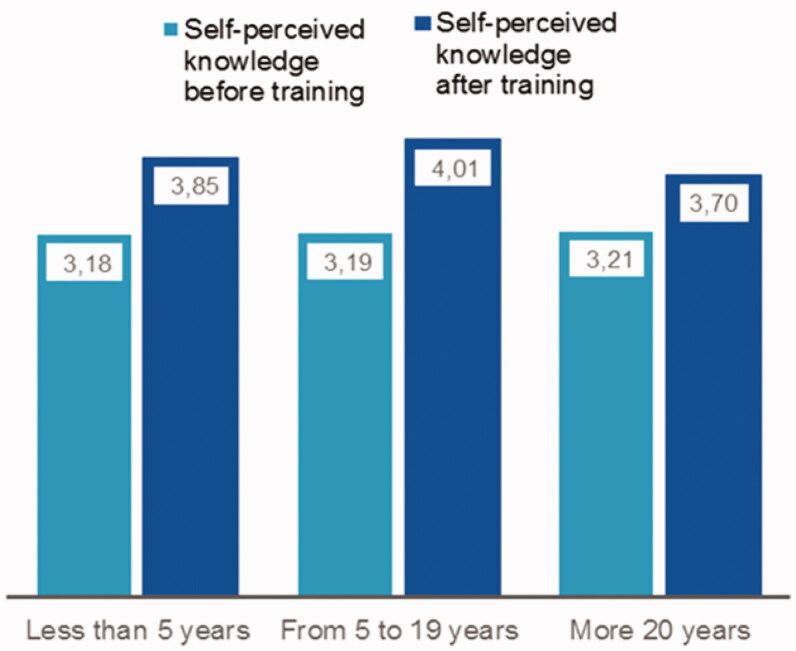
Objective: The aim is to report the outcomes of the suicide prevention training in terms of the self-perceived impact on the participants.Design: The three-hour training consisted areas of risk and protective factors, screening and evaluating suicide risk, raising concerns and confronting suicidal patients, and treating suicidal ideation in primary healthcare and the associated referral processes.Subjects: The studied participants consisted of general practitioners, nurses, public health nurses and social work professionals.Main outcome measures: Participants assessed their own competence on online form regarding four training areas prior to and two weeks after the training.Results: The response rate was 25%. The self-perceived competence of the healthcare professionals increased in all training areas and in all occupational groups. The healthcare professionals’ competence regarding the risk and protective factors training area saw the greatest increase across all professional groups except nurses. There were, however, differences between the groups.Conclusion: Suicide prevention training for primary healthcare professionals did increase the self-perceived competence of the participants in all areas covered by the training. Regular follow-up training is required in order for these improvements to be further developed and retained.Key pointsAfter the suicide prevention training all participants self-perceived increase in their competence in all training areas.The GPs self-perceived most increase in risk and protective factors and nurses in raising concerns and confronting suicidal patients.The GPs’ lowest increase was in the area of treating suicidal ideation in primary health care and the referral processes.
Overview
The claims and statistics of this paper haven’t been checked yet.
Free: it reads the open-access text and checks the first 5 claims that cite a source we can check. Create a free account to check every claim.
Integrity signals
Registry
Cites
Statistics
Figures
Verification
Claims the paper makes
The claims and statistics of this paper haven’t been checked yet.
Free: it reads the open-access text and checks the first 5 claims that cite a source we can check. Create a free account to check every claim.
Claims other papers make about this one
Each is checked against this paper’s own text: does it say what the citing paper says it does?
The source backs part of the claim, not all of it — or backs it for a different population, condition or comparison.
In the citing paper
“Furthermore, many mental health professionals lack the necessary knowledge, attitudes, skills, and confidence to screen, assess, and address suicide risk with patients [64–66].”
From Suicide among youth and young adults in Canada: bereaved parents' perspectives on the systems of care (2025) · cites this paper as [65]
Experimental — accuracy not yet measuredThe source backs part of the claim, not all of it — or backs it for a different population, condition or comparison.
In the citing paper
“This training also helps change attitudes, reduce biases, and decrease stigma among service providers [65].”
From Suicide among youth and young adults in Canada: bereaved parents' perspectives on the systems of care (2025) · cites this paper as [65]
Experimental — accuracy not yet measured
Self-check
Percentages, sums and reported differences re-computed from the paper’s own numbers.
The self-check needs the paper’s full text.
Citations
Cites
Suicide Prevention Strategies: A Systematic Review
Mann, J. J., Apter, A., Bertolote, J., Beautrais, A., Currier, D., Haas, A., Hegerl, U., Lonnqvist, J., Malone, K., Marusic, A., et al. (2005) · JAMA · doi:10.1001/jama.294.16.2064 · Cited by 2,852 · cited 1×
“[16] found that training for general practitioners focusing on screening for suicide risk decreased patient suicides by 22 to 73%.”
BackgroundContact With Mental Health and Primary Care Providers Before Suicide: A Review of the Evidence
Luoma, J. B., Martin, C. E., & Pearson, J. L. (2002) · American Journal of Psychiatry · doi:10.1176/appi.ajp.159.6.909 · Cited by 1,576
Health care contacts in the year before suicide death.
Ahmedani, B. K., Simon, G. E., Stewart, C., Beck, A., Waitzfelder, B. E., Rossom, R., Lynch, F., Owen-Smith, A., Hunkeler, E. M., Whiteside, U., et al. (2014) · Journal of General Internal Medicine · doi:10.1007/s11606-014-2767-3 · Cited by 671 · cited 1×
“[3] indicate that issues related to mental health and risk of suicide may need more profound assessment, especially in primary healthcare settings.”
BackgroundThe European Psychiatric Association (EPA) guidance on suicide treatment and prevention
Wasserman, D., Rihmer, Z., Rujescu, D., Sarchiapone, M., Sokolowski, M., Titelman, D., Zalsman, G., Zemishlany, Z., & Carli, V. (2012) · European Psychiatry · doi:10.1016/j.eurpsy.2011.06.003 · Cited by 390
Let's Not Talk About It: Suicide Inquiry in Primary Care
Feldman, M. D., Franks, P., Duberstein, P. R., Vannoy, S., Epstein, R., & Kravitz, R. L. (2007) · The Annals of Family Medicine · doi:10.1370/afm.719 · Cited by 167
Suicide prevention: an emerging priority for health care
Hogan, M. F., & Grumet, J. G. (2016) · Health Affairs · doi:10.1377/hlthaff.2015.1672 · Cited by 159
Wiener Klinische Wochenschrift
(1964) · JAMA · doi:10.1001/jama.1964.03070230143101 · Cited by 144
Preventing suicide and premature death by education and treatment
Rutz, W. (2001) · Journal of Affective Disorders · doi:10.1016/s0165-0327(00)00356-6 · Cited by 137 · cited 1×
“17] but also reduces suicide rates [25].”
Terpstra, S., Beekman, A. T. F., Abbing, J., Jaken, S., Steendam, M., & Gilissen, R. (2018) · BMC Public Health · doi:10.1186/s12889-018-5512-8 · Cited by 106
What’s the Harm in Asking About Suicidal Ideation?
Mathias, C. W., Michael Furr, R., Sheftall, A. H., Hill‐Kapturczak, N., Crum, P., & Dougherty, D. M. (2012) · Suicide and Life-Threatening Behavior · doi:10.1111/j.1943-278x.2012.0095.x · Cited by 99
Cited by
Sodium Nitrite Intoxication and Death: Summarizing Evidence to Facilitate Diagnosis
Padovano, M., Aromatario, M., D’Errico, S., Concato, M., Manetti, F., David, M. C., Scopetti, M., Frati, P., & Fineschi, V. (2022) · International Journal of Environmental Research and Public Health · doi:10.3390/ijerph192113996 · Cited by 47
“Therefore, in hospitals, one important aspect is the training of health professionals— not necessarily psychiatrists—to quickly identify an acute intoxication and to implement the necessary treatments (intravenous methylene blue and life-support therapies) [61,62].”
BackgroundWärdig, R. E., Hultsjö, S., Lind, M., & Klavebäck, I. (2022) · Issues in Mental Health Nursing · doi:10.1080/01612840.2022.2089789 · Cited by 71
Wärdig, R. E., Engström, A.-S., Carlsson, A., Wärdig, F., & Hultsjö, S. (2022) · Primary Health Care Research & Development · doi:10.1017/s146342362200055x · Cited by 48
“Research has shown that short education, such as theme days with suicidology, have shown good results (Solin et al ., 2021).”
InfluentialSchulz, P., Zapata, I., & Huzij, T. (2024) · Frontiers in Public Health · doi:10.3389/fpubh.2024.1331208 · Cited by 13
“Physicians who have participated in trainings report feeling less afraid to ask about suicide, have an increased ability to recognize suicidal risk factors and behaviors, and have a greater understanding of the correlation between mental illness and suicidality (18, 23).”
BackgroundTwo Halves of the Same Whole: A Framework to Integrate Autism and Mental Health Services
Cleary, M. L., West, S., McLean, L., Kornhaber, R. A., & Hungerford, C. L. (2022) · Issues in Mental Health Nursing · doi:10.1080/01612840.2022.2126570 · Cited by 15
“Research suggests a considerable impact on suicide rates when such awareness and prevention programs are provided for health professionals (Rutz et al., 1992; Solin et al., 2021), education professionals (Hashimoto et al., 2021), and parents of young adults and adolescents (McKay et al., 2022).”
BackgroundSela, Y., & Levi‐Belz, Y. (2024) · Healthcare · doi:10.3390/healthcare12030284 · Cited by 13
“Suicide prevention training relating to these issues has been shown to dramatically improve the prospect of nurses choosing to react and not disregard the situation [44].”
BackgroundEffective suicide prevention strategies in primary healthcare settings: a systematic review
Azizi, H., Esmaeili, E. D., Khodamoradi, F., & Sarbazi, E. (2022) · Middle East Current Psychiatry · doi:10.1186/s43045-022-00271-4 · Cited by 15
“Hogan et al., George et al. [30], and Wintersteen et al. [28] in the USA; Azizi et al. [7] and Malakouti et al. [4] in Iran; Solin et al. [27] in Finland; and Hegerl et al. [31] in Germany.”
Kourgiantakis, T., Cooper, D., Cooper, D., Craig, S., Lee, E., Jones, J., Lau, C. K. Y., Tousignant, R.-N., Singer, J. B., Johnstone, M., et al. (2025) · International Journal of Mental Health Systems · doi:10.1186/s13033-025-00680-y · Cited by 7
Schwinn, T., Hirschmiller, J., Wiltink, J., Zwerenz, R., Brähler, E., Beutel, M. E., & Ernst, M. (2025) · Journal of Cancer Research and Clinical Oncology · doi:10.1007/s00432-025-06106-z · Cited by 8
“Suicide prevention training can improve self-perceived knowledge about suicide and related skills (Siau et al. 2018; Solin et al. 2021; Stuber et al. 2023 ), enhance self-efficacy (Osteen et al. 2017; Siau et al. 2018 ), increase confidence in managing suicidal patients (Muehlenkamp et al. 2023;…”
Tanaka, K., & Ikeuchi, S. (2022) · Journal of Advanced Nursing · doi:10.1111/jan.15522 · Cited by 8
Power, L., & O'Connor, M. (2023) · Radiography · doi:10.1016/j.radi.2023.08.006 · Cited by 5
Flornoy-Guédon, A., Fonzo‐Christe, C., Meier, E., Gazengel-Marchand, M., Francois, O., Gschwind, L., & Bonnabry, P. (2023) · European Journal of Hospital Pharmacy · doi:10.1136/ejhpharm-2022-003679 · Cited by 12
“29 Indeed, at pre-test, participants perceived themselves as less competent in ‘Communication’, even though they had a better mean score, and as quite competent in ‘Cutting and crushing tablets or opening capsules’, even though their mean score was fairly median.”
BackgroundO’Driscoll, M., O’Mahony, C., Keating, E., O’Regan, N., & Sahm, L. J. (2023) · Exploratory Research in Clinical and Social Pharmacy · doi:10.1016/j.rcsop.2023.100293 · Cited by 5
“Indeed, suicide prevention training courses have been shown to increase healthcare professionals' confidence and knowledge in this area.(26) The HSE have developed a number of online and face-to-face suicide prevention training programmes such as SafeTalk and ASIST (Applied Suicide Intervention Skills Training),(27) h…”
BackgroundZhu, J., Ding, M., Si, D., Li, Y., Yuan, Z., Li, D., Deng, L., Tang, C., & Xiong, S. (2025) · BMC Nursing · doi:10.1186/s12912-025-03335-y · Cited by 5
Bahamón, M. J., Javela, J. J., Bechara, A. O., Corcione, A. C., & Cudris–Torres, L. (2024) · Healthcare · doi:10.3390/healthcare12212169 · Cited by 5
“However, the proposed actions, such as continuing education, did not always align with the actual needs identified [26,27].”
BackgroundAnalysis of Professionals' Perceptions of Suicide in Older Adults Living in Care Homes
Redondo, R., Pinazo‐Clapés, C., Checa, I., Hernandis, S. P., & Sales, A. (2025) · International Journal of Geriatric Psychiatry · doi:10.1002/gps.70152 · Cited by 5
“Recognising and responding to suicide in older adults requires communication skills and specific competencies on the part of professionals to know how to identify, approach and manage these cases [52, 53].”
Suicide Education to Improve Knowledge and Confidence of Nurse Practitioners
Langster, H. J., Sartain, K., & Booher, L. (2024) · The Journal for Nurse Practitioners · doi:10.1016/j.nurpra.2023.104905 · Cited by 3
Roux, P., Okuya, Y., Morel, C., Soulès, M., Bottemanne, H., Brunet-Gouet, É., Frileux, S., Passerieux, C., Younès, N., & Martin, J. (2025) · JMIR Serious Games · doi:10.2196/69347 · Cited by 8
“Short lectures and discussions of health care staff experiences and videotaped testimonials by experts on the lived experience of suicidal crises have been shown to be associated with an increase in self-perceived competence [15].”
Öztürk, S., & Hiçdurmaz, D. (2024) · Seminars in Oncology Nursing · doi:10.1016/j.soncn.2024.151740 · Cited by 2
Integrating community health into primary care: two case studies from Barcelona's Raval neighborhood
Ortega, F., de Fortuny, B. B., García, R. A., Raya‐Tena, A., Prats, J. B. I., & Djurdjevic, M. (2025) · Frontiers in Public Health · doi:10.3389/fpubh.2025.1564009 · Cited by 3
Schwinn, T., Hirschmiller, J., Wiltink, J., Zwerenz, R., Brähler, E., Beutel, M. E., & Ernst, M. (2025) · European Journal of Oncology Nursing · doi:10.1016/j.ejon.2025.102933 · Cited by 2
Hultsjö, S., Jormfeldt, H., Allstrin, E., & Karlsson, A. (2025) · Journal of Psychiatric and Mental Health Nursing · doi:10.1111/jpm.13150 · Cited by 4
“Training in SFI can increase nurses' perceived competence, resulting in more effective suicide risk follow-up (Solin, Tamminen, and Partonen 2021).”
Gallagher, K., Walls, E., O’Brien, C., Griffin, E., Phillips, G., & O’Driscoll, M. (2025) · PLoS ONE · doi:10.1371/journal.pone.0327538 · Cited by 3
“…health and suicide prevention education for healthcare students and professionals, as well as the need for earlier, structured intervention [20,21,6,9–12, 22, 23 One of the key challenges in embedding suicide prevention training more systematically is the already overcrowded nature of healthcare…”
Nurses’ experiences of suicide attempts in palliative care
Hultsjö, S., Persdotter, A., Jakobsson, M., Löfgren, F., Annerhult, S., & Wärdig, R. E. (2023) · Palliative & Supportive Care · doi:10.1017/s147895152300024x · Cited by 6
TEACHERS’ EXPERIENCES OF SIMULATION WHEN TEACHING NURSING STUDENTS TO ENCOUNTER A SUICIDAL PERSON
Ylitalo, M., & Söderlund, E. (2023) · INTED proceedings · doi:10.21125/inted.2023.0942
FORMER À L’ÉVALUATION DU RISQUE SUICIDAIRE EN TRAVAIL SOCIAL : LA SIMULATION PAR LES PAIRS
Simard, S. (2023) · Canadian social work review · doi:10.7202/1100665ar
Ose, S. O., & Kaspersen, S. L. (2023) · Suicidologi/Nytt i suicidologi · doi:10.5617/suicidologi.10312
Non-Qualified Staff’s Experience of Suicidal Behaviour in Adult Mental Health Inpatient Services
Shinton, R., & Ledwith, S. (2023) · OMEGA - Journal of Death and Dying · doi:10.1177/00302228231212649
“Participation in suicide prevention training can increase self-perceived competence in working with suicidal behaviour (Solin et al., 2021), therefore lack of training may have in fl uenced the participants ’ feelings of professional failure.”
Enhancing General Practitioner Training for Suicide Risk Management–A Response
O’Reilly, L. M., Wiggs, K. K., & Quinn, P. D. (2024) · Psychiatric Services · doi:10.1176/appi.ps.20240231
Intento autolítico: factores protectores e intervenciones de enfermería
Villamarín, V. G. P., Guevara, J. K. S., Buñay, S. P., & Sinchiguano, G. E. D. (2025) · Anatomía Digital · doi:10.33262/anatomiadigital.v8i1.3275 · Cited by 1
“Solin et al. (21) recalcan que una concepción errónea sobre las conductas autolíticas, falta de conocimiento, experiencia y destrezas en los profesionales de la APS durante el manejo a las personas con conductas suicidas, pueden resultar fatales para los pacientes.”
Suicide Literacy: A Call for National Training in Suicide Competencies for All Medical Doctors
Roshan, M. P., Martínez, S. S., Fu, K., Bonnin, R., & Shoua-Desmarais, N. (2025) · Cureus · doi:10.7759/cureus.93150 · Cited by 1
Suïcidaliteit in de huisartsenpraktijk
Elzinga, E., Magnée, T., & Hartman, T. O. (2026) · doi:10.1007/978-90-368-3172-7_22
Suicide knowledge test: Development and application of psychometric networks
Rodas, N., Yucra-Camposano, J. F., Salas, J. D. N., Vallejos-Saldarriaga, J., Basauri-Delgado, M., O’Diana, A. G., Baldeón, Á. J. Z., Ramos‐Vera, C., & Grigoropoulos, I. (2026) · Death Studies · doi:10.1080/07481187.2026.2676984
Contemporary competencies of public health professionals: a conceptual analysis and scoping review
de Souza, E. N. D. C., de Almeida, M. D. L., Reynaldos-Grandón, K. L., Araya, P. A. D., Conejero, J. E. S., & Peres, A. M. (2026) · Revista gaúcha de enfermagem · doi:10.1590/1983-1447.2026.20250161.en
de Souza, E. N. D. C., de Almeida, M. D. L., Reynaldos-Grandón, K. L., Araya, P. A. D., Conejero, J. E. S., & Peres, A. M. (2026) · Revista gaúcha de enfermagem · doi:10.1590/1983-1447.2026.20250161.pt
Streicher, B. E., Cooley, J. L., Sims, J. G., Marvin, C., Rojas, D., Wakefield, S. M., & Mitchell, S. M. (2026) · Evidence-Based Practice in Child and Adolescent Mental Health · doi:10.1080/23794925.2026.2718212
“Importantly, previous studies have found that suicide prevention training led to an increase in providers’ knowledge and self-perceived competence in conducting suicide risk assessments (Pisani et al., 2021; Solin et al., 2021).”
Ethical dimensions of suicide prevention education in health professions: A narrative review
Sayyah, M. (2026) · Scientific Reviews · doi:10.1038/s44573-026-00007-z
“…reviewed above—inconsistent curricular structure and instructional time 14–16 , the absence of nationally agreed competency standards or supervision benchmarks 32 , and clinicians’ own reports of limited self-perceived competence and inconsistent training experiences during their education 44 .”
Metadata
- Authors
- Solin, P., Tamminen, N., & Partonen, T.
- Affiliations
- Finnish Institute for Health and Welfare (FI)
- Corresponding author
- Solin, Pia
- Venue
- Scandinavian Journal of Primary Health Care
- Publisher
- Informa UK Limited
- Published
- 2021-07-03
- Volume
- 39
- Issue
- 3
- Pages
- 332-338
- ISSN
- 0281-3432 (ISSN-L)
- 1502-7724
- PMC
- PMC8475147
- OpenAlex
- W3187618523
- Semantic Scholar
- 590d7dc344b5a51ddf8f59f0f02f05726574774e
- Cited by
- 37
- References
- 27
- Citations by year
- 2026: 6 · 2025: 11 · 2024: 6 · 2023: 8 · 2022: 6
- FWCI
- 3.41
- Type
- journal article
- Language
- en
- Open access
- gold
- doi.org
- Licence
- Locations
- Scandinavian Journal of Primary Health Care (publishedVersion, cc-by)
- Europe PMC (PubMed Central) (publishedVersion, other-oa)
- PubMed Central (publishedVersion, cc-by)
- PubMed (publishedVersion)
- DOAJ (DOAJ: Directory of Open Access Journals) (submittedVersion, cc-by-sa)
- STM:n Hallinnonalan avoin julkaisuarkisto (Julkari) (submittedVersion)
- WOS
- Topics
- Social Sciences › Psychology › Clinical Psychology › Suicide and Self-Harm Studies
- Social Sciences › Education › Innovations in Medical Education
- Health Sciences › Medicine › Public Health, Environmental and Occupational Health › Opioid Use Disorder Treatment
- Keywords
- suicide prevention training, perceived competence, primary healthcare professionals, general practitioners, nurses, public health nurses, social workers, suicide risk assessment, risk and protective factors, suicidal ideation, referral process, continuing professional development
- MeSH terms
- Suicide Prevention, Attitude of Health Personnel, Clinical Competence, Health Personnel, Humans, Primary Health Care, Suicidal Ideation
About these checks
Registry, retraction, Cites and statistics results are computed, not judged, with one exception: a printed reference that no index lists is read once by a model before it counts as a citation error. Claims are extracted by a model and kept only when their quote appears verbatim in the text; each cited source is then checked, with a model’s help, for whether it says what the claim relies on. Those verdicts can be wrong — read the claim’s quote and the cited source before relying on one.
Statistics and arithmetic are recomputed, not judged.
Confidence bands are shown only for fields calibrated on our annotated test set. None is calibrated yet, so no band is shown.
What counts as a claim ›How we measure confidence ›How we check this ›
Are you an author, or do you see a problem with this page? Request a review
Data sources
Bibliographic data: Semantic Scholar, OpenAlex, Crossref.
Contains information from the Semantic Scholar Academic Graph Datasets, made available under the ODC Attribution License (ODC-BY 1.0).
Semantic Scholar’s data is described in: Kinney, R., et al. (2023). The Semantic Scholar Open Data Platform. arXiv:2301.10140.
