

Impact of body fat distribution and sarcopenia on the overall survival in patients with spinal metastases receiving radiotherapy treatment: a prospective cohort study
Open accessThe DOI matches its Crossref record; 39 of the 39 references it cites were found in a registry or an index; none of the 26 sources its claims cite is checked for support yet.
Abstract
Introduction: An increasing number of patients is diagnosed with spinal metastases due to elevated cancer incidence and improved overall survival. Patients with symptomatic spinal bone metastases often receive radiotherapy with or without surgical stabilisation. Patients with a life expectancy of less than 3 months are generally deemed unfit for surgery, therefore adequate pre-treatment assessment of life expectancy is necessary. The aim of this study was to assess new factors associated with overall survival for this category of patients.Patients and methods: Patients who received radiotherapy for thoracic or lumbar spinal metastases from June 2013 to December 2016 were included in this study. The pre-treatment planning CT for radiotherapy treatment was used to assess the patient’s visceral fat area, subcutaneous fat area, total muscle area and skeletal muscle density on a single transverse slice at the L3 level. The total muscle area was used to assess sarcopenia. Furthermore, data were collected on age, sex, primary tumour, Karnofsky performance score, medical history, number of bone metastases, non-bone metastases and neurological symptoms. Univariable and multivariable cox regressions were performed to determine the association between our variables of interest and the survival at 90 and 365 days.Results: A total of 310 patients was included. The median age was 67 years. Overall survival rates for 90 and 365 days were 71% and 36% respectively. For 90- and 365-day survival, the Karnofsky performance score, muscle density and primary tumour were independently significantly associated. The visceral or subcutaneous fat area and their ratio and sarcopenia were not independently associated with overall survival.Conclusions: Of the body morphology, only muscle density was statistically significant associated with overall survival after 90 and 365 days in patients with spinal bone metastases. Body fat distribution was not significantly associated with overall survival.
Overview
CoChat Summary
TL;DR
In a prospective single-centre cohort of 310 patients receiving radiotherapy for thoracic or lumbar spinal metastases, 90- and 365-day overall survival were 71% and 36%. Muscle density, Karnofsky performance score, and primary tumour were independently associated with survival, whereas body fat distribution and sarcopenia were not independently associated.
Key findings
- Among 310 patients (median age 67 years; median follow-up 202 days, IQR 73–576), overall survival was 71% at 90 days and 36% at 365 days; 63% were male, and the most common primary tumours were lung (28%), prostate (27%), and breast (18%).
- In multivariable Cox regression, decreased muscle density was associated with decreased survival at 90 and 365 days, adjusted for Karnofsky performance score and primary tumour type: HR 0.62 (95% CI 0.41–0.94) and HR 0.70 (95% CI 0.53–0.92), respectively. Karnofsky performance score and primary tumour were also independently significantly associated.
- Visceral fat area, subcutaneous fat area, VFA/SFA ratio, and sarcopenia were not independently associated with overall survival at any time point. In univariable analysis, increased age, increased VFA/SFA ratio, increased subcutaneous fat area, decreased muscle density, and sarcopenia increased the probability of death; higher Karnofsky performance score and breast or prostate cancer versus lung cancer decreased it.
Methods
- Prospective cohort from a single centre: all patients treated with radiotherapy for thoracic or lumbar spinal bone metastases between June 2013 and December 2016 were included (n = 310); no distinction was made by radiotherapy scheme/modality or concurrent systemic therapy. Survival was defined as days from start of radiotherapy to death from all causes or end of follow-up on 31 March 2018, with vital status from a governmental database.
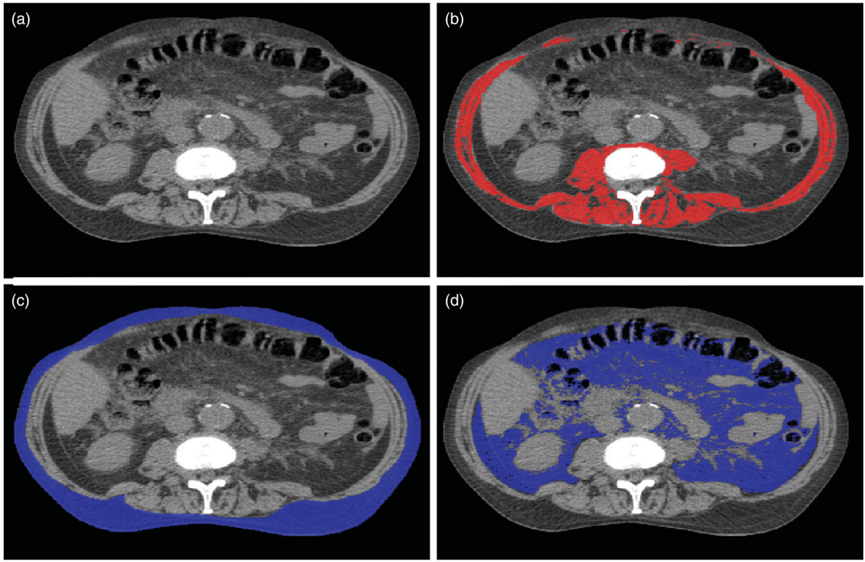
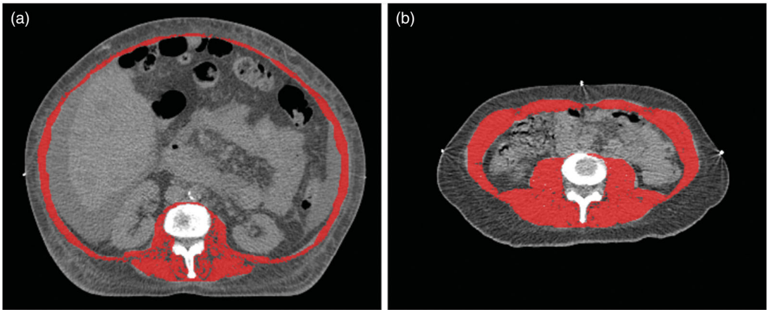
- Pre-treatment radiotherapy planning CT at the L3 level was used. A single trained observer, blinded to clinical information, manually delineated the abdominal muscle wall; subcutaneous fat area, visceral fat area, total muscle area, and muscle density were measured using tissue-specific Hounsfield unit thresholds. Skeletal muscle index was total muscle area divided by height squared; sarcopenia cut-offs were <52.4 cm²/m² for males and <38.5 cm²/m² for females.
- Univariable and multivariable Cox regressions were performed for 90- and 365-day survival. Missing data were handled with multiple imputation using Markov Chain Monte Carlo; collinearity was tested with variance inflation factor; analyses used SPSS version 22.
Limitations
- Stated: missing data were present in 180 patients (58%), mostly Karnofsky performance score (n = 134, 43%) and height (n = 93, 30%), handled by multiple imputation. The cohort was heterogeneous, making model creation difficult but pragmatic; only radiotherapy-treated patients were included, and future studies could include surgically treated patients. A single pre-treatment scan was used rather than serial scans.
- Stated: there is limited consensus on the cut-off value for sarcopenia; this study used the Prado et al. cut-off.
- Evident: the study is a single-centre observational cohort, made no distinction by radiotherapy scheme/modality or concurrent systemic therapy, and neuromuscular impairment was present in 9% of patients, which could confound the muscle density–survival association, although multivariable analysis showed the association to be independent of neuromuscular impairment.
Model-written summary. Check it against the paper before relying on it.
Integrity signals
Registry
Cites
Statistics
Figures


Verification
Claims the paper makes
0 Valid · 0 Not valid · 14 Not checked · 21 Own results and interpretations
A result the paper reports from its own data — it cites no other source for it, so there is none to check. The quote shows it is in the paper.
In the paper
“In addition, we found that muscle density was statistically significant associated with overall survival.”
§ Impact of body fat distribution and sarcopenia on the overall survival in patients with spinal metastases receiving radiotherapy treatment: a prospective cohort study > Conclusion
plainstates an association- Asserted: passes — The authors put it forward as true.
- Checkable: passes — It can be checked against evidence.
- Load-bearing: passes — The paper’s conclusions depend on it.
- Based: passes — The paper gives a reason why it holds.
- Rests on 2 assumptions not shown here.
A result the paper reports from its own data — it cites no other source for it, so there is none to check. The quote shows it is in the paper.
In the paper
“Neuromuscular impairment was present in 9% of our patients, which could have confounded the association of muscle density and survival, but multivariable analysis showed the association to be independent of neuromuscular impairment.”
§ Impact of body fat distribution and sarcopenia on the overall survival in patients with spinal metastases receiving radiotherapy treatment: a prospective cohort study > Discussion
plainstates an association- Asserted: passes — The authors put it forward as true.
- Checkable: passes — It can be checked against evidence.
- Load-bearing: passes — The paper’s conclusions depend on it.
- Based: passes — The paper gives a reason why it holds.
- Rests on 2 assumptions not shown here.
A result the paper reports from its own data — it cites no other source for it, so there is none to check. The quote shows it is in the paper.
In the paper
“Of the body morphology, only muscle density was statistically significant associated with overall survival after 90 and 365 days in patients with spinal bone metastases.”
§ Impact of body fat distribution and sarcopenia on the overall survival in patients with spinal metastases receiving radiotherapy treatment: a prospective cohort study > Abstract
plainstates an association- Asserted: passes — The authors put it forward as true.
- Checkable: passes — It can be checked against evidence.
- Load-bearing: passes — The paper’s conclusions depend on it.
- Based: passes — The paper gives a reason why it holds.
- Rests on 2 assumptions not shown here.
A result the paper reports from its own data — it cites no other source for it, so there is none to check. The quote shows it is in the paper.
In the paper
“Body fat distribution was not significantly associated with overall survival.”
§ Impact of body fat distribution and sarcopenia on the overall survival in patients with spinal metastases receiving radiotherapy treatment: a prospective cohort study > Abstract
plain- Asserted: passes — The authors put it forward as true.
- Checkable: passes — It can be checked against evidence.
- Load-bearing: passes — The paper’s conclusions depend on it.
- Based: passes — The paper gives a reason why it holds.
- Rests on 2 assumptions not shown here.
None of the sources cited for this claim have been checked yet.
In the paper
“In the present work we found an association between low muscle density and poor prognosis which was independent of other clinical factors as found in different studies as well [2,34].”
§ Impact of body fat distribution and sarcopenia on the overall survival in patients with spinal metastases receiving radiotherapy treatment: a prospective cohort study > Discussion
What the sources say
- Not checked yetcites [2] Martin L, Birdsell L, Macdonald N, et al. Cancer cachexia in the age of obesity: skeletal muscle depletion is a powerful prognostic factor, independent of body mass index. JCO. 2013;31(12): 1539-1547. source
Checked before — its earlier verdict is held back until a new check runs.
- Not checked yetcites [34] Friedman J, Lussiez A, Sullivan J, et al. Implications of sarcopenia in major surgery. Nutr Clin Pract. 2015;30(2):175-179. source
Checked before — its earlier verdict is held back until a new check runs.
plainstates an association- Asserted: passes — The authors put it forward as true.
- Checkable: passes — It can be checked against evidence.
- Load-bearing: passes — The paper’s conclusions depend on it.
- Based: passes — The paper gives a reason why it holds.
- Rests on 2 assumptions not shown here.
- Not checked yet
3 more claims
Create a free account to see all 35 claims and to verify the 25 references still open.
- It may state two separate claims as one. 13
- Probably not a substantial claim. 15
Self-check
Percentages, sums and reported differences re-computed from the paper’s own numbers.
Each contradiction between two passages listed here was confirmed by an independent check.
Rated major: it would touch a result — a value a result rests on, reported and recomputed p-values on opposite sides of the significance level, two passages that conflict with no sign which is right, or a cited work retracted before this paper was published.
In the paper
§ Impact of body fat distribution and sarcopenia on the overall survival in patients with spinal metastases receiving radiotherapy treatment: a prospective cohort study > Study population
“A total of 310 patients with spinal metastases treated with palliative radiation therapy was included.Median follow-up was 202 days (IQR 73-576) and overall survival rates after 90 and 365 days were 71% and 36% respectively.”
§ Impact of body fat distribution and sarcopenia on the overall survival in patients with spinal metastases receiving radiotherapy treatment: a prospective cohort study > Conclusion
“| | Died within 90 days n (%) | HR (95% CI) | Died within 365 days n (%) | HR (95% CI) | | Sex | | | | | | Male | 64 (33) | ref | 147 (71) | ref | | Female | 28 (24) | 0.68 (0.44-1.07) | 73 (53) | 0.62 (0.46-0.84) |”
Rated minor: it would not touch a result — a value no result rests on, a p-value that stays on the same side of the significance level, or a conflict that is clerical, resolved elsewhere in the paper, or outside its own findings.
In the paper
§ Impact of body fat distribution and sarcopenia on the overall survival in patients with spinal metastases receiving radiotherapy treatment: a prospective cohort study > Study population
“Univariable analysis showed that an increased age, increased VFA/SFA-ratio, increased SFA or a decrease in muscle density and a diagnosis of sarcopenia increased the probability of death.”
§ Impact of body fat distribution and sarcopenia on the overall survival in patients with spinal metastases receiving radiotherapy treatment: a prospective cohort study > Conclusion
“| Subcutaneous fat area per 100 cm 2 | | 0.79 (0.63-0.99) | | 0.69 (0.59-0.81) |”
Rated minor: it would not touch a result — a value no result rests on, a p-value that stays on the same side of the significance level, or a conflict that is clerical, resolved elsewhere in the paper, or outside its own findings.
In the paper
§ Impact of body fat distribution and sarcopenia on the overall survival in patients with spinal metastases receiving radiotherapy treatment: a prospective cohort study > Conclusion
“| Female | 28 (24) | 0.68 (0.44-1.07) | 73 (53) | 0.62 (0.46-0.84) |”
§ Impact of body fat distribution and sarcopenia on the overall survival in patients with spinal metastases receiving radiotherapy treatment: a prospective cohort study > Study population
“The majority of patients was male (63%) (Table 1).”
Rated minor: it would not touch a result — a value no result rests on, a p-value that stays on the same side of the significance level, or a conflict that is clerical, resolved elsewhere in the paper, or outside its own findings.
In the paper
§ Impact of body fat distribution and sarcopenia on the overall survival in patients with spinal metastases receiving radiotherapy treatment: a prospective cohort study > Conclusion
“| Prostate | 16 (19) | 0.33 (0.19-0.60) | 47 (48) | 0.30 (0.20-0.44) |”
§ Impact of body fat distribution and sarcopenia on the overall survival in patients with spinal metastases receiving radiotherapy treatment: a prospective cohort study > Study population
“The most common primary tumour originated from the lung (28%), followed by prostate and breast (27% and 18% respectively).”
Rated minor: it would not touch a result — a value no result rests on, a p-value that stays on the same side of the significance level, or a conflict that is clerical, resolved elsewhere in the paper, or outside its own findings.
In the paper
§ Impact of body fat distribution and sarcopenia on the overall survival in patients with spinal metastases receiving radiotherapy treatment: a prospective cohort study > Conclusion
“| No | 44 (23) | Ref | 112 (59) | Ref | | Yes | 48(40) | 2.03 (1.57-2.48) | 86 (72) | 1.61 (1.31-1.91) |”
§ Impact of body fat distribution and sarcopenia on the overall survival in patients with spinal metastases receiving radiotherapy treatment: a prospective cohort study > Conclusion
“| Male | 64 (33) | ref | 147 (71) | ref | | Female | 28 (24) | 0.68 (0.44-1.07) | 73 (53) | 0.62 (0.46-0.84) |”
Citations
Cites
Charlson, M. E., Pompei, P., Ales, K. L., & MacKenzie, C. R. (1987) · Journal of Chronic Diseases · doi:10.1016/0021-9681(87)90171-8 · Cited by 49,742
A Caution Regarding Rules of Thumb for Variance Inflation Factors
O’brien, R. M. (2007) · Quality & Quantity · doi:10.1007/s11135-006-9018-6 · Cited by 11,217
Prado, C. M., Lieffers, J. R., McCargar, L. J., Reiman, T., Sawyer, M. B., Martin, L., & Baracos, V. E. (2008) · The Lancet Oncology · doi:10.1016/s1470-2045(08)70153-0 · Cited by 3,238
Partial residuals for the proportional hazards regression model
SCHOENFELD, D. (1982) · Biometrika · doi:10.1093/biomet/69.1.239 · Cited by 3,111
Martin, L., Birdsell, L., MacDonald, N., Reiman, T., Clandinin, M. T., McCargar, L. J., Murphy, R., Ghosh, S., Sawyer, M. B., & Baracos, V. E. (2013) · Journal of Clinical Oncology · doi:10.1200/jco.2012.45.2722 · Cited by 2,680
Mourtzakis, M., Prado, C. M. M., Lieffers, J. R., Reiman, T., McCargar, L. J., & Baracos, V. E. (2008) · Applied Physiology, Nutrition, and Metabolism · doi:10.1139/h08-075 · Cited by 2,224
Prognostic value of sarcopenia in adults with solid tumours: A meta-analysis and systematic review
Shachar, S. S., Williams, G. R., Muss, H. B., & Nishijima, T. F. (2016) · European Journal of Cancer · doi:10.1016/j.ejca.2015.12.030 · Cited by 1,099
Classifications In Brief: American Spinal Injury Association (ASIA) Impairment Scale
Roberts, T. T., Leonard, G. R., & Cepela, D. J. (2016) · Clinical Orthopaedics and Related Research · doi:10.1007/s11999-016-5133-4 · Cited by 922
Macedo, F., Ladeira, K., Pinho, F., Saraiva, N., Bonito, N., Pinto, L., & Gonçalves, F. (2017) · Oncology Reviews · doi:10.4081/oncol.2017.321 · Cited by 775
Sarcopenia in an Overweight or Obese Patient Is an Adverse Prognostic Factor in Pancreatic Cancer
Tan, B. H. L., Birdsell, L. A., Martin, L., Baracos, V. E., & Fearon, K. C. H. (2009) · Clinical Cancer Research · doi:10.1158/1078-0432.ccr-09-1525 · Cited by 653
New prognostic factors and scoring system for patients with skeletal metastasis
Katagiri, H., Okada, R., Takagi, T., Takahashi, M., Murata, H., Harada, H., Nishimura, T., Asakura, H., & Ogawa, H. (2014) · Cancer Medicine · doi:10.1002/cam4.292 · Cited by 421
Kim, K. M., Jang, H. C., & Lim, S. (2016) · The Korean Journal of Internal Medicine · doi:10.3904/kjim.2016.015 · Cited by 403
Pamoukdjian, F., Bouillet, T., Lévy, V., Soussan, M., Zelek, L., & Paillaud, E. (2018) · Clinical Nutrition · doi:10.1016/j.clnu.2017.07.010 · Cited by 387
Tournadre, A., Vial, G., Capel, F., Soubrier, M., & Boirie, Y. (2019) · Joint Bone Spine · doi:10.1016/j.jbspin.2018.08.001 · Cited by 375
Macedo, F. (2017) · Cancer therapy & Oncology International Journal · doi:10.19080/ctoij.2017.04.555637 · Cited by 257
Subcutaneous adiposity is an independent predictor of mortality in cancer patients
Ebadi, M., Martin, L., Ghosh, S., Field, C. J., Lehner, R., Baracos, V. E., & Mazurak, V. C. (2017) · British Journal of Cancer · doi:10.1038/bjc.2017.149 · Cited by 247
Yip, C., Dinkel, C., Mahajan, A., Siddique, M., Cook, G. J. R., & Goh, V. (2015) · Insights into Imaging · doi:10.1007/s13244-015-0414-0 · Cited by 230
Antoun, S., Lanoy, E., Iacovelli, R., Albiges‐Sauvin, L., Loriot, Y., Merad‐Taoufik, M., Fizazi, K., di Palma, M., Baracos, V. E., & Escudier, B. (2013) · Cancer · doi:10.1002/cncr.28218 · Cited by 215
Surgical Management of Metastatic Bone Disease
Bickels, J., Dadia, S., & Lidar, Z. (2009) · The Journal of Bone and Joint Surgery-American Volume · doi:10.2106/jbjs.h.00175 · Cited by 203
Irlbeck, T., Massaro, J. M., Bamberg, F., O'Donnell, C. J., Hoffmann, U., & Fox, C. S. (2010) · International Journal of Obesity · doi:10.1038/ijo.2009.279 · Cited by 199
Implications of Sarcopenia in Major Surgery
Friedman, J., Lussiez, A., Sullivan, J., Wang, S., & Englesbe, M. (2015) · Nutrition in Clinical Practice · doi:10.1177/0884533615569888 · Cited by 158
Rier, H. N., Jager, A., Sleijfer, S., van Rosmalen, J., Kock, M. C. J. M., & Levin, M.-D. (2017) · The Breast · doi:10.1016/j.breast.2016.10.014 · Cited by 149 · cited 1×
“Furthermore, the association between a decrease in muscle density and decreased survival was also reported for multiple other primary tumours [21,31,32].”
BackgroundCamus, V., Lanic, H., Kraut, J., Modzelewski, R., Clatot, F., Picquenot, J. M., Contentin, N., Lenain, P., Groza, L., Lemasle, E., et al. (2014) · European Journal of Haematology · doi:10.1111/ejh.12285 · Cited by 120
Current Paradigms for Metastatic Spinal Disease: An Evidence-Based Review
Kaloostian, P. E., Yurter, A., Zadnik, P. L., Sciubba, D. M., & Gokaslan, Z. L. (2013) · Annals of Surgical Oncology · doi:10.1245/s10434-013-3324-8 · Cited by 112
Black, D. H., Mackay, C., Ramsay, G., Hamoodi, Z., Nanthakumaran, S., Park, K. G. M., Loudon, M. A., & Richards, C. H. (2017) · Annals of Surgical Oncology · doi:10.1245/s10434-017-5829-z · Cited by 105
Rutten, I. J. G., Ubachs, J., Kruitwagen, R. F. P. M., van Dijk, D. P. J., Beets-Tan, R. G. H., Massuger, L. F. A. G., Olde Damink, S. W. M., & Van Gorp, T. (2017) · European Journal of Surgical Oncology (EJSO) · doi:10.1016/j.ejso.2016.12.016 · Cited by 102
Simultaneous multi-modality ROI delineation in clinical practice
Bol, G. H., Kotte, A. N. T. J., van der Heide, U. A., & Lagendijk, J. J. W. (2009) · Computer Methods and Programs in Biomedicine · doi:10.1016/j.cmpb.2009.04.008 · Cited by 101
Self-citationSurgical Management of Metastatic Spinal Tumors
Laufer, I., Sciubba, D. M., Madera, M., Bydon, A., Witham, T. J., Gokaslan, Z. L., & Wolinsky, J.-P. (2012) · Cancer Control · doi:10.1177/107327481201900206 · Cited by 94
Huisman, M., van der Velden, J. M., van Vulpen, M., van den Bosch, M. A. A. J., Chow, E., Öner, F. C., Yee, A., Verkooijen, H. M., & Verlaan, J. (2014) · The Spine Journal · doi:10.1016/j.spinee.2014.03.043 · Cited by 83
Self-citationChambard, L., Girard, N., Ollier, É., Rousseau, J., Duboeuf, F., Carlier, M.-C., Brevet, M., Szulc, P., Pialat, J., Wegrzyn, J., et al. (2018) · Bone · doi:10.1016/j.bone.2018.01.004 · Cited by 74
Verlaan, J.-J., Choi, D., Versteeg, A., Albert, T., Arts, M., Balabaud, L., Bunger, C., Buchowski, J. M., Chung, C. K., Coppes, M. H., et al. (2016) · Journal of Clinical Oncology · doi:10.1200/jco.2015.65.1497 · Cited by 71
Self-citationHa, Y., Kim, D., Han, S., Chon, Y. E., Lee, Y. B., Kim, M. N., Lee, J. H., Park, H., Rim, K. S., & Hwang, S. G. (2018) · Cancer Research and Treatment · doi:10.4143/crt.2017.232 · Cited by 50
van Vugt, J. L. A., Gaspersz, M. P., Vugts, J. J. A., Buettner, S., Levolger, S., de Bruin, R. W. F., Polak, W. G., de Jonge, J., Willemssen, F. E. J. A., Koerkamp, B. G., et al. (2018) · Digestive Surgery · doi:10.1159/000486867 · Cited by 47
Bollen, L., Wibmer, C., Van der Linden, Y. M., Pondaag, W., Fiocco, M., Peul, W. C., Marijnen, C. A. M., Nelissen, R. G. H. H., Leithner, A., & Dijkstra, S. P. D. (2016) · SPINE · doi:10.1097/brs.0000000000001192 · Cited by 47
Grignol, V. P., Smith, A. D., Shlapak, D., Zhang, X., Del Campo, S. M., & Carson, W. E. (2015) · Surgical Oncology · doi:10.1016/j.suronc.2015.09.002 · Cited by 44
Okamura, A., Watanabe, M., Mine, S., Nishida, K., Imamura, Y., Kurogochi, T., Kitagawa, Y., & Sano, T. (2016) · Annals of Surgical Oncology · doi:10.1245/s10434-015-5018-x · Cited by 38
Karhade, A. V., Shin, J. H., & Schwab, J. H. (2019) · Annals of Translational Medicine · doi:10.21037/atm.2019.04.87 · Cited by 21
Mizuno, R., Miyajima, A., Hibi, T., Masuda, A., Shinojima, T., Kikuchi, E., Jinzaki, M., & Oya, M. (2017) · Medical Oncology · doi:10.1007/s12032-017-0908-3 · Cited by 18
Mizuno, R., Miyajima, A., Hayakawa, N., Kikuchi, E., Shinojima, T., Asanuma, H., Mikami, S., Jinzaki, M., & Oya, M. (2016) · European Urology Supplements · doi:10.1016/s1569-9056(16)30509-7
Research works printed but not linked: 1
- IBM Corp. Released 2013. IBM SPSS Statistics for Windows, Version 22.0. Armonk, NY: IBM Corp.
Cited by
Couderc, A., Liuu, É., Boudou, P., Poisson, J., Frélaut, M., Montégut, C., Mebarki, S., Geiss, R., Thomas, Z. A., Noret, A., et al. (2023) · Nutrients · doi:10.3390/nu15051193 · Cited by 60
Tseng, T., Lee, C., Yen, H., Groot, O. Q., Hou, C., Lin, S.-Y., Bongers, M. E. R., Hu, M., Karhade, A. V., Ko, J.-C., et al. (2021) · Clinical Orthopaedics and Related Research · doi:10.1097/corr.0000000000001969 · Cited by 53
Self-citationZhang, Y., Zhang, J., Zhan, Y., Pan, Z., Liu, Q., & Yuan, W. (2024) · Journal of Cachexia, Sarcopenia and Muscle · doi:10.1002/jcsm.13629 · Cited by 37
Aleixo, G. F. P., Shachar, S. S., Deal, A. M., Nyrop, K. A., Muss, H. B., Chen, Y. T., Yu, H., & Williams, G. R. (2020) · Breast Cancer Research and Treatment · doi:10.1007/s10549-020-05731-1 · Cited by 35
Çatıkkaş, N. M., Bahat, Z., Ören, M. M., & Bahat, G. (2022) · Aging Clinical and Experimental Research · doi:10.1007/s40520-022-02085-0 · Cited by 30
Metadata
- Authors
- Pielkenrood, B. J., van Urk, P. R., van der Velden, J. M., Kasperts, N., Verhoeff, J. J. C., Bol, G. H., Verkooijen, H. M., & Verlaan, J. J.
- Affiliations
- University Medical Center Utrecht (NL)
- Utrecht University (NL)
- Corresponding author
- Pielkenrood, B. J.
- ORCID
- Venue
- Acta Oncologica
- Published
- 2019-11-23
- Volume
- 59
- Issue
- 3
- Pages
- 291-297
- ISSN
- 0284-186X (ISSN-L)
- 1651-226X
- OpenAlex
- W2991366971
- Cited by
- 17
- References
- 37
- Citations by year
- 2026: 2 · 2025: 1 · 2024: 2 · 2023: 1 · 2022: 8 · 2021: 2 · 2020: 1
- FWCI
- 2.39
- Type
- journal article
- Language
- en
- Open access
- diamond
- doi.org
- Licence
- Locations
- Acta Oncologica (publishedVersion, cc-by-nc-nd)
- PubMed (publishedVersion)
- Utrecht University Repository (Utrecht University) (submittedVersion, other-oa)
- Topics
- Health Sciences › Medicine › Surgery › Management of metastatic bone disease
- Health Sciences › Medicine › Physiology (medical) › Nutrition and Health in Aging
- Health Sciences › Medicine › Oncology › Brain Metastases and Treatment
- Keywords
- spinal metastases, radiotherapy, overall survival, sarcopenia, body fat distribution, visceral fat, subcutaneous adipose tissue, skeletal muscle density, Karnofsky performance status, prognostic factors, thoracic and lumbar spine
- MeSH terms
- Aged, Female, Humans, Male, Middle Aged, Prognosis, Prospective Studies, Radiotherapy, Spinal Neoplasms, Survival Rate, Karnofsky Performance Status, Body Fat Distribution, Sarcopenia
About these checks
Registry, retraction, Cites and statistics results are computed, not judged, with one exception: a printed reference that no index lists is read once by a model before it counts as a citation error. Claims are extracted by a model and kept only when their quote appears verbatim in the text; each cited source is then checked, with a model’s help, for whether it says what the claim relies on. Those verdicts can be wrong — read the claim’s quote and the cited source before relying on one.
A language model drew the claims from the paper on 2026-11-21, under version 3 of the claim definition (model deepseek-v4.1-flash, prompt extract-v3).
A second model labelled each claim on 2026-11-21 (model jev-1.13-20260917, definition revision gold-guideline-v0.2).
Statistics and arithmetic are recomputed, not judged.
Confidence bands are shown only for fields calibrated on our annotated test set. None is calibrated yet, so no band is shown.
What counts as a claim ›How we measure confidence ›How we check this ›
Are you an author, or do you see a problem with this page? Request a review
Data sources
Bibliographic data: Semantic Scholar, OpenAlex, Crossref.
Contains information from the Semantic Scholar Academic Graph Datasets, made available under the ODC Attribution License (ODC-BY 1.0).
Semantic Scholar’s data is described in: Kinney, R., et al. (2023). The Semantic Scholar Open Data Platform. arXiv:2301.10140.
