

Human-AI collaboration patterns in AI-assisted academic writing
Open accessThe DOI matches its Crossref record; 39 of the 39 references it cites were found in a registry or an index; 4 of the 9 sources its claims cite were checked for support.
Abstract
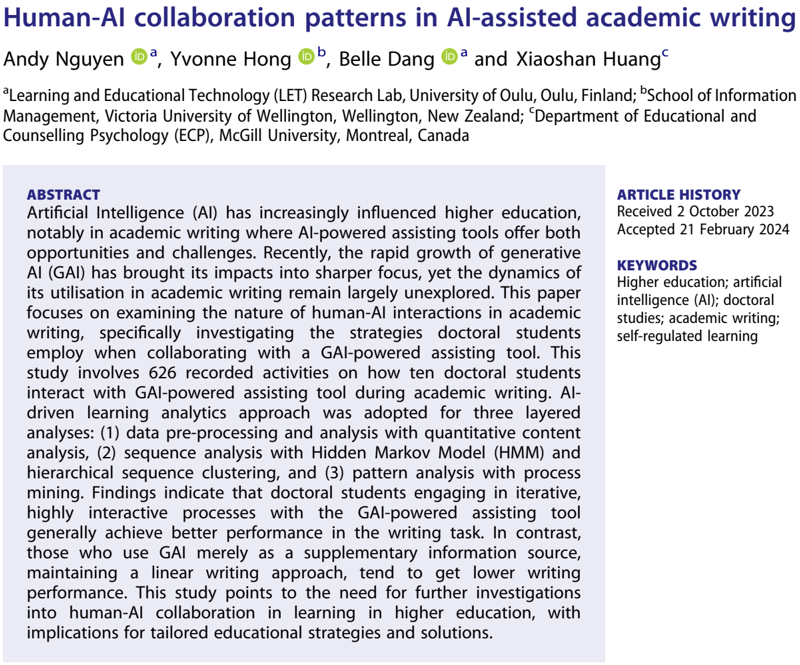
Artificial Intelligence (AI) has increasingly influenced higher education, notably in academic writing where AI-powered assisting tools offer both opportunities and challenges.Recently, the rapid growth of generative AI (GAI) has brought its impacts into sharper focus, yet the dynamics of its utilisation in academic writing remain largely unexplored.This paper focuses on examining the nature of human-AI interactions in academic writing, specifically investigating the strategies doctoral students employ when collaborating with a GAI-powered assisting tool.This study involves 626 recorded activities on how ten doctoral students interact with GAI-powered assisting tool during academic writing.AIdriven learning analytics approach was adopted for three layered analyses: (1) data pre-processing and analysis with quantitative content analysis, (2) sequence analysis with Hidden Markov Model (HMM) and hierarchical sequence clustering, and (3) pattern analysis with process mining.Findings indicate that doctoral students engaging in iterative, highly interactive processes with the GAI-powered assisting tool generally achieve better performance in the writing task.In contrast, those who use GAI merely as a supplementary information source, maintaining a linear writing approach, tend to get lower writing performance.This study points to the need for further investigations into human-AI collaboration in learning in higher education, with implications for tailored educational strategies and solutions.
Overview
CoChat Summary
TL;DR
This study used process mining and Hidden Markov Models on screen-recorded writing sessions to examine how 10 doctoral students collaborated with ChatGPT in a 30-minute academic writing task. It identified two strategy types—Structured Adaptivity and Unstructured Streamline—with the more iterative, interactive type achieving higher writing performance.
Key findings
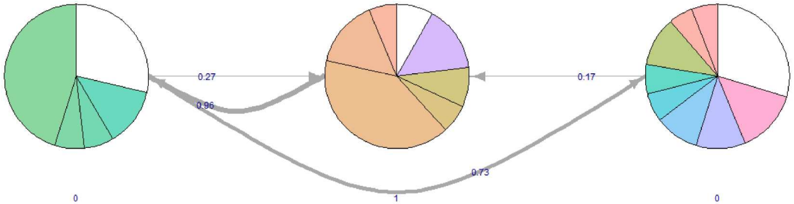
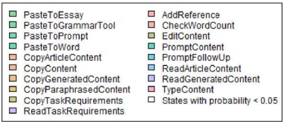
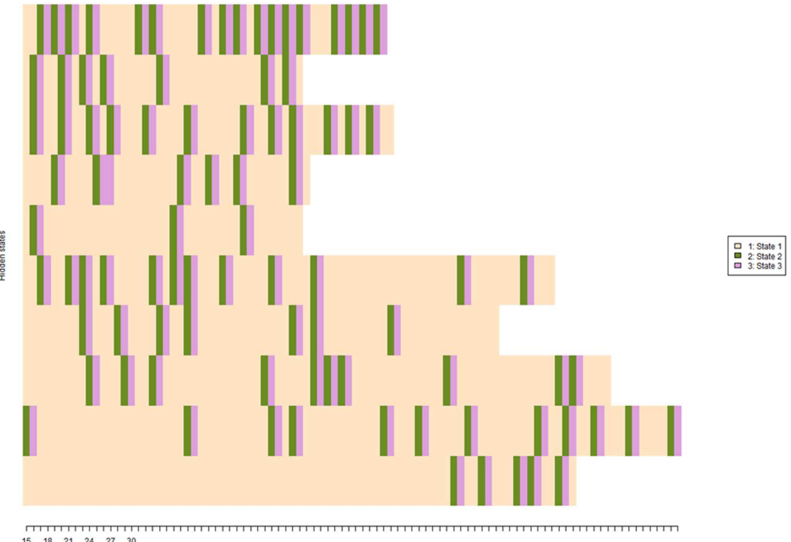
- HMM identified 3 hidden states: Content Pasting (14.6% of writing-tactic data; 82.6% paste-related actions), Content Copying (14.5%; 97.8% copying-related actions), and Component Shaping (70.8%; broader tactics such as AddReference, TypeContent, EditContent, PromptContent, PromptFollowUp).
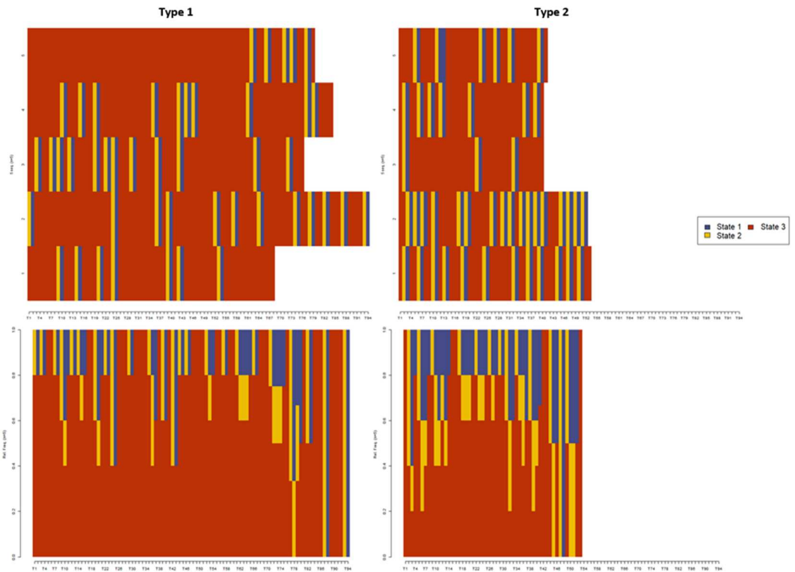
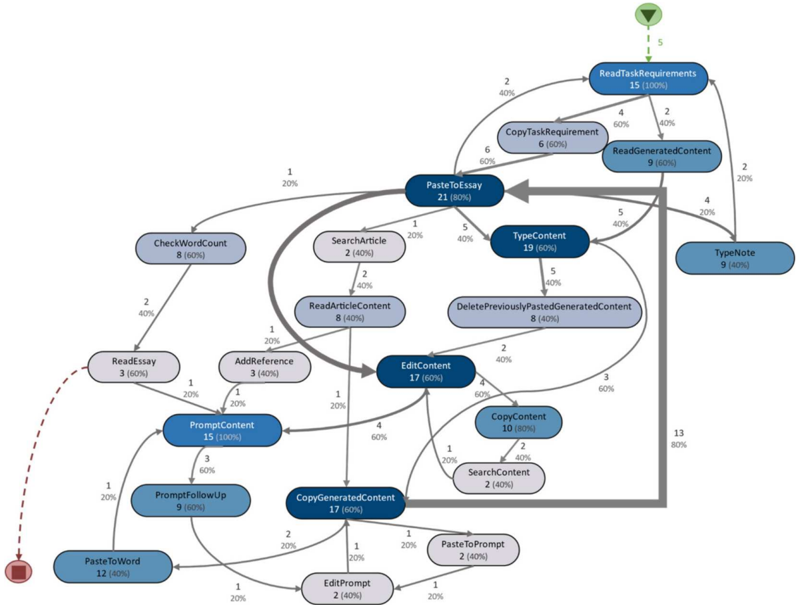
- Sequence clustering yielded two writing strategy types: Type 1 Structured Adaptivity (5 sequences) and Type 2 Unstructured Streamline (5 sequences), with a silhouette score of 0.372 and agglomerative coefficient of 0.77.
- Type 1 had higher mean performance (M = 79.75, SD = 20.64) than Type 2 (M = 54.75, SD = 10.77; table reports 54.7), a significant difference (t = 2.4011, df = 6.0267, p ≤ 0.05). Type 1 used more PromptFollowUp (21 vs. 9) and EditPrompt (5 vs. 2); Type 2 had DeletePreviouslyPastedGeneratedContent (8 vs. 0).
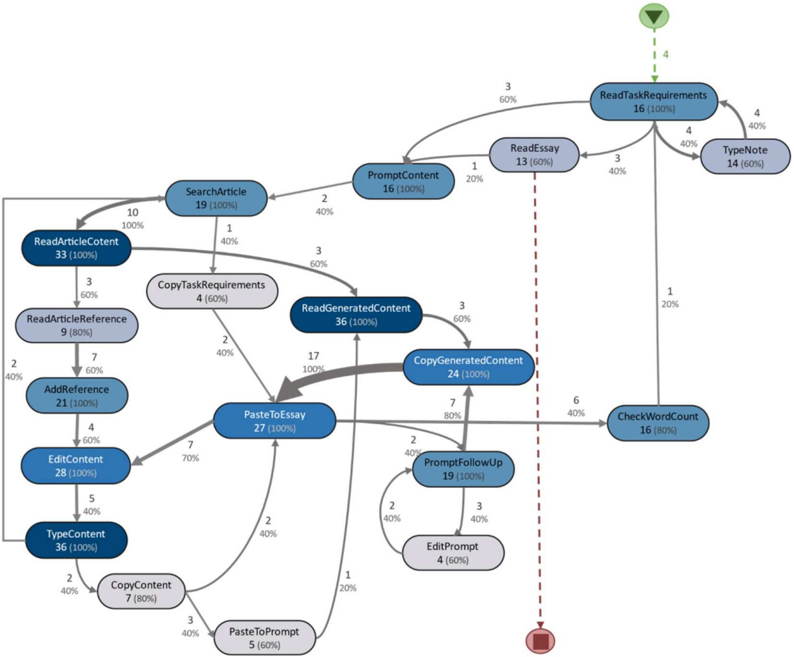
- Type 1 showed iterative, multifaceted engagement with ChatGPT; Type 2 used a more linear prompt-copy-paste approach with limited use and familiarity, associated with lower performance.
Methods
- Participants were 10 doctoral students from Finland and New Zealand enrolled in English doctoral programs in Information Systems or Learning and Educational Technology. The online experiment via Zoom required a ~500-word essay on AI use in education within 30 minutes, allowing any tools including ChatGPT and Google Scholar; screen recording with audio and a pre-survey were used.
- Data included 626 coded events from quantitative content analysis. The three-layer AI-driven learning analytics approach comprised: (1) content analysis, (2) Hidden Markov Model and Agglomerative Hierarchical Clustering, and (3) process mining using Fuzzy Miner and Fluxicon Disco. HMM state number was selected via AIC/BIC; writing was scored by a university lecturer using a rubric (content 30%, analysis 30%, organisation/structure 15%, quality 15%, word limit/referencing 10%).
- Normality was checked with Shapiro-Wilk (W = 0.91534, p > 0.05), and a t-test compared mean performance scores between the two clusters.
Limitations
- Stated: the small cohort (N = 10) limits statistical power, generalizability, and robustness; it heightens risk of sampling bias, and findings should be viewed as exploratory, requiring larger and more diverse samples.
- Stated: variability in factors influencing academic writing performance (e.g., interest in the task, familiarity with subject matter) may affect outcomes and generalizability; the common assessment procedure may not fully capture the transformational potential of generative AI, focusing instead on efficiency gains.
- Evident from the text: the study uses a single 30-minute task with one GAI tool (ChatGPT) in a specific doctoral population, and the data are not publicly available due to privacy or ethical restrictions.
Model-written summary. Check it against the paper before relying on it.
Integrity signals
Registry
Cites
Statistics
Figures


Verification
Claims the paper makes
3 Valid · 0 Not valid · 2 Not checked · 76 Own results and interpretations
The cited sources support only part of this claim — read each source’s verdict below.
In the paper
“This finding emphasises the potential benefits of adopting a cyclical approach to writing coordination with the GAI-powered tool (Dwivedi et al. 2023;Yan 2023).”
§ Human-AI collaboration patterns in AI-assisted academic writing > Discussion
What the sources say
- Partly supportedcites Dwivedi et al. 2023 matched to “Opinion Paper: “So what if ChatGPT wrote it?” Multidisciplinary perspectives on opportunities, challenges and implications of generative conversational AI for research, practice and policy” (2023) sourceExperimental — accuracy not yet measured
Section 4.2.10.1 (p. 34) describes using ChatGPT to improve writing, and Section 4.2.7 (p. 30) discusses improving an AI-generated first draft. These support potential benefits from working with the tool, but the passages do not describe a cyclical approach to coordinating the writing process. (LLM, conf=0.84)
- Not checked — no full text of the sourcecites Yan 2023 matched to “Impact of ChatGPT on learners in a L2 writing practicum: an exploratory investigation” (2023) source
hedgedstates a possible cause- Asserted: passes — The authors put it forward as true.
- Checkable: passes — It can be checked against evidence.
- Load-bearing: passes — The paper’s conclusions depend on it.
- Based: passes — The paper gives a reason why it holds.
- Partly supported
A result the paper reports from its own data — it cites no other source for it, so there is none to check. The quote shows it is in the paper.
In the paper
“This state occupies 14.5% of the data on writing tactics”
§ Human-AI collaboration patterns in AI-assisted academic writing > RQ1a) What are the key hidden states in GAI-assisted academic writing? Hidden Markov model results
plain- Asserted: passes — The authors put it forward as true.
- Checkable: passes — It can be checked against evidence.
- Load-bearing: unclear — It is unclear whether the paper’s conclusions depend on it.
- Based: passes — The paper gives a reason why it holds.
- Rests on 2 assumptions not shown here.
A result the paper reports from its own data — it cites no other source for it, so there is none to check. The quote shows it is in the paper.
In the paper
“This state captures 14.6% of the total data on writing tactics”
§ Human-AI collaboration patterns in AI-assisted academic writing > RQ1a) What are the key hidden states in GAI-assisted academic writing? Hidden Markov model results
plain- Asserted: passes — The authors put it forward as true.
- Checkable: passes — It can be checked against evidence.
- Load-bearing: unclear — It is unclear whether the paper’s conclusions depend on it.
- Based: passes — The paper gives a reason why it holds.
- Rests on 2 assumptions not shown here.
A result the paper reports from its own data — it cites no other source for it, so there is none to check. The quote shows it is in the paper.
In the paper
“Unlike the other two states, this one presents a broader range of writing tactics.”
§ Human-AI collaboration patterns in AI-assisted academic writing > RQ1a) What are the key hidden states in GAI-assisted academic writing? Hidden Markov model results
plain- Asserted: passes — The authors put it forward as true.
- Checkable: passes — It can be checked against evidence.
- Load-bearing: unclear — It is unclear whether the paper’s conclusions depend on it.
- Based: passes — The paper gives a reason why it holds.
- Rests on 2 assumptions not shown here.
A result the paper reports from its own data — it cites no other source for it, so there is none to check. The quote shows it is in the paper.
In the paper
“our study shows that the lower-performing students demonstrate a more simplistic and potentially inefficient engagement with the GAI-powered tool.”
§ Human-AI collaboration patterns in AI-assisted academic writing > Discussion
boostedstates an association- Asserted: passes — The authors put it forward as true.
- Checkable: passes — It can be checked against evidence.
- Load-bearing: passes — The paper’s conclusions depend on it.
- Based: passes — The paper gives a reason why it holds.
- Rests on an assumption not shown here.
35 more claims
Create a free account to see all 81 claims and every source verdict.
- Probably not a substantial claim. 23
- It may state two separate claims as one. 23
- The quote only partly states this claim. 1
Claims other papers make about this one
Each is checked against this paper’s own text: does it say what the citing paper says it does?
The cited source doesn’t support the claim as written.
In the citing paper
“(ii) they revealed limited insight into writers' writing behaviours and the corresponding cognitive processes and thus offered limited implications for supporting human learning in this particular task (studies by Nguyen et al., 2024;Shibani et al., 2023;Wambsganss et al., 2023).”
From Ink and algorithm: Exploring temporal dynamics in generative AI ‐assisted writing (2026) · cites this paper as Nguyen et al., 2024
Checked by a reasoning model — may be wrong.
Experimental — accuracy not yet measuredThe source backs part of the claim, not all of it — or backs it for a different population, condition or comparison.
In the citing paper
“Third, iterative AI-mediated revision cycles make the writing process more visible and deliberate—students compare AI-generated alternatives against their own drafts, evaluate competing formulations, and make explicit accept-or-reject decisions that strengthen metacognitive awareness of compositional choices (Chan et al., 2024; Hong et al., 2025; Nguyen et al., 2024).”
From From tool to scaffold: structured human–AI collaboration and its effects on academic writing and digital critical thinking among Saudi EFL learners (2026) · cites this paper as Nguyen et al., 2024
Experimental — accuracy not yet measuredThe cited source says what the claim attributes to it.
In the citing paper
“Nguyen et al. (2024) proposed using Hidden Markov Models (HMM) and hierarchical sequence clustering to analyse human-AI interaction sequences in academic writing, finding that doctoral students who engaged in iterative, highly interactive processes with GAI-powered tools generally performed better in the writing task.”
From Ink and algorithm: Exploring temporal dynamics in generative AI ‐assisted writing (2026) · cites this paper as Nguyen et al., 2024
In the citing paper
“Nguyen et al. (2024) further show that human-AI collaboration in academic writing follows recurrent interactional patterns over time.”
From Identity, Agency, and Human–AI Mediation in L2 Academic Writing: An Interactional Study (2026) · cites this paper as Nguyen et al. (2024)
In the citing paper
“Writing, in this sense, is constituted through coordination between human and nonhuman actors whose contributions are asymmetrical but interdependent (Nguyen et al., 2024).”
From Identity, Agency, and Human–AI Mediation in L2 Academic Writing: An Interactional Study (2026) · cites this paper as Nguyen et al., 2024
1 more claim about this paper
Create a free account to see every claim other papers make about this one.
Self-check
Percentages, sums and reported differences re-computed from the paper’s own numbers.
Each contradiction between two passages listed here was confirmed by an independent check.
Rated major: it would touch a result — a value a result rests on, reported and recomputed p-values on opposite sides of the significance level, two passages that conflict with no sign which is right, or a cited work retracted before this paper was published.
In the paper
§ Human-AI collaboration patterns in AI-assisted academic writing > RQ1a) What are the key hidden states in GAI-assisted academic writing? Hidden Markov model results
“Based on the fitting scores, where the lowest values for BIC are preferred (see Table 2), our HMM model identified 3 hidden states in the sequence of writing tactics students employ while interacting with ChatGPT.”
§ Human-AI collaboration patterns in AI-assisted academic writing > Conclusions and final remarks
“| 2 | 4235.582 | 3902.631 | | 3 | 4307.197 | 3792.232 |”
Rated minor: it would not touch a result — a value no result rests on, a p-value that stays on the same side of the significance level, or a conflict that is clerical, resolved elsewhere in the paper, or outside its own findings.
In the paper
§ Human-AI collaboration patterns in AI-assisted academic writing > RQ2. How is the effectiveness of each identified strategic pattern in GAI-assisted academic writing characterised by its specific nature and underlying attributes?
“Although both types expressed comparable confidence levels regarding digital skills (M = 4.40),”
§ Human-AI collaboration patterns in AI-assisted academic writing > Conclusions and final remarks
“| Digital Skills | 5.20 | 0.45 | 5.20 | 0.45 |”
Citations
Cites
Learning Transferable Visual Models From Natural Language Supervision
Radford, A., Kim, J. W., Hallacy, C., Ramesh, A., Goh, G., Agarwal, S., Sastry, G., Askell, A., Mishkin, P., Clark, J., et al. (2021) · arXiv · doi:10.48550/arxiv.2103.00020 · Cited by 15,293 · cited 2×
“…to aid in overcoming language and style-related challenges in complex academic writing, facilitating translation, vocabulary selection, sentence structuring, and adherence to scholarly tone, thereby enhancing the speed and clarity of the writing process (Dwivedi et al. 2023; Radford et al. 2021).”
BackgroundChatGPT for Good? On Opportunities and Challenges of Large Language Models for Education
Kasneci, E., Seßler, K., Küchemann, S., Bannert, M., Dementieva, D., Fischer, F., Gasser, U., Groh, G., Günnemann, S., Hüllermeier, E., et al. (2023) · doi:10.35542/osf.io/5er8f · Cited by 7,552
ChatGPT for good? On opportunities and challenges of large language models for education
Kasneci, E., Sessler, K., Küchemann, S., Bannert, M., Dementieva, D., Fischer, F., Gasser, U., Groh, G., Günnemann, S., Hüllermeier, E., et al. (2023) · Learning and Individual Differences · doi:10.1016/j.lindif.2023.102274 · Cited by 7,326 · cited 3×
“Generative AI distinguishes itself from other technological advancements in its capacity to react based on prior interactions between human users and the AI system (Kasneci et al. 2023; Kishore et al. 2023).”
BackgroundDwivedi, Y. K., Kshetri, N., Hughes, L., Slade, E. L., Jeyaraj, A., Kar, A. K., Baabdullah, A. M., Koohang, A., Raghavan, V., Ahuja, M., et al. (2023) · International Journal of Information Management · doi:10.1016/j.ijinfomgt.2023.102642 · Cited by 4,584
Cognitive load theory, learning difficulty, and instructional design
Sweller, J. (1994) · Learning and Instruction · doi:10.1016/0959-4752(94)90003-5 · Cited by 3,801 · cited 1×
“Moreover, writing processes share the working memory capacity (McCutchen 1996; 2000), and if the cognitive load surpasses this capacity, these processes can be hindered (Sweller 1994).”
BackgroundA Qualitative Framework for Collecting and Analyzing Data in Focus Group Research
Onwuegbuzie, A. J., Dickinson, W. B., Leech, N. L., & Zoran, A. G. (2009) · International Journal of Qualitative Methods · doi:10.1177/160940690900800301 · Cited by 1,775 · cited 1×
“To characterise the writing behaviour associated with the micro-processes undertaken by students, we conducted a qualitative content analysis utilising the constant comparison approach as delineated by Onwuegbuzie et al. (2009).”
MethodEthical principles for artificial intelligence in education
Nguyen, A., Ngo, H. N., Hong, Y., Dang, B., & Nguyen, B.-P. T. (2023) · Education and Information Technologies · doi:10.1007/s10639-022-11316-w · Cited by 1,228
Self-citationA cognitive process theory of writing
Flower, L., & Hayes, J. R. (1981) · College Composition & Communication · doi:10.58680/ccc198115885 · Cited by 1,025 · cited 2×
“Writing is a complex activity (Graham 2018), encompassing the navigation of language rules, communication norms, and the transition from the writer’s to the reader’s perspective.”
MethodLund, B. D., Wang, T., Mannuru, N. R., Nie, B., Shimray, S., & Wang, Z. (2023) · Journal of the Association for Information Science and Technology · doi:10.1002/asi.24750 · Cited by 919 · cited 1×
“…breakthroughs has been shown to enhance learning experiences, nurture creativity, and streamline knowledge management, there are growing concerns about their implications for academic integrity and the possible erosion of academic writing skills (Kasneci et al. 2023; Lund et al. 2023).”
BackgroundFuzzy Mining – Adaptive Process Simplification Based on Multi-perspective Metrics
Günther, C. W., & van der Aalst, W. M. P. (2007) · Lecture Notes in Computer Science · doi:10.1007/978-3-540-75183-0_24 · Cited by 890 · cited 1×
“Specifically, our analysis was rooted in the Fuzzy Miner approach, as detailed by Günther and van der Aalst (2007), and utilised Fluxicon’s Disco analysis software, a recognised tool in process mining.”
Method
Research works printed but not linked: 1
- Kishore, S., Y. Hong, Andy Nguyen, and Saima. Qutab. 2023. “Should ChatGPT be Banned at Schools? Organising Visions for Generative Artificial Intelligence (AI) in Education.” International Conference on Information Systems (ICIS).
Cited by
Items 101–200 of 424
Optimising Data Analytics to Enhance Postgraduate Student Academic Achievement: A Systematic Review
Ncube, M. M., & Ngulube, P. (2024) · Education Sciences · doi:10.3390/educsci14111263 · Cited by 15
Mohamed, N. A. (2025) · Journal of The Institution of Engineers (India) Series B · doi:10.1007/s40031-025-01213-4 · Cited by 16
“Nguyen et al. [12] explored participatory designs between humans and AI within a scholastic composing system.”
(2025) · Journal of Applied Learning & Teaching · doi:10.37074/jalt.2025.8.1.20 · Cited by 7
van Wyk, M. M. (2025) · Open Praxis · doi:10.55982/openpraxis.17.1.711 · Cited by 11
Amin, R. M., Kühle, O. H., Buschek, D., & Butz, A. M. (2025) · CHI Conference Extended Abstracts on Human Factors in Computing Systems (CHI EA) · doi:10.1145/3706599.3720243 · Cited by 14
A qualitative assessment of the accuracy of AI-LLM in academic research
Bareh, C. K. (2025) · AI and Ethics · doi:10.1007/s43681-025-00730-8 · Cited by 10
Artificial Intelligence Common Good in Research and Academics
Abdelwahab, M. (2024) · The Scholarship Without Borders Journal · doi:10.57229/2834-2267.1058 · Cited by 13
ChatGPT as a Virtual Peer: Enhancing Critical Thinking in Flipped Veterinary Anatomy Education
Martín‐Alguacil, N., Avedillo, L., Mota-Blanco, R. A., Marañón-Almendros, M., & Gallego-Agúndez, M. (2025) · International Medical Education · doi:10.3390/ime4030034 · Cited by 12
Adoption of AI tools and their impact on the academic research output of business school students
Soldevilla, O. A. L., Ibarra, V. M., Urdanegui, R., Zilberman, J., Lizola-Margullis, P. E., Peraltilla, A. V. F., Ghersi, J. M. H., Brenis, M. F. V., & Valdez, J. R. A. (2025) · Cogent Education · doi:10.1080/2331186x.2025.2556892 · Cited by 14
“Furthermore, Nguyen et al. (2024) suggest that human-AI collaboration can optimise learning, highlighting the importance of further research into this interaction.”
Student Engagement With AI Feedback: Evidence From Ethnic Minority Students in China
Yang, F., Li, K., & Qian, L. (2025) · International Journal of Applied Linguistics · doi:10.1111/ijal.70066 · Cited by 7
From Transparency to Trust: A Literature Review on Explainable AI in Educational Systems
Tınmaz, H. (2025) · Mersin Üniversitesi Eğitim Fakültesi Dergisi · doi:10.17860/mersinefd.1739347 · Cited by 12
Zhang, L., Li, J., & Tsung, L. (2026) · System · doi:10.1016/j.system.2026.104002 · Cited by 13
Bridging or Widening the Gap? The Role of AI in Shaping Global Research Performance
Ni, R., Qu, Y., & Wang, J. (2026) · Journal of Chinese Political Science · doi:10.1007/s11366-026-09931-2 · Cited by 7
Wang, X., Zhang, L. J., & Zhang, Y. (2026) · Metacognition and Learning · doi:10.1007/s11409-026-09481-1 · Cited by 11
“Preliminary empirical evidence from doctoral students indicates that learners differ in how they interact with GenAI during writing, with some tending toward linear, task-focused exchanges while others engage more iteratively with the tool across the writing process (Nguyen et al., 2024 ).”
Exploring GenAI Technologies within Collaborative Learning
Anderson, E., Lin, G. C., Farid, A., Fenech, M., Hanks, B., Klopfer, E. D., Doherty, E. J., Hirshfield, L., Ko, M. M., Foltz, P. W., et al. (2025) · Computer-supported collaborative learning/The Computer-Supported Collaborative Learning Conference · doi:10.22318/cscl2025.991659 · Cited by 15
Self-citationInk and algorithm: Exploring temporal dynamics in generative AI ‐assisted writing
Yang, K., Cheng, Y., Zhao, L., Raković, M., Swiecki, Z., Gašević, D., & Chen, G. (2026) · British Journal of Educational Technology · doi:10.1111/bjet.70031 · Cited by 22
Translingual Digital Feedback in English as an Additional Language Writing
Sun, Y. (2025) · RELC Journal · doi:10.1177/00336882251389970 · Cited by 11
“…yet writing remains a highly individual, cognitively driven activity affected by each writer ’ s goals, knowledge and self-regulation (Hayes, 2012), and, as technologies advance, routine interactions with digital tools and online resources increasingly in fl uence that process (Nguyen et al., 2024).”
Efimova, E., & Nygren, T. (2025) · The Journal of Social Studies Research · doi:10.1177/0885985x251382072 · Cited by 8
“On the other, using AI for this purpose comes at risk of spreading misinformation (Kidd & Birhane, 2023) and biased representation (A. Nguyen, Hong, et al., 2024).”
Reconstructing stance in EFL doctoral thesis writing through generative artificial intelligence
Zhao, W. (2025) · Humanities and Social Sciences Communications · doi:10.1057/s41599-025-06249-x · Cited by 10
“Research indicates that doctoral candidates exhibit two collaborative modes with AI: ‘ surface-level transplantation ’ (replicating AI output) and ‘ deep reconstruction ’ (critical integration) (Nguyen et al., 2024).”
Evaluating the Effectiveness of AI ‐Driven Approaches on EFL Learners' Expository Writing Skills
Bahari, A. (2026) · TESOL Journal · doi:10.1002/tesj.70099 · Cited by 14
Jia, C., Jin, Z., & Lu, Y. (2026) · Interactive Learning Environments · doi:10.1080/10494820.2026.2658206 · Cited by 7
“…prior research showing that students achieve better writing outcomes when engaging in iterative, highly interactive processes supported by GenAI (Nguyen et al., 2024), and further suggests that SRL strategies have a stronger effect on learners with lower English proficiency (Teng & Zhang, 2024).”
Butarbutar, R., & Vallejo, R. G. (2025) · Data & Metadata · doi:10.56294/dm2025203 · Cited by 16
Yang, Y., Ling, Q., Wu, Z., Shen, Y., Estigoy, E. B., Gray, S. Z., Sun, H., Zhang, B., & Jiang, G. (2025) · International Journal of Computer-Assisted Language Learning and Teaching · doi:10.4018/ijcallt.379336 · Cited by 7
GenAI as scholarly ally: patterns, pedagogy, and policies in graduate writing research
Гаманюк, В. А., Semerikov, S. O., & Shramko, Y. (2025) · Educational Technology Quarterly · doi:10.55056/etq.965 · Cited by 7
Nguyen, A., Scrivner, O., de Laat, M. F., & Scrivner, J. (2025) · Policy Futures in Education · doi:10.1177/14782103251408926 · Cited by 8
“Beyond driving digital transformation, generative AI challenges long-standing assumptions about knowledge production, teaching, assessment, and academic integrity (Molenaar, 2022; A. Nguyen et al., 2024; Xia et al., 2024).”
Self-citationAI4Research: a survey of artificial intelligence for scientific research
Chen, Q., Yang, M., Qin, L., Liu, J., Yan, Z., Guan, J., Peng, D., Ji, Y., Li, H., Hu, M., et al. (2026) · Science China Information Sciences · doi:10.1007/s11432-025-5000-y · Cited by 4
Lyric Poetry in the Face of Posthumanism: An Analysis of Generative AI-Assisted Poetry Writing
Huang, Y., Shea, J., Howe, D. C., & Holopainen, J. P. (2025) · Creativity and Cognition · doi:10.1145/3698061.3726919 · Cited by 7
Large language model AI-guided creative writing co-creation in secondary schools
Spitsberg, T., Kettler, T., & McKamie, J. (2025) · Theory Into Practice · doi:10.1080/00405841.2025.2528551 · Cited by 5
Guo, R., Li, G., Miao, H., Huang, X., & Wang, Z. (2025) · International Conference on Computer Science and Technologies in Education (CSTE) · doi:10.1109/cste64638.2025.11092069 · Cited by 5
“Generative artificial intelligence has shown significant positive impacts in fields such as foreign language learning[10], writing[11], and medical education[12].”
Self-citationMeishar‐Tal, H. (2025) · Ethics & Behavior · doi:10.1080/10508422.2025.2562589 · Cited by 6
“These tools enable users with limited skills or knowledge to produce high-quality results (Nguyen et al., 2024).”
Tian, J., Hu, W., Li, R., & Li, Y. (2025) · Distance Education · doi:10.1080/01587919.2025.2578773 · Cited by 3
“…learning has gradually shifted from exploring its immediate effects to focusing on how it shapes the learning process (Chen et al., 2025; Nguyen et al., 2024), scholars have called for greater attention to the role of human factors in influencing students’ cognitive processes within GAI…”
Automating transparent learner profiling through explainable AI
Ouared, A., May, M., Piau-Toffolon, C., & Dugué, N. (2025) · Automated Software Engineering · doi:10.1007/s10515-025-00574-w · Cited by 7
“Recent work explores interactions between generative AI and human expertise using chatbots and voice explanations (e.g., Yan et al. 2024; Lee et al. 2024; Nguyen et al. 2024).”
Eaton, S. E., Figueroa, B. A. M., McDermott, B., Kumar, R., Brennan, R. W., & Wiens, J. (2025) · Assessment & Evaluation in Higher Education · doi:10.1080/02602938.2025.2587246 · Cited by 12
“Participants’ understandings aligned with research suggesting that the synthesis of literature or critical writing and the presentation of high-quality supporting evidence were still outside chatbots’ reach (eg Bearman and Luckin 2020; Liu et al. 2024; Nguyen et al. 2024).”
Liao, X. (2025) · International Journal of Web-Based Learning and Teaching Technologies · doi:10.4018/ijwltt.394575 · Cited by 4
Huang, Z., Tian, X., Chen, C., Wang, P., & Jin, H. (2025) · International Journal of Applied Linguistics · doi:10.1111/ijal.70055 · Cited by 4
Symbiosis or stagnation? Investigating the impact of AI on creativity in L1 Chinese writing
Yao, G. (2025) · Thinking Skills and Creativity · doi:10.1016/j.tsc.2025.102096 · Cited by 6
PaperBridge: Crafting Research Narratives through Human-AI Co-Exploration
Zhang, R., Ouyang, Y., Shen, L., Tang, Y., Ma, X., Qu, H., & Xu, X. (2025) · ACM Symposium on User Interface Software and Technology (UIST) · doi:10.1145/3746059.3747713 · Cited by 9
Entangled cognition in EFL education: The role of generative AI
Hsu, L. (2025) · Contemporary Educational Technology · doi:10.30935/cedtech/17621 · Cited by 9
Wang, Y. (2026) · Journal of Computer Assisted Learning · doi:10.1002/jcal.70179 · Cited by 8
Şen, E., Vaněček, D., & Adnan, M. (2026) · Studies in Higher Education · doi:10.1080/03075079.2026.2614986 · Cited by 15
Hasanbaşoğlu, B., & Балоглу, М. (2026) · Contemporary Educational Technology · doi:10.30935/cedtech/17984 · Cited by 5
Self-efficacy in AI-assisted L2 academic writing: scale development and validation
Yao, G., & Fan, L. (2026) · BMC Psychology · doi:10.1186/s40359-026-04503-8 · Cited by 7
“Furthermore, as human-AI interaction patterns become more iterative and intertwined [32], the ethical boundaries of authorship become increasingly complex, requiring a specific form of volitional efficacy to maintain academic integrity.”
From information evaluation to technology use: Generative AI adoption in Chinese business schools
Yu, T., Dai, J., Chen, X., & Wang, C. (2026) · The International Journal of Management Education · doi:10.1016/j.ijme.2026.101430 · Cited by 6
Student-AI collaboration patterns in project-based learning: Temporal and structural characteristics
Fei, X. (2026) · Journal of Research on Technology in Education · doi:10.1080/15391523.2026.2661697 · Cited by 4
Restructuring the Landscape of Generative AI Research
Edam, S. M. I. (2024) · Advances in educational technologies and instructional design book series · doi:10.4018/979-8-3693-0884-4.ch012 · Cited by 3
Percepción de estudiantes universitarios sobre el uso de ChatGPT en la escritura académica
Maturrano, E. F. L. (2024) · EDUCARE ET COMUNICARE Revista de investigación de la Facultad de Humanidades · doi:10.35383/educare.v12i2.1195 · Cited by 31
Trinovita, D., Nurchurifiani, E., Hastomo, T., Andewi, W., & Hasbi, M. (2025) · JURNAL IQRA · doi:10.25217/ji.v10i2.6389 · Cited by 30
“This oversight is particularly notable for EFL learners, who face unique cultural and motivational barriers, such as teacher dependency, when using these tools (Nguyen et al., 2024; O’Toole & Horvát, 2024) .”
Harnessing Ethical AI: Measures of Redressing Hate Speech in the Social Media Context
Mansoor, S. I. U., & Wani, S. A. (2025) · Advances in social networking and online communities book series · doi:10.4018/979-8-3693-9904-0.ch003 · Cited by 3
Misiejuk, K., López‐Pernas, S., Kaliisa, R., & Saqr, M. (2025) · SSRN Electronic Journal · doi:10.2139/ssrn.5145012 · Cited by 4
Anthuvan, T., Nagendra, L., Lakhani, O., Prabhuram, S., Rizvi, A. H., Maheshwari, K., & Kalra, S. (2025) · doi:10.2139/ssrn.5394918 · Cited by 2
Wei, S., Wei, W., & Zou, G. (2026) · Frontiers in Medicine · doi:10.3389/fmed.2026.1832598 · Cited by 2
Impact of AI Literacy on Student-AI Interactions on Academic Writing
Kim, J., Detrick, R., Lee, S.-S., & Li, N. (2025) · Proceedings. · doi:10.22318/icls2025.161433 · Cited by 4
Anthony, A., & Sharma, S. (2025) · Journal of Educational Technology Systems · doi:10.1177/00472395251356520 · Cited by 5
Digital dystopianism as affirmation: Notes on the perpetual loose ends of scholarly reading
Brady, A. M. (2025) · Research in Education · doi:10.1177/00345237251364545 · Cited by 4
Autonomy in Transition: AI, Self-Identity, and the Evolution of Human Agency
Margondai, A., Willox, S., & Mouloua, M. (2025) · Proceedings of the Human Factors and Ergonomics Society Annual Meeting · doi:10.1177/10711813251364790 · Cited by 7
“Nguyen et al. (2024) found that adaptive, cyclical strategies outperform linear, passive AI use.”
Su, W., & Huang, A. (2025) · International Journal of Applied Linguistics · doi:10.1111/ijal.12850 · Cited by 6
Heuling, D. S., Jakobi, A. P., Schaal, G. S., & Gerlich, M. (2025) · Politische Vierteljahresschrift · doi:10.1007/s11615-025-00631-9 · Cited by 6
“Die Ergebnisse dieser Studie decken sich mit jenen von Nguyen et al. (2024).”
Korchak, A., Patarakin, E., & Costley, J. (2025) · RUDN Journal of Informatization in Education · doi:10.22363/2312-8631-2025-22-1-37-57 · Cited by 10
GenAI-Assisted Critical Reading Report Revision: A Mixed-Methods Study
Lin, H., Wei, W., & Liu, F. (2025) · ECNU Review of Education · doi:10.1177/20965311251387350 · Cited by 8
“Nguyen et al. (2024) explored the use of ChatGPT and Google Scholar with ten PhD students writing academic essays and found that the students prioritized evaluating the quality of evidence.”
InfluentialAlam, A. (2026) · Advances in computational intelligence and robotics book series · doi:10.4018/979-8-3373-5747-8.ch008 · Cited by 3
Kazemy, H., Ravari, A., Kamiab, Z., Iranmanesh, F., & Mirzaei, T. (2026) · Next research. · doi:10.1016/j.nexres.2026.101426 · Cited by 4
Chisale, P. B. (2026) · Frontiers in Education · doi:10.3389/feduc.2025.1694819 · Cited by 2
“Such studies should also evaluate validity, reliability, workload, and student trust in addition to integrity metrics (Hattie and Timperley, 2007; Elshall and Badir, 2025; Walter, 2024; Luo et al., 2024; Li et al., 2025; Wang et al., 2024; Nguyen et al., 2024; Freeman, 2025).”
InfluentialXia, L., Dong, Y. H., & Teo, W. (2026) · NeuroImage · doi:10.1016/j.neuroimage.2026.121796 · Cited by 3
Education 5.0 and AI for Academic Research and Citation Management
Rana, J., Gahlot, R., Jain, R., & Lamba, J. (2026) · Advances in computational intelligence and robotics book series · doi:10.4018/979-8-3373-5601-3.ch013 · Cited by 2
Ethics in publishing: From plagiarism to artificial intelligence
Alnaimat, F., AlSamhori, A. R. F., Seiil, B., Qumar, A. B., & Zimba, O. (2026) · Autoimmunity Reviews · doi:10.1016/j.autrev.2026.104015 · Cited by 7
Hybrid Intelligence Feedback: A Model Proposal and Preliminary Study
Coşkun, A., & Er, E. (2026) · Journal of Computer Assisted Learning · doi:10.1002/jcal.70212 · Cited by 5
Dialogic triad: Balancing human-AI collaboration in academic writing for scholarly publication
Cao, L., & Lin, A. M. Y. (2025) · Journal of English for Research Publication Purposes · doi:10.1075/jerpp.00038.cao · Cited by 4
Luo, Y. T., Liu, T., Pang, P. C., McKay, D., Chang, S., & Buchanan, G. R. (2026) · Information · doi:10.3390/info17030288 · Cited by 6
Sharma, R., & Singhal, E. (2026) · FIIB Business Review · doi:10.1177/23197145261425820 · Cited by 3
Exploring generative AI assisted-EFL academic writing: An activity theory perspective
Jia, C., & Lu, Y. (2026) · Journal of English for Academic Purposes · doi:10.1016/j.jeap.2026.101672 · Cited by 12
EFFICIENCY, ENGAGEMENT, AND COGNITIVE OFFLOADING: A REVIEW OF GENERATIVE AI IN EDUCATION
Khalid, N., Kasbun, R., & Rahman, N. F. A. (2026) · International Journal of Education Psychology and Counseling · doi:10.35631/ijepc.1162072 · Cited by 5
Ge, Z.-G., & Li, Q. (2026) · Interactive Learning Environments · doi:10.1080/10494820.2026.2667464 · Cited by 3
Zhang, H., & Jiang, R.-J. (2026) · Education and Information Technologies : Official Journal of the IFIP technical committee on Education · doi:10.1007/s10639-026-14026-9 · Cited by 6
“In contrast, moderate AI dependency is expected to be associated with more substantial workflow alignment, fewer extraneous operations, and more consistent generative engagement (Järvelä et al., 2023 ; Nguyen et al., 2024 ).”
Xia, T., Tan, M., & Guo, J. (2026) · British Journal of Educational Technology · doi:10.1111/bjet.70072 · Cited by 5
Beyond Model Prompts: Developing Writer Agency in Japanese EFL Learners’ ChatGPT-Mediated Writing
Sasaki, M., Moriya, R., & Mizumoto, A. (2026) · Digital studies in language and literature · doi:10.1515/dsll-2026-0007 · Cited by 2
“Although such dialogic composing has been reported mainly for more advanced L2 writers (e.g., Nguyen et al. 2024; Wang et al. 2025), the present fi ndings suggest that even GenAI-novice writers can begin to engage with it.”
bin Ahsan, W., & Islam, F. (2025) · Userhub Journal · doi:10.58947/journal.mqzd67 · Cited by 2
Enhancing Collaborative Academic Writing with Generative Artificial Intelligence: Use and Effects
Korchak, A., Fanguy, M., Адамович, К., Zhang, H., Baldwin, M., & Costley, J. (2025) · Communications in computer and information science · doi:10.1007/978-3-031-99264-3_37 · Cited by 2
Generative AI in Higher Education: Uses and Ethical Dilemmas of Students
Amzalag, M., & Kurtz, G. (2025) · Artificial intelligence · doi:10.5772/intechopen.1012802 · Cited by 3
Huang, X., Li, S., & Lajoie, S. P. (2024) · SN Social Sciences · doi:10.1007/s43545-024-00908-7 · Cited by 3
“Artificial intelligence (AI) has become increasingly recognized for its pivotal role in society (e.g., writing in higher education, Nguyen et al. 2024), due to its enormous ability to comprehend and respond to human inquiries (Lund and Wang 2023).”
Self-citationMahajan, P. T. (2025) · SSRN Electronic Journal · doi:10.2139/ssrn.5339873 · Cited by 3
Gabay, R. A. E., Funa, A. A., & Ricafort, J. D. (2025) · Research Square · doi:10.21203/rs.3.rs-7440784/v1 · Cited by 5
Responsible AI in Non-Empirical Research: Guidance for Authors, Reviewers, and Editors in HRD
Crocco, O. S., Rasdi, R. M., & Garavan, T. N. (2026) · Human Resource Development Review · doi:10.1177/15344843261445531 · Cited by 3
Zhang, L., Wei, R., & Jiang, C. (2026) · Acta Psychologica · doi:10.1016/j.actpsy.2026.107983 · Cited by 2
Alshehri, O. A. O., Lamouchi, A., Abdellatif, M. S., Al-Dosari, M. N. A., Mekheimer, M., & Nemt-allah, M. A. (2026) · Frontiers in Psychology · doi:10.3389/fpsyg.2026.1830103 · Cited by 2
“…visible and deliberate—students compare AI-generated alternatives against their own drafts, evaluate competing formulations, and make explicit accept-or-reject decisions that strengthen metacognitive awareness of compositional choices (Chan et al., 2024; Hong et al., 2025; Nguyen et al., 2024).”
Панкова, Т. Н., Вячеславовна, Я. Н., Sadykova, N., Tomin, V. V., & Колбасина, А. Д. (2025) · Вестник педагогических наук. · doi:10.62257/2687-1661-2025-1-202-208 · Cited by 4
Yu, B. (2025) · International Journal of Education and Humanities · doi:10.54097/x8q26w95 · Cited by 1
New applications of artificial intelligence in elections
Fedorov, V. (2025) · Journal of Political Research · doi:10.12737/2587-6295-2025-9-2-86-96 · Cited by 1
Navigating the Fine Line: Originality and Authenticity in AI-Generated Literature
Supriadi, S., & Asrifan, A. (2025) · Advances in computational intelligence and robotics book series · doi:10.4018/979-8-3373-1057-2.ch001 · Cited by 1
Scripts and Stories: AI's Role in Modern Creative Writing
Syamsuri, A. S., & Asrifan, A. (2025) · Advances in computational intelligence and robotics book series · doi:10.4018/979-8-3373-1057-2.ch006 · Cited by 1
The Role of AI Disclosure in Academic Grading: Lecturer Perceptions, Challenges, and Implications
Spirgi, L. (2025) · Lecture Notes in Computer Science · doi:10.1007/978-3-031-98465-5_19 · Cited by 1
Learners’ Awareness of AI as Originator of an Academic Text During Revision: An Exploratory Study
Radtke, A., Meyer, J., & Rummel, N. (2025) · Lecture notes in computer science · doi:10.1007/978-3-031-98417-4_1 · Cited by 1
Exploring the Use of Generative AI on Students’ Academic Writing: An Exploratory Study
Zhang, X., Lu, Y., Jia, C., Jin, L., & Shi, Y. (2025) · International Conference on Computer Science and Technologies in Education (CSTE) · doi:10.1109/cste64638.2025.11091942 · Cited by 2
“Regarding utilization, only Nguyen et al. [7] classified students' adoption into two types based on their familiarity with GenAI interactions.”
Informačná tvorivosť pri digitálnom akademickom písaní
Steinerová, J. (2025) · ProInflow Časopis pro informační vědy · doi:10.5817/proin2025-41161 · Cited by 2
La inteligencia artificial desde la mirada de los estudiantes universitarios
Torres, Á. F. R., & Pereira, M. M. B. (2025) · European Public & Social Innovation Review · doi:10.31637/epsir-2026-1895 · Cited by 7
“How about our stance?”: college students’ stance on using artificial intelligence educational tools
Bringula, R. P., Trillanes, A. O., & Catacutan-Bangit, A. E. (2025) · Education and Information Technologies · doi:10.1007/s10639-025-13859-0 · Cited by 3
The Use of ChatGPT Among High And Mid To Low Achiever Students in Writing Undergraduate
Hasyim, M. W., Zuhairi, A., Yunus, M., & Subarjo, S. (2025) · Ethical Lingua Journal of Language Teaching and Literature · doi:10.30605/25409190.870 · Cited by 2
“In the context of academic writing, AI has introduced unprecedented possibilities for automation, personalization, and enhancement of textual production (Nguyen et al., 2024).”
Funa, A. A., & Gabay, R. A. E. (2025) · Social Sciences & Humanities Open · doi:10.1016/j.ssaho.2025.102358 · Cited by 15
DO or D.O.! When AI helps and when it hinders doctoral persistence
Triangga, B., Noermijati, N., Rohman, F., & Sumiati, S. (2026) · Journal of Applied Research in Higher Education · doi:10.1108/jarhe-10-2025-0821 · Cited by 2
Yan, R., Zhang, S., Zhang, H., & Qiu, H. (2026) · Journal of Hospitality and Tourism Technology · doi:10.1108/jhtt-06-2025-0498 · Cited by 8
Balancing Support and Autonomy in ELT Master Students' Use of AI for Academic Writing
Üvek, N., & Solmaz, O. (2026) · Advances in computational intelligence and robotics book series · doi:10.4018/979-8-3373-5601-3.ch008 · Cited by 3
Metadata
- Authors
- Nguyen, A., Hong, Y., Dang, B., & Huang, X.
- Affiliations
- University of Oulu (FI)
- Victoria University of Wellington (NZ)
- McGill University (CA)
- Corresponding author
- Nguyen, Andy
- Venue
- Studies in Higher Education
- Publisher
- Informa UK Limited
- Published
- 2024-02-28
- Volume
- 49
- Issue
- 5
- Pages
- 847-864
- ISSN
- 0307-5079 (ISSN-L)
- 1470-174X
- OpenAlex
- W4392239564
- Cited by
- 449
- References
- 38
- Citations by year
- 2026: 250 · 2025: 170 · 2024: 29
- FWCI
- 168.07
- Type
- journal article
- Language
- en
- Open access
- hybrid
- doi.org
- Licence
- Locations
- Studies in Higher Education (publishedVersion, cc-by)
- Figshare (submittedVersion, cc-by-nc-nd)
- Victoria University of Wellington
- Funders
- Research Council of Finland (350249)
- University of Oulu
- Topics
- Social Sciences › Education › Artificial Intelligence in Education
- Social Sciences › Education › Doctoral Education Challenges and Solutions
- Physical Sciences › Computer Science › Computer Science Applications › Online Learning and Analytics
- Keywords
- human-AI collaboration, generative AI, AI-assisted writing, academic writing, doctoral students, writing performance, writing strategies, higher education, learning analytics
About these checks
Registry, retraction, Cites and statistics results are computed, not judged, with one exception: a printed reference that no index lists is read once by a model before it counts as a citation error. Claims are extracted by a model and kept only when their quote appears verbatim in the text; each cited source is then checked, with a model’s help, for whether it says what the claim relies on. Those verdicts can be wrong — read the claim’s quote and the cited source before relying on one.
The claim verdicts this report counts are experimental: their accuracy is not yet measured.
A language model drew the claims from the paper on 2026-10-05, under version 3 of the claim definition (model deepseek-v4.1-flash, prompt extract-v3).
A second model labelled each claim on 2026-10-05 (model jev-1.13-20260917, definition revision gold-guideline-v0.2).
Cited sources are checked with a language model’s help (gpt-6-sol).
Statistics and arithmetic are recomputed, not judged.
Confidence bands are shown only for fields calibrated on our annotated test set. None is calibrated yet, so no band is shown.
What counts as a claim ›How we measure confidence ›How we check this ›
Are you an author, or do you see a problem with this page? Request a review
Data sources
Bibliographic data: Semantic Scholar, OpenAlex, Crossref.
Contains information from the Semantic Scholar Academic Graph Datasets, made available under the ODC Attribution License (ODC-BY 1.0).
Semantic Scholar’s data is described in: Kinney, R., et al. (2023). The Semantic Scholar Open Data Platform. arXiv:2301.10140.
