

The DOI matches its Crossref record; the references it cites are not checked yet.
High prevalence of depression and sleep-wake disorders among female emergency medicine residents in South Korea
Open accessAbstract
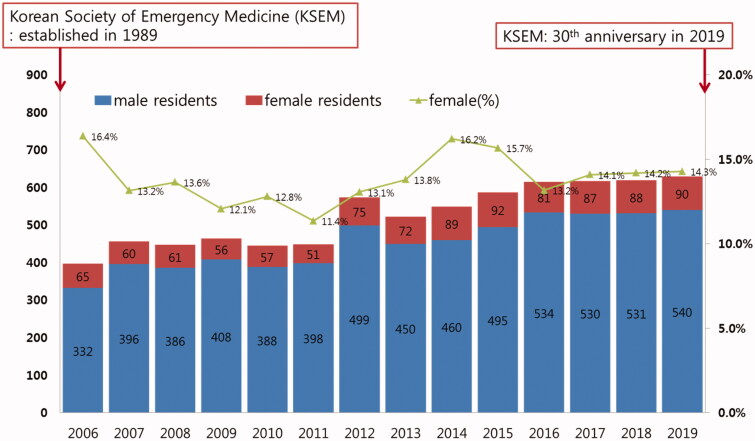
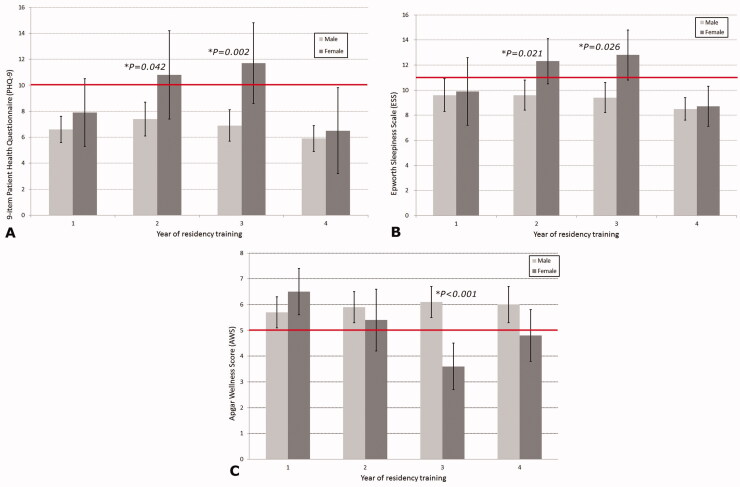
Background Depression and sleep–wake disorders are recognized as one of the major problems among emergency physicians. While depression is more common in females than in males, the associated factors linking depression and sleep–wake disorders in emergency physicians, particularly females, remain unknown.Objective To analyze the prevalence of depression and sleep–wake problems among emergency medicine (EM) residents in South Korea and to identify the gender differences and situations that adversely predispose female residents to mental health problems.Methods We conducted a cross-sectional analysis using the data collected from the 2019 National EM Residents Wellness Survey targeting all of 630 EM residents in South Korea. The survey included variables potentially influencing depression and sleep–wake problems, such as personal characteristics, work-related stress, and extrinsic environment. Information regarding medical conditions, depression, job stress, and sleep deprivation was obtained using the self-administered Patient Health Questionnaire (PHQ-9), the Apgar Wellness Score (AWS), and the Epworth Sleepiness Scale (ESS). We analyzed the data using IBM SPSS Statistics version 25 and MedCalc version 17.Results A total of 384 residents participated in the survey. Overall, 27.5% of the EM residents met the criteria for at least moderate depression and 36.9% of the EM residents had sleep-related problems. We found that difficulty in trading the shift schedule and frequent night shifts was associated with depression (p = .001, p = .005; respectively). Female residents demonstrated an increased risk of depression and sleepiness compared to their male counterparts (odds ratio [OR] 1.95, OR 1.81; respectively). In addition, logistic regression analysis revealed significant differences by gender in depression with regards to flexibility of trading shifts (p = .005), level of training in the emergency medical centre (p = .035), and frequent night shifts (p = .010).Conclusions Approximately, one-third of EM residents report depression and sleep–wake problems, with female residents showing a higher risk than male residents. Several risk factors were identified, and future strategies should be aimed to address these issues to improve the training environment and overall wellbeing of EM residents.KEY MESSAGESThe prevalence of depression and sleep-related problems were, respectively, 1.95 and 1.81 times higher in female residents compared to their male colleagues.The associated risk factors for depression were flexibility of shift trade, level of training in the emergency medical centre, and frequency of night shifts.Improving the training environment and facilities, as well as offering more flexible duty trading options can provide potential opportunities to reduce the risk.
Overview
The claims and statistics of this paper haven’t been checked yet.
Run the check — free, no account needed. It reads the open-access text and checks the sources it cites.
Integrity signals
Registry
Cites
Statistics
Figures
Verification
Claims the paper makes
The claims and statistics of this paper haven’t been checked yet.
Run the check — free, no account needed. It reads the open-access text and checks the sources it cites.
Claims other papers make about this one
Each is checked against this paper’s own text: does it say what the citing paper says it does?
The source backs part of the claim, not all of it — or backs it for a different population, condition or comparison.
In the citing paper
“research has identified long and irregular working hours, irregular sleep schedules (52, 60, 61) and stress (48, 54, 58, 59, 62–64) as main drivers associated with sleep disturbances.”
From Sleep disturbances and psychological well-being among military medical doctors of the Swiss Armed Forces: study protocol, rationale and development of a cross-sectional and longitudinal interventional study (2024) · cites this paper as [63]
Experimental — accuracy not yet measured
Self-check
Percentages, sums and reported differences re-computed from the paper’s own numbers.
The self-check needs the paper’s full text.
Citations
The citation lists haven’t been fetched yet
References 37 · Cited by 18
Research works printed but not linked: 3
- Kim YG, Ryoo HW, Seo KS, et al. Job stress, job satisfaction of emergency residents and its related factors. J Korean Soc Emerg Med. 2008;19(6):749–759.
- Kim JK, Kim YJ, Seo KS, et al. Job stress, job satisfaction and occupational commitment among Korean emergency physicians. J Korean Soc Emerg Med. 2010;21(2):246–258.
- Lee HM, Cho KH, Yang HJ, et al. 2010 Korean society of emergency physician survey. J Korean Soc Emerg Med. 2014;25:238–251.
Metadata
- Authors
- Lee, M. J., Nho, W. Y., Jung, H., Cho, J. W., Seo, J. S., Lee, H. M., Cho, K. H., Kim, Y. J., & Kim, J. K.
- Affiliations
- Kyungpook National University (KR)
- CHA University (KR)
- Dongguk University (KR)
- Kyung Hee University (KR)
- Eulji University (KR)
- Corresponding author
- Nho, Woo Young
- ORCID
- Venue
- Annals of Medicine
- Publisher
- Informa UK Limited
- Published
- 2022-03-29
- Volume
- 54
- Issue
- 1
- Pages
- 846-855
- ISSN
- 0785-3890 (ISSN-L)
- 1365-2060
- PMC
- PMC8967212
- OpenAlex
- W4220755455
- Cited by
- 18
- References
- 37
- Citations by year
- 2026: 2 · 2025: 3 · 2024: 6 · 2023: 3 · 2022: 4
- FWCI
- 4.59
- Type
- journal article
- Language
- en
- Open access
- gold
- doi.org
- Licence
- Locations
- Annals of Medicine (publishedVersion, cc-by)
- PubMed Central (publishedVersion, cc-by)
- PubMed (publishedVersion)
- DOAJ (DOAJ: Directory of Open Access Journals) (submittedVersion, cc-by-sa)
- Topics
- Health Sciences › Health Professions › General Health Professions › Healthcare professionals’ stress and burnout
- Health Sciences › Medicine › Public Health, Environmental and Occupational Health › Occupational Health and Burnout
- Social Sciences › Psychology › Clinical Psychology › COVID-19 and Mental Health
- Keywords
- sleep-wake disorders, emergency medicine residents, female residents, gender differences, night shift work, shift scheduling, sleepiness, resident well-being, medical education, occupational stress, South Korea, residency training
- MeSH terms
- Cross-Sectional Studies, Depression, Emergency Medicine, Female, Humans, Internship and Residency, Male, Sleep, Sleep Wake Disorders, Prevalence, Republic of Korea
About these checks
Registry, retraction, Cites and statistics results are computed, not judged, with one exception: a printed reference that no index lists is read once by a model before it counts as a citation error. Claims are extracted by a model and kept only when their quote appears verbatim in the text; each cited source is then checked, with a model’s help, for whether it says what the claim relies on. Those verdicts can be wrong — read the claim’s quote and the cited source before relying on one.
Statistics and arithmetic are recomputed, not judged.
Confidence bands are shown only for fields calibrated on our annotated test set. None is calibrated yet, so no band is shown.
What counts as a claim ›How we measure confidence ›How we check this ›
Are you an author, or do you see a problem with this page? Request a review
How to cite
Cite CoChat for the checks on this page, and the paper for its own findings.
- This page
- CoChat. (2026). Citation check: High prevalence of depression and sleep-wake disorders among female emergency medicine residents in South Korea. https://app.cochat.ai/papers/10.1080/07853890.2022.2053568
- The paper
- Lee, M. J., Nho, W. Y., Jung, H., Cho, J. W., Seo, J. S., Lee, H. M., Cho, K. H., Kim, Y. J., & Kim, J. K. (2022). High prevalence of depression and sleep-wake disorders among female emergency medicine residents in South Korea. Annals of Medicine. https://doi.org/10.1080/07853890.2022.2053568
