

Toward sustainable household laundry. Washing quality vs. environmental impacts
Open accessThe DOI matches its Crossref record; 33 of the 34 references it cites were found in a registry or an index; none of the 33 sources its claims cite is checked for support yet.
Abstract
We tested the efficacy of standard soil removal and bacterial reduction from textile. A life cycle analysis for different washing cycles was also performed. The results show that washing at 40 °C and 10 g/L was the most effective and resulted in good removal of standard soiling. However, bacteria reduction was highest at 60 °C, 5 g/L and 40 °C, 20 g/L (> 5 log CFU/carrier). With the 40 °C, 10 g/L scenario, we approached the standard requirements for household laundry of ~ 4 log CFU/carrier reduction and good soil removal. Howsoever, life cycle analysis shows that washing at 40 °C and 10 g/L has a higher environmental impact than 60 °C and 5 g/L due to the significant contribution of the detergent. Reducing energy consumption and reformulation of detergents needs to be implemented in the household laundry to achieve sustainable washing without compromising the quality.
Overview
CoChat Summary
TL;DR
Washing at 40 °C with 10 g/L ECE reference detergent gave good standard soil removal and approached the ~4 log CFU/carrier bacterial-reduction benchmark, but its life cycle assessment (LCA) impact was higher than 60 °C with 5 g/L because detergent dominated the burden. Complete bacterial elimination required either 40 °C with 20 g/L or 60 °C with 5 g/L, and increasing detergent beyond 10 g/L impaired soil removal.
Key findings
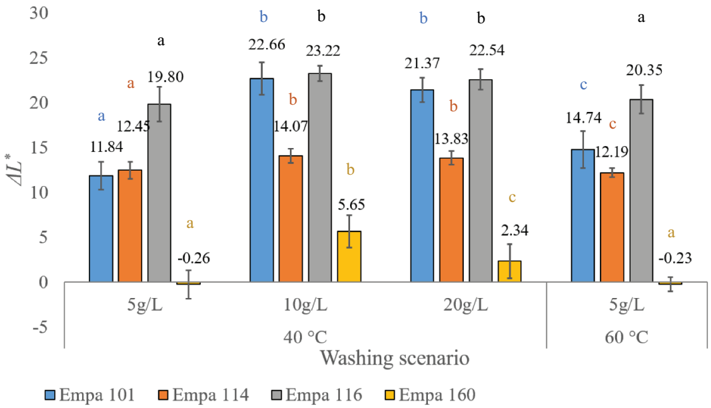
- Soil removal at 40 °C improved with increasing ECE reference detergent up to 10 g/L: doubling from 5 to 10 g/L increased ΔL* for Empa 101, Empa 116, and Empa 160 by 2.3, 1.2, and 5.0 times, respectively; further increase to 20 g/L reduced ΔL* for all standard soils tested. Empa 114 (red wine) remained approximately unchanged because the ECE detergent contained no bleach.
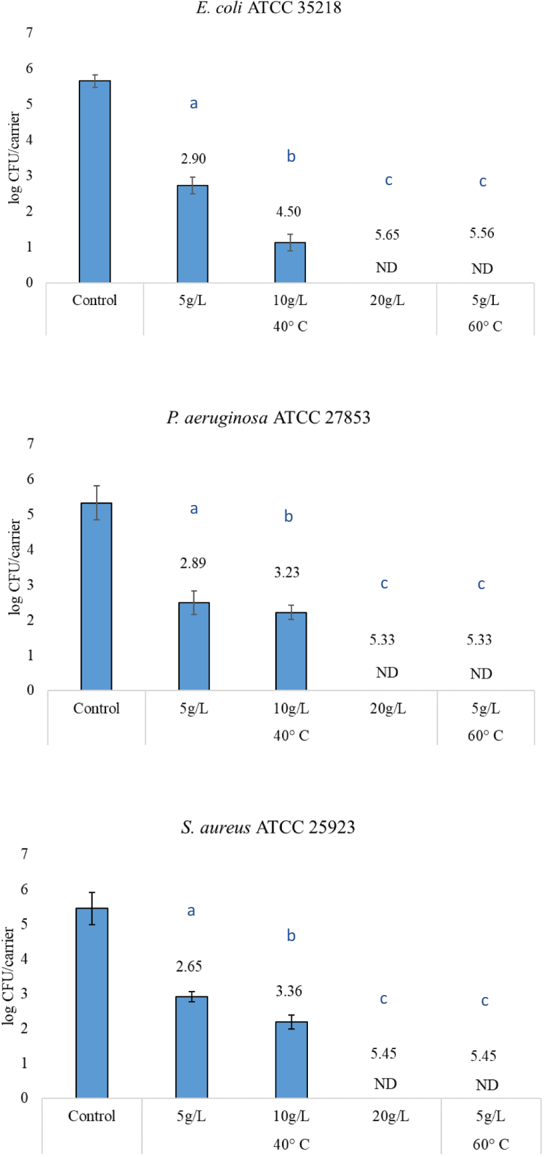
- Bacterial reduction at 40 °C and 5 g/L was about 2.8 log CFU/carrier overall (2.9 log for E. coli and P. aeruginosa, 2.6 log for S. aureus); at 40 °C and 20 g/L, complete elimination (ND) was achieved, comparable to 60 °C and 5 g/L. At 40 °C and 10 g/L, reductions were 4.5 log CFU/carrier for E. coli, 3.4 log for S. aureus, and 3.2 log for P. aeruginosa, so the EN 17658 criterion of ≥4 log CFU/carrier was not fully met for all strains.
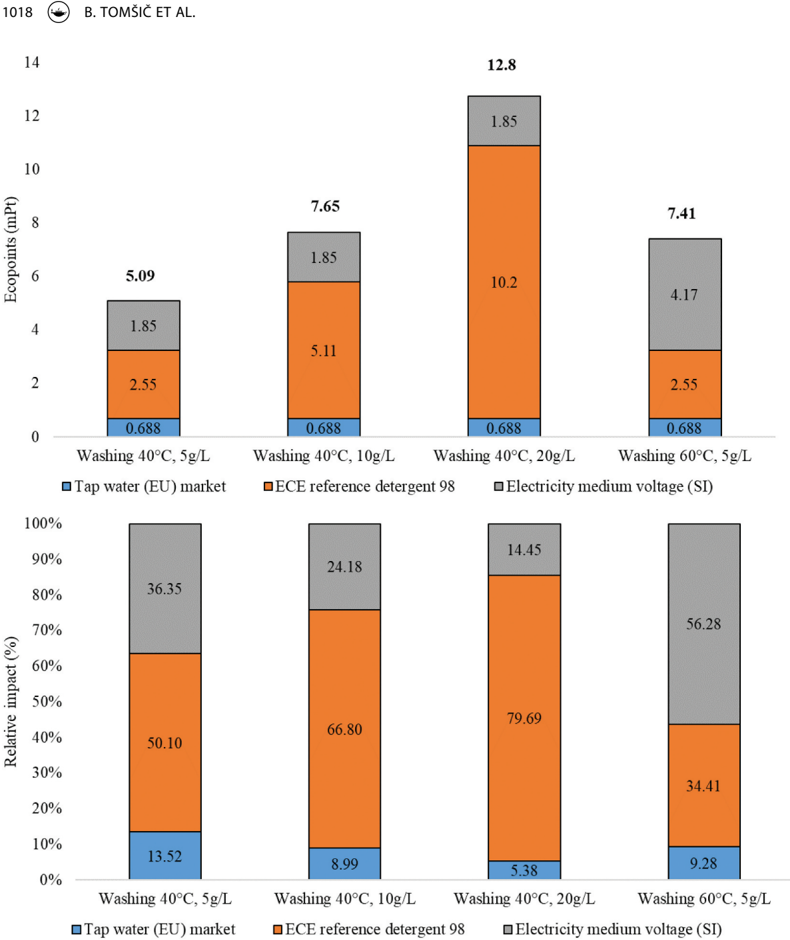
- LCA eco-points were highest for 40 °C/20 g/L (12.8 mPt), followed by 40 °C/10 g/L (7.65 mPt), 60 °C/5 g/L (7.41 mPt), and lowest for 40 °C/5 g/L (5.09 mPt). At 40 °C, detergent contributed 50%, 67%, and 80% of impact at 5, 10, and 20 g/L, respectively; at 60 °C/5 g/L, electricity was the largest contributor (4.17 mPt; 56.28%). Energy use rose from 0.340 kWh at 40 °C to 0.764 kWh at 60 °C.
Methods
- Standard soil removal followed SIST EN 60456:2005 using four Empa soiled fabrics (carbon black/olive oil, red wine, blood/milk/ink, chocolate), washed in a Gorenje/Asko household washing machine with ECE reference detergent 98, 2.45 kg cotton ballast, 10 L wash bath, 30 min, and four scenarios: 40 °C with 5, 10, or 20 g/L and 60 °C with 5 g/L. Soil removal was measured as ΔL* by spectrophotometry.
- Bacterial reduction followed EN 16616:2015 with modifications, using E. coli ATCC 35218, P. aeruginosa ATCC 27853, and S. aureus ATCC 25923 on cotton carriers in defibrinated sheep blood; after washing, cells were neutralised, plated, and expressed as log CFU/carrier. Experiments used five parallel runs and three replicates (N = 15).
- LCA followed ISO 14040:2006 and ISO 14044:2006 using SimaPro 9.4.0.1, Ecoinvent 3.6, and ReCiPe 2016 Endpoint (H) v1.07, expressed in eco-points (mPt); electricity was measured with an EMOS P5821 meter, and the LCA covered the wash cycle without pre-washing or drying. Statistics used R 4.1.1, Shapiro-Wilk, one-way ANOVA, and Duncan test at p < 0.05.
Limitations
- No explicit limitations section is stated in the paper.
- Evident from the text: the LCA was calculated for a wash cycle without pre-washing and drying the laundry, so impacts from drying are excluded.
- Evident from the text: the study used only phosphate-free ECE reference detergent 98 without bleach or enzymes, and only three bacterial strains (E. coli, P. aeruginosa, S. aureus), so findings may not generalise to commercial detergents, additives, or other microorganisms.
Model-written summary. Check it against the paper before relying on it.
Integrity signals
Registry
Cites
Statistics
Figures
Verification
Claims the paper makes
0 Valid · 0 Not valid · 27 Not checked · 54 Own results and interpretations
A result the paper reports from its own data — it cites no other source for it, so there is none to check. The quote shows it is in the paper.
In the paper
“A more detailed analysis shows that for the wash cycles at 40°C, the majority of the environmental impact is for the ECE reference detergent 5 g/L (2.55 mPt; 50%), 10 g/L (5.11 mPt; 67%), 20 g/L (10mPt; 80%).”
§ Toward sustainable household laundry. Washing quality vs. environmental impacts > Results
plainstates an association- Asserted: passes — The authors put it forward as true.
- Checkable: passes — It can be checked against evidence.
- Load-bearing: passes — The paper’s conclusions depend on it.
- Based: passes — The paper gives a reason why it holds.
- Rests on 2 assumptions not shown here.
A result the paper reports from its own data — it cites no other source for it, so there is none to check. The quote shows it is in the paper.
In the paper
“The LCA of our four washing processes shows significant differences in terms of environmental impact and contribution of the processes.”
§ Toward sustainable household laundry. Washing quality vs. environmental impacts > Discussion
plainstates an association- Asserted: passes — The authors put it forward as true.
- Checkable: passes — It can be checked against evidence.
- Load-bearing: passes — The paper’s conclusions depend on it.
- Based: passes — The paper gives a reason why it holds.
A result the paper reports from its own data — it cites no other source for it, so there is none to check. The quote shows it is in the paper.
In the paper
“increasing the ECE standard detergent concentration twice (from 5 g/L to 10 g/L) results in an increase in the ΔL* value of the standard soil Empa 101, Empa 116 and Empa 160 by 2.3, 1.2 and 5.0 times, respectively.”
§ Toward sustainable household laundry. Washing quality vs. environmental impacts > Discussion
plainstates a cause- Asserted: passes — The authors put it forward as true.
- Checkable: passes — It can be checked against evidence.
- Load-bearing: unclear — It is unclear whether the paper’s conclusions depend on it.
- Based: passes — The paper gives a reason why it holds.
A result the paper reports from its own data — it cites no other source for it, so there is none to check. The quote shows it is in the paper.
In the paper
“Figure 2 shows that increasing the concentration of ECE reference detergent 98 at 40°C results in a decreasing number of cells for all bacteria tested (p < 0.05; Table S1).”
§ Toward sustainable household laundry. Washing quality vs. environmental impacts > Results
plainstates a causen = 15 ·- Asserted: passes — The authors put it forward as true.
- Checkable: passes — It can be checked against evidence.
- Load-bearing: passes — The paper’s conclusions depend on it.
- Based: passes — The paper gives a reason why it holds.
- Rests on 3 assumptions not shown here.
A result the paper reports from its own data — it cites no other source for it, so there is none to check. The quote shows it is in the paper.
In the paper
“Howsoever, life cycle analysis shows that washing at 40 °C and 10 g/L has a higher environmental impact than 60 °C and 5 g/L due to the significant contribution of the detergent.”
§ Toward sustainable household laundry. Washing quality vs. environmental impacts > Abstract
plainstates a cause- Asserted: passes — The authors put it forward as true.
- Checkable: passes — It can be checked against evidence.
- Load-bearing: passes — The paper’s conclusions depend on it.
- Based: passes — The paper gives a reason why it holds.
- Rests on 2 assumptions not shown here.
30 more claims
Create a free account to see all 81 claims and to verify the 20 references still open.
- It may state two separate claims as one. 29
- Probably not a substantial claim. 20
Citations
Cites
Global burden of bacterial antimicrobial resistance in 2019: a systematic analysis
Murray, C. J. L., Ikuta, K. S., Sharara, F., Swetschinski, L., Robles Aguilar, G., Gray, A., Han, C., Bisignano, C., Rao, P., Wool, E., et al. (2022) · The Lancet · doi:10.1016/s0140-6736(21)02724-0 · Cited by 16,316
Surfactants and Interfacial Phenomena
Rosen, M. J., & Kunjappu, J. T. (2012) · Wiley eBooks · doi:10.1002/9781118228920 · Cited by 2,535
Sustainability and sustainable development: A review of principles and definitions
Ruggerio, C. A. (2021) · Science of The Total Environment · doi:10.1016/j.scitotenv.2021.147481 · Cited by 825
The environmental impacts of clothing: Evidence from United States and three European countries
Sohn, J. L., Nielsen, K. S., Birkved, M., Joanes, T., & Gwozdz, W. (2021) · Sustainable Production and Consumption · doi:10.1016/j.spc.2021.05.013 · Cited by 105
Dirtying Linen: Re‐evaluating the sustainability of domestic laundry
Yates, L., & Evans, D. M. (2016) · Environmental Policy and Governance · doi:10.1002/eet.1704 · Cited by 86
Honisch, M., Stamminger, R., & Bockmühl, D. P. (2014) · Journal of Applied Microbiology · doi:10.1111/jam.12647 · Cited by 81
Laundry and textile hygiene in healthcare and beyond
Bockmühl, D. P., Schages, J., & Rehberg, L. (2019) · Microbial Cell · doi:10.15698/mic2019.07.682 · Cited by 81
Laundry Hygiene and Odor Control: State of the Science
Abney, S. E., Ijaz, M. K., McKinney, J., & Gerba, C. P. (2021) · Applied and Environmental Microbiology · doi:10.1128/aem.03002-20 · Cited by 59
Riley, K., Williams, J., Owen, L., Shen, J., Davies, A., & Laird, K. (2017) · Journal of Applied Microbiology · doi:10.1111/jam.13485 · Cited by 48
Shahmohammadi, S., Steinmann, Z., Clavreul, J., Hendrickx, H., King, H., & Huijbregts, M. A. J. (2018) · The International Journal of Life Cycle Assessment · doi:10.1007/s11367-017-1426-4 · Cited by 47
A review: life cycle assessment of cotton textiles
CHEN, F., JI, X., CHU, J., XU, P., & WANG, L. (2021) · Industria Textila · doi:10.35530/it.072.01.1797 · Cited by 34
The effect of domestic laundry processes on fungal contamination of socks
Amichai, B., Grunwald, M. H., Davidovici, B., Farhi, R., & Shemer, A. (2013) · International Journal of Dermatology · doi:10.1111/ijd.12167 · Cited by 33
Evaluation of the virucidal performance of domestic laundry procedures
Heinzel, M. A., Kyas, A., Weide, M. R., Breves, R., & Bockmühl, D. P. (2010) · International Journal of Hygiene and Environmental Health · doi:10.1016/j.ijheh.2010.06.003 · Cited by 32
Comparative life-cycle analysis of synthetic detergents and biosurfactants-an overview
Rebello, S., Anoopkumar, A. N., Sindhu, R., Binod, P., Pandey, A., & Aneesh, E. M. (2020) · Refining Biomass Residues for Sustainable Energy and Bioproducts · doi:10.1016/b978-0-12-818996-2.00023-5 · Cited by 32
Li, H., Chen, J., & Jiang, L. (2013) · Environmental Earth Sciences · doi:10.1007/s12665-013-2783-3 · Cited by 31
Morgan, E., Foxon, T. J., & Tallontire, A. (2018) · Journal of Cleaner Production · doi:10.1016/j.jclepro.2018.04.117 · Cited by 31
Cleaning Effect of Household Laundry Detergents at Low Temperatures
Laitala, K., & Jensen, H. M. (2010) · Tenside Surfactants Detergents · doi:10.3139/113.110096 · Cited by 29
Honisch, M., Brands, B., Weide, M. R., Speckmann, H. ‐., Stamminger, R., & Bockmühl, D. P. (2016) · Tenside Surfactants Detergents · doi:10.3139/113.110465 · Cited by 26
A New Method to Evaluate the Antimicrobial Efficacy of Domestic Laundry Detergents
Schages, J., Stamminger, R., & Bockmühl, D. P. (2020) · Journal of Surfactants and Detergents · doi:10.1002/jsde.12401 · Cited by 26
Quantifying pathogen infection risks from household laundry practices
Reynolds, K. A., Verhougstraete, M. P., Mena, K. D., Sattar, S. A., Scott, E. A., & Gerba, C. P. (2022) · Journal of Applied Microbiology · doi:10.1111/jam.15273 · Cited by 24
Maceno, M. M. C., João, S., Voltolini, D. R., & Zattar, I. C. (2022) · Environment Development and Sustainability · doi:10.1007/s10668-022-02388-2 · Cited by 21
Laundry Performance: Effect of Detergent and Additives on Consumer Satisfaction
Ferri, A., Osset, M., Abeliotis, K., Amberg, C., Candan, C., Owens, J., & Stamminger, R. (2016) · Tenside Surfactants Detergents · doi:10.3139/113.110451 · Cited by 18
Chen, K., Jiang, Z., Zhao, J., Liu, R., Li, Q., Li, Y., He, B., Cui, X., Zhang, Y., & Sa, Z. (2020) · Asian Journal of Surgery · doi:10.1016/j.asjsur.2020.11.024 · Cited by 18
Zinn, M., Flemming, H., & Bockmühl, D. P. (2022) · Microorganisms · doi:10.3390/microorganisms10071465 · Cited by 16
Sterilization efficiency of pathogen-contaminated cottons in a laundry machine
Shin, Y., Park, J., & Park, W. (2019) · The Journal of Microbiology · doi:10.1007/s12275-020-9391-1 · Cited by 15
Tavčer, P. F., Brenčič, K., Fink, R., & Tomšič, B. (2021) · Molecules · doi:10.3390/molecules27010195 · Cited by 14
Self-citationDamage Assessment of Bitumen Refineries Using Simapro (LCA) Inventory Data
Morsali, S. (2017) · Journal of Petroleum & Environmental Biotechnology · doi:10.4172/2157-7463.1000317 · Cited by 13
Laundering in Cold Water: Detergent Considerations for Consumers
Cameron, B. A. (2007) · Family and Consumer Sciences Research Journal · doi:10.1177/1077727x07308159 · Cited by 11
Eberle, U., Lange, A., Dewaele, J., & Schowanek, D. (2007) · The International Journal of Life Cycle Assessment · doi:10.1065/lca2006.05.245 · Cited by 11
Monleón-Getino, T., & Cavalleri, M. (2022) · PLoS ONE · doi:10.1371/journal.pone.0269556 · Cited by 9
Influence of Bleach Activators in Removing Different Soils from Cotton Fabric
Tavčer, P. F. (2020) · Fibres and Textiles in Eastern Europe · doi:10.5604/01.3001.0013.9023 · Cited by 5
(2007) · Elsevier eBooks
(2010) · TEKSTİL VE KONFEKSİYON
Johansson, I., & Somasundaran, P. (2007) · Handbook for Cleaning/Decontamination of Surfaces · doi:10.1016/b978-044451664-0/50000-0
Research works printed but not linked: 1
- Drol P, Kert M, Simoncic B, Hladnik A. 2012. Evaluation of the influence of different parameters in removing standard soil from cotton fabric using multi-factorial analysis of variance. Tekstilec. 55(3):194-205.
Cited by
Release of microplastic fibers from synthetic textiles during household washing
Akyıldız, S. H., Fiore, S., Bruno, M., Sezgin, H., Yalçın-Eniş, İ., Yalçın, B., & Bellopede, R. (2024) · Environmental Pollution · doi:10.1016/j.envpol.2024.124455 · Cited by 154
Lacalamita, D., Mongioví, C., & Crini, G. (2024) · Frontiers in Environmental Science · doi:10.3389/fenvs.2024.1387041 · Cited by 84
Characterization and treatment of industrial laundry wastewaters: a review
Crini, G., Lacalamita, D., Lichtfouse, É., Morin‐Crini, N., Liu, C., Wilson, L. D., Picos‐Corrales, L. A., Akhere, M. A., Sotiropoulou, M., Bradu, C., et al. (2024) · Environmental Chemistry Letters · doi:10.1007/s10311-024-01770-y · Cited by 34
El‐Samad, L. M., Arafat, E. A., Nour, O. M., Kheirallah, N. A., Gad, M. E., Hagar, M., El‐Moaty, Z. A., & Hassan, M. A. (2024) · Antioxidants · doi:10.3390/antiox13091039 · Cited by 20
Superhydrophilic self-cleaning fabric with enhanced antibacterial and UV protection properties
Pakdel, E., Daoud, W. A., Kashi, S., Gashti, M. P., & Wang, X. (2024) · Cellulose · doi:10.1007/s10570-024-06346-1 · Cited by 19
Metadata
- Authors
- Tomšič, B., Ofentavšek, L., & Fink, R.
- Affiliations
- University of Ljubljana (SI)
- Corresponding author
- Fink, Rok
- Venue
- International Journal of Environmental Health Research
- Publisher
- Informa UK Limited
- Published
- 2023-03-26
- Volume
- 34
- Issue
- 2
- Pages
- 1011-1022
- ISSN
- 0960-3123 (ISSN-L)
- 1369-1619
- OpenAlex
- W4360976171
- Semantic Scholar
- 15ce2629f2757363d8b4af5a026cc0cb5ff380ed
- Cited by
- 33
- References
- 33
- Citations by year
- 2026: 7 · 2025: 10 · 2024: 13 · 2023: 3
- FWCI
- 3.81
- Type
- journal article
- Language
- en
- Open access
- hybrid
- doi.org
- Licence
- Locations
- International Journal of Environmental Health Research (publishedVersion, cc-by-nc-nd)
- Repository of the University of Ljubljana (University of Ljubljana) (publishedVersion, cc-by-nc-nd)
- PubMed (publishedVersion)
- Funders
- Slovenian Research Agency (Program P2-0213)
- Topics
- Physical Sciences › Environmental Science › Waste Management and Disposal › Wastewater Treatment and Reuse
- Physical Sciences › Environmental Science › Environmental Engineering › Environmental Impact and Sustainability
- Physical Sciences › Environmental Science › Environmental Chemistry › Environmental Chemistry and Analysis
- Keywords
- household laundry, washing temperature, soil removal, bacterial reduction, washing cycles, environmental impact, energy consumption, life cycle assessment
- MeSH terms
- Bacteria, Detergents, Environment, Soil
About these checks
Registry, retraction, Cites and statistics results are computed, not judged, with one exception: a printed reference that no index lists is read once by a model before it counts as a citation error. Claims are extracted by a model and kept only when their quote appears verbatim in the text; each cited source is then checked, with a model’s help, for whether it says what the claim relies on. Those verdicts can be wrong — read the claim’s quote and the cited source before relying on one.
A language model drew the claims from the paper on 2026-11-18, under version 3 of the claim definition (model deepseek-v4.1-flash, prompt extract-v3).
A second model labelled each claim on 2026-11-18 (model jev-1.13-20260917, definition revision gold-guideline-v0.2).
Statistics and arithmetic are recomputed, not judged.
Confidence bands are shown only for fields calibrated on our annotated test set. None is calibrated yet, so no band is shown.
What counts as a claim ›How we measure confidence ›How we check this ›
Are you an author, or do you see a problem with this page? Request a review
Data sources
Bibliographic data: Semantic Scholar, OpenAlex, Crossref.
Contains information from the Semantic Scholar Academic Graph Datasets, made available under the ODC Attribution License (ODC-BY 1.0).
Semantic Scholar’s data is described in: Kinney, R., et al. (2023). The Semantic Scholar Open Data Platform. arXiv:2301.10140.
