

The DOI matches its Crossref record; none of the 101 sources its claims cite is checked for support yet.
‘My how I have walked and worked to get those names’: Petitioning and the Women's Suffrage Movement in the United States, 1908–1920.
Open accessAbstract
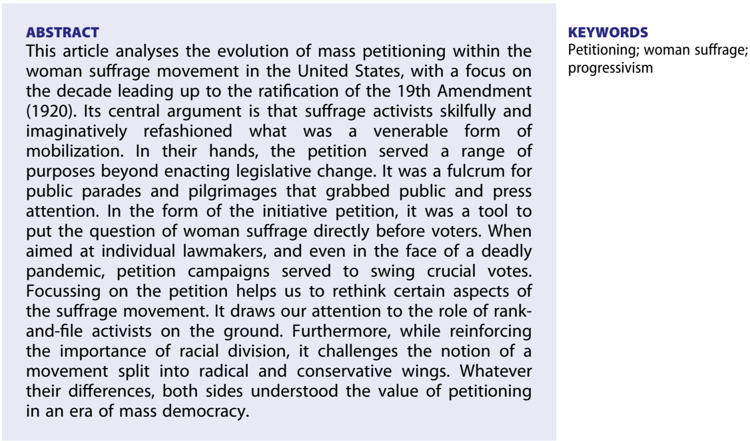
This article analyses the evolution of mass petitioning within the woman suffrage movement in the United States, with a focus on the decade leading up to the ratification of the 19th Amendment (1920). Its central argument is that suffrage activists skilfully and imaginatively refashioned what was a venerable form of mobilization. In their hands, the petition served a range of purposes beyond enacting legislative change. It was a fulcrum for public parades and pilgrimages that grabbed public and press attention. In the form of the initiative petition, it was a tool to put the question of woman suffrage directly before voters. When aimed at individual lawmakers, and even in the face of a deadly pandemic, petition campaigns served to swing crucial votes. Focussing on the petition helps us to rethink certain aspects of the suffrage movement. It draws our attention to the role of rank-and-file activists on the ground. Furthermore, while reinforcing the importance of racial division, it challenges the notion of a movement split into radical and conservative wings. Whatever their differences, both sides understood the value of petitioning in an era of mass democracy.
Overview
AI snapshot
Written from the paper’s full text.
TL;DR
This article analyzes how US woman suffrage activists between 1908 and 1920 refashioned mass petitioning into a versatile tool for publicity, direct democracy, and legislative pressure. It argues that petitioning reveals grassroots activism and cross-faction cooperation between NAWSA and the NWP, while also reinforcing the movement’s racial exclusions.
Key findings
- Carrie Chapman Catt’s 1908 “Big Petition” aimed for a million signatures but gathered just over 400,000; it culminated in an 18 April 1910 procession of seventy-five automobiles to Congress. In 1917, New York suffragists amassed over a million signatures for a state referendum petition, staged the half-mile “Procession of the Petitions,” and the referendum passed by more than 100,000 votes.
- Alice Paul and the NWP used petition pilgrimages: about 500 pilgrims met at Hyattsville, Maryland, on 30 July 1913 and set out in eighty cars; in 1915 Sara Bard Field’s cross-country drive delivered over half a million signatures and won a presidential interview; in 1916 Leda Richberg-Hornsby attempted to bombard the presidential yacht with suffrage petitions by plane.
- Initiative petitions put suffrage directly before voters: from 1898 to 1918 the initiative was added to constitutions of 20 states, with roughly 350 ballot initiatives; suffrage appeared on ballots in Oregon (1906, 1908, 1910, 1912), Oklahoma (1910), Arizona (1912), Missouri, Nebraska, and Ohio (1914). Voters approved suffrage amendments in Arizona and Oregon in 1912 but rejected them in Oklahoma (1910), Ohio, Missouri, and Nebraska (1914); Nebraska courts struck out 12,404 names.
- Race shaped petitioning: Black women petitioned through the NACW and the Women’s Convention of the National Baptist Convention, and in 1913 Ida B. Wells-Barnett joined William Monroe Trotter to present Wilson a protest signed by 20,000. Mainstream leaders pursued a “Southern strategy,” and Alice Paul sought to exclude Black women from the 1913 parade and the petition pilgrimage’s banquet and automobile procession; in 1916 the Franklin County Suffrage Association in Columbus, Ohio, tabled a Black women’s petition seeking desegregation support.
Methods
- Qualitative historical analysis of US suffrage petitioning from 1908 to the ratification of the 19th Amendment in 1920, centered on national, state, and local petition campaigns.
- Draws on archival correspondence and organizational records, including NAWSA and National Woman’s Party papers, Laura Clay and Carrie Chapman Catt papers, newspapers, suffrage periodicals, and an oral history interview with Sara Bard Field.
- Traces petition uses across three arenas: mass publicity parades/pilgrimages, Progressive-era initiative petitions, and targeted pressure on state legislators and US Senators during the federal amendment fight.
Limitations
- The paper states no formal limitations section. It notes that it has not discovered evidence of an ongoing trans-Atlantic dialogue over petition use and calls for a comprehensive trans-Atlantic study of suffrage petitioning.
- The paper itself observes that, unlike initiative petitions, the tangible impact of the final petition campaigns on individual Senate votes was difficult to assess.
- Evident from the text: the analysis is qualitative and archive-based, so rank-and-file canvassers and Black women’s campaigns appear mainly through surviving correspondence and organizational records, which may unevenly capture their perspectives and contributions.
Model-written summary. Check it against the paper before relying on it.
Integrity signals
Registry
Cites
Statistics
Figures


Verification
Claims the paper makes
100 Sources not found · 74 No basis given · 70 Own interpretation · 5 Not checked yet · 5 Own result
The paper states this without a source or data behind it here, so there is nothing to check it against. The quote shows it is in the paper.
In the paper
“When aimed at individual lawmakers, and even in the face of a deadly pandemic, petition campaigns served to swing crucial votes.”
§ 'My how I have walked and worked to get those names': Petitioning and the Women's Suffrage Movement > Abstract
plainstates a cause- Asserted: passes — The authors put it forward as true.
- Checkable: passes — It can be checked against evidence.
- Load-bearing: passes — The paper’s conclusions depend on it.
- Based: unclear — It is unclear why the paper says it holds.
The paper states this without a source or data behind it here, so there is nothing to check it against. The quote shows it is in the paper.
In the paper
“Catt was under no illusion that even a million signatures would force Congress to support a suffrage amendment.”
§ 'My how I have walked and worked to get those names': Petitioning and the Women's Suffrage Movement > Carrie Chapman Catt and the Big Petition
plain- Asserted: passes — The authors put it forward as true.
- Checkable: passes — It can be checked against evidence.
- Load-bearing: passes — The paper’s conclusions depend on it.
- Based: passes — The paper gives a reason why it holds.
A result the paper reports from its own data — it cites no other source for it, so there is none to check. The quote shows it is in the paper.
In the paper
“In July 1913 she wrote to Paul, rejecting her request to join the drive.”
§ 'My how I have walked and worked to get those names': Petitioning and the Women's Suffrage Movement > Alice Paul and the petition pilgrimage
plainSingle case- Asserted: passes — The authors put it forward as true.
- Checkable: passes — It can be checked against evidence.
- Load-bearing: unclear — It is unclear whether the paper’s conclusions depend on it.
- Based: passes — The paper gives a reason why it holds.
The paper states this without a source or data behind it here, so there is nothing to check it against. The quote shows it is in the paper.
In the paper
“But the event made the front page of the New York Times, and over the next years she would push on with larger and more elaborate petition parades.”
§ 'My how I have walked and worked to get those names': Petitioning and the Women's Suffrage Movement > Carrie Chapman Catt and the Big Petition
hedged- Asserted: passes — The authors put it forward as true.
- Checkable: passes — It can be checked against evidence.
- Load-bearing: unclear — It is unclear whether the paper’s conclusions depend on it.
- Based: passes — The paper gives a reason why it holds.
The paper states this without a source or data behind it here, so there is nothing to check it against. The quote shows it is in the paper.
In the paper
“Nevertheless, it was Catt who, at the Buffalo Convention, pushed forward a plan for a mass petition in support of a sixteenth amendment forbidding disenfranchisement on account of sex.”
§ 'My how I have walked and worked to get those names': Petitioning and the Women's Suffrage Movement > Carrie Chapman Catt and the Big Petition
plain- Asserted: passes — The authors put it forward as true.
- Checkable: passes — It can be checked against evidence.
- Load-bearing: passes — The paper’s conclusions depend on it.
- Based: passes — The paper gives a reason why it holds.
The paper states this without a source or data behind it here, so there is nothing to check it against. The quote shows it is in the paper.
In the paper
“The colour line was visible in petition campaigns, too.”
§ 'My how I have walked and worked to get those names': Petitioning and the Women's Suffrage Movement > Introduction
plainstates an association- Asserted: passes — The authors put it forward as true.
- Checkable: passes — It can be checked against evidence.
- Load-bearing: unclear — It is unclear whether the paper’s conclusions depend on it.
- Based: passes — The paper gives a reason why it holds.
In the paper
“Duniway bluntly told Catt that it would be 'unfortunate' to circulate a petition in Oregon, principally because it would interfere with her own plans for a campaign focussed on the state legislature.41”
§ 'My how I have walked and worked to get those names': Petitioning and the Women's Suffrage Movement > Carrie Chapman Catt and the Big Petition
What the sources say
- Not matchedcites [41]
Couldn’t be matched to a paper in Crossref, so it can’t be checked.
plainstates a causeSingle case- Asserted: passes — The authors put it forward as true.
- Checkable: passes — It can be checked against evidence.
- Load-bearing: unclear — It is unclear whether the paper’s conclusions depend on it.
- Based: passes — The paper gives a reason why it holds.
- Not matched
The paper states this without a source or data behind it here, so there is nothing to check it against. The quote shows it is in the paper.
In the paper
“In the decade leading up to the passage of the 19th Amendment, petitioning assumed a central role in a string of state and national campaigns.”
§ 'My how I have walked and worked to get those names': Petitioning and the Women's Suffrage Movement > Carrie Chapman Catt and the Big Petition
plainstates an association- Asserted: passes — The authors put it forward as true.
- Checkable: passes — It can be checked against evidence.
- Load-bearing: passes — The paper’s conclusions depend on it.
- Based: unclear — It is unclear why the paper says it holds.
In the paper
“Suffragists would again take up petitioning in earnest, but this time with a direct eye on, as Catt put it, its 'agitational value.' 39”
§ 'My how I have walked and worked to get those names': Petitioning and the Women's Suffrage Movement > Carrie Chapman Catt and the Big Petition
What the sources say
- Not matchedcites [39]
Couldn’t be matched to a paper in Crossref, so it can’t be checked.
hedged- Asserted: passes — The authors put it forward as true.
- Checkable: passes — It can be checked against evidence.
- Load-bearing: passes — The paper’s conclusions depend on it.
- Based: passes — The paper gives a reason why it holds.
- Not matched
- Probably not a substantial claim. 103
- It may state two separate claims as one. 72
- The quote only partly states this claim. 5
The paper states this without a source or data behind it here, so there is nothing to check it against. The quote shows it is in the paper.
In the paper
“Large floats carried ballot boxes filled with petitions, flanked by women holding placards which proclaimed the number of signers from each voting district.”
§ 'My how I have walked and worked to get those names': Petitioning and the Women's Suffrage Movement > Carrie Chapman Catt and the Big Petition
plain- Asserted: passes — The authors put it forward as true.
- Checkable: passes — It can be checked against evidence.
- Load-bearing: fails — The paper’s conclusions may not depend on it.
- Based: fails — The paper may give no reason why it holds.
Probably not a substantial claim. The paper’s conclusions may not depend on it. The paper may give no reason why it holds. It may state two separate claims as one.
The paper states this without a source or data behind it here, so there is nothing to check it against. The quote shows it is in the paper.
In the paper
“But in certain periods, the momentum was with state rather than national organizers, and the rivalry between them could sabotage a campaign.”
§ 'My how I have walked and worked to get those names': Petitioning and the Women's Suffrage Movement > Introduction
hedgedstates a possible cause- Asserted: passes — The authors put it forward as true.
- Checkable: passes — It can be checked against evidence.
- Load-bearing: passes — The paper’s conclusions depend on it.
- Based: fails — The paper may give no reason why it holds.
Probably not a substantial claim. The paper may give no reason why it holds. It may state two separate claims as one.
The paper states this without a source or data behind it here, so there is nothing to check it against. The quote shows it is in the paper.
In the paper
“The process of revival began at the 1908 NAWSA Convention in Buffalo.”
§ 'My how I have walked and worked to get those names': Petitioning and the Women's Suffrage Movement > Carrie Chapman Catt and the Big Petition
plainstates a cause- Asserted: passes — The authors put it forward as true.
- Checkable: passes — It can be checked against evidence.
- Load-bearing: passes — The paper’s conclusions depend on it.
- Based: fails — The paper may give no reason why it holds.
Probably not a substantial claim. The paper may give no reason why it holds.
The paper states this without a source or data behind it here, so there is nothing to check it against. The quote shows it is in the paper.
In the paper
“Yet both factions saw value in petitioning, and at times set aside their differences to cooperate on joint campaigns.”
§ 'My how I have walked and worked to get those names': Petitioning and the Women's Suffrage Movement > Introduction
plainstates an association- Asserted: passes — The authors put it forward as true.
- Checkable: passes — It can be checked against evidence.
- Load-bearing: passes — The paper’s conclusions depend on it.
- Based: unclear — It is unclear why the paper says it holds.
It may state two separate claims as one.
The paper states this without a source or data behind it here, so there is nothing to check it against. The quote shows it is in the paper.
In the paper
“Some were enthusiastic; others, such as Abigail Scott Duniway in Oregon, were not.”
§ 'My how I have walked and worked to get those names': Petitioning and the Women's Suffrage Movement > Carrie Chapman Catt and the Big Petition
plain- Asserted: passes — The authors put it forward as true.
- Checkable: passes — It can be checked against evidence.
- Load-bearing: unclear — It is unclear whether the paper’s conclusions depend on it.
- Based: passes — The paper gives a reason why it holds.
It may state two separate claims as one.
In the paper
“Just over 400,000 signatures were gathered, an outcome that Alice Stone Blackwell blamed largely on a lack of cooperation from state committees.44”
§ 'My how I have walked and worked to get those names': Petitioning and the Women's Suffrage Movement > Carrie Chapman Catt and the Big Petition
What the sources say
- Not matchedcites [44]
Couldn’t be matched to a paper in Crossref, so it can’t be checked.
plainstates a cause- Asserted: passes — The authors put it forward as true.
- Checkable: passes — It can be checked against evidence.
- Load-bearing: fails — The paper’s conclusions may not depend on it.
- Based: passes — The paper gives a reason why it holds.
Probably not a substantial claim. The paper’s conclusions may not depend on it.
- Not matched
In the paper
“Suffragists in Sweden had recently gathered the signatures of 100000 men and women.She saw no reason that the United States, with eighteen times the population of Sweden, could not reach the million mark.31”
§ 'My how I have walked and worked to get those names': Petitioning and the Women's Suffrage Movement > Carrie Chapman Catt and the Big Petition
What the sources say
- Not matchedcites [31]
Couldn’t be matched to a paper in Crossref, so it can’t be checked.
plain- Asserted: passes — The authors put it forward as true.
- Checkable: passes — It can be checked against evidence.
- Load-bearing: fails — The paper’s conclusions may not depend on it.
- Based: passes — The paper gives a reason why it holds.
Probably not a substantial claim. The paper’s conclusions may not depend on it.
- Not matched
The paper states this without a source or data behind it here, so there is nothing to check it against. The quote shows it is in the paper.
In the paper
“Suffragists complained that their petitions were swiftly 'pigeon-holed,' which is to say dispatched to a committee and left to languish.”
§ 'My how I have walked and worked to get those names': Petitioning and the Women's Suffrage Movement > The era of disenchantment
plain- Asserted: passes — The authors put it forward as true.
- Checkable: passes — It can be checked against evidence.
- Load-bearing: fails — The paper’s conclusions may not depend on it.
- Based: passes — The paper gives a reason why it holds.
Probably not a substantial claim. The paper’s conclusions may not depend on it.
In the paper
“Headed by a short, plain text sitting atop a long list of signers, this model of petition could be printed cheaply and in huge numbers and, aided by advancements in transportation and communications, pushed into virtually every corner of the nation.”
§ 'My how I have walked and worked to get those names': Petitioning and the Women's Suffrage Movement > The era of disenchantment
What the sources say
- Not matchedcites [12]
Couldn’t be matched to a paper in Crossref, so it can’t be checked.
hedgedstates a cause- Asserted: passes — The authors put it forward as true.
- Checkable: passes — It can be checked against evidence.
- Load-bearing: unclear — It is unclear whether the paper’s conclusions depend on it.
- Based: passes — The paper gives a reason why it holds.
It may state two separate claims as one.
- Not matched
The paper states this without a source or data behind it here, so there is nothing to check it against. The quote shows it is in the paper.
In the paper
“Harriet Taylor Treadwell was the President of the Chicago Political Equality League.”
§ 'My how I have walked and worked to get those names': Petitioning and the Women's Suffrage Movement > Alice Paul and the petition pilgrimage
plain- Asserted: passes — The authors put it forward as true.
- Checkable: passes — It can be checked against evidence.
- Load-bearing: fails — The paper’s conclusions may not depend on it.
- Based: passes — The paper gives a reason why it holds.
Probably not a substantial claim. The paper’s conclusions may not depend on it.
In the paper
“There were so many petitions that Mary Burt, the President of the WCTU, had her batch wheeled down the aisle of the convention hall in a wheelbarrow.14”
§ 'My how I have walked and worked to get those names': Petitioning and the Women's Suffrage Movement > The era of disenchantment
What the sources say
- Not matchedcites [14]
Couldn’t be matched to a paper in Crossref, so it can’t be checked.
plainstates a causeSingle case- Asserted: passes — The authors put it forward as true.
- Checkable: passes — It can be checked against evidence.
- Load-bearing: fails — The paper’s conclusions may not depend on it.
- Based: passes — The paper gives a reason why it holds.
Probably not a substantial claim. The paper’s conclusions may not depend on it.
- Not matched
In the paper
“It was now 'familiar and frequent' and had been robbed of its 'dignity and importance.' 13”
§ 'My how I have walked and worked to get those names': Petitioning and the Women's Suffrage Movement > The era of disenchantment
What the sources say
- Not matchedcites [13]
Couldn’t be matched to a paper in Crossref, so it can’t be checked.
plainstates a cause- Asserted: passes — The authors put it forward as true.
- Checkable: passes — It can be checked against evidence.
- Load-bearing: passes — The paper’s conclusions depend on it.
- Based: passes — The paper gives a reason why it holds.
It may state two separate claims as one.
- Not matched
The paper states this without a source or data behind it here, so there is nothing to check it against. The quote shows it is in the paper.
In the paper
“The result was a blizzard of petitions in support of a range of causes, including prohibition, immigration restriction, Sabbath laws and the eight-hour working day.”
§ 'My how I have walked and worked to get those names': Petitioning and the Women's Suffrage Movement > The era of disenchantment
plainstates a cause- Asserted: passes — The authors put it forward as true.
- Checkable: passes — It can be checked against evidence.
- Load-bearing: fails — The paper’s conclusions may not depend on it.
- Based: passes — The paper gives a reason why it holds.
Probably not a substantial claim. The paper’s conclusions may not depend on it.
In the paper
“Hedenberg, who insisted on keeping hold of the petitions, first delayed their presentation and then had them all burned, a fitting coda to years of frustration.28”
§ 'My how I have walked and worked to get those names': Petitioning and the Women's Suffrage Movement > The era of disenchantment
What the sources say
- Not matchedcites [28]
Couldn’t be matched to a paper in Crossref, so it can’t be checked.
plainSingle case- Asserted: passes — The authors put it forward as true.
- Checkable: passes — It can be checked against evidence.
- Load-bearing: unclear — It is unclear whether the paper’s conclusions depend on it.
- Based: passes — The paper gives a reason why it holds.
It may state two separate claims as one.
- Not matched
The paper states this without a source or data behind it here, so there is nothing to check it against. The quote shows it is in the paper.
In the paper
“As leader, Paul adopted an even more aggressive strategy to force President Wilson to support a federal suffrage amendment, urging voters to turn against the Democratic Party, and from 1917 picketing the White House.”
§ 'My how I have walked and worked to get those names': Petitioning and the Women's Suffrage Movement > Alice Paul and the petition pilgrimage
plainstates a cause- Asserted: passes — The authors put it forward as true.
- Checkable: passes — It can be checked against evidence.
- Load-bearing: fails — The paper’s conclusions may not depend on it.
- Based: passes — The paper gives a reason why it holds.
Probably not a substantial claim. The paper’s conclusions may not depend on it. It may state two separate claims as one.
The paper states this without a source or data behind it here, so there is nothing to check it against. The quote shows it is in the paper.
In the paper
“In 1876 there were calls for universal suffrage backed by more than 10,000 names, followed by another mass campaign two years later.”
§ 'My how I have walked and worked to get those names': Petitioning and the Women's Suffrage Movement > The era of disenchantment
plain- Asserted: passes — The authors put it forward as true.
- Checkable: passes — It can be checked against evidence.
- Load-bearing: fails — The paper’s conclusions may not depend on it.
- Based: fails — The paper may give no reason why it holds.
Probably not a substantial claim. The paper’s conclusions may not depend on it. The paper may give no reason why it holds. It may state two separate claims as one.
The paper states this without a source or data behind it here, so there is nothing to check it against. The quote shows it is in the paper.
In the paper
“Congress did not, as Catt anticipated, vote in favour of a suffrage amendment.”
§ 'My how I have walked and worked to get those names': Petitioning and the Women's Suffrage Movement > Carrie Chapman Catt and the Big Petition
plain- Asserted: passes — The authors put it forward as true.
- Checkable: passes — It can be checked against evidence.
- Load-bearing: fails — The paper’s conclusions may not depend on it.
- Based: passes — The paper gives a reason why it holds.
Probably not a substantial claim. The paper’s conclusions may not depend on it.
The paper states this without a source or data behind it here, so there is nothing to check it against. The quote shows it is in the paper.
In the paper
“Paul and her supporters then split from NAWSA and formed the National Woman's Party (NWP).”
§ 'My how I have walked and worked to get those names': Petitioning and the Women's Suffrage Movement > Alice Paul and the petition pilgrimage
plain- Asserted: passes — The authors put it forward as true.
- Checkable: passes — It can be checked against evidence.
- Load-bearing: fails — The paper’s conclusions may not depend on it.
- Based: passes — The paper gives a reason why it holds.
Probably not a substantial claim. The paper’s conclusions may not depend on it. It may state two separate claims as one.
In the paper
“The drama overshadowed Wilson's inauguration, and a subsequent Congressional inquiry into the failure of police to protect the marchers kept the issue on the front pages.48”
§ 'My how I have walked and worked to get those names': Petitioning and the Women's Suffrage Movement > Alice Paul and the petition pilgrimage
What the sources say
- Not matchedcites [48]
Couldn’t be matched to a paper in Crossref, so it can’t be checked.
plainstates a cause- Asserted: passes — The authors put it forward as true.
- Checkable: passes — It can be checked against evidence.
- Load-bearing: unclear — It is unclear whether the paper’s conclusions depend on it.
- Based: passes — The paper gives a reason why it holds.
It may state two separate claims as one.
- Not matched
The paper states this without a source or data behind it here, so there is nothing to check it against. The quote shows it is in the paper.
In the paper
“The result was the 'Procession of the Petitions' which stretched for half a mile and which transformed the once humble petition into a striking visual pageant of democracy.”
§ 'My how I have walked and worked to get those names': Petitioning and the Women's Suffrage Movement > Carrie Chapman Catt and the Big Petition
plainstates a causeSingle case- Asserted: passes — The authors put it forward as true.
- Checkable: passes — It can be checked against evidence.
- Load-bearing: unclear — It is unclear whether the paper’s conclusions depend on it.
- Based: passes — The paper gives a reason why it holds.
It may state two separate claims as one.
The paper states this without a source or data behind it here, so there is nothing to check it against. The quote shows it is in the paper.
In the paper
“At first glance, a survey of mass petitioning at the dawn of the twentieth Century supports Carpenter's narrative of decline.”
§ 'My how I have walked and worked to get those names': Petitioning and the Women's Suffrage Movement > The era of disenchantment
hedgedstates an association- Asserted: passes — The authors put it forward as true.
- Checkable: passes — It can be checked against evidence.
- Load-bearing: fails — The paper’s conclusions may not depend on it.
- Based: fails — The paper may give no reason why it holds.
Probably not a substantial claim. The paper’s conclusions may not depend on it. The paper may give no reason why it holds.
The paper states this without a source or data behind it here, so there is nothing to check it against. The quote shows it is in the paper.
In the paper
“Yet the fate of what became known as the Hedenberg Memorial provided more disappointment.”
§ 'My how I have walked and worked to get those names': Petitioning and the Women's Suffrage Movement > The era of disenchantment
plain- Asserted: passes — The authors put it forward as true.
- Checkable: passes — It can be checked against evidence.
- Load-bearing: fails — The paper’s conclusions may not depend on it.
- Based: fails — The paper may give no reason why it holds.
Probably not a substantial claim. The paper’s conclusions may not depend on it. The paper may give no reason why it holds.
The paper states this without a source or data behind it here, so there is nothing to check it against. The quote shows it is in the paper.
In the paper
“As signatory lists ballooned, accusations of fraud became commonplace.”
§ 'My how I have walked and worked to get those names': Petitioning and the Women's Suffrage Movement > The era of disenchantment
plainstates an association- Asserted: passes — The authors put it forward as true.
- Checkable: passes — It can be checked against evidence.
- Load-bearing: fails — The paper’s conclusions may not depend on it.
- Based: fails — The paper may give no reason why it holds.
Probably not a substantial claim. The paper’s conclusions may not depend on it. The paper may give no reason why it holds.
The paper states this without a source or data behind it here, so there is nothing to check it against. The quote shows it is in the paper.
In the paper
“Not long after the marchers set out, huge crowds blocked the route, and the women were insulted, spat on and physically attacked.”
§ 'My how I have walked and worked to get those names': Petitioning and the Women's Suffrage Movement > Alice Paul and the petition pilgrimage
plain- Asserted: passes — The authors put it forward as true.
- Checkable: passes — It can be checked against evidence.
- Load-bearing: fails — The paper’s conclusions may not depend on it.
- Based: fails — The paper may give no reason why it holds.
Probably not a substantial claim. The paper’s conclusions may not depend on it. The paper may give no reason why it holds. It may state two separate claims as one.
The paper states this without a source or data behind it here, so there is nothing to check it against. The quote shows it is in the paper.
In the paper
“Canvassers recorded the rudeness, hostility and idiocy which they encountered.”
§ 'My how I have walked and worked to get those names': Petitioning and the Women's Suffrage Movement > The era of disenchantment
plain- Asserted: passes — The authors put it forward as true.
- Checkable: passes — It can be checked against evidence.
- Load-bearing: fails — The paper’s conclusions may not depend on it.
- Based: passes — The paper gives a reason why it holds.
Probably not a substantial claim. The paper’s conclusions may not depend on it.
The paper states this without a source or data behind it here, so there is nothing to check it against. The quote shows it is in the paper.
In the paper
“On several occasions the opportunity to build a multiracial mobilization was spurned by leading suffragists.”
§ 'My how I have walked and worked to get those names': Petitioning and the Women's Suffrage Movement > Introduction
plain- Asserted: passes — The authors put it forward as true.
- Checkable: passes — It can be checked against evidence.
- Load-bearing: fails — The paper’s conclusions may not depend on it.
- Based: fails — The paper may give no reason why it holds.
Probably not a substantial claim. The paper’s conclusions may not depend on it. The paper may give no reason why it holds.
The paper states this without a source or data behind it here, so there is nothing to check it against. The quote shows it is in the paper.
In the paper
“In 1894, for example, Susan B. Anthony led a campaign to force the New York Constitutional Convention to remove the word 'male' from the Constitution.”
§ 'My how I have walked and worked to get those names': Petitioning and the Women's Suffrage Movement > The era of disenchantment
plainstates a cause- Asserted: passes — The authors put it forward as true.
- Checkable: passes — It can be checked against evidence.
- Load-bearing: fails — The paper’s conclusions may not depend on it.
- Based: passes — The paper gives a reason why it holds.
Probably not a substantial claim. The paper’s conclusions may not depend on it.
The paper states this without a source or data behind it here, so there is nothing to check it against. The quote shows it is in the paper.
In the paper
“Once there, women presented representatives with bundles of petitions tied neatly in yellow ribbons, and cheered from the Senate gallery as Robert M. La Follette gave a rousing speech in support.”
§ 'My how I have walked and worked to get those names': Petitioning and the Women's Suffrage Movement > Carrie Chapman Catt and the Big Petition
plain- Asserted: passes — The authors put it forward as true.
- Checkable: passes — It can be checked against evidence.
- Load-bearing: fails — The paper’s conclusions may not depend on it.
- Based: passes — The paper gives a reason why it holds.
Probably not a substantial claim. The paper’s conclusions may not depend on it. It may state two separate claims as one.
The paper states this without a source or data behind it here, so there is nothing to check it against. The quote shows it is in the paper.
In the paper
“On 3 March 1913, Paul organized a suffrage procession in Washington D.C. on the day before President Woodrow Wilson's inauguration.”
§ 'My how I have walked and worked to get those names': Petitioning and the Women's Suffrage Movement > Alice Paul and the petition pilgrimage
plain- Asserted: passes — The authors put it forward as true.
- Checkable: passes — It can be checked against evidence.
- Load-bearing: fails — The paper’s conclusions may not depend on it.
- Based: passes — The paper gives a reason why it holds.
Probably not a substantial claim. The paper’s conclusions may not depend on it.
A result the paper reports from its own data — it cites no other source for it, so there is none to check. The quote shows it is in the paper.
In the paper
“This followed a startling offer by a wealthy Chicago businessman, John Wesley Hedenberg, to cover all the expenses, as well as to provide an introduction to the leaders of workingmen's associations.”
§ 'My how I have walked and worked to get those names': Petitioning and the Women's Suffrage Movement > The era of disenchantment
plain- Asserted: passes — The authors put it forward as true.
- Checkable: passes — It can be checked against evidence.
- Load-bearing: fails — The paper’s conclusions may not depend on it.
- Based: passes — The paper gives a reason why it holds.
Probably not a substantial claim. The paper’s conclusions may not depend on it. It may state two separate claims as one.
In the paper
“The President insisted on the 'absolute valuelessness of such a petition.'32”
§ 'My how I have walked and worked to get those names': Petitioning and the Women's Suffrage Movement > Carrie Chapman Catt and the Big Petition
What the sources say
- Not matchedcites [32]
Couldn’t be matched to a paper in Crossref, so it can’t be checked.
plain- Asserted: passes — The authors put it forward as true.
- Checkable: passes — It can be checked against evidence.
- Load-bearing: fails — The paper’s conclusions may not depend on it.
- Based: passes — The paper gives a reason why it holds.
Probably not a substantial claim. The paper’s conclusions may not depend on it.
- Not matched
A result the paper reports from its own data — it cites no other source for it, so there is none to check. The quote shows it is in the paper.
In the paper
“To win over the recalcitrant Senators, activists gathered huge petitions from their constituents.One of their targets was William Borah of Idaho.”
§ 'My how I have walked and worked to get those names': Petitioning and the Women's Suffrage Movement > The initiative petition
plainstates a cause- Asserted: passes — The authors put it forward as true.
- Checkable: passes — It can be checked against evidence.
- Load-bearing: passes — The paper’s conclusions depend on it.
- Based: passes — The paper gives a reason why it holds.
It may state two separate claims as one. The quote only partly states this claim.
In the paper
“The petition also called for the effective enforcement of the fourteenth and fifteenth amendments to the Constitution, which guaranteed the rights of citizenship and of voting respectively, and demanded that the government provide 'redress' for the acts of discrimination which 'deprive us of common opportunities and also subject us to all kinds of injustice and indignities.'64”
§ 'My how I have walked and worked to get those names': Petitioning and the Women's Suffrage Movement > Suffrage petitioning and race
What the sources say
- Not matchedcites [64]
Couldn’t be matched to a paper in Crossref, so it can’t be checked.
plain- Asserted: passes — The authors put it forward as true.
- Checkable: passes — It can be checked against evidence.
- Load-bearing: unclear — It is unclear whether the paper’s conclusions depend on it.
- Based: passes — The paper gives a reason why it holds.
It may state two separate claims as one.
- Not matched
In the paper
“On 30 July around 500 pilgrims met at the assembly point at Hyattsville, Maryland.Following a banquet and a speech by the mayor, they set out for the Capitol in a procession of eighty cars adorned with yellow flags.58 Cheering crowds followed their progress which culminated in the presentation of their petitions to Senators.”
§ 'My how I have walked and worked to get those names': Petitioning and the Women's Suffrage Movement > Alice Paul and the petition pilgrimage
What the sources say
- Not matchedcites [58]
Couldn’t be matched to a paper in Crossref, so it can’t be checked.
plain- Asserted: passes — The authors put it forward as true.
- Checkable: passes — It can be checked against evidence.
- Load-bearing: unclear — It is unclear whether the paper’s conclusions depend on it.
- Based: passes — The paper gives a reason why it holds.
It may state two separate claims as one.
- Not matched
In the paper
“In Oregon, which was an early and enthusiastic adopter of direct democracy, votes for women got on the ballot in 1906, 1908, 1910 and 1912.Suffrage appeared on the ballot as well in Oklahoma (1910), Arizona (1912), Missouri (1914) Nebraska (1914) and Ohio (1914).”
§ 'My how I have walked and worked to get those names': Petitioning and the Women's Suffrage Movement > The initiative petition
What the sources say
- Not matchedcites [77]
Couldn’t be matched to a paper in Crossref, so it can’t be checked.
plain- Asserted: passes — The authors put it forward as true.
- Checkable: passes — It can be checked against evidence.
- Load-bearing: unclear — It is unclear whether the paper’s conclusions depend on it.
- Based: passes — The paper gives a reason why it holds.
It may state two separate claims as one.
- Not matched
In the paper
“It was women 'actually taking these trips,' she wrote, that would 'really affect public opinion.'”
§ 'My how I have walked and worked to get those names': Petitioning and the Women's Suffrage Movement > Alice Paul and the petition pilgrimage
What the sources say
- Not matchedcites [57]
Couldn’t be matched to a paper in Crossref, so it can’t be checked.
hedgedstates a cause- Asserted: passes — The authors put it forward as true.
- Checkable: passes — It can be checked against evidence.
- Load-bearing: passes — The paper’s conclusions depend on it.
- Based: passes — The paper gives a reason why it holds.
Probably not a substantial claim.
- Not matched
In the paper
“A federal woman suffrage amendment, it concluded, 'will IN NO WAY complicate the race problem.' 67”
§ 'My how I have walked and worked to get those names': Petitioning and the Women's Suffrage Movement > Suffrage petitioning and race
What the sources say
- Not matchedcites [67]
Couldn’t be matched to a paper in Crossref, so it can’t be checked.
boosted- Asserted: passes — The authors put it forward as true.
- Checkable: passes — It can be checked against evidence.
- Load-bearing: fails — The paper’s conclusions may not depend on it.
- Based: passes — The paper gives a reason why it holds.
Probably not a substantial claim. The paper’s conclusions may not depend on it.
- Not matched
In the paper
“Now they had a means of bypassing this obstacle and taking their case to the people; the initiative was, as NAWSA affirmed in 1905, 'a potent factor in the progress of true democracy.'76”
§ 'My how I have walked and worked to get those names': Petitioning and the Women's Suffrage Movement > The initiative petition
What the sources say
- Not matchedcites [76]
Couldn’t be matched to a paper in Crossref, so it can’t be checked.
plainstates a cause- Asserted: passes — The authors put it forward as true.
- Checkable: passes — It can be checked against evidence.
- Load-bearing: passes — The paper’s conclusions depend on it.
- Based: passes — The paper gives a reason why it holds.
It may state two separate claims as one.
- Not matched
In the paper
“In 1917, the Nebraska legislature passed a limited suffrage act.The move angered anti-suffrage activists, who responded by petitioning for a referendum on the law at the next state election.When the petitions were submitted, suffragists undertook a long, painstaking and expensive audit of the signers.They found a shocking level of fraud.Several of the purported signers were dead; others stated”
§ 'My how I have walked and worked to get those names': Petitioning and the Women's Suffrage Movement > The initiative petition
What the sources say
- Not matchedcites [83]
Couldn’t be matched to a paper in Crossref, so it can’t be checked.
plainSingle case- Asserted: passes — The authors put it forward as true.
- Checkable: passes — It can be checked against evidence.
- Load-bearing: passes — The paper’s conclusions depend on it.
- Based: passes — The paper gives a reason why it holds.
It may state two separate claims as one. The quote only partly states this claim.
- Not matched
In the paper
“But at the moment she wrote her letter, Paul had already made clear that Black women were not welcome at the event which would seal her reputation as a militant, the March 3 parade.As several scholars have documented, Paul was determined that Black women would not take part.'We must have a white procession, or a negro procession, or no procession at all,' she wrote.69”
§ 'My how I have walked and worked to get those names': Petitioning and the Women's Suffrage Movement > Suffrage petitioning and race
What the sources say
- Not matchedcites [69]
Couldn’t be matched to a paper in Crossref, so it can’t be checked.
boosted- Asserted: passes — The authors put it forward as true.
- Checkable: passes — It can be checked against evidence.
- Load-bearing: passes — The paper’s conclusions depend on it.
- Based: passes — The paper gives a reason why it holds.
It may state two separate claims as one.
- Not matched
In the paper
“On 2 December 1916, pilot Leda Richberg-Hornsby and her passenger Ida Blair took to the air on an extraordinary mission: to bombard the Presidential yacht with suffrage petitions.Unfortunately, high winds forced the plane down in a swamp before they could deliver their message.”
§ 'My how I have walked and worked to get those names': Petitioning and the Women's Suffrage Movement > Alice Paul and the petition pilgrimage
What the sources say
- Not matchedcites [61]
Couldn’t be matched to a paper in Crossref, so it can’t be checked.
plainstates a causeSingle case- Asserted: passes — The authors put it forward as true.
- Checkable: passes — It can be checked against evidence.
- Load-bearing: unclear — It is unclear whether the paper’s conclusions depend on it.
- Based: passes — The paper gives a reason why it holds.
It may state two separate claims as one.
- Not matched
In the paper
“In a rousing call to arms issued in July, Carrie Chapman Catt, now president of NAWSA, declared that the fate of the amendment hinged upon 'the extent and success of the petition work.' 89”
§ 'My how I have walked and worked to get those names': Petitioning and the Women's Suffrage Movement > The initiative petition
What the sources say
- Not matchedcites [89]
Couldn’t be matched to a paper in Crossref, so it can’t be checked.
plainstates a cause- Asserted: passes — The authors put it forward as true.
- Checkable: passes — It can be checked against evidence.
- Load-bearing: fails — The paper’s conclusions may not depend on it.
- Based: passes — The paper gives a reason why it holds.
Probably not a substantial claim. The paper’s conclusions may not depend on it.
- Not matched
None of the sources cited for this claim could be matched to a paper in Crossref, so there is nothing to check it against.
In the paper
“Black women were engaged in their own crusade for equal rights.As Rosalyn Terborg-Penn notes, petitioning was seen as a vital tool by the two main organizations, the National Association of Colored Women (NACW) and the Women's Convention of the National Baptist Convention.62”
§ 'My how I have walked and worked to get those names': Petitioning and the Women's Suffrage Movement > Suffrage petitioning and race
What the sources say
- Not matchedcites Rosalyn Terborg-Penn
Couldn’t be matched to a paper in Crossref, so it can’t be checked.
- Not matchedcites [62]
Couldn’t be matched to a paper in Crossref, so it can’t be checked.
plain- Asserted: passes — The authors put it forward as true.
- Checkable: passes — It can be checked against evidence.
- Load-bearing: unclear — It is unclear whether the paper’s conclusions depend on it.
- Based: passes — The paper gives a reason why it holds.
It may state two separate claims as one.
- Not matched
In the paper
“Rather than begin with the Senate, the next link in the ratification chain, Catt directed activists to petition state legislatures.This was, she argued, 'a stone aimed at three birds.'91 First, it would counter the argument, parroted by so many hostile Senators, that women did not want the vote.Second, winning the support of state legislatures would exert enormous pressure on the Senate, the rep”
§ 'My how I have walked and worked to get those names': Petitioning and the Women's Suffrage Movement > The initiative petition
What the sources say
- Not matchedcites [91]
Couldn’t be matched to a paper in Crossref, so it can’t be checked.
plainstates a cause- Asserted: passes — The authors put it forward as true.
- Checkable: passes — It can be checked against evidence.
- Load-bearing: passes — The paper’s conclusions depend on it.
- Based: passes — The paper gives a reason why it holds.
It may state two separate claims as one.
- Not matched
In the paper
“When, after much delay, it finally voted on 1 October 1918, the measure fell just short of the required majority.This was despite President Wilson, now a supporter of woman suffrage, directly addressing the Senate and calling for its support.A second vote in February 1919 also failed.”
§ 'My how I have walked and worked to get those names': Petitioning and the Women's Suffrage Movement > The initiative petition
What the sources say
- Not matchedcites [100]
Couldn’t be matched to a paper in Crossref, so it can’t be checked.
plain- Asserted: passes — The authors put it forward as true.
- Checkable: passes — It can be checked against evidence.
- Load-bearing: passes — The paper’s conclusions depend on it.
- Based: passes — The paper gives a reason why it holds.
It may state two separate claims as one.
- Not matched
A result the paper reports from its own data — it cites no other source for it, so there is none to check. The quote shows it is in the paper.
In the paper
“'I have no heart,' she informed Paul, 'in asking women to carry petitions and that I will not ask them to do.'”
§ 'My how I have walked and worked to get those names': Petitioning and the Women's Suffrage Movement > Alice Paul and the petition pilgrimage
plainSingle case- Asserted: passes — The authors put it forward as true.
- Checkable: passes — It can be checked against evidence.
- Load-bearing: fails — The paper’s conclusions may not depend on it.
- Based: passes — The paper gives a reason why it holds.
Probably not a substantial claim. The paper’s conclusions may not depend on it. It may state two separate claims as one.
The paper states this without a source or data behind it here, so there is nothing to check it against. The quote shows it is in the paper.
In the paper
“Since it triggered a ballot proposal, the petition had to conform to a strict set of rules, and every name could in theory be audited by sometimes hostile officials.”
§ 'My how I have walked and worked to get those names': Petitioning and the Women's Suffrage Movement > The initiative petition
hedgedstates a cause- Asserted: passes — The authors put it forward as true.
- Checkable: passes — It can be checked against evidence.
- Load-bearing: passes — The paper’s conclusions depend on it.
- Based: passes — The paper gives a reason why it holds.
It may state two separate claims as one.
In the paper
“Interviewed more than three decades later, Field recalled a procession of 40 cars escorting them to a public meeting in Detroit, where more than 4000 prominent men and women added their names.59”
§ 'My how I have walked and worked to get those names': Petitioning and the Women's Suffrage Movement > Alice Paul and the petition pilgrimage
What the sources say
- Not matchedcites [59]
Couldn’t be matched to a paper in Crossref, so it can’t be checked.
plainSingle case- Asserted: passes — The authors put it forward as true.
- Checkable: passes — It can be checked against evidence.
- Load-bearing: unclear — It is unclear whether the paper’s conclusions depend on it.
- Based: passes — The paper gives a reason why it holds.
It may state two separate claims as one.
- Not matched
In the paper
“In the first decade of the century, they called on Congress to combat racism at home through anti-lynching laws as well as abroad through a formal protest against the atrocities committed in the Belgian Congo.”
§ 'My how I have walked and worked to get those names': Petitioning and the Women's Suffrage Movement > Suffrage petitioning and race
What the sources say
- Not matchedcites [62]
Couldn’t be matched to a paper in Crossref, so it can’t be checked.
plain- Asserted: passes — The authors put it forward as true.
- Checkable: passes — It can be checked against evidence.
- Load-bearing: unclear — It is unclear whether the paper’s conclusions depend on it.
- Based: passes — The paper gives a reason why it holds.
It may state two separate claims as one.
- Not matched
In the paper
“In December 1916, the Rhode Island Equal Suffrage Association called on the United States Senate to pass a federal amendment.One of the petitions in its campaign came from the Colored Women's Club of Providence, and was signed by twenty-three members.72”
§ 'My how I have walked and worked to get those names': Petitioning and the Women's Suffrage Movement > Suffrage petitioning and race
What the sources say
- Not matchedcites [72]
Couldn’t be matched to a paper in Crossref, so it can’t be checked.
plainSingle case- Asserted: passes — The authors put it forward as true.
- Checkable: passes — It can be checked against evidence.
- Load-bearing: unclear — It is unclear whether the paper’s conclusions depend on it.
- Based: passes — The paper gives a reason why it holds.
It may state two separate claims as one.
- Not matched
In the paper
“Elsewhere the petition work continued, but it was a sign of the pandemic's impact that not a single state reached its allotted quota, and the cash prize was never awarded.”
§ 'My how I have walked and worked to get those names': Petitioning and the Women's Suffrage Movement > The initiative petition
What the sources say
- Not matchedcites [99]
Couldn’t be matched to a paper in Crossref, so it can’t be checked.
plain- Asserted: passes — The authors put it forward as true.
- Checkable: passes — It can be checked against evidence.
- Load-bearing: unclear — It is unclear whether the paper’s conclusions depend on it.
- Based: passes — The paper gives a reason why it holds.
It may state two separate claims as one.
- Not matched
In the paper
“After four months battling poor roads, freezing weather and anti-suffrage hecklers, they arrived bearing a petition with over half a million signatures, and won a personal interview with the President.60”
§ 'My how I have walked and worked to get those names': Petitioning and the Women's Suffrage Movement > Alice Paul and the petition pilgrimage
What the sources say
- Not matchedcites [60]
Couldn’t be matched to a paper in Crossref, so it can’t be checked.
plainSingle case- Asserted: passes — The authors put it forward as true.
- Checkable: passes — It can be checked against evidence.
- Load-bearing: unclear — It is unclear whether the paper’s conclusions depend on it.
- Based: passes — The paper gives a reason why it holds.
It may state two separate claims as one.
- Not matched
In the paper
“One sent a petition that bore the grime and dirt of the hands of the 'toiling wage-slaves' who signed.54”
§ 'My how I have walked and worked to get those names': Petitioning and the Women's Suffrage Movement > Alice Paul and the petition pilgrimage
What the sources say
- Not matchedcites [54]
Couldn’t be matched to a paper in Crossref, so it can’t be checked.
plainSingle case- Asserted: passes — The authors put it forward as true.
- Checkable: passes — It can be checked against evidence.
- Load-bearing: fails — The paper’s conclusions may not depend on it.
- Based: passes — The paper gives a reason why it holds.
Probably not a substantial claim. The paper’s conclusions may not depend on it.
- Not matched
In the paper
“While Black women canvassed for the Big Petition in 1908-9, their work went largely unacknowledged, with only a fleeting reference in the official NAWSA organ, Progress.66”
§ 'My how I have walked and worked to get those names': Petitioning and the Women's Suffrage Movement > Suffrage petitioning and race
What the sources say
- Not matchedcites [66]
Couldn’t be matched to a paper in Crossref, so it can’t be checked.
plain- Asserted: passes — The authors put it forward as true.
- Checkable: passes — It can be checked against evidence.
- Load-bearing: passes — The paper’s conclusions depend on it.
- Based: passes — The paper gives a reason why it holds.
It may state two separate claims as one.
- Not matched
In the paper
“For a start, the only signatures that counted were those of voting men.Some were willing supporters.But as one Oklahoma canvasser realized, many expressed their fear that a vote for women would bring on prohibition.78 Nor could suffragists rely solely on pockets of support in urban areas.For an initiative petition to be valid, it had to contain signatures from a range of counties.”
§ 'My how I have walked and worked to get those names': Petitioning and the Women's Suffrage Movement > The initiative petition
What the sources say
- Not matchedcites [78]
Couldn’t be matched to a paper in Crossref, so it can’t be checked.
plain- Asserted: passes — The authors put it forward as true.
- Checkable: passes — It can be checked against evidence.
- Load-bearing: passes — The paper’s conclusions depend on it.
- Based: passes — The paper gives a reason why it holds.
It may state two separate claims as one.
- Not matched
In the paper
“In March 1908, the League presented a petition to Congressman William H. Calder in favour of a piece of legislation known as the Bennet bill, which aimed to punish southern states for disenfranchizing black men.Under the bill, those states guilty of this practice would see their representation in the House of Representatives cut from 82 to 52.”
§ 'My how I have walked and worked to get those names': Petitioning and the Women's Suffrage Movement > Suffrage petitioning and race
What the sources say
- Not matchedcites [64]
Couldn’t be matched to a paper in Crossref, so it can’t be checked.
plainSingle case- Asserted: passes — The authors put it forward as true.
- Checkable: passes — It can be checked against evidence.
- Load-bearing: unclear — It is unclear whether the paper’s conclusions depend on it.
- Based: passes — The paper gives a reason why it holds.
It may state two separate claims as one.
- Not matched
In the paper
“Given the logistical challenges, suffrage organizations offered cash payments.Oklahoma organizers solicited $100 from NAWSA to cover the costs of travel during their 1909 initiative petition.In Oregon in 1905, Colby received $5 for every 100 signatures.”
§ 'My how I have walked and worked to get those names': Petitioning and the Women's Suffrage Movement > The initiative petition
What the sources say
- Not matchedcites [81]
Couldn’t be matched to a paper in Crossref, so it can’t be checked.
plainstates a cause- Asserted: passes — The authors put it forward as true.
- Checkable: passes — It can be checked against evidence.
- Load-bearing: unclear — It is unclear whether the paper’s conclusions depend on it.
- Based: passes — The paper gives a reason why it holds.
It may state two separate claims as one.
- Not matched
In the paper
“Woman suffrage, another wrote, is 'part of our religion.'55”
§ 'My how I have walked and worked to get those names': Petitioning and the Women's Suffrage Movement > Alice Paul and the petition pilgrimage
What the sources say
- Not matchedcites [55]
Couldn’t be matched to a paper in Crossref, so it can’t be checked.
plainSingle case- Asserted: passes — The authors put it forward as true.
- Checkable: passes — It can be checked against evidence.
- Load-bearing: fails — The paper’s conclusions may not depend on it.
- Based: passes — The paper gives a reason why it holds.
Probably not a substantial claim. The paper’s conclusions may not depend on it.
- Not matched
In the paper
“A 1910 flyer used population tables to prove that in thirteen of fifteen southern states, white women voters would outnumber Black women.Furthermore, it stressed, the amendment would outlaw disenfranchisement on the grounds of sex only.The South would be free to bar Black women from registering to vote on other grounds, whether through physical violence, poll taxes or literacy tests.”
§ 'My how I have walked and worked to get those names': Petitioning and the Women's Suffrage Movement > Suffrage petitioning and race
What the sources say
- Not matchedcites [67]
Couldn’t be matched to a paper in Crossref, so it can’t be checked.
plainstates a cause- Asserted: passes — The authors put it forward as true.
- Checkable: passes — It can be checked against evidence.
- Load-bearing: passes — The paper’s conclusions depend on it.
- Based: passes — The paper gives a reason why it holds.
It may state two separate claims as one.
- Not matched
In the paper
“In the autumn of 1918, the influenza pandemic exploded across the nation.In state after state, canvassers fell sick or were called into action as nurses, while widespread bans on public meetings stymied plans for inspection days and presentations to governors.”
§ 'My how I have walked and worked to get those names': Petitioning and the Women's Suffrage Movement > The initiative petition
What the sources say
- Not matchedcites [98]
Couldn’t be matched to a paper in Crossref, so it can’t be checked.
plainstates a cause- Asserted: passes — The authors put it forward as true.
- Checkable: passes — It can be checked against evidence.
- Load-bearing: unclear — It is unclear whether the paper’s conclusions depend on it.
- Based: passes — The paper gives a reason why it holds.
It may state two separate claims as one.
- Not matched
In the paper
“Less studied is her subsequent effort to apply the same principle to the culmination of the petition pilgrimage, the procession to Congress on 31 July.”
§ 'My how I have walked and worked to get those names': Petitioning and the Women's Suffrage Movement > Suffrage petitioning and race
What the sources say
- Not matchedcites [70]
Couldn’t be matched to a paper in Crossref, so it can’t be checked.
plain- Asserted: passes — The authors put it forward as true.
- Checkable: passes — It can be checked against evidence.
- Load-bearing: passes — The paper’s conclusions depend on it.
- Based: passes — The paper gives a reason why it holds.
The quote only partly states this claim.
- Not matched
In the paper
“The result was a stunning victory.Nebraska courts struck out 12404 names and awarded costs to the state suffrage body.84”
§ 'My how I have walked and worked to get those names': Petitioning and the Women's Suffrage Movement > The initiative petition
What the sources say
- Not matchedcites [84]
Couldn’t be matched to a paper in Crossref, so it can’t be checked.
plain- Asserted: passes — The authors put it forward as true.
- Checkable: passes — It can be checked against evidence.
- Load-bearing: unclear — It is unclear whether the paper’s conclusions depend on it.
- Based: passes — The paper gives a reason why it holds.
It may state two separate claims as one.
- Not matched
In the paper
“Socialists in Hudson New Jersey promised to do 'everything in our power' to help with the petition work.53”
§ 'My how I have walked and worked to get those names': Petitioning and the Women's Suffrage Movement > Alice Paul and the petition pilgrimage
What the sources say
- Not matchedcites [53]
Couldn’t be matched to a paper in Crossref, so it can’t be checked.
plain- Asserted: passes — The authors put it forward as true.
- Checkable: passes — It can be checked against evidence.
- Load-bearing: fails — The paper’s conclusions may not depend on it.
- Based: passes — The paper gives a reason why it holds.
Probably not a substantial claim. The paper’s conclusions may not depend on it.
- Not matched
In the paper
“plan was for local activists to set out from their homes and converge on Washington, holding public meetings and canvassing for signatures at each stage of their journey.”
§ 'My how I have walked and worked to get those names': Petitioning and the Women's Suffrage Movement > Alice Paul and the petition pilgrimage
What the sources say
- Not matchedcites [57]
Couldn’t be matched to a paper in Crossref, so it can’t be checked.
plain- Asserted: passes — The authors put it forward as true.
- Checkable: passes — It can be checked against evidence.
- Load-bearing: passes — The paper’s conclusions depend on it.
- Based: passes — The paper gives a reason why it holds.
It may state two separate claims as one.
- Not matched
In the paper
“In Arizona and Oregon, voters approved suffrage amendments in 1912, two signal victories for the cause.But having expended so much effort to get suffrage on the ballot, voters rejected the proposal in Oklahoma (1910), Ohio (1914), Missouri (1914) and Nebraska (1914).87”
§ 'My how I have walked and worked to get those names': Petitioning and the Women's Suffrage Movement > The initiative petition
What the sources say
- Not matchedcites [87]
Couldn’t be matched to a paper in Crossref, so it can’t be checked.
plain- Asserted: passes — The authors put it forward as true.
- Checkable: passes — It can be checked against evidence.
- Load-bearing: unclear — It is unclear whether the paper’s conclusions depend on it.
- Based: passes — The paper gives a reason why it holds.
It may state two separate claims as one.
- Not matched
In the paper
“Petitions, she wrote, are 'good in themselves.'But by turning the process into a pilgrimage, the publicity effect would be magnified.”
§ 'My how I have walked and worked to get those names': Petitioning and the Women's Suffrage Movement > Alice Paul and the petition pilgrimage
What the sources say
- Not matchedcites [57]
Couldn’t be matched to a paper in Crossref, so it can’t be checked.
hedgedstates a cause- Asserted: passes — The authors put it forward as true.
- Checkable: passes — It can be checked against evidence.
- Load-bearing: passes — The paper’s conclusions depend on it.
- Based: passes — The paper gives a reason why it holds.
Probably not a substantial claim. It may state two separate claims as one.
- Not matched
The paper states this without a source or data behind it here, so there is nothing to check it against. The quote shows it is in the paper.
In the paper
“Despite the occasional misstep, canvassers adapted to the more rigorous certification requirements and succeeded in filling their quotas.”
§ 'My how I have walked and worked to get those names': Petitioning and the Women's Suffrage Movement > The initiative petition
plainstates a cause- Asserted: passes — The authors put it forward as true.
- Checkable: passes — It can be checked against evidence.
- Load-bearing: unclear — It is unclear whether the paper’s conclusions depend on it.
- Based: passes — The paper gives a reason why it holds.
It may state two separate claims as one.
In the paper
“From 1898 to 1918, the initiative was added to the constitutions of 20 states, mostly in the mid-West and West, and roughly 350 ballot initiatives were put to voters.74”
§ 'My how I have walked and worked to get those names': Petitioning and the Women's Suffrage Movement > The initiative petition
What the sources say
- Not matchedcites [74]
Couldn’t be matched to a paper in Crossref, so it can’t be checked.
plain- Asserted: passes — The authors put it forward as true.
- Checkable: passes — It can be checked against evidence.
- Load-bearing: fails — The paper’s conclusions may not depend on it.
- Based: passes — The paper gives a reason why it holds.
Probably not a substantial claim. The paper’s conclusions may not depend on it. It may state two separate claims as one.
- Not matched
The paper states this without a source or data behind it here, so there is nothing to check it against. The quote shows it is in the paper.
In the paper
“Local branches sent in scores of petitions along with demands for more blank forms and circular letters.”
§ 'My how I have walked and worked to get those names': Petitioning and the Women's Suffrage Movement > Alice Paul and the petition pilgrimage
plain- Asserted: passes — The authors put it forward as true.
- Checkable: passes — It can be checked against evidence.
- Load-bearing: fails — The paper’s conclusions may not depend on it.
- Based: passes — The paper gives a reason why it holds.
Probably not a substantial claim. The paper’s conclusions may not depend on it.
In the paper
“In response, Paul could only deflect the charge, arguing that the suffrage movement encompassed 'noble women of all so called classes.' 56”
§ 'My how I have walked and worked to get those names': Petitioning and the Women's Suffrage Movement > Alice Paul and the petition pilgrimage
What the sources say
- Not matchedcites [56]
Couldn’t be matched to a paper in Crossref, so it can’t be checked.
hedged- Asserted: passes — The authors put it forward as true.
- Checkable: passes — It can be checked against evidence.
- Load-bearing: fails — The paper’s conclusions may not depend on it.
- Based: passes — The paper gives a reason why it holds.
Probably not a substantial claim. The paper’s conclusions may not depend on it.
- Not matched
The paper states this without a source or data behind it here, so there is nothing to check it against. The quote shows it is in the paper.
In the paper
“To begin with, experience had taught her that they rarely produced 'beneficial results.'”
§ 'My how I have walked and worked to get those names': Petitioning and the Women's Suffrage Movement > Alice Paul and the petition pilgrimage
plainSingle case- Asserted: passes — The authors put it forward as true.
- Checkable: passes — It can be checked against evidence.
- Load-bearing: fails — The paper’s conclusions may not depend on it.
- Based: passes — The paper gives a reason why it holds.
Probably not a substantial claim. The paper’s conclusions may not depend on it.
The paper states this without a source or data behind it here, so there is nothing to check it against. The quote shows it is in the paper.
In the paper
“There were some odd alliances, as for example when the largely middle-class leaders of the NWP joined forces with radical socialists.”
§ 'My how I have walked and worked to get those names': Petitioning and the Women's Suffrage Movement > Conclusion
plainstates an association- Asserted: passes — The authors put it forward as true.
- Checkable: passes — It can be checked against evidence.
- Load-bearing: fails — The paper’s conclusions may not depend on it.
- Based: fails — The paper may give no reason why it holds.
Probably not a substantial claim. The paper’s conclusions may not depend on it. The paper may give no reason why it holds.
The paper states this without a source or data behind it here, so there is nothing to check it against. The quote shows it is in the paper.
In the paper
“A host of activists, including Catt and Paul, crossed the Atlantic to observe and to take part in the struggle there.”
§ 'My how I have walked and worked to get those names': Petitioning and the Women's Suffrage Movement > Conclusion
plain- Asserted: passes — The authors put it forward as true.
- Checkable: passes — It can be checked against evidence.
- Load-bearing: fails — The paper’s conclusions may not depend on it.
- Based: passes — The paper gives a reason why it holds.
Probably not a substantial claim. The paper’s conclusions may not depend on it.
None of the sources cited for this claim have been checked yet.
In the paper
“First he went back on his word, dismissing the petition and demanding instead that the New Hampshire legislature pass a formal resolution in support of the suffrage amendment.”
§ 'My how I have walked and worked to get those names': Petitioning and the Women's Suffrage Movement > The initiative petition
plainstates a causeSingle case- Asserted: passes — The authors put it forward as true.
- Checkable: passes — It can be checked against evidence.
- Load-bearing: fails — The paper’s conclusions may not depend on it.
- Based: passes — The paper gives a reason why it holds.
Probably not a substantial claim. The paper’s conclusions may not depend on it. It may state two separate claims as one.
In the paper
“Senator Hale from Maine appeared impervious, reputedly telling a fellow republican that he would not be swayed.”
§ 'My how I have walked and worked to get those names': Petitioning and the Women's Suffrage Movement > The initiative petition
What the sources say
- Not matchedcites [105]
Couldn’t be matched to a paper in Crossref, so it can’t be checked.
hedgedSingle case- Asserted: passes — The authors put it forward as true.
- Checkable: passes — It can be checked against evidence.
- Load-bearing: fails — The paper’s conclusions may not depend on it.
- Based: passes — The paper gives a reason why it holds.
Probably not a substantial claim. The paper’s conclusions may not depend on it.
- Not matched
In the paper
“Alice Paul was convinced that the strategy worked in shifting the vote of Senator Charles Culberson of Texas.”
§ 'My how I have walked and worked to get those names': Petitioning and the Women's Suffrage Movement > The initiative petition
What the sources say
- Not matchedcites [104]
Couldn’t be matched to a paper in Crossref, so it can’t be checked.
plainstates a causeSingle case- Asserted: passes — The authors put it forward as true.
- Checkable: passes — It can be checked against evidence.
- Load-bearing: fails — The paper’s conclusions may not depend on it.
- Based: passes — The paper gives a reason why it holds.
Probably not a substantial claim. The paper’s conclusions may not depend on it.
- Not matched
In the paper
“One explained that he had no other grounds for refusal other than the fact that he was 'peeved' to have been solicited last rather than first.”
§ 'My how I have walked and worked to get those names': Petitioning and the Women's Suffrage Movement > The initiative petition
What the sources say
- Not matchedcites [103]
Couldn’t be matched to a paper in Crossref, so it can’t be checked.
plainstates a causeSingle case- Asserted: passes — The authors put it forward as true.
- Checkable: passes — It can be checked against evidence.
- Load-bearing: fails — The paper’s conclusions may not depend on it.
- Based: passes — The paper gives a reason why it holds.
Probably not a substantial claim. The paper’s conclusions may not depend on it.
- Not matched
The paper states this without a source or data behind it here, so there is nothing to check it against. The quote shows it is in the paper.
In the paper
“Petition campaigns were organized and directed at the upper levels of leadership.”
§ 'My how I have walked and worked to get those names': Petitioning and the Women's Suffrage Movement > Conclusion
plain- Asserted: passes — The authors put it forward as true.
- Checkable: passes — It can be checked against evidence.
- Load-bearing: fails — The paper’s conclusions may not depend on it.
- Based: fails — The paper may give no reason why it holds.
Probably not a substantial claim. The paper’s conclusions may not depend on it. The paper may give no reason why it holds.
In the paper
“They came up, she wrote, with the most 'innane [sic] reasons.'”
§ 'My how I have walked and worked to get those names': Petitioning and the Women's Suffrage Movement > The initiative petition
What the sources say
- Not matchedcites [103]
Couldn’t be matched to a paper in Crossref, so it can’t be checked.
plain- Asserted: passes — The authors put it forward as true.
- Checkable: passes — It can be checked against evidence.
- Load-bearing: fails — The paper’s conclusions may not depend on it.
- Based: passes — The paper gives a reason why it holds.
Probably not a substantial claim. The paper’s conclusions may not depend on it.
- Not matched
The paper states this without a source or data behind it here, so there is nothing to check it against. The quote shows it is in the paper.
In the paper
“In the critical push to ratification, they even cooperated on campaigns.”
§ 'My how I have walked and worked to get those names': Petitioning and the Women's Suffrage Movement > Conclusion
plainstates an association- Asserted: passes — The authors put it forward as true.
- Checkable: passes — It can be checked against evidence.
- Load-bearing: passes — The paper’s conclusions depend on it.
- Based: fails — The paper may give no reason why it holds.
Probably not a substantial claim. The paper may give no reason why it holds.
The paper states this without a source or data behind it here, so there is nothing to check it against. The quote shows it is in the paper.
In the paper
“The WCTU was a loud advocate of votes for women, and for decades its members had circulated and signed suffrage petitions.”
§ 'My how I have walked and worked to get those names': Petitioning and the Women's Suffrage Movement > Conclusion
plain- Asserted: passes — The authors put it forward as true.
- Checkable: passes — It can be checked against evidence.
- Load-bearing: fails — The paper’s conclusions may not depend on it.
- Based: fails — The paper may give no reason why it holds.
Probably not a substantial claim. The paper’s conclusions may not depend on it. The paper may give no reason why it holds. It may state two separate claims as one.
The paper states this without a source or data behind it here, so there is nothing to check it against. The quote shows it is in the paper.
In the paper
“Among the six Republicans to vote against, however, were William Borah of Idaho as well as George Moses, despite his pledge to bow to the will of his state legislature.”
§ 'My how I have walked and worked to get those names': Petitioning and the Women's Suffrage Movement > The initiative petition
plain- Asserted: passes — The authors put it forward as true.
- Checkable: passes — It can be checked against evidence.
- Load-bearing: unclear — It is unclear whether the paper’s conclusions depend on it.
- Based: passes — The paper gives a reason why it holds.
It may state two separate claims as one.
In the paper
“Undaunted, a team of activists crisscrossed the state in the depth of winter at the mercy of, as Gram wrote, 'dingy coaches pulled by last century's engines,' seeking the support of state legislators.102 The result was a petition signed by the majority of both houses of the New Hampshire legislature, and the satisfaction of seemingly locking in Moses' vote.”
§ 'My how I have walked and worked to get those names': Petitioning and the Women's Suffrage Movement > The initiative petition
What the sources say
- Not matchedcites [102]
Couldn’t be matched to a paper in Crossref, so it can’t be checked.
hedgedstates a causeSingle case- Asserted: passes — The authors put it forward as true.
- Checkable: passes — It can be checked against evidence.
- Load-bearing: unclear — It is unclear whether the paper’s conclusions depend on it.
- Based: passes — The paper gives a reason why it holds.
It may state two separate claims as one.
- Not matched
The paper states this without a source or data behind it here, so there is nothing to check it against. The quote shows it is in the paper.
In the paper
“English women in turn toured the United States to publicize their efforts and to seek support.”
§ 'My how I have walked and worked to get those names': Petitioning and the Women's Suffrage Movement > Conclusion
plain- Asserted: passes — The authors put it forward as true.
- Checkable: passes — It can be checked against evidence.
- Load-bearing: fails — The paper’s conclusions may not depend on it.
- Based: passes — The paper gives a reason why it holds.
Probably not a substantial claim. The paper’s conclusions may not depend on it. It may state two separate claims as one.
In the paper
“As she detailed in a letter to Senator Charles Curtis, Moses pressured nine petition signers to vote against the legislative resolution, for no other reason than to spare himself the embarrassment of being forced to change his position.”
§ 'My how I have walked and worked to get those names': Petitioning and the Women's Suffrage Movement > The initiative petition
What the sources say
- Not matchedcites [107]
Couldn’t be matched to a paper in Crossref, so it can’t be checked.
plainstates a causeSingle case- Asserted: passes — The authors put it forward as true.
- Checkable: passes — It can be checked against evidence.
- Load-bearing: fails — The paper’s conclusions may not depend on it.
- Based: passes — The paper gives a reason why it holds.
Probably not a substantial claim. The paper’s conclusions may not depend on it.
- Not matched
In the paper
“As a result, one activist told Paul in January, the effort in Maine was 'wasting our time.'”
§ 'My how I have walked and worked to get those names': Petitioning and the Women's Suffrage Movement > The initiative petition
What the sources say
- Not matchedcites [106]
Couldn’t be matched to a paper in Crossref, so it can’t be checked.
plainSingle case- Asserted: passes — The authors put it forward as true.
- Checkable: passes — It can be checked against evidence.
- Load-bearing: fails — The paper’s conclusions may not depend on it.
- Based: passes — The paper gives a reason why it holds.
Probably not a substantial claim. The paper’s conclusions may not depend on it.
- Not matched
The paper states this without a source or data behind it here, so there is nothing to check it against. The quote shows it is in the paper.
In the paper
“Nevertheless, he voted in favour when the Senate finally approved the amendment on 4 June 1919 and sent it to the states for ratification.”
§ 'My how I have walked and worked to get those names': Petitioning and the Women's Suffrage Movement > The initiative petition
plain- Asserted: passes — The authors put it forward as true.
- Checkable: passes — It can be checked against evidence.
- Load-bearing: fails — The paper’s conclusions may not depend on it.
- Based: passes — The paper gives a reason why it holds.
Probably not a substantial claim. The paper’s conclusions may not depend on it.
In the paper
“When NAWSA's Big Petition would be presented to the Capitol in the coming days, she continued, the reception would be very different.The NAWSA women, she said, would be 'received with courtesy.'”
§ 'My how I have walked and worked to get those names': Petitioning and the Women's Suffrage Movement > Conclusion
What the sources say
- Not matchedcites [113]
Couldn’t be matched to a paper in Crossref, so it can’t be checked.
hedged- Asserted: passes — The authors put it forward as true.
- Checkable: passes — It can be checked against evidence.
- Load-bearing: fails — The paper’s conclusions may not depend on it.
- Based: passes — The paper gives a reason why it holds.
Probably not a substantial claim. The paper’s conclusions may not depend on it.
- Not matched
The paper states this without a source or data behind it here, so there is nothing to check it against. The quote shows it is in the paper.
In the paper
“On 10 September 1919, New Hampshire became the sixteenth state to ratify the suffrage amendment.”
§ 'My how I have walked and worked to get those names': Petitioning and the Women's Suffrage Movement > The initiative petition
plain- Asserted: passes — The authors put it forward as true.
- Checkable: passes — It can be checked against evidence.
- Load-bearing: fails — The paper’s conclusions may not depend on it.
- Based: fails — The paper may give no reason why it holds.
Probably not a substantial claim. The paper’s conclusions may not depend on it. The paper may give no reason why it holds.
None of the sources cited for this claim have been checked yet.
In the paper
“Then, in what Catt termed an act of 'deliberate bribery,' he manipulated the vote to ensure that the resolution failed.”
§ 'My how I have walked and worked to get those names': Petitioning and the Women's Suffrage Movement > The initiative petition
plainstates a cause- Asserted: passes — The authors put it forward as true.
- Checkable: passes — It can be checked against evidence.
- Load-bearing: fails — The paper’s conclusions may not depend on it.
- Based: passes — The paper gives a reason why it holds.
Probably not a substantial claim. The paper’s conclusions may not depend on it.
The paper states this without a source or data behind it here, so there is nothing to check it against. The quote shows it is in the paper.
In the paper
“Some Democrats apparently believed that the anti-suffrage vote of the Republican Senator Hale would damage his re-election chances, and thereby work to their benefit.”
§ 'My how I have walked and worked to get those names': Petitioning and the Women's Suffrage Movement > The initiative petition
hedgedstates a possible cause- Asserted: passes — The authors put it forward as true.
- Checkable: passes — It can be checked against evidence.
- Load-bearing: fails — The paper’s conclusions may not depend on it.
- Based: passes — The paper gives a reason why it holds.
Probably not a substantial claim. The paper’s conclusions may not depend on it.
The paper states this without a source or data behind it here, so there is nothing to check it against. The quote shows it is in the paper.
In the paper
“But on the question of race, even proudly progressive women like Alice Paul hesitated to reach across the divide.”
§ 'My how I have walked and worked to get those names': Petitioning and the Women's Suffrage Movement > Conclusion
plain- Asserted: passes — The authors put it forward as true.
- Checkable: passes — It can be checked against evidence.
- Load-bearing: passes — The paper’s conclusions depend on it.
- Based: fails — The paper may give no reason why it holds.
Probably not a substantial claim. The paper may give no reason why it holds.
The paper states this without a source or data behind it here, so there is nothing to check it against. The quote shows it is in the paper.
In the paper
“Many Americans recoiled from the militancy of the suffragettes, which they feared would alienate public and political support at home.”
§ 'My how I have walked and worked to get those names': Petitioning and the Women's Suffrage Movement > Conclusion
plain- Asserted: passes — The authors put it forward as true.
- Checkable: passes — It can be checked against evidence.
- Load-bearing: fails — The paper’s conclusions may not depend on it.
- Based: fails — The paper may give no reason why it holds.
Probably not a substantial claim. The paper’s conclusions may not depend on it. The paper may give no reason why it holds.
In the paper
“In 1852, thousands of campaigners accompanied a mass petition carried on a sleigh as it made its way to the Boston State House.”
§ 'My how I have walked and worked to get those names': Petitioning and the Women's Suffrage Movement > Conclusion
What the sources say
- Not matchedcites [109]
Couldn’t be matched to a paper in Crossref, so it can’t be checked.
plain- Asserted: passes — The authors put it forward as true.
- Checkable: passes — It can be checked against evidence.
- Load-bearing: fails — The paper’s conclusions may not depend on it.
- Based: passes — The paper gives a reason why it holds.
Probably not a substantial claim. The paper’s conclusions may not depend on it.
- Not matched
The paper states this without a source or data behind it here, so there is nothing to check it against. The quote shows it is in the paper.
In the paper
“What we lack though is an understanding of the many ways in which suffrage activists experimented with and refined their use of the petition, to the point that it became a vital instrument of political mobilization.”
§ 'My how I have walked and worked to get those names': Petitioning and the Women's Suffrage Movement > Introduction
plain- Asserted: passes — The authors put it forward as true.
- Checkable: fails — It may be too vague to check against evidence.
- Load-bearing: passes — The paper’s conclusions depend on it.
- Based: fails — The paper may give no reason why it holds.
Probably not a substantial claim. It may be too vague to check against evidence. The paper may give no reason why it holds.
A conclusion the paper draws from its own results — it cites no other source for it, so there is none to check. The quote shows it is in the paper.
In the paper
“It draws our attention to the role of rankand-file activists on the ground.”
§ 'My how I have walked and worked to get those names': Petitioning and the Women's Suffrage Movement > Abstract
plainstates a cause- Asserted: passes — The authors put it forward as true.
- Checkable: passes — It can be checked against evidence.
- Load-bearing: passes — The paper’s conclusions depend on it.
- Based: fails — The paper may give no reason why it holds.
Probably not a substantial claim. The paper may give no reason why it holds.
In the paper
“A more recent analysis argues that women activists learned a valuable set of political skills by organizing and carrying out mass campaigns, skills that would be put into practice once they became voters.”
§ 'My how I have walked and worked to get those names': Petitioning and the Women's Suffrage Movement > Introduction
What the sources say
- Not matchedcites [2]
Couldn’t be matched to a paper in Crossref, so it can’t be checked.
hedgedstates a cause- Asserted: fails — The authors may not put it forward as true.
- Checkable: passes — It can be checked against evidence.
- Load-bearing: fails — The paper’s conclusions may not depend on it.
- Based: passes — The paper gives a reason why it holds.
Probably not a substantial claim. The authors may not put it forward as true. The paper’s conclusions may not depend on it.
- Not matched
In the paper
“As Carpenter argues, the petition served as a recruitment tool, with signers in many cases turning into members or even organizers.”
§ 'My how I have walked and worked to get those names': Petitioning and the Women's Suffrage Movement > Introduction
What the sources say
- Not matchedcites [4]
Couldn’t be matched to a paper in Crossref, so it can’t be checked.
plainstates a cause- Asserted: passes — The authors put it forward as true.
- Checkable: passes — It can be checked against evidence.
- Load-bearing: fails — The paper’s conclusions may not depend on it.
- Based: passes — The paper gives a reason why it holds.
Probably not a substantial claim. The paper’s conclusions may not depend on it.
- Not matched
In the paper
“What also changed was the deployment of the petition as a multipurpose tool of democratic mobilization.”
§ 'My how I have walked and worked to get those names': Petitioning and the Women's Suffrage Movement > Introduction
What the sources say
- Not matchedcites [3]
Couldn’t be matched to a paper in Crossref, so it can’t be checked.
plain- Asserted: passes — The authors put it forward as true.
- Checkable: passes — It can be checked against evidence.
- Load-bearing: passes — The paper’s conclusions depend on it.
- Based: passes — The paper gives a reason why it holds.
Probably not a substantial claim.
- Not matched
In the paper
“The petition, as she shows, was the centrepiece of street parades that were in part designed to generate publicity for the cause, but on a deeper level affirmed women's identity as public and political actors.”
§ 'My how I have walked and worked to get those names': Petitioning and the Women's Suffrage Movement > Introduction
What the sources say
- Not matchedcites [1]
Couldn’t be matched to a paper in Crossref, so it can’t be checked.
plainstates a cause- Asserted: passes — The authors put it forward as true.
- Checkable: passes — It can be checked against evidence.
- Load-bearing: fails — The paper’s conclusions may not depend on it.
- Based: passes — The paper gives a reason why it holds.
Probably not a substantial claim. The paper’s conclusions may not depend on it. It may state two separate claims as one.
- Not matched
In the paper
“Key works by Henry J. Miller as well as Daniel Carpenter have argued persuasively that the long nineteenth century witnessed a transformation of petitioning.”
§ 'My how I have walked and worked to get those names': Petitioning and the Women's Suffrage Movement > Introduction
What the sources say
- Not matchedcites [3]
Couldn’t be matched to a paper in Crossref, so it can’t be checked.
boosted- Asserted: passes — The authors put it forward as true.
- Checkable: passes — It can be checked against evidence.
- Load-bearing: fails — The paper’s conclusions may not depend on it.
- Based: passes — The paper gives a reason why it holds.
Probably not a substantial claim. The paper’s conclusions may not depend on it.
- Not matched
A conclusion the paper draws from its own results — it cites no other source for it, so there is none to check. The quote shows it is in the paper.
In the paper
“A similar process of adaptation occurred in the United States.”
§ 'My how I have walked and worked to get those names': Petitioning and the Women's Suffrage Movement > Introduction
plain- Asserted: passes — The authors put it forward as true.
- Checkable: passes — It can be checked against evidence.
- Load-bearing: passes — The paper’s conclusions depend on it.
- Based: fails — The paper may give no reason why it holds.
Probably not a substantial claim. The paper may give no reason why it holds.
A conclusion the paper draws from its own results — it cites no other source for it, so there is none to check. The quote shows it is in the paper.
In the paper
“In April 1910, Alice Paul had recently returned from England with a determination to shake up the American suffrage movement.”
§ 'My how I have walked and worked to get those names': Petitioning and the Women's Suffrage Movement > Alice Paul and the petition pilgrimage
plain- Asserted: passes — The authors put it forward as true.
- Checkable: passes — It can be checked against evidence.
- Load-bearing: fails — The paper’s conclusions may not depend on it.
- Based: fails — The paper may give no reason why it holds.
Probably not a substantial claim. The paper’s conclusions may not depend on it. The paper may give no reason why it holds.
In the paper
“Activists turned instead to more direct forms of lobbying such as personal letters and telegrams.”
§ 'My how I have walked and worked to get those names': Petitioning and the Women's Suffrage Movement > Introduction
What the sources say
- Not matchedcites [5]
Couldn’t be matched to a paper in Crossref, so it can’t be checked.
plainstates a cause- Asserted: passes — The authors put it forward as true.
- Checkable: passes — It can be checked against evidence.
- Load-bearing: fails — The paper’s conclusions may not depend on it.
- Based: passes — The paper gives a reason why it holds.
Probably not a substantial claim. The paper’s conclusions may not depend on it.
- Not matched
The paper states this without a source or data behind it here, so there is nothing to check it against. The quote shows it is in the paper.
In the paper
“Finally, suffrage campaigners in the United States could tap into the energy of a Progressive movement that aimed at nothing less than a revitalization of American democracy.”
§ 'My how I have walked and worked to get those names': Petitioning and the Women's Suffrage Movement > Introduction
hedgedstates a cause- Asserted: passes — The authors put it forward as true.
- Checkable: passes — It can be checked against evidence.
- Load-bearing: fails — The paper’s conclusions may not depend on it.
- Based: fails — The paper may give no reason why it holds.
Probably not a substantial claim. The paper’s conclusions may not depend on it. The paper may give no reason why it holds.
The paper states this without a source or data behind it here, so there is nothing to check it against. The quote shows it is in the paper.
In the paper
“There were no doubt major differences in strategy between the National American Woman Suffrage Association (NAWSA) and the National Woman's Party (NWP), not to mention some very raw personality clashes.”
§ 'My how I have walked and worked to get those names': Petitioning and the Women's Suffrage Movement > Introduction
plainstates an association- Asserted: passes — The authors put it forward as true.
- Checkable: passes — It can be checked against evidence.
- Load-bearing: fails — The paper’s conclusions may not depend on it.
- Based: fails — The paper may give no reason why it holds.
Probably not a substantial claim. The paper’s conclusions may not depend on it. The paper may give no reason why it holds. It may state two separate claims as one.
In the paper
“In his Democracy by Petition: Popular Politics in Transformation, 1790-1870, Carpenter identifies the highpoint of petitioning as the pre-Civil War era.”
§ 'My how I have walked and worked to get those names': Petitioning and the Women's Suffrage Movement > Introduction
What the sources say
- Not matchedcites [5]
Couldn’t be matched to a paper in Crossref, so it can’t be checked.
plain- Asserted: passes — The authors put it forward as true.
- Checkable: passes — It can be checked against evidence.
- Load-bearing: passes — The paper’s conclusions depend on it.
- Based: passes — The paper gives a reason why it holds.
Probably not a substantial claim.
- Not matched
A conclusion the paper draws from its own results — it cites no other source for it, so there is none to check. The quote shows it is in the paper.
In the paper
“More fundamentally, in an era of regular elections and an unfettered press, citizens could send a message to their lawmakers by more direct and effective routes.”
§ 'My how I have walked and worked to get those names': Petitioning and the Women's Suffrage Movement > The era of disenchantment
hedgedstates a cause- Asserted: passes — The authors put it forward as true.
- Checkable: passes — It can be checked against evidence.
- Load-bearing: passes — The paper’s conclusions depend on it.
- Based: fails — The paper may give no reason why it holds.
Probably not a substantial claim. The paper may give no reason why it holds.
In the paper
“From that point, petitioning became stale and formulaic; even as petitioning reached new heights in terms of raw numbers, its potency diminished.”
§ 'My how I have walked and worked to get those names': Petitioning and the Women's Suffrage Movement > Introduction
What the sources say
- Not matchedcites [5]
Couldn’t be matched to a paper in Crossref, so it can’t be checked.
plainstates an association- Asserted: passes — The authors put it forward as true.
- Checkable: passes — It can be checked against evidence.
- Load-bearing: passes — The paper’s conclusions depend on it.
- Based: passes — The paper gives a reason why it holds.
Probably not a substantial claim. It may state two separate claims as one.
- Not matched
A conclusion the paper draws from its own results — it cites no other source for it, so there is none to check. The quote shows it is in the paper.
In the paper
“The significance of the Big Petition was that it marked a shift in how suffragists thought about the value of petitioning.”
§ 'My how I have walked and worked to get those names': Petitioning and the Women's Suffrage Movement > Carrie Chapman Catt and the Big Petition
plainstates a cause- Asserted: passes — The authors put it forward as true.
- Checkable: passes — It can be checked against evidence.
- Load-bearing: passes — The paper’s conclusions depend on it.
- Based: fails — The paper may give no reason why it holds.
Probably not a substantial claim. The paper may give no reason why it holds.
In the paper
“The more cautious suffragists, in turn, experimented with maleonly petitions that, when signed in large numbers, became primitive referenda on woman suffrage.”
§ 'My how I have walked and worked to get those names': Petitioning and the Women's Suffrage Movement > Introduction
What the sources say
- Not matchedcites [6]
Couldn’t be matched to a paper in Crossref, so it can’t be checked.
plainstates a cause- Asserted: passes — The authors put it forward as true.
- Checkable: passes — It can be checked against evidence.
- Load-bearing: fails — The paper’s conclusions may not depend on it.
- Based: passes — The paper gives a reason why it holds.
Probably not a substantial claim. The paper’s conclusions may not depend on it.
- Not matched
A conclusion the paper draws from its own results — it cites no other source for it, so there is none to check. The quote shows it is in the paper.
In the paper
“Through the prism of the petition campaign, we see the interplay between national, state and local efforts, and the balance between elite direction and grassroots energy and toil in the drive for suffrage.”
§ 'My how I have walked and worked to get those names': Petitioning and the Women's Suffrage Movement > Introduction
plainstates an association- Asserted: passes — The authors put it forward as true.
- Checkable: passes — It can be checked against evidence.
- Load-bearing: passes — The paper’s conclusions depend on it.
- Based: fails — The paper may give no reason why it holds.
Probably not a substantial claim. The paper may give no reason why it holds. It may state two separate claims as one.
In the paper
“Radical suffragettes used it as a wedge to force their way into male-dominated political spaces such as Parliament, 10 Downing Street and Buckingham Palace.”
§ 'My how I have walked and worked to get those names': Petitioning and the Women's Suffrage Movement > Introduction
What the sources say
- Not matchedcites [6]
Couldn’t be matched to a paper in Crossref, so it can’t be checked.
plainstates a cause- Asserted: passes — The authors put it forward as true.
- Checkable: passes — It can be checked against evidence.
- Load-bearing: fails — The paper’s conclusions may not depend on it.
- Based: passes — The paper gives a reason why it holds.
Probably not a substantial claim. The paper’s conclusions may not depend on it.
- Not matched
The paper states this without a source or data behind it here, so there is nothing to check it against. The quote shows it is in the paper.
In the paper
“The more decentralized American political system, with activists switching between state legislatures and Congress, was one important difference.”
§ 'My how I have walked and worked to get those names': Petitioning and the Women's Suffrage Movement > Introduction
plainstates a cause- Asserted: passes — The authors put it forward as true.
- Checkable: passes — It can be checked against evidence.
- Load-bearing: passes — The paper’s conclusions depend on it.
- Based: fails — The paper may give no reason why it holds.
Probably not a substantial claim. The paper may give no reason why it holds.
In the paper
“As Henry J. Miller shows, the Edwardian era was the stage for British suffragists and suffragettes to refashion and to revitalize the practice of petitioning.”
§ 'My how I have walked and worked to get those names': Petitioning and the Women's Suffrage Movement > Introduction
What the sources say
- Not matchedcites [6]
Couldn’t be matched to a paper in Crossref, so it can’t be checked.
plainstates a cause- Asserted: passes — The authors put it forward as true.
- Checkable: passes — It can be checked against evidence.
- Load-bearing: fails — The paper’s conclusions may not depend on it.
- Based: passes — The paper gives a reason why it holds.
Probably not a substantial claim. The paper’s conclusions may not depend on it.
- Not matched
The paper states this without a source or data behind it here, so there is nothing to check it against. The quote shows it is in the paper.
In the paper
“One result of this democratic ferment was the initiative petition.”
§ 'My how I have walked and worked to get those names': Petitioning and the Women's Suffrage Movement > Introduction
plainstates a cause- Asserted: passes — The authors put it forward as true.
- Checkable: passes — It can be checked against evidence.
- Load-bearing: fails — The paper’s conclusions may not depend on it.
- Based: fails — The paper may give no reason why it holds.
Probably not a substantial claim. The paper’s conclusions may not depend on it. The paper may give no reason why it holds.
A conclusion the paper draws from its own results — it cites no other source for it, so there is none to check. The quote shows it is in the paper.
In the paper
“It inspired bonds of solidarity within the movement, and demonstrated that women were an organized, disciplined and focussed group with all the desired attributes of active citizens.”
§ 'My how I have walked and worked to get those names': Petitioning and the Women's Suffrage Movement > Carrie Chapman Catt and the Big Petition
boostedstates a cause- Asserted: passes — The authors put it forward as true.
- Checkable: passes — It can be checked against evidence.
- Load-bearing: unclear — It is unclear whether the paper’s conclusions depend on it.
- Based: passes — The paper gives a reason why it holds.
It may state two separate claims as one.
In the paper
“As a display of 'nonviolent visual rhetoric,' in K.H. Adams and Michael L. Keene's terms, it was a stirring visual statement of collective strength as well as organization.34”
§ 'My how I have walked and worked to get those names': Petitioning and the Women's Suffrage Movement > Carrie Chapman Catt and the Big Petition
What the sources say
- Not matchedcites [34]
Couldn’t be matched to a paper in Crossref, so it can’t be checked.
plain- Asserted: passes — The authors put it forward as true.
- Checkable: passes — It can be checked against evidence.
- Load-bearing: unclear — It is unclear whether the paper’s conclusions depend on it.
- Based: passes — The paper gives a reason why it holds.
It may state two separate claims as one.
- Not matched
A conclusion the paper draws from its own results — it cites no other source for it, so there is none to check. The quote shows it is in the paper.
In the paper
“On the other hand, a rise in supply seemed to equate to a loss in value.”
§ 'My how I have walked and worked to get those names': Petitioning and the Women's Suffrage Movement > The era of disenchantment
hedgedstates an association- Asserted: passes — The authors put it forward as true.
- Checkable: passes — It can be checked against evidence.
- Load-bearing: passes — The paper’s conclusions depend on it.
- Based: passes — The paper gives a reason why it holds.
Probably not a substantial claim.
In the paper
“Historians have identified the suffrage movement's embrace of 'spectacular activism' as a key ingredient in its success.33”
§ 'My how I have walked and worked to get those names': Petitioning and the Women's Suffrage Movement > Carrie Chapman Catt and the Big Petition
What the sources say
- Not matchedcites [33]
Couldn’t be matched to a paper in Crossref, so it can’t be checked.
plainstates a cause- Asserted: passes — The authors put it forward as true.
- Checkable: passes — It can be checked against evidence.
- Load-bearing: fails — The paper’s conclusions may not depend on it.
- Based: passes — The paper gives a reason why it holds.
Probably not a substantial claim. The paper’s conclusions may not depend on it.
- Not matched
A conclusion the paper draws from its own results — it cites no other source for it, so there is none to check. The quote shows it is in the paper.
In the paper
“She quickly gathered a young generation of activists who were impatient with what they saw as NAWSA's reliance on old-fashioned forms of agitation and who itched to bring the more confrontational strategies of English militants to the American movement.”
§ 'My how I have walked and worked to get those names': Petitioning and the Women's Suffrage Movement > Alice Paul and the petition pilgrimage
plainstates a cause- Asserted: passes — The authors put it forward as true.
- Checkable: passes — It can be checked against evidence.
- Load-bearing: fails — The paper’s conclusions may not depend on it.
- Based: passes — The paper gives a reason why it holds.
Probably not a substantial claim. The paper’s conclusions may not depend on it. It may state two separate claims as one. The quote only partly states this claim.
In the paper
“as a number of scholars have argued, the American suffrage movement was heavily influenced by its English counterpart.”
§ 'My how I have walked and worked to get those names': Petitioning and the Women's Suffrage Movement > Introduction
What the sources say
- Not matchedcites [7]
Couldn’t be matched to a paper in Crossref, so it can’t be checked.
boostedstates a cause- Asserted: passes — The authors put it forward as true.
- Checkable: passes — It can be checked against evidence.
- Load-bearing: fails — The paper’s conclusions may not depend on it.
- Based: passes — The paper gives a reason why it holds.
Probably not a substantial claim. The paper’s conclusions may not depend on it.
- Not matched
A conclusion the paper draws from its own results — it cites no other source for it, so there is none to check. The quote shows it is in the paper.
In the paper
“Furthermore, success or failure depended on the willingness of anonymous canvassers to brave poor weather, fatigue and, as we shall see, a deadly pandemic to gather names.”
§ 'My how I have walked and worked to get those names': Petitioning and the Women's Suffrage Movement > Introduction
plainstates a cause- Asserted: passes — The authors put it forward as true.
- Checkable: passes — It can be checked against evidence.
- Load-bearing: passes — The paper’s conclusions depend on it.
- Based: fails — The paper may give no reason why it holds.
Probably not a substantial claim. The paper may give no reason why it holds.
A conclusion the paper draws from its own results — it cites no other source for it, so there is none to check. The quote shows it is in the paper.
In the paper
“Regional disparities were another complicating factor, with the South proving to be difficult terrain for organizers and canvassers.”
§ 'My how I have walked and worked to get those names': Petitioning and the Women's Suffrage Movement > Introduction
plainstates an association- Asserted: passes — The authors put it forward as true.
- Checkable: passes — It can be checked against evidence.
- Load-bearing: fails — The paper’s conclusions may not depend on it.
- Based: fails — The paper may give no reason why it holds.
Probably not a substantial claim. The paper’s conclusions may not depend on it. The paper may give no reason why it holds.
In the paper
“Carpenter sees this golden age of innovation coming to an end with the Civil War.”
§ 'My how I have walked and worked to get those names': Petitioning and the Women's Suffrage Movement > Introduction
What the sources say
- Not matchedcites [5]
Couldn’t be matched to a paper in Crossref, so it can’t be checked.
plainstates a cause- Asserted: passes — The authors put it forward as true.
- Checkable: passes — It can be checked against evidence.
- Load-bearing: passes — The paper’s conclusions depend on it.
- Based: passes — The paper gives a reason why it holds.
Probably not a substantial claim.
- Not matched
In the paper
“Scholars have long argued that the mainstream suffrage movement absorbed and reproduced a set of racial hierarchies at home and abroad.”
§ 'My how I have walked and worked to get those names': Petitioning and the Women's Suffrage Movement > Introduction
What the sources say
- Not matchedcites [8]
Couldn’t be matched to a paper in Crossref, so it can’t be checked.
boostedstates a cause- Asserted: passes — The authors put it forward as true.
- Checkable: passes — It can be checked against evidence.
- Load-bearing: fails — The paper’s conclusions may not depend on it.
- Based: passes — The paper gives a reason why it holds.
Probably not a substantial claim. The paper’s conclusions may not depend on it.
- Not matched
A conclusion the paper draws from its own results — it cites no other source for it, so there is none to check. The quote shows it is in the paper.
In the paper
“Even when genuine, there was no guarantee that a signature indicated an active assent to the petition claim.”
§ 'My how I have walked and worked to get those names': Petitioning and the Women's Suffrage Movement > The era of disenchantment
plain- Asserted: passes — The authors put it forward as true.
- Checkable: passes — It can be checked against evidence.
- Load-bearing: passes — The paper’s conclusions depend on it.
- Based: fails — The paper may give no reason why it holds.
Probably not a substantial claim. The paper may give no reason why it holds.
A conclusion the paper draws from its own results — it cites no other source for it, so there is none to check. The quote shows it is in the paper.
In the paper
“Paul went further than Catt and NAWSA in two ways.”
§ 'My how I have walked and worked to get those names': Petitioning and the Women's Suffrage Movement > Alice Paul and the petition pilgrimage
plain- Asserted: passes — The authors put it forward as true.
- Checkable: passes — It can be checked against evidence.
- Load-bearing: unclear — It is unclear whether the paper’s conclusions depend on it.
- Based: passes — The paper gives a reason why it holds.
It may state two separate claims as one.
A conclusion the paper draws from its own results — it cites no other source for it, so there is none to check. The quote shows it is in the paper.
In the paper
“Alice Paul and the NWP always had their sights fixed on passing a constitutional amendment guaranteeing the right to vote across the nation.The mixed success of the experiment with state initiatives now pushed NAWSA in the same direction.”
§ 'My how I have walked and worked to get those names': Petitioning and the Women's Suffrage Movement > The initiative petition
plainstates a cause- Asserted: passes — The authors put it forward as true.
- Checkable: passes — It can be checked against evidence.
- Load-bearing: fails — The paper’s conclusions may not depend on it.
- Based: fails — The paper may give no reason why it holds.
Probably not a substantial claim. The paper’s conclusions may not depend on it. The paper may give no reason why it holds. It may state two separate claims as one.
In the paper
“Aside from the use of rhetoric, petitioning took on a martial flavour in the emphasis on efficiency, speed and precision.Key targets were identified from the outset: the thirtyone states where women did not yet vote and where ratification was likely to be most difficult.”
§ 'My how I have walked and worked to get those names': Petitioning and the Women's Suffrage Movement > The initiative petition
What the sources say
- Not matchedcites [94]
Couldn’t be matched to a paper in Crossref, so it can’t be checked.
plainstates a cause- Asserted: passes — The authors put it forward as true.
- Checkable: passes — It can be checked against evidence.
- Load-bearing: unclear — It is unclear whether the paper’s conclusions depend on it.
- Based: passes — The paper gives a reason why it holds.
It may state two separate claims as one.
- Not matched
A conclusion the paper draws from its own results — it cites no other source for it, so there is none to check. The quote shows it is in the paper.
In the paper
“In this final push, activists cleverly adapted their use of the tool yet again.Less concerned with education and publicity, they used the petition much more incisively in order to pressure lawmakers, and particularly a handful of hostile Senators.”
§ 'My how I have walked and worked to get those names': Petitioning and the Women's Suffrage Movement > The initiative petition
plainstates a cause- Asserted: passes — The authors put it forward as true.
- Checkable: passes — It can be checked against evidence.
- Load-bearing: passes — The paper’s conclusions depend on it.
- Based: passes — The paper gives a reason why it holds.
It may state two separate claims as one.
A conclusion the paper draws from its own results — it cites no other source for it, so there is none to check. The quote shows it is in the paper.
In the paper
“In the years that followed, women of colour continued to petition and to agitate for suffrage rights, while holding out little hope of being accepted as partners by the main suffrage organizations.”
§ 'My how I have walked and worked to get those names': Petitioning and the Women's Suffrage Movement > Suffrage petitioning and race
plain- Asserted: passes — The authors put it forward as true.
- Checkable: passes — It can be checked against evidence.
- Load-bearing: passes — The paper’s conclusions depend on it.
- Based: passes — The paper gives a reason why it holds.
It may state two separate claims as one.
A conclusion the paper draws from its own results — it cites no other source for it, so there is none to check. The quote shows it is in the paper.
In the paper
“Racism was one factor which in the American context shaped the deployment of the mass petition.Another was the Progressive movement which was intent on revitalizing mass democracy.”
§ 'My how I have walked and worked to get those names': Petitioning and the Women's Suffrage Movement > The initiative petition
plainstates a cause- Asserted: passes — The authors put it forward as true.
- Checkable: passes — It can be checked against evidence.
- Load-bearing: passes — The paper’s conclusions depend on it.
- Based: unclear — It is unclear why the paper says it holds.
It may state two separate claims as one.
A conclusion the paper draws from its own results — it cites no other source for it, so there is none to check. The quote shows it is in the paper.
In the paper
“But Treadwell, like many of the militants who flocked to Paul, believed the movement had outgrown them.”
§ 'My how I have walked and worked to get those names': Petitioning and the Women's Suffrage Movement > Alice Paul and the petition pilgrimage
plain- Asserted: passes — The authors put it forward as true.
- Checkable: passes — It can be checked against evidence.
- Load-bearing: fails — The paper’s conclusions may not depend on it.
- Based: passes — The paper gives a reason why it holds.
Probably not a substantial claim. The paper’s conclusions may not depend on it.
A conclusion the paper draws from its own results — it cites no other source for it, so there is none to check. The quote shows it is in the paper.
In the paper
“For all its militancy, the NWP was a largely middleclass movement, and some socialists began to question its commitment to radical change.”
§ 'My how I have walked and worked to get those names': Petitioning and the Women's Suffrage Movement > Alice Paul and the petition pilgrimage
plainstates an association- Asserted: passes — The authors put it forward as true.
- Checkable: passes — It can be checked against evidence.
- Load-bearing: fails — The paper’s conclusions may not depend on it.
- Based: passes — The paper gives a reason why it holds.
Probably not a substantial claim. The paper’s conclusions may not depend on it. It may state two separate claims as one.
A conclusion the paper draws from its own results — it cites no other source for it, so there is none to check. The quote shows it is in the paper.
In the paper
“America's entry into World War I in April 1917 boosted the suffrage movement in several ways.The patriotic response on the part of national organizations and countless women across the nation strengthened their case that they should enjoy the full rights of citizens.A wartime surge of nativism gave a greater rhetorical bite to the complaint that foreign-born men benefitted from a right that was”
§ 'My how I have walked and worked to get those names': Petitioning and the Women's Suffrage Movement > The initiative petition
plainstates a cause- Asserted: passes — The authors put it forward as true.
- Checkable: passes — It can be checked against evidence.
- Load-bearing: unclear — It is unclear whether the paper’s conclusions depend on it.
- Based: passes — The paper gives a reason why it holds.
It may state two separate claims as one.
A conclusion the paper draws from its own results — it cites no other source for it, so there is none to check. The quote shows it is in the paper.
In the paper
“There was scope, then, for some kind of cross-racial mobilization, Unfortunately, the mainstream suffrage leaders would not countenance it.”
§ 'My how I have walked and worked to get those names': Petitioning and the Women's Suffrage Movement > Suffrage petitioning and race
plainstates a cause- Asserted: passes — The authors put it forward as true.
- Checkable: passes — It can be checked against evidence.
- Load-bearing: passes — The paper’s conclusions depend on it.
- Based: passes — The paper gives a reason why it holds.
It may state two separate claims as one.
In the paper
“One of the main Progressive cures for the sickness of representative democracy was the initiative, a mechanism through which citizens could directly place a law or constitutional amendment on the ballot on condition that they gathered a certain number of valid signatures to a petition.”
§ 'My how I have walked and worked to get those names': Petitioning and the Women's Suffrage Movement > The initiative petition
What the sources say
- Not matchedcites [74]
Couldn’t be matched to a paper in Crossref, so it can’t be checked.
plainstates a cause- Asserted: passes — The authors put it forward as true.
- Checkable: passes — It can be checked against evidence.
- Load-bearing: fails — The paper’s conclusions may not depend on it.
- Based: passes — The paper gives a reason why it holds.
Probably not a substantial claim. The paper’s conclusions may not depend on it.
- Not matched
A conclusion the paper draws from its own results — it cites no other source for it, so there is none to check. The quote shows it is in the paper.
In the paper
“This statement captures much of the frustration and indeed humiliation associated with a form of mobilization that was for so long the sole political recourse for voteless women.”
§ 'My how I have walked and worked to get those names': Petitioning and the Women's Suffrage Movement > Conclusion
plainstates an association- Asserted: passes — The authors put it forward as true.
- Checkable: passes — It can be checked against evidence.
- Load-bearing: passes — The paper’s conclusions depend on it.
- Based: passes — The paper gives a reason why it holds.
It may state two separate claims as one.
In the paper
“Patricia Greenwood Harrison has detailed the close linkages between the American and English suffrage movements.”
§ 'My how I have walked and worked to get those names': Petitioning and the Women's Suffrage Movement > Conclusion
What the sources say
- Not matchedcites [112]
Couldn’t be matched to a paper in Crossref, so it can’t be checked.
plainstates an association- Asserted: passes — The authors put it forward as true.
- Checkable: passes — It can be checked against evidence.
- Load-bearing: fails — The paper’s conclusions may not depend on it.
- Based: passes — The paper gives a reason why it holds.
Probably not a substantial claim. The paper’s conclusions may not depend on it.
- Not matched
A conclusion the paper draws from its own results — it cites no other source for it, so there is none to check. The quote shows it is in the paper.
In the paper
“Initiative petitions served to bypass the roadblock of state legislatures and take the question of suffrage to voters.”
§ 'My how I have walked and worked to get those names': Petitioning and the Women's Suffrage Movement > Conclusion
plainstates a cause- Asserted: passes — The authors put it forward as true.
- Checkable: passes — It can be checked against evidence.
- Load-bearing: passes — The paper’s conclusions depend on it.
- Based: unclear — It is unclear why the paper says it holds.
It may state two separate claims as one.
In the paper
“Nevertheless, from 1907 to the outbreak of World War I, as Harrison argues, the trans-Atlantic ties were strong, and the influence flowed clearly from England to the United States.”
§ 'My how I have walked and worked to get those names': Petitioning and the Women's Suffrage Movement > Conclusion
What the sources say
- Not matchedcites [112]
Couldn’t be matched to a paper in Crossref, so it can’t be checked.
boostedstates a cause- Asserted: passes — The authors put it forward as true.
- Checkable: passes — It can be checked against evidence.
- Load-bearing: fails — The paper’s conclusions may not depend on it.
- Based: passes — The paper gives a reason why it holds.
Probably not a substantial claim. The paper’s conclusions may not depend on it. It may state two separate claims as one.
- Not matched
A conclusion the paper draws from its own results — it cites no other source for it, so there is none to check. The quote shows it is in the paper.
In the paper
“A similar argument could be made about their American counterparts.”
§ 'My how I have walked and worked to get those names': Petitioning and the Women's Suffrage Movement > Conclusion
hedged- Asserted: passes — The authors put it forward as true.
- Checkable: passes — It can be checked against evidence.
- Load-bearing: passes — The paper’s conclusions depend on it.
- Based: fails — The paper may give no reason why it holds.
Probably not a substantial claim. The paper may give no reason why it holds. The quote only partly states this claim.
A conclusion the paper draws from its own results — it cites no other source for it, so there is none to check. The quote shows it is in the paper.
In the paper
“There were other differences too, from the role of state legislatures to the existence of a white supremacist south as well as the intensity of the Progressive movement.”
§ 'My how I have walked and worked to get those names': Petitioning and the Women's Suffrage Movement > Conclusion
plain- Asserted: passes — The authors put it forward as true.
- Checkable: passes — It can be checked against evidence.
- Load-bearing: fails — The paper’s conclusions may not depend on it.
- Based: fails — The paper may give no reason why it holds.
Probably not a substantial claim. The paper’s conclusions may not depend on it. The paper may give no reason why it holds. It may state two separate claims as one.
In the paper
“Yet as one historian notes, petitioning and parading soon became distinct forms of mobilization, and in the Progressive era the movement stuck to traditional methods.”
§ 'My how I have walked and worked to get those names': Petitioning and the Women's Suffrage Movement > Conclusion
What the sources say
- Not matchedcites [110]
Couldn’t be matched to a paper in Crossref, so it can’t be checked.
plain- Asserted: passes — The authors put it forward as true.
- Checkable: passes — It can be checked against evidence.
- Load-bearing: fails — The paper’s conclusions may not depend on it.
- Based: passes — The paper gives a reason why it holds.
Probably not a substantial claim. The paper’s conclusions may not depend on it. It may state two separate claims as one.
- Not matched
A conclusion the paper draws from its own results — it cites no other source for it, so there is none to check. The quote shows it is in the paper.
In the paper
“In the lead-up to ratification, the strategy shifted to exerting pressure on small numbers of hostile Senators.”
§ 'My how I have walked and worked to get those names': Petitioning and the Women's Suffrage Movement > Conclusion
plainstates a cause- Asserted: passes — The authors put it forward as true.
- Checkable: passes — It can be checked against evidence.
- Load-bearing: passes — The paper’s conclusions depend on it.
- Based: fails — The paper may give no reason why it holds.
Probably not a substantial claim. The paper may give no reason why it holds.
A conclusion the paper draws from its own results — it cites no other source for it, so there is none to check. The quote shows it is in the paper.
In the paper
“Women were one of many groups to benefit from the Progressive movement's advocacy of initiative petitions and direct democracy.”
§ 'My how I have walked and worked to get those names': Petitioning and the Women's Suffrage Movement > Conclusion
plainstates a cause- Asserted: passes — The authors put it forward as true.
- Checkable: passes — It can be checked against evidence.
- Load-bearing: fails — The paper’s conclusions may not depend on it.
- Based: fails — The paper may give no reason why it holds.
Probably not a substantial claim. The paper’s conclusions may not depend on it. The paper may give no reason why it holds.
A conclusion the paper draws from its own results — it cites no other source for it, so there is none to check. The quote shows it is in the paper.
In the paper
“But their success hinged on the work of local organizers and door to door canvassers, whose testimony provides a vivid insight into the hard graft of winning supporters on the ground.”
§ 'My how I have walked and worked to get those names': Petitioning and the Women's Suffrage Movement > Conclusion
plainstates a cause- Asserted: passes — The authors put it forward as true.
- Checkable: passes — It can be checked against evidence.
- Load-bearing: passes — The paper’s conclusions depend on it.
- Based: passes — The paper gives a reason why it holds.
It may state two separate claims as one.
A conclusion the paper draws from its own results — it cites no other source for it, so there is none to check. The quote shows it is in the paper.
In the paper
“Amidst a deadly pandemic, targeting a small pool of elected officials was easier than a public canvass.”
§ 'My how I have walked and worked to get those names': Petitioning and the Women's Suffrage Movement > The initiative petition
plainstates a cause- Asserted: passes — The authors put it forward as true.
- Checkable: passes — It can be checked against evidence.
- Load-bearing: fails — The paper’s conclusions may not depend on it.
- Based: fails — The paper may give no reason why it holds.
Probably not a substantial claim. The paper’s conclusions may not depend on it. The paper may give no reason why it holds.
A conclusion the paper draws from its own results — it cites no other source for it, so there is none to check. The quote shows it is in the paper.
In the paper
“One is to nuance our view of a movement riven between the cautious and conservative NAWSA and the radical, confrontational NWP.”
§ 'My how I have walked and worked to get those names': Petitioning and the Women's Suffrage Movement > Conclusion
plain- Asserted: passes — The authors put it forward as true.
- Checkable: passes — It can be checked against evidence.
- Load-bearing: passes — The paper’s conclusions depend on it.
- Based: fails — The paper may give no reason why it holds.
Probably not a substantial claim. The paper may give no reason why it holds.
A conclusion the paper draws from its own results — it cites no other source for it, so there is none to check. The quote shows it is in the paper.
In the paper
“Veterans like Catt may forever have associated petitioning with second-class citizenship.”
§ 'My how I have walked and worked to get those names': Petitioning and the Women's Suffrage Movement > Conclusion
hedgedstates an association- Asserted: passes — The authors put it forward as true.
- Checkable: fails — It may be too vague to check against evidence.
- Load-bearing: fails — The paper’s conclusions may not depend on it.
- Based: fails — The paper may give no reason why it holds.
Probably not a substantial claim. It may be too vague to check against evidence. The paper’s conclusions may not depend on it. The paper may give no reason why it holds.
None of the sources cited for this claim have been checked yet.
In the paper
“Henry J. Miller has made the argument that, for all their differences in strategy, English suffragists and suffragettes agreed that the petition was a valuable tool.”
§ 'My how I have walked and worked to get those names': Petitioning and the Women's Suffrage Movement > Conclusion
plain- Asserted: passes — The authors put it forward as true.
- Checkable: passes — It can be checked against evidence.
- Load-bearing: fails — The paper’s conclusions may not depend on it.
- Based: fails — The paper may give no reason why it holds.
Probably not a substantial claim. The paper’s conclusions may not depend on it. The paper may give no reason why it holds.
The paper relies on this without support.
The petition was a venerable form of mobilization in the United States woman suffrage movement.
“suffrage activists skilfully and imaginatively refashioned what was a venerable form of mobilization.”
Self-check
Percentages, sums and reported differences re-computed from the paper’s own numbers.
Each contradiction between two passages listed here was confirmed by an independent check.
Rated minor: it would not touch a result — a value no result rests on, a p-value that stays on the same side of the significance level, or a conflict that is clerical, resolved elsewhere in the paper, or outside its own findings.
In the paper
§ 'My how I have walked and worked to get those names': Petitioning and the Women's Suffrage Movement > Suffrage petitioning and race
“In March 1908, the League presented a petition to Congressman William H. Calder in favour of a piece of legislation known as the Bennet bill”
§ 'My how I have walked and worked to get those names': Petitioning and the Women's Suffrage Movement > Conclusion
“Bennet introduced his bill to the House of Representatives in 1910.”
Citations
Cites
Still being checked.
Research works printed but not linked: 40
- Linda J. Lumsden, Rampant Women: Suffragists and the Right of Assembly (Knoxville: Uni- versity of Tennessee Press, 1997), esp. Chapter
- For a brief overview, Susan Zaeske, Signa- tures of Citizenship: Petitioning, Antislavery, and Women's Political Identity (Chapel Hill: University of North Carolina Press, 2003), 179-84.
- Daniel Carpenter, Zachary Popp, Tobias Resch, Benjamin Schneer and Nicole Topich, 'Suffrage Petitioning as Formative Practice: American Women Presage and Prepare for the Vote, 1840-1940', Studies in American Political Development 32, no.1 (2018): 24-48.
- Henry J. Miller, 'Introduction: The Transformation of Petitioning in the Long Nineteenth Century (1780-1914)', Social Science History 43, no. 3 (2019): 409-29;
- Daniel Carpenter, Democracy by Petition: Popular Politics in Transformation, 1790-1870 (Cambridge, MA: Harvard University Press, 2021);
- Henry J. Miller, A Nation of Petitioners: Petitions and Peti- tioning in the United Kingdom, 1780-1918 (Cambridge: Cambridge University Press, 2023).
- Daniel Carpenter, 'Recruitment by Petition: American Antislavery, French Protestantism, English Suppression', Perspectives on Politics 14, no. 3 (2016): 700-23.
- Henry J. Miller, 'The British Women's Suffrage Movement and the Practice of Petitioning, 1890-1914', Historical Journal 64, no. 2 (2021): 335.
- Patricia Greenwood Harrison, Connecting links: the British and American Woman Suffrage Movements, 1900-1914 (Westport, CT: Greenwood Press, 2000);
- Christine A. Lunardini, From Equal Suffrage to Equal Rights: Alice Paul and the National Woman's Party, 1912- 1928 (New York: New York University Press, 1986);
- Katherine H. Adams and Michael Keene, Alice Paul and the American Suffrage Campaign (Urbana: University of Illinois Press, 2008).
- Louise Newman, White Women's Rights the Racial Origins of Feminism in the United States. (New York: Oxford University Press, 1999);
- Allison L. Sneider, Suffragists in an Imperial Age: U.S. Expansion and the Woman Question, 1870-1929 (New York: Oxford University Press, 2008).
- Cathleen D. Cahill, Recasting the Vote: How Women of Color Transformed the Suffrage Movement (Chapel Hill, NC: University of North Carolina Press, 2020).
- Susan Ware, Why They Marched: Untold Stories of the Women Who Fought for the Right to Vote (Cambridge, MA: Harvard University Press, 2019).
- Woodrow Wilson, Notes on Constitutional Government (Princeton: Princeton University Press, 1909), 15.
- Woman's Journal, January 12, 1878.
- Woman's Journal, February 1, 1879.
- Woman's Journal, January 27, 1877. 19. Ibid.
- Woman's Journal, February 1, 1879.
- Harriot Stanton Blatch and Theodore Stanton, eds., Elizabeth Cady Stanton as Revealed in Her Letters, Diary and Reminiscences, vol. 2 (New York: Harper and Bros., 1922), 302.
- For opinions of this kind, Woman's Journal, November 17, 1877; January 5, 1884; Woman's Standard, August 1899.
- Woman's Journal, December 10, 1892.
- Woman's Journal, March 14, 1891; Woman's Tribune, March 14, 1891;
- Susan B. Anthony and Ida Husted Harper, eds., The History of Woman Suffrage, vol. 4 1883-1900 (Indianapo- lis: Hollenbeck Press, 1902), 184.
- In an 1899 letter to Hedenberg's daughter, Susan B. Anthony described Clara Bewick Colby's shock at learning of their destruction. 'It revived with her all the struggle and hard work, and large amount of money expended, in gathering up those most important resolutions and signatures.' Anthony to Hedenberg-Wells, May 16, 1899, Susan B. Anthony letters 1881-1939, Chicago History Museum.
- Lee Ann Banaszak, Why Movements Succeed or Fail: Opportunity, Culture and the Struggle for Women Suffrage (Princeton N.J.: Princeton University Press, 1996), 133-36.
- Mary Chapman and Barbara Green, 'Suffrage and Spectacle', in 100 Years of Women's Suffrage, ed. Dawn Durante and Nancy A. Hewitt (Champaign: University of Illinois Press, 2019), 46.
- Katherine H. Adams and Michael L. Keene, Alice Paul and the American Suffrage Campaign (Champaign: University of Illinois Press, 2008), xvi;
- Margaret Mary Finnegan, Selling Suffrage: Consumer Culture & Votes for Women. Popular Cultures, Everyday Lives (New York: Columbia University Press, 1999).
- Laura Clay papers, University of Kentucky, Box 8, Folder 6. On Clay, Paul E. Fuller, Laura Clay and the Woman's Rights Movement (Lexington, KY: University Press of Kentucky, 1975).
- On the 1913 parade, Belinda A. Stillion Southard, Militant Citizenship: Rhetorical Strategies of the National Woman's Party, 1913-1920 (College Station: Texas A&M University Press, 2011), chapter 2.
- This included sending 35,000 letters of support. The 1914 Wisconsin measure was, however, rejected. Handbook of the National American Woman Suffrage Association and proceedings of the Forty-sixth Annual Convention (New York: The Association, 1914), 182.
- NAWSA, Bulletin No. 17, 'Rewards for Petition Work,' June 21, 1918. NAWSA papers, LOC, Miscellany, 1890-1950, Box 83.
- NAWSA, Bulletin No. 20, 'How to Get the Most Value from Petitions', July 6, 1918. NAWSA papers, LOC, Miscellany, 1890-1950, Box 83.
- NAWSA, Bulletin No. 18, 'Washington Prospects', July 3, 1918. Papers of Madeline McDo- well Breckinridge, LOC, Manuscript Division, Box 703.
- NAWSA, Bulletin No. 20, 'How to Get the Most Value from Petitions.' July 6, 1918.
- The reward was provided by the Leslie Woman Suffrage Commission. NAWSA, Bulletin No. 17, 'Rewards for Petition Work'. June 21, 1918. NAWSA papers, LOC, Miscellany, 1890-1950, Box 83.
- Ann-Marie E. Szymanski, Pathways to Prohibition: Radicals, Moderates, and Social Move- ment Outcomes (Durham, NC: Duke University Press, 2003), 6. 111. Press accounts refer to marchers holding petitions. New York Times, December 11, 1913;
- Washington Herald, December 11, 1913. However, official accounts refer only to the pres- entation of joint resolutions calling for a prohibition amendment. Anti-Saloon League Year- book 1914 (Westerville, Ohio: Anti-Saloon League, 1914), 7. 112. Harrison, Connecting Links: the British and American Woman Suffrage Movements. 113. Woman's Journal, May 7, 1910. 114. Special forum, 'Interchange: Women's Suffrage, the Nineteenth Amendment, and the Right to Vote,' Journal of American History 106, no. 3 (2019): 694.
Cited by
Still being checked.
Metadata
- Authors
- Verhoeven, T.
- Affiliations
- Monash University (AU)
- Corresponding author
- Verhoeven, Timothy
- ORCID
- Verhoeven, Timothy
- Venue
- Women's History Review
- Publisher
- Informa UK Limited
- Published
- 2023-10-18
- Volume
- 33
- Issue
- 5
- Pages
- 669-691
- ISSN
- 0961-2025 (ISSN-L)
- 1747-583X
- OpenAlex
- W4387743298
- Semantic Scholar
- 6dd78caa6b37f2d3cb75e9f5e2513f13a8f9900a
- Cited by
- 0
- References
- 0
- FWCI
- 0.00
- Type
- journal article
- Language
- en
- Open access
- hybrid
- dx.doi.org
- Licence
- Locations
- Women s History Review (publishedVersion, cc-by-nc-nd)
- Topics
- Social Sciences › Sociology and Political Science › Historical Gender and Feminism Studies
- Social Sciences › Gender Studies › Gender Politics and Representation
- Social Sciences › Gender Studies › Gender and Feminist Studies
- Keywords
- women's suffrage movement, petitions, initiative petitions, Nineteenth Amendment, political mobilization, mass democracy, United States
About these checks
Registry, retraction, Cites and statistics results are computed, not judged, with one exception: a printed reference that no index lists is read once by a model before it counts as a citation error. Claims are extracted by a model and kept only when their quote appears verbatim in the text; each cited source is then checked, with a model’s help, for whether it says what the claim relies on. Those verdicts can be wrong — read the claim’s quote and the cited source before relying on one.
A language model drew the claims from the paper on 2026-11-11, under version 3 of the claim definition (model deepseek-v4.1-flash, prompt extract-v3).
A second model labelled each claim on 2026-11-11 (model jev-1.13-20260917, definition revision gold-guideline-v0.2).
Statistics and arithmetic are recomputed, not judged.
Confidence bands are shown only for fields calibrated on our annotated test set. None is calibrated yet, so no band is shown.
What counts as a claim ›How we measure confidence ›How we check this ›
Are you an author, or do you see a problem with this page? Request a review
